Author: Mei Ling Tan

  • Mercedes-Benz India To Hike Car Prices By 3% From August

    Mercedes-Benz India To Hike Car Prices By 3% From August

    Mercedes-Benz India has announced an increase in prices for select model range in India. With effect from August 2019, select Mercedes-Benz cars will see an upward revision in prices, up to 3 percent across the model range. While the company hasn’t shared the list of models that will see the price hike next month, the carmaker does mention that the current increase in customs duty on automotive parts and additional cess and excise duty on fuel has led to the price hike.

    Martin Schwenk, Managing Director & CEO, Mercedes-Benz India said, “As the leading luxury automobile maker in India, we have been relentlessly working on offering the best of products and industry benchmark customer service and ownership experience. However, a hike in customs duty on automotive parts, compounded by an increase in excise duty, and cess on fuel have had a significant impact on our bottom line. We were left with fewer options, but to make some necessary price adjustments to our product range at the moment to offset the impact of the rising input costs.”

    Last time the carmaker announced a price hike in India was back in September 2018, along with several other carmakers, after the value of the Indian Rupee reaches almost 73 compared to the US dollar.

    Recently, Mercedes-Benz India also reported a sales decline of 18.60 percent in the Indian market in the first half of the calendar year 2019. The company has sold 6561 units in the January-June period this year against 8061 units which were sold in the same period a year ago.

  • APAC Banks Face More Competition From Disruptors

    APAC Banks Face More Competition From Disruptors

    Technology and e-commerce disruptors such as Google, Alibaba and Apple are considered the biggest threat to banks, followed by payment players and Neo-banks, says Asia’s bankers.

    In markets where mobile payments have already taken root, banks and payment processors are battling tech companies on two fronts. They are working to retain their own retail card and current-account customers and attract new users to their apps and e-wallets. They also need to get and keep merchants on their side if they are to reap the economies of scale from a high-volume, low-margin sector, according to a study by The Economist Intelligence Unit commissioned by Swiss software firm Temenos.

    The survey, entitled «A Whole New World: How technology is driving the evolution of intelligent banking in Asia-Pacific», found that competition is intensifying between established retail banks and the technology and e-commerce disruptors that threaten to carve up the payment solutions market. Big tech giants Google, Alibaba and Apple are considered the biggest threat to banks (32 percent), followed by payment players such as PayPal, Ripple, and Alipay (28 percent) and Neo-banks such as Volt Bank, Varo Money and Monzo (25 percent).

    With these threats top of mind, 37 percent of Asia-Pacific bankers see mastering digital marketing and engagement as their top strategic priority by 2020.

    Asia-Pacific bankers are acutely aware of the race they find themselves in against technology giants that have the capital and scale to take market share from established players. Neo-banks are not far behind and have the flexibility to outmaneuver major banks on the margins. To remain relevant, retain customers and appeal to the evolving demands of younger generations, banks must master digital engagement, and quickly, said  Martin Frick, Managing Director of APAC at Temenos, in a media statement on Tuesday.

    To counter the possibility of losing customers to non-traditional banking competitors, some banks are following a “2 app” approach in order to counter non-traditional banking competitors. For example, Singapore’s DBS bank has its traditional banking phone app and PayLah!, an app that is used for transactions and lifestyle services. With over 1 million users for its PayLah! app, DBS DBS believes more users would come on board for its trusted data privacy and security measures.

    In contrast, big tech competition could struggle to ensure the trust of traditional bank users because of the high possibility of data leaks that have occurred in the past in the tech industry.

    One of the main issues being brought forward from the survey is how to regulate banking effectively across the APAC region. The survey highlighted the dangers of a deregulated banking environment with the dominance of the WeChat Pay and AliPay duopoly in China. Sopnendu Mohanty of the Monetary Authority of Singapore argues that a common data policy would be beneficial for the APAC region.

    A regional regulatory banking policy would be effective in creating a balanced and transparent intelligent banking industry, the survey highlights. The European Union’s General Data Protection Regulation could be an inspiration for how to push forward such regulatory oversight in the APAC region. These standards would be easier to implement in the digital economy than in the physical economy.

    Regulation across the region has developed disparately. In Australia, open banking is being driven by the government to increase competition within established regulatory frameworks. In other parts of Asia-Pacific, such as Singapore, open banking is primarily being driven by the players themselves propelled by their desire to remain competitive and resulting in a need for retrospective regulation. In China, tighter licensing and data protection rules are set to diminish Alipay and WeChat Pay’s duopoly across the broader region.

  • Uber Freight Launches In Germany

    Uber Freight Launches In Germany

    U.S. ride-hailing company Uber is launching a freight platform in Germany, taking on local technology startups in a race to grab a share of Europe’s $500 billion trucking market.

    Germany will be Uber Freight’s second European market to go live after the Netherlands, an executive told Reuters, adding that the firm would consider expanding elsewhere in Europe once the new German operations were running smoothly.

    In the United States, Uber Freight connects 48 states and generates more than $125 million in quarterly revenues.

    Uber’s bid, under its founder Travis Kalanick, to establish its ride-hailing services in Germany met intractable opposition from taxi companies, politicians and the courts.

    Under Kalanick’s successor, Dara Khosrowshawi, Uber has consulted German officials and industry to win support for its freight business, said Daniel Buczkowski, Uber Freight’s head of European expansion.

    “After the change in leadership, we really engaged in doing the right thing,” Buczkowski, who is German, told Reuters.

    Uber will compete with local players, including Berlin-based startup sennder, which has raised $70 million from private equity house Lakestar and other investors, and which already has a wider presence in Europe.

    Uber and sennder aim to digitalize an industry dominated by firms running 10 or fewer trucks and to improve efficiency – trucks are empty for 21% of the distance they travel. Real-time tracking of consignments and payment automation will make life easier for shippers and hauliers, tech platforms say.

    “The key to getting a lot of value out of this industry is understanding how to use those empty kilometers,” said Nicolaus Schefenacker, a co-founder of sennder, which was set up in 2016.

    He told Reuters that, as its network expanded, it was easier to model and forecast traffic flows to ensure consignments found the right truck at the right price.

    Unlike Uber’s ride-hailing app or its food-delivery service, Uber Freight will operate as a middle-man in a market with an established pricing structure.

    It will make money from the margin between the price paid by the shipper and the amount it pays on to the trucker, insulating it from the type of complaints made by many ride-hailing drivers who say they struggle to earn a decent income.

    Given the fragmented nature of the freight forwarding market, a single player was unlikely to dominate but regional players might emerge, said one investor who backed sennder.

    Uber, with a stock market capitalization of $74 billion, aims to adapt its model used in the United States, where many truck drivers are sole operators, to Europe, where small, family-run firms dominate.

    The apps still face challenges, ranging from environmental issues confronting an industry that runs on diesel to ensuring drivers are not overworked with long hours on the road.

    The industry also needs new recruits, with the World Bank estimating two-thirds of German drivers will retire over the next decade, threatening a shortage in capacity for an industry that handles more than 70% of freight.

    “The problem that we see today is that we are not using the assets that we have efficiently,” Buczkowski said, adding this was what apps like Uber Freight would seek to address in Germany, and in other European nations in future.

  • KFC invests millions in drive-thru-only restaurants

    KFC invests millions in drive-thru-only restaurants

    Quick service restaurant KFC announced last week it is investing $1.5 million in a “completely new concept for the fast-food industry” – a first of its kind drive-thru-only restaurant.

    Located in Newcastle, NSW, the store will feature five lanes and will utilize new technology to improve efficiency and speed in order from the on-site kitchen.

    Customers will be able to order and pay via the KFC app or website before arriving at the restaurant, and they will receive a four digit code to enter on a touchscreen receiver when they pull up to concept store, which sends the order to be prepared.

    Construction started in late June, and the restaurant is set to open in early November. The company said it potentially will roll out more drive-thru-only locations across Australia.

    “Drive-Thru Only is the latest example of KFC’s commitment to innovation, and to giving Aussies the most delicious and fresh chicken possible,” KFC Australia’s chief marketing officer Kristi Woolrych said.

    “We’re dedicated to continually building on our customer offering, that we’re always providing delicious and fresh meals, in the most convenient way to meet their busy lifestyles.”

    The store was conceptualized after KFC saw its e-commerce offering surge in popularity, with online ordering growing 100 per cent year on year for the last five years straight.

  • Sands Macao Fashion Week 2019 insights

    Sands Macao Fashion Week 2019 insights

    Sands Resorts Macao will host the Sands Macao Fashion Week 2019 from October 17 to 23 with a week of fashion shows, exhibitions and promotions.

    The event, being held for the third time, is designed to showcase the many retail outlets at Sands Shoppes Macao and the upcoming autumn/winter collections. Apart from the opening night invitation-only event, all other events are free and open to the general public. With approximately 850 stores, Sands Shoppes Macao is the territory’s largest duty-free luxury-shopping experience.

    Sands Macao Fashion Week 2019 will feature a packed program, showcasing leading luxury and lifestyle brands across The Shoppes at Venetian, The Shoppes at Four Seasons, The Shoppes at Cotai Central and The Shoppes at Parisian. The week will be launched with a glamorous event for VIP guests, media and key industry influencers.

    Aimed at both the fashion industry and the general public, Sands Macao Fashion Week 2019 will present a series of ready-to-wear group runway shows spotlighting current collections together with various retail workshops and initiatives across the integrated resort.

    As with the two previous events, outstanding local designers hosted by the Macau Productivity and Technology Transfer Center (CPTTM) will again be invited to participate in Sands Macao Fashion Week 2019 as part of Sands China Ltd.’s ongoing campaign to support Macao’s cultural and creative industries.

    “Following its launch two years ago, Sands Macao Fashion Week continues to go from strength to strength,” said Las Vegas Sands Corp’s executive VP of global retail, David Sylvester.

    “As with the previous editions, this year’s SMFW will represent a celebration of all things fashion, taking in some of the biggest brands alongside boutique labels, with a spotlight on Macao’s homegrown fashion industry. We’re anticipating a thrilling week.”

    Sands Macao Fashion Week 2019 will also feature offers and exclusive promotions on a wide range of products.

  • Country Manager, Levi Aron leaving Deliveroo

    Country Manager, Levi Aron leaving Deliveroo

    Deliveroo’s country manager in Australia, Levi Aron, is leaving the food delivery company after nearly four years at the helm of the business Down Under.

    Merten Wulfert, managing director of APAC and the Middle East, will take over the day-to-day management of the food delivery service in Australia, while the company looks for a new country manager.

    Greg Ellis, former CEO of REA Group and Scout24, will also become senior adviser to Deliveroo Australia, and is expected to aid the company’s next phase of growth and expansion.

    Aron joined Deliveroo in August 2015 as country manager for Australia, and launched Deliveroo in the market in November of the same year. Under his leadership, the food delivery platform has grown to work with 11,000 restaurants across 13 Australian cities. It has 8000 riders and reaches 11 million Australians.

    Deliveroo plans to take the company’s growth to the next level by focusing on increasing restaurant selection, rolling out more virtual brands for restaurants to increase selection for customers and sales for restaurants and providing the best service to customers and riders.

    In a statement announcing his departure on Friday, July 19, Aron said he plans to pursue external opportunities.

  • First Blockchain-Based Remittance in Philippines Completed

    First Blockchain-Based Remittance in Philippines Completed

    Major Philippines lender Union Bank has completed the first-ever blockchain-based remittance in the nation from OCBC in Singapore.

    The bank reportedly used an Ethereum-powered liquidity management system alongside its own proprietary i2i platform to complete the transaction from OCBC as a pilot. The funds were remitted to an account holder at Cantilan Bank in Surigao del Sur, a southeastern province.

    Chief fintech officer of the Monetary Authority of Singapore Sopnendu Mohantynoted that the city-state’s regulator had been exploring blockchain-based payments since 2016.

    We are excited to see this potential being realized, with cross-border payments that are cheaper, faster, and safer through the i2i network, he said.

    Rural banks have limited access to financial networks and a lag for remittances to be credited—five to seven days. Non-bank remittance counters offer faster execution but at a higher and sometimes unbearable cost for the relevant market segment.

    On the other hand, the crypto-based platform which the aforementioned banks used, Adhara, allows users to settle real-time payments at low cost and high efficiency by tokenizing assets and smart contracts on an Ethereum-based ledger.

  • Popeyes China planning over 1500 restaurants openings

    Popeyes China planning over 1500 restaurants openings

    Popeyes Louisiana Kitchen is set to develop and open more than 1500 Popeyes restaurants in Mainland China over the next 10 years.

    Popeyes China will be the last of Restaurant Brands International’s three major brands to enter the Chinese market. Burger King has operated in the territory since 2005, and it now has more than 1000 locations in China.

    “We’re very excited to grow the Popeyes brand in the Chinese market,” said Restaurant Brands International COO Josh Kobza. “We look forward to bringing our great tasting chicken, biscuits, sides and beautiful new restaurants to our guests in China with our partner, TFI TAB Food Investments.”

    Popeyes operates more than 3100 locations in more than 25 countries worldwide, including the United States and Canada. The commencement of Popeyes China operations is subject to regulatory clearances.

  • China key driver for Hermes sales growth

    China key driver for Hermes sales growth

    Chinese consumers have been credited with driving a 14.7 per cent rise in Hermes’ sales in the June quarter.

    While the Sino-US trade war may have been impacting on many brands, subduing consumer confidence and generating uncertainty, the French luxury leather retailer seems immune to the tempest.

    Sales reached €1.67 billion, exceeding analysts forecasts, with first-half sales totalling €3.28 billion.

    “Hermes sales were very dynamic in the first half of 2019, in all regions and in all business lines,” said CEO Axel Dumas.

    The fastest-growing region, however, was Asia (excluding Japan) where sales soared 18.6 per cent in the second quarter, excluding currency effects. Hermes referred to “positive momentum in continental China and double-digit growth in all other countries in the area” in a statement.

    Eric du Halgouet, Hermes’ finance director, said sales in Hong Kong rose by a double-digit rate during the first half year, despite the impact of June’s pro-democracy demonstrations when two of the company’s stores had to close briefly.

    Sales in Japan rose by nearly 10 per cent.

    Sales of the company’s core business lines, including handbags, rose by 12.2 per cent, while ready-to-wear fashion and accessories achieved 16.9 per cent growth.

    Jewellery and homewares posted the highest growth, at 21 per cent.

    In the statement, Hermes said that despite growing economic, geopolitical and monetary uncertainties around the world, the group confirms an ambitious goal for revenue growth in the medium term, at constant exchange rates.

  • ‘Grooming men’ brings opportunities for retailers

    ‘Grooming men’ brings opportunities for retailers

    Men who lavishly invest in fashion and beauty – so-called grooming men -have emerged as new flagship customers for the South Korean retail industry.

    Those who open their wallets without hesitation to improve their appearance are working hard to groom themselves, a thought that was unimaginable in the past, with emphasis on whitening, anti-aging and waxing.

    In the first half of this year, men focused on anti-aging products that slow down aging, and waxing related products, according to an analysis by Gmarket, an online shopping site.

    In the same period, men purchased 53 per cent more eye cream, 94 per cent more hand-and-foot mask packs, and 12 per cent more eye and lip patches compared to last year.

    Younger grooming men preferred pack or patch products that can provide intensive care to specific parts of the body.

    An analysis of the increase in sales of hand-and-foot masks by age showed that purchases among those in their 20s and 30s were 4.6 times higher and 3.8 times higher, respectively, than the average. Meanwhile the share of eye- and lip-patch purchases among those in their 20s and 30s were 13 per cent and 62 per cent, respectively.

    Many men care about whitening and waxing, according to the survey. In the first half of this year, overall sales of waxing products rose 17 per cent from a year earlier, while men’s purchases increased by 130 per cent.

    The retail industry is welcoming the ‘grooming men.’

    The Hyundai Department Store operates a “Hyundai Men’s” boutique, where male customers can purchase all the necessary products within one store, including fashion, beauty and electronics, at its Trade Center and Pangyo branches.

    Thanks to such services, sales at the men’s boutique at the Pangyo branch in the first half of this year rose 15.1 per cent from the same period last year, compared to 10.6 per cent at its Trade Center branch.

    “Men’s interest in fashion and beauty can now be seen in daily life,” a retail industry source said, adding that investment in appearance is diversifying beyond fashion and accessories.

  • L’Occitane sales down in Hong Kong

    L’Occitane sales down in Hong Kong

    L’Occitane sales plunged by nearly one fifth in Hong Kong and Macau during the June quarter.

    According to a stock exchange filing, the Hong Kong-listed retailer’s sales in the two territories, which includes Asian travel retail wholesale business, fell by 18.8 per cent on a currency-neutral basis. That contrasts with 9.3 per cent growth in the same quarter last year.

    On the mainland, L’Occitane sales rose by 8.3 per cent which, given the higher store count of 190 versus just 36 in Hong Kong and Macau, somewhat compensated. Sales in Japan were up by 6 per cent with sales stable in Taiwan, the other Asian market the company breaks out.

    Globally, group sales rose 18.8 per cent at reported rates and by 16.2 per cent at constant exchange rates.

    The company’s standout market was the UK which recorded a massive 253 per cent increase in sales, driven by the inclusion of the Elemis business in the quarter-on-quarter data, and recovery of the core L’Occitane en Provence brand there.

    L’Occitane sales globally reached €352.5 million. Elemis became a subsidiary of the group in March and its sales are consolidated from April.

    Globally, L’Occitane finished the quarter with 1575 stores, up a net three during the quarter.

  • Credit cards decline amid buy now pay later boom

    Credit cards decline amid buy now pay later boom

    In the twelve months to March 2019, almost half a million Australians got rid of their credit cards, with the total number of credit cards in the country falling to 14.6 million compared to the 15 million a year prior.

    This trend, highlighted in illion’s second Credit Card Nation report, suggests that Australia has surpassed ‘peak card’ and is now on a long-term downward trend in terms of credit card ownership.

    According to illion chief executive Simon Bligh, falling house prices have had the secondary effect of causing urban Australians to consolidate their financial position – including a focus on clearing unnecessary debt.

    “In the country, it’s a different story, and many parts of rural Australia have faced extenuating circumstances with their livelihoods heavily impacted by the drought,” Bligh said.

    “Farmers have needed support with their cash flow and have turned to credit cards.

    “The Australian economy is facing weak spending patterns, low wage growth, high levels of mortgage debt and low rates of saving.

    “While the number of credit cards overall is falling, those who have them are using them more often. Some consumers are struggling to manage their cash flow and are opting to drift into debt rather than pay off their bills immediately.”

    According to the report, card-based transactions are likely to continue to fall in volume due to the rise of alternative payment systems, such as direct debit, PayPal, BNPL, and payment through social platforms such as Facebook.

    According to Bligh, as credit lenders have adjusted their assessment criteria based on increased pressure from regulators, credit users who were already problematic are finding it more difficult to obtain further credit, while those who are low-risk and high-reward have been able to maintain strong credit ratings.

    “But here’s where it gets interesting – our research this time around shows that millennials are now the only group that have increased ownership of credit cards,” Bligh said.

    “Granted the numbers are small, and you may be asking why this is – especially as we know that young people under 25 pose the greatest risk of failing to pay back their debts and are almost six times more likely to be two months behind in their repayments than their parents.”

    There are two potential reasons for this, Bligh said. Firstly, millennial men are using both credit cards and buy now pay later services, and secondly that market forces may be pushing credit lenders to take on more risky endeavours to keep their numbers up as overall credit usage falls.

    “Our society is in the early stages of moving towards a buy now pay later approach for many low-cost items, with this coming at the cost of a general decline in the usage of credit cards,” Bligh said.

    “Young people are at the forefront of these changes and are using both at the moment – almost in equal measure.”

  • AirAsia India announces new routes

    AirAsia India announces new routes

    AirAsia India is on an expansion spree. the budget carrier will start operating daily direct flight on the Delhi-Chandigarh route from 1 August onwards. The launch fare on Delhi-Chandigarh route is 1,365, the airline mentioned. The flight would leave from Delhi at 10.40 am every day and would reach Chandigarh at 11.50 am. The return flight would depart from Chandigarh every day at 12.50 pm and arrive at the Delhi airport at 1.55 pm, the low-cost carrier said.

    The airline will also be introducing fourth additional flight on the New Delhi-Bengaluru route from 5 August onwards. The airline currently runs three flights daily on the New Delhi-Bengaluru route.

    As part of expansion plans, AirAsia India is likely to launch international services by September-October with flights to destinations in South East Asia, including Malaysia and Thailand.

    Air Asia India, which started operations in June 2014, is a joint venture between Tata and AirAsia Berhad. It currently operates 164 flights a day, covering 19 destinations and carrying over 25,000 passengers.

    GoAir is also expanding its operations with five new international services to the Gulf region, two to Bangkok and eight new domestic services. GoAir’s new international services are Delhi-Abu Dhabi, Mumbai-Abu Dhabi, Mumbai-Muscat, Delhi-Bangkok, Kannur-Dubai, Mumbai-Bangkok and Kannur-Kuwait routes.

    GoAir is expanding its India operations from Hyderabad with eight new flights covering cities like Cochin, Chennai, Jaipur, Bengaluru, Chandigarh and Patna.

  • SM Group nearly ready to take over Harrison Plaza in Manila

    SM Group nearly ready to take over Harrison Plaza in Manila

    SM Group will assume ownership of Manila’s Harrison Plaza complex from the Martel family by next year, most likely refurbishing the seven-hectare property into a new mixed-used development.

    “The plans are being reviewed,” said a source from the firm. “It might be mixed use, but definitely there will be a mall.”

    “The area is a prime location and can be very well expanded into another sprawling mall with residential developments around it,” said SM Investments Corp chairman Jose Sio last year upon announcing the group’s plans to develop and manage the complex.

    Harrison Plaza has been a highly recognisable fixture in the city since its construction in 1976, and is often referred to as the Philippines’ first modern shopping centre. The complex has, however, fallen into decline in the years since its renovation in the early 1980s. It currently has around 200 shops.

    SM will buy out the plaza’s current owners from its contract with local government, which expires next year.

  • Flight Centre could see benefits from right-sizing

    Flight Centre could see benefits from right-sizing

    Amid an industry-wide effort to right-size store networks, analysts at Citi have singled out Flight Centre as a business which could particularly benefit from such an effort.

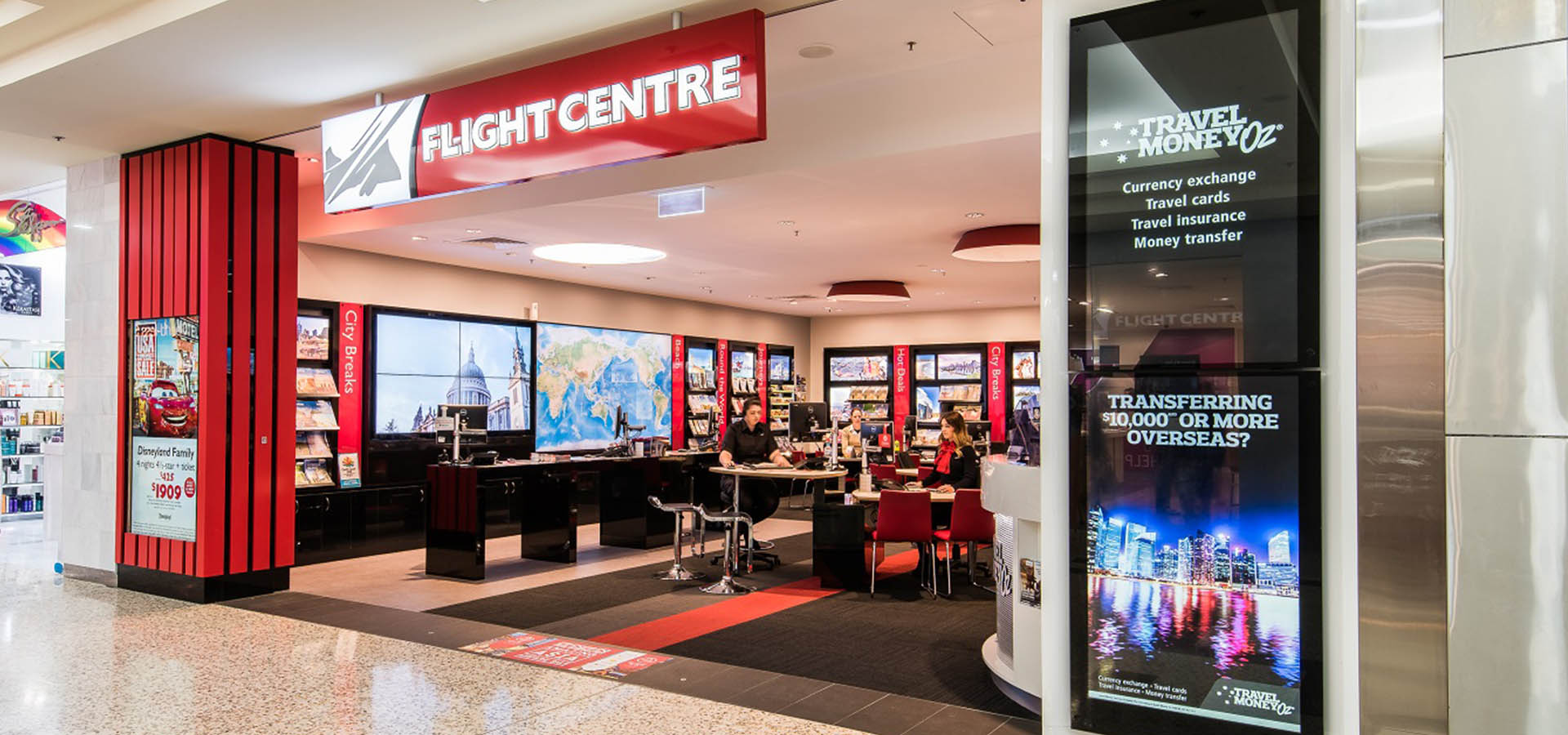
    According to Citi analyst Bryan Raymond, approximately 10 per cent of Flight Centre’s store network could be culled – largely the result of a network consolidation which has led to many locations featuring several Flight Centre stores located closely together.

    “Following Flight Centre’s brand consolidation, 83 per cent of the ~950 store bricks-and-mortar network is now branded as Flight Centre. This has resulted in a high store density for a single brand, particularly as online penetration is rising,” Raymond said.

    “Our geospatial analysis of Flight Centre’s network has identified 259 Flight Centre branded stores that are located within 1km of another Flight Centre.

    “In our view, this creates an opportunity for store network consolidation to drive higher levels of profitability through lower rent and labour costs, and the expense of [total transaction value].”

    According to Raymond, this could drive an improvement of $8 million in profit before tax over two years.

    This could be particularly helpful for the brand as the Australian leisure bricks-and-mortar industry has seen a significant contraction in the last 12 to 18 months, falling from $106 million in FY18 to an estimated $29 million in FY19.

    A Flight Centre spokesperson told Inside Retail the travel retailer instead utilises this network to create more specialised business travel teams in CBD locations, and will offer “alternatives to Flight Centre” in shopping centres with multiple stores, such as the Universal Traveller brand.

    “We close some shops every year, relocate some others and, when good opportunities arise, we work closely with landlords to secure new sites and open new shops,” the spokesperson said.

    “Within Flight Centre brand in Australia, most of these openings in recent years have tended to be specialist shops and teams, rather than traditional Flight Centre shops.”

    However, many of the factors that led to the contraction of the leisure market are unlikely to continue into FY20 and FY21, Citi argues, with the leisure bricks-and-mortar industry forecasted to rebound by $5 million, to $34 million in FY20.

    Partially as a result of this market contraction, Flight Centre recently amended its guidance for the 2019 financial year from between $390 million and $420 million, to between $335 million and $360 million – roughly a 10 per cent decrease.

    “Our FY19 results will highlight the challenges we are addressing in Australia but will also underline two of our great strengths – our emergence as a world leader in corporate travel and our changing earnings profile,” Flight Centre managing director Graham Turner said.

    “While we expect Australian leisure results to improve as short-term operational improvement plans gain traction and as longer-term transformational strategies are implemented, we also expect these trends to continue.”