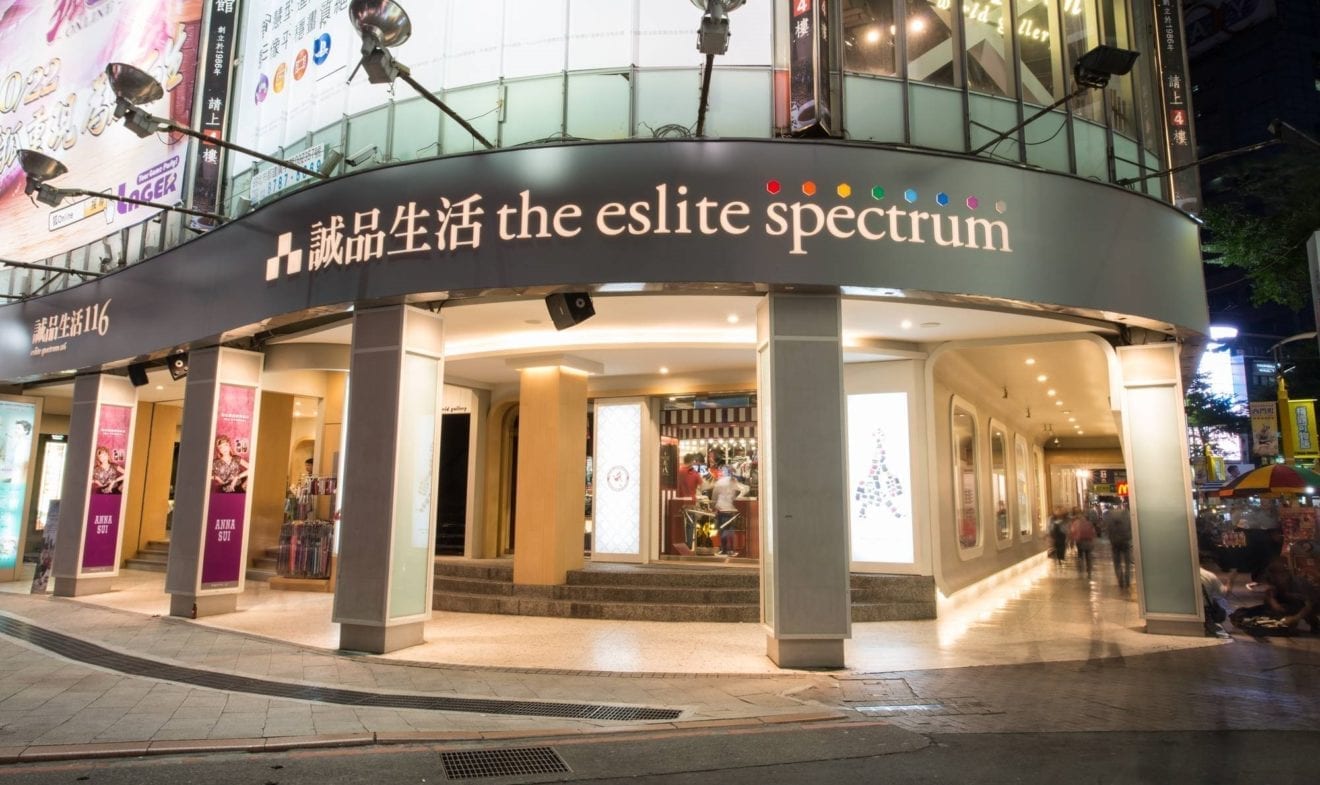
Taiwanese bookstore chain Eslite is planning to expand into Japan. The prominent bookstore business is using the move to build its international profile, and has announced its plans as amounting to a “new starting point for cross-culture ventures”. Eslite’s Japanese partner has yet to be named.
The firm’s long-term plan is to expand into Southeast Asia, and it has been contacted by multiple potential partners, according to chairperson Mercy Wu. It is currently considering potential different modes of partnership.
Eslite is a prominent name in the books industry in Taiwan, with 42 stores nationwide, as well as an additional three in Hong Kong and one in Suzhou.
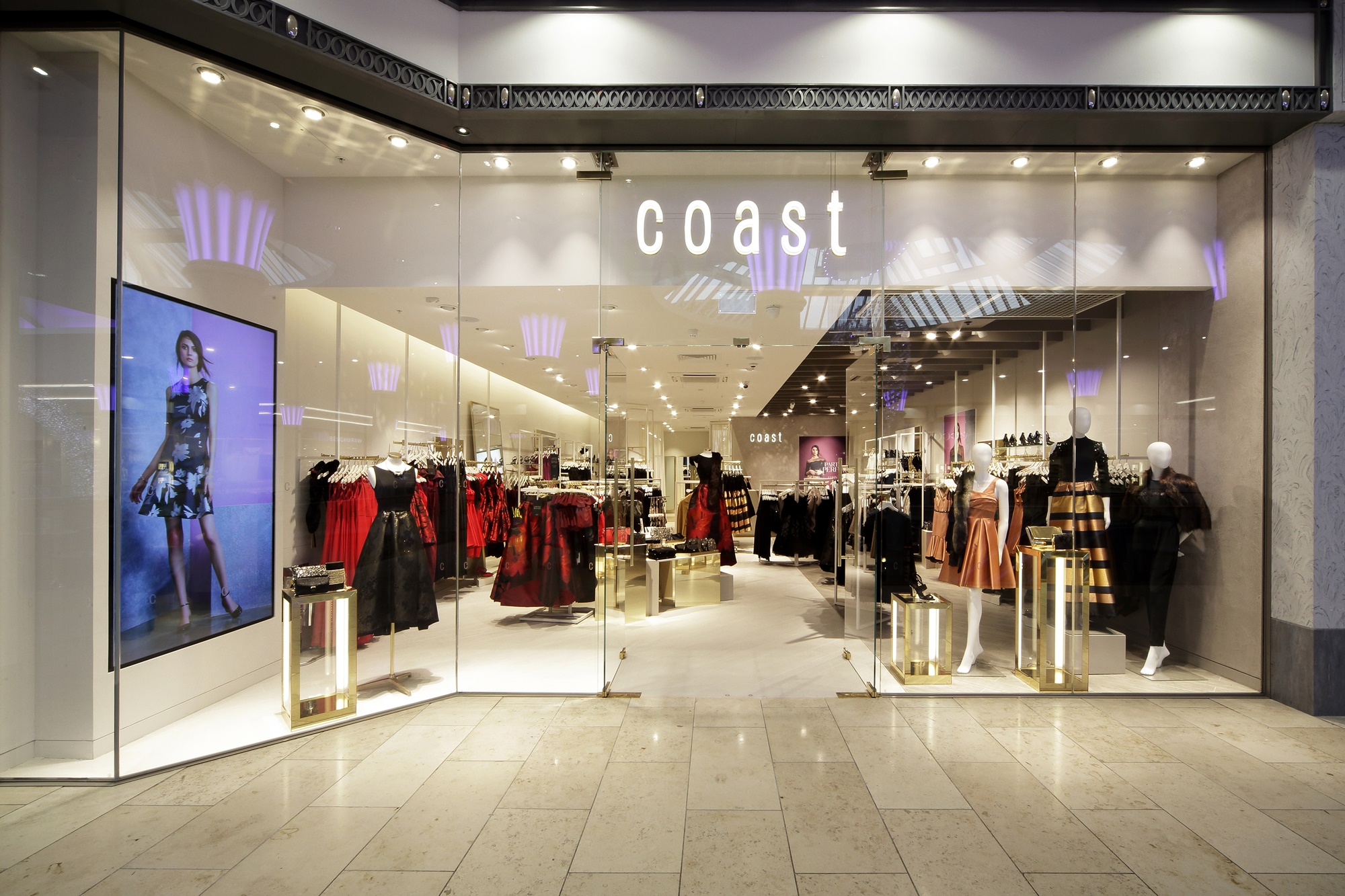
British clothing retailer Karen Millen has bought a stake in fashion label Coast following the brand’s administration by PwC. The purchasing company has agreed to take on Coast’s UK concessions portfolio and online businesses, saving 600 jobs in the ailing firm. It will be trading through cooperating wholesale and franchise businesses. Coast’s standalone stores were excluded from the deal.
Karen Millen CEO Beth Butterwick said: “We are excited to be welcoming over 600 Coast employees to the family. With its beautiful fabrics, stunning colours and signature designs, Coast is a much-loved fashion brand that has dressed women for all occasions since 1996. Our expertise and infrastructure puts us in a unique position to create a lean and profitable business, ensuring it remains a thriving destination in department stores and online.”
Coast was originally part of a group owned by Karen Millen’s parent company, Icelandic bank Kaupthing.
Coast gift cards and returns will be honoured by its new owners.
L’Oréal-owned skincare brand Kiehl’s is leveraging star power and immersive digital technologies for the third edition of its annual ‘Kiehl’s Loves’ campaign, titled ‘Kiehl’s Loves Around the World 2018’. The campaign was officially launched in Hainan last month with an influencer-driven mega event and an immersive pop-up featuring augmented reality (AR) technology and digital retailtainment – a first for the brand.
In another first, Kiehl’s has appointed some of the region’s top celebrities to front the campaign, which will run in nine locations across Asia Pacific travel retail: Hainan, Bangkok, Jeju, Seoul, Beijing, Shanghai, Hong Kong, Macau and Taiwan.
These celebrities will serve as “adventurers” in the travel-themed campaign, each representing a specific location.
South Korean singer Hwang Chi-Yeul has been chosen as the campaign’s “global explorer”, representing Kiehl’s home city of New York.
Joining him as local “city hosts” are Chinese singer Wang Ziyi (representing Hainan), Chinese actor Dong Zijian (Beijing), Chinese fencing athlete turned singer and actor Dong Li (Shanghai), Taiwanese singer and actress Emma Wu Ying-chieh (Taiwan), and Hong Kong Cantopop singer and songwriter Pakho Chau (Hong Kong).
Kiehl’s Loves is a global campaign that celebrates the countries and cities served by Kiehl’s worldwide.
Following in its annual tradition of working with internationally acclaimed artists, this year Kiehl’s has teamed up with New York-based graphic designer and illustrator Ali Mac to create limited-edition packaging for Kiehl’s products.
Ali Mac has designed artwork for more than 50 international Kiehl’s locations, combining symbols of the brand’s heritage with visual icons that are characteristic to each city’s local culture and DNA.
Besides product packaging, the fun and colourful artwork will also be featured on travel-themed items such as totes bags, pouches and luggage tags.
Kiehl’s Loves Around the World 2018 kicked off in Hainan, China, with an immersive pop-up store that ran from 1–29 September at China Duty Free Group’s Sanya International Duty Free Shopping Complex.
Located at the level 1 concourse, the pop-up was designed to highlight Kiehl’s bestselling products using AR technology to create a disruptive, engaging experience.
It comprised a number of themed areas – a nature room, an adventure room and a Kiehl’s 1851 apothecary – with digital touchpoints to engage shoppers.
Scanning the QR code on WeChat called up AR features that illustrated product information and directed users to the Kiehl’s e-commerce site and the Kiehl’s store on level 2 of the shopping complex, driving O2O (offline-to-online/online-to-offline) conversion.
A digital photo booth also provided photo opportunities and encouraged sharing on social media. Thanks to AR technology, shoppers could find out more about the products via WeChat.
On 22 September, L’Oréal Travel Retail Asia Pacific and China Duty Free Group (CDFG) celebrated the campaign launch with a high-profile promotional event, attended by key opinion leaders (KOLs) and media from China.
Global campaign ambassador Hwang Chi-Yeul and Hainan ambassador Wang Ziyi made special appearances at the event, where they played games and interacted with their fans.
Thanks to their participation in Chinese reality shows, both singers have amassed a significant following in China, with more than five million Weibo fans each.
Terry Chua, CDFG-Sunrise Group Merchandising Director of Perfumes & Cosmetics, commented: “Kiehl’s Loves Around the World is a 360 campaign. It has targeted communications on WeChat, and they have invited celebrities and KOLs which appeal to the younger generation – the Millennials and Generation Z. On top of that, it’s important that we have sufficient stocks to cater to demand and are well prepared in terms of design and safety, so that customers can have an enjoyable experience when they come to the Kiehl’s pop-up and leave with nice memories. This kind of continuous investment in brand building will continue to keep Kiehl’s at the top of the consumers’ minds.”
Following Hainan, the Kiehl’s Loves Around the World 2018 campaign will continue its travel retail roll-out this month in Seoul.
A similar consumer engagement event will take place downtown, with another appearance by global ambassador Hwang Chi-Yeul.
L’Oréal Travel Retail Asia Pacific General Manager of Kiehl’s Adele Zhang told The Moodie Davitt Report that China and Korea were natural choices when it came to selecting the locations for hosting events as they both have very good travel retail shopping environments and are very advanced in engaging millennial consumers.
“We believe that travel retail is a great showcase to promote the brand and to engage customers. Of course, we have some constraints in the airports with space etc., but with downtown duty free shops we have more flexibility.” she said.
The Kiehl’s Loves campaign taps into the demand for exclusive gifts in travel retail and creates a Sense of Place, a trend that has been pioneered by Kiehl’s for years, Zhang said.
The digitalisation of the campaign, through e-commerce and digital/social media, allows Kiehl’s to reach out to millennials and better engage them, she added.
The use of AR technology to highlight the brand heritage also helps to create memorable experiences.
Looking ahead, Zhang is looking to continue the strong growth of Kiehl’s and make it a leading skincare brand.
“Kiehl’s is not a media-driven brand, and we don’t invest heavily in above-the-line. The brand relies on two things: word-of-mouth and high-quality, effective products. Kiehl’s can be categorised as a lifestyle brand, and it originates from New York so it’s perceived as a fun and hot brand, so I think we can do something different from other brands.
“We hope to make Kiehl’s a brand that is desired by young people. When they think about brands with high-quality products and 100% natural ingredients, we want Kiehl’s to be at the top of their minds,” she said.
View the gallery below for photos of the event (8 images) :
Kiehls Loves Hainan CDF Mall 1 1
黄致列在科颜氏全球第一家Kiehls Loves快闪店 1024×682
Kiehls Loves Hainan Pop up Exterior 1 edited 1024×682 1
Walimai, the safe-product retail channel that utilizes the WaBi token, has announced its strategic partnership and ecosystem integration with HiNounou, a connected healthcare and intelligent data platform. The partnership is set to provide millions of Chinese senior citizens with access to safe, trusted goods and services, including insurance and health products.
The partnership merges the respective ecosystems of both parties, allowing participants of either service to use their loyalty tokens on both platforms. It also allows for Walimai cross-promotion on the HiNounou service, which targets one of Walimai’s key demographics — senior citizens. Powered by AI, IoT, blockchain, and genomics, HiNounou’s platform and ecosystem features leading insurers AXA and Ping An, who are offering their first dedicated ‘insurance as a service’ products for Chinese senior citizens.
Current data indicates China has 1.3 billion citizens over 60, equal to 17 percent of the world’s total population. According to state projections by China’s Office of the National Working Commission on Aging, more than 25 percent of the population will be over 60 by 2030. China faces an enormous challenge in sustaining the provision of healthcare, pensions, and viable insurance, against the background of national productivity concerns and a variety of social and welfare-related issues.
The Walimai-HiNounou alliance creates a unique, safe, and trusted environment, which gives seniors the opportunity to access a rich ecosystem of trusted services tailored to them, ensuring a healthier and more active daily life.
“Our Walimai partnership is another important step in creating an integrated ecosystem of products and services focused on the well-being of seniors at home to live longer, healthier, and happier,” said Charles Bark, CEO, HiNounou. “The partnership creates cross-ecosystem interactivity for the WaBi and HiNounou tokens, enabling seniors to seamlessly transact across an extensive range of trusted products and services.”
“By linking WaBi in the HiNounou ecosystem, we can provide our selection of verifiably authentic imported goods to one of our main target consumer groups, and help improve their health,” said Alexander Busarov, CEO, Walimai and WaBi. “This is hugely empowering for the elderly. We provide easy access to products and services, stimulating both the mind and body, across a variety of activities and interests, allowing seniors to stay engaged in society and lead more rewarding lives.”
The WaBi token can be used to acquire products and services on the HiNounou platform, customized to the needs of seniors, such as insurance, supplements, nutritious foods, wellness classes, and more. HiNounou users will also be able to use the HiNounou token to make purchases through the Walimai safe product retail channel.
Walimai’s anti-counterfeiting technology and blockchain-based data platform ensure goods are safe and authentic, while customer data is kept secure, which helps limit fraudulent activity and reduce seniors’ exposure to unwanted risks. HiNounou leverages high-tech robotics and healthcare applications to improve the quality of life for seniors, potentially extending the working life of many elderly citizens.
HiNounou has risen to be one of the most promising companies in the healthcare industry. Recognized for its innovation by major names such as Bayer and Intel, HiNounou technology has been showcased at events worldwide (including CES ASIA 2018 and European Economic Congress), had its CEO and founder Charles Bark named one of France’s top 3 AI entrepreneurs in China by President Emmanuel Macron, and struck partnerships with major industry names such as ZTE, AXA, and Ping An.
Qualtrics, the leader in experience management, announced the expansion of XM Solutions to help customers close experience gaps and harness the power of the world’s leading Experience Management (XM) Platform™. There are now over 45 expert-built solutions spanning automated projects, guided programmes and full-service research, designed by industry and research experts to accelerate customer experience, employee experience, and market research.
For years, organisations have struggled to quickly set up experience management and market research programmes, while ensuring programmes were best-in-class. With XM Solutions, Qualtrics’ team of PhDs and industry experts have created solutions to help customers quickly and confidently launch their programmes and drive business outcomes. Solutions include both guided programmes – designed to accelerate customer experience and employee experience programmes with pre-configured surveys, expert-validated methods, and dashboards tailored to your business – as well as automated projects for quick-turn research projects that yield near-immediate results.
“XM Solutions will improve the speed and accuracy with which organisations can launch their experience management programmes,” said Ryan Smith, co-founder and CEO of Qualtrics. “Our team of experts have designed packaged solutions that leverage the learnings from thousands of customer experience, employee engagement and research programmes running on the Qualtrics platform. This will help any organization–large or small–jumpstart its experience management and research programmes, and make it easy to scale those programmes to fit the organisation’s needs.”
Leveraging XM Solutions, customers can more quickly and confidently conduct comprehensive customer, employee, product and brand research in a fraction of the time. From pricing, to customer NPS, to brand awareness studies, XM solutions delivers fast results with automated setup, streamlined distribution, and smart analysis for research of all sizes.
“XM Solutions have made it possible to simultaneously enhance our suite of research capabilities and reduce costs,” said Andrew Mun, Consumer Intelligence Manager at Kia Motors America. “These out-of-the-box solutions have changed the way Kia conducts research and improved our speed to insights. In a highly competitive industry, that means the difference between success and failure.”
Philippine Airlines’ new Airbus A350-900 is set to make a temporary appearance on the carrier’s Manila-Los Angeles route starting September 28, with the aircraft taking on one flight per week for a period of approximately one month. The short-term deployment comes as the airline prepares to permanently fly its latest aircraft on its non-stop flights to New York starting October 30.
According to Philippine Airlines’ current schedule, the A350 will take over flights PR112 and PR113 every Friday until October 19, with its Boeing 777-300ER operating the flights on all other days. PR112 and PR113 operate four times a week on Wednesdays, Fridays, Saturdays and Sundays.
Philippine Airlines Manila-Los Angeles A350 schedule:
Flight No.
From
To
Departs
Arrives
Days
PR112
Manila (MNL)
Los Angeles (LAX)
1125
1000
Sept 28, Oct 5, 12, 19
PR113
Los Angeles (LAX)
Manila (MNL)
1230
1825+1
The airline’s other daily flight on the route, PR102/PR103, also will continue to be flown by the 777-300ER throughout this period.
The temporary deployment gives passengers a small window during which they can experience the aircraft when flying to the US ahead of its deployment to New York at the end of next month.
Philippine Airlines’ A350 notably features the airline’s new long-haul business class seat product, a variant of Thompson Aero’s Vantage XL seat. Along with reclining to a fully flat position, these seats are also notably laid out in a 1-2-1 configuration that offers direct aisle access to all passengers, a benefit not offered with the airline’s 2-3-2 business class layout on board its 777-300ER.
A total of 30 seats are offered in the business class cabin, with each offering 24 inches of width, 44 inches of pitch (legroom) when in a seated position and reclining to provide a 78-inch-long flat bed.
Philippine Airlines took delivery of its first A350 back in July and earlier this month began flying the aircraft on its first long-haul service to London.
Skoda says it will rename its Rapid compact hatchback the Scala when the new model goes on sale next year. The car’s name comes from the Latin word for “ladder,” Skoda said in a statement.
The Scala was previewed as the Vision RS concept that was unveiled at the Paris auto show this month.
The name change signifies the step up Volkswagen Group’s Czech subsidiary has made with the new car, Skoda CEO Bernhard Maier explained in the statement. “This is a completely new development that sets standards in terms of technology, safety and design in this class,” he said.
The Scala will be pitched further upmarket compared with the current budget Rapid to create a more credible rival for cars such as the Ford Focus.
“I think the problem of the current Rapid is maybe it’s too low-market. Maybe we went too far toward value for money,” Bjorn Kroll, Skoda’s head of product marketing and the brand’s commercial leader on electric cars, said at a preview of the concept ahead of the Paris show. “With this one, we tried to balance it out.”
Skoda said the car would offer innovative features that “have only been seen in higher segments,” without being specific about those features.
The Scala will be engineered for Europe on the VW Group’s small-car MQB A0 platform. The current model uses a version of the low-cost PQ platform.
The name change also signifies a break with the Rapid sold in China and Russia. A future replacement for the Rapid in those markets is expected to use an updated version of the PQ platform to keep costs down.
Instead of a badge, the Scala will feature the word Skoda affixed to the tailgate — the first Skoda to feature this, the brand said.
The range is expected to include an RS high-performance version using the same plug-in hybrid drivetrain previewed by the Vision RS concept. It combines a 150-hp, 1.5-liter gasoline turbo engine with a 102-hp electric motor to accelerate the car from 0 to 100 kph (62 mph) in 7.1 seconds. The 13-kWh battery provides a range of 70 km (43 miles), compared with 50 km (31 miles) in the discontinued VW Golf GTE plug-in hybrid.
Skoda sold 35,206 units of the Rapid notchback and Spaceback hatchback in the first half of this year across Europe, down 2.7 percent compared with the year before, figures from JATO Dynamics show. The notchback will be discontinued in Europe, Skoda said.
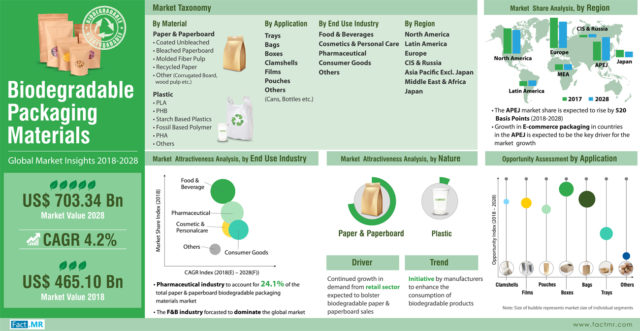
Biodegradable packaging market witnessed moderate growth during 2013 to 2027, and the status quo is envisaged to prevail over the period of forecast 2018 to 2028, according to new Fact.MR study. Volume sales of biodegradable packaging are foreseen to record a modest 4.2% CAGR through 2028, which is anticipated to equal a market value in excess of US$ 703 billion. The study finds that tier 3 players will collectively continue to account for over three-fifth share of the biodegradable packaging market.
Biodegradable packaging market is expected to envisage healthy value CAGR of 4.2% during the period 2018-2028, with revenues surpassing US$ 703 billion by 2028 end. The study also opines that the paper & paperboard biodegradable packaging will retain its undisputed dominance in the biodegradable packaging market, as it may account for more than 95% of the total market revenue by the end 2028. The global war against plastic packaging materials is opening an attractive window of opportunities for paper packaging companies, enticing them into entering the biodegradable packaging market.
A majority of regulatory bodies and international environmental organizations have proposed a ban on single-use packaging materials to mitigate the perilous effects of non-degradable solid waste on the environment. Increasing environmental awareness and consumer inclination towards making sustainable purchases is providing a major boost to the growth of the market.
Positive effects of the ban on single-use packaging on the biodegradable packaging market are offset by stringent labeling regulations and certification procedures to control false claims about the biodegradability of packaging materials. The market is characterized by the needs to comply with strict quality standards established in various regional markets, which may complicate it for market players to maintain competitive prices of biodegradable packaging solutions.
Meanwhile, the study finds that leading players in the biodegradable packaging market are adopting strategies to acquire their smaller rivals to consolidate a stronger position in the packaging sector. DS Smith plc – a British paper packaging company – recently announced its plans to acquire its Spanish rival Europac Group for over US$ 2 billion, in order to merge the Western European biodegradable packaging market. Another leading player – Smurfit Kappa Group recently completed the acquisition of Reparenco – a paper and recycling company in Netherlands – for €460 million to expand its European biodegradable packaging capacities.
An American manufacturer of biodegradable packaging – WestRock Company recently acquired packaging businesses across the world, including Hanna Group Pty Ltd, Plymouth Packaging, Inc., and Schlüter Print Pharma Packaging GmbH, to establish a stronger presence in the market. The company also revealed its plans to acquire KapStone Paper and Packaging Corp., an American paper company, for a total enterprise value of around US$ 4.9 Bn to leverage KapStone’s expertise in biodegradable packaging using kraft paper.
“Increasing growth of the e-commerce sector and popular trends of online grocery shopping is opening new avenues of growth for players in the biodegradable packaging market. Purchasing decisions of environment-conscious consumers are greatly influenced by sustainable packaging materials, which may create high demand for biodegradable packaging solutions in the coming future. Stakeholders in the biodegradable packaging market are shifting their focus on the dynamic trends in the e-commerce sector while adopting their future business strategies,” says a lead analyst at Fact.MR.
The study further states that, among all the leading end-user industries in the biodegradable packaging market, food & beverage industry is expected to account for more than 30% of the total market share throughout the forecast period. Increasing demand for packaged food products, convenience foods, and ready-to-eat meals is reflected in supermarket shelves. Leading market players are introducing biodegradable packaging films, trays, and bags to further improve the fresh food experience for consumers while offering numerous environmental benefits.
Sensing the extraordinary growth opportunities in the biodegradable packaging market for the F&B industry – the Mondi Group recently developed an innovative, paper-based, biodegradable packaging bag for food – Sustainex®, in collaboration with a Polish converter, SILBO. Multifold opportunities for biodegradable packaging in the F&B industry are boosting market players to develop innovative technologies, biodegradable packaging materials, and designs, which is expected to influence the dynamics of the biodegradable packaging market in the upcoming years.
Japan’s Softbank and automaker Toyota announced plans to form a joint venture by April 2019 to provide launch Mobility-as-a-Service (MaaS) in the country. The company, called Monet Technologies, will combine Toyota’s mobility services platform and information infrastructure for connected vehicles with Softbank’s Internet of Things platform, the companies said in a joint statement.
Initially, Monet plans to roll out just-in-time vehicle dispatch services for Japanese public agencies and private companies to meet user demand. Those services include on-demand transportation service and corporate shuttles.
By the second half of the 2020s, Monet intends to launch an autono-MaaS (autonomous mobility as a service) businesses, using Toyota’s e-Palette battery electric vehicles.
These vehicles will deliver meals with food prepared in the vehicles, provide hospital shuttles where onboard medical examinations can be carried out onboard. These vehicles can also serve as mobile offices, Softbank said.
Softbank said Monet will roll out its mobility services in Japan before focusing on future expansion to the global market.
The joint venture will have initial capital of 2 billion yen ($17.49 million), and this will be increased to 10 billion yen in future.
Softbank will own 50.25% of the JV and Toyota take the remaining 49.75%.
SoftBank Corp representative director and CTO Junichi Miyakawa will be president and CEO of the new joint venture.
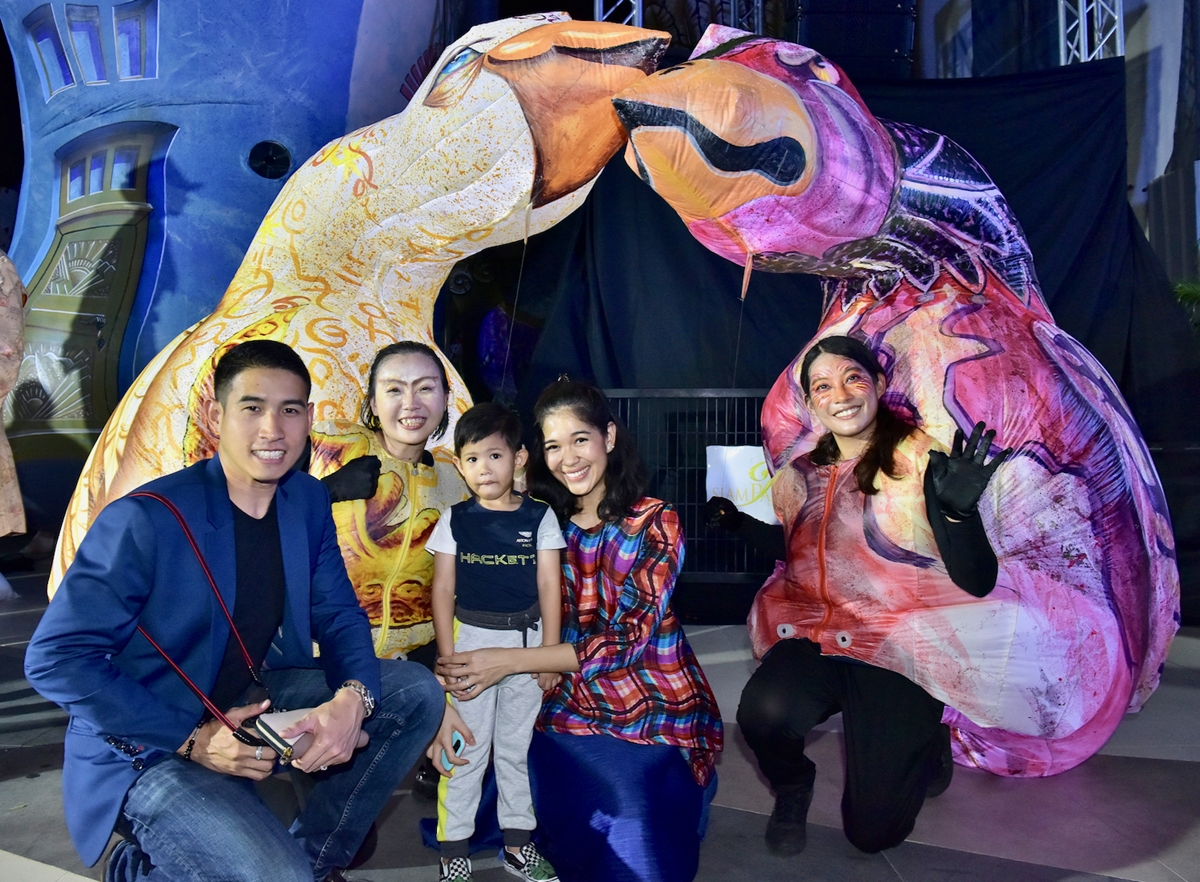
Siam Paragon celebrating the school break organizes “Kids Carnival: Little Nemo in Slumberland”, the spectacular Balloon Festival imported directly from France to be held in the South East Asia for the first time during 17-21 October at Parc Paragon, Siam Paragon
Siam Paragon together with Siam Commercial Credit Card and Origin Property organize “Kids Carnival: Little Nemo in Slumberland”, fantastic balloon carnival imported directly from France. Opening the world of imagination with over 20 inflatable characters, the carnival will debut for the first time in South East Asia from 17-21 October at Parc Paragon, Siam Paragon.
On the opening day (17 October 2018), Mayuree Chaipromprasith, Executive of Siam Paragon, Pochana Ittisukanant from SCB, Aphisit Soonthronchukiet from Origin Property, and many celebrities such as MR Chantaraladda Yugala Ubondejpracharak, Pol.Lt.Col.Nopparat-Pornpat Boontanom, Wantita Lewchalermwong, Visarat Chunhavat, Sopitnapa Chumpanee, Parinya Roonpraphan, and their children also joined the event.
Mayuree Chaipromprasith, Senior Executive Vice President – Marketing at Siam Paragon, said “As one of the world’s shopping destinations, Siam Paragon always keep customer satisfaction as top priority and always provide new experience to our customer. In the upcoming school break, Siam Paragon joins hands with Plasticiens Volants from France come up with a unique and fascinating balloon show entitled “Little Nemo in Slumberland”. Performed by world-renowned French street theater, Plasticiens Volants, the show presents a spectacular giant inflated puppets fly over Parc Paragon combining with stunning light, music, and special technique. The five-day event will bring the New York Herald Tribune’s legendary cartoon to life. We guarantee to bring an exclusive experience to our local and international customers, while will definitely create a wonderful moment for the family”
Little Nemo in Slumberland is about a character named Nemo, who has a fantastic dream but awoke in bed in the final part. His adventure will be told through over 20 colorful floating inflatables where Parc Paragon will turn to be a fantasy dreamland in Slumberland and surrounded by imaginary light, sound and music. Audiences will be thrilled with Nemo’s adventurous dream from a flying magical bed, which its legs can enlarge to nine meters height. While also enjoy with a journey through a dreamlike floating castle, fanciful wild lives and gigantic raspberry fields. Much more characters will also entertain audiences during the carnival.
Created by American cartoonist Winsor McCay, Nemo is a fictional character originally the comic strip published in New York Herald Tribune from 1905-1914. The fantasy adventure story plus a wonderful performance of Plasticiens Volants has brought joyful and incredible experience to children and every people around the global
Bosch and Huawei have struck a partnership to accelerate the development of the Internet of Things (IoT) in China. The collaboration will see the pair makes Bosch’s IoT Suite software services available in China on Huawei Cloud. The software platform of Bosch connects web-enabled objects to facilitate data sharing across a multitude of digital services and business models. The first service made available to Chinese consumers via Huawei Cloud will be the Bosch IoT Remote Manager – a service for managing and controlling gateways, sensors, and devices. Additional services from the Bosch IoT Suite will follow in 2019.
The pair also said a Chinese automotive manufacturer has chosen to deploy the Bosch IoT Suite on Huawei Cloud for updating its vehicles’ firmware over the air (FOTA). The service is expected to be rolled out to millions of connected cars in China over the coming years.
“The demand for IoT solutions in China is rising. The partnership between Bosch and Huawei Cloud marks a decisive step for Bosch in one of the fastest growing IoT markets in Asia,” said Dr. Stefan Ferber, CEO of Bosch Software Innovations, a wholly-owned subsidiary of Bosch.
Bosch Software Innovations has been active in China since 2012 and has implemented IoT projects ranging from Industry 4.0 to connected transportation. The company expects China’s market for IoT platforms to grow by close to 70% over the coming years, Ferber said.
Bosch and Huawei also intend to develop an integrated end-to-end IoT offering as a result of the partnership.
Huawei is developing IoT hardware gateways that will be pre-configured with Bosch IoT Gateway Software and managed through the Bosch IoT Remote Manager to run on Huawei Cloud.
This close integration will provide customers with a more complete IoT solution that is easier to deploy and manage, the companies said.
Samsung Electronics, a part of the Samsung Group, has announced the introduction of two new chipsets or processors for the automotive segment for connected cars technology. Christened the Samsung Exynos Auto and Samsung ISOCELL Auto, the new chipsets claim to offer cutting-edge application processor and image sensor technology solutions to the road. While the former Exynos will help manufacturers develop in-car apps for infotainment, advanced driving assistance systems, and telematics, the ISOCELL Auto is targeted at developing in-vehicle infotainment systems and telematics solutions.
Talking about the two new chipsets, Kenny Han, vice president of Samsung’s Device Solutions Division said, “Samsung’s new automotive brand solutions, Exynos Auto and ISOCELL Auto, bring Samsung’s market-proven technologies to automotive applications with enhanced features and durability required by the market. With fast telecommunication, accurate sensing and powerful processing capabilities, Samsung’s Auto-branded solutions will enable new driving experiences to next-generation smart vehicles.”
Processors from Exynos Auto range come in three sub-categories: Exynos Auto V series for advanced in-vehicle infotainment (IVI) systems, Exynos Auto A series for ADAS, and Exynos Auto T series for telematics solutions. On the other hand, Samsung’s ISOCELL image sensors are built on the company’s innovative pixel isolation technology, which provides greater visibility of the road and surroundings even in low-light environments, while enabling more precise identification of objects. The sensors also allow vehicles to perceive road conditions or potential hazards even when driving through tunnels or other high-contrast environments.
UK-based Worldpay has introduced new payment solutions aimed at providing eCommerce businesses with more choices to disburse funds to partners and customers and across country borders.
Worldpay’s dynamic payment solutions combine the enhanced Worldpay Bankout solution, which now delivers 154 direct bank disbursement destinations (up from 65), and Worldpay FastAccess – enabled by Visa Direct.
With these payment options, partners and customers need no longer wait for days to receive funds or refunds as they now can obtain them via card in near real-time – through a mobile wallet or directly to a local bank account.
Bankout is targeted at businesses needing to make a large number of global payments to – or on behalf of – their customers and suppliers. With 89 new local markets, Worldpay now provides seamless cross-border payouts for businesses in local currencies without the expense of making multiple international bank transfers.
Dynamic payouts allow businesses to make faster, seamless card-based payouts in near-real time within a maximum of 30 minutes. Building on its launch in the United States last year, FastAccess is now available to Worldpay customers in over 50 new markets across Europe and Asia.
The new payment solutions are targeted at wide range of industries. For example, travel and tourism companies and marketplaces can pay out funds to accommodation vendors or disbursements to travellers in a variety of countries and currencies; gaming businesses can provide near-instant payouts to customers; insurance companies can save costs by replacing local checks with bank transfers; and marketplaces can allow independent sellers to retrieve funds more quickly.
BMW plans the largest ever product offensive from any manufacturer in India in the coming year. 2019 will see the introduction of a slew of new products that BMW expects will really fire up the market and help strengthen its position in the premium car space. The plan is to bring twelve model launches to India next calendar year from the BMW brand, and two additional new models also from MINI. The motorcycle side of the business will also see two all-new models being added in.
This will be further supplemented by new variants or updates on existing products, Speaking at the inauguration of BMW India’s brand new headquarters in Gurgaon, Hildegard Wortmann, Senior Vice President – Region Asia Pacific, BMW Group said the new car strategy is planned across the region, with India playing a strong part in it. “On a worldwide scale, it (will be) the biggest product segments that we have done at BMW. So we are really going full blast here into the product segments and I can full-heartedly say, the future is really bright. Fantastic cars coming, strong design aspects, strong performance, and you can feel the joy of BMW in every instance now!”, she added.
Spearheading that charge will be the most awaited new generation of the BMW 3 Series sedan. The 7th generation G20 just made its public debut at the recently concluded Paris Motor Show and it will get to India next year. There are big expectations from the new sedan, which includes its performance on the road, as well as on the sales charts. Speaking about the 3 series and also another significant upcoming model, Ms Wortmann says, “Clearly if you look at it, the core of BMW business around the 3 series is a very very important part of our business. And having the new 3 series coming is obviously a milestone again. I think I am not exaggerating if I see the 3 series as an icon in the automotive industry, not just in India, but everywhere in the world. So having that model coming next year is very exciting. Personally I think the big news will be the X7, where again we created something very special, very new, and I think that one will have very big impact.” So the other big plan then is a huge offensive of the X range of cars. Currently the X portfolio comprises four models, but in 2019 that will go to seven with the addition of the X7 flagship SUV, as well as the X2 and X4 crossovers. BMW sees much potential for the large and very luxurious X7 in the Asia Pacific region as a whole, but particularly so in India.
BMW India had its most successful year in India in 2017, with total car sales at 9800 units, which was a 25 per cent growth over the previous year. And it expects 2018 to end even bigger, with the first nine months already showing an 11 per cent year-on-year growth at 7915 units. But next year will clearly be another one for the record books, and also one where it might be able to eye the number one slot again – held by Mercedes-Benz for 3 years straight. “I think we’ve shown over the 11 years that we have to find the right strategy, the right way of approaching the market, and really making sure we grasp what customers desire here, I think last year was a really good jump and I am highly satisfied to seeing the development here. And 2018 as a strong year now, with the major launches – you’ve seen the 6 GT coming and again a new segment that we created. And obviously the future is very bright as I look forward to the next year. 12 launches! So it will definitely keep the team here, spending long evenings in these offices!” says Ms Wortmann.
Indonesia’s Telkomsel has arranged to adopt the Kinetica advanced analytics platform to help it transform the customer experience for its users.
The operator will use the Kinetica engine and NVIDIA graphics processing units (GPUs) to enable real-time analytics, location-based visualization and AI capabilities.
Telkomsel plans to use thee capabilities to deliver data-driven customer experiences and to enable real-time financial and business reporting.
“The rapid growth in mobile devices, digital users, and the micro-services nature of prepaid across the Indonesian market has led to exponentially more data generated than ever before,” Telkomsel CIO Montgomery Hong said.
“This influx of extreme data presents a massive opportunity to develop new, personalized, digital lifestyle experiences for Indonesian consumers. Unlike traditional database solutions, the Kinetica engine is purpose-built for extreme data and provides real-time data analysis and location intelligence across our business, from prepaid and postpaid mobile, to digital lifestyle services (video, gaming, music), to mobile financial services, and digital advertising for starters.”