Author: Mei Ling Tan

  • Alibaba platform receives registration from 2,000 SMEs

    Alibaba platform receives registration from 2,000 SMEs

    More than 2,000 SMEs have registered with the Alibaba group platform under the the Digital Free Trade Zone initiative.

    International Trade and Industry Minister Datuk Seri Mustapa Mohamed said it is targeting for 10,000 SMEs to be on the platform by this year.

    At the Malaysia Digital Economy Forum here this morning, he said Malaysia’s digital economy has seen exponential growth.

    To date, 58,824 online businesses have registered with the Companies Commission of Malaysia. The digital economy accounted for 18.2% of the country’s gross domestic product (GDP) in 2016.

  • Asia boosts Hermes international sales

    Asia boosts Hermes international sales

    Hermes international sales showed strong growth last year, pushed by an upward curve in Asia.

    Sales for the French fashion brand were up 9 per cent at constant exchange rates, with consolidated revenues reaching €5.5 billion (US$6.7 billion). After adjustment for the negative currency effect resulting from the year-end strengthening of the euro, the increase was 7 per cent.

    In the final quarter growth was sustained at 5 per cent at constant exchange rates.

    During the year Hermes continued to improve its distribution network, renovating and extending almost 20 stores. It launched websites in Canada and the US, to be followed by China at the end of this year.

    Asia, excluding Japan, saw sales rise 11 per cent with a positive outlook in Mainland China and South Asia.

    Hermes says the context is improving in Hong Kong and Macau. Regional stores were extended and renovated – the Sogo Fuxing store in Taiwan, Kowloon Elements in Hong Kong and the Kuala Lumpur store.

    Despite a high comparison basis, Japan recorded a sustained increase of 4 per cent thanks to its selective distribution network.

    All sectors recorded growth, with a “remarkable” performance by the ready-to-wear and accessories, perfumes and other sectors.

    Leather goods and saddlery sales grew 10 per cent to meet demand for such bags as Constance, Halzan, Lindy and Verrou. Shoes particularly boosted sales in the ready-to-wear and accessories division, up 9 per cent, silk and textiles had a  6 per cent rise, while the perfumes division posted 10 per cent growth with the launch of Twilly d’Hermes.

    There was a 1 per cent rise in watch sales, while other Hermes business lines ‒ encompassing jewellery, Art of Living and Hermes Table Arts ‒ rose 11 per cent.

    Currency fluctuations had a negative impact of €100 million on revenues.

    The company will publish its annual results next month.

  • More than half of millennials prefer online retailer info to in-store assistance

    More than half of millennials prefer online retailer info to in-store assistance

    More than half of millennial customers would rather look for retail information online than talk to a shop assistant, according to research.

    A survey of online marketplace OnBuy.com’s customers found that 53% of young people aged between 25 and 34 prefer to seek out details online rather than talk to store staff when they are in a shop.

    The younger generation also prefer to avoid shops when they need information, with 61% of the millennial age group saying they find it easier to chat to a retailer via digital communication channels such as text, online chat or messaging applications as opposed to visiting a physical location.

    Cas Paton, MD of Onbuy.com, said consumers increasingly want to see more retail technology in stores as well as an online offering.

    “As technology is evolving so rapidly, it is important that companies incorporate new technologies into their business to help keep up with the times,” said Paton.

    More than half of shoppers believe that in the near future they will increasingly be using mobile devices to make more of the in-store experience.

    The purpose of stores has been slowly shifting since the arrival of e-commerce – stores are increasingly becoming showrooms for consumers to try out products before buying them online, with many physical locations becoming experience centres instead of just places to buy goods.

    Younger consumers often demand more from the shopping experience because of their use of technology, and as well as using mobile devices for information in store, want to be able to buy products through social media. Also, more and more consumers want to be able to collect loyalty points through their smartphones.

    This change in customer behaviour over the past 50 years as technology proliferation has increased also makes it more difficult to retain customers – but, surprisingly, the older generation are more likely to change between brands than the more tech-savvy millennials, perhaps because there is less social pressure for them to be affiliated with particular brands.

    Onbuy.com found that just under half of customers between the ages of 18 and 40 could be persuaded to buy from a particular brand or retailer if its stores were more different or interesting. This was true of 65% of the millennials in the group, who would be more likely to be enticed by a more exciting store experience.

    Almost three-quarters of consumers said retailers will have to keep up with changes in the technology landscape if they hope to improve the consumer experience and keep customers loyal.

    Some retailers have been trying to address this shift to omni-channel by offering services such as voice-ordering through internet-connected home devices or click and collect.

    But some larger retailers struggle to implement these new technologies because of legacy technology, and some have begun to turn to startups to help them test and implement new technologies.


  • Turnover soars 94 per cent for H&M India

    Turnover soars 94 per cent for H&M India

    With store openings and competitive pricing, H&M India has upped its turnover 94.5 per cent in India for the year to the end of November.

    The Swedish fast-fashion retailer’s turnover reached INR955 crore (US$148 million) for the 12 months.

    Its growth follows it opening more stores in India, taking the count from 15 to 27. It entered small markets such as Coimbatore, Indore and Raipur, as well as adding outlets in Mumbai and the Delhi-National Capital Region, where it has had a presence since 2015.

    In its earning release, H&M says it plans to launch an e-store later in India this year.

    Meanwhile, Inditex-owned Zara crossed INR1000 crore in sales last year, seven years after arriving in India, and last year opened an e-commerce portal.

    But H&M is confident its low-priced apparel and wide variety will help it win in India. “I think our business concept is working,” says country manager Janne Einola.

  • Vietnam paper imports up last year

    Vietnam paper imports up last year

    Việt Nam imported US$682.1 million worth of paper products last year, a year-on-year increase of 10.86 per cent, reported the Việt Nam General Department of Customs.

    In December 2017 alone, Việt Nam imported $58.8 million worth of paper products, down 10 per cent compared to November, the first drop in three consecutive months.

    Vietnamese paper products are mainly imported from China, accounting for 42 per cent of total turnover, reaching $285 million in 2017 and increasing 19.95 per cent against 2016. The second largest import market was Thailand with $91.1 million, up 9.35 per cent compared to the previous year, followed by the Republic of Korea and Japan with $59.5 million and $50.3 million, respectively.

    In addition to these markets, Việt Nam also imports from other markets such as Hong Kong, Taiwan, Indonesia and Malaysia, as well the United States, Germany and Singapore.

    In general, last year, the import turnover of paper products from all markets grew significantly, compared to 2016 and accounted for 72.2 per cent.

    Particularly, imports from the German market increased sharply. Although Germany is not the main import market, it accounted for only 0.7 per cent of the country’s total import turnover; compared to 2016, this result increased 1.3 times. Besides, imports from Indonesia and Japan were also up sharply, rising by 33.16 per cent and 19.09 per cent, respectively.

    In contrast to markets with strong increases, imports from Singapore, Malaysia and Hong Kong decreased 12.01 per cent, 10.4 per cent and 1.26 per cent, respectively.


  • Quick Serve to expand Texas Chicken in Indonesia

    Quick Serve to expand Texas Chicken in Indonesia

    Quick Serve Indonesia, the new franchisee for US quick-service chicken chain Texas Chicken, has launched its first two stores.

    The first is in Surabaya, East Java, in the Tunjungan Plaza 3 (TP3), with a second a signature stand-alone restaurant in Kertajaya, East Java. The two-storey restaurant seats 175 guests.

    As well as items from Texas Chicken’s international menu, the two outlets offer chicken and rice dishes with international and Asian sauces.

    “The Surabaya location is in a culinary hub for our region, which gives the brand an opportunity to solidify its base in Indonesia,” says Quick Serve Indonesia MD Julius Evan Kritianto.

    Texas Chicken already has 60 outlets in Indonesia run by another franchise group, Cipta.

    Quick Serve says it plans to move quickly to expand the brand primarily in the Java and Bali regions.

  • Yum China Reports A Strong Quarter

    Yum China Reports A Strong Quarter

    A strong fourth quarter has been recorded by Yum China Holdings, which runs KFC and Pizza Hut restaurants on the mainland.

    Its unaudited results for the quarter to the end of December show 5 per cent growth in same-store sales, up 7 per cent at KFC and 1 per cent at Pizza Hut.

    Total system sales grew 9 per cent, including growth of 11 per cent at KFC and 6 per cent at Pizza Hut, and excluding foreign currency conversion (F/X).

    Total revenues were US$2.2 billion, an increase of 13 per cent (9 per cent excluding F/X).

    The group opened 339 restaurants during the quarter.

    Operating profit rose 23 per cent to $71 million, but excluding special items and F/X, there was a 9 per cent decrease in adjusted operating profit because of product upgrades at Pizza Hut during the quarter, partially offset by strong sales at KFC.

    There was an estimated one-time tax charge of $164 million related to tax reform in the US. This resulted in a net loss of $90 million. Excluding this impact, adjusted net income was $74 million, up 12 per cent (18 per cent, excluding F/X).

    For the full year, same-store sales were up 4 per cent – an increase of 5 per cent at KFC and 1 per cent at Pizza Hut.

    Total system sales grew 8 per cent, including growth of 9 per cent at KFC and 7 per cent at Pizza Hut, excluding F/X.

    Total revenues were $7.1 billion, an increase of 6 per cent (8 per cent, excluding F/X).

    During the year, 691 restaurants were opened, taking the total store count to 7983 across more than 1200 cities.

    Restaurant margin improved 1.5 points to 16.8 per cent, primarily driven by same-store sales and helped by retail tax structure reform.

    Operating profit rose 23 per cent to $785 million. Excluding special items, the adjusted operating profit was $782 million, an increase of 20 per cent (23 per cent excluding F/X) driven by strong sales and margin expansion.

    Net income dropped 20 per cent to $403 million. Excluding special items, adjusted net income was $564 million, up 20 per cent (24 per cent excluding F/X).

    Loyalty program membership grew to more than 110 million for KFC and more than 35 million for Pizza Hut at year end.

    Mobile payments accounted for about 53 per cent of company sales during the fourth quarter, while delivery contributed to 14 per cent of company sales for the year.

    It was the first full year of Yum China as an independently listed company. CEO Micky Pant will hand over the reins to Joey Wat, currently president and COO, from March.

  • Malaysia continues to attract expats from Europe and Eastern Asia region

    Malaysia continues to attract expats from Europe and Eastern Asia region

    HSBC Bank Malaysia said Malaysia continues to attract expats particularly from Europe and Eastern Asia regions.

    Country head, retail banking and wealth management, Lim Eng Seong said one of the reasons why expats love settling down here are the friendly nature of the Malaysians.

    “Looking for accommodation, organising healthcare and schooling are all easy to do in Malaysia, hence the plus points for expats to move here,” he said in a statement.

    Based on HSBC’s Expat Explorer survey conducted last year, he said Asia continues to provide promising economic prospects and improved quality of life that appeal to professionals and entrepreneurs both from within the region and across the globe.

    Now in its 10th year, the HSBC Expat Explorer survey is the world’s largest and longest running study of expats life, involving over 27,500 expats about their experience abroad.

    61 per cent expat experience in Malaysia found it was easier to make friends. In terms of active social life, 44 per cent noted they have better social lives now than they did at home compared to 31 per cent of all expats around the world and 40 per cent regionally.

    The survey revealed that Malaysia offers simplicity and smooth transition for expats in finding accommodation (61 per cent), organising healthcare (54 per cent) and arranging childcare and schooling (52 per cent).

    “In fact, once expats settle down, life continues to be positive for most of them where more than half (55 per cent) live in a better property than they would have had in their home country.”

    The survey also found that life abroad typically increases expats’ income by 25 per cent, with expats earning just under US$100,000 a year on average.

    “Far from compromising their wellbeing, expats seem to find the right balance. 41 per cent expats adopt a more positive outlook on life after moving abroad, with 44 per cent becoming more physically active.”

    The surveyed highlighted that expats in Asia said they have experienced an uplift in income of at least 10 per cent, including Australia, China, Hong Kong, India, Indonesia, Malaysia and New Zealand.

    Lim said Asia continues to draw expats from all over the globe for its buoyant economic prospects.

    “We still see a significant proportion of expats coming from Europe and North America but also a robust pool of Asian expats working in Singapore, Malaysia, Indonesia and Greater China – all trying to capture opportunities from the region’s fast-growing consumer services sector, increased tech and digital focus and infrastructure push,” he added.

    He pointed out the continued growth in China and Asean would require a diverse mix of talent from people who are internationally mobile.

    Lim said expats’ financial needs are more complex, citing that managing accounts in multiple markets and currencies, health and protection cover, as well as saving and investing for education, retirement and property aspirations are key aspects of their holistic financial plan.

    “Wherever they live, expats should seek financial advice from a trusted provider who can help them manage their more complex financial affairs,” he said.

  • L’Oreal reports healthy 2017: notes “strong potential” of travel retail

    L’Oreal reports healthy 2017: notes “strong potential” of travel retail

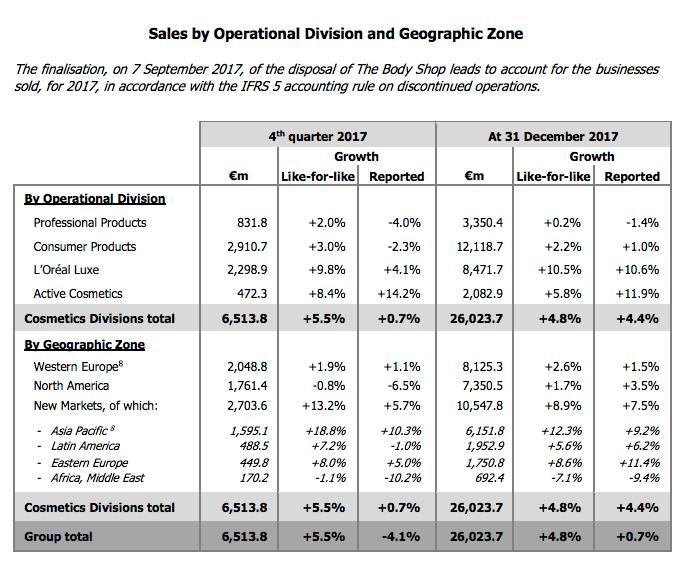
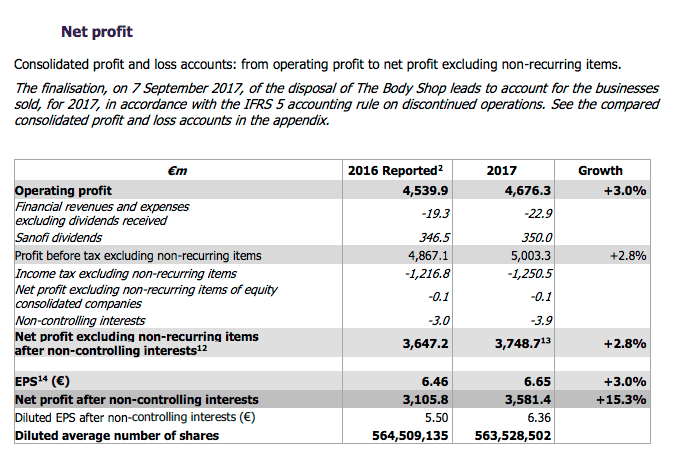
    L’Oréal’s 2017 sales climbed +2% year-on-year (at constant exchange rates) to €26 billion. Like-for-like sales were up +4.8% and net profit (excluding non-recurring items) increased +2.8% to €3.7 billion.

    The company noted the “strong potential” of its travel retail business, which celebrated its 40th anniversary last year.

    Group revenue growth was buoyed by e-commerce sales, which rose +33%.

    L’Oréal Luxe sales grew by +10.6% on a reported basis with Asia Pacific delivering a double-digit increase. China and travel retail both achieved “particularly good figures”.

    Sales in the Active Cosmetics division rose by +11.9%, with sales breaking €2 billion.

    The Consumer Products division posted +1% growth while Professional Products sales decreased -1.4%.

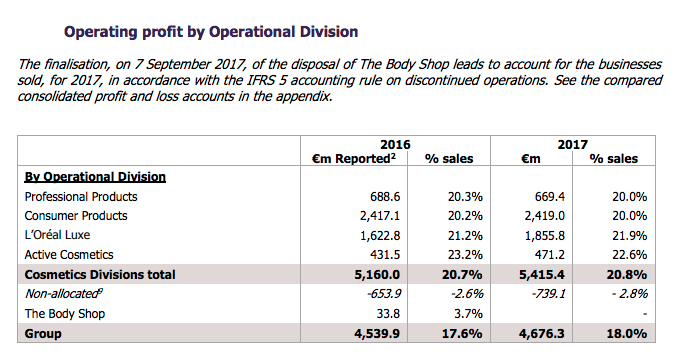
    L’Oréal Chairman and CEO Jean-Paul Agon said: “In a beauty market that pursued its steady growth in 2017, L’Oréal had a good year with sustained sales growth momentum, and robust profits. As announced, the second half accelerated compared with the first, particularly in the fourth quarter with +5.5% like-for-like growth. All the divisions recorded sales growth, especially L’Oréal Luxe which is delivering spectacular growth, particularly in Asia. The Active Cosmetics division achieved more than €2 billion in sales for the first time.

    “Growth in the Consumer Products division is being slowed by the continuing difficulties of the American and French markets, while sales in the Professional Products division improved at the end of the year. Today more than ever, L’Oréal can rely on its unique portfolio of powerful and complementary brands, eight of which now have sales above €1 billion.

    “As for the geographic zones, the New Markets exceeded more than €10 billion of sales for the first time ever, thanks especially to the dynamism of Asia Pacific. Performance in Western Europe remained solid.

    “2017 was especially notable for the accentuation of our digital edge and the strengthening of our positions in two strategic channels. Firstly in e-commerce, where our sales accelerated to reach €2 billion, an increase of +33.6%. Secondly in travel retail, a channel with strong potential, in which L’Oréal celebrated 40 years of presence by strengthening its number one position.

    “In terms of results, as announced, operating margin has reached the record level of 18% of sales, while increasing research expenses and business drivers. There were improvements in all our operating parameters; the quality of the results is also reflected in the record cash flow.

    “And finally, in 2017, L’Oréal was recognised for its leadership in corporate social responsibility with, for the second year running, the best score awarded by the CDP, three ‘A’s, and L’Oréal has been ranked number 1 in all sectors by Vigeo Eiris. L’Oréal has also obtained first place in the world ranking by Equileap for gender equality.

    “As for 2018, in a market that should remain dynamic and contrasted, L’Oréal more than ever before has the best advantages in terms of innovation, brand power, digital prowess, and the quality of its teams all over the world, to win market share and strengthen its beauty leadership. We are therefore confident that, this year once again, we will outperform the market and achieve significant growth in like-for-like sales and an increase in profitability.”

    RESULTS BY REGION

    Western Europe

    In 2017, Western Europe posted growth of +2.6% like-for-like and +1.5% reported. Growth was particularly robust in Great Britain, Spain and Germany, fuelled by the make-up and skincare categories. Sales in France continued to be held back by a slightly contracting market. The two main divisions, Consumer Products and L’Oréal Luxe, outperformed their respective markets, and the Active Cosmetics division’s growth accelerated in the second part of the year.

    North America

    North America posted growth of +1.7% like-for-like and +3.5% reported. Make-up sales were driven by NYX Professional Makeup and L’Oréal Paris. Haircare is “proving less dynamic”, L’Oréal said. The strong performance of Active Cosmetics was bolstered by the recent acquisition of CeraVe and the SkinCeuticals and La Roche-Posay brands.

    New markets

    Asia Pacific recorded growth of +12.3% like-for-like and +9.2% reported. China’s strong growth was fuelled by ‘very good’ e-commerce results across all divisions. India, Thailand and Malaysia all posted strong gains.

    Latin America sales increased +5.6% like-for-like and +6.2% reported. Mexico and Argentina recorded double-digit growth, while the economic environment remains difficult in Brazil. The L’Oréal Luxe and Active Cosmetics divisions achieved double-digit rises, driven by Lancôme and La Roche-Posay. Make-up turned in a solid performance for Consumer Products, reflecting the expansion of NYX and the continued growth of Maybelline.

    Eastern Europe was up +8.6% like-for-like and +11.4% reported. Turkey and Central Europe were the growth drivers, while sales in Russia were ‘satisfactory’. E-commerce now accounts for more than 5% of sales in this region.

    Sales growth in Africa and the Middle East was -7.1% like-for-like and -9.4% reported, with a “clear improvement” in the second half. Despite substantial declines in markets, the situation is stabilising in the Gulf states, said L’Oréal. Sales in Egypt were “dynamic”.

  • Alibaba Throws $486 Million Behind Big Data

    With plans to expand its offline presence, Alibaba Group Holding Ltd. will be investing $486 million in a China-based big-data firm centered on the hotel, catering and retail industries.

    A filing to the Shenzhen stock exchange today shows that the company is set to buy a 38 percent stake in Beijing Shiji Information Technology Co. Ltd. through its subsidiary Alibaba Investment Ltd. The e-commerce giant is shifting into what it calls a “New Retail” strategic cooperation and intends to leverage big data as part of a bigger push to restructure the domestic retail market, which has seen troubling times over the past few years.

    Led by Chinese billionaire Jack Ma, Alibaba reported 61 percent growth in quarterly revenue last November, beating retail and financial analysts’ expectations. “We are seeing the early results from our efforts to integrate online and offline with our New Retail strategy, and consumers have benefited from access to high-quality products, improved customer experience and the tremendous convenience of shopping anytime, anywhere,” CEO Daniel Zhang said at the time.

    Already dominating the country’s online shopping market, the e-commerce and technology giant has been experimenting with brick-and-mortar retail, reportedly investing billions in physical stores as it faces growing competition with rival company Tencent Holdings Ltd. Ma also announced a plan last fall to spend $15 billion on research and development within three years, with the goal of serving 2 billion customers and creating 100 million job opportunities over the next two decades.

  • Seafood restaurants shut down in China as New Year approaches

    Seafood restaurants shut down in China as New Year approaches

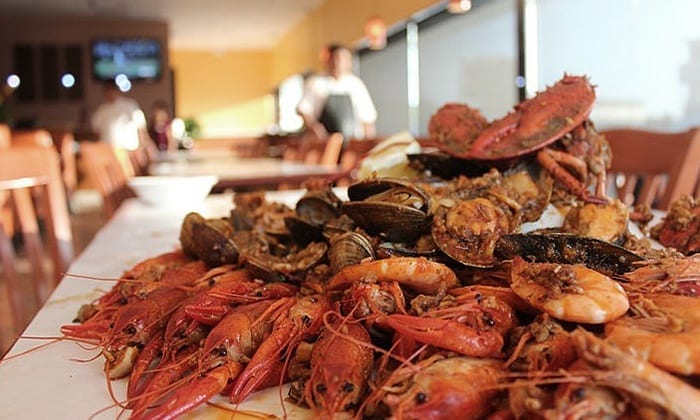
    China’s premier seaside tourist region is seeking to rein in malpractice in the seafood catering sector, which has seen customers overcharged and a restaurant charged with bribery.

    A clampdown involving the China Food and Drug Administration, the Industry and Commerce Bureau (which issues business licenses), the Tourism Administration, and the Public Security Bureau has resulted in the high-profile closure of two restaurants in Sanya, the coastal city on the tropical island of Hainan that is often touted as China’s answer to Miami.

    The Liu Mei Jia seafood restaurant has had its license revoked for “soliciting customers” – reference to a practice in which restaurateurs use misleading advertising and salespeople to lure in customers who are then frequently overcharged. Also put out of business was the Qiong Mei Jia seafood restaurant, which stands accused of “bribery,” according to the local office of the Industry and Commerce Bureau, which didn’t elaborate on the charge.

    Price-bilking by seafood restaurants has become a major consumer issue in China in recent years, particularly in major tourist destinations like Sanya. This, in turn, has drawn more scrutiny onto the seafood catering trade. The latest crackdown, which featured prominently on state-run TV, comes just before the annual Chinese New Year  on 16 February 16, a peak period for dining out.

  • Lotte Shopping swings to loss in 2017 due to THAAD row

    Lotte Shopping swings to loss in 2017 due to THAAD row

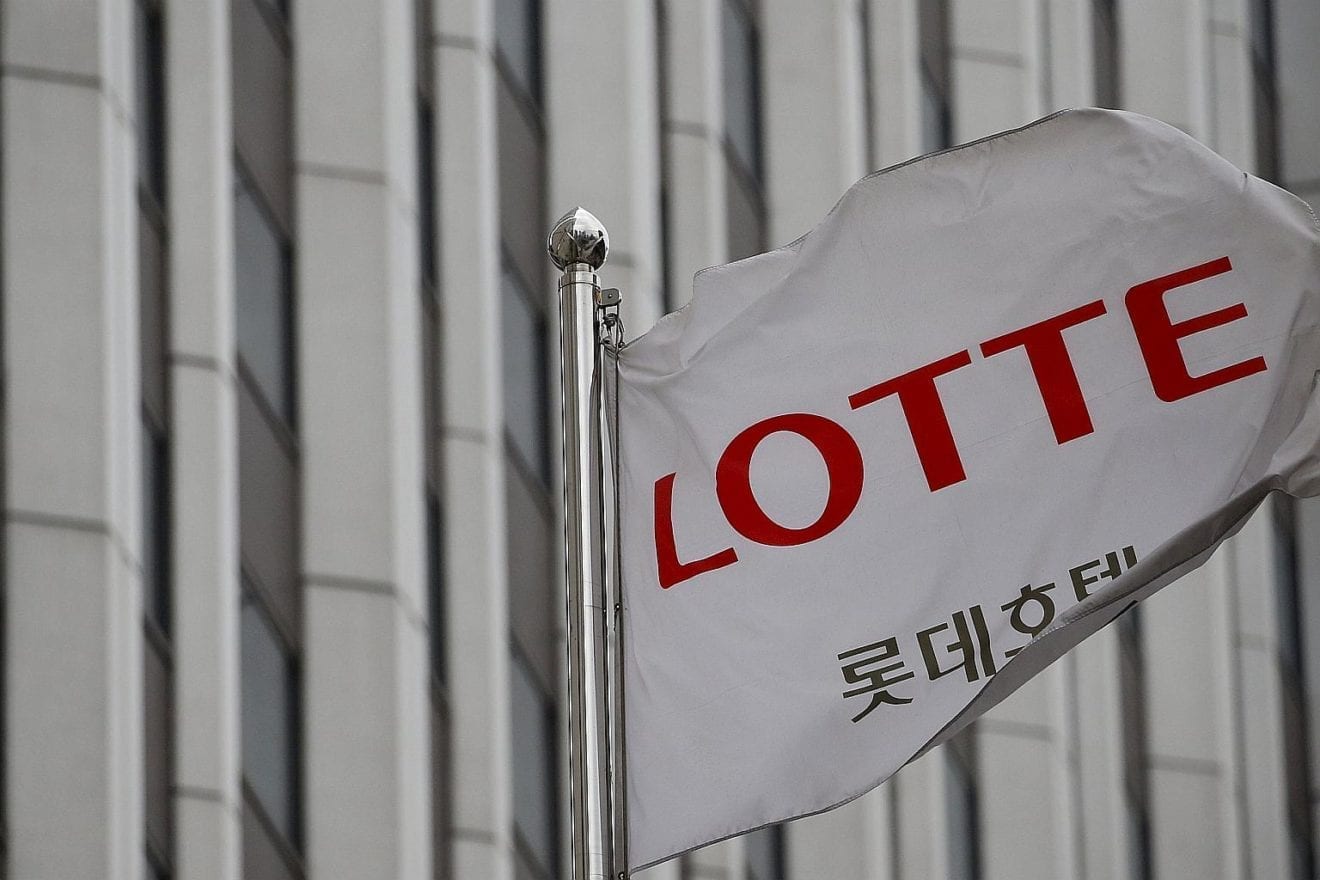
    Lotte Shopping Co., the retail affiliate of South Korea’s fifth-largest conglomerate Lotte Group, said Thursday it swung to the red in 2017 from a year earlier amid a diplomatic row between Seoul and Beijing over the deployment of a U.S. anti-missile system here.

    Its losses reached 20.6 billion won (US$18.9 million) on a consolidated basis last year, compared to a net profit of 246.9 billion won posted in 2016, the company said in a regulatory filing. The firm operates Lotte’s key retail units, including its department store and hypermarket chains.

    Operating income stood at 530.3 billion won, down 30.5 percent on-year, and sales dropped 24.6 percent to 18.2 trillion won during the cited period, it said.

    The numbers reflect the performance of Lotte Shopping and its subsidiaries, including Lotte HiMart Co., which specializes in electronics and home appliances.

    The drop in the revenue was largely expected following Beijing’s apparent retaliation over Seoul’s deployment of the U.S. Terminal High Altitude Area Defense (THAAD) system on its soil. Lotte Shopping was one of the most affected companies from the economic retaliation after it signed a land-swap deal with the Seoul government to host the missile shield system.

    Shares of Lotte Shopping soared 4.17 percent to close at 250,000 won on the main bourse Thursday, with the broader KOSPI index gaining 0.46 percent. The earnings results were released after the stock market closed.


  • Korea Ginseng Corp Opens ‘LOUNGE 1899’ to Tap into health and beauty market

    Korea Ginseng Corp Opens ‘LOUNGE 1899’ to Tap into health and beauty market

    Korea Ginseng Corp (KGC) is expanding into the health and beauty market with experimental stores.

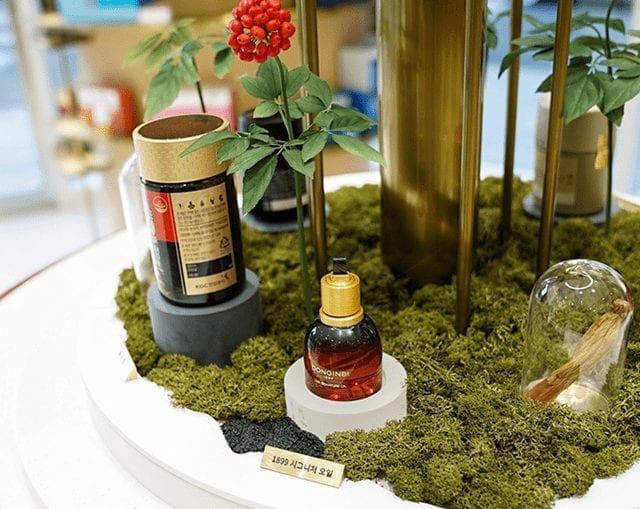
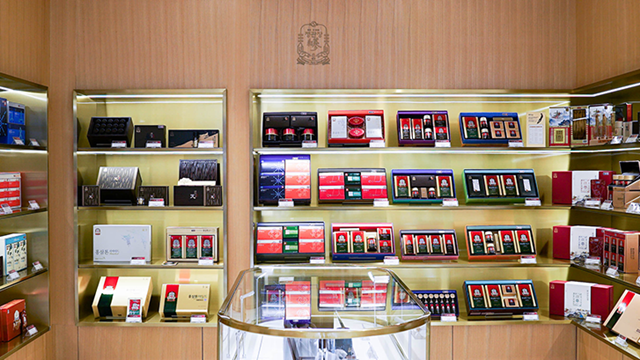
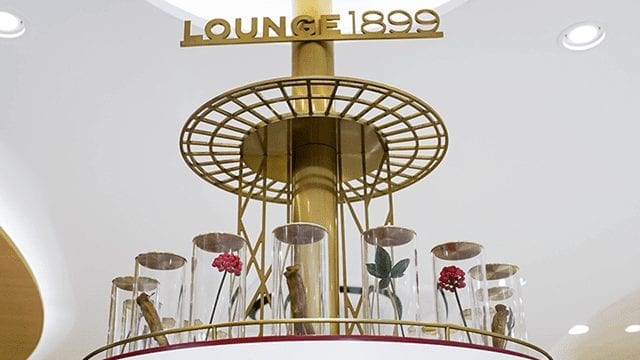
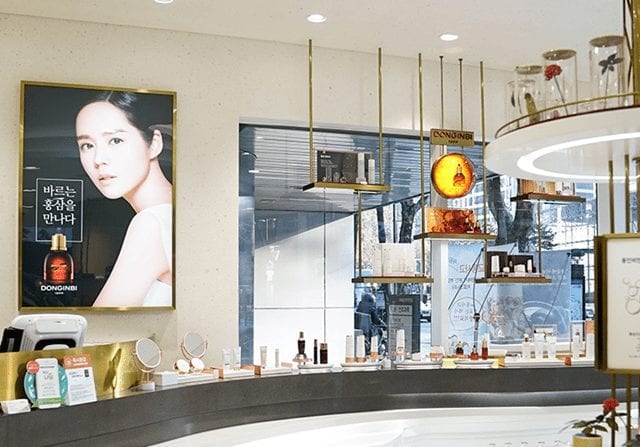
    Called “Lounge 1899” as a way to emphasise 119 years of history of its ginseng, the stores target consumers in their 20s and 30s and foreign tourists. They allow consumers to try out premium red ginseng-based products from KGC’s “Cheong Kwan Jang” and “Donginbi” lines.


    Customers can have personalised counselling from experts about products suited to their skin conditions, and experience oil-hand massage and red ginseng-hand spa, and a tea service.

    KGC currently runs six “Lounge 1899” stores across Korea with the first one opening in Seoul’s Gangnam district on January 26.

    The company plans to open 60 more stores by the end of this year.

  • Rimowa unveils new brand identity for its 120th anniversary

    Rimowa unveils new brand identity for its 120th anniversary

    A worker intently studies an aluminium suitcase on the assembly line at the Rimowa factory in Cologne. He opens and closes it repeatedly, lays it flat, pounds a hinge with his mallet, stands it on its wheels and starts over again. Until this bag is perfectly balanced, it will not leave the factory. Such labour-intensive quality has been in Rimowa’s DNA since Paul Morszeck founded it in Cologne in 1898.

    With its immediately recognisable aluminium cases and grooved design, Rimowa is a cult brand, the type that bonds owners in a kind of unspoken club.

    The German company turns 120 this year, but there will be no one special event, says Alexandre Arnault, the new 25-year-old CEO, who finds the idea of a party ‘outdated’. Rather, it will be a whole year of celebration, of taking a fresh look at the suitcase brand that pioneered aluminium and polycarbonate, and finding ‘a cool way to remind people who we are’.

    Tall, poised and impeccably dressed, fluent in French, English and German, Arnault is the third child of LVMH CEO Bernard Arnault and it was his idea that the luxury goods conglomerate acquire Rimowa. He had been using a matte black ‘Salsa’ model since age 17 or 18, when he moved to New York for an internship.

    ‘My family was not too happy when I travelled with it,’ he recalls. ‘But when they looked at it carefully, they understood the beauty of the product, the craft behind it.’ The family operation has high-profile luggage brands of its own, of course, but when Louis Vuitton started to modernize its suitcase line with lighter and four-wheeled models, Rimowa’s particular set of skills became clear.

    LVMH bought Rimowa in January 2017, after two years of negotiation, and Arnault was appointed CEO alongside Dieter Morszeck. He has been actively shepherding the brand ever since, with collaborations, new stores, a pop-up, and no sign of slowing down.
    ‘What I have learned from growing up in my family and seeing other CEOs is that you have to be involved in the product on every single level,’ he says.

    In June he hired Hector Muelas, formerly of Apple and DKNY, as Rimowa’s chief brand officer. Early this year they unveiled a new visual identity, a collaboration with Munich-based Bureau Borsche and London-based Commission Studio.

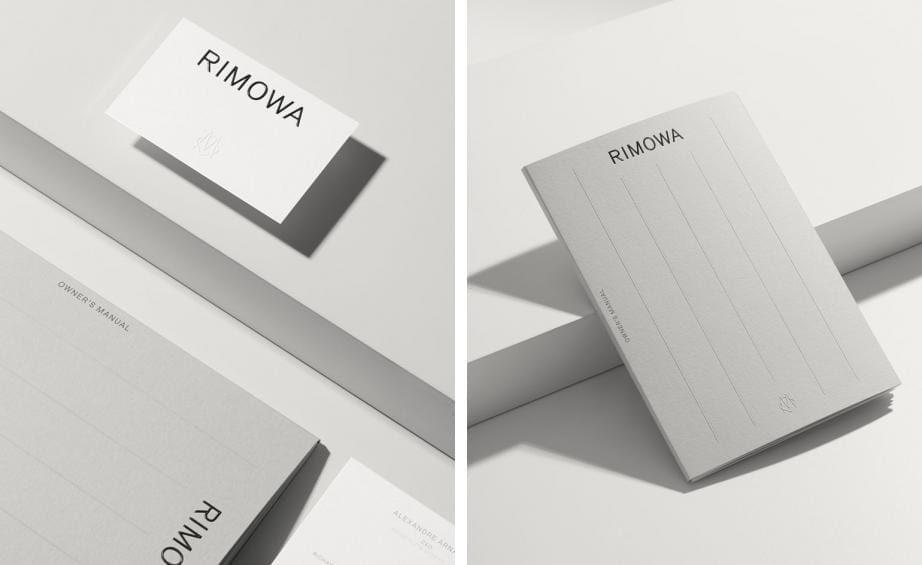
    The pill-shaped frame and rounded letters of the previous logo have been replaced with an understated design, with a refined sans serif font that ‘encapsulates the timeless and considered nature of the brand’, says Muelas. The colour blue has disappeared in favour of neutral shades – black, white and grey.

    The team also designed a new monogram inspired by Rimowa’s original from 1898. It features sharpened vertices like the spires of Cologne’s famous cathedral, intertwined with angular curves that mirror the industrial forms of contemporary Rimowa suitcases.

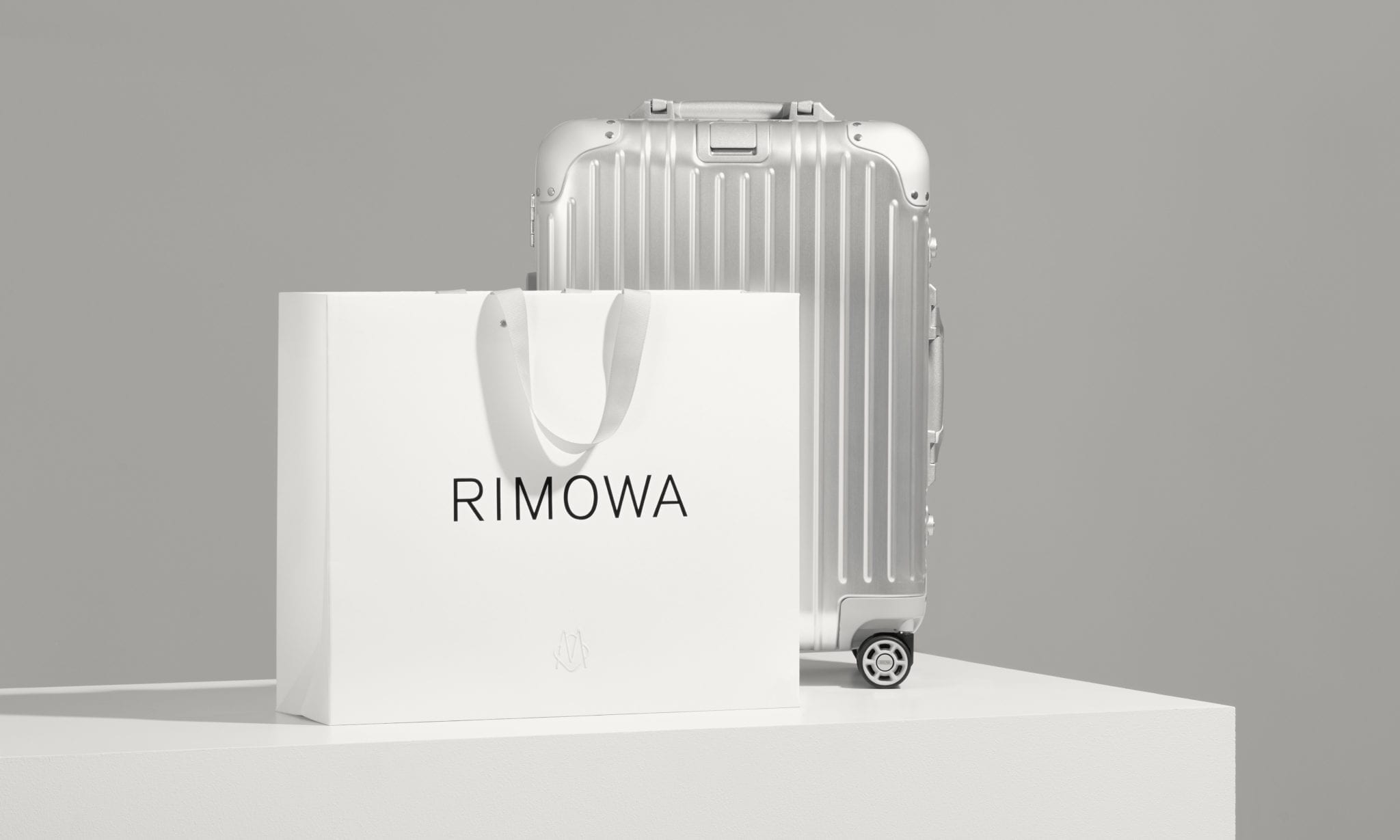
    Both the logo and monogram appear on a redesigned range of packaging. Once an afterthought, Rimowa’s packaging now aspires to be as pleasing as that of an iPhone.

    There are dust bags, shopping bags with straps held in place by rivets, and gift boxes for carry-ons. Demonstrating a price tag that slides out of a little folder, Muelas says, ‘With every single piece of design, we put a lot of consideration into how it would make people feel. When you buy Rimowa it’s a magic moment. It’s got to have a ritual.’

    Paper accessories such as an owner’s manual and notebooks are embossed with fine parallel lines to mirror the suitcases’ grooves. Geographic coordinates appear here and there, making oblique reference to meaningful locations for the company, such as the factory where each case was produced.

    The number of meaningful locations is increasing, as last year saw a slew of new store openings in cities such as Paris, Frankfurt and Tokyo. Arnault wants each one to give customers an experience, and he plans to hire in-country architects to design individual stores for different markets. Beyond suitcases, customers in larger cities will discover unique lifestyle products made by local talents especially for the brand. In Paris, for example, the new flagship is selling chocolate bars by Patrick Roger, available until mid-February.

    Arnault is also excited about the pop-up concept, having launched the company’s first in Beverly Hills last December, built to look like a luggage conveyor belt and selling products such as fresh juice and travel and design books, as well as aluminium pens by Kaweco and T-shirts by German brand Merz b Schwanen. ‘A pop-up in a new place for six months allows us to try a new store concept, a new design. If it works, great, we learn from it. If it doesn’t work, we also learn from it.’

    As for collaborations, Rimowa teamed up with Fendi for a limited-edition suitcase with a belt, leather handles and the double F logo melded onto the aluminium surface. Also launched last December, the cases came with a price tag of €1,700 and sold out within a week. While more such team-ups are on the horizon, Arnault is keeping the details to himself. What he does admit to is his dream collaboration, with Nasa. He plans to contact them soon.

    This goal reflects Arnault’s love of technology (he Is a graduate of Paris’ prestigious École Polytechnique). In 2016, Rimowa introduced electronic luggage tags, and the young CEO is considering what other digital innovations might add value for the customer. Nothing gimmicky, he insists. A suitcase with an integrated battery charger would be heavy and unnecessary, while one with its own scale seems practical.

    For the 80th anniversary of its signature aluminium suitcase last year, the house produced a fully digital campaign – portraits of Rimowa cases belonging to Karl Lagerfeld, Martha Stewart and the Italian chef Massimo Bottura, among others.

    Reached at his recent Gucci Garden restaurant opening in Florence, Bottura recalls, ‘I bought my first Rimowa after years of luggage envy, watching other travellers wheel their metal cases around with ease.

    In particular, I was fascinated by the Rimowa photography cases, these big aluminium boxes that protected fragile equipment. Finally, a wheel broke on a black plastic trolley I had and I bought a Rimowa silver bullet trolley at the airport to replace it. And that was the beginning of the obsession.’

    At a time when many brands talk about storytelling, suitcases are natural vehicles for it. ‘They’re travel companions,’ notes Muelas, witnesses to the experiences and memories that mark a journey. Indeed, when LVMH announced the acquisition, Arnault received notes from people around the world telling him their Rimowa stories.

    He says, ‘There’s an amount of love that exists out there for this product that I’ve rarely seen before, and I think it’s linked to this relationship of trust. Our suitcases are so robust that people trust us with their most personal belongings, their most valuable things.’
  • Michael Kors numbers is worrying

    Michael Kors numbers is worrying

    The latest numbers from Michael Kors are far from being a good result, indicating a distinct lack of momentum at the brand.

    In some divisions, the Michael Kors brand has experienced a reversal of fortunes since the last reporting period and the results highlight the company was not one of the winners this holiday season as it was not able to capitalise on heightened consumer spending and confidence.

    An overall sales growth of 6.5 per cent might look reasonable enough, however, this is inflated by the addition of revenue from Jimmy Choo, which contributed $114.7 million during the quarter. Remove this, and revenue fell by 2 per cent. Even this number is flattered by some favorable currency movements; take these into account and revenue dipped by a rather more depressing 3.9 per cent.

    Admittedly, part of the decline at the core brand is down to a pullback from unfavorable sales channels. However, as this process has been ongoing for a long period, it cannot be used to explain away the weak performance entirely.

    Michael Kors has full control of its retail business, where it reported modest growth of 1.1 per cent. However, that number hides some worrying weaknesses: all of the growth in retail came from the opening of 32 new stores over the past year. And at a regional level, only Europe and Asia increased revenue. Within the Americas, retail sales decreased by 4.5 per cent and the poor store performance contributed to a global comparable sales dip of 3.2 per cent. Worryingly, all of the growth numbers are materially worse since the prior quarter. In other words, while the overall retail and luxury market strengthened, Michael Kors’ performance deteriorated.

    The sales softness might be acceptable if the company could point to a stronger bottom line. However, this is not the case. Operating margins were static in the retail group and fell for the Michael Kors division as a whole. As a consequence, operating income fell by 8.3 per cent over the prior year. With its relatively weak margins, Jimmy Choo did little to offset this.

    Despite attempts to revive the brand, it is clear that Michael Kors has lost momentum and is now heading in the wrong direction. This does not mean the strategy is entirely wrong; indeed, we would argue that the company is stronger now than it was a couple of years ago. However, Michael Kors needs to review its positioning and think about how it can connect more effectively with consumers.

    One of the issues is that Michael Kors is a fairly brash brand that lacks the softness of classic luxury labels. This plays well in some segments, but it alienates others – and that alienation is growing as consumers increasingly look for authentic and unassuming products. Admittedly, this is a difficult balancing act for Michael Kors, as it needs to be edgy and distinct, but at the same time generate broader appeal. However, we believe the balance is currently wrong.

    Jimmy Choo has been more successful at squaring this circle and has a playbook that Michael Kors should look to emulate.

    Overall, we do not see Michael Kors unfavourably, and we believe management has addressed many of the weaknesses that previously plagued the company. That said, it is clear there is a lot more work to be done before better results come through.

    -Neil Saunders