Author: Mei Ling Tan

  • China online spending is already 50 per cent of retail sales

    China online spending is already 50 per cent of retail sales

    China online spending is set to account for almost 50 per cent of the country’s total retail market this year.

    According to fresh data from Mintel, this year’s figure will be 45.7 per cent of “total per capita retail spend”. In many categories, already more is spent on goods online than in physical stores in the world’s largest digital economy.

    “China is experiencing a fundamental shift in the way consumers shop, and in how the shopping experience fits into the wider environment of customer service, delivered both online and in-store,” said Matthew Crabbe, research director, APAC, with Mintel.

    The research shows China’s online retail market has reached a critical mass. Business-to-consumer (B2C) online retail is expected to reach more than 60 per cent of total e-commerce sales this year, with mobile online retail expected to make up more than 80 per cent of the B2C retail category.

    However, while Mintel estimates per capita online retail spend will reach 45.7 per cent of total per capita retail spend by the end of this year it predicts that share will hold steady between until the end of 2019.

    Crabbe said there are several reasons for the projected peak.

    “One issue is that consumers are increasingly buying experiences and services online, rather than products. The other issue is that consumers are already adapting to ‘new retail’; they are embracing greater integration between online and in-store shopping. This will mean much tougher competition between retailers. It will also likely mean more pressure for further consolidation in the market, resulting in more mergers, acquisitions and strategic partnerships,” he said.

    China’s ‘new retail’ experience has consumers purchasing different products from different channels. Mintel research shows that 72 per cent of in-home food shoppers prefer to shop in-store, compared with 60 per cent of consumers who prefer to shop online for toys, games, clothing, and accessories. Apart from alcoholic drinks (61 per cent shop in-store) and pharmaceuticals and healthcare products (57 per cent shop in-store), in all other sectors the combined total of those who shop online via a mobile device or lap/desktop is greater than the proportion who shop in-store.

    While in-store grocery shopping still dominates, 66 per cent of consumers buy in-home food and drinks in-store, the average number of consumers who shop online (mobile or desk/laptop) for in-home food and drinks grew three percentage points since 2016, with 49 per cent buying in-home food online using a mobile device.

    “The growth in mobile online shopping across all sectors this year illustrates how mobile is driving the convergence of online and offline shopping into ‘new retail’,” said Crabbe. “Meanwhile, online shopping penetration is high across most sectors. There may be room to expand fresh and luxury food product sales online, thus increasing the number of high-income consumers who shop online, but the room for expansion of share of pocket among China’s consumers is running out.”

    Arise the ‘grocernauts’

    In fact, urban Chinese consumers are keen to get the immediate experience that only shopping in-store can offer. Mintel research reveals that 62 per cent of urban Chinese consumers say the ability to try, see, and experience products in-person before buying encourages them to shop in-store; the same proportion (62 per cent) shop in-store to ensure the freshness of produce, and 55 per cent say in-store shopping means they can get what they want faster.

    “Supermarkets and hypermarkets are moving away from just selling in-home foods towards  providing catering services (so called ‘groceraunts’), as well as offering online food ordering and in-store pick up services. And convenience stores are morphing into unmanned, checkout-free, cashless, elaborate vending machines. We’ve also seen shopping malls evolve away from retail spots into theme park-like leisure developments. This is all leading to a very diverse potential retail environment that includes retail as part of a wider range of consumer services. Store functions will increasingly incorporate online-enabled, front-of-store consumer touch points for selling goods and providing other customer services – even ones not related to the retailer’s core business,” Crabbe added.

    Probably the main driver of online retail’s success, 65 per cent of urban Chinese consumers say they find products cheaper online, while 63 per cent say that online offers more choice. More than half (52 per cent) of consumers say they find what they were looking for faster when shopping online.

    “Despite the instant sensual and entertainment experiences that consumers enjoy when shopping in-store, low cost, high convenience and more choices are the key ingredients that drive consumers to do more of their shopping online. As online retail platforms invest in and collaborate with physical retailers, who in turn look to increase their online exposure, these new business models will create the ideal ‘new retail’ experience for shoppers. However, companies and brands will be challenged to find their own, unique combination of online and in-store features in order to create their own bespoke experience,” concluded Crabbe.

    Total B2C and consumer-to-consumer (C2C) online retail sales in China are expected to reach RMB 6.4 trillion by year-end, having grown at a compound annual growth rate of 37.9 per cent since 2012 – that represents nearly fivefold value growth in just five years.


  • Trump to sell new Asia policy at regional summit

    Trump to sell new Asia policy at regional summit

    President Donald Trump is expected to bill a new policy for Asia during his two-day stay in Vietnam this week, but the U.S. administration needs to follow through with concrete actions to restore waning confidence in a region weary of his erratic diplomacy.

    At the Asia Pacific Economic Cooperation (APEC) this week in the central Vietnamese city of Da Nang and his state visit later on in Hanoi, Trump will promote the concept of a “free and open Indo-pacific region”. Japan first floated this idea, tailored to push the U.S. to coalesce three other maritime democracies — Japan, Australia, and India. According to American officials, this sales pitch is aimed at demonstrating America and the Trump administration’s commitment to the Indo-Pacific region.

    But political rhetoric only will not be enough to reassure a region increasingly anxious about U.S. commitment, analysts say.

    A survey in March by the Iseas Yusof Ishak Institute in Singapore that polled government officials, business representatives, academics and journalists in Southeast Asia found that around 75 percent of the respondents saw China, not the U.S., as the most influential player now and in the next decade. Two-thirds of respondents also viewed the U.S. less favorably than four months ago, according to the survey.

    “Some of Trump’s statements and actions since he came to power have undermined the U.S. strategic position in the region, but most regional countries would like to see Washington’s continued engagement with the region,” Le Hong Hiep, a research fellow at the Iseas Yusof Ishak Institute, said.

    “As such, his concept of a ‘free and open Indo-Pacific’ is likely to be welcomed by most regional countries,” Hiep said. “But again, at this stage, it is just a policy concept. Washington needs to follow up with concrete actions aimed at maintaining and strengthening economic and strategic engagement with the region to restore its strategic position in this part of the world.”

    His attendance at the APEC Summit is part of his 13-day five-nation Asia tour, the longest tour of Asia by any U.S. president since George Bush in late 1991. Trump had planned to skip the East Asia Summit, a key gathering of Southeast Asian leaders in the Philippines on November 13. He only made a last-minute change to attend apparently at the request of other leaders.

    “It is still not too late for the U.S.,” Dennis C. McCornac, an economics professor at Loyola University Maryland in Baltimore, said, “to come to its senses and understand that this so-called ‘American first’ policy is really a disguised form of isolation – a policy that will and has never really worked for any country,”

  • Beerlicious starts brewing more

    Beerlicious starts brewing more

    A year after introducing Australian craft beer to Thailand, Beerlicious has partnered with Canadian brewery Molson Coors International to introduce Cobra Premium beer.

    Initially the company offered six craft beers from Bridge Road Brewers, an award-winning small-batch brewery near Melbourne. It soon expanded to 10 different beers from the brewery, and has just introduced a range of Christmas brews.

    “We chose to work with Bridge Road Brewers as it is a family business, conceived by a father and son who focus on traditional brewing techniques,” says Beerlicious MD/founder Niran Khanijou.

    Cobra Premium beer, brewed in the UK for Molson Coors, has won more than 94 gold medals at the international Monde Selection awards.

    “Our immediate plans are to introduce not only Cobra but also King Cobra, a ‘champagne lager’ in an impressive 750ml bottle, to the Thai market over Christmas,” says Khanijou. King Cobra has won the Grand Gold award, the highest accolade, at Monde Selection.

    “Our Australian selection will have a limited stock of the two seasonal beers Fat Man, Red Suit, Big Sack and Magical Christmas Unicorn, a vanilla ice-cream ale.”

    Beerlicious products are available at select Bangkok restaurants and craft-beer venues as well as branches of Central Food Hall, Gourmet Market and Tops.

  • India is next plan for PayPal

    India is next plan for PayPal

    Global technology platform and digital payments company PayPal Holdings has launched in India.

    This enables Indian consumers to use PayPal to shop online. Merchants offering PayPal will be able to process both local and global payments, gaining access to the brand’s more than 218 million customers across 200 global markets.

    Offering cross-border payments in India for nearly a decade, PayPal has now rolled out secure transactions and such benefits as One Touch, Buyer and Seller Protection and Refunded Return Shipping.

    India has all the ingredients to become a true digital economy, says PayPal Private CEO Rohan Mahadevan.

    “India is transitioning away from our biggest competitor, cash, and our digital platform and technology has immense scope to enable this at scale,” says PayPal India MD Anupam Pajuja. “For us, the marathon has just begun.”

    PayPal has set up a customer service centre in India with multilingual support and on-ground sales team.

    As digital payments become more mainstream in India, PayPal is partnering with government and state-owned banks on such initiatives as a digital financial literacy program and an eTourist visa.

  • Ba&Sh plan for Asia expansion

    Ba&Sh plan for Asia expansion

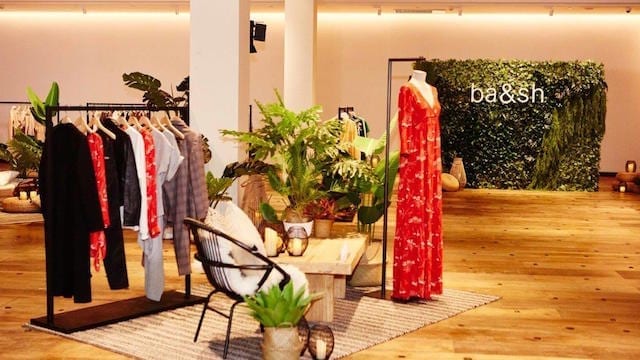
    Parisian affordable luxury brand Ba&Sh plans to ramp up its Asian presence after early success in Hong Kong.

    The region has become a top priority for founders Barbara Boccara and Sharon Krief after a cornerstone 50 per cent investment by LVMH-linked PE fund L Capital in 2015. Ba&Sh plans to open 12 more stores in China, Macau and Hong Kong next year.

    The co-founders made their first personal appearance in Asia at the recent Spring-Summer 2018 collection media preview in Beijing.

    “Ba&Sh is spreading fast in Asia and seems to match the local way of life, confirming the universal reach of its lifestyle,” said Ba&Sh CEO Asia Isolde Andouard.

    Hongkongers quickly embraced the Ba&Sh label, with growing foot traffic in the three stores which have opened since April, at Times Square, Harbour City and IFC Mall.

    “The shops are flourishing, so the brand is all the more optimistic and enthusiastic at the time of launching Ba&Sh in China,” she said.

    Five Mainland China stores have opened since September in fashionable and luxury malls in Beijing – Shin Kong Place, Galeries Lafayette and Taikoo Li – and in Shanghai – Reel and Taikoo Hui.

    The Asia roll-out is being led by Andouard, who previously headed up rival fashion operator, the Chinese-owned French company SMCP, parent of the Sandro, Maje and Claudie Pierlot.

    “Isolde is the right person to achieve ba&sh development in Asia,” explained Ba&Sh global CEO Pierre-Arnaud Grenade. “Her versatile background and her in-depth understanding of the Asian market are strong assets to support Ba&Sh implementation there.”

    Isolde Andouard, Ba&Sh CEO Asia with Pierre-Arnaud Grenade, CEO Global.

    Authenticity wins following

    Andouard says the brand’s authenticity won over French women and believes that same authenticity appeals to Asian consumers.

    Despite its LVMH-linked ownership, Barbara and Sharon remain the faces of the brand “and, as such, they do reinforce the customers’ identification with Ba&Sh. But above all, Ba&Sh benefits from its success in France and from the LVMH network to carry out a daring expansion strategy. The launch in Asia and in the US were done simultaneously, a bold move that is starting to show tangible results,” she said.

    The co-founders, high school girlfriends, have given the first two letters of their names and more than 10 years of their lives to create the brand before attracting the attention of LVMH.

    Globally, Ba&Sh now has 500 points of sale worldwide, including 163 direct retail stores.

    ba&sh SS18 press event_10

    The brand’s two core values – freedom and friendship – are at the heart of the creative process.

    “Trend books never set foot in the Ba&Sh workshop, where only refined fabrics and craftsmanship ignite the spark of the stylists’ creativity. Barbara and Sharon dreamed of building the ideal wardrobe, and that’s why our products are so versatile, in fitting with today’s never-resting metropolitan woman who parties when she’s not working or with her family.”

    The new SS18 collection mixes Anglo-Saxon and Asian inspirations to embody “the joyful and Parisian Ba&Sh spirit”.

    Most prints draw their inspiration from the heart of Asia; Japanese and traditional Chinese patterns are reinterpreted with flair.

  • Arl-shipping.com launches Facebook chatbot last mile container tracker

    Arl-shipping.com launches Facebook chatbot last mile container tracker

    Arl-shipping.com has launched it’s Facebook chatbot tracking of containers on the road en route from discharge port to import warehouse, giving real-time visibility of the truck(s) on the road. Import customer and warehouse operator follows the trucks in real-time and prepare for speedy container unstuffing upon arrival to the warehouse. The tracking is facilitated by truck drivers using arl-shipping.com’s free app, tracking the shipment and OCR’ed container numbers via driver’s smartphone GPS location services. The Facebook tracking service is fully embedded into the transport provider’s Facebook page as an integral service.


    “On top of Facebook chatbot cargo tracking, we are soon launching also Skype and WeChat Last Mile Container Tracking for shipping line agents, freight forwarders, warehouse operators or other intermediaries via the arl-shipping.com powered chatbot,” said arl-shipping.com director, René Bendt. He added, “We explore maturing technologies, which can be deployed with little effort to the benefit of real life shipping scenarios like container number OCR, GPS trackers and other IoT devices, drones and blockchain technology.”


    The tracking is facilitated by truck drivers using arl-shipping.com’s free app, tracking the shipment and OCR’ed container numbers via driver’s smartphone GPS location services.

    The Facebook chatbot Last Mile Container Tracker tracks shipment en route from discharge port to warehouse, prepping the warehouse operator for warehouse dock, unstuffing gang and x-docking operation readiness. Upon providing the warehouse’s location to the chatbot via smartphones’ built-in location sharing services, Last Mile Container Tracker alerts in Facebook messenger when container(s) is close to the warehouse, as well as giving hourly status messages while container(s) is on the road, en route to the warehouse.

    Soon the chatbot will also advise warehouse ETA imbedding online traffic pattern services into the Last Mile Container Tracker.

  • Dachser Chennai on the move

    Dachser Chennai on the move

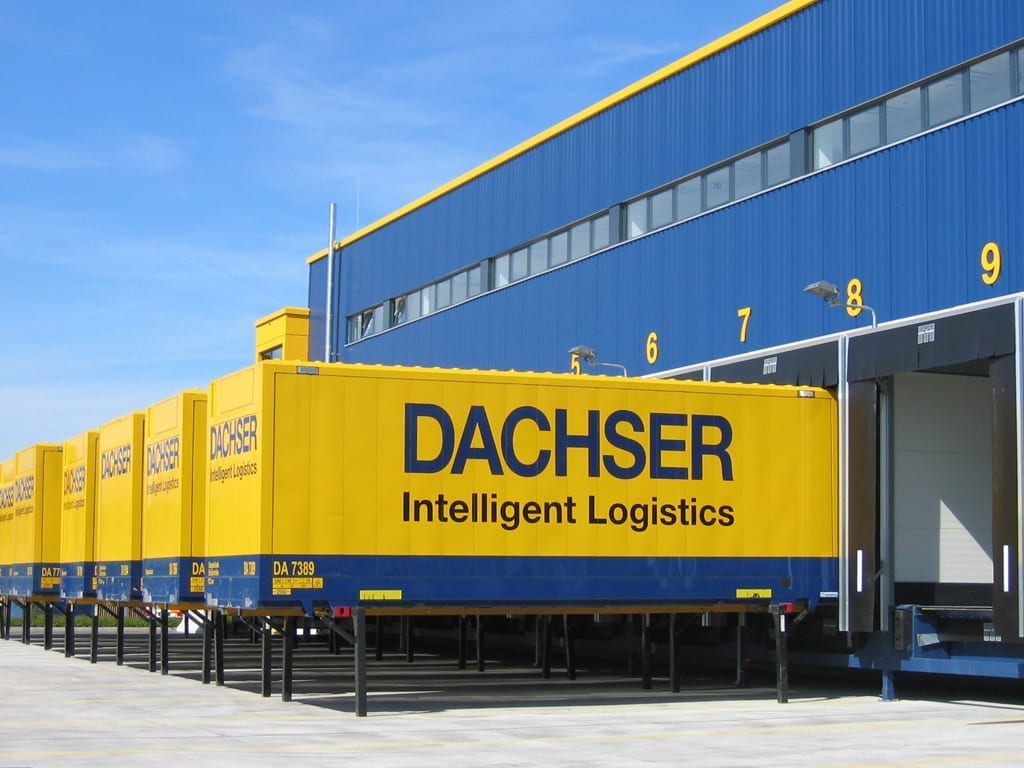
    Dachser India has moved its Chennai branch to a new location to facilitate the company’s prospects for growth and development. The new premises are centrally located in the modern KRM Plaza, and offers easy connectivity by road, rail and air travel.

    Dachser India has moved its Chennai branch to a new location to facilitate the company’s prospects for growth and development.

    “The new office is designed to provide a pleasant and comfortable workplace for our Chennai team and is easily accessible for our customers,” said Sivagurunathan B, deputy general manager India South Air & Sea Logistics.

    “This new office provides a perfect environment for our teams to serve our customers better. Markets in South India, especially Chennai and other cities in Tamil Nadu, have always contributed significantly to Dachser’s success in India. We expect very strong growth from this market in the years to come,” added Huned Gandhi, managing director Air & Sea Logistics India

  • IoT, other connected technologies will accelerate security threats

    IoT, other connected technologies will accelerate security threats

    Life sciences and healthcare companies will follow the lead of other industries and integrate connected technologies including Internet of Things (IoT) and intelligent scanners across their ecosystems as a means to improve operational efficiencies, enhance supply chain visibility and deliver better patient care – but the increasing use of such technologies will accelerate security risks, according to a new set of predictions from experts at Unisys Corporation.

    “Market forces that to this point have primarily affected other industries are now demonstrating the potential to transform the way life sciences and healthcare companies operate,” said Jeff R Livingstone, PhD, vice president and global head, Life Sciences and Healthcare, Unisys. “For example, if the pharmaceutical industry looks at the processes and best practices being used in other types of manufacturing, they can apply and adapt those technological advancements in how they manufacture, provision and supply therapeutics. Ultimately, there is a lot of interconnectivity between industries that can be taken advantage of.”

    Consequently, Dr Livingstone predicts a fundamental consumer-driven shift based on the “retailisation” of industries such as healthcare, which incorporates expanded roles for security, and which in turn facilitates a shift from on-premise data management to the cloud.

    Prediction: The “retailisation” of healthcare – based on the IoT – will fundamentally alter how life sciences and healthcare organisations conduct business

    As industries such as retail have already started using connected technology like intelligent scanners and e-readers to track and ship their products, so too has this technology demonstrated potential for life sciences and healthcare.

    Unisys predicts that in the coming year, connected technology will take a more prominent role within the supply chain, as sensor-based track-and-trace technology will allow companies to verify product shipping information, monitor temperature issues and adjust routes based on environmental factors affecting drug viability, as well as using cross-platform analytics based on tracking data to help improve route efficiencies and deliver critical medications to people who need them, when they need them.

    Prediction: Continued rise in cyberattacks and shift in how patient data is accessed will require a multi-tiered approach to cybersecurity

    According to a recent report, in the second quarter of 2017 life sciences and healthcare organisations suffered more security incidents than any other industry, surpassing the public sector. Simultaneously, as more providers use personal or hand-held devices to access data, it means extremely valuable patient data is more vulnerable to cyber threats. In the coming years, the industry will see a rapid rise in ransomware and DDoS attacks that threaten patient data, as well as the business reputations of the organisations trusted to protect it.

    These security risks are not lost on consumers; the recent Unisys Security Index found that a large majority of US respondents registered concern about the possibility of hackers or malicious intruders gaining access to internet-connected medical devices such as defibrillators, pacemakers or insulin pumps belonging to them or someone they know.

    As a result, Unisys predicts companies will shift toward a multi-tiered, holistic approach to security. To ensure proper security, all devices will require equally strong protection, including personal devices that interact with multiple networks. While it will require more than one type of protection, those that are best poised to adapt will start with a thorough security assessment to analyse network and devices, which in turn can determine how different aspects of security can work together best for the business.

    Prediction: Compliance and certification move to the cloud

    Historically, legacy hardware and a lack of centralised mandates for certification have hindered migration to the cloud in life sciences and healthcare. This has largely been based upon a general distrust of allowing critical IP and patient information “outside the gates”.

    Unisys predicts that advancements in cloud-based software and security, coupled with proper guidance, will help providers more quickly adapt to ensure up-to-date compliance based regulatory needs and help bridge the gap between compliance, security and privacy.

    “To prepare for what’s to come, first you have to take a step back,” Livingstone said. “Completing a thorough review and assessment of one’s technological and security needs, as well as data and compliance management as it relates to IP, patent and regulatory issues, life sciences and healthcare companies will make one well-positioned to succeed in the digital future.”

  • Importance of customer service

    Importance of customer service

    The golden rule for every business man is this: “Put yourself in your customer’s place.” – Orison Swett Marden

    I know, I get it, it’s November and we need to get staff on board for our Christmas period, not too early and certainly as inexpensively as possible.

    For so many retail businesses, the Christmas trading period is the most profitable trading period of the year. This applies to both small and large businesses where typically some categories can take as much as 25 per cent of their annual sales in December, which could translate into more than half of their annual profit. Department stores included.

    Yet during this period, so many sales positions are left to the young inexperienced junior casuals who have been poorly trained, if at all, in the art of selling. The product knowledge can be mixed, their selling skills can be variable and in many cases their care factor is careless.

    So, why would a retail business, at the best time of the trading year, have the most inexperienced people on the front line, dealing with customers who are in the mood and mindset to spend, perhaps more freely than at any other time of the year? Is this good logic?

    When a retail business seeks the very best temporary sales people, invests in training them on products, the features and benefits thereof and as well as the art of selling, we consistently see a huge difference to the sales outcome.

    Although what is the commercial sense of training staff that may not be with us in the New Year?

    Well here’s the logic of investing in all staff regardless of their tenure,

    Let us assume a business decided to attract the best casuals, and employed them on attitude, paid them 20 per cent above the going rate (NSW) of $13.65 per hour and rewarded them for over achieving their sales targets, could we expect them to produce 33 per cent more sales than the normal, unmotivated casual staff that we so often see in stores at that time of the year. And the wage cost % improves in that equation.

    Weekly wage     Sales          Wage per cent

    Normal 17 yo @ award rate 30hrs pw                  $410              $2,000       20 per cent


    Motivated, trained @ $17.00 ph, 30 hrs             $510             $2,700         19 per cent

    Not only is the business ahead in pure financial terms, but in the experience that customers will have and the lasting impression of the business though having these ‘Effective People’ in your business.

    I suggest that one of the best investments a business can make around Christmas is to make sure it has the very best skills available to care for their customers in the best possible way. After all, one indifferent experience in a store is another reason to go online and avoid inferior service and sale skills, in stores.

    Train, motivate, measure and reward your casuals and Christmas sales could be as good as you hope! Put untrained, unmotivated and cheap staff to serve your customers and Christmas could be not to your liking.

  • Marks & Spencer to close more stores

    Marks & Spencer to close more stores

    UK department store chain Marks & Spencer is about to announce further store closures along with reduced profits amid worsening high-street trading conditions.

    Last year, the company announced the closure of 30 stores, but The Guardian newspaper reports a plan has been devised by CEO Steve Rowe and incoming chairman Archie Norman for a bolder store rationalisation plan.

    The company is struggling to regain market share in its apparel division, which is almost exclusively own-label and has failed to keep pace with design and innovation of branded rivals.

    Analysts are tipping the company to announce a further 10 per cent decline in profits for the six months to September 30, to around £201 million. That’s a far cry from the £1 billion full-year profit back in 2008.

    In place of apparel, the company is redirecting its focus onto its successful food category, with some of the full-line stores to be converted into food-only stores.

    Last year, the company exited the China market and this year began preparations to sell its Hong Kong business to Al-Futtaim under a franchise agreement.

    The Guardian suggested that if M&S decides to close more stores it will deal a blow to the towns involved, where the retailer is often the main destination store, especially following the demise of BHS.

    “But with more purchases made online, stores in smaller or less attractive town centres and shopping centres are finding life difficult especially amid rising costs for retailers.”

  • China’s singles day VS black friday

    China’s singles day VS black friday

    For the past few years, Black Friday has become a focal point for many US and UK retailers – and for media outlets hungry for images of shoppers bursting into stores in pursuit of posh televisions. The event, supposedly named after the moment when retailers move into profit for the year, has quickly escalated into a four-day shopping festival. But it is not the only game in town – or even the biggest.

    Black Friday falls the day after Thanksgiving in the US (November 23 this year) and is followed up by a long-weekend extravaganza which culminates in the online-focused “Cyber Monday”. It has recalibrated, and brought forward, many consumers’ pre-Christmas shopping plans.

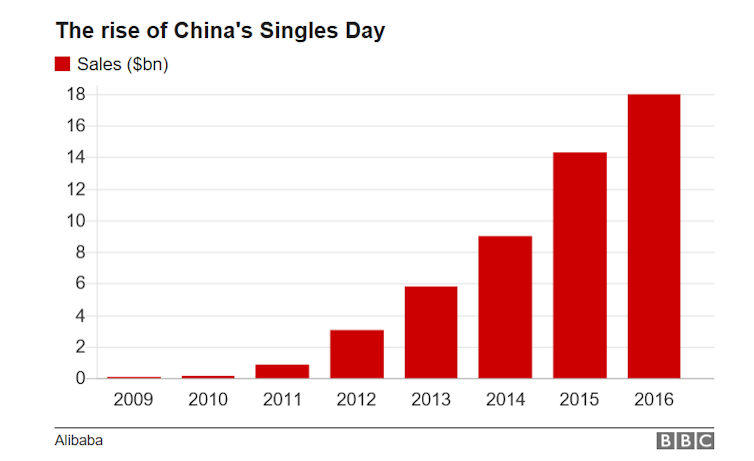
    However, unlike Black Friday, China’s November 11 “Singles Day” is still predominately focused on local consumers and completely dominated by one online retailer – Alibaba. The economic impact of Black Friday is dwarfed by this online one-day retail festival from China. Singles Day has gone under the radar for most of the general public in the West, but in 2016, Chinese shoppers spent an incredible US$17.8 billion in 24 hours on the Alibaba online platform – China’s Amazon equivalent.

    This online sales bonanza shifts more goods than the Black Friday and Cyber Monday sales days in the US combined. Black Friday in the US saw online sales hit a record of just over US$3 billion in 2016.

    Origins

    Singles Day started as an obscure “anti-Valentine’s” celebration for single people in China back in the 1990s. The popular story is that it was started by students at Nanjing University who celebrated their singledom by treating themselves. It takes place on November 11 every year and is sometimes known as “bare sticks holiday”, after the way the date is written (11/11).

    The event is also known as “Bachelors’ Day”, and it’s not hard to see why. China has a surplus of males caused by years of the government’s “one child” policy. By 2020, sociologists expect the gender imbalance to have widened to 35m and by 2030, it is estimated that one in four Chinese men in their late 30s will never have married. That is a big market.

    Black Friday was, of course, initially driven and then “exported” to the UK and other markets by major US retailers, specifically Walmart and Amazon. In China, it was the e-commerce giant Alibaba which adopted Singles Day in 2009, just as online shopping started to explode.

    It has now become a day when everyone, regardless of their relationship status, buys themselves gifts. Alibaba spotted this as a chance for retailers to generate interest and excitement and to boost sales in the lull between China’s Golden Week national holiday in October and the peak Christmas season.

    Like much of the global growth in online sales, Singles Day has been driven by mobile. Nowhere is this more stark than in China where, with 1.3 billion smartphone users, mobile shopping is huge. Around 37 per cent of Chinese shoppers buy products using their phones, compared to the global average of 13 per cent.

    We’ve seen that Alibaba’s sales numbers for Singles Day are astonishing. And the growth has been too. The chart below shows how Singles Day sales for Alibaba have risen over the past seven years. Last year alone, sales were up 32 per cent on the previous year.

    Alibaba/BBC, Author provided

    According to Alibaba, during the event on 2016 they processed more than a billion payment transactions in total, with 120,000 transactions per second at peak and their distribution system processed more than 657m delivery orders.

    Analysts have predicted this year’s event could see Alibaba rack up sales of US$20 billion despite a slowdown in China’s economy, partly due to it having a broader audience.

    Copy cats

    Of course those kinds of numbers attract the interest of Western retailers too and the 2016 event saw 37 per cent of total buyers purchasing products from international brands or merchants. Companies like US retailers Costco and Macys as well as Britain’s Top Shop and House of Fraser have marketplaces on Alibaba’s Tmall site have already got involved.

    And, for the first time, Alibaba’s 2017 Singles Day festival will bring more than 100 Chinese brands to overseas buyers, offering special promotions targeting over 100m overseas Chinese consumers in Asia and around the world.

    There is one rather sensitive obstacle to the adoption of Singles Day in the UK, however. The eleventh day of the eleventh month is Armistice Day when Britain marks the end of World War I and the nation remembers all those who have died in military service. There will be many who think it distasteful to run a shopping event on that day. However, as David McCorquodale, head of retail at KPMG, pointed out: “Singles Day in China is the biggest promotions day in the world. [The date] will stall its entry to the UK, but not forever.”

    Given the rapid globalisation of most retail trends and the way online retail now allows immediate access to millions of products from thousands of manufacturers, it is indeed impossible to envisage that Singles Day won’t extend it’s reach, in some form, to Western consumers very quickly.

  • EU seeks details on Apple’s tax set-up

    EU seeks details on Apple’s tax set-up

    EU regulators have asked iPhone maker Apple for details of its recent tax structure following last year’s order to pay back taxes of up to €13 billion (A$20 billion) to Ireland, Europe’s anti-trust chief says.

    European Competition Commissioner Margrethe Vestager, who issued the record back-tax bill against Apple in August 2016, said she wanted to make sure the company now complies with the bloc’s rules which ban unfair state aid.

    “I have been asking for an update on the arrangement made by Apple, the recent way they have been organised, in order to get the feeling whether or not this is in accordance with our European rules but that remains to be seen,” Vestager told a news briefing on the sidelines of an international tech summit in Lisbon.

    “We are looking into this of course without any kind of prejudice, just to get the information,” she said.

    Vestager said her request preceded reports based on the “Paradise Papers” which showed that Apple shifted key parts of its business to Jersey as an offshore tax haven in a move to maintain a low tax rate. Apple has said no operations were moved from Ireland.

    “We have no contact after the Paradise Papers. We are in the process. There is no particular need,” she said.

    She also said it was too early to say whether the latest leaks on tax arrangements by companies would lead to any investigation.

    “That remains to be seen if we will open more cases after the Paradise Papers.”

    The European Commission last month sued Ireland for its tardiness in collecting the money from Apple.

  • Boom predicted for China Singles’ Day

    Boom predicted for China Singles’ Day

    Three days out from China Singles’ Day, retail experts are predicting Alibaba’s annual e-commerce sales event will continue to set records.

    With the Chinese online giant expanding it to a 24-day shopping and entertainment bonanza, the global marketing hype is likely translate to record cross-border e-commerce demand, according to marketing research company eMarketer Retail.

    Global payments processor Worldpay has released new data showing that last year’s event grew by 39 per cent globally. When sales peaked, Worldpay was processing 44,505 payments a minute.
    Meanwhile, more and more international brands have been opting to participate in this year’s 11.11 shopping festival.

    Worldpay’s transaction data supports findings from the Global eCommerce Leaders Forum (GELF), which revealed the rise in consumer spending power in China is translating into growing sales on international e-commerce sites as growing numbers of shoppers seek genuine products from trusted global brands.

    Fastest growth

    Retailers in Australia and Hong Kong are seeing the fastest growth, with sales rising by 105 and 71 per cent year on year respectively, says Worldpay. While the volume of sales has plateaued in Mainland China, the average spend per purchase continues to rise at a rate of 9 per cent.

    “Since its inception as a local celebration of singledom, Singles’ Day has risen to become the world’s top grossing-online shopping holiday, and the event knows no boundaries,” says Worldpay Asia Pacific GM Phil Pomford.

    “For international businesses looking to break into the huge Chinese e-commerce market, November 11 should be an important landmark in the calendar year.

    eMarketer Retail analyst and editor-at-large Andria Cheng agrees. “For international brands this event will continue to mark Alibaba’s biggest pitch and showcase for them to get on board its platform and test the waters regarding Chinese consumer demand and promise,” she says

    “The fact more than two-fifths of this year’s 140,000 brands at the shopping extravaganza come from outside of China speaks to the continued international hope and bet that Chinese consumers will pick up the slack left by the slowing domestic growth for many brands.”

    Threefold increase

    According to marketing technology company Criteo, sales on Singles’ Day have increased threefold, with shoppers browsing online up to four days earlier.

    “This makes it the main sales peak of the season, impacting most retail categories, and is a major opportunity for both shoppers and retailers,” says Criteo GM Alban Villani, who covers Southeast Asia, Hong Kong and Taiwan.

    Analysing more than 5.1 million online transactions in Southeast Asia between October 1 and December 31 last year, it found that retail sales spiked by 254 per cent on November 11.

    Between November 9 and 12 there had been a rise of 28 per cent in average online traffic on key retail companies’ websites, and shoppers had started buying as early as November 7.

    Shoppers are increasingly buying via apps, accounting for nearly half of all transactions and 73 per cent of mobile transactions.

    Meantime, a forecast from eMarketer Retail shows that retail e-commerce sales in China will grow by 33.1 per cent this year to reach $1.13 trillion, representing 23.1 per cent of total retail sales.

    Retail m-commerce, which includes products and services ordered via mobile devices, will increase by almost 42 per cent in China this year, reaching $881.96 billion, and accounting for nearly three-quarters of all retail e-commerce sales, says eMarketer Retail.

    Close competition

    Alibaba says $18.2 billion worth of products were sold on its platforms during Singles’ Day last year, up 32 per cent from the previous year. By comparison, says eMarketer Retail, JD.com’s 618 Festival, which involved 18 days of discounts from June 1 to 18, was reported to have brought in $17.6 billion this year.

    Worldwide e-commerce sales are expected to reach $2 trillion this year. Almost half of these sales will be generated by consumers in China. eMarketer Retail says retail e-commerce sales worldwide will increase at four times the rate of retail sales this year, jumping 23.2 per cent to $2.2 trillion.

    Also, Alibaba has overtaken Google this year to be the second company to Facebook for display ad revenue, with a spend of $14.62 billion.

    Meanwhile, Worldpay has advice for retailers opting in to the Alibaba festival… “To turn browsers into buyers, it is essential to tailor the online shopping experience to local tastes. For Chinese consumers, this means focusing on your mobile proposition. Shoppers expect to use their preferred payment option – increasingly e-wallets like Alipay and WeChat Pay.”

    For Singles’ Day last year, Worldpay processed a total of 14.9 billion transactions altogether worth £451.1 billion (US$594.1 billion).

    Worldpay provides payment technology and services to about 400,000 customers. It can process payments across 146 countries and 126 currencies, helping its clients accept more than 300 different types of payment.

  • Precita flagship store in Ho Chi Minh City

    Precita flagship store in Ho Chi Minh City

    Emerging jewellery brand, Precita, has opened a stylish flagship in the centre of Ho Chi Minh City in Vietnam, designed by a Hong Kong company.

    With its traditional focus being on monetary value, the Vietnamese jewellery market is proving a challenge for international brands. With that in mind, Stefano Tordiglione, chief designer for the company bearing his name, sought to create a balance between sensitivity and boldness, introducing fashionable jewellery pieces in a modern and chic light with an eye on the classic vogue. His client was Ben Thanh Jewelry JSC.

    Stefano Tordiglione Design - Precita 10

    Visitors to the bright, 150sqm store are drawn in by the jewellery cabinets with smooth lines of subtle blue edging. The grandeur and the historical structure of the Vietnamese building is softened by soft stucco white walls and large wall cabinets reminiscent of windows, where a sense of contemporary feel is highlighted in a touch of sky blue – the brand’s colour.

    Stefano Tordiglione Design - Precita 5

    The feature wall behind the circular display unit highlights a geometric pattern reinterpreting the word ‘Precita’ in oak and glass, a unique expression of the brands identity created by the designer.

    Stefano Tordiglione Design - Precita 2

    A VIP area displays higher-value items in a secluded area inside the boutique.

    “Here transparent cabinets and mirrors are accompanied and differentiated by wooden lines, which descend to hold them suspended in an atmosphere of lightness and curiosity,” explains Tordiglione.

    “The floor is a deliberately open space that looks out over the entryway, inviting a breath upon entry and exit with an ample double-height space over the 8m-high facade.”

    The materials were chosen to represent the character of the brand. The cabinets are off-white, with subtle recalls of the Precita pattern in relief, rose-gold coloured metal edging the glass and brand pattern and colour.

    Stefano Tordiglione Design - Precita 11

    “The brand logo frame is given modern assurance by a scraped concrete background, while clean grey stone flooring is surrounded by oak to add warmth. Wood also holds the legs of the cabinets where they meet the floor, giving a sense of lightness. The store lights marry form and function, illuminating the precious pieces and also forming a starry night from the exterior.”

    Stefano Tordiglione Design - Precita 3

    The facade, inspired by American 1950s style, stands unique and clean.

    Explains Tordiglione: “It expresses the defining elements of the store in layers – the cool blue lines against clean beige stone, the unique Precita pattern that forms the visual identity of this new brand.

    Stefano Tordiglione Design - Precita 7

    Together with the repeated light fixtures, they all combine to create a tone of graceful dynamism.

    “At night the LED lights come on, framing and confirming the presence of a new brand, and a refreshed way of thinking about jewellery.”

    Stefano Tordiglione Design Ltd completed the project in May of this year. Precita currently has three stores in Ho Chi Minh City.

  • New store for Zara Vietnam

    New store for Zara Vietnam

    Zara Vietnam opens its first Hanoi store tomorrow in Vincom Centre Ba Trieu.

    According to an announcement on the Spanish fashion brand’s website, the three-storey store will face Doan Tran Nghiep street and offer styles for women, children, teens, and men. It will feature hoodies and coats as the capital faces winter.

    Zara arrived in Vietnam two months ago, launching at Vincom Centre Dong Khoi in Ho Chi Minh City, covering 2400sqm over two levels.

    Swedish fast-fashion brand H&M, which also entered Vietnam with a store in Vincom Centre Dong Khoi, will follow on Saturday with its first Hanoi store at Vincom Mega Mall Royal City Thanh Xuan.