Author: Mei Ling Tan

  • Zalora Enhances Customer Experiences Through a Single Personalization Platform from Evergage

    Zalora Enhances Customer Experiences Through a Single Personalization Platform from Evergage

    Evergage, the real-time personalization platform company, today announced that ZALORA, Asia’s leading online fashion destination, has selected Evergage to support its real-time personalization initiatives across all the company’s digital properties. In a move to streamline its personalization efforts, which previously involved multiple vendors, ZALORA chose Evergage to easily and comprehensively manage all aspects of Web personalization for the company. 

    Established in early 2012, ZALORA has dedicated websites for fashion consumers in Southeast Asia, Hong Kong and Taiwan. Offering a wide array of items from more than 500 top international and local brands, ZALORA gives customers access to thousands of products across a variety of categories online.

    Prior to its deployment of Evergage in July 2015, ZALORA was working with multiple vendors, each providing specific elements of personalization for the company’s websites. This made tailoring the customer experience in real time a challenge for the marketing team as they could access only a fragmented view of each customer, versus a holistic perspective encompassing each interaction with the brand. By tracking and interpreting visitors’ historical preferences, in-the-moment behavior and intent across platforms and touchpoints, Evergage provides a well-rounded and actionable view of visitors – so digital marketers can deliver personalized experiences at the 1:1 level across channels.

    ZALORA’s Regional Marketing Director, Patrick Steinbrenner, said: “In line with our efforts to streamline processes and improve efficiency in ZALORA, we needed to unify our personalization program under one single solution. Evergage’s comprehensive and acclaimed platform is the perfect fit for our needs. We’re pleased with our results so far, and look forward to using Evergage to drive even deeper levels of customer engagement.”

    Within the first three months of using Evergage, ZALORA launched several personalization campaigns – to communicate and capture email addresses at optimal times during shoppers’ visits – and has already seen a significant lift in conversion rates and revenue per user for its Web-based customers. Looking ahead, as ZALORA continues to advance its efforts with Evergage, delivering real-time personalization through ZALORA’s mobile app will be a key new initiative.

    ZALORA has seen significant increases in site traffic since Q1 2015, and working with Evergage, it will be able to maximize the benefits of this influx by supporting personalized, relevant experiences to site visitors. 

    “We’re thrilled to be working with ZALORA as they take their personalization efforts to the next level,” said Karl Wirth, CEO and co-founder of Evergage. “By delivering a single platform to manage every aspect of ZALORA’s real-time personalization program, we’re able to help them better understand each individual visitor and instantaneously provide a tailored shopping experience to drive more sales.”

  • eCommerce growth a bright spot amid retail gloom

    eCommerce growth a bright spot amid retail gloom

    A combination of lower gas prices at the pump and the knock-on effects of slowing economic growth in China contributed to a global retail sales slowdown in 2015.

    But there is a bright spot in the gloom: eCommerce.

    Online sales are expanding faster than previously anticipated and are projected to increase by double-digit rates every year through 2019, according to a new forecast from independent research firmeMarketer. Led by China, the Asia Pacific region is expected to be the main engine of this growth.

    In 2015, worldwide retail sales rose by 5.6 per cent to $22.5 trillion, down from a 6.1 per cent growth rate in 2014. eCommerce sales, by contrast, jumped by 25.1 per cent, reaching nearly $1.7 trillion.

    While online spending last year made up just 7.4 per cent of global retail sales, eMarketer projects that eCommerce sales growth will outpace brick-and-mortar sales growth by a more than 3-to-1 margin from 2014 through 2019.  At this pace, eCommerce sales by 2019 are expected to more than double to nearly $3.6 trillion, accounting for 12.8 per cent of all retail spending.

    With its rising consumer class and huge population of online shoppers, China is expected to play an outsized role in that growth. The report states that eCommerce sales in China will more than quadruple between 2014 and 2019. The country already leads the world in eCommerce, but by 2019, China’s eCommerce market will reach $1.97 trillion, making it 3.5 times larger than that of the US, according to the eMarketer forecast.

  • Wildcraft expands out of India

    Wildcraft expands out of India

    As a first step toward growing its international presence, Indian fashion brand Wildcraft has launched into the Middle East and Southeast Asia.

    It has formed partnerships for its foray into the UAE, Oman and Muscat markets, and online partnerships for Hong Kong, Indonesia, Malaysia, Singapore and Taiwan, reports ETRetail.com.

    Wildcraft unveiled a new brand identity last year while expanding its product portfolio into clothing and footwear. It has also added 130 retail outlets in more than 50 cities across India, giving it more than 3000 distribution points in more than 400 cities in India.

    In Southeast Asia, the brand has partnered with Zalora, part of the Global Fashion Group, giving Wildcraft access to the Hong Kong, Malaysia, Singapore and Taiwan markets. It will use this alliance to initially sell its outdoor gear products.

    Co-founder Gaurav Dublish says the international expansion “is just the start of our growth plans”.

    “The focus, at this point, is to reach countries with similar climatic conditions and geo-proximity.”

  • Mars chocolate products removed from DFS in Singapore

    Mars chocolate products removed from DFS in Singapore

    DFS (Singapore) has removed Mars chocolate products from its shelves following a global recall of the products. Mars Inc said on Tuesday (Feb 23) that it was recalling chocolate bars and other products in 55 countries, including Singapore, due to choking risk after a piece of plastic was found in a Snickers bar in Germany.

    On Wednesday, the Agri-Food and Veterinary Authority of Singapore (AVA) also issued a recall of such products manufactured in the Netherlands as a precautionary measure.

    DFS said on Thursday that the products which have been removed from its stores here are Mars Minis Pouch and Celebrations Pouch that expire on Jan 1, 2017; Mini Variety Pack that expires on Oct 9 and Celebrations Pouch that expires on Dec 11 this year.

    “As Mars has issued this recall, we will wait to hear from them on any necessary next steps and act accordingly to ensure the safety of our customers,” said DFS, which offers shoppers a selection of duty-free goods in its stores, yesterday.

    Meanwhile, The Cocoa Trees, a candy retail chain, said it has removed all Dutch-made products from its shelves, and is waiting for further clarification from Mars to ensure that its products are safe.

    The company said it is still in talks with the AVA, and is prepared to throw away its stock of Mars products if they are certified to be unsafe.

  • The Hong Kong book shops thriving in the face of digital dominance

    The Hong Kong book shops thriving in the face of digital dominance

    There was much ado in literary circles about British book retailer Foyles’ 2011 decision to fend off the digital media onslaught by investing in an “experience” bookstore. As in an actual, bricks and mortar shop.

    “You can sit at home and buy a book, and have it delivered to your door, but you don’t get that social interaction,” says Janette Cross, Foyles’ head of customer experience, who notes a returning fondness for the immersive experience of browsing and sharing.

    So in the face of market research predicting the demise of the printed word, Foyles closed its London flagship – a literary institution for 85 years – to open a highly designed new “experience” store a few doors down on Charing Cross Road.

    It worked, from a commercial viewpoint, and Foyles has now expanded the concept to new stores in Birmingham (opened September 2015) and Bristol (last December). But while Foyles was lauded for its pluck in reviving reverence for the book, Freeman Lau, a Hong Kong-based designer, points out that the Chinese have been doing so for years.

    He’s alluding to Eslite, the famous Taiwanese bookstore chain with stores throughout Taiwan, the mainland and Hong Kong, which has been redefining book culture since in 1989. Though its range of books is impressive, chic cafes, cosy nooks and high-end design have become the hallmarks of the Eslite brand.

    While other retailers were still sleeping, Eslite introduced 24-hour shopping, its stores drawing late-night crowds intent on browsing, not boozing. Even the A list set are getting in on the act. “After midnight,” says Lau, co-founder of KL&K Design, a Hong Kong and mainland-based design studio, “you can go to Eslite and see movie stars.”

    Extrapolating its successful theme, the brand has even opened the first Eslite Hotel, where the lobby is like an intimate library, and bookshelves in the 99 guest rooms are stocked with curated collections.

    David Hong of EHS ArchiLab, architect, project manager and designer of Eslite Hotel, says the brief was not to build a traditional luxury hotel, but imagine a privileged lifestyle.

    The site is within an old factory complex in Taipei dating from the Japanese colonial era, recently repurposed as cultural space.

    A bookstore sits next to the hotel, but independently. “You go into the lobby, and feel a sense of privacy – inviting you to sit and read a book quietly,” says Hong. Guest rooms have a warm ambience – lighter, textured brick walls and polished concrete – which are traditional materials used in Taiwan houses, and also, he adds, “relate to how an intellect should be living”.

    Hong agrees that Eslite has made literary culture more accessible. Eslite Hotel, opened early last year, received a best design award at Taiwan’s 2015 Golden Pin design competition.

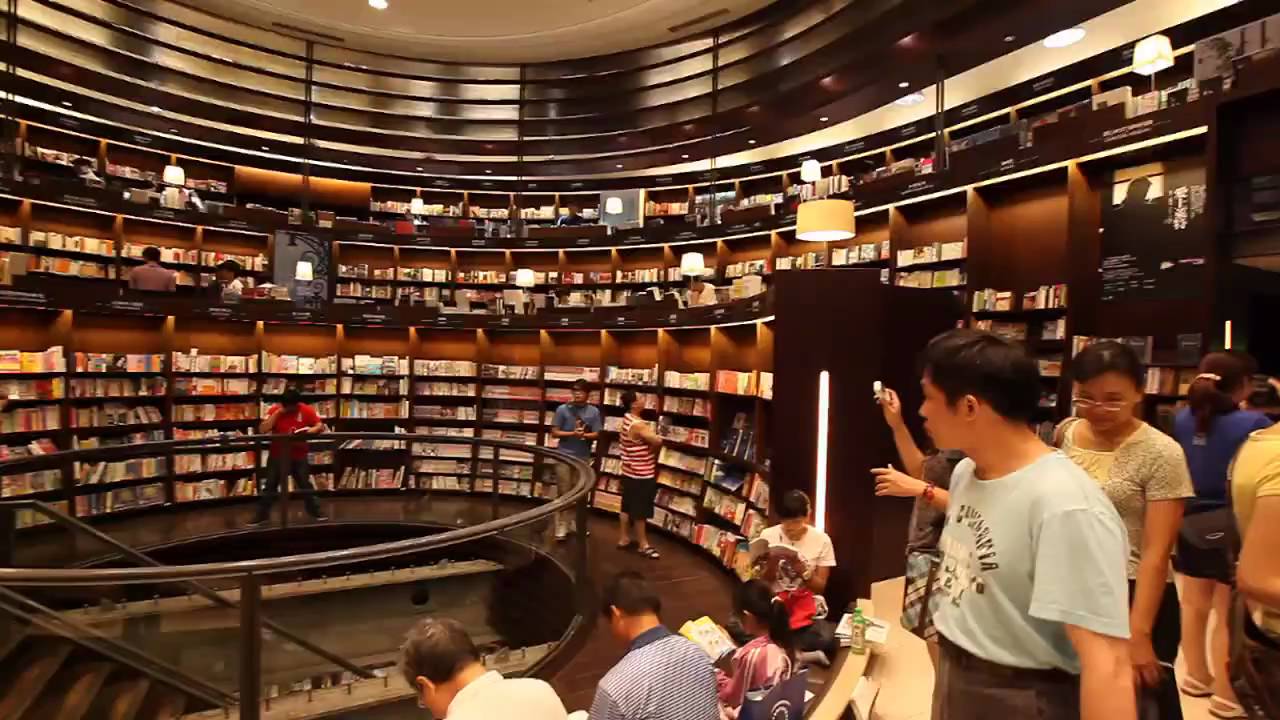
    KL&K Design explored the theme when it was commissioned in 2014 to create a total branding and space concept for Reading Mi bookstore in Shenzhen. Designer Ko Hong, partner in charge of the project, says that bookstores nowadays can’t maintain revenue by just selling books. Hence, he says, Reading Mi is more than just a bookstore but “a multihyphenated lifestyle destination that lends richness to the physical retail experience.” The project is a Golden Pin Design Award 2015 Design Mark recipient.

    Targeting the location’s younger population, the bookstore makes up a third of the 994 square metre space, with the remaining areas allocated to a cultural section, a cafe, and a children’s illustration area.

    “At Reading Mi,” says Ko, “visitors can spend their leisure time poring over books, but also shop for cultural design products, drink coffee, and participate in workshops and seminars.” There’s magic afoot, he adds. “Reading Mi is a place to search for your inner self. The bookstore is the cultural core, everything else spirals around it.”

    The overall layout of the store follows the linear grid of bookshelves, Ko explains. “A cylindrical floor-to-ceiling bookshelf with cushioned seating serves as a focal point. Inspired by the British Museum Library, we wanted to create a noble yet embracing feeling of humanity. We call it ‘the man and book united nook’, which serves as a strong visual DNA as well as a social media photo opportunity (which has proven to be quite successful).”

    By incorporating multiple retail and lifestyle experiences in a single, cohesive space, Reading Mi has considered all ways to attract the customer of today, Ko says. The brand is planning to set up its chain in Guangdong province first and then spread to the rest of China. Its second shop opened in October 2015, and the third is scheduled for May 2016.

    In London, the architect of Foyles’ new flagship, Alex Lifschutz, of Lifschutz Davidson Sandilands, agrees that Foyles was “incredibly brave” to make such an investment in the midst of recession, and at a time when selling books was becoming “extremely difficult”. Focus groups with industry representatives revealed the need to bring immersive qualities in store – events, talks, and music – creating “almost like a book-centred village feel”, he explains.

    Situated in the former home of Central Saint Martin’s College of Art & Design, it was a beautiful building to begin with. “Our design has stripped away a century’s ad hoc accretions to reveal the original structure,” says Lifschutz. By enlarging the existing central lightwell, an atrium brings daylight in. Instead of the labyrinth of old, the new bookshop is devoid of walls – the bookshelves provide the partitions; the books create the journey.

    “The book stack partitions have the natural property of absorbing sound and provide a magical way to juxtapose quiet browsing with different music (jazz and classical, for instance) and film departments, author talks and happenings without walls or doors,” says Lifschutz, “so walking through the store is a much more dynamic and immersive experience.” A new cafe, gallery, jazz record shop and event space allow for in-store events.

    Lifschutz sees an opportunity for booksellers to make a book purchase part of a more meaningful experience – “a glorious meal rather than a snack”. Much like progressive greengrocers have done to counter competition from supermarkets: redesigning stores to present their wares in a more appealing way.

    “None of these things are rocket science – the ingredients of the meal are pretty much the same. It’s whether you can put them together in a way that makes the meal intriguing, fun and tasty,” Lifschutz says. To that end, he adds, architecture “is just one part of the story”.

    “My advice to booksellers is step outside themselves, think about what makes their local environment unique, what is special about their local community and focus on providing a customer experience that cannot be matched by digital bookselling.”

  • Alipay, WeChat drive China Jo-Jo sales

    Alipay, WeChat drive China Jo-Jo sales

    China Jo-Jo Drugstores, the US listed, China-based multichannel pharmaceutical and healthcare retailer, says customers are embracing Tencent’s WeChat and Alibaba’s Alipay to buy its goods from mobile phones.

    In the third quarter, Alipay mobile transactions with China Jo-Jo grew 84 per cent quarter on quarter, while sequential traditional payment transactions such as City Health Insurance payment transactions grew 27 per cent.

    According to research firm Analysys, Alipay and WeChat currently dominate mobile payment in China with 45 per cent and 19 per cent of the market respectively.

    “Integrating these mobile payment platforms is an important growth initiative for China Jo-Jo as consumers in China, especially the young and growing middle-class, have been keen to actively adopt mobile payment as the method of choice for their integrated mobile and physical retail store shopping experience,” the pharmacist said in a statement.

    “Providing customers this convenient and familiar mobile payment platform is helping to drive overall transaction growth in both our retail and online pharmacies.”

    Since launching Alipay’s mobile payment service in November 2014, China Jo-Jo has been initiating novel marketing campaigns including in-store sales and bonus promotions in order to attract and customers while promoting premium branded products. Payment transactions and marketing initiatives under WeChat Payment which launched in July 2015 have also been successful in growing China Jo-Jo’s customer base and overall transactions.

    Chairman and CEO Lei Liu says mobile payment platforms have had immense success in China providing consumers with a fast, secure and novel means of paying for both online and offline pharmacy goods and services that is becoming the standard method for paying for goods and services in China.

    “Mobile payment platforms now account for more and more of China Jo-Jo’s online payment transactions and is playing an integral role in the push to drive adoption of China Jo-Jo’s business model.”

    As of December 31, China Jo-Jo had 59 retail pharmacies in Zhejiang Province, China.

  • World of Beer Asia launch confirmed

    World of Beer Asia launch confirmed

    An American tavern chain known for its craft beer is headed for Asia this year, opening first in Shanghai, then India and The Philippines.

    It is the first overseas bar for World of Beer, based in Tampa, Florida. CEO Paul Avery, a 20-year veteran of the Outback Steakhouse chain, says the move to open franchisee-owned taverns overseas is the next logical step for the brand’s growth.
    “I am very confident that World of Beer will do well in international markets,” he says. “Craft beer is already there, but no-one offers what we do.”
    Avery, 56, bought a controlling interest in the six-year-old company in January 2013, and has built it up to now offer craft cocktails. The footprint is nearly double in size, and most of the taverns serve food. But the focus is squarely on craft beer, reports Tampa Bay Times.
    World of Beer has 77 locations in 19 states in mainland America. Fourteen are company owned, the rest by franchisees.

    Avery says the company will open 35 new restaurants this year, including at least one of the three World of Beer Asia locations.. The goal is to grow the number of company-owned stores to 30 per cent.

  • Singapore-based ecommerce marketing startup raises $1m to enter Indonesia

    Email and digital marketing startup Ematic Solutions has raised a pre-series A round of close to US$1 million, it announced today. The funding comes from MDI Ventures, a venture capital fund backed by Telkom Indonesia, the country’s major telco.

    The pre-series A round comes just two months after Ematic raised its seed round, worth US$1.07 million, led by Wavemaker Partners and joined by 500 Startups and Convergence Ventures.

    The funding will be used to intensify the Singapore-based startup’s quest for regional expansion. Indonesia was already a priority destination for the company, and it expects MDI’s support to help it further along. It has just opened an office in Jakarta, its first outside of Singapore, and is currently recruiting there.

    Ematic’s products include HiIQ, a tool that figures out when is the best time to reach out to which customer, and ByeIQ, a method for encouraging engagement when a user is about to leave your website.

    Indonesia is a particularly attractive market for Ematic given its mammoth market size and ecommerce potential. The numbers are well known; a population of 250 million, the largest in Southeast Asia, with a recent annual GDP increase of five to six percent. A 65.6 percent growth for retail ecommerce in 2015, according to eMarketer. 73 million internet users – the highest number in Southeast Asia.

    singapore-based-ecommerce-marketing-startup-raises-1m-to-enter-indonesia

    “Indonesia has the largest internet population in Southeast Asia, which is set to grow at a blistering pace,” says Ematic founder and CEO Paul Tenney in a statement. “There has been a huge pull for us from regional and local online retailers to be in Indonesia to help these retailers capitalize on this opportunity.”

    Paul explains that the resources provided by MDI Ventures in terms of investment and market insight will help Ematic to quickly expand in the country. Telkom’s 150 million customer base and network is also an attractive prospect for the startup.

    Even in the event that market enthusiasm isn’t completely warranted, there’s enough of an incentive for ecommerce players to strike while the iron’s hot. Ematic, in turn, wants to be there to offer its services to those ecommerce players. It’s already signed up high-profile clients like fashion estore Berrybenka and lifestyle marketplace Bobobobo. Back in December, the company had more than 50 clients in Singapore, Thailand, and Indonesia.

    “Email marketing is the most important channel for digital marketers in Indonesia; we see it contributing between 25 to 35 percent of total sales for the companies we work with,” Paul adds.

    “Our approach allows us to achieve desired long term results and improve all marketing metrics within a short period. But more importantly, our solutions are much more manageable for the small marketing teams that we often see in Southeast Asia.”

  • Retail closures add to Wing Tai woes

    Retail closures add to Wing Tai woes

    Costs related to the closure of retail stores were among the factors contributing to reduced second-quarter earnings for Singapore’s Wing Tai Holdings.

    Store closures caused a 12 per cent rise to S$23.8 million in administrative and other expenses quarter-on-quarter, according to a stock exchange filing by the company.

    Lower rental income and depreciation from its Singapore retail outlets also resulted in a 20 per cent fall in distribution expenses to S$22.2 million from S$27.7 million. No dividend was declared for the quarter.

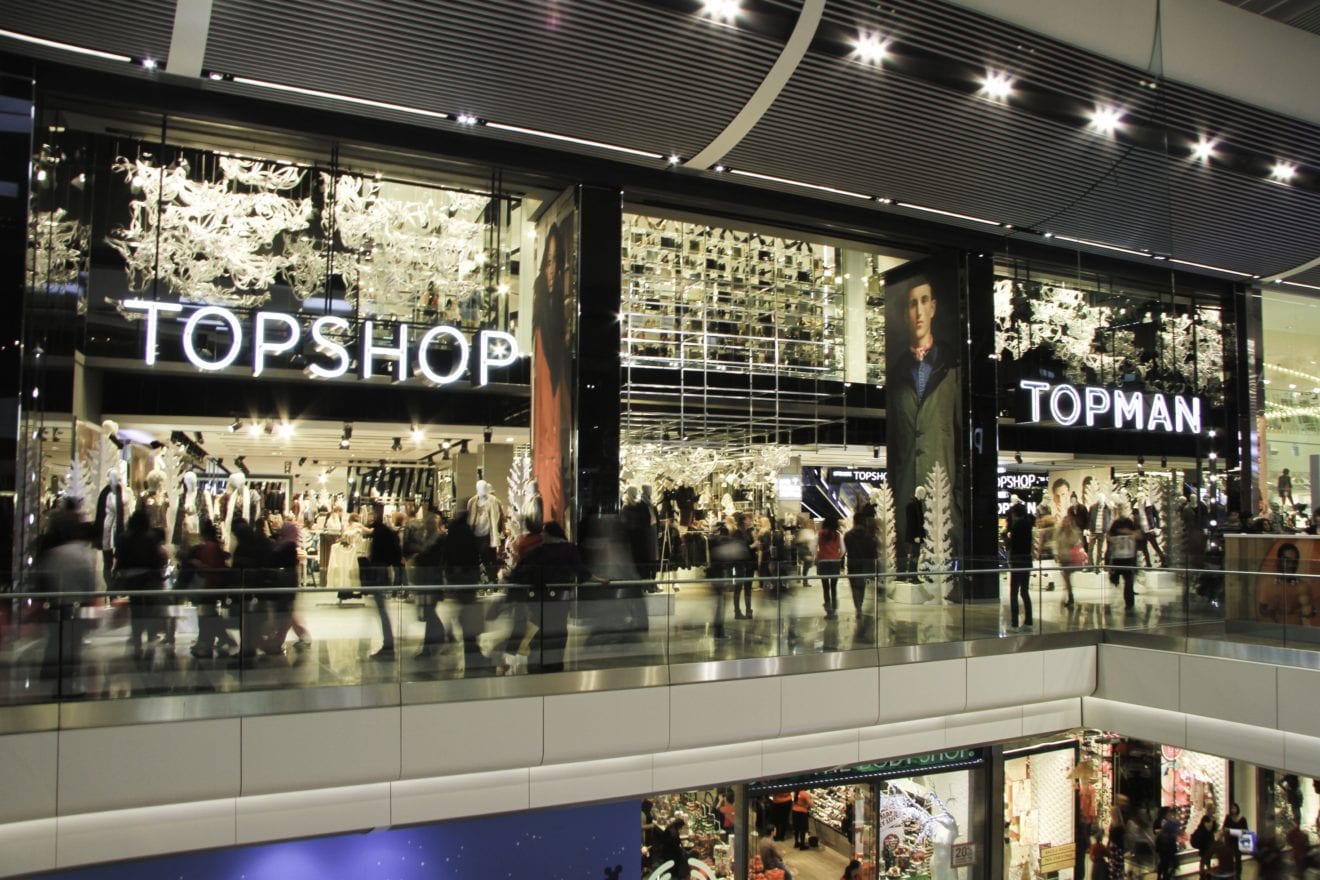
    Wing Tai’s retail division represents the brands Adidas, Fox Kids and Baby, Topshop, BCBGMaxazria, G2000, Topman, Burton Menswear London, I.T., Uniqlo, Dorothy Perkins, Karen Millen, Warehouse, Etam, Pumpkin Patch and Yoshinoya. The company also has hospitality, residential and commercial property interests.

    Also contributing to the second-quarter net profit fall of 85 per cent year-on-year to S$1.08 million were lower contributions from the property development segment and a higher tax rate. These were partially offset by a stronger share of profits from associates/JVs, and lower distribution expenses.

    Overall, the group said earnings had come in below expectations as its operating and sales environment had proved tougher than anticipated. However, it is confident it is well-positioned to ride out the current down-cycle with its portfolio of prime residential and investment assets.

    Cooling measures will continue to weigh on market sentiment in Singapore this year, the group expects, while economic conditions in Malaysia will probably keep sales soft.

  • Korea’s baby market undeterred by economic slowdown

    Korea’s baby market undeterred by economic slowdown

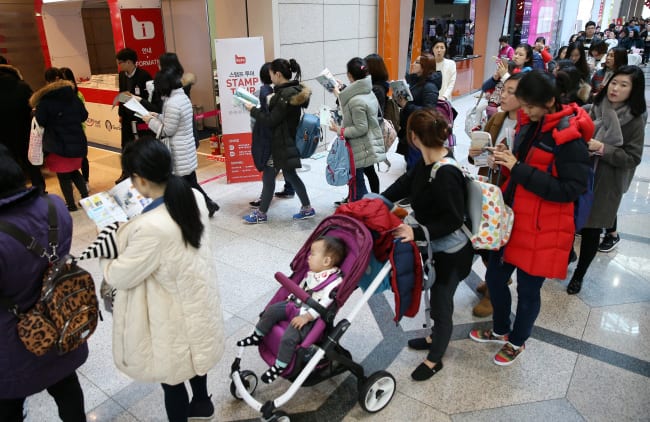
    From couples with babies on strollers to seniors holding toddlers’ hands, a recent annual baby fair held at Coex, in Samseong-dong, southern Seoul, was packed with a sea of Koreans wanting to explore the latest and premium products for their children.

    The three-day event that ended Sunday had about 110,000 visitors, according to organizers, reflecting Korean parents’ unwavering love for their children and their endless interests on the market.

    The market has been thriving in recent years, despite falling birthrates and growing fears over a slowing economy. Korea’s fertility rate is among the lowest in the world. The size of the baby market, however, has been growing rapidly in recent years, and is expected to grow further. The market is now estimated at 1.7 trillion won ($1.38 billion).

    “The number of parents having one kid has been growing. Those parents, even though they might not be able to afford it financially, are more willing to pay for what they believe is necessary for their kids’ well-being,” said an industry watcher.

    Concerns over the economic downturn has led to a growing number of customers looking for quality local products offered at reasonable prices, organizers said.

    Interest, however, still remains high for European products such as strollers priced at around 2 million won and baby chairs offered at nearly 500,000 won each, as young parents are more open to spending money on luxury goods than the older generation, they added.

    A recent Scandinavian fever has also been heating up the market, particularly its luxury segment.

    Parents think highly of Nordic designs and brands that stress safety and cleanliness, according to reports quoting comments from industry insiders. This is why foreign brands have been diversifying retail channels in order to reach out to more customers. They have been making aggressive marketing efforts by expanding their presence in online and mobile markets, they said.

    Another noteworthy trend in the market for baby products is that it is seeing growing spending power among senior consumers.

    According to a recent survey by a daily deals website, sales of baby care products, including diapers and powdered milk, surged the most last year among those in their 60s, followed by customers in their 50s.

    This has led some baby product companies or retailers to closely watch the rise of “urban grannies,” referring to enthusiastic senior consumers purchasing products in a modern way. Some companies have even introduced feeding bottles with numbers printed in larger sizes.

    This is not limited to just the traditional players, such as toy and food companies, the market has seen a growing number of newcomers — such as home appliances and bio companies — targeting parents whose interests go beyond the basic requirements of feeding and changing diapers.

    Coway, a Korean home appliances company, has showcased its latest air purifier that automatically monitors the level of fine dust in the room and transmits the information to users’ smartphones in real time. The smart defect system was devised especially for parents with babies concerned over the impact of worsening dust level in the air to their little ones, the company said.

    At the baby fair, many parents showed interest in smaller gadgets, such as nasal aspirators and digital thermometers manufactured by local companies.

    A crowd of people line up Sunday to enter a baby fair held at Coex in Seoul. (Yonhap)

    “I have come here not only for toy products, but to experience smart gadgets devised for easier baby care,” said Cho Young-eun, a 38-year-old mom with a 2-year-old daughter.

    Bio companies have also been expanding marketing efforts in light of growing health consciousness.

    Local companies like Medipost and Boryung Medience offered services at discounted prices at the fair in a bid to lure parents to invest in their babies’ future health. Both firms operate cord blood banks that store blood cells collected at birth. Cord blood can be used to treat various incurable diseases, including leukemia, later on if needed, the companies said.

  • 2016 Chinese business gets off to a roaring start in Korea

    2016 Chinese business gets off to a roaring start in Korea

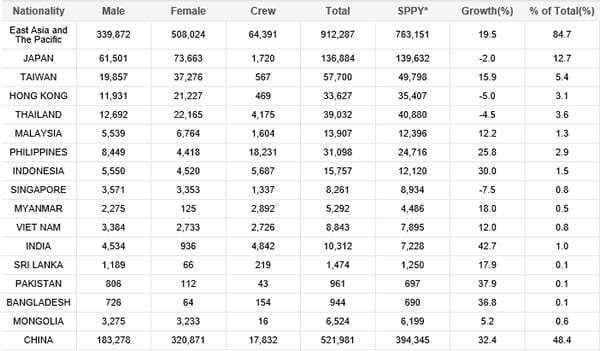
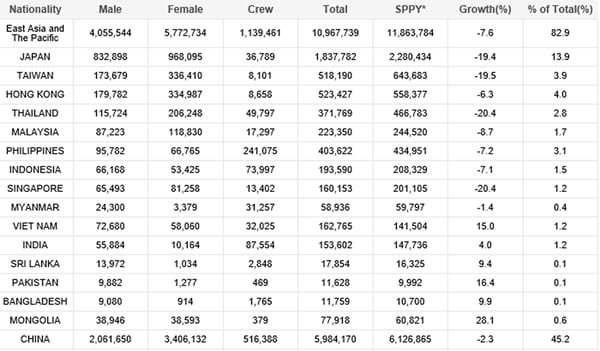
    The Chinese tourism and travel retail business began with a bang in January with arrivals up by +32.4% year-on-year to 521,981, according to Korea Tourism Organization.

    The growth is all the more impressive for coming off a strong base. January 2015 saw a similarly robust +32.9% rise to 394,345.

    Departures by Koreans also rose strongly, up +15.1% in January to 2,112,337, following an impressive +20.1% increase in 2015.

    The January figures will be much welcomed by Korean travel retailers after a difficult 2015 caused by the mid-year MERS crisis. Chinese arrivals dipped by -2.3% last year, a fall driven entirely by the catastrophic slump in tourism from June through August.

    Japanese visitor arrivals remained soft in January, falling -2.0% to 136,884, following a -19.4% fall in 2015.

    For 2015, Chinese visitors accounted for 45.2% of all arrivals, with the once dominant Japanese representing a mere 13.9% share.

    Visitor arrivals by gender for January; Source: Korea Tourism Organization
    Visitor arrivals by purpose and nationality for January; Source: Korea Tourism Organization
    Outbound departures of Korean nationals by gender for January; Source: Korea Tourism Organization
    Visitor arrivals by gender for 2015; Source: Korea Tourism Organization
  • Korean’s Eland To Build Tourism JV With China’s Wanda

    Korean’s Eland To Build Tourism JV With China’s Wanda

    South Korea’s apparel brand Eland recently signed an agreement with China’s Wanda Group to establish a tourism joint venture in South Korea.

    This is reportedly the first cooperating result of the two parties since they signed their leisure industry investment agreement in June 2014.

    According to the agreement, Eland and Wanda will each hold a 50% stake in the tourism JV and they will each account for half of the board of directors. However, Eland will be responsible for the operation of the JV. The two parties are expected to agree on actual processes, including deciding on a corporate name, in March 2016 at the latest.

    A representative from Eland said that by combining Eland’s diversity with Wanda’s online advantage in China, the two parties will achieve better results. Wanda Group operates in various industries such as department stores, hotels, real estate, and tourism in China. By cooperating with Wanda, Eland plans to transfer its major business from fashion to logistics.

  • Online shopping boom in Korea risks mall debt downgrades

    Online shopping boom in Korea risks mall debt downgrades

    South Koreans are spending record amounts shopping with their mobile devices, raising the risk of debt downgrades for retail giants still focused on mall traffic.

    The odds that the nation’s No 1 department store operator, Lotte Shopping Co, will miss debt payments in the coming 12 months doubled to 0.64 per cent from 0.29 per cent a year earlier, according to Bloomberg’s default-risk model that takes into account a company’s finances and stock moves. That suggests it merits a non-investment debt rating. Default risk using the model also climbed for Shinsegae Co, the third-ranked department store operator.

    Moody’s Investors Service and Fitch Ratings have both changed their outlook for Lotte Shopping’s score to negative from stable this month, following a cut in Shinsegae’s outlook to negative by Korea Investors Service last month. The nation’s mobile shopping transactions surged 64 per cent to a record 24.4 trillion won (S$28 billion) last year while sales at department stores dropped for a second straight year, according to Statistics Korea data.

    “We don’t expect a meaningful improvement in Lotte Shopping’s earnings this year,” said Hong Kong- based senior analyst at Moody’s, Wan Hee Yoo.

    Lotte Shopping expects sales in its overseas business to grow this year and it also seeks to increase domestic sales by linking its online and off-line businesses, said its spokesman on Wednesday.

    Shinsegae has been making efforts to reduce its debt ratio since last year, including by selling shares of Samsung Life Insurance Co and issuing perpetual bonds, said its spokesman on Wednesday.

    The spread on Shinsegae’s dollar notes due in 2045 rose to 185 basis points on Feb 23, the highest since its issue in May, showed Bloomberg-compiled data. Lotte Shopping’s 2017 bond spread has fallen 14 basis points this year to 130.

    The nation’s online shopping market is forecast to grow to more than 100 trillion won by 2019, with purchases on mobiles making up about 75 per cent, said Korea Ratings last month, citing Bain & Co’s projection.

    Total transactions on the Internet increased 19 per cent to 53.9 trillion won last year, according to Statistics Korea data.

    South Korea’s smartphone penetration rate is the world’s fourth highest at 83 per cent as of end-March, according to a KT Economics & Management Research Lab report released in July.

  • Indonesia to close down all red-light districts by 2019

    Indonesia to close down all red-light districts by 2019

    Indonesia plans to close down all red-light districts in the country by 2019, media reports said on Wednesday.The plan, under the supervision of the Indonesian Social Affairs Ministry, looks to shutting down a total of 168 such prostitution zones in the country, Efe news agency reported.

    While 68 red-light areas have already been closed down, the remaining will be closed down in the next three years, said Social Affairs Minister Khofifah Indar Parawasan.The ministry offers programmes for the social rehabilitation of women trapped in the sex trade.According to Unicef, 30 percent of sex workers in the country are minors.

    Prostitution is widespread in the Indonesian archipelago, flourishing mainly in big cities such as Jakarta, Surabaya and Bandung and tourist destinations like Bali and Riau, the last being a hub for visitors principally from Singapore.Theoretically, prostitution is legal in the country as it is not classified under any law in Indonesia — however, the police tends to penalise it by including it among offences related to indecency or outrage to public morality.

  • Indonesia to Block Line, WhatsApp, Other Unlicensed OTT Apps

    Indonesia to Block Line, WhatsApp, Other Unlicensed OTT Apps

    The Indonesian government plans to block over-the-top (OTT) applications that fail to meet the state regulation on permanent business entities.

    Rudiantara, Minister of Communication and Informatics, said his department is finalizing a bill related to the obligations of permanent business entities for OTT players operating in Indonesia. The bill is expected to be released in March 2016.

    The minister said the rule will stipulate a transition period for these OTT developers to meet the requirements.

    “The punishment is easy technically, they will be blocked by the cellular carrier,” he said on Wednesday, February 24.

    Rudiantara also said that he does not want these OTT developers to only open branches in Indonesia. Instead he wants them to become an incorporated business entity in the country,

    The OTT players, he said, can also opt to establish a joint venture or form a partnership with local cellular carriers.

    According to Rudiantara, this is the government’s way of protecting Indonesian consumers. The regulation, he said, can also pool in tax potentials that Indonesia are losing since the OTTs are not a legal entity working in Indonesia.

    As an example, he said that in 2015 the value of digital ad revenues from Indonesia stood at US$430 million. “If these ad revenues are imposed a 10-percent income tax, the state could get US$43 million,” he said.

    Some time ago, the Indonesian Telematics Society (Mastel) urged the government to block foreign OTTs that have been operating for quite a long time in Indonesia without contributing anything to the state; only making Indonesia a market to rake in profits.

    Mastel Institute chairman Nonot Harsono projects the growth of foreign OTTs in Indonesia will be more significant, as indicated by the rapid growth of the country’s internet and smartphone users.

    “Most of these OTT players are running their business in Indonesia without licenses; like LINE, Whatsapp, Kakao Talk, Netflix, and plenty of others. They should have filed for a license first if they wish to sell here,” he said.

    Of Indonesia’s 255.5 million citizens, 72.2 million are active internet users. Meanwhile, the number of smartphone users in the country has exceeded the population with 308 million.