Author: Mei Ling Tan

  • Google, Facebook CEOs sign off on illegal ad deal

    Google, Facebook CEOs sign off on illegal ad deal

    Sundar Pichai and  Mark Zuckerberg, the CEOs of Google and Facebook respectively, allegedly signed off a secret and illegal ad deal according to BuzzFeed. As a result, Facebook was given “information, speed, and other advantages” during auctions for ad space run by Google. Yesterday, unredacted court documents revealed the involvement of the two CEOs in the deal.

    The documents are from a complaint originated by Texas and other states in December 2020 that accused Google of committing “false, deceptive, or misleading acts” while running its buy-and-sell auction system for digital ads. The complaint states that Google teamed up with Facebook in 2018 that Google called “Jedi Blue,” a name that riffs on the Star Wars movie franchise.

    Facebook unnerved Google by promoting a method called “header bidding” that was a threat to Google. With “header bidding,” publishers offer inventory to multiple ad exchanges before calling their ad servers. By hiking demand for limited inventory, publishers make more money.

    According to the complaint that was released on Friday, “Google understood the severity of the threat to its position if Facebook were to enter the market and support header bidding. To diffuse this threat, Google made overtures to Facebook.” The deal was made at the highest level of both companies and the complaint notes that “Google CEO Sundar Pichai also personally signed off on the terms of the deal.”

    The complaint also revealed that Facebook CEO Zuckerberg wanted to meet with the company’s COO Sheryl Sandberg before making a decision. While employees’ names were redacted in the court documents, their titles weren’t.

    Both Google and Facebook are under pressure for using anti-competitive methods. Google says that the lawsuit isn’t accurate, and company spokesperson Peter Schottenfels said, “We sign hundreds of agreements every year that don’t require CEO approval, and this was no different. And contrary to AG Paxton’s claims, the fact of this agreement was never a secret — it was well-publicized. It simply enables FAN [Facebook Audience Network] and the advertisers it represents to participate in Open Bidding, just like over 25 other partners do.”

    Facebook’s corporate parent Meta agreed with Google that the deal between the two tech giants did not call for Facebook to receive any particular advantages that other companies were not being given. “Meta’s non-exclusive bidding agreement with Google and the similar agreements we have with other bidding platforms, have helped to increase competition for ad placements,” said Meta spokesperson Stephen Peters. “These business relationships enable Meta to deliver more value to advertisers while fairly compensating publishers, resulting in better outcomes for all.”

    As you might have expected, Google is planning to ask a judge to toss the case. Both Google and Facebook have been under fire from lawmakers for antitrust issues. Last summer, bills were introduced in Congress with lawmakers worried that firms like Google, Facebook, Amazon, and Apple were using their dominance in businesses like online shopping, search, and entertainment in order to crush their competition.

    Additionally, Congress is concerned that these firms are making acquisitions that never should have received approval from antitrust regulatory agencies. As a result, there has been a call in Washington D.C. to force tech giants to break up into smaller companies.

    Last year, the filing fees imposed on transactions valued at over $1 billion rose while the same fees for transactions valued at less than $500,000 would decrease. The idea is to give tech giants the incentive to purchase smaller firms instead of larger ones. In addition, the higher fees are expected to generate $135 million for antitrust enforcement agencies in its first year.

  • Vietnam leads region in power production

    Vietnam leads region in power production

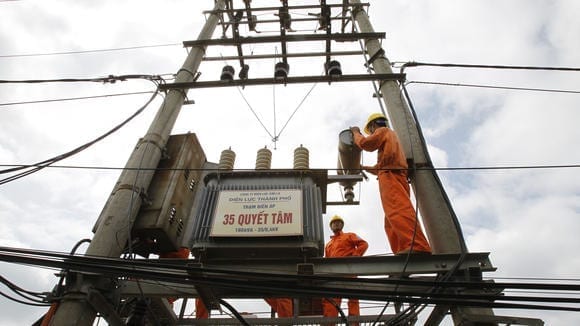
    After adding 3,420 megawatts of power capacity last year, Vietnam now leads Southeast Asia with 76,620 MW.

    It represented a 9.8 percent increase in capacity, CEO of national utility Vietnam Electricity (EVN), Tran Dinh Nhan, said at a forum Friday.

    He however expressed concern that 27 percent of it is from renewable sources and this high ratio is causing difficulties in managing distribution.

    There were times last year when 60 percent of power generation were from renewable energy, but due to plunging demand because social distancing curbs to contain Covid-19, this led to an oversupply of power, he said.

    But EVN has forecast that in June, when temperatures peak, the north could see power shortages while the central and the southern regions might have oversupply.

    It expects power consumption to rise by 7.6 percent this year to 242.4 billion kilowatt-hours.

  • Renault Relatively Confident For 2022 Despite Some Chip Supply Worries

    Renault Relatively Confident For 2022 Despite Some Chip Supply Worries

    Renault is “relatively confident” about its business year but still sees some problems over chips supplies which it expects to be felt mostly in the first half of 2022, the French carmaker’s Chief Executive Officer said on Thursday.

    “We are relatively confident for 2022 but we know that it’s a volatile and uncertain world,” CEO Luca de Meo told journalists at a company event, adding that the carmaker’s restructuring efforts were running ahead of their schedule.

    Shares in Renault edged up after the publication of the comments midday on Wednesday and traded 3.9 % higher at 1231 GMT, topping France’s bluechip CAC40 index which was down 0.55%.

    Renault’s finance chief at the same event said that the carmaker was hoping to pay back as soon as possible the remainder of a 3 billion euros ($3.44 billion) loan backed by the French state, Renault’s biggest shareholder.

    0Comments

    The company also said it would step up the ambitions to shift its core Renault brand towards e-mobility, targeting to produce a “100 % electric” fleet by 2030, from 90% previously announced.

  • Serious Safari bug reveals iPhone, iPad, and Mac users’ personal data

    Serious Safari bug reveals iPhone, iPad, and Mac users’ personal data

    Security firm FingerprintJS published a report on Friday about a bug found in the iOS 15 version of the Safari mobile browser. The report states that this bug “lets any website track your internet activity and even reveal your identity.” A bug found in an Application Programming Interface (API) used and supported by most browsers could be used by attackers to find out many things about you.
    An API is used by programmers to connect parts of the software to other software making it easier to develop programs. One such API, called IndexedDB, is supported by most major browsers and holds what the report calls “a significant amount of data.”

    The bug in the iOS 15, iPadOS 15, and macOS allows random websites to know what other sites a user is visiting on other windows and tabs. That is possible because sites like YouTube, Google Calendar, and Google Keep use “unique user-specific identifiers” in their database names. As a result, authenticated users can be identified as the aforementioned sites create databases that include the  Google User ID belonging to the user, and databases are opened for all the accounts being used.

    The Google User ID leads an attacker to a wealth of personal data. Each one can be used to identify a specific Google account and in combination with Google APIs, it can, at the least, reveal your profile picture to a hacker. It also could help the attacker grab much more personal information and unravel “multiple separate accounts” owned by the same user.

    Unfortunately, learning your personal information doesn’t require you to perform any specific action as the report states “A tab or window that runs in the background and continually queries the IndexedDB API for available databases, can learn what other websites a user visits in real-time. Alternatively, websites can open any website in an iframe or popup window in order to trigger an IndexedDB-based leak for that specific site.”

    FingerprintJS checked with Alexa’s top 1,000 visited sites and found that 30 interact with indexed databases right on their homepage, without any interaction or authentication required by the user. Even if a person is using the private mode in Safari, if he visits multiple websites using the same tab, all databases interacted with are leaked to the sites the user subsequently visits.

    There isn’t much that a Safari user can do if he is running iOS 15 or iPadOS 15. One suggestion is to block all JavaScript by default and only allow it on sites that are 100% trusted. Mac users can switch browsers to escape this bug, but this is not a solution on iOS 15 or iPadOS 15. We should point out that the bug was submitted by FingerprintJS to the WebKit Bug Tracker on November 28, 2021, as bug 233548.

    If you want to check this out on your iPhone or iPad, open Safari and point it at safarileaks.com and follow the simple directions. Quickly (too quickly), the name of the last site you visited appears (if it was one of the sites listed on the Demo page) and your unique Google User ID can be accessed.

    Frankly, the only solution that you have is to wait for Apple to update the iOS and iPadOS software and make sure to install it as soon as it is released. Again, if you’re using a Mac, changing browsers is a valid option although that is not the case with iOS and iPadOS. And keep in mind that users don’t need to perform any specific action in order to set off the bug.

  • HKT’s digital venture arm partners Google Cloud to up customer experience

    HKT’s digital venture arm partners Google Cloud to up customer experience

    HKT’s loyalty program and digital ventures arm – The Club, announces its strategic collaboration with Google Cloud to develop an innovative hyper-personalization platform, named Copernicus, to integrate into The Club’s digital ecosystem across its business pillars. Combining its strong network and database with Google Cloud’s expertise and state-of-the-art technology, The Club aims to provide customers with a uniquely tailored online digital experience.

    Through closely collaborating with many business partners, The Club has long provided its members with truly unprecedented experiences and a variety of premium services, ranging from lifestyle, shopping, travel, insurance, and much more. This time, The Club looks to Copernicus to achieve a more focused and personalized customer experience, leveraging Google Cloud’s expertise in data security and governance, data analytics and data visualization capabilities to deliver products and services geared specifically to each customer’s specific needs.

    The Club’s Data Science team will develop machine learning and AI algorithms to identify customer needs-based products and services by analysing members’ behaviors and preferences, allowing The Club to take further steps towards enhancing consumer experiences with more personalized offerings.

    Specifically, Google Cloud’s advanced data analytics technology empowers The Club to build Copernicus which enables The Club to understand each individual member’s purchasing behavior and interests more precisely and quickly on one unified platform. This in turn allows The Club to deploy more targeted and personalized marketing strategies for reaching individual members across all touchpoints of the customer journey. The Club members will benefit from tailored recommendations that match their interests and needs through their preferred channels.

    Mr. Alan Tsui, CEO of HKT’s loyalty, digital and analytics, said, “We are excited to announce this ground-breaking collaboration with Google Cloud in Copernicus. This enables us to provide the best services and products at the right time for individual members. In recent times, we have adopted data science technology to tailor exclusive rewards to selected members, piquing their already heightened interests. We firmly believe our unique in-house data capabilities, partnered with Google Cloud’s advanced technology, will lay a strong foundation for our digital transformation journey.”

    Copernicus’ machine learning ability is more than just an analysis of The Club’s extensive database. Copernicus will allow The Club to constantly optimize its performance by forecasting customers’ behaviors with prescriptive information, thereby increasing the customer base by identifying and converting the right target audience segments. The Club hopes to connect more partners and customers to The Club ecosystem. With support from this collaboration which combines HKT’s comprehensive networks with Google Cloud’s secure infrastructure and global network, Copernicus will open a whole new world of opportunities for new and existing partners from across different industries and promises enhanced services and unique experiences tailored to each individual member.

  • M1 partners with AWS to improve customer experiences

    M1 partners with AWS to improve customer experiences

    M1 Limited (M1), one of Singapore’s leading Mobile Network Operators (MNO), announced its collaboration with Amazon Web Services (AWS), to launch Maxine, a VoiceBot for M1’s hotlines.

    Maxine is built on Amazon Connect, AWS’s omnichannel cloud-based contact center service that helps improve contact center agent productivity and end-user customer experiences. Powered by AWS Artificial Intelligence (AI) technologies such as automatic speech recognition and natural language understanding, Maxine is able to engage in more lifelike conversations with customers. Combined with M1’s Session Initiation Protocol (SIP) trunk services for high quality digital voice communication, Maxine will help improve end-user customer experiences by engaging them in open-ended conversations instead of menu-driven interfaces.

    Since Maxine’s rollout in the last quarter of 2021, M1 is seeing an improved performance to the existing call system with the VoiceBot performing sophisticated functions such as authentication of callers with a One-Time Pin (OTP), or sharing the customer’s position in the call queue and estimated waiting time. In comparison with December 2020, M1’s Net Promoter Score (NPS) for December 2021 has seen a marked 40% increase, largely attributed to Maxine’s ability to capture callers’ intentions which then improves call agent productivity by freeing them up to focus on more complex cases.

    The deployment of Maxine is part of M1’s continuous transformation journey to be a digital platform. As a cloud native solution, M1 is able to regularly develop and deploy new and incremental features and capabilities that enhance Maxine’s services.

    The easy to use and quick to deploy solution enables M1 to scale up and down in a short period of time. It also provides call center agents the flexibility they need to work remotely, without compromising the customer experience.

    M1 has its 1627 (Bespoke), 1622 (Business) and 1800-843-8288 (Prepaid) hotlines operating on the Amazon Connect platform. This will be progressively rolled out to other hotlines. M1 is also supporting other members of the Keppel Group that are making the transition to adopt Maxine, starting with Keppel Electric.

  • Asos hit by supply chain disruption, volatile Christmas demand

    Asos hit by supply chain disruption, volatile Christmas demand

    British online fashion retailer ASOS reiterated its already downgraded outlook on Thursday after supply chain constraints and volatile demand limited sales growth in its four months to Dec. 31 trading period.

    It posted total sales growth of 5%, following a 22% rise in the year to end August, and said gross margin decreased by 400 basis points to 43.0% driven by a need to discount goods and higher freight costs.

    For the full year it reiterated its outlook of revenue growth in the range of 10%-15% and adjusted profit before tax of 110 million pounds to 140 million pounds. That hit its shares when it was published in October, and would represent a more than 40% drop on the year before.

    “ASOS has delivered a robust start to the year, in line with the guidance we set out at full-year results, despite challenging market conditions,” Chief Operating Officer Mat Dunn said.

    ASOS, once a darling of the stockmarket, was hit by a difficult end to 2021, when it cut its annual profit forecast and parted ways with its CEO following supply chain pressures and a return by shoppers to pre-pandemic ways.

    While shoppers often return partywear clothing and fashion, incurring a cost for the company, they retained the athleisure wear bought during the pandemic to use at home, giving the company a boost to its finances during lockdowns.

    Its shares are down 56% this year, prior to Thursday’s update, mirroring similar falls seen at rival Boohoo which has also been hit by high product return rates, disruption to international deliveries and inbound freight costs.

    ASOS added that it intended to move to the LSE’s main stock market, expected by the end of February.

  • Samsung is first in the world to invent MRAM in-memory computing

    Samsung is first in the world to invent MRAM in-memory computing

    Samsung has long been at the forefront of tech innovation, both when it comes to mobile technology and other electronics. The Korean giant just re-affirmed that fact this week, when they became the first company in the world to demonstrate a working in-memory computing process on MRAM.

    In devices like smartphones and computers, most of the computing processes are performed by the processing chip, which exists just for this purpose and is highly efficient at it—despite additionally being one of the most power-hungry components.

    A device’s memory (or RAM) on the other hand, bears the traditional purpose of temporarily storing bits of information for the processor to access immediately, anytime it asks for it.

    This memory allows for much faster data transfer with the processor than a storage drive, but also comes in much smaller quantities—such as 4GB, 6GB, or 8GB or 16GB depending on your traditional computing device.

    For years now, however, there has been plenty of experimentation with the quest to come up with an efficient and practical in-memory computing solution.

    While many other solutions have already been found using alternative types of RAM (such as PRAM or RRAM), as SamMobile notes, MRAM in-memory computing had not yet been prototyped in working form. At least until now, when Samsung has finally managed to create the first prototype.

    Most of the computing devices we interact with from day to day—namely smartphones and computers—run with DRAM, or Dynamic Random Access Memory, as their main memory.

    This type of memory is dynamic and volatile, meaning it only stores information as long as the device is powered on with a current flowing through, and it needs to be constantly refreshed or overwritten in order to retain that data.

    MRAM, on the other hand—Magnetoresistive Random Access Memory—is a type of non-volatile memory, meaning it can retain bits of data even without an electric current flowing through. It stores memory on magnetic charges, rather than electric charges like standard RAM.

    MRAM’s main advantage is its extremely low power usage, although it has faced difficulties in practical integration in modern everyday technology, such as keeping write error rates adequately low. It is also more hostile to in-memory computing than DRAM because of its low resistance.

    Samsung’s in-house MRAM, built for the first computer to ever use it as its main memory

    The main appeal of in-memory computing as a rule, is that it allows for substantial savings of both time and power. A system that performs at least part of its computing inside the memory, will end up saving all of those milliseconds which it would otherwise take for that data to be requested by the processor, travel to the processor, and be processed there.

    Memory also takes significantly less power than a processing chip—which is responsible for a whole slew of tasks at any given time—which is why a device using in-memory computing will also save on energy.

    Samsung believes that once further developed, MRAM technology will truly shine in processing tasks for artificial intelligence. When tested in AI applications, Samsung demonstrated that its in-memory computing process produced a 93% success rate in picking out specific faces in images, and 98% accuracy in its ability to recognize handwritten numbers.

    One of the main authors of Samsung’s research paper, Dr. Seungchul Jung, made the following statement:

    “In-memory computing draws similarity to the brain in the sense that in the brain, computing also occurs within the network of biological memories, or synapses, the points where neurons touch one another. In fact, while the computing performed by our MRAM network for now has a different purpose from the computing performed by the brain, such solid-state memory network may in the future be used as a platform to mimic the brain by modeling the brain’s synapse connectivity.”

    Samsung hopes that this new invention will be revolutionary in increasing the power efficiency in AI chips more than was ever considered possible before.

  • Tesla To Reveal CyberTruck Production Roadmap On Jan 26

    Tesla To Reveal CyberTruck Production Roadmap On Jan 26

    If 2021 was the year of Tesla scaling its product portfolio across the world, 2022, certainly is the year of the CyberTruck which the world’s most valuable automaker revealed just before the pandemic. During its Q4 2021, earnings call, Elon Musk, its techno king, revealed that there will be a separate briefing for the roadmap of the CyberTruck which the company has said will be delivered to customers starting later this year.

    “Tesla will post its financial results for the fourth quarter and full-year ended December 31, 2021, after market close on Wednesday, January 26, 2022. At that time, Tesla will issue a brief advisory containing a link to the Q4 and full-year 2021 update, which will be available on Tesla’s Investor Relations website. Tesla management will hold a live question and answer webcast that day at 4:30 p.m. Central Time (5:30 p.m. Eastern Time) to discuss the Company’s financial and business results and outlook,” said Tesla in a release.

    Elon Musk has said that he will be attending the product roadmap briefing in the call on January 26. Recently, Tesla had removed the specs of the Cybertruck from its website and now will give an update on the new trims and specs that have evolved over the 2 odd years since its original unveiling. Tesla had also tweaked the design of the car from the original.

    Tesla is also expected to give an update on the Semi electric truck. The semi-truck has already entered low volume production in the Nevada gigafactory.

  • Auto sales down 3 pct in 2021

    Auto sales in Vietnam last year dropped 3 percent from 2020 to 383,444 units as the fourth Covid-19 wave forced dealers to shut down.

    The sales figure is a combination of data from the Vietnam Automobile Manufacturers Association (VAMA), TC Motor, and VinFast.

    VAMA, which includes Truong Hai Auto Corporation (Thaco), Toyota, and Honda, saw 277,203 units sold, down 2 percent from the previous year.

    TC Motor, which distributes Hyundai cars, saw sales declining 13.3 percent to 70,518 units.

    VinFast posted a growth of 21.2 percent to 35,723 units.

    In the third quarter last year, most auto units in the south were shut down as the Delta variant spread.

    But a 50 percent reduction in the registration fee, which came into effect in December and will last until the end of May this year, pushed up sales.

    VAMA members sold 43,526 units in December alone, the highest last year. December was the fourth month in a row that auto sales rose.

    Most media representatives of auto brands in Vietnam expect a recovery in sales this year as the Covid-19 pandemic seems to be under control.

  • Uniqlo owner’s profits boosted by overseas surge as Japan sales fall

    Uniqlo owner’s profits boosted by overseas surge as Japan sales fall

    Japan’s Fast Retailing, owner of clothing brand Uniqlo, said on Thursday overseas markets powered profit growth in the first quarter, even as sales declined at home and in China.

    The results marked a reversal from the past few years when China and Japan were the big sales and profit growth drivers for the retailer.

    Operating profit rose 5.6 percent to 119.4 billion yen ($1.04 billion) in the three months ended Nov. 30. That beat the market’s consensus of 102.6 billion yen, according to the average of analysts’ forecasts from Refinitiv.

    The company maintained its forecast for operating profit to climb 8.4 percent to 270 billion yen in the fiscal year ending in August.

    Uniqlo’s international business reported record first-quarter results, driven by sales from South Asia, North America, and Europe. The pandemic weighed on results in China, while warm weather in Japan depressed sales of Fall and Winter clothes.

    The company said in October it expects a gradual recovery to pre-pandemic levels as Covid-19 vaccinations progress and as it makes further inroads in the Chinese market.

    Fast Retailing opened a flagship store in Beijing in November, its third megastore in mainland China, and plans to open 100 locations in the country each year going forward.

    But the company has also flagged the risk of continued production and logistic delays that have plagued major clothing groups. In September, Fast Retailing said some clothing releases would be delayed due to pandemic-related lockdowns at partner factories in Vietnam.

    In addition, the rapid depreciation of the yen is raising costs for raw materials and shipping, adding to domestic pricing pressure, chief financial officer Takeshi Okazaki told reporters in Tokyo.

    “We have reached a point where we have no choice but to raise the prices of some products,” he said.

    As the company becomes increasingly global, strength or weakness of the yen will become less important, and stable currency markets are ideal for operations, he added.

    Fast Retailing’s shares have fallen 9.5 percent year-to-date, compared with a 1.1 percent drop in the benchmark Nikkei 225 index.

  • ZTE and China Unicom jointly complete PoC of computing power network service scheduling

    ZTE and China Unicom jointly complete PoC of computing power network service scheduling

    ZTE and China Unicom have jointly completed Proof of Concept (PoC) of computing power network service scheduling.  This PoC, based on the SDN+SRv6 Policy framework, achieves flexible scheduling of value-added services across multiple resource pools, and completes integrated scheduling of computing power network. Thus, it provides a basis for further exploration into the application of computing power network and lays foundation for future commercial deployments of computing power network.

    The computing power network is a new focus of the development of the digital economy and intelligent society. By introducing new frameworks and technologies, it implements integrated scheduling of computing, storage and network resources, and optimizes resource utilization and user experiences. Therefore, accelerating the development of the computing power networks has become one of the most important strategies of operators.

    China Unicom proposed the concept of “computing power network brings new value” for the first time at Network 5.0 Summit in June 2019. Taking the transport network based on computing and cloud integration as the basic architecture of CUBE-Net 3.0, China Unicom proposed the “ultimate, elastic, intelligent and simplified” computing power network and aimed to build it as the first computing power “engine” of the digital economy.

    ZTE and China Unicom have been jointly promoting cooperation on computing power network, actively exploring cutting-edge technologies and innovations, and continuously investigating deployment scenarios of computing power network, to achieve a win-win of computing power network.

    At CCSA TC3, ZTE and China Unicom developed the industrial standards of the computing power identification system and led the researches in computing power network DevOps and microservice-based SRv6 computing power network.

    In this PoC, the network value-added service scheduling, based on the computing power status perception, was set as the basic scenario. Virtual value-added services were deployed in multiple resource pools, and streaming media AI reasoning services were used based on the computing power network service orchestration system developed by China Unicom Research Institute.

    In this PoC, the unified scheduling of computing power and network in many specific scenarios, including the initial state, service overlapping, intra-resource pool scheduling, inter-resource pool scheduling and service fallback have been verified via the collaboration of the service orchestration system, network controller, cloud management platform, and computing power gateway, so as to achieve prototype service flow stickiness and find the nearest service provisioning location of computing power network.

    ZTE and China Unicom defined the instantiated scenarios, selected value-added service types, designed service flows, and selected overlapped service types to complete end-to-end service demonstration and acceptance.

    Moving forward, ZTE will make further innovations in collaboration with China Unicom. By virtue of the CUBE-Net 3.0 architecture, ZTE will continue to promote the evolution of networks from basic connections to computing power network integration. Also, ZTE will assist China Unicom in achieving a new computing power network with advanced architecture and high security to deliver high-quality services.

  • Swiss Advance in Central Bank Digital Money Push

    Swiss Advance in Central Bank Digital Money Push

    A group of commercial and public institutions got together to see how tokenized financial assets based on distributed ledger technology work with today’s banking systems.

    A project involving the Swiss National Bank, the Bank for International Settlements (BIS), the Swiss Securities Exchange SIX and five commercial banks to test the integration of a national digital currency into existing back-office systems and processes, was successful, the central bank said in a statement Thursday.

    The banks included in phase II of the project called «Helvetia» were: Citi, Credit Suisse, Goldman Sachs, Hypothekarbank Lenzburg and UBS.

    The central bank expects more financial assets to be tokenized in the future with financial infrastructures to run on distributed ledger technology (DLT), it said, while adding that international regulatory standards suggest that operators of systemically important infrastructures should settle obligations in central bank money whenever practical and available.

    Tests covered a wide range of transactions in Swiss francs – interbank, monetary policy and cross-border, the statement said.

    None of the existing DLT-based platforms are systemic yet, but they may become so in the future, the central bank said, while highlighting the «exploratory nature» of the project.

    To continue fulfilling their mandates of ensuring monetary and financial stability, central banks need to stay on top of technological change, head of the BIS Innovation Hub, Benoît Cœuré, said.

    Project Helvetia allowed the SNB to deepen its understanding of how the safety of central bank money could be extended to tokenized asset markets, Andréa Maechler, member of the Swiss National Bank’s governing Board said.

    While SIX CEO, Jos Dijsselhof, said that the project demonstrated that the SDX platform could support wholesale central bank digital currency (CBDC) for settling tokenized assets end to end.

    Separately the UK government published a report on Thursday, which concluded that there was no convincing case for establishing a central bank digital currency (CBDC) at present.

    While CBDC may provide some advantages, it could present significant challenges for financial stability and the protection of privacy, the report said. It added that the British government had not yet has not yet decided whether to introduce a CBDC.

  • Instagram testing TikTok-like vertical scrolling for Stories

    Instagram testing TikTok-like vertical scrolling for Stories

    Instagram is working on ways it can better rival the crazy popular short-video-sharing platform TikTok, and a redesigned way to show Stories is one of them. The company announced such a feature will be coming back last year, but now, it has finally started appearing to some users for testing.

    The feature was first spotted by social media consultant Matt Navara, and it seems Instagram is currently testing for some users located in Turkey. The update brings vertical scrolling to Stories, and in order to jump to the next user’s Stories, you need to swipe down, just as on TikTok. To view Stories from the same user, you still need to tap the left or right side of the screen.

    Additionally, the update was also received in Brazil, thus making us think that the tested feature has a more global rollout, or it has been expanding to more countries.

    The new feature immediately reminds us of TikTok, and it could as well be interpreted as an attempt by Instagram to better compete with the app with steadily growing popularity. What’s more, Instagram has also been making Stories more focused on video instead of just a simple photo.

    At the moment, it is unclear when this feature will be available to all users, as it is currently in its testing period.

    The feature we reported on above is not the only attempt that Instagram has recently made to better rival video-sharing TikTok.Back in December, Instagram also tested an increased maximum duration limit for videos in Stories. When posting videos in Stories, if they are longer than 15 seconds, they would get segmented into different Stories, and Instagram is currently working on amending this. It has been testing allowing up to 60 seconds of videos in Stories without segmentation.

    And let’s not forget to mention Reels: it is the more obvious TikTok-like feature on the social media platform. Instagram has been pushing for it to gain traction and popularity and is even offering a bonus of up to $10,000 for content creators that post Instagram Reels.

    Reels actually debuted back in 2020, but it hasn’t been gaining as much attention as the rival TikTok, which continues to rank quite high across all metrics of popularity. Recently, TikTok was even crowned as the “most visited website of 2021”, at least in a Cloudflare domain ranking. By the way, TikTok surpassed Google.com in this ranking!

    Nevertheless, that doesn’t stop Instagram-owner Meta to continue developing its services and enriching the user experience with new features. One particularly good feature that Instagram has recently announced and is planning to implement soon is a version of the chronological feed that vanished in 2016. Basically, Instagram will have three different options for your main feed: one dubbed Home (which will be the current one), one dubbed “Favorites”, and one dubbed “Following”. The latter will allow people to scroll through the posts of only the creators they have followed and view them in chronological order.

    For many people that would be quite handy as many users don’t like getting post recommendations from people that they don’t follow in their feed instead of the content of people they like and want to see more of.

    Another recent feature that Instagram is working on is called “Edit Grid”, and it will allow you to arrange the posts in your profile to your liking, regardless of the date the photo was published.

    Of course, all these features are currently in testing or under development and an official global release date has not been specified.

  • Apple to change App Store prices in some regions

    Apple to change App Store prices in some regions

    Apple is bumping up prices in the App Store in some regions, the company announced on Wednesday. Citing taxes and foreign exchange rate changes, Apple says that apps will become more expensive in the following regions:

    • Bahrain: Increase of value-added tax from 5% to 10%
    • Ukraine: New value-added tax of 20%
    • Zimbabwe: New digital services tax of 5%

    Furthermore, there are some changes that involve the proceeds for developers. Prices will remain unchanged in the following regions but developers’ proceeds will be adjusted to account for some tax changes

    • The Bahamas: Decrease of value-added tax from 12% to 10%
    • Oman: New value-added tax of 5%
    • Tajikistan: Decrease of value-added tax from 18% to 15%

    Finally, three other regions will be subject to changes, again this involves the proceeds that developers receive from the App Store.

    • Austria: Value-added tax rate reversion to 10% after temporary decrease to 5% for qualifying e-books and audiobooks
    • Latvia: Value-added tax rate decrease from 21% to 5% for qualifying e-books and e-publications
    • Romania: Value-added tax rate decrease from 19% to 5% for qualifying e-books, audiobooks, and e-publications

    What does it mean for you?

    If you live outside the aforementioned regions – absolutely nothing. Otherwise, expect prices of apps to go up if you live in Ukraine, Bahrain, or Zimbabwe. As for the other six countries, it would be up to the developers.

    Some might choose to bump up the prices in order to keep the same level of proceeds from the App Store, while others might leave their app prices alone. Apple leaves the choice to the developers with the following statement:

    “You can change the price of your apps and in-app purchases (including auto-renewable subscriptions) at any time in App Store Connect. If you offer subscriptions, you can choose to preserve prices for existing subscribers.”

    The changes are expected to go into effect in the following days. When this happens, the Pricing and Availability section of My Apps will also be updated.