Category: Automotive

Retail News Asia is committed to providing both local and global retailers with the latest Auto and Car news throughout the Asian market. This on a daily base.

  • India To Order Taxi Aggregators Like Uber, Ola To Go Electric By 2026

    India To Order Taxi Aggregators Like Uber, Ola To Go Electric By 2026

    India plans to order taxi aggregators like Uber and Ola to convert 40% of their fleet of cars to electric by April 2026, according to a source and records of government meetings to discuss new rules for clean mobility. Uber and Ola, both backed by Softbank Group, would need to start converting their fleet as early as next year to achieve 2.5% electrification by 2021, 5% by 2022, 10% by 2023 before hiking it to 40%, according to the person and the records that have been reviewed by Reuters.

    Some taxi players, like Ola, have previously tried to operate electric cars in the country, but with little success given inadequate infrastructure and high costs.

    New Delhi, however, is looking to push the new policy to boost the adoption of electric vehicles (EVs) as it tries to bring down its oil imports and curb pollution so it can meet its commitment as part of the 2015 Paris climate change treaty.

    Indian think-tank Niti Aayog, chaired by Prime Minister Narendra Modi and which plays a crucial role in policymaking, is working with several ministries on the new policy.

    Neighbouring China, home to the world’s top auto market, is already leading the world in electrification by setting tough EV sales targets for car makers and offering incentives to taxi operators to increase their fleet of clean-fuel cars.

    EV sales in India grew three-fold to 3,600 in the year ended March but still account for about 0.1% of the 3.3 million diesel and gasoline cars sold in the country over the period, industry data showed. China’s electric car sales, meanwhile, rose 62% in 2018 to 1.3 million vehicles.

    In a meeting in New Delhi on May 28, Niti Aayog officials and the ministries of road transport, power, renewable energy and steel, as well as the departments of heavy industries and trade, were among those recommending taxi operators in India gradually convert to electric.

    Motorcycles and scooters sold for commercial purposes, like food delivery or for use by e-commerce companies, will also need to be electric from April 2023, the person added.

    India has seen a boom in food delivery apps like Zomato and Swiggy, which counts Naspers and Tencent as investors. Sales by e-commerce firms like Amazon.com and Walmart-owned Flipkart are also rising.

    The EV proposal comes weeks after the inter-ministerial committee recommended electrifying most motorbikes and scooters for private use and all three-wheeled autorickshaws within the next six to eight years.

    While there are several electric scooter manufacturers in the country including Ather Energy, Hero Electric and Okinawa, there are only two car makers that build and sell electric cars – Mahindra & Mahindra and Tata Motors.

    Some taxi operators have so far had little success operating electric cars in India. Ola launched a pilot project in the central Indian city of Nagpur in 2017 but a year later drivers, unhappy with long wait times at charging stations and high operating expenses, wanted to return to gasoline cars.

    Ola, however, is not giving up yet.

    Its Ola Electric Mobility unit in March raised 4 billion rupees ($58 million) from investors including venture capital fund Tiger Global and Matrix Partners.

    It also raised $300 million from Hyundai Motor and Kia Motors and formed a strategic partnership with the South Korean duo to help build India-specific EVs.

    Modi’s government in 2017 had set an ambitious target to electrify new cars and utility vehicles by 2030 but resistance from the industry forced it to scale back the plan.

  • Michelin’s Airless Wheel Which Does Not Puncture To Enter Production By 2024

    Michelin’s Airless Wheel Which Does Not Puncture To Enter Production By 2024

    Michelin and General Motors presented a new generation of airless wheel technology for passenger vehicles. It’s called the Uptis Prototype (or “Unique Punctureproof Tyre System”) – at the Movin’On Summit for sustainable mobility. The joint research agreement will see both the companies validate the Uptis Prototype with the goal of introducing the Uptis on passenger models as early as 2024. Michelin and GM are testing the Uptis Prototype, beginning with vehicles like the Chevrolet Bolt EV. Later this year, the companies will initiate real-world testing of Uptis on a test fleet of Bolt EV vehicles in Michigan.

    Michelin has been working at making airless tyres for the past five years now. The company showcased the Tweel concept in 2014 and an investment of $50 million has gone into the new plant for making it ready for commercial usage. The Uptis is a version of this and is airless. It completely eliminates the risk of flat tyres and blowouts.

    Florent Menegaux, chief executive officer for Michelin Group said, “Uptis demonstrates that Michelin’s vision for a future of sustainable mobility is clearly an achievable dream. Through work with strategic partners like GM, who share our ambitions for transforming mobility, we can seize the future today.”

    The Uptis Prototype is re-engineered for today’s passenger vehicles, and it is also well suited to emerging forms of mobility. The vehicles and fleets of tomorrow – whether autonomous, all electric, shared service or other applications – will demand near-zero maintenance from the tire to maximize their operating capabilities.

    The Uptis features a different architecture and composite materials, which enables the tyre to bear the car’s weight at road-going speeds. Approximately 200 million tyres worldwide are scrapped prematurely every year as a result of punctures, damage from road hazards or improper air pressure that causes uneven wear. These advancements through the Uptis Prototype demonstrate Michelin’s and GM’s shared commitment to delivering safer, more sustainable mobility solutions. Of course these tyres will be pricey but we wait to see how these tyres fair on production cars.

  • France Ready To Cut Renault Stake To Shore Up Nissan Partnership

    France Ready To Cut Renault Stake To Shore Up Nissan Partnership

    France is ready to consider cutting its stake in Renault in the interests of consolidating the automaker’s alliance with Nissan, Finance Minister Bruno Le Maire said Saturday. He was speaking in Japan after Italian-US carmaker Fiat Chrysler pulled the plug on its proposed merger with Renault, saying negotiations had become “unreasonable” due to political resistance in Paris.

    In an interview with AFP on the sidelines of the G20 finance ministers meeting in Japan, Le Maire said Paris might consider reducing the state’s 15-percent stake in Renault if it led to a “more solid” alliance between the Japanese and French firms.

    “We can reduce the state’s stake in Renault’s capital. This is not a problem as long as, at the end of the process, we have a more solid auto sector and a more solid alliance between the two great car manufacturers Nissan and Renault,” he told AFP.

    Last week, FCA stunned the auto world with a proposed “merger of equals” with Renault that would — together with Renault’s Japanese partners Nissan and Mitsubishi Motors — create a car giant spanning the globe.

    The combined group would have been by far the world’s biggest, with total sales of some 15 million vehicles, compared to both Volkswagen and Toyota, which sell around 10.6 million apiece.

    But the deal collapsed suddenly on Thursday, with FCA laying the blame at the door of Paris.

    “It has become clear that the political conditions in France do not currently exist for such a combination to proceed successfully,” FCA said in a statement.

    Le Maire said Renault should concentrate on forging closer ties with its Japanese partner Nissan before seeking other alliances.

    Things need to be done “in the right order…. First the alliance (between Nissan and Renault) should be consolidated and then consolidation (more generally) and not one before the other.”

    “Otherwise, everything risks collapsing like a house of cards,” he warned.

    The minister said it would be up to the bosses of Renault and Nissan to decide how to push the alliance forward as ties between the two firms have been strained after the shock arrest of former boss Carlos Ghosn.

    Renault is pushing for a full merger between the pair but there is deep scepticism of the plan at Nissan.

  • Mini Cooper SE Electric Teased Towing An Aircraft

    Mini Cooper SE Electric Teased Towing An Aircraft

    The Mini Electric will soon be launched internationally but of course, the teasers have started to fall in place. The recent ‘testing programme’ for the first purely electrically powered MINI was an unconventional one. The company chose Frankfurt airport as its venue and a close-to-series prototype of the new model demonstrated just what electromobility in the style of MINI is capable of setting in motion. The Mini Cooper SE slipped straight into the role of an aircraft tug, setting off to the loading point towing a Boeing 777F freight aircraft with an unladen weight of some 150 tons. The unusual hook-up was filmed in a video clip. Created collaboratively by the BMW Group and Lufthansa Cargo, the 45-second commercial shows the Mini Cooper SE as a ‘muscle car’ pulling the significantly larger and heavier transport aircraft across the airfield.

    The MINI Cooper SE will go into serial production at the British plant in Oxford as of November 2019. It is based on the Mini 3 door and combines locally emissions-free driving with the brand’s characteristic go-kart feeling, premium quality and expressive design. After the BMW i3 it is the second purely electrically powered model within the company’s premium automobile portfolio. Helping the Mini Cooper SE perform its muscle car role, the performance characteristics of the electric motor combine spontaneous power delivery with a high level of torque available directly from standing.

    Although the company has not revealed any details for the electric mini, the iconic car maintains its traditional design while also keeping up with the future. According to the company, the electric concept brings ‘the iconic design, city-dwelling heritage, and customary go-kart feeling’ into the modern motoring era. Up front, the closed-off grille and simulated air intakes remind that this is an electric car. There are no exhaust outlets, but a tweaked rear clip with a rear diffuser giving the car a muscular look. The bolt-on side panels are made of fiberglass in order to keep the overall weight of the car under check. MINI EV Concept gets LED taillamps that make an interesting Union Jack pattern.

  • New Bentley Flying Spur To Be Unveiled This Month

    New Bentley Flying Spur To Be Unveiled This Month

    The third-generation 2020 Bentley Flying Spur Grand Touring Sedan is all set to make its global debut this month, on June 11, 2019. This year also marks the 100-year-anniversary of the British luxury carmaker, which calls the new-gen Bentley Flying Spur a combination of a sports sedan and luxury limousine. Among its key highlight, the new 2020 Flying Spur will be the very first Bentley to get an All-Wheel Steering, enhancing both stability at cruising speeds and agility.

    Bentley says that similar to the recently launched Continental GT, the all-new Flying Spur is also a ground-up development that offers superior technology and craftsmanship to deliver high levels of performance and refinement. In fact, the four-door sport sedan will come with the same 6.0-litre twin-turbo W12 engine that powers the new Continental GT. The motor is tuned to churn out a massive 625 bhp and develops a monstrous 897 Nm of torque. Having said that, Bentley is expected to a couple more engine options later in the future – a smaller 4.0-liter twin-turbo V8 that makes 542 bhp and 770 Nm torque, along with a 2.9-litre V6 plug-in hybrid engine as well.

    In addition to the all-wheel steering, the new Bentley Flying Spur will also get an updated All-Wheel Drive system. Interestingly, the new AWD has been designed to supply power only to the rear wheels in standard road conditions, thus offering the classic sports sedan handling characteristics. However, if the system detects any kind of slip, it’s capable of instantly sending power to the front wheels providing active All-Wheel Drive, fully automatically. This is the first time that Bentley has introduced such an AWD system for the first time.

    Furthermore, for superior ride and comfort, the new Flying Spur now also comes with a new suspension setup that allows you to change the stiffness setting on demand to combat cornering forces and minimise body roll. However, other technical specifications and details will be revealed at the time of the official unveiling.

  • Mercedes-Benz GLB All Set To Make Its World Debut

    Mercedes-Benz GLB All Set To Make Its World Debut

    Mercedes-Benz has dropped a teaser of its upcoming GLB and it’s all set to make it’s world debut on June 10, 2019. The GLB, as the name suggests is based on the B-Class and is built on the MFA2 platform, which underpins the latter. It will be positioned between the GLA and the GLC models. Spy shots of the car give us a peek into what the GLB will look like and the teaser confirms much of these details. The size shows that the GLB is likely to be a 7 seater model and it’s a far cry from being a baby G-Class as it was rumoured to be. The long hood, short overhangs, and the boxy rear end all point out to a GLB being a bigger SUV.

    The upcoming Mercedes-Benz GLB is expected to be a family car like the B-Class so expect a spacious five-seater cabin with a large boot space, possibly above 500 litres. It’s said that Mercedes might even consider offering an optional third row in certain markets. In terms of design and styling for the cabin, we expect the GLB to take inspiration from the new-gen A-Class’ cabin, which was revealed last year.

    Engine options are still not confirmed but, we expect the Mercedes-Benz GLB to get the same engine options as the new A-Class. It could also get the new engines that have been developed in partnership with the Renault-Nissan alliance. The GLB is also expected to get a new electronically controlled four-wheel drive system, but can only confirm that when the SUV make its official debut.

  • A New Maruti Suzuki Dzire Is Sold In India Every 2 Minutes

    A New Maruti Suzuki Dzire Is Sold In India Every 2 Minutes

    Maruti Suzuki has been selling the Dzire compact sedan in India for over 10 years now and till now has reached around 19 lakh customers. The Dzire, now, is a subcompact sedan but Maruti Suzuki has had a compact sedan iteration before and the number of customers it has reached to is a combination of sales of both these cars. In 2018-19, Maruti Suzuki sold over 2.5 lakh units of the Dzire subcompact sedan averaging a monthly sales of 21,000 units. There’s no doubt it leads the pack in the segment and boasts of a market share of 55 per cent, while the Amaze is a distant second.

    Shashank Srivastava, Executive Director (Marketing & Sales), Maruti Suzuki India Limited said: “The brand Dzire has been a major contributor to Maruti Suzuki’s journey and we express our gratitude to customers. With the launch of Dzire, we created a new ‘compact sedan’ segment. This segment is continuously evolving and growing. Over the years, Maruti Suzuki Dzire has led this growth and it continues to be relevant and attractive to customers. A testimony to its strong customer connect is that the sales of third generation Dzire went up by nearly 20%.”

    The automatic variant of the Dzire too has received significant success with close to 13 per cent buyers opting for the AMT version. The Maruti Dzire is offered in a 1.2-litre petrol and a 1.3-litre diesel engine along with automated manual transmission or AMT offered on both models. The petrol engine makes 82 bhp and 113 Nm of peak torque while the diesel engine makes 74 bhp and 190 Nm of peak torque. The petrol model has a claimed mileage of 22 kmpl while the diesel Dzire has a claimed mileage of 28 kmpl.

  • Jaguar XE SV Project 8 Touring Breaks Cover

    Jaguar XE SV Project 8 Touring Breaks Cover

    Trust Jaguar’s Special Vehicle Operations (SVO) division to come with some absolutely menacing offerings and it sure doesn’t disappoint. This time though, the special division has developed a more restrained version of the absolutely bonkers XE SV Project 8 that adds the Touring badge to its name and gets revised to more road-friendly mannerisms. The Jaguar XE SV Project 8 Touring swaps the imposing rear wing for a subtle spoiler that lends a calm look to the 599 bhp car’s track-focussed capabilities. The new Touring version will be sold alongside the Project 8 and much like its track-honed sibling.

    Speaking about the new Jaguar XE SV Project 8 Touring, Jamal Hameedi, Engineering Director, Jaguar Special Vehicle Operations, said, “Project 8 has received outstanding critical acclaim since its launch, demonstrating the Special Vehicle Operations team’s ability to create a compact Jaguar sedan with supercar-rivalling performance. Touring specification extends the appeal of Project 8 to performance car enthusiasts and collectors who prefer a more discreet appearance, without compromising its driver-focused on-road dynamics.”

    So what changes on the Jaguar XE SV Project 8 Touring, the adjustable carbon-fibre rear wing that generates over 122 kg of downforce at 300 kmph and has been swapped for a lip spoiler on the boot-lid. The Touring also has a fixed front splitter to “maintain aerodynamic balance,” even as all other aspects remain the same. The special version based on the XE sedan is offered in four colour options – British Racing Green, Corris Grey Satin, Valencia Orange, and Velocity Blue – while the standard Project 8’s decals and stripes are now offered as optional. The big change though comes in the top speed of the car that has been reduced from 320 kmph on the Project 8 to 300 kmph on the Project 8 Touring.

    Power continues to come from the same 5.0-litre Supercharged V8 Project 8 motor that can accelerate from 0-100 kmph in 3.7 seconds. The Special Vehicle Operations division will hand assemble only 15 examples on the XE SV Project 8 Touring exclusively in the four-seat configuration at the Technical Centre in Warwickshire, UK. The 15 cars of the Touring version are part of the 300 units that were originally announced for the Project 8 and is priced at the same $185,495

  • Hella Develops Battery Solutions For Mild Hybrid Vehicles

    Hella Develops Battery Solutions For Mild Hybrid Vehicles

    Hella announced that it will develop and manufacture products that support all stages of automotive electrification. With new products like dual voltage battery management system and powerpack 48 Volt, the company is now one of the first on the market to offer innovative battery module solutions for mild hybrid vehicles. The new solutions enable savings of 5 to 6 grams of CO2 per kilometer and thus help to achieve CO2 targets in the short term.

    Starting 2020, newly registered vehicles in the EU will not be allowed to exceed a limit value of 95 grams of CO2 per kilometer. Hella’s dual voltage battery management system for the compact and mid-range class allows vehicles with internal combustion engines to be converted to a mild hybrid. It combines the conventional separate core elements such as 48 V battery, 12 V battery and voltage transformer (DC-DC converter) within a single product in the package space of a conventional lead-acid battery. This makes it easy to integrate the system into the existing vehicle architecture. Another advantage: The Dual Voltage Battery Management System eliminates the need for a lead-acid battery in the car. The innovative system consists of lithium-ion cells that are switched intelligently depending on the application. Thus the capacity can be used specifically in the 12-volt or 48-volt vehicle electrical system.

    Hella has designed the PowerPack 48 Volt for vehicles in higher power rating classes. It combines a 48-volt lithium-ion battery pack including battery management and DC-DC converter. In addition to the 12-volt battery, the PowerPack 48 is also drawn into the vehicle. It enables hybrid functions such as recuperation (ability to recover energy while braking) or active coasting (the internal combustion engine is switched off while driving) as well as other comfort functions for the luxury class. These include ambient lighting, automatic climate control and active chassis control.

  • Land Rover Discovery Launched In India

    Land Rover Discovery Launched In India

    Jaguar Land Rover India has launched the 2-liter diesel variant of the 2019 Land Rover Discovery in India and prices start from ₹ 75.18 lakh (ex-showroom India). The 2019 Discovery is available in S, SE, HSE & HSE Luxury trim, The new diesel engine churns out 237 bhp while torque figures stand at 500 Nm. This advanced engine is the first Jaguar Land Rover powerplant to feature series sequential turbo technology to deliver its additional thrust.

    The 7 seater Discovery is feature rich and comes with features like electrically reclining seats, intelligent Seat Fold, four-zone climate control, powered third-row seats, a panoramic sunroof, cabin air ionization, 360 Degree surround camera, adaptive cruise control, protect and remote. It also gets the best in class off-road capability because of the approach and departure angle as also the ramp angle.

    The Land Rover Discovery has a water wading depth capability of 900 mm and a 3500 kg towing capacity, all of which makes it a very capable and versatile SUV.

    Rohit Suri, President & Managing Director, Jaguar Land Rover India Ltd. (JLRIL), said, “The Discovery’s unmatched capability and versatility has now been enhanced with the introduction of the high powered Ingenium diesel variant at an attractive price that we believe will enable the Discovery to appeal to a wider customer base.”

  • BMW Motorrad Files Patent For Electric Front Wheel Drive

    BMW Motorrad Files Patent For Electric Front Wheel Drive

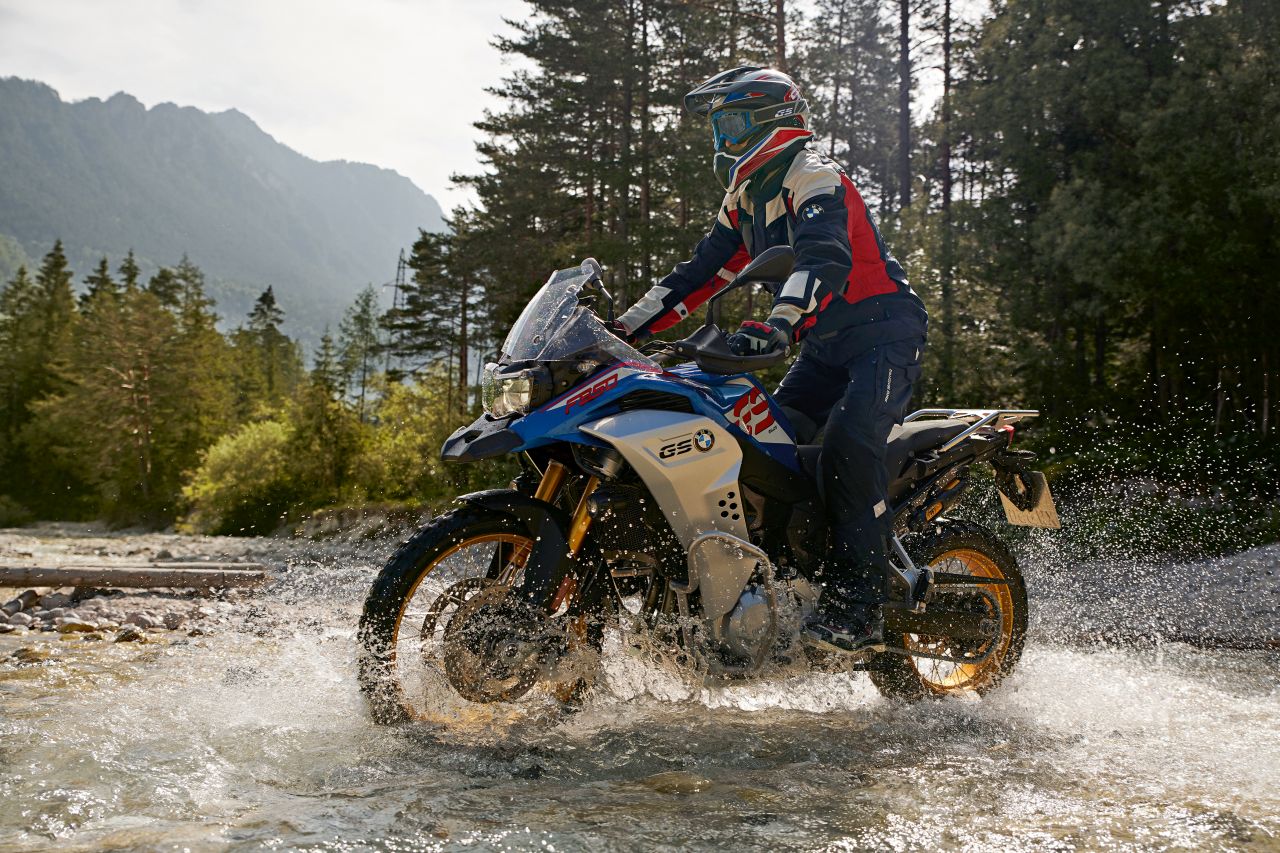
    BMW Motorrad has filed patents for an electrically-driven front wheel that is likely to be featured in future generation adventure bikes. The patent drawings are ostensibly of an electric front wheel drive system, which will be able to supply drive force in combination with the conventional rear-wheel drive on motorcycles. The drawings show what is an all-in-one unit mounted around a front wheel hub, which will offer drive to the front wheel when needed in particularly steep inclines or slippery surfaces. The system isn’t a full-time two-wheel drive, but can be engaged only when the rider wishes to use it.

    The accompanying patent description does not say much about how it works, or what goes behind the front wheel drive concept, but BMW Motorrad states that it can be applied to motorcycles, as well as other vehicles, including three-wheelers and four-wheel vehicles. A patent application doesn’t always mean that such technologies will be introduced, or neither are these a sure-shot guarantee that BMW Motorrad will in fact introduce an electric two-wheel drive system.

    In fact, more than two years ago, there were reports of BMW Motorrad’s all-wheel drive system as well, on what was to be the world’s first series-production all-wheel drive travel enduro motorcycle with hybrid drive. Called the xDrive Hybrid, that system is similar to the one filed in the new patent application, but two years hence, it is yet to see something of a production form.

    If BMW Motorrad is indeed working on such an all-wheel drive system for motorcycles, with an electric front-wheel drive system, two years is a long time to be working on it, and about time we saw something, at least in concept form. Our guess is, something may be shown at the EICMA show in Milan, in November this year. But then again, who knows? Either ways, it will be interesting to see what the next generation motorcycle technology will be showcased at the world’s most popular motorcycle show in November 2019.

  • Official Designs Reveal Aprilia RS 660

    Official Designs Reveal Aprilia RS 660

    The Supersport class may not be getting much interest from consumers, across all brands, but now Aprilia seems intent to introduce a new 660 cc motorcycle, the Aprilia RS 660, which was showcased as a concept at the EICMA 2018 show in Milan, Italy, last year. Aprilia has revealed production drawings of the RS 660. From the concept showcased at the EICMA show, the design is nearly identical, but a closer look reveals that the production drawings show reveals that almost every body panel has been completely redesigned.

    The powerplant and other elements though remain the same as the concept, including the 660 cc, parallel-twin engine. The bike’s fairing has undergone some changes in design on the production drawings, with reshaped side panels as well as some changes in the cycle parts. The production design reveals the bike will sport Sachs suspension and Brembo Monoblocs, while the concept featured Ohlins suspension and Brembo Systema calipers. A top-spec production variant could also feature the Ohlins and Systema hardware which could be introduced at a later stage once Aprilia introduced the production model of the RS 660. The wheel design is also different on the production drawings.

    The triple clamp on the steering is a straight lift from the Aprilia RSV4, while the clip-on handlebars have a less aggressive riding position – placed higher and are significantly straighter than the ones shown on the concept. The swingarm seems to be completely new, but the single seat design has remained the same on the production model. We expect the production-spec Aprilia RS 660 to be showcased at this year’s EICMA 2019 show in November.

  • Sahara Group To Sell Electric Vehicles Under New Brand Sahara Evols

    Sahara Group To Sell Electric Vehicles Under New Brand Sahara Evols

    Sahara Group has recently announced its plan to foray into the electric vehicle business under a new brand name ‘Sahara Evols’. This is the first time the the company is entering the automobile sector, and under the new Sahara Evols brand, the company will offer a range of electric vehicles (EVs) along with advanced allied services. Sahara Evols electric vehicle portfolio will include everything from electric scooters and motorcycles to electric three-wheelers and cargo vehicles. It is introducing a network of battery charging-cum-swapping stations.

    Sahara India Pariwar Chairman Subrata Roy said, “We are proud to introduce for the first time, a complete ecosystem of electric vehicles in India. Sustainable and environment-friendly modes of transportation are the need of the time. The Sahara Evols range of electric vehicles is going to be our contribution…towards alternative, sustainable and eco-friendly modes of transportation.”

    The company has already gone live with its official website, which currently lists two electric scooters – Classic and JMT 1000, and an electric three-wheeler named Veera. The website also confirms the imminent arrival of two new electric motorcycles – Whiz ES, and Whiz SE, however, currently no other details are available about them. As for the Scooters, both Sahara Evols Classic and JMT 1000, offer a maximum range of 75 km on a full charge, and a top-speed of 55 kmph. The e-rickshaw Veera on the other hand offers a range of 145 km and it comes with a Driver+4 passenger setup.

    The vehicles are powered by dry lithium-ion batteries. The cost of driving Sahara Evols Electric Vehicles in an average can go as low as 20 paise per kilometer against the cost of ₹ 2 per kilometer on petrol vehicles, thus entailing direct and substantial economic benefits to the users.

    Starting with Lucknow, Sahara Evols will establish its ecosystem in the country’s tier-II and III cities by the end of this financial year, in a phased manner. Subsequently, in the next financial year, it will roll out its products and services pan-India.

  • Piaggio India Launches Vespa Urban Club 125 In India

    Piaggio India Launches Vespa Urban Club 125 In India

    Piaggio India has announced the launch of its new 125 cc scooter range, the Vespa Urban Club. Priced at ₹ 73,733, the new Urban Club 125 is currently the of the most affordable Vespa scooter available in India, right below the Vespa ZX that is priced at ₹ 81,829 (both ex-showroom, Delhi). The new Vespa Urban Club 125 is offered in four vibrant colors of Azzurro Provenza, Maze Grey, Glossy Yellow, and Glossy Red, with glossy black embellishments like mirrors, grab rail, brake levers and wheels, with all options.

    Commenting on the launch of Vespa Urban Club, Diego Graffi, CEO and MD Piaggio India said, “We are delighted to launch the classy Vespa Urban Club in India. Drawing inspiration from the timeless brand, Vespa Urban Club is a culmination of elegance and new trends, backed by cutting edge technology. We believe the new Vespa Urban Club will add to the style quotient of the rider and will be well-appreciated by Vespa fans.”

    Like the other Vespa such as SXL, VXL, and Elegante, the new Urban Club is also powered by the same 125cc single-cylinder air-cooled engine that is tuned to churn out 9.5 bhp at 7,250 rpm and develops a peak torque of 9.9 Nm at 6,250 rpm. The 3-valve motor comes with an aluminum cylinder head, overhead cam, roller rocker arm, and variable spark timing management.

    In terms of features, the new Vespa Urban Club comes with 10-inch black alloy wheels, equipped with drum brakes, both at the front and back, assisted by a Combined Braking System. It also offers additional provisions for owners to install Piaggio’s mobile connectivity feature to operate and control features of the scooter at a click.

  • Volvo Cars Partners With POC To Develop Safer Helmets For Cyclists

    Volvo Cars Partners With POC To Develop Safer Helmets For Cyclists

    Volvo Cars are one of the pioneers in the development of safer modern cars and the Swedish carmaker is now coming up with something innovative to take the safety quotient one step ahead. Volvo is partnering with POC for a series of world’s first crash test of bike helmets against cars in a bid to protect cyclists in case of a collision. Accidents between cars and cyclists often result in severe injuries and even death of the rider. Cyclist detection with full auto brake uses cameras and radars to detect cyclists, warn the driver of an imminent collision and apply the brakes as a precautionary measure.

    The Volvo-POC research project consists of a number of specially designed crash tests at the Volvo Cars safety research facilities in Gothenburg, Sweden and is part of a wider research project to understand the types of long-term injuries sustained by cyclists. Speaking about the new project, Malin Ekholm, head of the Volvo Cars Safety Centre said, “This project with POC is a good example of our pioneering spirit in safety. We often develop new testing methods for challenging traffic scenarios. Our aim is not only to meet legal requirements or pass rating tests. Instead, we go beyond ratings, using real traffic situations to develop technology that further improves safety.”

    The tests are based on existing regulatory test procedures for pedestrian head protection. During these tests, POC bike helmets are worn by crash dummy heads mounted on a testing rig, from where they are launched towards different areas of the hood of a static Volvo car, at different speeds and angles for various measurements. The learnings from the research project will help POC make its helmets safer and more protective in the event of a car-bike accident, while the tests will also provide valuable insights and learnings for Volvo Cars into these types of accidents for future development.