Category: Automotive

Retail News Asia is committed to providing both local and global retailers with the latest Auto and Car news throughout the Asian market. This on a daily base.

  • GM joins other carmakers investing in self-driving startup Nauto

    GM joins other carmakers investing in self-driving startup Nauto

    General and Japan’s Softbank Group Corp are among the latest investors in Nauto, a Silicon Valley startup developing software for self-driving vehicles.

    Nauto, based in Palo Alto, said on Tuesday it closed a $159 million Series B funding round, led by Softbank and venture capital firm Greylock Partners. Previous investors included German automaker BMW and Japanese automaker Toyota, as well as German insurance firm Allianz.

    Nauto is unusual in attracting money from big-name automakers, and also in its focus on software and data, which cost less to develop than hardware or entire vehicles.

    “Any (vehicle) manufacturer is better than any startup at building cars,” said Stefan Heck, founder and chief executive officer of two-year-old Nauto. “Our aim is to provide the data, intelligence and a cloud platform” to automakers that plan to begin putting self-driving cars on the road from 2020.

    The amount of GM’s investment in Nauto was not disclosed. The Detroit automaker bought Silicon Valley startup Cruise Automation in early 2016 for more than $500 million.

    Heck declined to specify the company’s post-funding valuation. He did say it was shy of $1 billion, “unicorn” status in Silicon Valley shorthand.

    “But we’re getting there,” he said.

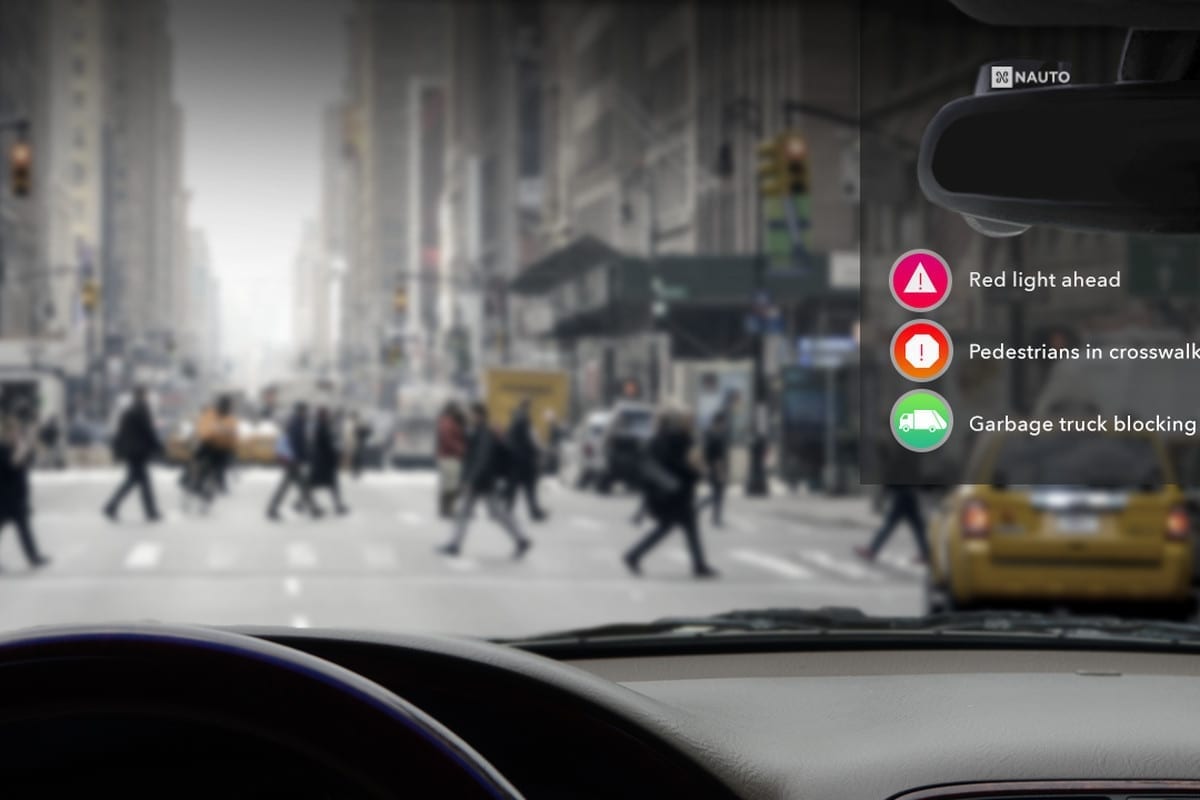
    To develop its technology, Nauto is retrofitting windshields of commercial trucks from North America to Europe and Japan with dual cameras: one aimed at the road and the other at the driver. The goal is to gather data on driver distraction and on the environment around vehicles and speed development of self-driving technology.

    Using such techniques as computer vision and deep learning, a form of artificial intelligence, the company is analyzing video feeds and data from the retrofit devices to improve driver performance and safety. Learning more about how humans drivers behave is critical, Heck said, because self-driving cars must share the roads with those vehicles for at least the next 20 to 30 years.

    “During that transition period, we need autonomous vehicles that are not just smart, but are able to collaborate with humans,” Heck said in an interview.

    Nauto is working with investors and other companies “to learn from human drivers, the best and the worst, to inform” the development of self-driving vehicles.

    Heck declined to say how many vehicles are using Nauto’s cameras and software, but said the company expects to accumulate more than one billion miles of real-world data within the next year.

  • With new Takata air bag recalls, automakers may face more liabilities

    With new Takata air bag recalls, automakers may face more liabilities

    Takata’s bankruptcy filing last month was meant to draw a line under the auto industry’s biggest safety recall, but last week’s announcement of more air bag inflator recalls suggests automakers could face fresh liabilities in the future.

    In late-2015, U.S. regulators gave Takata until the end of 2019 to prove that its replacement air bag inflators – which add a drying agent to combat moisture that can set off the ammonium nitrate compound in an inflator, with potentially lethal results – are also safe.

    If Takata fails that test – and some industry consultants, explosives experts and former employees question whether the workaround guarantees safety over the long-term – the 100 million or so replacement inflators currently being installed may themselves need to be replaced.

    “Absent proof that the other desiccated inflators are safe, they will also be subject to recall,” the U.S. National Highway Traffic Safety Administration (NHTSA) said in a statement last week. The agency declined to comment on the risk that additional inflators may be subject to recall.

    NHTSA announced last Tuesday that new testing at Takata prompted the Japanese parts firm to declare 2.7 million of the new air bag inflators defective, raising questions about the risk from replacement air bags as moisture can still seep into the propellant of some inflators.

    Takata’s automaker customers, which have so far borne much of the estimated $10 billion cost of replacing faulty bag inflators, could be on the hook for future liabilities in the event that Takata fails to prove that the desiccant workaround is sufficient.

    Last week’s recall is the first to involve Takata bag inflators that use a drying agent.

    Nearly 20 automakers have been affected by the air bag recalls, and some still use Takata inflators for replacements in the recalls. Automakers including Honda Motor Co, Toyota Motor Corp and Nissan Motor Co have said they will stop using Takata inflators for new contracts for future models.

    “If NHTSA in the future raises issues about the safety (of desiccated inflators) we will of course comply with their orders,” Nissan’s chief sustainability officer Hitoshi Kawaguchi told Reuters. “At the moment, our focus is on getting replacement inflators to our customers.”

    Toyota said it was “working closely with all stakeholders, including Takata, other suppliers and relevant agencies, to assess any potential impact and take action accordingly” on the recall issue. Honda, Takata’s biggest client, declined to comment.

    “The automakers… and Takata – they all know that this is a future issue,” said Scott Upham, chief executive at Valient Market Research, whose clients include auto parts suppliers. “But I think everybody is concerned about the near-term issues, and the financial arrangements of the bankruptcy.”

    Takata says it has produced around 100 million replacement inflators containing drying agents: the 2.7 million recalled last week used calcium sulfate, and the rest contain zeolite.

    “We still have to prove the safety of our desiccated inflators, but we believe those using zeolite are safer than those using calcium sulfate,” said spokesman Toyohiro Hishikawa.

    The company has declined to comment further on the testing process or the NHTSA deadline.

    Takata is the only global air bag maker to use ammonium nitrate as a propellant in its inflators. The compound’s vulnerability to high temperature and moisture can trigger an explosion that can spew shrapnel inside a vehicle. The defect has been linked to at least 17 deaths, mostly in the United States.

    ‘Lengthening the Fuse’

    The new inflators with the added desiccant have not been linked to any deaths or injuries, but the problems with the original inflators typically took five years or more to emerge.

    Keiichi Hori, who oversees automotive safety components at the Japan Explosives Society, said adding a drying agent can reduce, but not eliminate, the risk of uncontrolled explosions.

    If the desiccant can prevent all moisture from reaching the inflator propellant, “then it would be possible that the inflators could be used safely,” he said. “Otherwise, alternatives should be considered.”

    But Upham, the industry consultant, predicts the recalled parts will themselves eventually be recalled – because ammonium nitrate is fundamentally too volatile – and Takata’s carmaker customers may again have to foot the bill given that Takata is unlikely to be able to cover the costs.

    “Automakers are hoping and praying that the desiccant solves the problem… (but) this might come back to bite them,” Upham said.

    Former Takata employees involved in manufacturing inflators have said the desiccant may buy Takata time. One told Reuters last year that by adding the desiccant, “you’re just lengthening the fuse, not correcting the problems.”

    Key Safety Systems, a U.S.-based components supplier owned by China’s Ningbo Joyson Electronic Corp, has agreed to buy Takata’s good assets such as seat belts and steering wheels, for $1.6 billion. The plan is for Takata’s air bag business to be wound down by March 2020 after making replacement inflators for the ongoing recalls.

  • Volkswagen group deliveries rise 4.2 percent in June

    Volkswagen group deliveries rise 4.2 percent in June

    Volkswagen Says group deliveries rise 4.2 percent to 920,700 in June. Volkswagen says June group deliveries rise 3.1 percent in Europe, 9.8 percent in the U.S., 5.2 percent in China.

    Volkswagen says January-June group deliveries rise 0.8 percent to 5.16 million.

  • Mercedes cars to face more emissions tests in Germany

    Mercedes cars to face more emissions tests in Germany

    Germany has found no signs so far that Mercedes-Benz used illegal software to manipulate diesel emissions but a new round of tests is being conducted, the transport ministry said on Friday.

    The Transport Ministry summoned officials from Daimler, which owns the Mercedes-Benz brand, to a meeting on Thursday to explain why some vehicles showed high levels of emissions under certain driving conditions.

    Engine management systems and software have come under scrutiny ever since Volkswagen admitted in Sept. 2015 that it had installed programs which cheat diesel emissions tests.

    “It was agreed that Mercedes vehicles will be tested by the KBA,” a ministry spokesman said on Friday, adding that Daimler had been cooperative and had reiterated its vehicles conform with emissions regulations.

    German magazine Der Spiegel on Friday said, without citing sources, that officials from the KBA, Germany’s vehicle certification authority, believe Mercedes-Benz may have diesel cars equipped with illegal cheating software.

    Upon being asked about the report in Der Spiegel, Daimler said that based on the information it had at its disposal, it would fight allegations about using an illegal software defeat device with all legal means.

    Upon being asked about whether KBA had found a defeat device in Mercedes cars, a KBA spokesman on Friday said, “We need to wait for the results of investigation to be published.”

    KBA reports to Germany’s transport ministry.

    Der Spiegel said that Germany’s Transport Ministry had threatened Mercedes with recalling vehicles equipped with OM642 and OM651 engines. Daimler said it could not comment on the contents of the meeting but denied there had been a threat of a forced recall.

    Germany’s Transport Ministry also said KBA had not threatened Daimler with a recall.

    In April last year, German Transport Minister Alexander Dobrindt said carmakers including Mercedes would voluntarily recall 630,000 diesel vehicles to change engine and emissions management software.

    At the time, Dobrindt said regulators on the lookout for illegal emissions cheating software had found carmakers exploited a legal loophole to reduce emissions filtering systems.

    Under certain circumstances carmakers are allowed to throttle back emissions management systems to protect the engine. Cars which start up when it is very cold outside run the risk of having condensation build up in their catalytic converters and engines causing rust.

  • BMW greenlighted to find new dealer in Vietnam

    BMW greenlighted to find new dealer in Vietnam

    Vietnamese government has given the greenlight to the German automobile manufacturer BMW to access and run maintenance services on a batch of 700 BMW cars being held at Vietnamese ports after Euro Auto—BMW’s official distributor in Vietnam—was charged with scandalous violations of counterfeit paperwork.

    The leader of the government also affirmed that the BMW Group in Germany had no part in these violations, only its dealership in Vietnam. Hence, BMW must change its dealer in Vietnam to help maintain a transparent and attractive business environment.

    In order to be able to continue its business in Vietnam, the German automaker will have to terminate the rights of its current partner to import and distribute BMW cars in the country, while looking for another distributor.

    Dealer replacement is needed

    Since 2006, Euro Auto, as the officially authorised distributor of BMW in Vietnam, has helped the company to become one of the most successful luxury car brands in the market after previous failures in manufacturing cars locally, which eventually led to its withdrawal from the Hoa Binh Automobile joint venture.

    In fact, Euro Auto is backed by Sime Darby Group (Malaysia). By the end of 2013, Sime Darby Motors—a major affiliate of the Malaysian multidisciplinary group—has acquired a more than 90 per cent stake in Euro Auto Corp. (EAC) by purchasing Europe Automobiles and other shareholders’ stakes.

    Via Euro Auto, Sime Darby has brought several luxury and premium car models to Vietnam, for example the MINI and BMW brands, through a chain of showrooms and stores in Ho Chi Minh City and Hanoi.

    Currently, Sime Darby is the world’s third largest distributor of BMW. The giant also holds the rights to sell Land Rover, Mini, Rolls-Royce, Jaguar, Lamborghini or Porsche in many neighbouring countries, such as Malaysia, Singapore, Thailand, and China.

    In early 2016, Sime Darby established another subsidiary named Performance Motors Vietnam with similar functions to Euro Auto, selling BMW cars, spare parts, and accessories. When this company came into operation, Euro Auto shifted focus onto imports, while Performance Motors was responsible for distribution. Still, there was no clear separation between the firms regarding their functional businesses as they were both reported doing retail activities in Sime Darby’s 2016 annual report.

    However, after being accused of conducting fraudulent paperwork and declaring low import prices to evade tax, Euro Auto has apparently lost its credibility with other firms.

    In December 2016, the BWM dealer was found to have sold a shipment of imported cars while it was still waiting for clearance from the Ho Chi Minh City customs agency, in addition to violating multiple regulations, according to the Ministry of Finance (MoF).

    The company was accused of forging documents, including purchase contracts and receipts, while failing to provide certificates of origin for its cars—a sign of fraud and scamming. It also bought BMW vehicles without completing customs clearance or receiving the necessary customs authority permits. In December Vietnamese customs officials were ordered to halt all clearance procedures for BMW cars after MoF reported import violations, a ban that is said to be still in effect.

    Afterwards, the Ministry of Public Security announced on April 27 that Nguyen Dang Thao, general director of Euro Auto, and two other individuals involved had been arrested in the course of an investigation of a batch of German luxury cars smuggled into Vietnam. The names of the other two persons have been kept undisclosed.

    At the meeting with Prime Minister Nguyen Xuan Phuc, the top executives of BMW also said that the company was seeking to invest in a factory in Vietnam as it would increase the localisation rate of many car components.

    According to experts, in order to achieve such a goal, the world’s big players usually choose to participate in a joint venture and technology transfer agreement with a local car manufacturer.

    There are many firms wanting to become BMW’s new distributor, including well-known names of the automobile industry and other multidisciplinary corporations that want to expand their portfolios. Yet for BMW, a joint venture with a local firm appears to be the best fit, to assemble cars in Vietnam.

    “Financial capability is not the key factor. Experience and the network infrastructure for distribution are supposed to be the core,” said the director of a luxury car company.

    This is also the path BMW and Sime Darby are pursuing in Malaysia. The joint venture between these two corporations was established in 2003, with a 51 per cent stake held by BMW and a 49 per cent by Sime Darby.

    Shortly after its establishment, the company started manufacturing some of the very first BMW models in Malaysia. To date, the plant has manufactured approximately 20 different commercial vehicle models under the brand names BMW and MINI, including Series 1, Series 3, X1 to X5 or Countryman, among others.

    Most recently, in April 2016, BMW Malaysia unveiled a plan to boost the assembly of BMW 3, 5, and 7 series sedans in Malaysia for export to Vietnam and the Philippines via Sime Darby’s distribution channels.

    Were it not for the Euro Auto incident, according to the company’s plan for 2018, Vietnamese customers would have purchased more BMW cars imported from Malaysia, not Germany. Then, BMW would have been granted tax incentives, particularly a zero per cent import tax, for import activities within the region as long as it could meet the requirement of a 40 per cent localisation rate.

    If BMW also adopts this model in Vietnam, the best possible way is to find a partner with good financial capabilities, a well-established distribution network across the country, and more importantly, a string of readily available factories and warehouses or bases for expansion. Other things involve agreements signed to regulate capital contributions and technology transfer or to attract investment from car accessory manufacturers and gradually increase the localisation rate.

    A long way ahead

    In Vietnam, the availability of these conditions is actually very limited. A prediction from industry insiders reckons that Sime Darby will still be in charge of the distribution of BMW cars, but through a different firm, not Euro Auto.

    It could be Performance Motors or a different agency. However, whoever will be BMW’s new representative, the giant still needs to invest in a joint venture with a large Vietnamese corporation so as to develop the plan to manufacture and assemble cars in Vietnam.

    If BMW cars are assembled and imported in Vietnam by a big company, the model used 20 years ago will come back. Around 1994, BMW cars were assembled at the factory of Hoa Binh Automobile Company (VMC), along with Mazda and Kia cars. However, all companies decided to “get out” because of undesirable failures. Mazda and Kia later came back to Truong Hai and started thriving.

    If BMW ties the knot with a big company, it will be the starting point of a new era for it to become the second luxury car brand manufactured in Vietnam, after Mercedes. The price may decrease if the proportion of domestic factors increases. The battle in the luxury car segment is also getting tougher with more noticeable opportunities for sales booming.

    After all, the luxury car brand of Bavaria is looking for a safe haven in Vietnam. It does not only want an extensive distribution system, services, factories, and warehouses ready for assembly and manufacturing, but also requires a stable policy framework in the long run.

  • Fiat Chrysler recalls 1.33 million vehicles over fire, air bag risks

    Fiat Chrysler recalls 1.33 million vehicles over fire, air bag risks

    Fiat Chrysler said on Friday it is recalling 1.33 million vehicles worldwide in two separate campaigns for potential fire risks and inadvertent airbag deployments.

    The Italian-American automaker said it is recalling about 770,000 sport utility vehicles because of a wiring issue that may lead to inadvertent deployment of the driver-side air bag and is linked to reports of five related minor injuries, but no crashes.

    The company said wiring could chafe against pieces of steering-wheel trim, potentially causing a short-circuit and ultimately leading to an inadvertent air bag deployment. The issue could also cause unintended windshield wiper operation or inoperable switches.

    The recall covers 538,000 2011-2015 Dodge Journey vehicles in North America and 233,000 2011-2015 Fiat Freemont crossovers sold elsewhere. Dealers will inspect and replace the wiring, as needed and equip it with additional protective covering.

    The automaker is also recalling 565,000 vehicles to replace their alternators because of fire risks. The company said hot ambient temperatures could lead to premature diode wear, may result in a burning odor or smoke, could impact the anti-lock braking system or lead to engine stalls.

    The company said it is aware of two potentially related accidents but no injuries.

    The recall covers 2011-2014 model year Chrysler 300, Dodge Charger and Dodge Challenger cars and Dodge Durango SUVs and 2012-2014 Jeep Grand Cherokee SUVs.

    In October, Fiat Chrysler recalled about 86,000 Ram 2500 and 3500 pickup trucks, 3500, 4500 and 5500 chassis cabs from the 2007-2013 model years and 2011-2014 Dodge Charger Pursuit sedans for the same alternator issue. Fiat Chrysler said at the time one minor injury was related to the recall.

    Dealers will replace the alternators.

  • Vietnam urged to focus on making 2-wheel vehicles

    Vietnam urged to focus on making 2-wheel vehicles

    While the Ministry of Industry and Trade (MOIT) and experts have decided that Vietnam needs to develop an automobile industry of its own, other experts believe that the ‘automobile dream’ is ‘far away’ and that Vietnam should focus on making 2-wheel vehicles.

    After five years of joining the market, Pega has announced it has succeeded in making electric vehicles, becoming the first Vietnamese brand in 2-wheel vehicle manufacturing.

    Pega’s products now have 85 percent of component value made domestically. Its main factory, covering an area of 15,000 square meters, located in Song Khe – Noi Hoang IZ in Bac Giang province, is designed to make 40,000 products a month.

    Pega’s major partners, the suppliers of components, have factories in Ha Dong district in Hanoi, Vinh Phuc and Bac Ninh. They are all prestigious companies which ensure high quality products. Vietnam’s bamboo-made bicycles worth thousands of dollars have also been launched into the domestic market and exported.

    Luong Thi Phi Loan, director of the Thien Chi Community Support & Development Center, a business in Binh Thuan province that manufactures and exports bicycles, said 80 percent of materials used on the bike are bamboo. The company has received numerous orders from the US and Germany.

    Vietbamboo is also a successful bamboo bicycle manufacturer with products sold between VND15 million and VND40 million.

    Analysts said that Vietnam has great opportunities to manufacture 2-wheel vehicles. It has a highly rated ecosystem with experienced component manufacturers which can satisfy requirements in materials, manufacturing standards, quality control and testing.

    Vietnam is one of the biggest personal 2-wheel vehicle consumer markets in the world.

    Analysts believe that it will continue to be a lucrative market in the upcoming years as demand has been increasing.

    To implement the localization plan, at first enterprises need to master the design and research, then seek component suppliers.

    They can also consider either making products in Vietnam or outsourcing to the ‘world’s production base’ – China.

    The localization will allow enterprises to stabilize production, satisfy market demand in the long term, and provide reasonable post-sale services.

    This will settle a problem now that manufacturers change design regularly and users have to throw away used vehicles because they cannot find high-quality spare parts.

    Le Hoang Long, CEO of Pega, said Vietnam now has excellent capability of making 2-wheel vehicles. He can also see great opportunities to cooperate with technology partners like Bosch and Panasonic to make electric scooters with smart features.

  • Honda recalls 2.1 million vehicles worldwide over fire risk

    Honda recalls 2.1 million vehicles worldwide over fire risk

    Honda Motor said on Friday it would recall about 2.1 million vehicles worldwide to replace battery sensors due to the risk of fire.

    Chris Martin, a spokesman for the Japanese automaker said the recall would include 1.15 million Honda Accord vehicles from the 2013-2016 model years in the United States, and nearly 1 million elsewhere, to replace a 12-volt battery sensor.

    The company said it had received four reports of engine compartment fires in the United States and at least one in Canada, in areas that use significant amounts of road salt during the winter. There have been no reported injuries.

    The automaker has received 3,972 U.S. warranty claims relating to the issue.

    The battery sensors may not be sufficiently sealed against moisture intrusion, Honda said. Over time, moisture may introduce road salt or other material into the battery sensor, leading to rust and eventual electrical shorting of the sensor.

    Due to the large size of the recall, Honda said dealers would initially adopt a temporary fix by applying an adhesive to prevent moisture intrusion, and then later replace the sensor.

    The company first received a claim of an engine compartment fire from Canada in 2015 and began investigating the issue. In early 2016, it received a claim of a similar fire in China.

    Honda introduced a redesigned battery sensor in June 2016. After an investigation of the China incident, the automaker said it initially believed the “future occurrence rate was estimated to be low,” but continued to probe the matter after receiving additional reports of fires.

  • Faraday Future moves electric SUV production site, mothballs Las Vegas plant

    Faraday Future moves electric SUV production site, mothballs Las Vegas plant

    Startup Faraday Future said it would move production of its planned luxury electric SUV to a new site, virtually scrapping a stalled $1 billion Las Vegas factory amid deepening financial woes of key investor Chinese entrepreneur Jia Yueting.

    Faraday is part of a network of young electric vehicle (EV) firms in China and the United States backed by Jia, who has said his company LeEco – that grew from a Netflix-like video website to a business empire spanning consumer electronics to cars within 13 years – is facing a severe shortage of cash after expanding too fast and in too many directions.

    Struggling to support goals that included beating Elon Musk’s Tesla in premium EV making, Jia is now trying to ride out the cash crunch by taking measures such as halting work on the Las Vegas factory and selling a Silicon Valley property less than a year after buying it from Yahoo.

    On the latest decision to shift production of Faraday’s luxury electric SUV FF 91 to a new site, the startup said: “This will allow product production to be realized faster, as well as allow our future strategy to be implemented more effectively.”

    For LeEco, this marks a second major setback to its ambition to become a major EV manufacturer after it recently pulled out of a joint project with British sports carmaker Aston Martin to develop RapidE electric car.

    Faraday had initially planned to open the Las Vegas factory late in 2017, with a product portfolio of seven models – an estimate that was later slashed to two, including the FF 91.

    Jia, who posted the Faraday statement on his social media account, did not name the new FF 91 production location. Faraday will continue to own the Nevada factory site.

    The FF 91 has been described by its designer as “weird-pretty” and Faraday executives say it will be the most technologically advanced vehicle of its kind on the market when it goes into production in early 2018. But cash shortages have raised questions about the company’s prospects.

    According to estimates from mutual fund investors, LeEco could see the market value of its listed unit, Leshi Internet Information & Technology Corp Beijing (300104.SZ), fall around $2.5 billion should its shares resume trading.

    The company is set to hold an extraordinary shareholders’ meeting on July 17 in the Chinese city of Shenzhen.

  • Carmaker Dacia recalls 2,032 cars to fix horn issue

    Carmaker Dacia recalls 2,032 cars to fix horn issue

    Romania’s agency for consumer protection (ANPC) Says carmaker Dacia, owned by French Renault is recalling 2,032 Duster SUVs in Romania to fix an issue with the horn’s electric wiring.

    Says Dacia has identified the possibility of incorrect sizing of the horn’s electrical wire system which could cause loss of function or smoke.

    Says issue fix would take about an hour per car.

  • Tesla steps up auto service as Model 3 debut nears

    Tesla steps up auto service as Model 3 debut nears

    Tesla said it is expanding its auto service centers and adding 350 mobile service vans as it gears up to support its Model 3 sedan, a mass-market car that is expected to drive a 500 percent increase in the electric car company’s sales. A senior executive speaking on behalf of the company told Reuters that Tesla would be able to triple its global service capacity by increasing efficiency, adding to mobile service, and adding 100 service centers to its current total of more than 150.

    Tesla is adding 1,400 technicians this year, and the company plans to continue expanding mobile and service center capacity at a similar pace over then next few years.

    Tesla needs to expand service quickly to be able to handle the increase in sales and as the electric car company transforms itself from a luxury vehicle maker into a competitor with mainstream cars.

    Expectations for a smooth roll out are particularly high among investors. Tesla has been challenging General Motors (GM.N) for the title of biggest U.S. automaker by market capitalization, even though its output is a fraction of GM’s.

    The $35,000 Model 3 is designed for easy production, creating lower service needs, the executive said.

    Tesla’s last launch was the Model X SUV in 2015, which had a number of production issues.

    Model 3 production began in the last few days and is expected to reach 20,000 per month in December. The first deliveries are expected on July 28.

    Tesla had fielded 373,000 Model 3 reservations as of April 2016, the latest date at which it announced a figure.

    The company has learned from previous problems including issues with seatbelt latches, seats and a 53,000-vehicle parking brake recall earlier this year, the executive said.

    Tesla said it has improved service time by automating paperwork, using cars’ wireless connections to diagnose problems, and expanding mobile support.

    Tesla deployed mobile vans to company charging stations to fix the seatbelt latch and cut the procedure to less than 20 minutes.

    About 80 percent of fixes on its vehicles do not require a lift and can be done by one of its mobile technicians, which frequently can handle an appointment in less than an hour.

  • Nissan expects up to 20 percent of sales to be zero emission cars by 2020

    Nissan expects up to 20 percent of sales to be zero emission cars by 2020

    Nissan Motor expects that zero-emission cars will make up to 20 percent of its sales in Europe by 2020, Gareth Dunsmore, Electric Vehicle (EV) Director for Nissan Europe said in a statement on Monday.

    Nissan said it welcomed France’s commitment to reward those who choose more sustainable vehicles.

    Last week, Ecology Minister Nicolas Hulot said France would aim to end the sale of gasoline and diesel vehicles by 2040 and become carbon neutral 10 years later.

    “By 2020, where the market conditions are right, I’m confident we’ll be selling up to 20 percent of our volume as zero emissions vehicles and this will only grow,” Dunsmore was quoted as saying in an emailed statement.

  • China vehicle sales rebound in June amid price cuts

    China vehicle sales rebound in June amid price cuts

    China’s vehicle sales rebounded in June, the country’s top industry association said, shaking off weakness seen in the previous two months as carmakers grappled with a rollback in tax incentives that drove strong growth last year.

    Total vehicle sales hit 2.17 million in June, up 4.5 percent from a year earlier, while sales for the first half of the year rose 3.8 percent to 13.4 million vehicles, the China Association of Automobile Manufacturers (CAAM) said on Tuesday.

    The rise in sales, which industry insiders said was helped by hefty discounting, lends a sheen to the world’s largest auto market, but growth overall is struggling to keep pace with 2016 when the market grew at its fastest pace in three years.

    Overall vehicle demand in China would likely grow just 1-4 percent this year, mainly because consumers made purchases last year to benefit from lower tax rates, said Yale Zhang, head of Shanghai-based consultancy Automotive Foresight.

    In January, CAAM predicted sales would rise 5 percent this year, slowing from 13.7 percent in 2016, citing the rollback of a tax incentive for small-engine cars and economic pressures. It stuck with that forecast on Tuesday.

    June’s rise, however, marks an improvement from April and May, when vehicle sales fell 2.2 percent and 0.1 percent, respectively, registering two straight months of declines for the first time since 2015.

    Peter Fleet, Ford Motor Co’s Asia-Pacific chief, told Reuters average vehicle transaction prices in China had fallen about 4 percent in the first half of this year against 2016. “We continue to see negative industry pricing in China,” he said.

    Ford is among the foreign brands strong in the small sedan segment that have seen China sales slow this year, others being General Motors Co and Volkswagen AG.

    Buyers in China have shied away since the purchase tax on vehicles with engines of 1.6 liters or below rose to 7.5 percent, from 5 percent, at the start of the year.

    However, there is one bright spot: sales of new-energy vehicles (NEVs) – all-electric battery vehicles and plug-in electric hybrids – that saw a 33 percent bump in June to 59,000 units, the latest CAAM data shows.

    In the first half of this year, sales volume of such NEVs totaled 195,000 vehicles, up 14.4 percent.

    China is the world’s largest market for green energy vehicles, with the government aggressively promoting the segment, including spending billions in subsidies, in a bid to fight intense urban air pollution.

  • GAC China to provide upstream logistics services for car imports

    GAC China to provide upstream logistics services for car imports

    Parallel car importer Shandong High Speed Qingdao West Coastport has appointed GAC China its upstream logistics provider. Under the one-year contract, it will handle the receiving and checking, container loading and freight services of an estimated 3,000-4,000 cars exported from Hamburg and Rotterdam to Qingdao and Hong Kong every year.

    Simon Xu, managing director of GAC China, is optimistic about the growth of that market and the opportunities that it will generate: “China was ranked as the world’s number one automotive market for the eighth year last year, with a double-digit total sales growth. We are also seeing a rising trend for the direct import of European cars into the country.

    “Our partnership with Shandong High Speed marks the beginning of a new chapter for GAC China, that will allow us to leapfrog into a new territory in the contract logistics market for fully assembled automobiles.”

    GAC China’s contract logistics team led by manager Tyrone Liu will work closely with GAC’s partners in Hamburg and counterparts at GAC Rotterdam to ensure the safe and prompt delivery of the vehicles.

    Chengguang Du, general manager of Shangdong High Speed Qingdao West Coastport says: “When looking for a logistics partner with global resources and extensive experience to handle the shipment of our high value automobiles, GAC came to our mind. We know GAC as a well-known brand in the logistics industry, but it was only when we flew to Hamburg and saw the facility and operations with our own eyes that we were fully convinced.”

    GAC China has already handled the first shipment under the contract – two Range Rover HSEs from Germany to Qingdao, China.

  • Giti Tire Building $560 Million Manufacturing-Distribution Campus

    Giti Tire Building $560 Million Manufacturing-Distribution Campus

    Giti Tire, the 10th largest tire company in the world based in Singapore, is on track to open its first first North American manufacturing facility on a 1,100-acre site, 170 miles northeast of Charleston, in Richburg, South Carolina.

    The company expects to invest $560 million and create 1,700 new jobs over the next decade in Chester County. The new facility, which will be located on the Carolinas I-77 Mega Site, will combine manufacturing and distribution activities, with total building area estimated to be 1.8 million square feet.

    Giti Tire will produce both passenger and light truck tires for the Original Equipment Manufacturer (OEM) and replacement markets in the Chester County plant.

    “This significant investment represents our strong commitment to customers in North America. This is a key milestone for Giti Tire and an important part of our growth strategy worldwide. Existing business and strong demand for Giti Tire’s passenger and light truck tires in North America has made this significant investment in South Carolina possible,” Enki Tan, executive chairman of Giti Tire Group said.

    During the first phase of production, the plant’s capacity is expected to be 5 million tires annually. Giti Tire plans to further increase production capacity in response to future market demand and conditions. The Chester County facility represents Giti’s ninth manufacturing plant in its global system.

    “Chester County is an excellent location for Giti Tire, offering extensive and efficient infrastructure network including interstate highways, rail, close proximity to airports and a major metropolitan area to support the company’s needs and growth for many years to come,” Lei Huai Chin, Managing Director of Giti Tire Group said.

    According to the State Department of Commerce the company’s decision to locate in South Carolina was driven by a number of factors, including the area’s workforce and training opportunities through the technical college system, proximity to major transportation infrastructure and deep-water port facilities in Charleston, market access to the growing Southeast region and the state’s business-friendly environment.

    As an incentive ready SC will be assisting the company with the recruiting and training of its initial workforce.