Category: Automotive

Retail News Asia is committed to providing both local and global retailers with the latest Auto and Car news throughout the Asian market. This on a daily base.

  • Mercedes-Benz ditches E220d in favour of E350e in Thailand

    Mercedes-Benz ditches E220d in favour of E350e in Thailand

    Sales of the diesel-powered executive saloon cease as the German automaker wants plug-in hybrids to account for 30% of total annual sales.

    Mercedes-Benz (Thailand) has launched its fourth plug-in hybrid vehicle: the E350e which follows the C350e, S500e and GLE500e.

    Like the C350e, the E350e uses a 2.0-litre petrol-turbo engine in conjunction with an electric motor, whose power from the lithium-ion battery can also be revitalised from the wall socket. The S500e and GLE500e employ a bigger 3.0-litre V6 petrol motor.

    Combined outputs in the E350e are rated at 286hp and 550Nm, while the maximum all-electric driving range is claimed at 33km. As the E350e spews out 44g/km of CO2 on the combined cycle, it is eligible for the new 5% excise tax imposed on locally made plug-in hybrids producing no more than 50g/km.

    There are three trims for the E350e: Avantgarde 3.49 million baht, Exclusive 3.79 million baht and AMG Dynamic 4.09 million baht.

    The similarly priced E220d has been dropped from the Thai E-class model lineup as Mercedes-Benz wants to promote plug-in hybrids in the country.

    Mercedes-Benz hopes that plug-in hybrids will account for 30% of total annual sales which is why diesel versions and other pure petrol derivatives aren’t available anymore. The same has happened in the C, S and GLE model ranges.

    BMW, meanwhile, is gearing up to launch the 530e in Thailand at the end of this year to rival the E350e. Volvo is also said to be preparing the introduction of the S90 T8.

    Unlike Mercedes-Benz, BMW is still selling diesel versions of the X5, 3 and 7-series as it wants to offer Thai customers with two distinct types of propulsion. BMW hopes that plug-in hybrids will account for 15% of annual sales this year.

  • Fiat Chrysler recalls 1.25 million trucks over software error

    Fiat Chrysler recalls 1.25 million trucks over software error

    Fiat Chrysler Automobiles said on Friday it would recall more than 1.25 million pickup trucks worldwide to address a software error linked to reports of one crash death and two injuries.

    The erroneous code could temporarily disable the side air bag and deployment seat of belt pretensioners – which reduce seat belt slack during impacts – during a vehicle rollover spurred by a significant underbody impact, such as striking onroad debris or driving off-road, the Italian-American automaker said.

    The company will reprogram computer modules in the affected vehicles to address this error.

    An FCA spokesman said the likelihood of an incident was very low because a sequence of events was needed to cause an incident.

    There is no definitive proof the error was involved in two accidents, one of which resulted in a fatality, but the automaker was conducting the recall proactively, he said.

    The spokesman declined to say whether the code was produced inhouse or by an FCA supplier, saying “we do not discuss supplier relationships.”

    Fiat Chrysler Automobiles said on Friday it would recall more than 1.25 million pickup trucks worldwide to address a software error linked to reports of one crash death and two injuries.

    The erroneous code could temporarily disable the side air bag and deployment seat of belt pretensioners – which reduce seat belt slack during impacts – during a vehicle rollover spurred by a significant underbody impact, such as striking onroad debris or driving off-road, the Italian-American automaker said.

    The company will reprogram computer modules in the affected vehicles to address this error.

    An FCA spokesman said the likelihood of an incident was very low because a sequence of events was needed to cause an incident.

    There is no definitive proof the error was involved in two accidents, one of which resulted in a fatality, but the automaker was conducting the recall proactively, he said.

    The spokesman declined to say whether the code was produced inhouse or by an FCA supplier, saying “we do not discuss supplier relationships.”

    Fiat Chrysler has been working to move faster to address vehicle issues after being fined twice in 2015 by the NHTSA.

    In December 2015, the company was fined $70 million for failing to report vehicle crash deaths and injuries since 2003.

    In July 2015, Fiat Chrysler agreed to a $105 million settlement with NHTSA for mishandling nearly two dozen recall campaigns involving 11 million vehicles.

    It agreed to a three-year consent agreement and monitoring by former Transportation Secretary Rodney Slater.

  • Dacia halts production after global cyber attack

    Dacia halts production after global cyber attack

    Romanian carmaker Dacia, owned by France’s Renault, said on Saturday some of its production had been hit by what appeared to be the global ransomware cyber attack that has infected computers in nearly 100 countries.

    Renault stopped production at several sites earlier on Saturday to prevent the spread of the cyber attack.

    “Part of Dacia’s production in Mioveni has been affected by disfunctionalities of IT systems and some employees were sent back home,” Dacia said in a statement. “The measure was taken to prevent extending the disfunctions, which at first glance are a consequence of the global cyber attack.”

  • Nvidia says Toyota will use its AI technology for self-driving cars

    Nvidia says Toyota will use its AI technology for self-driving cars

    Nvidia announced a partnership with Toyota Motor Corp on Wednesday, saying the Japanese car maker would use Nvidia’s artificial intelligence technology to develop self-driving vehicle systems planned for the next few years.

    Toyota will use Nvidia’s Drive PX artificial intelligence platform for its autonomous vehicles planned for market introduction, Nvidia Chief Executive Jensen Huang said in his opening keynote at the company’s GPU Technology Conference in San Jose.

    Nvidia came to prominence in the gaming industry for designing graphics processing chips, but in recent years has been a key player in the automotive sector for providing the so-called “brain” of the autonomous vehicle.

    Nvidia, which also has partnerships with Audi and Mercedes, is among the more popular technology partners in the self-driving car race. Its partnership with Toyota is the latest in a string of alliances between tech companies, automakers and suppliers in the fast-growing sector.

    Nvidia’s Drive PX supercomputer fuses incoming data from the car’s hardware such as cameras and radar and uses artificial intelligence to help the car understand and react to its environment.

    “We’re talking about not just development now but the introduction of vehicles into the market,” said Danny Shapiro, Nvidia’s senior director of automotive. “Now we have the biggest (automaker) in Japan using our Drive PX platform.”

    In January, Nvidia and Audi (VOWG_p.DE) said the German automaker would use the Drive PX to help it put autonomous vehicle on the road starting in 2020. Nvidia is also co-developing with Mercedes a project to come to market within the next 12 months, both companies said in January.

    Toyota, which last year set up a U.S.-based Toyota Research Institute (TRI) to focus on AI and robotics, envisions a dual-track development of autonomous technology. It is simultaneously developing full self-driving cars while also working on what it calls “guardian angel” partially autonomous technology that may still require involvement from drivers.

  • Toyota’s new SUV C-HR becomes best-selling model in Japan

    Toyota’s new SUV C-HR becomes best-selling model in Japan

    Toyota Motor’s newly launched C-HR crossover sports utility vehicle grabbed the top spot in monthly domestic sales in April, becoming the first SUV to top the list in Japan since at least 2007, data from industry bodies showed on Tuesday.

    The country’s largest carmaker by volume sold 13,168 units of the C-HR subcompact crossover in the reporting month. The Japan Automobile Dealers Association and the Japan Light Motor Vehicle and Motorcycle Association said the model rolled out last December is the first SUV to become the best-selling model since they began compiling data in 1968 and 2007 respectively.

    The C-HR, which uses the same platform as its popular gasoline-electric hybrid car Prius, attracts fuel-cost sensitive customers with its fuel-efficiency. Its hybrid model runs 30.2 kilometres per liter of gasoline, among the best in the segment. Toyota plans to market the model in over 100 countries on the back of growing demand for compact SUVs worldwide.

    Honda Motor’s minicar N-Box came in second with 12,265, up 4.9% from the same month last year, ceding the crown to the C-HR after maintaining the No. l position for four consecutive months through March. The Move minicar of Daihatsu Motor  — Toyota’s subsidiary — was third, as sales of the minicar model more than doubled to 12,004 units in the month.

    Five minivehicle models with engines no larger than 660 cc made it into the top 10 ranking, according to the two associations, as they continue to entice customers with a relatively low tax levied on them and their fuel-economy.

    Daihatsu’s Tanto minivehicle ranked fourth with 11,926 units, up 8.5%, followed by Toyota’s Prius hybrid, the best seller in 2016, with 9,920 units, down 52.2%.

  • BMW to raise production capacity to 3 million cars by 2020

    BMW to raise production capacity to 3 million cars by 2020

    German luxury carmaker BMW Group will raise its annual production capacity to 3 million cars by 2020 and plans to build its X5 offroader in China, citing company sources familiar with the plans.

    BMW Group, which includes the Mini and Rolls-Royce brands, and built 2.37 million cars last year, plans to double its production capacity in China to 600,000 cars.

    In North America and Mexico, production capacity will be increased to 750,000 vehicles from 410,000, the paper said, adding that BMW brand wants to overtake rival Mercedes-Benz, which is owned by Daimler, to reclaim the volume sales crown for premium carmakers.

  • Daimler drops bid to win approval to sell U.S. 2017 Mercedes diesels

    Daimler drops bid to win approval to sell U.S. 2017 Mercedes diesels

    German automaker Daimler said on Tuesday it had dropped plans to seek U.S. approval to sell 2017 Mercedes-Benz U.S. diesel models, but had not decided whether to exit the American passenger diesel market.

    “We constantly review our portfolio offerings and make adjustments to meet immediate customer need,” Mercedes-Benz USA spokesman Rob Moran said in an email. “Combined with the increased effort to certify diesel engines in the U.S., we have put the certification process for diesel passenger cars on hold.”

    There has been growing scrutiny of diesel vehicles in the United States since Volkswagen AG admitted in September 2015 to installing secret software on 580,000 U.S. vehicles that allowed them to emit up to 40 times legally allowable emissions.

    VW was sentenced in April after pleading guilty in the emissions scandal. In total, VW has agreed to spend up to $25 billion in the United States to address claims from owners, environmental regulators, states and dealers and offered to buy back about 500,000 polluting U.S. vehicles.

    Last month, Daimler said investigations by authorities of diesel emissions and auxiliary emission control devices could lead to significant penalties and recalls.

    The U.S. Justice Department, EPA, California Air Resources Board and a prosecutor in Stuttgart, Germany, are investigating emissions of Mercedes-Benz diesel vehicles.

    In March, the Stuttgart prosecutor launched an investigation against Daimler employees on suspicion of fraud and misleading advertising tied to vehicle emissions.

    The company told in October that it planned to seek approval to sell four U.S. Mercedes diesel models for the 2017 model year. Last year, Mercedes-Benz offered four U.S. diesel models.

    In April, Dietmar Exler, president and chief executive of Mercedes-Benz USA, told reporters the company had not made a decision “one way or the other” on the future of U.S. diesel sales.

    Moran said diesel vehicles in the U.S. in 2016 accounted for less than 1 percent of U.S. sales and the company could still opt to seek 2017 certification at a later date. The company is “leaving the door open to offer diesels as a potential option in our passenger cars and SUVs.”

    Daimler won approval in late April to sell U.S. diesel Sprinter commercial vans after months of talks with regulators.

    In January, the EPA and CARB accused Fiat Chrysler Automobiles NV of illegally using software to allow excess diesel emissions from 104,000 U.S. trucks and SUVs. Regulators have refused to grant Fiat Chrysler approval to sell 2017 U.S. diesel models.

  • Nissan Motor begins mass production of new Navara pickup truck in China

    Nissan Motor begins mass production of new Navara pickup truck in China

    Nissan Motor’s manufacturing joint venture Zhengzhou Nissan Automobile began production of its new Navara pickup truck Monday, in China.

    Nissan Motor’s manufacturing JV, Zhengzhou Nissan, plans to begin sales of the Navara in June, but has not released price or sales target.

  • Subaru sees flat profit this year on higher costs, below expectations

    Subaru sees flat profit this year on higher costs, below expectations

    Subaru on Tuesday forecast a flat operating profit this year, undershooting market estimates and sending its share price lower, as the Japanese automaker expects rising incentive-related costs and research expenses to offset higher sales.

    Subaru, which changed its name from Fuji Heavy Industries in April, said it expected operating profit to ease 0.2 percent to 410.0 billion yen ($3.62 billion) in the year to March. That was below a mean estimate of 538.5 billion yen from 19 analysts polled by Thomson Reuters I/B/E/S.

    Shares in Japan’s No. 7 automaker fell 4.2 percent after the announcement, hitting their lowest in nearly two weeks.

    Subaru posted an operating profit of 410.8 billion yen in the year ended March, down 27.4 percent on the year, as higher costs from the recall of Takata Corp’s air bags and a stronger currency offset a jump in sales.

    Subaru said it expected net profit of 285.0 billion yen this year, up 0.9 percent from last year.

    It expects to sell around 1.11 million vehicles globally this year, a record high and up from around 1.07 million in the year just ended. The automaker sees a 3 percent rise in sales in the United States, where the automaker has carved out a niche in family cars.

    The maker of the Outback SUV crossover and the Legacy and Impreza sedans has ramped up production of its cars in the United States, where it sells around 60 percent of its global production.

    Subaru is assuming an average dollar rate of 110 yen for the current year, anticipating a stronger yen over the year compared with the currency pair’s trading rate of around 113 yen on Tuesday.

    While the automaker has been increasing localised production in the United States, it continues to produce the majority of its vehicles in Japan, making it vulnerable to currency swings.

  • The Serious Fraud between Roll Royce with Countries Including Indonesia

    The Serious Fraud between Roll Royce with Countries Including Indonesia

    Rolls-Royce Holdings doesn’t expect to take a hit from the investigation into the company’s audits, according to finance chief Stephen Daintith. The Financial Reporting Council, the U.K. regulator for corporate governance and reporting, said Thursday it has commenced an investigation into the conduct of KPMG Audit PLC related to the auditing of financial statements for two company entities over a four year time period.

    The FRC decision follows an announcement by the Serious Fraud Office in January of a deferred prosecution agreement between the SFO and Rolls-Royce. U.K. fraud investigators said at the time Rolls-Royce engaged in illegal business practices over a period spanning three decades and would pay more than $800 million in fines. The SFO has done a “thorough piece of work”, Mr. Daintith said.

    In February, the company reported a record loss of £4.03 billion ($5.2 billion). KPMG said Thursday it was “confident in the quality of all the audit work” it performed for the aircraft engine maker.

    “It is important that regulators acting in the public interest should review high profile issues. We will co-operate fully with the FRC’s investigation, which follows the SFO’s investigations into Rolls-Royce,” said the auditor in a statement. Jimmy Daboo, partner at KPMG, said “we have confidence in the audits we’ve done.”

    The illegal payments would have been hard for an external auditor to spot, said Sandy Morris, an equity analyst at Jefferies International Ltd. in London. “Most of these payments were small and it is very unlikely KPMG would have selected these cash transactions to be tested during their audit,” Mr. Morris said.

    On average, Rolls-Royce made payments between $1 million and $4 million, he said. As KPMG only tested a proportion of Rolls-Royce transactions during its audit, chances are high it would have missed these payments, especially as they were often obfuscated and conducted by middle managers, Mr. Morris said.

    The Serious Fraud Office said the January agreement covers 12 counts of conspiracy to corrupt, false accounting and failure to prevent bribery. Wrongdoing took place in business dealings in Indonesia, Thailand, India, Russia, Nigeria, China and Malaysia, the U.K. government said.

  • Hyundai shows twin headlights on Kona

    Hyundai shows twin headlights on Kona

    The upcoming Hyundai Kona, the South Korean brand’s attempt to break into the hot subcompact crossover segment, will get “twin headlamps” with running lights positioned above the main lights as Hyundai looks to set its entry apart from an increasingly crowded field.

    A teaser photo of the Kona released April 28 shows a frontal view with sliver-thin chains of LED running lights up high near the seams of the hood. The unorthodox arrangement is reminiscent of the funky placement on the Nissan Juke, another subcompact crossover known for its edgy styling.

    “The new twin headlamp enhances the visual impact, with the LED daytime running lights positioned on top of the LED headlights,” Hyundai Motor Co. said in a release. “The separated lights at the front deliver a confident, progressive appearance with sleek and sharp shapes.”

    Hyundai said the Kona will launch this summer.

    The U.S. version, also named Kona in keeping with a Hyundai crossover nomenclature based on travel destinations, is expected to go on sale in the first quarter of 2018.

    Kona takes its name from the lava-lined coastal district of Hawaii’s Big Island.

    The vehicle fills another gap in Hyundai’s lineup.

    Subcompact crossover sales in the U.S. climbed 15 percent in the first quarter, while compact crossovers were up 11 percent, even as the overall market retreated 1.5 percent.

    Hyundai, a latecomer to the small crossovers, has been unable to tap that growth.

    The Kona will deliver good driver visibility and comfort, with agile handling, Hyundai said.

    “The imminent arrival of Kona,” Hyundai said, “marks Hyundai Motor’s bold first move into the B-SUV segment and leads the wider expansion of its SUV range.”

  • Ferrari Q1 beats expectations, shares up by 3%

    Ferrari Q1 beats expectations, shares up by 3%

    Italian luxury sportscar maker Ferrari reported a better-than-expected 36 percent rise in first-quarter core earnings on Thursday and confirmed its full-year guidance, lifting shares up more than 3 percent.

    Ferrari said adjusted earnings before interest, tax, depreciation and amortisation (EBITDA) in January-March rose to 242 million euros ($265 million), above a Thomson Reuters SmartEstimate consensus of 222 million euros.

    Quarterly revenues were up 22 percent to 821 million euros, above expectations of 767 million euros, helped by sales of its 12 cylinder models such as the GTC4Lusso and the newly-launched LaFerrari Aperta hybrid convertible.

  • VW brand targets productivity gains through 2020

    VW brand targets productivity gains through 2020

    Volkswagen has set itsef fixed targets for raising productivity at its troubled core division through 2020 by pushing cost savings, stemming overseas losses and launching more higher-margin cars.

    Volkswagen’s namesake VW brand is targeting an operating margin at the upper end of a 2.5 to 3.5 percent range this year, with revenue expected to exceed 2016 levels by around 10 percent, the carmaker said on Friday.

    Europe’s biggest carmaker said it expects its largest division to continue to improve financially over the course of the year after a strong first quarter, and will increase guidance on key targets if necessary.

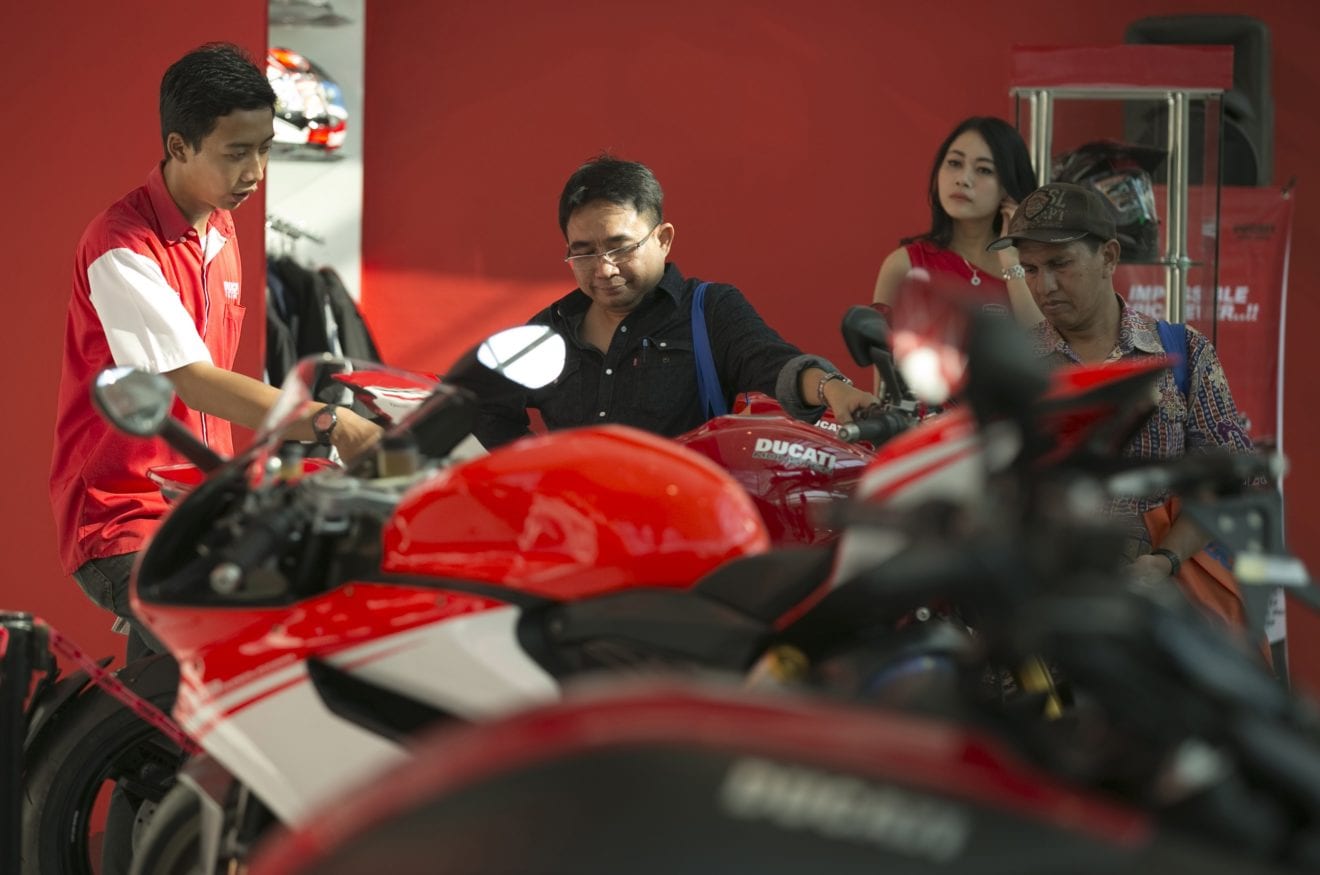
  • Vietnam Motorcycle Show 2017 opens in HCM City

    Vietnam Motorcycle Show 2017 opens in HCM City

    The exhibition, the second edition, is being held with numerous challenges facing domestic manufacturers and importers.

    A wide range of models from commercial and sport bikes to motors were showcased at the exhibition.

    A number of activities were also held during the event, including driving games and a freestyle motorcross performance by Japanese athletes, funded by Yamaha.

    The event also gathered 55 trademarks of support industries and spare part providers as well as relevant industries, including foreign brands including Motul, Michelin, Caltex, Total, Nissin and Quik Fix.

    The exhibition is open until May 7.

    According to the Vietnam Association of Motorcycle Manufacturers, last year, automatic motorcycles accounted for 45 percent of total sales.

    Vietnam’s motorcycle market is expected to continue growing in 2017, the association added.

  • Opel to build new Corsa model with Peugeot technology

    Opel to build new Corsa model with Peugeot technology

    Car maker Opel, which PSA Group has agreed to buy from General Motors, will use the French carmaker’s technology in the next generation of its best-selling Corsa model, a company spokesman said, confirming a report.

    The current Corsa model is built with GM technology. Opel had previously said its new Corsa, slated to be launched in 2019, would also be built with GM technology but has now decided to use Peugeot technology, allowing for higher margins, Allgemeine Zeitung Mainz reported in its online edition on Monday.

    PSA, which agreed to buy Opel in March, was not immediately available for comment.

    The new Corsa will be Opel’s fourth joint project with PSA after Opel models Crossland X, Grandland X and Combo. The Corsa will be built at Opel’s largest manufacturing site, in Saragossa, Spain.