Category: Automotive

Retail News Asia is committed to providing both local and global retailers with the latest Auto and Car news throughout the Asian market. This on a daily base.

  • Audi halts A4, A5 production at Ingolstadt over parts shortage

    Audi halts A4, A5 production at Ingolstadt over parts shortage

    German luxury carmaker Audi will halt production of the A4 and A5 luxury models at its Ingolstadt base this week until Thursday due to a parts shortage after a fire at a supplier, it said on Monday.

    Audi produces 1,400 A4 and A5 models per day at the plant, its largest, so it will lose 5,600 vehicles this week. A fire at a supplier making front wall cladding had disrupted parts deliveries, a spokeswoman said on Monday.

    About 8,500 of the 43,000 workers Audi employs at the plant will be affected and will not be working between Monday and Thursday, she said. Production of A4 and A5 models at a plant in Neckarsulm had not been affected.

    German news agency Deutsche Presse-Agentur reported the stoppages earlier on Monday.

  • Nissan will introduce 8 new premium products by 2021

    Nissan will introduce 8 new premium products by 2021

    India’s third largest passenger car exporter Nissan Motor India confirmed that the company is planning to introduce eight new models in different segments by 2021. The company also confirmed that its Nissan brand will be focussing on premium products and Datsun will concentrate on compact segments.

    Guillaume Sicard, President, Nissan India Operation on the side-lines of Nissan Terrano facelift launch said:

    “The structure of Indian market is you have a certain set of population who need global products, they are well travelled and they also have the bank power. So, we can offer that with Nissan. We are also lucky to have two brands which is also difficult to manage at times but it’s also a strength. Datsun is for the first – time four-wheeler buyers, The brand concentrates on emerging markets and India is the leading country in terms of decisions for the Datsun brand. This is where we have the biggest potential. We have 20 cars for over 1000 habitants and so India is paradise for OEMs. If we manage infrastructure correctly, it can be a paradise for everybody.”

    Sicard expressed his reservations about the future of sub-4 meter cars in India and confirmed that Nissan would not be coming up with a sub-compact sedan. Nissan aims to bring in premium SUVs and cars. The company also hinted a possible comeback of Nissan Teana sedan and Nissan Patrol SUV along with other affordable luxury products but did not share more details on upcoming products.

    “We are very careful with our compact cars. Talking about Nissan, it is not positioned in the compact market. We want to bring in slightly upper market SUVs and cars. We want to position Nissan as a high technology brand. The future of the sub-4 meter vehicles is not so clear. In terms of taxations we still have some doubts. This is the uniqueness of Indian market and so being a global car maker we are looking at it and are very careful to what we plan as well. No sub-4 meter cars for Nissan, we might have one but will not be our focus. If the sub-4-meter rule still exists we will develop new cars under Datsun brand.” Sicard added.

    In the upcoming financial year, Nissan will launch its first hybrid SUV in India – Nissan X-Trail hybrid which will come to India as a completely built unit. The company also confirmed that a flow of new products will roll out from beginning of 2018. Nissan in India has been manufacturing products in alliance with Renault at its Renault-Nissan Alliance plant in Chennai and going forward the company claims 100% differences from its products with Renault.

    Guillaume Sicard said: “There will be 100% differences in terms of both the brands, similar products is not something which we would like to repeat and I will be very transparent in terms of strategy, which was an interesting idea from the start which worked very well but with maturity of the Renault-Nissan Alliance obviously we are going to separate more and more even though we will continue to keep making synergies in terms of platforms and engines which the customer doesn’t see to obtain the best price possible for the alliance for the retail market.”

    Sooner or later the Alliance will also see the Mitsubishi contributing to the overall synergy. While the details on the role of Mitsubishi specially in India is still under the wraps the President of India operations did mention that Nissan is meeting Mitsubishi at global level and India is a major part of the on-going discussions. The objective of the Alliance is to find and create win-win situation for both the companies.

    “This is the spirit of the alliance that Carlos Ghosn has developed so far and we are in the understanding mode, expertise mode and project mode for the time being and for sure we will find synergies. This is the objective of the alliance and we will soon find synergy in India.” Said President of India operations.

    In the 2017-18 financial year, Nissan confirms that its exports will decline as the new generation Nissan Micra which has debuted in many global markets will not be built or sold in the India. Nissan currently exports to over 100 countries and Nissan Micra is the top exported model for the company from India. Current generation Nissan Micra will continue to be sold in the domestic market and to a few export markets retaining the model. However, the export for the same will be at a slower pace confirms the Indian arm of the Japanese car maker.

    Guillaume Sicard commented that “Next year exports will decline slightly because of the Micra, but year after it will really pick up as we will be on the high export programme. We have capacity in the plant close to 500,000 units. There is always possibility to do more, we can invest more if required. For me to keeping 1/3rd of production for exports from India is the safe side of the strategy.”

    By 2021, with new products coming in the company is also looking to phase out Nissan Micra and Nissan Sunny then. Nissan Motor India is not looking to flood Indian market with a lot of products but want to get it right with its offering.

    “I think number of cars in our portfolio is not important as much as to be spot on to what you offer. If you look at the structure of the market, I think there is a threshold in the industry, for a product to be significant in terms of economy of scales and financial efficiency it has to cross a sales of 50,000 units. You have about 22 cars that are sold above 50,000 sales.”

    “Out of the 22 cars, You have 11 Maruti Suzukis, six from Hyundai and then after you have one of the six brands. To reach 50,000 mark is extremely difficult for global OEMs. Instead of expanding the portfolio, We are planning to introduce may be up to three models to be successful to reach that 50,000 mark. This is the way to monitor your success. There is no need for us or any global OEM to have a lot of products to be efficient in India.” Sicard concluded.

  • India’s Motherson Sumi buys Finland’s PKC Group for $619 million

    India’s Motherson Sumi buys Finland’s PKC Group for $619 million

    Indian auto parts maker Motherson Sumi Systems Ltd said on Monday it had completed the buyout of Finland’s PKC Group for 571 million euros ($619.4 million).

    Motherson is now the controlling shareholder of PKC Group, holding 93.75 percent of PKC’s outstanding shares and stock options.

    “There is a great synergy between MSSL & PKC and a complementary geographical presence to serve the customers in all regions,” Motherson said in a statement.

    Shares of Motherson, which have gained 12 percent since the deal was made public on Jan. 20, were trading slightly higher on Monday.

  • Shinsegae department store opens Tesla charging stations

    Shinsegae department store opens Tesla charging stations

    Tesla has completed the installation of three Destination Chargers at Shinsegae department store in the Gangnam, Seoul.

    The move follows the opening of two showrooms in the city last month as the brand picks up momentum with its South Korean operations.

    It was the second set of Tesla chargers introduced at a Shinsegae outlet after another batch was installed at the Yeoju Premium Outlets.

    Tesla charging stations 3

    The Korean giant Shinsegae Group signed a partnership with the American automaker last year, planning to equip 25 of its locations with Tesla’s charging stations this year.

    One of the two Tesla stores that opened last week is located in Starfield Hanam, the largest shopping complex in Korea, which opened last year under a Shinsegae-Taubman partnership.

  • Hyundai Suspends Production at a China Factory for a Week Amid Political Spat

    Hyundai Suspends Production at a China Factory for a Week Amid Political Spat

    South Korea’s Hyundai Motor on Monday said it had suspended production at one of its Chinese factories for a week, fueling concern that a diplomatic standoff may be hurting sales in the automaker’s top market.

    South Korean companies, from cosmetics firms to retailers, say they are being targeted in China because of Beijing’s objections to a planned deployment of the U.S. Terminal High Altitude Area Defence (THAAD) system in South Korea. China worries the system’s powerful radar can penetrate its territory.

    News of Hyundai’s China plant closure, first reported by online media ChosunBiz on Sunday, drove shares of the company down as much as 3% on Monday. The shares recovered slightly to end down 1.2%.

    Shares in Hyundai’s affiliates, Kia Motors and Hyundai Mobis, also finished lower.

    Hyundai said it had suspended the plant in Hebei Province, from March 24 to April 1, in order to check its production line to modify technology. The automaker has three other passenger car factories in China – a country that accounts for about a quarter of its total sales. No further details were available.

    Industry officials and analysts say the suspension may be aimed at bringing down inventories given slowing sales in China, due to political tension and rising competition.

    Ko Tae-bong, an analyst at Hi Investment & Securities, said Hyundai’s March sales in China may have fallen year-on-year due to the political spat, after gaining in January and February.

    China Competition

    The automaker is already grappling with falling market share in China with a product line-up that features more sedans at a time when sport utility vehicles have become more popular.

    China’s Geely Automobile Holdings recently reported its biggest profit growth in eight years, underlining a threat from Chinese makers armed with cheaper SUVs.

    Hyundai makes Verna subcompact cars at its Hebei plant, which came online less than six months ago.

    The automaker plans to start production at a fifth China factory later this year. Hyundai’s China operations are a 50-50 joint venture with state-owned Beijing Automotive.

    Hyundai officials have previously said the company’s business ties with Chinese firms meant they were less likely to be the main target of any punishment resulting from the diplomatic standoff over the deployment of the THAAD.

    The chill in business ties between the nations is evident from the fact that China’s tourism ministry has instructed tour operators in Beijing to stop selling trips to South Korea, while state media has called for a boycott of South Korean goods.

    Chinese authorities have also closed nearly two dozen retail stores of South Korea’s Lotte Group, with some workers saying the closures were fire-safety related. Earlier this year, Lotte approved a land swap outside Seoul that will allow South Korea to install the THAAD.

  • Volkswagen’s Seat returns to profit; to launch third SUV in 2018

    Volkswagen’s Seat returns to profit; to launch third SUV in 2018

    Volkswagen’s Spanish division Seat reported on Thursday its first annual operating profit since 2007 and announced plans to launch a third sport-utility vehicle (SUV) in as many years in 2018 to try to build on its recovery.

    Seat said it made an operating profit of 143 million euros ($154 million) last year compared with a 7 million euro loss in 2015, helped by selling more models with higher specifications and integrating its R&D operations with parent Volkswagen (VW).

    “Seat is now preparing itself for development and growth,” chief executive Luca de Meo said in an emailed statement.

    The 2018 SUV, which follows the launch of the Ateca crossover in 2016 and its smaller sibling Arona later this year, “will boost brand image and will have a very big effect on our ability to generate margins,” the CEO said.

    “This car will bring new customers to us.”

    Seat’s third SUV model will be built at VW’s main Wolfsburg factory and use the German group’s cost-saving MQB modular platform that underpins VW’s top-selling Tiguan SUV.

    VW, which bought Seat in 1986 to increase its exposure to the then fast-growing Spanish market, has long battled to reverse losses caused by under-utilised capacity at Seat’s factory in Martorell near Barcelona.

  • Valmet to build new Mercedes-Benz compact cars

    Valmet to build new Mercedes-Benz compact cars

    Finland’s Valmet Automotive said on Wednesday it had signed a new contract to build future Mercedes-Benz compact cars for Daimler AG.

    The company said it would hire about 1,000 staff to help with its existing contract under which it manufactures Mercedes-Benz passenger cars and SUVs. The plant currently has 2,300 employees.

    The facility is one of the bright spots in the Finnish economy which is slowly recovering from a decade of stagnation.

    In January, Chinese battery maker Contemporary Amperex Technology Ltd bought a 22 percent stake in Valmet Automotive.

  • China’s Geely doubles earnings as Volvo tech boosts sales

    China’s Geely doubles earnings as Volvo tech boosts sales

    China’s Geely Automobile Holdings posted its biggest profit growth in eight years on Wednesday, as improved product design and engineering following its 2010 purchase of Sweden’s Volvo helped propel it to record sales.

    Geely, which also owns the maker of London’s black cabs, has already forecast a 31 percent jump in sales for the current year as affordable models introduced after the Volvo acquisition, such as its GC9 sedan and Boyue sport-utility vehicle, exceed initial estimates.

    Long seen as a no-frills brand, Geely has transformed itself into an automaker with up-market aspirations, using its Volvo research-and-development advantage to climb the sales table in the world’s largest auto market where it ranks around seventh.

    Come next year, Geely plans its next phase of expansion as it aims to become China’s first automaker to market its own brand – new Volvo collaboration Lynk & Co – in developed markets, beginning with Europe and the United States.

    Entering major markets with an unknown Chinese brand is an expensive risk, analysts say, but investors are unperturbed: Geely’s share price has trebled over the past 12 months.

    “It’s a total turnaround story,” said a fund manager at a Taiwan-based investment firm that bought a significant amount of Geely stock last year.

    “Before it was just a normal domestic brand, but after several new product launches it successfully elevated its brand image,” said the person who was not authorized to speak publicly on the firm’s investments and so declined to be identified.

    Geely’s China sales grew 50 percent last year to 766,000 vehicles, powered by the GC9 and Boyue, as well as small cars featuring Volvo technology. It aims to top 1 million this year, though could sell far more depending on market conditions, a Geely official with direct knowledge of the matter told Reuters.

    For 2016, net profit more than doubled to 5.1 billion yuan ($741 million), its strongest growth since 2008. The figure is set to rise 37 percent to 7 billion yuan in 2017, showed a Reuters poll of analyst estimates prior to Geely’s Wednesday filing.

    Geely shares were down 1.2 percent in early afternoon trading after the earnings release.

    OVERSEAS GAMBLE

    To be sure, growth has come at a cost. Geely and parent Zhejiang Geely Holding Group have spent 10 billion yuan on R&D in each of the past three to four years, or about 15 percent of current revenue, said spokesman Victor Yang.

    That compared with 2 billion yuan in 2015 at domestic rival BYD.

    But Geely’s domestic growth spurts could lessen as expansion in China’s overall passenger car market slows following the reduction of subsidies for small-engine vehicles, adding impetus to any international push.

    “The current focus of our work is firstly the pace of development in China and increasing our share of the Chinese auto market, then next we can focus our work abroad,” Geely Chairman Li Shufu told reporters in Beijing earlier this month.

    But entering markets where the brand is unknown is a gamble, and it could take years to gain traction, said James Chao, Asia-Pacific chief of consultancy IHS Markit Automotive.

    As there is plenty of room for growth in China, however, there is no need to be concerned about the move abroad, said fund managers at two investment firms that hold Geely stock.

    “If they do well abroad it’s a bonus, and if they don’t then it’s not a big reason to worry,” one of the managers said.

  • Polaris Industries to recall about 19,200 ATVs

    Polaris Industries to recall about 19,200 ATVs

    Polaris Industries Inc is recalling about 19,200 all-terrain vehicles due to fire hazard and risk of injury, the U.S. Consumer Product Safety Commission said on Tuesday.

    Polaris will recall all model year 2015 and 2016 Sportsman 850 and 1000 all-terrain vehicles, the U.S. consumer-safety regulator said.

    The right side panel heat shield in the ATVs can melt, posing burn and fire hazards to riders.

    In addition, the exhaust springs can stretch and damage the exhaust seal in 2015 Sportsman 1000 ATVs, resulting in exhaust leaks that could pose burn and fire hazards.

    Polaris has received at least 793 incidents, including reports of warped, melted or burned side panels, 47 fires and four minor burn injuries, the regulator said.

  • Vietnam driven to protect domestic automobile industry

    Vietnam driven to protect domestic automobile industry

    Vietnamese policymakers are looking at ways to safeguard the domestic automobile industry against foreign rivals, based on an official document released by the government office.

    Vietnam’s automobile industry is expected to face more hurdles in the years to come as the local market opens up to foreign competitors.

    Locally-assembled cars could cost 20 percent more than those imported from neighboring countries such as Thailand and Indonesia in 2018, when tariffs on car imports into Vietnam from other ASEAN countries will be cut to zero from the current 50 percent, the trade ministry said.

    The government has asked trade officials to look at ways to prevent a surge in car imports.

    Meanwhile, the finance ministry will review import tariffs on cars and monitor their origin to prevent tax dodging.

    Vietnamese policymakers also plan to adjust import tariffs on automotive parts that are not available in the domestic market.

    The Southeast Asian country has targeted car manufacturing as a “spearhead industry” that could help it move up the global chain.

    However, the fact that it still heavily relies on imported cars to meet local demand has exerted tremendous pressure on local manufacturers.

    Vietnam imported 15,270 units in the first two months this year, a 35 percent jump from a year ago, customs data showed.

    The import surge comes as Vietnamese people switch from motorbikes to cars, with more than half of the imported cars classed as midsize sedans, based on official statistics.

  • 5GAA, EATA ink MOU on C-V2X

    5GAA, EATA ink MOU on C-V2X

    5G Automotive Association (5GAA) and the European Automotive and Telecom Alliance have signed partnership MOU, which will see cooperation around jointly promoting the Cellular-V2X industry in term of use cases, standardization, spectrum, and pre-deployment projects with cellular based communication technologies.

    5GAA and EATA commit to prioritize use cases that are identified from two organizations to figure out the technical requirement to be addressed from short to long term. In order to better support connected and automated driving standard, standardization prioritization for the standard bodies such as ETSI, 3GPP, SAE, etc. is necessary as well.

    The agreement between MNO and OEM is deemed important to help work out a business model and unify an industry timeline.

    5GAA is a multi-industry association to develop, test and promote communications solutions, initiate their standardization and accelerate their commercial availability and global market penetration to address societal need.

    Meanwhile, the main goal of the EATA alliance is to promote the wider deployment of connected and automated driving in Europe.

    The first concrete step is the advancement of a “Pre-Deployment Project” aimed at testing use-case categories such as C-ITS services, automated driving, road safety and traffic efficiency. The tests will identify and address both technological and regulatory issues.

    Among other important elements, the project will tackle interoperability issues as well as infrastructure investment to address connectivity needs, and the improving of safety and security.

    “This MOU with the 5GAA not only brings the different industry partners closer together, but also reinforces the European Commission’s strategy on cooperative, connected and automated mobility that was launched at the end of 2016,” said Erik Jonnaert, chairman of the EATA Steering Committee.

    “Car connectivity and automation will require a mix of communications technologies, but it is clear that 5G technology can become a key enabler of Europe’s digital highways,” said Jonnaert.

  • VW trucks division targets strong profitability gain in 2017

    VW trucks division targets strong profitability gain in 2017

    Volkswagen’s truck division aims to significantly increase its profitability this year as deepening cooperation between the MAN and Scania brands and improving overseas markets spur business, it said on Monday.

    Volkswagen, which launched a new truck & bus division in 2015 to challenge global rivals Daimler and Volvo, is targeting a long-term operating margin target of 9 percent, up from 6.1 percent last year.

    “We are not striving to become a volume champion, we want to be the most profitable ones,” chief executive Andreas Renschler told journalists, referring to improving markets in Western Europe, Russia and China.

    But finance chief Matthias Gruendler made clear a significant improvement in financial results requires a rebound in the key Brazilian market where the VW division commands a 37-percent share of the country’s commercial-vehicles market.

    Overall truck and bus sales in Brazil have been falling for four years but demand is expected to rebound slightly in the second half of the year amid the improving economy with a chance for stronger growth in 2018, Gruendler said.

    “Brazil has always been an important market and is characterized by a high degree of cyclicality,” chief executive Andreas Renschler said.

    Under Renschler, who ran Daimler Trucks before joining VW in February 2015, Europe’s largest automotive group has also been seeking to expand its footprint in international truck markets.

    Last year, VW announced a stake purchase in U.S. truck maker Navistar International which may earn the German group access to the vast North American truck market, and is also in talks about finding a new partner in China.

    “We are currently in discussions about different opportunities,” Renschler said. “All options are open” including a possible increase in MAN’s stake in China’s Sinotruk and finding a new partner.

  • Liaoning SG Auto cancels new energy car components JV with South Korea’s Samsung SDI

    Liaoning SG Auto cancels new energy car components JV with South Korea’s Samsung SDI

    Liaoning SG Automotive Group Co Ltd Says it will not set up new energy car components JV with partners including South Korea’s Samsung SDI.

    Says it will dissolve a Tianjin-based financial leasing JV, which was set up in 2014.

  • Toyota aims to boost Brazil exports with locally made engines

    Toyota aims to boost Brazil exports with locally made engines

    Toyota Motor will soon begin selling Brazilian-made Corollas in Peru, executives said on Thursday, and is in advanced studies to export from Brazil to Chile and Colombia in a push to make its South American plants more competitive.

    Steve St. Angelo, Toyota’s most senior executive in the region, said the exports to Peru were part of a long-term plan to integrate Brazilian operations with the rest of Latin America, which has long imported Corollas from the United States.

    Toyota’s Brazilian factories, which exported only to Argentina when St. Angelo arrived in 2013, also send the mid-sized Corolla sedan and smaller Etios to Uruguay and Paraguay now.

    Toyota has invested in a new engine plant and engineering facilities in Brazil, which St. Angelo said would be key to lifting the domestic content of the Corolla and Etios from about 60 percent currently. As Brazilian plants import fewer parts, they should be able to export more competitively to new markets, he said.

    Rafael Chang, the company’s new chief executive in Brazil, said he hoped to have news “soon” on exports to Chile and Colombia.

    Toyota’s exports from Brazil rose nearly 10 percent in 2016 to about 43,000 cars, of some 176,000 vehicles produced in the country last year.

    “We’re trying to diversify our Brazilian operations, so we’re not so dependent on this one economy,” St. Angelo told journalists at a launch event for the new Corolla in Brazil.

    Brazil’s worst recession in more than a century has nearly halved auto sales since 2012, battering automakers’ profitability and leading them to cut some 35,000 workers.

    Auto factories in Brazil are still using less than half of installed capacity, as high unemployment and tight credit pinch demand. St. Angelo acknowledged that Toyota had struggled to turn a profit in the country during the recession.

    “We’re not going to break even this year,” he said of the Brazilian business, adding that Toyota had not finalized its projections for the fiscal year. “We’ve been doing an unbelievable amount of cost cutting. Everyone is sacrificing.”

    St. Angelo said an overhaul of Argentine operations had also diversified exports from that country beyond just Brazil to include Honduras, Guatemala, Peru, Chile and Colombia.

  • Car industry players diverge on timescale for self-driving cars

    Car industry players diverge on timescale for self-driving cars

    Carmakers and suppliers gave widely differing timelines for the introduction of self-driving vehicles on Thursday, showing the uncertainties surrounding the technology as well as a split between cautious established players and bullish new entrants.

    Chipmaker Nvidia, facing direct competition with the world’s top chipmaker after Intel’s (INTC.O) $15 billion deal to buy autonomous driving technology firm Mobileye this week, gave the most optimistic predictions.

    Chief Executive Jen-Hsun Huang forecast carmakers may speed up their plans in the light of technological advances and that fully self-driving cars could be on the road by 2025.

    “Because of deep learning, because of AI (artificial intelligence) computing, we’ve really supercharged our roadmap to autonomous vehicles,” he said in a keynote speech to the Bosch Connected World conference in Berlin.

    Germany’s Bosch, however, the world’s biggest automotive supplier, gave a timetable as much as six years longer to get to the final stage before fully autonomous vehicles, and declined even to forecast when a totally self-driving car might take to the streets.

    Progress is fraught by issues including who is liable when a self-driving car has an accident, bringing down the costs of sensor technology and guarding against hacking.

    “Of course, we still have to prove that an autonomous car does better in driving and has less accidents than a human being,” Bosch CEO Volkmar Denner told a news conference.

    Nvidia has applied its market-leading expertise in high-end computer graphics to the intense visualization and simulation needs of autonomous cars, and has been working on artificial intelligence – teaching computers to learn to write their own software code – for a decade.

    “No human could write enough code to capture the vast diversity and complexity that we do so easily, called driving,” said Huang.

    Together with Bosch executives, Huang presented a prototype AI on-board computer that is expected to go into production by the beginning of the next decade. The computer will use Nvidia’s processing power to interpret data gathered by Bosch sensors.

    DEGREES OF AUTONOMY

    On the way to fully self-driving cars, levels of autonomy have been defined, with most cars on the road today at level two and Tesla (TSLA.O) ready to switch from level four to five – full autonomy – as soon as it is permitted to do so.

    Level three means drivers can turn away in well-understood environments such as motorway driving but must be ready to take back control, while level four means the automated system can control the vehicle in most environments.

    Independent technology analyst Richard Windsor wrote in a note this week he doubted automakers would have autonomous vehicles leaving factories by a typical self-imposed deadline of 2020, mainly because the liability issue was unresolved.

    “This is good news for the automotive industry which is notoriously slow to adapt to and implement new technology as it will have more time to defend its position against the new entrants,” he wrote.

    But Nvidia’s Huang said he expected to have chips available for level three automated driving by the end of this year and in customers’ cars on the road by the end of 2018, with level four chips following the same pattern a year later.

    That is at least a year ahead of the plans of most carmakers that have an autonomous-driving strategy.

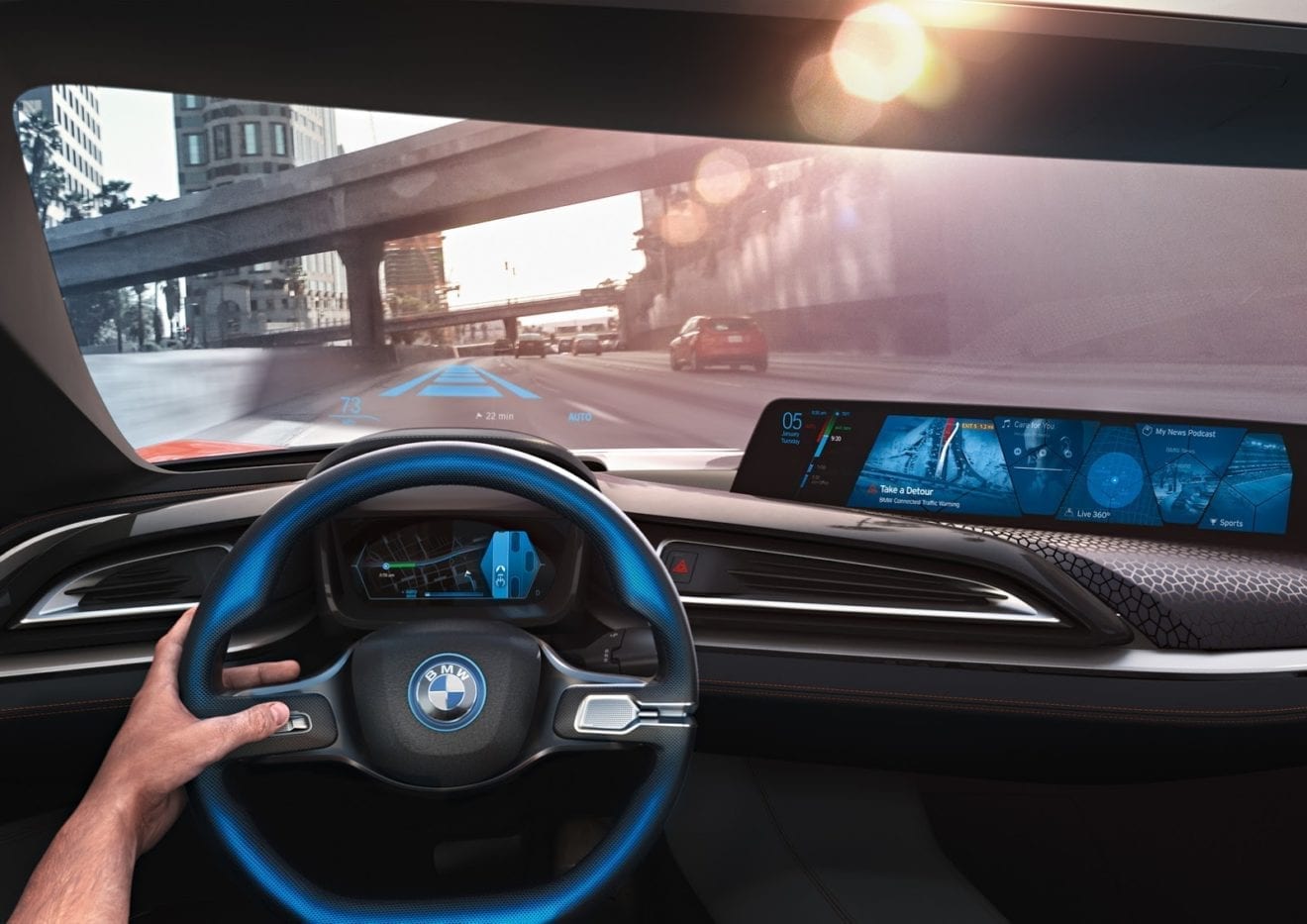
    The head of autonomous driving at BMW told the conference the luxury carmaker was on its way to deliver a level three autonomous car in 2021, but could produce level four or five autonomous cars in the same year.

    “We believe we have the chance to make level three, level four and level five doable,” he said. He told Reuters the decision on which levels to release would depend in part on the market, and that cars with more autonomy might first be produced in small batches for single fleets.

    Bosch said it saw level three vehicles being released with its on-board computer at the end of the decade, and level four driving not before 2025.

    Uber , Baidu and Google spin-off Waymo are testing self-driving taxis, while carmakers including Volvo, Audi and Ford expect to have level four cars on the road by 2020 or 2021.

    Nvidia’s Huang predicted those plans would speed up: “In the near future, you’re going to see these schedules pull in.”