Category: Automotive

Retail News Asia is committed to providing both local and global retailers with the latest Auto and Car news throughout the Asian market. This on a daily base.

  • Forbes Japan names Auto-cybersecurity Start-Up Trillium the ‘RISING STAR’ Startup

    Forbes Japan names Auto-cybersecurity Start-Up Trillium the ‘RISING STAR’ Startup

    Forbes Japan, the Tokyo-based edition of Forbes, one of the world’s most authoritative business news medias, celebrated entrepreneurs and Start-ups today at the Annual “JAPAN’S STARTUP” Awards, and the winner of the ‘RISING STAR’ STARTUP OF THE YEAR 2017 Award – Trillium Inc, a Tokyo-based Start-up that has developed a robust, comprehensive cybersecurity solution for the automotive industry.

    The Awards promote start-ups ready to create a ‘New Japan’ – leading the Japanese economy into the next age through innovation and entrepreneurial efforts. Finalists for the ‘RISING STAR’ 2017 were selected by the Forbes Japan editorial team with input from online readers. The winning Start-ups will be featured in the magazine’s Jan 2017 edition, which will appear on Nov 25.

    David Uze, Trillium CEO, an American who has lived in Japan for over 25 years, hopes Trillium can make a valuable contribution to his adopted country. “As autos and electronics are the bedrock of Japan’s prosperity, we believe our cybersecurity solution can help ensure the nation’s economic future. And we are grateful to Forbes Japan for recognizing the importance of our work.”

    “This is another indication that Trillium is on track to emerge as that rarest of creatures, a ‘Made-in-Japan Innovator,’” said Uze. “For automakers, cybersecurity is a mission as urgent as ending hydrocarbon use. Plans for innovation across-the-board depend on digitizing tomorrow’s cars: in emissions, safety, autonomous drive, driving dynamics and infotainment. But until they find an adaptive, multi-layered solution to cyber threats, all plans could come screeching to a halt with one devastating hack. The industry doesn’t yet have a solution – but we do, and we’re ready to go.”

    Trillium’s ‘Made-in-Japan solution’ strongly secures all three key ‘cyber-threat domains’ in the car with a software-based approach that is compatible with any architecture or operating system. More than just robust and comprehensive, it can be implemented for as little as 1/20th the cost of competing solutions – most of which are still under development.

    “Meanwhile, our multi-layered solution is at an advanced stage,” Uze said. “We have moved into the real-world testing phase via partnerships with a legendary Japanese Super GT racing team and a leading maker of automotive semiconductors. And we are now in discussions with a wide range of automakers and tier-one component suppliers. We’re ready to implement whenever they are.”

    Trillium Inc. was founded in 2014 with a team of executives and engineers from Japan, Europe and the U.S. with extensive experience in relevant fields, backed by lead investment from Global Brain Corp, a Tokyo-based venture capitalist.

  • Tesla to open its first Korean showroom on November 29th

    Tesla to open its first Korean showroom on November 29th

    The U.S.-based electric carmaker Tesla Motors will open its first Korean showroom at the Starfield Hanam shopping mall in Gyeonggi Province, Nov. 29.

    A Starfield Hanam official said he received an in-house notice of the Tesla showroom opening date.

    “However, the opening date may be moved up or delayed depending on Tesla’s preparations,” he added.

    Starfield Hanam, which had its grand opening on Sept. 9, is the largest shopping complex in Korea built as a joint venture between retail giant Shinsegae and U.S.-based shopping mall management company Taubman’s regional affiliate Taubman Asia.

    Before the grand opening, Tesla said Aug. 31 in a press release it would open its first Korean showroom on the second floor of the mall.

    The showroom is currently under construction, covered with a screen to hide the interior. However, Tesla has reportedly completed the ground construction for a charging station on the mall’s second-floor parking lot.

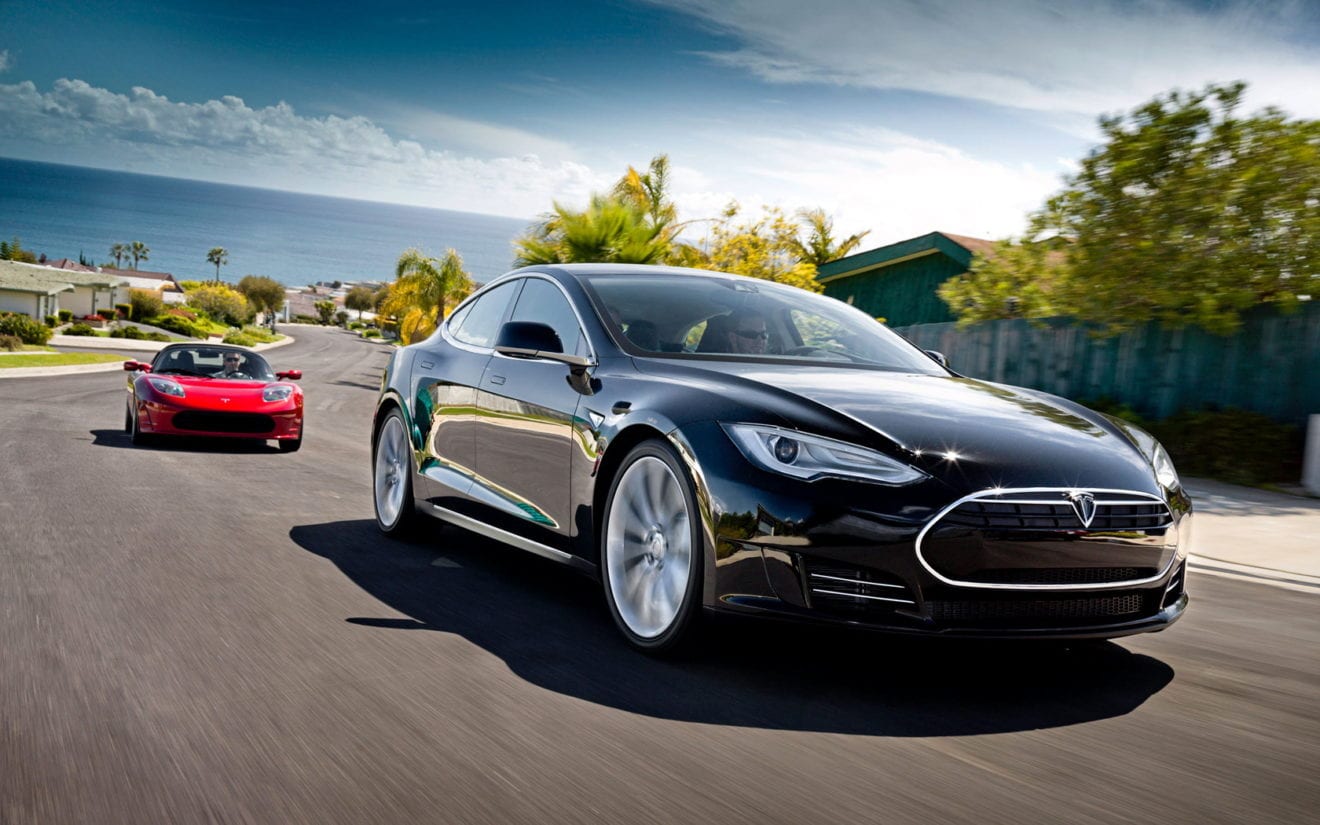
    The showroom will present Tesla’s Model S 90D, a full-size all-electric five-door luxury sedan.

    When the model was introduced in 2012, it received a perfect 5.0 from the U.S. National Highway Traffic Safety Administration (NHTSA) car safety rating. The U.S. Environmental Protection Agency (EPA) official range for the 2012 Model S equipped with an 85kWh battery pack is 426 kilometers.

    Tesla’s official webpage said the current Model S 90D’s range is 512 kilometers.

    Tesla has already received approval for emissions and noise standards from the Ministry of Environment, and is preparing for another approval with the Ministry of Land, Infrastructure and Transport (MOLIT). It is expected to take about two weeks to get MOLIT approval.

    Tesla is also preparing to open its second Korean showroom in Gangnam, southern Seoul.

    It reportedly signed a lease to rent a building in Cheongdam-dong on Sept. 1. It will use the building’s basement, first and second floors until Aug. 31, 2021.

    The Gangnam showroom is also currently under construction and Tesla officials visited the site last week to monitor the construction process.

    Tesla also announced last week via an email interview with ZDNet Korea, an IT-focused online newspaper, its plan to establish charging infrastructure in Korea.

    “Tesla is reviewing its plan to build a few supercharging stations in Seoul,” Atsuko Doi, Tesla’s head of communications for Asia Pacific, was quoted as saying.

    “We are discussing how to rent the sites for the charging stations.”

  • Jaguar Land Rover October sales up 11% at 46,325 units

    Jaguar Land Rover October sales up 11% at 46,325 units

    Tata Motors-owned Jaguar Land Rover (JLR) today reported 11 per cent increase in October retail sales of 46,325 units. The month’s performance has been driven by strong sales of the Land Rover Discovery Sport, Range Rover Evoque, Jaguar XF and the introduction of the Jaguar F-PACE, as well as strong year-on-year sales growth in China and Europe, JLR said in a statement.

    JLR Group Sales Operations Director Andy Goss said: “With our most engaging productline up to date, we are continuing to see positive sales momentum. Impressive performances across Europe and China have boosted our year-to-date sales to over 4,80,000 vehicles.”

    The company said its retail sales grew across majority of key regions in October year-on-year, with China up 39 per cent, Europe up 25 per cent, the UK and North America both up 8 per cent but other overseas markets were down 22 per cent.

    In the first ten months of 2016, JLR sold 4,80,349 vehicles, 23 per cent up on the same period in the prior year.

    The Jaguar brand recorded retail sales of 14,402 units in October, up 93 per cent on the previous year, reflecting the strong launch of the F-PACE and the introduction of the long- wheel base XFL in China, JLR said.

    Sales of the Land Rover brand however were down 6 per cent in October at 31,923 units. The company had ceased production of the Defender and Discovery in January 2016 and August 2016 respectively.

  • Bridgestone appoints M&C Saatchi Singapore as APAC AOR

    Bridgestone appoints M&C Saatchi Singapore as APAC AOR

    Bridgestone China & Asia Pacific has appointed M&C Saatchi Singapore as its agency of record (AOR) from January 2017 following a closed-door pitch involving four global agencies.

    This win follows the agency’s recent wins as AOR for Shell Retail Singapore and the social media accounts of NETS and Bank of Singapore.

    M&C Saatchi Singapore will partner with Bridgestone China and Asia Pacific to drive digital transformation of customer experience and related operational processes.

    The agency’s remit includes developing a through-the-line brand campaign, with a focus on a thorough revamp of the current website and social media strategy. Malaysia will be the first focus market for the agency.

    In a statement, Chris Yang, GM, Bridgestone China and Asia Pacific, said the agency impressed with “their understanding of consumer insights and how it translates into solutions for our brand and business across all touch points.”

    “Consumer experience has always been at the heart of what we do at Bridgestone,” he added.

    Tanuj Philip, CEO of M&C Saatchi Singapore, said the agency has been focused on building a specialist digital and social unit within the agency, and that the win is “a testament to the expertise and experience of the team”.

    “We look forward to partnering with Bridgestone to reinvent customer experience in the category,” he added.

  • Little Vespa for the wanderlust

    Little Vespa for the wanderlust

    Naza Premira Sdn Bhd, the official distributor of Vespa scooters in Malaysia, announced the arrival of the Vespa Sprint Adventure earlier this week. It is basically a customised Vespa Sprint 150cc ABS “designed with a unique adventurous look”, which probably means it is not quite ready to travel the world, but certainly looks the part.

    The Vespa Sprint Adventure is a derivative of the Vespa Sprint, which was launched by Naza last year. Among the features of the Sprint Adventure are sporty black matt details and travel accessories. Underneath the more rugged exterior is a new Piaggio i-Get 150cc single cylinder, four-stroke, air cooled engine with electronic injection. Pushing out 13hp at 7,750 rpm, and 12.8Nm of torque at 6,500 rpm, the little mill is quite efficient, giving gas mileage of up to 42 km/l (Measured by the World Motorcycle Test Cycle). The exhaust system is also a new unit, which Vespa says makes the engine quieter while at the same time giving “a more full and pleasant timbre”.

    The Sprint Adventure is also equipped with an ABS brake system. The accessories that differentiate the Vespa Sprint Adventure from the standard variation are a black front and rear carrier as well as a smoked fly screen. The accessories will be received and assembled separately at the dealership. The Sprint Adventure is available in Green Matt and Desert Sand and will retail at RM17,000, rather steep for a 150cc scooter, notwithstanding its adventure “credentials”. The standard Sprint was priced at 15k with GST at its launch last year. In conjunction with the launch of the new limited edition scooter, an adventure tour of South East Asia is being organised with a fleet of the Vespas ridden by journalists, “influencers”, celebrities, photographers and Vespa adventure lovers participating. The convoy will take them from Vietnam to Singapore.

    Malaysia will be represented by photographer Mark Teo. A social media contest will also be held. More details can be found on the official Vespa Sprint Adventure (VSA) Facebook page and Instagram profile. Fun Fact: The Guinness Book of Records states the minimum distance around the world to be 29,000km in their recognised round the world attempts.

    At 42 km/l, it would require just 690.5 litres of petrol for the Vespa Sprint Adventure to circumnavigate the earth. At the current Malaysian RON95 price of RM1.80 (which is not really possible since the scooter would be travelling around the world), it would cost just RM1,243 in fuel costs for the entire journey!

  • No Incentives for Hybrids in Thailand

    No Incentives for Hybrids in Thailand

    The Thai government rejects Toyota’s request to include hybrid vehicles in investment-incentive packages about to be offered for electric vehicles.

    Industry Ministry Permanent Secretary Somchai Harnhirun says the Board of Investment (BOI) will not include hybrids because government policy is to promote international-standard automobiles.

    The cabinet agreed in August to waive import tariffs on battery-electric vehicles (BEVs) and to give BOI incentives to investors who set up assembly plants for BEVs and produce critical parts such as batteries and motors within five years.

    Toyota Motor Thailand Senior Vice President Suparat Sirisuwannagkura argues the government should include hybrid vehicles in its promotion policy to keep them no more than 5% more expensive than pure internal-combustion-engine vehicles.

    Suparat argues hybrid technologies share some core technologies such as batteries and motors that producers could develop further for plug-in hybrid vehicles, BEVs and fuel-cell vehicles (FCVs) in the future. Moreover, EVs still have many limitations, especially in battery technology, and automakers may eventually bypass them and leapfrog to FCVs.

    Suparat says Toyota’s facility in Thailand has the capacity to develop more HEVs in the near future, “But a production volume of more than 100,000 vehicles and batteries a year will be tough to achieve without government support.”

    The Nation English-language newspaper reports Somchai told a seminar held by the Thailand Development Research Institute (TDRI) that the government does not pick winners.

    “We want to see real investment,” Somchai says. “We won’t be giving away our taxes for free, but we want a commitment as to what they will produce in the future.”

    TDRI researchers told the seminar the government must revamp the automobile excise tax structure to accurately reflect emission-release levels and be technology-neutral. They say that would make next-generation vehicles more competitive, increase buyer demand and make Thailand attractive as a manufacturing base for critical EV parts.

    TDRI President Somkiat Tangkitvanich says as global automotive trends tilt toward environmentally friendly vehicles, Thailand’s traditional non-alignment of energy and industrial policies could hinder the future of its local auto industry.

    A report quotes research fellow Wichsinee Wibulpolprasert saying Thailand’s ambition to develop EVs is unlikely to be realized any time soon because the domestic car market is not yet ready and its focus remains largely on conventional vehicles.

    She says while the government wants to generate a fleet of up to 1.2 million EVs and increase the number of charging stations to 690 by 2036, there are no clear policies on renewable energy and the environment.

    “The number of EVs and charging stations is just the final result,” Wichsinee says. “What is desperately needed for Thailand’s future automotive development is a solid background and fundamentals, which are renewable energy and environmentally friendly industry development plans.

    “EVs are an upcoming technology for the world’s automobiles, but the current situation is that excise tax for eco-friendly vehicles and conventional ones still overlap, making EV retail prices unattractive for buyers.”

    More importantly, Wichsinee says, the government has yet to launch any schemes to create a production hub for core components of EVs, such as batteries and motors, which are the building blocks of high-tech vehicles.

    She says that when the government waived customs duty for related components for assembling hybrids during 2011-2013, which cut retail prices by TB20,000 ($574), it boosted sales from 9,256 units in 2010 to 69,911 units in 2015.

    “The government should develop and stimulate demand for HEVs and PHEVs in the short run, with more tax incentives to support massive production,” she says.

  • Kia Soul Receives 2017 Consumer Guide Automotive Best Buy Award

    Kia Soul Receives 2017 Consumer Guide Automotive Best Buy Award

    Consumer Guide Automotive has awarded the Kia Soul one of its coveted Best Buy Awards for 2017 in the Subcompact Car segment, marking the third year in a row the fun-loving box car has received the award. Once again, the Soul’s funky personality resonated with the editors, along with its roomy interior, premium-looking cabin and long list of desirable features.

    “People gravitate toward the Soul because of its head-turning style, extensive feature content, and excellent value. Its practicality makes it a perfect fit for just about every type of lifestyle,” said Orth Hedrick, vice president product planning Kia Motors America. “Being recognized by Consumer Guide Automotive for a third consecutive year proves the Soul continues to be a crowd favorite, and with the new turbocharged version offered for 2017, we anticipate its popularity will surge to new heights.”

    For 2017, the Soul gains a 201-hp 1.6-liter turbocharged engine for more fun than ever. Though the 1.6-liter turbo engine adds 40 horsepower, fuel economy is 28 miles-per-gallon, city and highway combined1 —slightly better than the combined mileage of the 2.0-liter normally-aspirated 161-hp engine in the Soul Plus and in the Soul Base 1.6-liter, which produces 130 horsepower. Performance in the turbocharged Exclaim is further enhanced by the addition of a new 7-speed Dual Clutch Transmission (DCT), which contributes to a more engaging driving experience. Other new options for the 2017 model year are convenience systems such as Rear Cross Traffic Alert and Blind Spot Detection. The 2017 Exclaim also gets standard UVO32 with e-Services with integrated Android Auto and Apple CarPlay.

    Each year Consumer Guide Automotive editors select the best vehicles from 20 segments to receive Best Buy Awards, with vehicle price and value being major factors in their selection process. By prioritizing these key consideration points in the car-buying process, the Consumer Guide Automotive Best Buy Awards serve a practical purpose to everyday car shoppers. Celebrating its 50th Anniversary in 2017, Consumer Guide Automotive is one of the most trusted names in the automobile industry.


  • eHi Car Services Announces Third Quarter 2016 Results

    eHi Car Services Announces Third Quarter 2016 Results

    eHi Car Services Limited rentals and car services provider in China, today announced its unaudited financial results for the third quarter ended September 30, 2016.

    Third Quarter 2016 Highlights

    • Net revenues increased by 47.8% year-over-year to RMB582.1 million (US$87.3 million[1]) for the third quarter of 2016, from RMB393.8 million for the third quarter of 2015.

    Three months ended September 30,

    Year-Over-Year

    (RMB ‘000)

    2015

    2016

    Comparison

    Car rentals

    300,700

    464,271

    54.4%

    Car services

    93,080

    117,783

    26.5%

    Total Net

    Revenues

    393,780

    582,054

    47.8%

    Gross profit[2] increased by 83.9% year-over-year to RMB165.7 million (US$24.8 million) for the third quarter of 2016, from RMB90.1 million for the third quarter of 2015. Gross profit margin[2] increased to 28.5% for the third quarter of 2016, from 22.9% for the third quarter of 2015.

    • Net income increased by 269.5% year-over-year to RMB22.3 million (US$3.3 million) for the third quarter of 2016, from RMB6.0 million for the third quarter of 2015. Net income margin increased to 3.8% for the third quarter of 2016, from 1.5% for the third quarter of 2015.
    • Non-GAAP adjusted EBIT[3] increased by 97.4% year-over-year to RMB80.6 million (US$12.1 million) for the third quarter of 2016, from RMB40.8 million for the third quarter of 2015. Non-GAAP adjusted EBIT margin[3]increased to 13.8% for the third quarter of 2016, from 10.4% for the third quarter of 2015.
    • Non-GAAP adjusted EBITDA[4] increased by 60.0% year-over-year to RMB264.5 million (US$39.7 million) for the third quarter of 2016, from RMB165.3 million for the third quarter of 2015. Non-GAAP adjusted EBITDA margin[4]increased to 45.4% for the third quarter of 2016, from 42.0% for the third quarter of 2015.
    • Total average available fleet size[5] increased by 46.5% year-over-year to 41,742 vehicles for the third quarter of 2016, from 28,499 vehicles for the third quarter of 2015. Total fleet RevPAC[6] increased to RMB152 for the third quarter of 2016, from RMB150 for the third quarter of 2015.

    [1] The Company’s business is conducted in China and substantially all of its revenues are denominated in Renminbi (RMB). However, this earnings announcement contains translations of RMB amounts into U.S. dollars (US$) at specified rates solely for the convenience of the reader. Unless otherwise noted, all translations from RMB to U.S. dollars are made at a rate of RMB6.6685 to US$1.00, the effective noon buying rate as of September 30, 2016 in The City of New York for cable transfers of RMB as certified for customs purposes by the Federal Reserve Bank of New York.

    [2] Gross profit is defined as net revenues less cost of net revenues (vehicle operating expenses).  Gross profit margin is defined as the percentage representing gross profit divided by net revenues.

    [3] Non-GAAP adjusted EBIT is defined as net income before share-based compensation, interest expenses, interest income, provision for income taxes, gains from waiver of warrants and gains from sale of cost method investment. For more information, refer to “About Non-GAAP Financial Measures” and “Reconciliation of GAAP and Non-GAAP Results” at the end of this press release. Non-GAAP adjusted EBIT margin is defined as the percentage representing Non-GAAP adjusted EBIT divided by net revenues.

    [4] Non-GAAP adjusted EBITDA is defined as net income before depreciation and amortization, share-based compensation, interest expenses, interest income, provision for income taxes, gains from waiver of warrants and gains from sale of cost method investment. For more information, refer to “About Non-GAAP Financial Measures” and “Reconciliation of GAAP and Non-GAAP Results” at the end of this press release. Non-GAAP adjusted EBITDA margin is defined as the percentage representing Non-GAAP adjusted EBITDA divided by net revenues.

    [5] “Average available fleet size” is calculated by dividing the aggregate number of days in which the Company’s fleet was in operation during a given period by the total number of days during the same period. In determining the size of the Company’s fleet in operation, eHi includes all vehicles in its car rentals and/or car services fleets except for vehicles that have been written off in accordance with its accounting policy and vehicles that have not been consistently made available for rent and that it may consider to dispose of when appropriate opportunities arise.

    [6] “RevPAC” refers to average daily net revenue per available car, which is calculated by dividing the net revenues during a given period by the aggregate number of days in which the Company’s fleet was in operation during the same period.


    Average Available

    Fleet Size

    RevPAC

    (RMB)

    2015Q3

    2016Q3

    Year-Over-Year

    Comparison

    2015Q3

    2016Q3

    Year-Over-Year

    Comparison

    Car rentals

    26,200

    39,227

    49.7%

    125

    129

    3.2%

    Car services

    2,299

    2,515

    9.4%

    440

    509

    15.7%

    Total

    28,499

    41,742

    46.5%

    150

    152

    1.3%

    • Fleet utilization rate[7] for car rentals was 71.9% for the third quarter of 2016, compared with 73.8% for the third quarter of 2015.
    • As of September 30, 2016, total period-end fleet size[8] was 48,934 vehicles.

    [7] “Fleet utilization rate” refers to the aggregate transaction days for the Company’s car rental fleet during a given period divided by the aggregate days the car rental fleet was in operation during the same period.

    [8] “Period-end fleet size” refers to the aggregate number of vehicles in the Company’s car rentals and car services fleets as of the last day of a given period which the Company holds legal title to and reflects in its balance sheet, including vehicles that are currently missing but have not been written off in accordance with its accounting policy. The period-end fleet size as of September 30, 2016 excluded 144 vehicles which the Company had written off from its balance sheet in accordance with its accounting policy.

    Mr. Ray Zhang, eHi’s Chairman and Chief Executive Officer, said, “Our business continued to thrive during the third quarter, leading to both strong top-line growth and significant improvement in profitability. As a fast-growing company, we are committed to driving ongoing operating leverage and are well-positioned to capture the growing demand from China’s rapidly rising domestic tourism and business-related travel.”

    “The recent regulations regarding online car-hailing business in China, we believe, provide us with greater potential to explore business and strategic cooperation opportunities to enhance our competitive position. Looking ahead, we remain focused on continuing to execute on our growth plan and achieving our strategic objectives,” Mr. Zhang concluded.

    Mr. Colin Sung, eHi’s Chief Financial Officer, said, “We are pleased to report strong third quarter results with net revenues increasing by 47.8% year-over-year, while recording 269.5% bottom-line growth from the prior-year period. Notably, our continued focus on operating efficiency and cost control measures contributed to broad-based margin improvement. Our gross margin and non-GAAP adjusted EBITDA margin both reached record-highs of 28.5% and 45.4%, respectively. Our financial discipline is well-established, and we remain committed to prudent expansion and a balanced approach between growth and profitability.”

    Third Quarter 2016 Financial Results

    Net revenues for the third quarter of 2016 were RMB582.1 million (US$87.3 million), up 47.8% year-over-year, attributable to increased net revenues from both car rentals and car services.

    Net revenues from car rentals for the third quarter of 2016 were RMB464.3 million (US$69.6 million), up 54.4% year-over-year, primarily driven by the growing average available fleet size for car rentals in response to customer demand.

    Net revenues from car services for the third quarter of 2016 were RMB117.8 million (US$17.7 million), up 26.5% year-over-year, primarily driven by the increased car services RevPAC as we provided services to more business clients.

    Cost of revenues (vehicle operating expenses) for the third quarter of 2016 was RMB416.4 million (US$62.4 million), up 37.1% year-over-year, primarily driven by increased depreciation and labor costs.

    In the third quarter of 2016, 486 used vehicles were disposed of, and 358 used vehicles were under sales contracts pending title transfer. The Company recognized a disposal loss of RMB0.3 million (US$0.04 million) in aggregate for these 844 vehicles. In addition, a disposal gain of RMB0.7 million (US$0.1 million), which was unrecognized in the previous quarters, was recognized in the third quarter of 2016 as a result of the completion of title transfer during such period. The disposal loss and gain were both recognized as adjustments to the vehicle-related depreciation expense as part of the cost of revenues.

    Gross profit for the third quarter of 2016 was RMB165.7 million (US$24.8 million), up 83.9% year-over-year. Gross profit margin for the third quarter of 2016 was 28.5%, compared with 22.9% for the third quarter of 2015. Gross profit margin improvement was due to certain cost controls primarily in vehicle insurance, and to a lesser extent, in vehicle repair and maintenance as well as labor costs, in connection with enhanced economies of scale and operating efficiency.

    Selling and marketing expenses for the third quarter of 2016 were RMB28.5 million (US$4.3 million), up 81.8% year-over-year, primarily due to increased channel marketing and promotion fees as the Company expanded branding and channel promotion activities during such period.

    General and administrative expenses for the third quarter of 2016 were RMB63.1 million (US$9.5 million), up 38.6% year-over-year, primarily due to increased employee-related costs including salaries and welfare expenses as a result of increased headcount, as well as a foreign exchange loss in the third quarter of 2016 compared with a foreign exchange gain in the third quarter of 2015.

    Profit from operations for the third quarter of 2016 was RMB77.0 million (US$11.5 million), up 124.2% year-over-year.

    Interest expense for the third quarter of 2016 was RMB55.7 million (US$8.3 million), up 79.5% year-over-year, primarily attributable to the interest expense associated with the Company’s senior unsecured notes of US$200 million due 2018.

    Net income for the third quarter of 2016 was RMB22.3 million (US$3.3 million), up 269.5% from RMB6.0 millionfor the third quarter of 2015. Net income margin for the third quarter of 2016 was 3.8%, compared with 1.5% for the third quarter of 2015.

    Basic and diluted earnings per ADS for the third quarter of 2016 were RMB0.32 (US$0.05) each, compared with basic and diluted earnings per ADS of RMB0.09 (US$0.01) each for the third quarter of 2015.

    Non-GAAP adjusted EBIT for the third quarter of 2016 was RMB80.6 million (US$12.1 million), up 97.4% year-over-year. Non-GAAP adjusted EBIT margin for the third quarter of 2016 was 13.8%, compared with 10.4% for the third quarter of 2015.

    Non-GAAP adjusted EBITDA for the third quarter of 2016 was RMB264.5 million (US$39.7 million), up 60.0% year-over-year. Non-GAAP adjusted EBITDA margin for the third quarter of 2016 was 45.4%, compared with 42.0% for the third quarter of 2015.

    As of September 30, 2016, the Company’s cash, cash equivalents and restricted cash balance was RMB1.5 billion (US$223.7 million).

    Recent Development

    On August 30, 2016, the Company entered into a US$150 million syndicated loan facility agreement. This loan facility agreement includes an initial facility of US$110 million and a greenshoe facility of US$40 million. The loan facilities have a three-year term and will be repaid in installments. The interest margin is priced at 350 basis points per annum over LIBOR. Deutsche Bank AG, Singapore Branch is acting as the original mandated lead arranger of the loan facilities. The Company had fully drawn down the US$150 million facility as of September 27, 2016, and used part of the proceeds for repaying certain existing indebtedness with high interest rates. The remaining proceeds will be used for funding capital expenditures and other general corporate purposes of the Company.

    Outlook

    The Company estimates that net revenues for the full year of 2016 will range from RMB2.1 billion to RMB2.2 billion, and total period-end fleet size will reach approximately 57,000 vehicles as of December 31, 2016. This outlook reflects the Company’s current and preliminary view, which is subject to change.

  • Volkswagen aims to sell 400,000 new energy vehicles a year in China by 2020

    Volkswagen aims to sell 400,000 new energy vehicles a year in China by 2020

    Volkswagen aims to boost new energy vehicle sales in China to 400,000 units a year by 2020, the automaker’s China chief Jochem Heizmann said, as Beijing pushes automakers to sell low-emissions cars via incentives and friendly regulations.

    It aims to eventually sell 1.5 million new energy vehicles (NEVs) annually by 2025, Heizmann told reporters ahead of the Guangzhou auto show, which opens on Friday.

    “We have to do more in the NEV area. The government is pushing, the general environment in China is pushing that,” Heizmann said.

    Overall sales of NEVs in China more than quadrupled last year with rapid growth continuing in 2016.

    Volkswagen will deliver its first locally produced NEVs, as battery electric and plug-in hybrid cars are referred to in China, under its Audi brand this year.

    Audi AG manufactures the vehicles in a joint venture with China FAW Group.

    Volkswagen also has a JV with SAIC Motor (600104.SS), and the two companies have plans to sell plug-in hybrid cars in China in the future.

    Global auto brands are only allowed to manufacture cars domestically in China through ventures with local partners, with automakers typically limited to two JV partners.

    Volkswagen said in September that it had signed a preliminary deal to explore making electric vehicles in a new joint venture with China’s Anhui Jianghuai Automobile.

    The deal is not final and is subject to approvals.

    “We are making good progress in our feasibility study with JAC,” Heizmann said.

    He said he was hopeful the government would allow what would be Volkswagen’s third JV in China, with the government pushing for less-polluting vehicles.

    “Normally the legal framework is you are only allowed to have two joint ventures. There is a special chance to have this additional joint venture just on pure battery cars,” Heizmann said.

  • Mazda Unveils the All-New CX-5

    Mazda Unveils the All-New CX-5

    Mazda Motor Corporation today unveiled the all-new Mazda CX-5 crossover SUV. The fully redesigned model, which refines every element of Mazda’s design and technology to offer new dimensions of driving pleasure, will be launched in Japan in February before being rolled out to global markets.

    The slogan for development of the all-new CX-5 was “an SUV all customers will enjoy,” and Mazda aimed to add a new dimension by offering driving pleasure that everyone on board can enjoy—not just the driver. The model is engineered in line with human sensibilities to deliver responsive performance that conforms to the driver’s expectations. It also prioritizes passenger comfort, with a quiet cabin and pleasant ride feel, and adopts G-Vectoring Control, the first of the SKYACTIV-VEHICLE DYNAMICS vehicle motion control technologies. Designed under the KODO—Soul of Motion design theme, the exterior is both bold and sensual, and the interior has been crafted to give occupants a pleasant feeling. The body color lineup includes the newly developed Soul Red Crystal, which highlights the beauty and quality of Mazda’s KODO designs.

    The powertrain lineup comprises the SKYACTIV-G 2.0 and 2.5 gasoline, and SKYACTIV-D 2.2 diesel engines. All three options offer powerful, linear driving performance and outstanding environmental performance.

    The all-new CX-5 will be on display at the Los Angeles Auto Show, open to the public Nov. 18-27.

    Launched in 2012, the CX-5 was the first new-generation model featuring SKYACTIV technology2 and KODO design. It has since grown into a core model that is sold in over 120 countries and accounts for approximately one quarter of Mazda’s global sales volume.3 It has won around 90 awards worldwide, including 2012-2013 Japan Car of the Year.4

    By providing driving pleasure to everybody who drives or rides in one of its vehicles, Mazda aims to enrich people’s lives and become a brand with which customers feel an emotional connection.

  • Jaguar Electrifies With I-PACE Concept Car

    Jaguar Electrifies With I-PACE Concept Car

    Jaguar’s engineering and design teams have torn up the rule book to create a bespoke electric architecture, matched with dramatic design. The result is no-compromise smart, five seat sports car and a performance SUV in one.

    Ian Callum, Director of Design, said: “The I-PACE Concept represents the next generation of electric vehicle design. It’s a dramatic, future-facing cab-forward design with a beautiful interior – the product of authentic Jaguar DNA, electric technology and contemporary craftsmanship.

    “Our virtual reality reveal today has pushed technology boundaries as well, and captures the hi-tech essence of the concept car. We only have one concept car and it is in LA for the reveal. For the first time, VR has allowed us to share it across the globe in the most immersive way possible.”

    This unique and world-first ‘social VR’ reveal is believed to be the largest live and connected VR event of its type to date. Throughout the day more than 300 guests were transported into a specially created life-like virtual space, into which, two of the car’s creators, Ian Callum and Ian Hoban were projected.

    From VR hubs in Los Angeles and London, groups of 66 guests including A-list stars Michelle Rodriguez, Miranda Kerr, James Corden and David Gandy, used HTC Vive Business Edition headsets, powered by Dell Precision workstations, to put themselves inside the concept car and interact live with other participants. Guests ‘sat’ on the concept’s virtual seats, had a 360[0] view of Venice Beach as the concept was built piece by piece around them, and saw the I-PACE Concept race towards them across a virtual desert.

    Dr Wolfgang Ziebart, Jaguar Land Rover, said: “This is an uncompromised electric vehicle designed from a clean sheet of paper: we’ve developed a new architecture and selected only the best technology available.”

    The I-PACE Concept transforms the electric driving experience and offers the driver-focused performance and response Jaguar is renowned for. To help deliver this, the I-PACE has electric motors on the front and rear axles. Their combined output is 400PS and 700Nm of torque – the same torque rating as the F-TYPE SVR, accelerating from 0-60mph in around four seconds. For rapid charging, using a typical public 50 KW DC charging network, a full charge will take just over 2 hours – enough to deliver more than 220 miles range.

    The virtual reality experience also allowed participants to sit in the front and rear of the Jaguar I-PACE Concept and explore the beautiful interior, discovering hidden details and features.

    Ian Callum said: “The interior of the I-PACE Concept is finished with beautiful, premium materials and an unwavering attention to detail. From the expansive panoramic glass roof to the sporting, beautifully finished seats, every feature bears the hallmark of British craftsmanship.”

    Renowned VR Director, Alexander Horton, led the creative direction. Participants experienced the car being built around them, speeding towards them and appearing to fall to Earth from another planet – clearly signalling the future-forward nature of the revolutionary Jaguar.

    The new and exciting VR platform pushed the boundaries further than ever before, with the inclusion of social interaction and a live presenter broadcast into a single VR world, so groups in both LA and London were able to communicate and interact with one another.

    The VR content from the reveal will now be available on Vive Port through a dedicated Jaguar app allowing consumers to experience the I-PACE Concept at home.

    Jaguar joined forces with VR leaders HTC, Computer experts Dell and Creative agencies ReWind and Imagination to create the world’s largest, global, connected VR experience.

    Hervé Fontaine, Vice President Virtual Reality B2B and Business Development at HTC said: “Jaguar Land Rover is renowned for its innovative spirit, and with Vive Business Edition we’re thrilled to be the virtual reality partner to help bring to life their latest launch. With the blend of cinematics and Vive’s room-scale VR technology, the I-PACE Concept VR experience offers an incredible level of immersion, and showcases an exciting reimagining of the traditional car launch as we know it.”

    Rahul Tikoo, Vice President and General Manager for Dell Precision, said: “Dell has long been involved in VR, and we’ve been evolving our business model to introduce solutions that are optimized for the future of VR. The Jaguar I-PACE Concept, designed and introduced with VR, reinforces the incredible innovation that’s possible with VR technologies and the potential to ultimately transform industries.”

    Ross Wheeler, Head of Automotive at Imagination, said: “For the first time in history, a global automotive brand has used fully immersive VR to launch their latest car. This launch takes the individual far beyond any new car experience they would have witnessed before, allowing people across the globe to connect in real time, be fully immersed within the vehicle and share live together their experience of Jaguar’s first ever electric vehicle.”

    “Jaguar, by embracing cutting-edge technology in this way, has created an experience rich and rewarding for its consumers. It has undoubtedly redefined the future of how automotive brands introduce their new vehicles to customers.”

    The Concept will make its first public physical appearance at the 2016 Los Angeles Auto Show on Wednesday 16 November.

  • Fiat Chrysler, Cummins reject diesel cheating suit

    Fiat Chrysler, Cummins reject diesel cheating suit

    Fiat Chrysler Automobiles NV and Cummins Inc said on Monday they will fight a class-action lawsuit filed against the companies accusing them of cheating on diesel emissions tests.

    On Monday, lawyers representing owners of older 2500 and 3500 Dodge Ram trucks filed a class-action lawsuit in U.S. District Court in Detroit, asserting the companies “conspired to knowingly deceive consumers and regulators of illegally high levels of diesel emissions in their vehicles.”

    The suit accuses the automakers of fraud, violating the Racketeer Influenced and Corrupt Organizations Act and consumer-protection laws by intentionally misleading the public, concealing emissions levels and illegally selling noncompliant polluting vehicles.

    The suit filed by Seattle lawyer Steve Berman said the emissions catalysts are not durable and do not meet emission standards, and that at times emissions are nearly 10 times legal limits.

    The class action suit comes as Fiat Chrysler and Cummins are fighting over the costs of an emissions recall involving a different, newer population of trucks.

    Fiat Chrysler said in a statement it “does not believe that the claims brought against it are meritorious” and the company “will contest this lawsuit vigorously.”

    Cummins spokesman Jon Mills said the lawsuit “has no merit. We are obviously disappointed in the effort to tarnish our image and we plan to vigorously defend ourselves.”

    The suit covers owners of 2007–2012 Dodge Ram 2500 and 2007–2012 Dodge Ram 3500 pickup trucks.

    Reuters reported on Oct. 10 that Fiat Chrysler and Cummins Inc have been fighting over the $200 million estimated cost for a recall of 130,000 newer 2500 Ram pickup trucks equipped with Cummins diesel engines that could exceed U.S. pollution limits.

    The U.S. Environmental Protection Agency and California Air Resources Board have demanded a recall of 2013-2015 model year Ram 2500 pickup trucks with 6.7L Cummins diesel engines because moisture can lead to the deactivation of the selective catalyst reduction system, causing excess nitrogen oxide emissions, Cummins said.

    Fiat Chrysler has sued Cummins to recover the $60 million it has spent to date repairing 42,000 trucks at its own expense, a company lawyer said in court documents. Settlement talks are ongoing.

    Cummins counter-sued, saying Fiat Chrysler would not cooperate in the recall “for one reason – money” and said the automaker was “holding both Cummins and its own customers hostage.”

    When the emissions system fails, the warning light goes on and if the vehicle isn’t fixed soon the vehicles go into “limp mode” that allow them to only be driven very slowly.

  • BMW eyes 100,000 electric car sales in 2017

    BMW eyes 100,000 electric car sales in 2017

    BMW wants to boost sales of electric cars by two-thirds next year to 100,000 vehicles as the luxury automaker is offering more battery-powered models, citing Chief Executive Officer Harald Krueger.

    Munich-based BMW expects to increase its deliveries of fully electric and hybrid vehicles to around 60,000 units this year, Krueger said. Sales of battery-powered BMW models have totaled about 100,000 cars since 2013, he noted.

    “Electric mobility will come, but demand is not going through the roof at the moment,” the newspaper quoted Krueger as saying.

    To help improve sales, BMW is also increasing the battery range of its i3 city vehicle by 50 percent this year. The i3, BMW’s only fully battery-powered car, sold only 25,000 units last year.

    The company, which has dropped behind Daimler’s Mercedes-Benz in global luxury-car sales rankings, wants to expand the share of electric cars and hybrid models to between 15 percent and 25 percent of sales by 2025, the newspaper reported.

  • Volkswagen’s Audi in talks with China’s SAIC Motor on tie-up

    Volkswagen’s Audi in talks with China’s SAIC Motor on tie-up

    Volkswagen’s Audi premium brand is in talks with China’s largest automaker, SAIC Motor, on a potential long-term collaboration, Audi said in a statement on Monday.

    Reuters reported on Saturday, citing a source familiar with the matter, that the two had signed an agreement that could pave the way for Volkswagen’s joint venture with SAIC to make Audi brand cars.

    An early entrant to China, the world’s largest car market, Audi is the best-selling premium car brand although it is rapidly losing ground to newer car models from Daimler’s Mercedes-Benz and non-German automakers like Toyota’s Lexus and General Motor’s Cadillac.

    Audi cars are now only made in China through a joint venture with China FAW Group, providing a lifeline to a state-owned company whose own brand cars have struggled with falling sales.

    Audi reaffirmed its commitment to FAW in the release announcing the talks with SAIC, saying it had outlined growth plans with FAW for the next 10 years that include making green energy SUVs and sedans in every major segment.

    Audi will also form a new joint venture company with FAW to be based in Beijing and focus on mobility and digital services, according to the statement.

  • Save the Date for Volvo Group Capital Market Day 2017

    Save the Date for Volvo Group Capital Market Day 2017

    The Volvo Group invites financial analysts and institutional investors to the Volvo Group Capital Market Day, to be held in Eskilstuna, Sweden on May 23, 2017.

    The Capital Market Day on May 23 will start at 9:00 a.m. at Volvo CE Customer Center in Eskilstuna, Sweden, and finish with a dinner in the evening. The program will include presentations by the CEO and the Executive Management as well as the possibility to test drive products.

    A formal invitation with a complete agenda and registration information will follow in early spring 2017. Further information will also be made available on the Volvo Group website well in advance of the event.

    The Volvo Group is one of the world’s leading manufacturers of trucks, buses, construction equipment and marine and industrial engines. The Group also provides complete solutions for financing and service. The Volvo Group, which employs about 100,000 people, has production facilities in 18 countries and sells its products in more than 190 markets. In 2015 the Volvo Group’s sales amounted to about SEK 313 billion (EUR 33,4 billion). The Volvo Group is a publicly-held company headquartered in Göteborg, Sweden. Volvo shares are listed on Nasdaq Stockholm.