Category: Electronics

Retail News Asia is committed to providing both local and global retailers with the latest Electronics news throughout the Asian market. This on a daily base.

  • Samsung ranks second in 2018 U.S. patent grants

    Samsung ranks second in 2018 U.S. patent grants

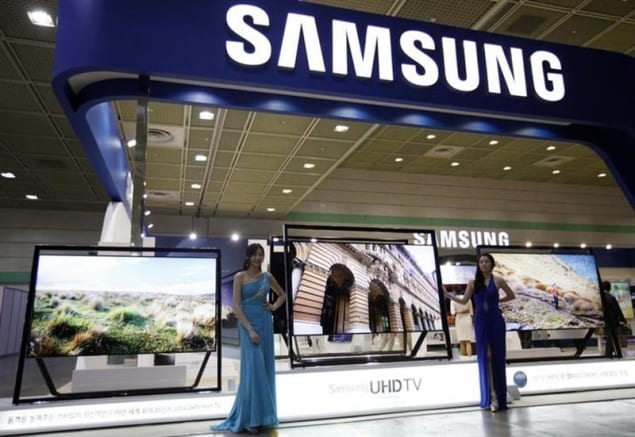
    Samsung Electronics grabbed the No. 2 spot in U.S. patent grants among global corporate giants in 2018, industry data showed Thursday. Samsung Electronics, the world’s top smartphone and memory chip maker, received 5,850 U.S. patent grants last year, up 13 from the previous year, according to the data from IFI Claims Patent Services, provider of a top global patent data platform.

    IBM topped the list with 9,100 grants, up 1 percent from a year earlier, maintaining the U.S. company’s position as top patent leader for a 26th consecutive year.

    Canon followed Samsung with 3,056. Intel came next with 2,735 then LG Electronics with 2,474. All registered declines from a year earlier.

    Other Korean firms included Samsung Display, which ranked 14th with 1,948 grants. Hyundai Motor placed 19th with 1,369.

    Last year, U.S. patent grants totaled 308,853, down 3.5 percent from the previous year.

    By country, the United States took up the largest share, at 46 percent, followed by Japan with 16 percent, Korea with 6.5 percent, Germany with 5 percent and China 4 percent.

    China was the only major patenting country to report an on-year increase in the 2018 patent grants.

  • Kutchina opens second store in Nepal

    Kutchina opens second store in Nepal

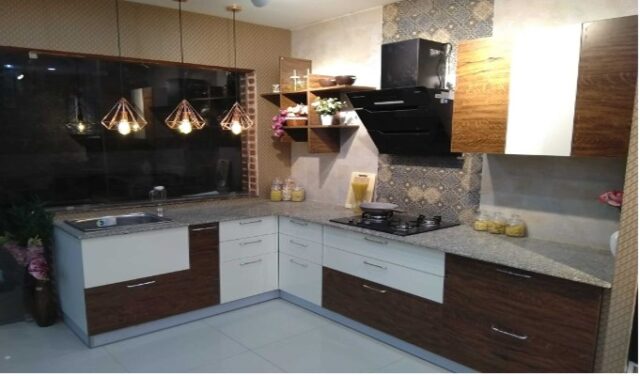
    Kutchina has opened its second store in Kathmandu spanning across 500 sq.ft. Targeting middle and higher income group customers, the store offers complete kitchen solutions including entire range of big appliances and modular kitchen. Look and feel of the store is a mixture of Kutchina’s modern concept with a traditional touch of Nepal’s rich culture. The walls of the store are given a look of Brick Mounting which resembles traditional houses of Nepal and adds that wow factor to the store.

    Designed by in-house designers, the store highlights all the elements of the products with the use of LED and Track lights. At present, the brand has 20 stores in India and 2 in Nepal.

  • Samsung plans to release robots this year

    Samsung plans to release robots this year

    Samsung robots are coming this year. Kim Hyun-suk, president and head of Samsung Electronics’ consumer electronics division, said the company has been conducting research on the robotics market and is now preparing to launch several robots this year during a press conference with reporters on Monday, a day prior to the opening of the Consumer Electronics Show (CES) in Las Vegas.

    Until now, Samsung Electronics has stayed mum on whether it is making robots. “To develop robots, it’s important to have an artificial intelligence [AI] platform ready [to mount on the robots],” Kim said. “That AI platform is almost ready.”

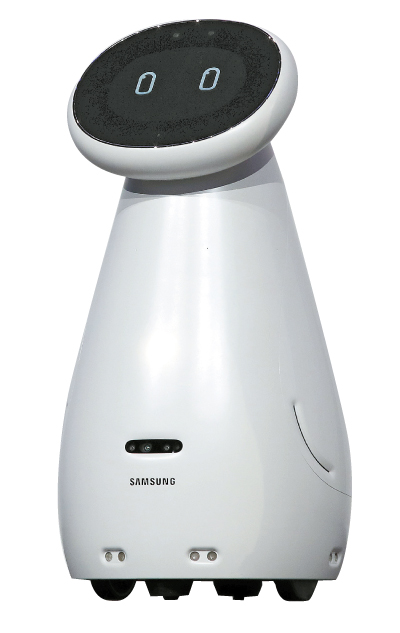
    Samsung unveiled three variations of its AI-based robot, dubbed Samsung Bot, at the briefing, revealing its robotics technology for the first time.

    The three Samsung Bots, labeled Care, Air and Retail, are designed to aid people’s health, and improve air quality and retail shop management. Samsung Bot Care, for instance, monitors users’ vitals like blood pressure and heartbeat and helps people take medicine at the right time. The robot can also call 119 and contact family members when it senses an emergency such as a heart attack.

    The electronics giant also introduced its wearable robot, dubbed GEMS. It assists people with difficulty walking due to weak muscles or injuries and reduces physical pain in the knees and ankles.

    “I can’t say for sure when the products introduced today will be commercialized,” Kim said. “There are possibilities that robot products not introduced yet could be commercialized first.”

    Kim added that demand for robots is expected to increase, especially due to societal aging, pointing out that robots like Samsung Bot Care will be useful for the elderly.

    “By exploiting Samsung’s know-how in AI, Internet of Things and developing multiple devices, we are considering our options for various types of robots,” Kim said.

    On concerns of whether Samsung’s own AI engine Bixby is losing ground due to the company’s AI partnerships with tech giants like Google and Amazon, Kim said that is a “misunderstanding.”

    Though Amazon’s Alexa AI assistant and Google Assistant may be a step ahead of Bixby in terms of technology and presence in the global market, Kim said partnerships make Bixby stronger, not weaker.
    The important thing, according to Kim, is that when people ask Bixby a question, the AI will be able to give out answers based on its own knowledge or by utilizing data from Google or Amazon.

    “No company has strengths in every aspect of business,” Kim said. “Though Bixby is a latecomer [to the AI assistant market], Samsung has relative strength in making devices compared to other tech companies, and Google and Amazon will focus on what they are good at.”

    Kim also commented on LG Electronics’ rollable TV that made headlines globally. LG’s rollable TV prototype can roll itself into a storage box that becomes a table with speakers.

    According to the Samsung president, there needs to be considerations on whether the product can be “economical.” He added that without the economic feasibility to commercialize the product, the prototype is a lot less meaningful.

    Brian Kwon, head of LG’s home entertainment division, said in a separate press briefing Tuesday in Las Vegas that the company will make rollable TVs its future growth engine.

    On concerns about the product’s cost, Kwon said while the price may be a barrier in widely expanding sales of the product right after launch, the company will strive to quickly improve the TV’s cost competitiveness.

  • Chinese Smartphone Realme Eyes to Expand Southeast Asia

    Chinese Smartphone Realme Eyes to Expand Southeast Asia

    BBK Electronics’ budget smartphone brand Realme is eyeing expansion into Southeast Asia, Africa and Europe. The company’s online distribution strategy has brought it success in the Indian market and makes broader expansion possible, according to Realme global CEO Sky Li Bingzhong. “The company’s asset-light operations and focus on online sales allow it to keep costs low. That way, more young consumers can afford its products, which makes the brand more competitive in the market,” said Li.

    Realme launched in India in May last year with handsets priced at INR8,990 (US$129) – becoming the second top-selling smartphone brand during the Diwali festival season from October to November. The brand has joined a number of Chinese phone manufacturers seeking to build strength in the Indian market as they challenge more established international competitors in more saturated markets.

    BBK also owns the Oppo, Vivo and OnePlus brands, selling mid- to high-end models. Independent Realme runs its own R&D operations, but partners with Oppo in smartphone production. Its expansion moves are indicative of Chinese phone manufacturers’ larger strategy to deploy varying brands that each target specific markets globally.

  • LG H&H buys Avon factory in China

    LG H&H buys Avon factory in China

    LG Household & Health Care announced Wednesday it is buying Avon’s Chinese factory in an effort to expand production facilities. According to LG Household, subsidiary The Face Shop will purchase the London-based cosmetics firm’s factory in Guangzhou, China, for around 79.3 billion won ($70.8 million). Avon’s 49,500-square-meter (12.25-acre) factory in Guangzhou, China is capable of producing 13,000 tons of cosmetics and hair care and body products every year. Its facilities meet cGMP (current Good Manufacturing Practice) regulations, which are enforced by the U.S. Food and Drug Administration.

    LG Household will use the Guangzhou factory to manufacture LG products like The Face Shop branded goods for its Chinese and other Asian businesses while continuing to produce Avon products as well. Avon employees will remain at the factory.

    The buyout deal is expected to be finalized in February after Chinese authorities approve the transaction.

    The move comes less than a year after LG Household purchased Avon’s Japanese operation for around $96 million last April. Avon said it hopes the Guangzhou factory sale will help increase its operational flexibility.

    “This transaction is a significant step forward in our effort to ‘Open Up Avon’ by operating more efficiently, with a leaner, more agile global infrastructure,” said Jan Zijderveld, CEO of Avon. “We know [LG Household] well and believe that they will continue to be a strong partner for Avon.”

    “We are pleased to … add a state-of-the-art facility with powerful capabilities to deliver quality products for the fast-growing local market,” added Suk Cha, CEO of LG Household.

  • LG profit plunges, missing forecasts by a mile

    LG profit plunges, missing forecasts by a mile

    LG Electronics’ operating profit fell nearly 80 percent in the fourth-quarter of 2018 year-on-year, according to preliminary figures disclosed in a Financial Supervisory Service regulatory filing Tuesday.  The smartphone and household appliances manufacturer estimated 75.3 billion won ($67.0 million) in operating profit for the final quarter of last year compared to 366.8 billion won in the same quarter in 2017.

    The estimate is far below the 398.1 billion won forecast by analysts surveyed by FnGuide, a data provider. The company anticipated 15.8 trillion won in revenue from October to December last year, a 7-percent decline from the same period a year earlier.

    Analysts pointed to the slowing global smartphone market as a factor weighing on the company.

    “With the smartphone market currently in a slump, [the company] is unable to find an opportunity to recover,” said Kim Ji-san, an analyst at Kiwoom Securities in a report Tuesday that predicted disappointing earnings prior to LG’s announcement. “Demand has slowed as smartphone replacement cycles have become longer in high-value markets such as Korea and the United States,” Kim added.

    Meanwhile, the company estimated annual operating profit for 2018 at 2.7 trillion won, a 9.5 percent rise from the previous year.

  • LG unveils TV that rolls up for storage

    LG unveils TV that rolls up for storage

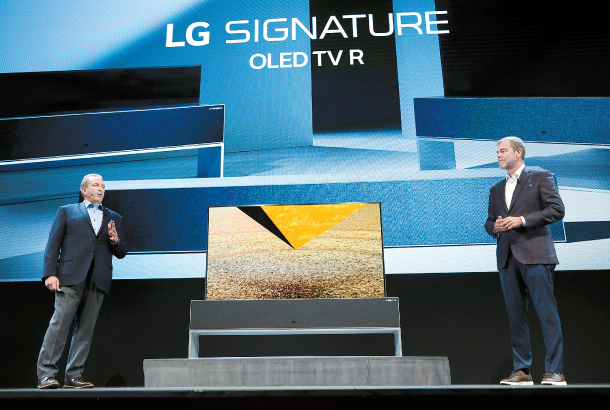
    LG Electronics unveiled the world’s first “rollable” television at the Consumer Electronics Show (CES) 2019 that launched in Las Vegas, United States, on Tuesday. Last year, its affiliate LG Display unveiled a prototype of a 65-inch rollable OLED display panel at the same event. Dubbed the LG Signature OLED TV R9, it uses the same technology, only it comes with an aluminium case at the screen’s bottom that looks like a long tissue box.

    A rolling OLED display was possible because unlike TV panels of the past, OLED screens don’t need backlight to show color, but have molecules that let out light on their own.

    The panel can roll itself up and down from the case so that the television set looks more like a long, rectangular table once the screen is completely inserted. LG boasts that the screen can maintain its color definition even as it rolls itself. R9 won the CES 2019 Innovation Awards in the video display sector.

    LG plans to launch global sales of R9 this year, starting from Korea. Its price was not disclosed, but it will be among LG’s premium television lineups. The advantage of the rollable TV set is that it can be placed in locations like the window side or in the middle of a room. For conventional TV screens, the popular choice was beside or on the walls as they take up space and block the view if installed elsewhere.

    The television set also comes with high-quality speakers and an artificial intelligence software that enhances the set’s performance to adjust definition and sound according to the film or video played. It also recognizes simple vocal commands.

    When the screens are rolled inside the case, R9 can work similarly to an audio set as it can play music via connection to smartphones or other portable devices. It also comes with various modes to use the screen apart from watching movies and TV shows.

    It can function like a huge electronic canvas that shows photos saved in your smartphone. For those who want to create a cozy atmosphere, it has a “Mood” mode that plays a video of a fireplace or displays mood-specific light on the screen.

    LG Display Vice Chairman Han Sang-beom expressed confidence in the panel in front of local reporters on Tuesday at the CES. According to Han, the rollable panel was rolled and unrolled more than 100,000 times during its development process.

    “We’re talking with other clients as well [apart from LG Electronics] for the rollable TV panels,” he said. “My plan is to target the premium market instead of aiming for sales volumes.”

  • Samsung cooperates with Apple

    Samsung cooperates with Apple

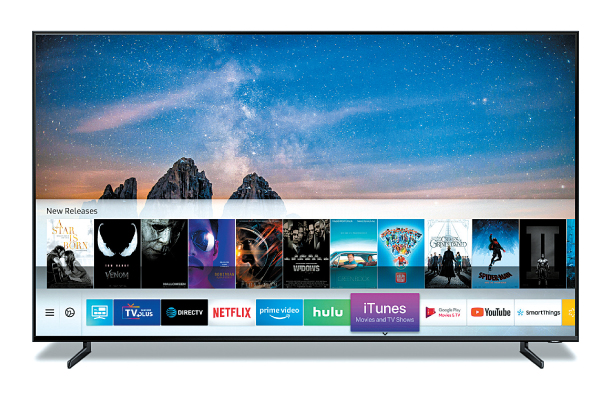
    Samsung Electronics is teaming with arch-rival Apple to enable its smart TVs to access video, audio and other programming from iTunes. It is the first time the two have cooperated on content. The partnership was announced Monday. Beginning this spring, Samsung smart TVs will have iTunes movies and TV as a default option, along with YouTube and Netflix. For customers with older versions of Samsung smart TVs, the service can be added with a software update.

    Apple’s new movie and TV streaming service is set for official introduction in March. Samsung Smart TVs will be the first non-Apple devices to have access to the service.

    Another feature to be made possible on Samsung TVs is AirPlay 2, a function that allows for wirelessly access to movies, photos, podcasts or music from Apple devices.

    Until recently, before Chinese manufacturers became smartphone leaders, Apple and Samsung competed intensely for domination in the market.

    The two were also embroiled in a seven-year patent battle that was only concluded last year.

    Despite the rivalry, they have continued to do business with each other. Samsung has supplied Apple with smartphone chips and displays.

    At an event held in Las Vegas Monday before the Consumer Electronics Show 2019, the president of the Samsung visual display business, Han Jong-hee said that the collaboration is a “win-win” for both companies while customers will benefit from a wider range of choices.

    “For now, the collaboration will be about content. But in the future, I expect there to be other fields in which we can work together as well,” said Han. According to another senior executive at the event, the project was initially suggested by Samsung.

    The company suggested that it is open to partnerships with other companies as well, saying in a press release that it aims to minimize the barriers between products and providers to offer a “rich selection of content.”

    For Samsung, Apple programming will give it an upper hand in attracting customers.

    The war in the TV market is now as much about what is available on devices as it is about brighter, more colorful and slimmer panels. How TVs seamlessly link to online resources is one of the major battlegrounds.

    The partnership also reflects how Apple is increasingly putting weight on services instead of hardware – the reason it came up with the iTunes video streaming service. Global iPhone sales are falling short of expectations as customers don’t change phones as frequently as before and many are being turned off by the high prices.

    Samsung brings with it the strength of being No. 1 in the global TV market, with more than a 40 percent share.

    “We look forward to bringing the iTunes and AirPlay 2 experience to even more customers around the world through Samsung smart TVs, so iPhone, iPad and Mac users have yet another way to enjoy all their favorite content on the biggest screen in their home,” said Eddy Cue, senior vice president of Internet Software and Services at Apple.

  • Samsung to release feature-rich phone to take on Huawei

    Samsung to release feature-rich phone to take on Huawei

    Samsung is releasing a phone with robust functions specifically designed to meet the challenge posed by Huawei. It has fast internet speeds — utilizing 5G wireless — is foldable and has an innovative screen design. Last year’s smartphone market can be summarized in one sentence: Apple’s defense, Huawei’s catch-up and the fall of Samsung Electronics.

    According Counterpoint Research, Apple’s share in the super high-end smartphone market, those priced over $900 (880,000 won), was 79 percent in the third quarter of 2018. In the $600-$900 market (660,000 to 880,000 won), Apple (61%) surpassed Samsung Electronics (21%) by a large margin, and in the $400-$600 range (440,000 to 660,000 won), Huawei (17%) was right behind Samsung (25%).

    At this critical moment, Samsung Electronics celebrates the 10th anniversary of the release of its “Galaxy” smartphone. The Galaxy Black came to market in April 2009. A new Galaxy S10, a commemorative issued for the anniversary, will be unveiled at the Mobile World Congress (MWC) 2019 in Barcelona, Spain this February. The name of the new S10 is “Beyond.”

    Samsung’s says it wants to outdo itself with the latest release.

    In the new S10, Samsung’s Infinity-O Display will be embedded. The display has a small hole in the screen for the selfie lens, so almost the entire face of the device is screen. The proportion that is screen is more than in Apple products, which utilize more real estate for the lens.

    The fingerprint-identifying sensor does not require separate hardware, but is found within the screen. The sensor itself utilizes Qualcomm ultrasonic-wave technology, which can identify prints that are less readable due to water or soil on the screen. Instead of scanning the user’s iris, the new model will utilize facial recognition, as is done with iPhones.

    It is expected that Samsung will maintain the 3.5mm-earphone jack, which has been scrapped on iPhones. It will also be 5G capable, allowing for a 1.5-gigabyte movie to be downloaded in less than a second. Samsung announced last month it will supply the world’s first 5G phones to Verizon and AT&T.

    Huawei is expected to release its own 5G phone in the first half of the year.

    Early versions of the new Galaxy S10, to be released in February, will not be 5G capable. It is possible that the S10 with a 5G communications chip will be released separately, as was done with the Galaxy S5 broadband LTE-A model, which was separately released in 2014.

    It was expected that LG Electronics will release its 5G smartphone this April or May, but it changed its goal for release to late March. Apple might not equip new iPhones, which will be released this year, with a 5G-communications chip.

    A telecommunications industry source said, “Apple originally did not really care about the speed of telecommunications that much. Apple might embed 5G in the iPhone in fall.”

    Smartphone competitors are seen pushing foldable phones in 2019. According to market research firm Strategic Analysis (SA), shipments of foldable smartphones globally will increase gradually from 3 million in 2019 to 14 million in 2020, and ultimately to 30 million in 2022.

    Chinese phone market Royole released a foldable first, in October last year, ahead of Samsung Electronics and Huawei. Royole will release its 7.8-inch Flex Pie foldable phone at the 2019 Consumer Electronics Show (CES), to be held in Las Vegas from Jan. 8-Jan. 11. Royole led the market but has received criticism about the quality of its device.

    The Galaxy foldable phone will be released in February. It will have a 7.3-inch screen as well as a 4.58-inch screen. The initial run will be about 1 million units.

  • Wavy waterfall by LG

    Wavy waterfall by LG

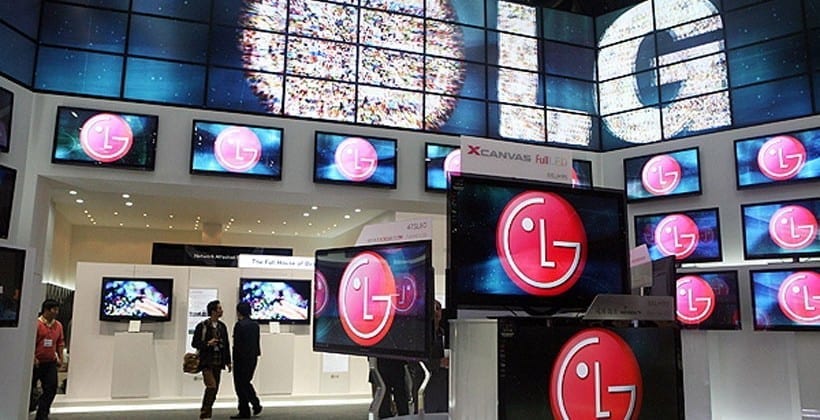
    Models showcase LG Electronics’ 260 flexible OLED signage displays put together to form a waterfall at the company’s Consumer Electronics Show 2019 exhibition entrance in Las Vegas on Monday. The annual event, which will host over 4,000 companies this year, began yesterday.

  • Export growth breezes in for Daikin Malaysia

    Export growth breezes in for Daikin Malaysia

    Air conditioning company Daikin Malaysia Sdn Bhd, which has allocated a capital expenditure (capex) of RM434 million for the next financial year ending March 31, 2020 (FY20), will ramp up its efforts on driving export growth, in line with its aim for export to contribute 70% of its total sales by FY20, from 65% now. COO Ooi Cheng Suan said products from its flagship factory here, mainly air conditioners for residential (household) use, as well as light commercial and commercial, are exported to 70 countries in the world.

    “We are driving export because the Malaysian market is not big and it is limited. To expand, we must go beyond, go out (of Malaysia). Being made in Malaysia, it (our products) is well accepted. In these two years, our ringgit has weakened and this has given us certain advantage when exporting. We become more competitive,” he said.

    He said traditionally, the company had been exporting to Europe, with the more prominent countries being Italy, Greece, France, UK, as well as the Middle East. This year, in addition to Central Europe, it has expanded its export to the US and Latin America.

    “We want to achieve at least 70% export for this factory here (remaining 30% for local market). As per our plan and budget, we’re on track to move towards 70%,” said Ooi.

    He explained that the US-China trade war has given the company an opportunity of exporting into the US due to the imposition of tariffs on products from China, which impacted Daikin China’s export into US.

    “Malaysia’s platform is similar to China’s platform, so we can transfer that demand from US (supplied originally by China) to Malaysia. We’re in a good position (to secure that opportunity) because we’re competitive and we’re able to respond fast to changes so there’s a high chance that the demand of US (for Daikin) will shift to Malaysia (from China),” explained Ooi.

    In Malaysia, Daikin, the world’s industry leader in air conditioning, prides itself as the number one air conditioner maker in terms of sales turnover and the number of air conditioners sold in the market. Annually, its Sungai Buloh factory produces 1.4 million sets (comprises indoor evaporator and outdoor condenser). Currently the residential segment makes up over 60% of its sales, while the remaining 40% comes from the light commercial, commercial and industrial segments.

    Ooi, who is also deputy regional general manager for Asia emerging districts, claims that the Japanese brand Daikin is also the top air conditioner maker in almost all of the markets in Southeast Asia (SEA), based on its survey.

    “Some players claim they’re number one at serving only a niche market. Daikin has the full range of air conditioners, from as small as 0.5 horsepower to a few thousand horsepower. We cover the full spectrum of the market,” said Ooi.

    The company is expecting to close FY19 with a double-digit growth based on its current sales momentum.

    “For the Malaysian market, the situation (sales) is slow, but the upcoming Chinese New Year will spur some buying from consumers. From past experience, when it comes to February and March, the weather turns hot and this will spur impulse buying.

    “Air conditioner has become a necessity. The price of air conditioner in Malaysia is not too far reaching that it becomes a luxury item. It has been relatively low, affordable for the public,” said Ooi, adding that globally, demand for air conditioner from developing countries like India and Africa is growing fast.

    He stressed on two important pillars for growing the local market, including the introduction of R32 refrigerant products (low global warming potential), as well as educating the market to move to energy-efficient products, such as the Inverter series.

    Daikin Malaysia will invest RM100 million annually as capex for facility and machine upgrading.

    Its two new factories in Shah Alam and Banting will focus on manufacturing applied products, comprising chillers and air handling units, for large, high rise buildings, shopping centres and industrial use. The Shah Alam factory, which was set up at RM140 million, will start its full-fledged production by 2019 and is expected to have a turnover of RM100 million per year in the beginning.

    “This is the only applied factory in SEA Oceania and this will be the factory that will support the whole SEA Oceania. With our plan to expand our applied business in SEA Oceania, we’ve set up our applied regional hub in Malaysia and Singapore to expand the sales in SEA.”

    Meanwhile, it will also invest RM125 million to set up a factory in Shah Alam to make electronic devices (air conditioner controllers), which will come into production by 2020. Ooi said this factory will supply to Daikin’s affiliates, of which there are 73 factories in the world.

    “Currently we’re already exporting to Daikin factories in Turkey, Vietnam, Czech Republic and the US. We can’t cater to the whole demand of Daikin. These factories that we’re catering for are less than 20% of the demand of Daikin group. A good percentage is still supplied by others,” said Ooi.

    It is also allocating RM135 million to set up a centralised logistics centre, which is expected to start operations by early 2020-2021.

    In addition, some RM74 million has been budgeted for research & development in FY20.
  • Samsung signals big 5G equipment push, again, at factory

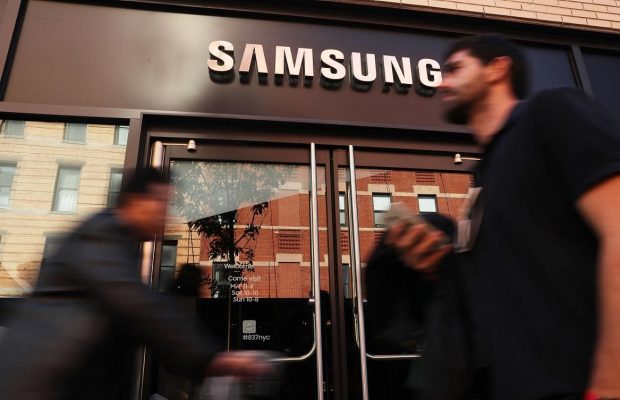
    Samsung signals big 5G equipment push, again, at factory

    Samsung Electronics Vice Chairman Lee Jae-yong’s first appearance in the field this year was to celebrate the start of production at a 5G network equipment factory Thursday. His field visit comes as the company puts more weight this year on the 5G network-equipment business, which involves components used in 5G networks. These components are supplied to telecommunications companies.

    Lee and several other top executives, including Koh Dong-jin, CEO and president of the IT & mobile division, were present at the celebration ceremony held at the company’s factory and office complex in Suwon, Gyeonggi.

    “The 5G market is a new field, and we have to build competence with the mindset of a challenger,” Lee told employees during the event.

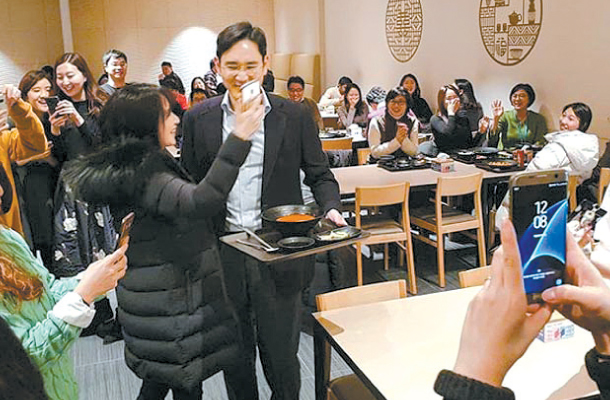
    Lee and the team of executives stopped by the cafeteria of the complex for lunch, resulting in posts on Instagram featuring Lee and employees.

    The manufacturing line for 5G equipment in Suwon is the first in the industry to be designed using “smart factory” principles. It utilizes 5G connections to enhance productivity and reduce the rate of defects.

    The company originally manufactured 5G network equipment in Gumi, North Gyeongsang, but had the production line relocated to Suwon, the site of its R&D center. This was done to help create synergies between the manufacturing and R&D facilities, said a spokesman.

    Samsung signaled last August that 5G connectivity is one of its four growth engines for the future when it announced a plan to invest $161 billion by 2021.

    The business area is receiving considerable attention from global technology companies. 5G connectivity is vital not only to telecommunications in the future, but will also be an essential component of other, related state-of-the-art technologies, such as autonomous cars, AI-powered robots and virtual reality.

    Samsung’s presence in the global telecommunications equipment market is relatively low, with a share of around 11 percent for fourth-generation LTE equipment, according to market research firm Dell’Oro. The larger players include Huawei, Ericsson and Nokia, all with shares of more than 25 percent.

    The company’s current goal is to hit a 20 percent market share in the 5G equipment market next year.

    Samsung has been expanding its client base for 5G equipment mainly in Korea and the United States. Names on the list include SK Telecom, KT, AT&T and Verizon. Samsung hopes to leverage those client relationships to attract other customers.

    The company plans to release the Galaxy S10 in March. It will be its first smartphone to support 5G connections.

    Kim Young-ki, Samsung’s president of network business, said at an event last November that the company will invest a total of $22 billion to develop 5G-network technology.

  • Apple sales plummet in Greater China

    Apple sales plummet in Greater China

    “In fact, most of our revenue shortfall to our guidance, and over 100 per cent of our year-over-year worldwide revenue decline, occurred in Greater China across iPhone, Mac and iPad,” he said.

    The Apple sales decline in China, Hong Kong and Taiwan would most likely exceed $4.3 billion, roughly equal to the company’s overall drop in revenue.

    Previously, Apple had forecast revenue of between $89 billion and $93 billion. Now it expects the figure will be closer to $84 billion, but notes final figures will not be calculated for several weeks.

    Cook said the rising tension between the US and China played a part in the declining sales, with traffic to Apple stores in the region declining as the quarter progressed. This, in turn, led to lower than expected iPhone revenue in the region, which was compounded by the stalling iPhone upgrades seen in other markets.

    “We believe there are other factors broadly impacting our iPhone performance, including consumers adapting to a world with fewer carrier subsidies, US dollar strength-related price increases, and some consumers taking advantage of significantly reduced pricing for iPhone battery replacements,” Cook explained.

    In response to these trends, the business is seeking to make it easier to trade in used iPhones at Apple stores, as well as allow payments to be made over a longer period.

    “This is not only great for the environment, it is great for the customer, as their existing phone acts as a subsidy for their new phone,” Cook said.

    Despite the slowing traffic, Apple’s other categories grew over the period, with the company’s wearables category growing by almost 50 per cent due to the popularity of Apple Watch and AirPods.

  • Korean iPhone owners claim low trade-in prices

    Korean iPhone owners claim low trade-in prices

    iPhone users are accusing Apple of paying Korean customers less for their trade-ins than the devices are worth, while noting differences between promotions in other countries and those in Korea.  If an iPhone owner wants to return an older model when buying a new device, iPhone Korea said it will offer up to a 300,000-won ($268.56) discount on the latest smartphones, the iPhone XS and iPhone XR. Korean customers are outraged.

    They claim that the deal has been made available to them a full month later than in other countries. In the United States, Japan and China, trade-in opportunities started in late November. The amount in compensation is also said to be too low.

    Apple Korea announced on Dec. 24 that it is taking iPhone trade-ins at its retail store in Garosugil, Seoul, and will continue to do so until late January next year.

    If the user returns an older model, it is possible for them to buy the 990,000 won iPhone XR for 690,000 won and the 1.37 million won iPhone XS for 1.07 million won.

    Internet community Clien exploded with comments on Dec. 25, the day after the announcement. “I might as well sell it at the Gangbyeon Electronics Mart rather than returning it to Apple,” said one. Another added: “It is disrespecting the customers.”

    While iPhone Korea only compensates up to 300,000 won for an iPhone 7+ released two years ago, the price for an iPhone 7+ in the second-hand market near Gangbyeon and Sindorim is around 380,000 won, according to mobile community Cetizen.

    If the product is an S class with almost no cracks, the price goes up to 450,000 won.

    After typing in the serial number for a black iPhone 7 with 128 gigabytes into the trade-in page on Apple Korea’s website, a reporter received a quote of 174,000 won. In the second-hand market, users can sell the phone for at least at 289,000 won. Apple is offering 115,000 won less for the device.

    Lee Doo-hee, a programmer who enjoys using Apple products said, “I can get more money if I sell directly, so I do not feel any need to go to the Apple store in person and exchange my iPhone.”

    Apple U.S. announced that it is offering trade-ins of about $300 for those buying an iPhone XR and iPhone XS. This is about 10 percent more than in the Korean market.

    NTT Docomo, Japan’s No. 1 mobile company, is offering the iPhone XR for 25,920 yen ($235.05), around 260,000 won, for those signing a two-year contract. No similar discounts are offered in Korea.

    “For Apple, Korea is the home turf for Samsung Electronics, Apple’s old enemy,” according to a source in the sector.

    “Apple only has to get a fair amount of earnings from hard-core iPhone fans, which possibly account for 15 percent of all mobile communications users in Korea. That is why it is pursuing unfavorable policies, like excluding certain countries from promotions.”

    It is believed that the current promotion from Apple Korea is due to the slump in sales of recent iPhones. High prices are seen as the main cause of the recent slowing of sales growth.

    Kuo Ming-chi, a Taiwanese Apple expert as well as an analyst at TF International Securities, has revised his first-quarter 2019 sales volume estimate for iPhones from a 47 million to 52 million range to a 38 million to 42 million range.

    A report written by Kuo was titled: “Shipments of iPhones in 2019 could be below 190 million.”

    The market value of Apple exceeded one trillion dollars in September last year. It is now around $700 billion.

  • LG U+ says it can download things 10 times faster on 5G

    LG U+ says it can download things 10 times faster on 5G

    LG U+ said Wednesday that it has demonstrated 10 times faster download times compared to 4G LTE on its 5G network. While 4G LTE offers 133.43 megabits per second download speeds on average, according to data from the Ministry of Science and ICT, LG U+ said it realized 1.33 gigabits per second on its 5G network.

    LG U+ claims it is nearly the fastest speed consumers can practically experience on 5G. Next year, when 5G is commercialized for smartphones, the smallest carrier in the country projects data download speeds will increase to as fast as 2 gigabits per second when the 5G network will be coupled with the 4G LTE network.

    LG U+ believes 5G is its chance to move up the mobile carrier ranking, currently dominated by SK Telecom and KT.