Category: Food

Retail News Asia is committed to providing both local and global retailers with the latest Food and Food & Beverage news throughout the Asian market. This on a daily base.

  • McDonald’s growth in second quarter is not “satisfying”

    McDonald’s growth in second quarter is not “satisfying”

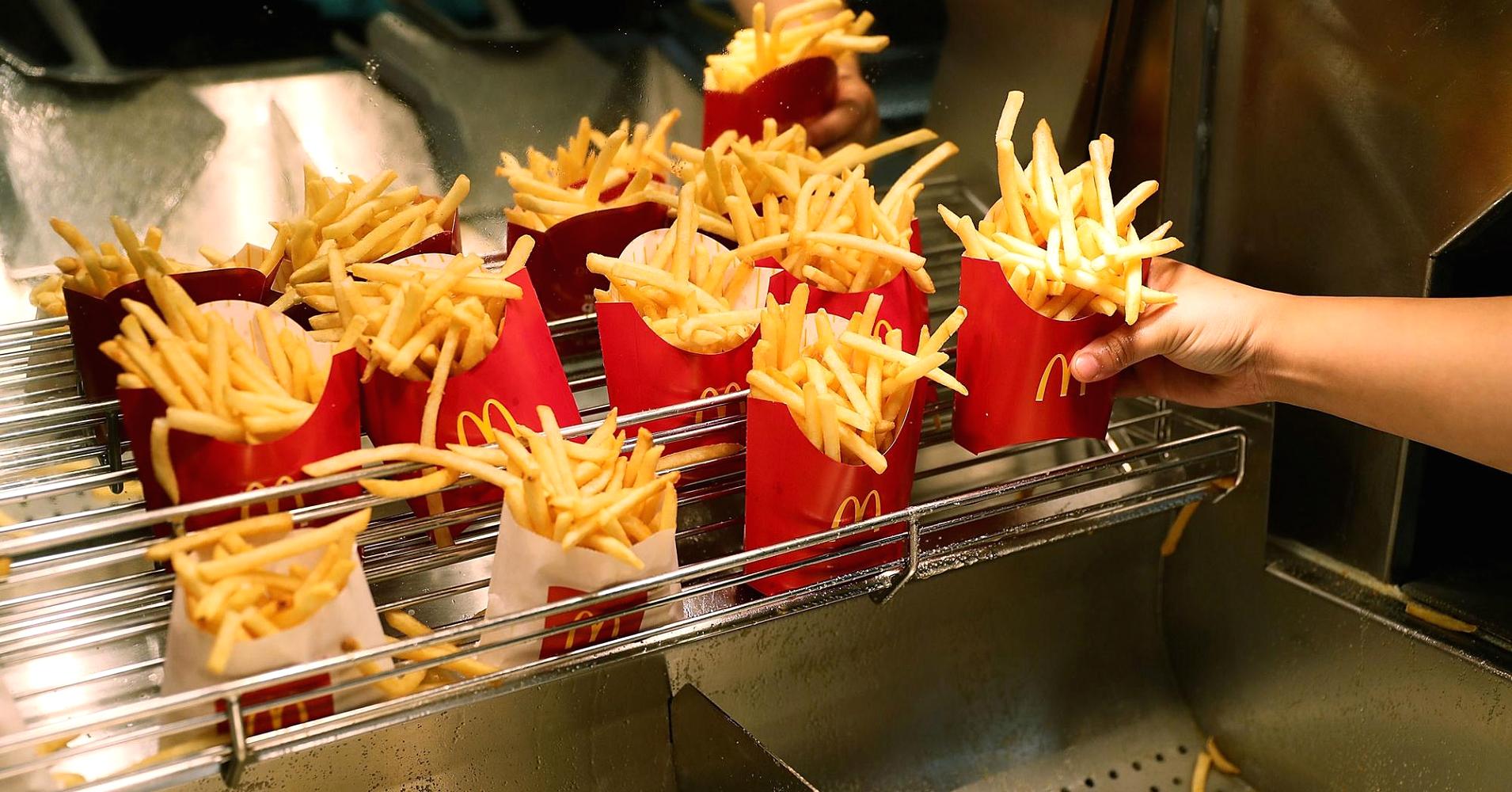
    McDonald’s Corporation has announced results for its second quarter, seeing consolidated revenues decrease by 12 per cent, pinned on the impact of the company’s strategic refranchising initiative.

    Little mention was made of McDonald’s Asian performance for the quarter, other than an acknowledgement of undefined “continued challenges” in South Korea.

    The fast-food giant found system wide sales increased by 5 per cent, while global comparable sales increased by 4 per cent, reflecting positive comparable sales in all segments.

    “We’re seeing good performance across our business as our customers tell us that they value and appreciate the moves we’re making to elevate the McDonald’s experience,” said McDonald’s president and CEO Steve Easterbrook.

    “We’ve now marked 12 consecutive quarters of positive comparable sales, and we are confident that we’re executing the right strategy to achieve long-term, profitable growth.”

    Comparable sales for the International Lead segment segment increased 4.9 per cent for the quarter, while operating income increased 15 per cent, primarily driven by progress in the UK and France, while comparable sales in the US increased 2.6 per cent.

    Neil Saunders, managing director of GlobalData Retail, notes that although revenue growth has softened over the past year this quarters results represent a positive outcome for the restaurant company; suggesting growth in the US and beyond.

    “Part of McDonald’s success comes from the fact it is attracting a wider mix of customers into its restaurants,” said Saunders.

    “This is, in large part, a consequence of the modernization program the company has been undertaking. With around 1,000 restaurants refurbished each quarter, there has been a positive step change in customer perception, especially among older consumer segments.

    According to Saunders, these changes have been cemented by initiatives to improve quality, such as the use of fresh rather than frozen beef; leading McDonald’s to become a destination more diners are prepared to visit and linger in.

    “McDonald’s will come up against some tough prior year comparatives,” notes Saunders, “[which] means growth continues to soften. However, so long as menu innovation continues, we believe the chain will continue to be a winner in the fast food space.”

    Not all is well at the restaurant chain, however, with a pair of McDonald’s workers taking it upon themselves to restrain, and attack, a customer who attempted to fill a water cup with soda, and then provoked the employees when they turned off the machine to prevent it.

    A video of the altercation was posted to social media, with many fearing for the employee’s jobs after the way they reacted to the customer’s provocations.

    The company has yet to release a statement regarding the incident.
  • Hanoi to go modern, install 1,000 public vending machines

    Hanoi to go modern, install 1,000 public vending machines

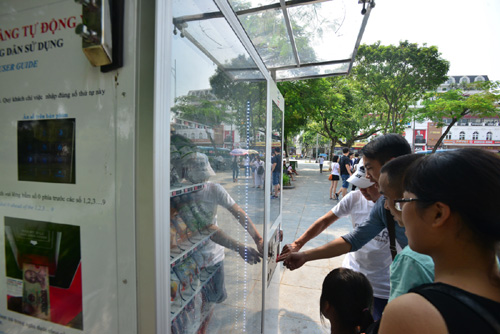
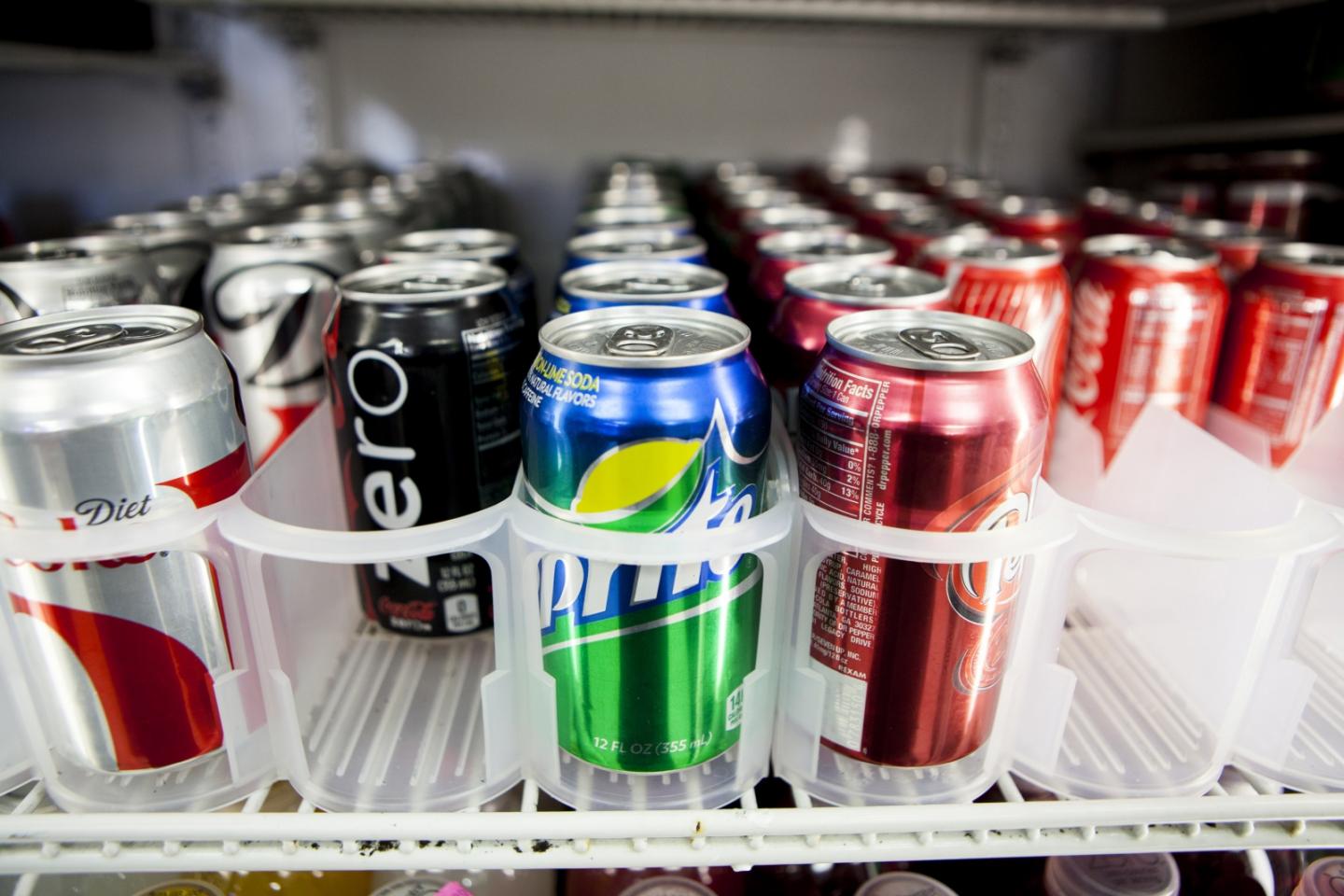
    Recently the city people’s committee approved the installation of around 1,000 vending machines in public locations under its own supervision.

    They are expected to provide a wide variety of beverages, snacks and fresh fruits besides customer assistance, especially to seniors, children and disabled people.

    The locations include parks, botanical gardens, hospitals, schools, and train and bus stations, which meet the space requirement of 2-3 square meters.

    They will be located at 500-1,000 metres away from each other with a maximum of four installed in close proximity if the specific needs of an area so demands.

    Thong Nhat Park (Lenin Park) will have the largest number — 10.

    The machines will be capable of returning correct change to customers besides also accepting other payment methods such as cards and QR codes.

    The people’s committee said the objective is to modernize retail sales in the city.

    There are now 161 public vending machines in the capital.

  • Dairy Farm restructures after recent result

    Dairy Farm restructures after recent result

    “Underperforming” subsidiaries and rising rent and labour costs are disturbing the chairman of Hong Kong-listed multinational retailer Dairy Farm International – but those factors failed to prevent a solid second-half year performance.

    Dairy Farm’s total sales rose 17 per cent to US$12.215 billion in the six months to June 30 and profit attributable to shareholders was $215 million, up 6 per cent. The increased sales came largely from the Yonghui supermarket operation and Maxim’s which owns food retail channels and the Starbucks business in Hong Kong, Singapore, Vietnam and Cambodia.

    Chairman Ben Keswick said the health and beauty business in Hong Kong and Macau drove strong results in North Asia, but the Southeast Asian food businesses continued to face challenges producing a weaker overall performance.

    “While the outlook for the remainder of the year is expected to remain challenging for the Food businesses, particularly in Southeast Asia, the group’s other businesses should continue to make steady progress. Significant management and structural changes have been made to address the issues the group faces in a number of areas, but time will be needed to deliver sustainable improvement.”

    The company has consolidated its trading operations into a more centralised structure with two main trading divisions: North Asia and Southeast Asia, in addition to the standalone business of Home Furnishings (essentially Ikea) and Maxim’s.

    Keswick says five strategic priorities have been identified: building capability, growing presence in Mainland China, protecting the group’s Hong Kong business, revitalising the Southeast Asia operations and driving digital innovation. “A series of programs are underway to support these priorities across all of the group’s businesses,” he said in the earnings statement.

    In North Asia, overall sales within the food businesses were ahead of prior year, but profits declined, mainly due to higher rent and labour costs in Hong Kong. “The health and beauty business in Hong Kong and Macau delivered very strong sales and profit growth, driven by a significant increase in business from higher numbers of mainland Chinese tourists.”

    Southeast Asia challenges

    However, in Southeast Asia, challenging trading conditions continued for Dairy Farm’s food businesses.

    “The group saw lower sales and profits in Singapore, Malaysia and Indonesia, while in the Philippines, sales were higher but profits lower, due to increased operating costs resulting from more store openings. Generally, these businesses have suffered from a lack of investment in infrastructure, range and competitive pricing for some time, while competition in each market has been increasing.

    “Turning these food businesses around and becoming more relevant to the changing demands of customers will take significant effort. Appropriate plans are now being put in place following the strategic review, but will require time to take effect,” said Keswick.

    He said the improving performance of the majority of the group’s health and beauty businesses in Southeast Asia is encouraging, with Malaysia, Indonesia and Vietnam reporting better underlying results.

    Dairy Farm’s convenience store operations (7-Eleven) performed well, with Hong Kong and Macau trading in line with last year.

    “In Singapore, overall convenience store sales were slightly lower than last year due to the termination of a multi-site agreement, but profitability improved following the closure of some underperforming stores. Like-for-like sales increases and store expansion in Mainland China continued to underpin growth in this sector.

    “In Home Furnishings, Ikea performed ahead of last year in Taiwan and Indonesia, with sales and profits growth. Hong Kong reported higher sales, helped by a contribution from the new store which opened in October last year, but associated higher operating costs resulted in reduced reduction in profits. Progress continues to be made on new store development in both Taiwan and Indonesia, with several sites under development. Meanwhile, e-commerce activities are showing increased results in all markets but from a small base.

    Keswick said Maxim’s delivered another good performance and is continuing to expand its presence across Mainland China and Southeast Asia. In Hong Kong, Maxim’s opened its first Shake Shack in May with “encouraging initial results”.

    Supermarket chain Yonghui reported strong sales growth and underlying profits from the core food business remained strong, but total profits were behind prior year due to the investment in new technology formats and the introduction of an employee incentive scheme announced earlier this year.

    Philippines restructure

    Meanwhile, back in March, the group announced it had agreed to partner with Robinsons Retail Holdings Inc. (‘RRHI’), the third largest retailer in the Philippines, to build a leading food retail business in that market. Dairy Farm will combine its Rustan Supercenters operations with RRHI to build on the combined strengths of both businesses, creating a new platform for growth. Following completion of the transaction, Dairy Farm would own 18.25 per cent of RRHI. The transaction, which is subject to certain regulatory approvals, is expected to be completed in the fourth quarter.

    As at June 30, Dairy Farm, including associates and joint ventures, operated more than 7400 outlets across all formats, compared with 7181 at the end of last year.

  • Jubilant FoodWorks operating revenues for Q1 FY19 stand strong at Rs 8,551 million

    Jubilant FoodWorks operating revenues for Q1 FY19 stand strong at Rs 8,551 million

    Jubilant FoodWorks Limited reported its financial results for the quarter ended 30th June, 2018.

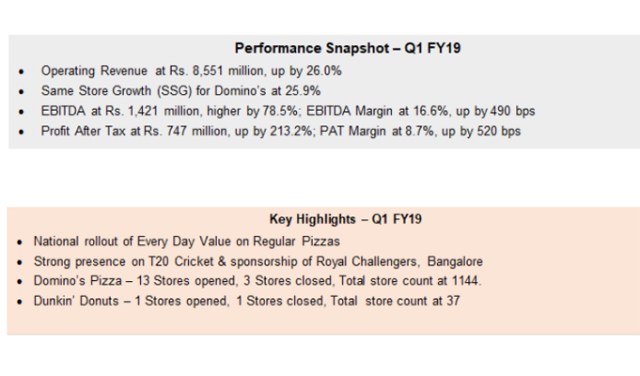
    Operating Revenues for Q1 FY19 stood strong at Rs 8,551 million, representing a growth of 26.0 percent over Q1 FY18, and a sequential growth of 9.6 percent over the preceding quarter. The growth was on the back of a strong Same Store Growth (SSG) of 25.9 percent in Domino’s Pizza.

    Overall profitability also improved, with EBITDA for Q1 FY19 coming in at Rs 1421 million at 16.6 percent of revenue, a growth of 78.5 percent over Q1 FY18. Profit after Tax in Q1 FY19 stood at Rs.747 million at 8.7 percent of revenue and a growth of 213.2 percent over Q1 FY18.

    The strong performance in Q1 FY19 was on account of a good response to the Every Day Value offer on regular pizzas launched in March 2018, and which was supported aggressively during the IPL T20 cricket season. In addition to this, the continued success of the all new Domino’s product upgrade launched last year also drove a strong growth in core pizza orders.

    In addition, Dunkin’ Donuts made sustained progress towards its goal of breaking even with a slew of innovations that drove sales growth and which was accompanied by disciplined cost management.

    Commenting on the performance for Q1 FY19, Shyam S. Bhartia, Chairman and Hari S. Bhartia, Co-Chairman, Jubilant FoodWorks Limited said,”We are pleased to start the year on a strong note with our robust performance in Q1 FY19. The strong growth in Domino’s came on the back of a superior product, Value for money delivery and growing digital contribution. This together with our focus on achieving break-even in Dunkin’ Donuts by the end of the financial year will continue to drive profitable growth for us.”

    Commenting on the performance for Q1 FY19, Pratik Pota, CEO and Whole time Director, Jubilant FoodWorks Limited said, “We delivered a strong quarter in both Domino’s and Dunkin’ Donuts. In Domino’s, the extension of EDV to Regular Pizzas received a very good response with an increase in both new customer acquisition as well as existing customer frequency. Dunkin’ Donuts too saw encouraging growth and made good progress towards profitability on the back of successful innovations and disciplined cost management.”

  • Fast food chain Jollibee to open 25 stores

    Fast food chain Jollibee to open 25 stores

    Philippine fast-food chain Jollibee plans to open 25 UAE stores by 2020.

    Describing the UAE as “a key market” in its regional development plans, Jollibee has already opened a 12th store in Al Ain Mall and is preparing two other mall locations in Abu Dhabi and Dubai. It has also updated its menu offerings to satisfy local palates, while still ensuring the menu appeals to the large population of Filipino OFWs in the area.

    Jollibee UAE CEO Hisham Al Gurg said, “The UAE is a key expansion market for the brand, ever since we launched our first outlet in Dubai Mall in 2015… the awareness of the brand in the UAE is increasing rapidly. The launch of the new restaurants is driven by strong demand from customers, thereby bringing the brand closer, not only to the larger Filipino community present in the country, but also to several other nationalities.”

    The company is currently developing a voice recognition service called Bee Talks to help customers place orders verbally via a Facebook app.

    Jollibee has operated as Golden Bee Restaurants in the UAE since 2015.

  • China’s Sandan Fresh to go offline

    China’s Sandan Fresh to go offline

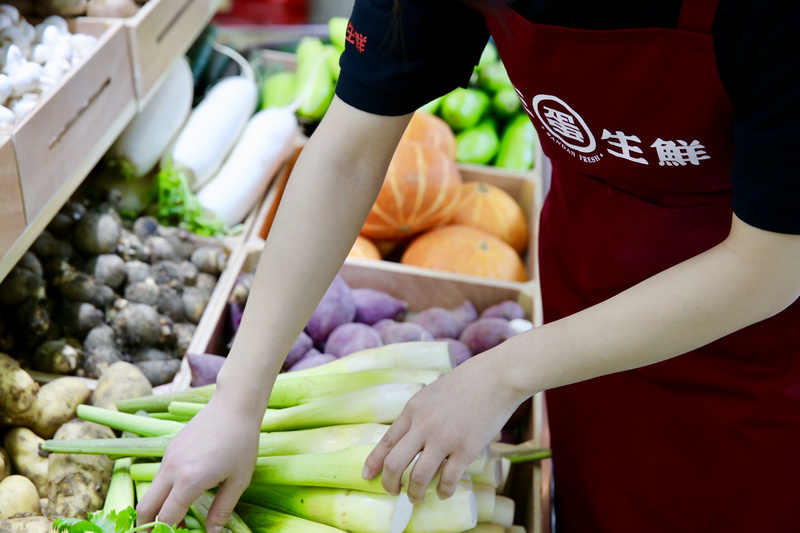
    Chinese online grocer Sandan Fresh has opened its first offline store in Shanghai.

    The Chinese company plans to open 30 more stores in the city over the next year as reported.

    The stores will be small in size, allowing a large number convenience-style stores to be established.

    The first store covers 100sqm, and currently has around 800 – 1000 items including fruit, vegetables, meat, eggs and soy products.

    Through a combination of ‘offline’ stores and ‘smart shelf’ machines, the company can provide customers with more of an integrated shopping solution, including delivery to stores, and home delivery for purchases made through the social media platform WeChat, a Sandan Fresh spokesperson said.

    In addition to its retail stores, Sandan will also install numerous self-service smart-shelf machines around the city for customers to place orders online and pick up their goods there.

    Each of the 30 planned stores are set to be accompanied by 10 smart-shelf machines.

    The company expects about half of its sales to come from in-store purchases and the other half from WeChat purchases for home deliveries.

  • Free fall for Ajisen Hong Kong

    Free fall for Ajisen Hong Kong

    Ajisen Hong Kong same-store sales plunged 10.8 per cent in the three months to June 30.

    Sales on the mainland slipped by a more modest 1.8 per cent.

    However, the company offered no explanation for the decline when it released basic operating data to the stock exchange yesterday.

    The Hong Kong-listed restaurant operator has been reporting difficult trading conditions for several successive quarters. In April, it reported a 4.3 per cent decline in Hong Kong same-store sales, however overall sales were marginally up for its first quarter.

    And in March, Ajisen announced it had ended the 2018 fiscal year with fewer restaurants, for the first time in recent years.

    Back then, the company said the market in China was over-supplied by restaurants with catering stores reaching 5.81 million last year, a decrease of about 3.4 per cent (210,000 outlets) on the previous year.

  • Ihop  opens third outlets in Thailand

    Ihop opens third outlets in Thailand

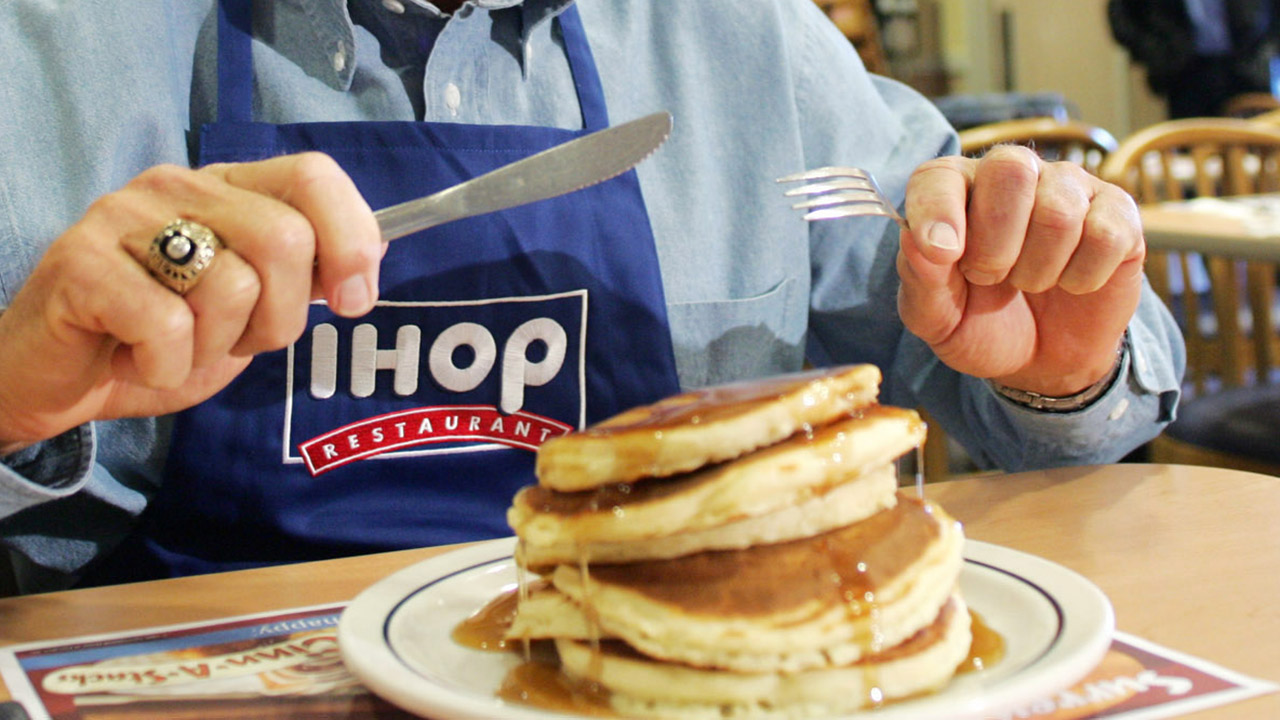
    American all-day breakfast restaurant chain Ihop Thailand has opened its third outlet, in the Mega Banga Mall.

    Located on the ground floor of the Foodwalk Zone, the new outlet spreads over 167sqm of interior space with an additional 92sqm of terrace, and can seat 88 guests.

    Guests will be able to enjoy Ihop’s buttermilk pancakes, waffles and omelets as well as burgers and beverages.

    Ihop was brought to Thailand last year by King of Pancakes, with the first outlet located in Bangkok’s Siam Paragon Mall.

    The chain expects to open 10th location by 2021.

  • Perfection in a Heineken pour

    Perfection in a Heineken pour

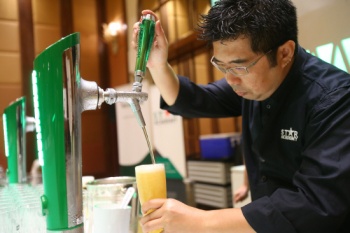
    HEINEKEN Malaysia’s Star Academy has kickstarted the latest edition of its programme to train bartenders to serve the perfect pour based on the five-step Heineken Pouring Ritual.

    The Heineken Star Serve, now in its fifth year, will see Star Academy trainers Jonathan Chong (pix) and Thomas Ling providing professional training to 600 participants across eight cities throughout this month.

    The participants will later be put through rigorous theoretical and practical assessments, not just on Heineken product history and knowledge, but also technical know-how, as well as other areas.

    The top performers will then enter a national finals competition where the winner will represent Malaysia at the Heineken Global Bartender Finals in Amsterdam, the Netherlands.

    In past global competitions, Malaysian finalists have made the country proud.

    Eddy Jay Jaimin was crowned champion in the 2016 Heineken Global Bartender Finals, while Jimmy Goh Teong Hock was the runner-up in 2013.

    The winner this year will be chosen based on his/her skill and knowledge in pouring the perfect pint of premium Heineken draught beer following the five-step Heineken Pouring Ritual of rinse, pour, skim, check and serve:

    Step 1: Rise the glass to make it clean and cold.

    Step 2: Pour with the glass at a 45° angle for a full, satisfying head.

    Step 3: Skim off the foam at a 45° angle to seal the head.

    Step 4: Check that the head sits on the horizontal line of the star.

    Step 5: Serve on a coaster with the logo facing the drinker.

    This golden standard includes ensuring a two-finger foam head to seal in the freshness and full-bodied flavour of the beer.

    But then again, less foam does not mean it’s a bad beer.

    Another key component to a perfect pour is the scientifically-designed glassware, which brings us to the next factor – beer bubbles.

    As one of the most vital constituents of a good pint of beer, the embossed base of the pint glass encourages the best carbonation, making for a long-lasting foam head, which ensures that every sip of beer is as good as its last.

  • New management targets lower profits for Vietnam’s top beer maker

    New management targets lower profits for Vietnam’s top beer maker

    Sabeco targets profits of VND4 trillion ($173 million) this year on revenues of VND36.09 trillion ($1.58 billion), a 2.4 percent rise over last year.

    Newly appointed chairman Koh Poh Tiong explained to shareholders that spending on brand promotion would be higher this year.

    He said rising cost of raw materials due to bad harvests across the world and the new special consumption tax, up to 60 percent from 50 percent, effective this year, would also hit profits.

    Last year Sabeco produced 1.8 billion liters of beer and reported sales of VND35.22 trillion ($1.54 billion), up 11.2 per cent year-on-year, and net profit of VND4.95 trillion ($216 million), up 9.6 percent.

    This is Sabeco’s first annual general meeting since the TCC Group, led by Thai tycoon Charoen Sirivadhanabhakdi, paid Vietnam’s Ministry of Industry and Trade (MOIT) VND110 trillion ($4.89 billion) for a 53.59 percent stake late last year.

    The management said that thanks to Sabeco’s collaboration with Thai Beverage it would be able to get raw materials cheaper in future.

    The firm also hopes to capitalize on ThaiBev’s experience in public relations, logistics and working with global PR agencies to promote its brand internationally.

    The management said Sabeco is exploring opportunities to expand capacity.

    Shareholders heard that the firm faced difficulties in competing with strong foreign brands, and so plans to further develop its distribution networks, especially in HCMC.

    Asked about the possibility that the Sabeco brand could disappear since “it is in Thai hands” now, especially if MOIT divests further, he said TCC Group plans to develop this brand since it had spent an enormous $4.89 billion to buy it.Koh said Sabeco has a 40 percent market share.

    Last April the ministry had called on Sabeco to pay VND2.5 trillion ($111 million) in undistributed profits to the government, the major shareholder with an 89.6 per cent stake as of December 31, 2016.

    Koh told shareholders that since the firm had submitted related documents to the government, he could not give them a more detailed answer.

    The AGM approved a new seven-member board for 2018-23 including four representatives of the Thai company – Koh, Michael Chye Hin Feh, Pramoah Phornprapha and Tran Kim Nga.

    Of the remaining three, chief accountant Nguyen Tien Dung and Luong Thanh Hai are MOIT’s representatives.

    The price of Sabeco (sticker SAB) shares on the Ho Chi Minh stock exchange has plunged since TCC Group’s acquisition.

    On July 20 it traded at around VND200,000 ($8.74), giving the company a market value of VND128 trillion ($5.6 billion).

    TCC Group had bought Sabeco’s shares at VND320,000 ($13.98).

    Koh told shareholders that the price merely reflects supply and demand in the market, while TCC looks at the long term and the firm’s future prospects.

    Vietnam is one of the top 10 beer producing countries in the world besides being the top consumer in Southeast Asia and the third largest in Asia with an average of 43 liters per person per year, according to Sabeco’s management.

    MOIT figures show that the brewery market growth has been slowing, growing at only around 5 per cent in the last five years compared with 10 per cent 10 years ago.

    Last year it grew at 5.6 per cent.

  • Cafe 25 opens 10,000th store

    Cafe 25 opens 10,000th store

    Convenience-store brand GS25 says 10,000 of its outlets now serve coffee products distributed under its house brand Cafe 25, just 30 months after the brand was launched.

    The figures show how successful South Korea’s convenience stores have been in challenging coffee-focused chains like Lotte’s Angel-in-Us and even Starbucks, by offering discounted alternatives through vast store networks.

    The GS Retail-owned group says it has already surpassed the 100 million-mark for the total number of coffee products sold, with Cafe 25 selling 40 million cups in the first half of this year alone.

    GS25 is putting significant effort into making the coffee products successful by installing top-notch coffee machines that sell for 13 million won (US$11,440) in each of its stores.To commemorate 10,000 GS25 store milestone, the company will be selling 50,000 promotional coupons online via Gmarket and Auction that allow customers to buy iced Americanos and iced lattes for half the usual price.

    An official at GS25 said the success of Cafe 25 products can be explained by the company’s bid to offer high-quality coffee products at affordable prices, while also leveraging the chain’s vast network of stores.

  • Shakey’s Pizza Asia first Dubai store opened

    Shakey’s Pizza Asia first Dubai store opened

    Shakey’s Pizza Asia Ventures has followed archrival Yellow Cab into Dubai.

    The Philippine pizza brand says it has opened a store targeting the ranks of Filipinos working in the Middle East.

    Shakey’s Pizza Asia’s Dubai franchisee Aljeel Capital plans to open 10 stores over the next five years.

    “Dubai, UAE, and the rest of the Middle East are great markets for us,” Shakey’s Pizza Asia Ventures president and CEO Vic Gregorio said in a stock exchange filing.

    Shakey’s Pizza Asia Ventures has the rights to the US brand in Asia (excluding Malaysia and Japan), Australia, the Middle East, China and Oceania. Besides moving into offshore markets, the company plans to open a further 20 stores in the Philippines by 2020.

    Founded in 1954, Shakeys was the first US pizza chain to adopt a franchise model. But its growth since has been slow compared to its rivals, and store numbers in North America have shrunk to the double-digits. The Philippines is the brand’s biggest market with more than 160 stores already.

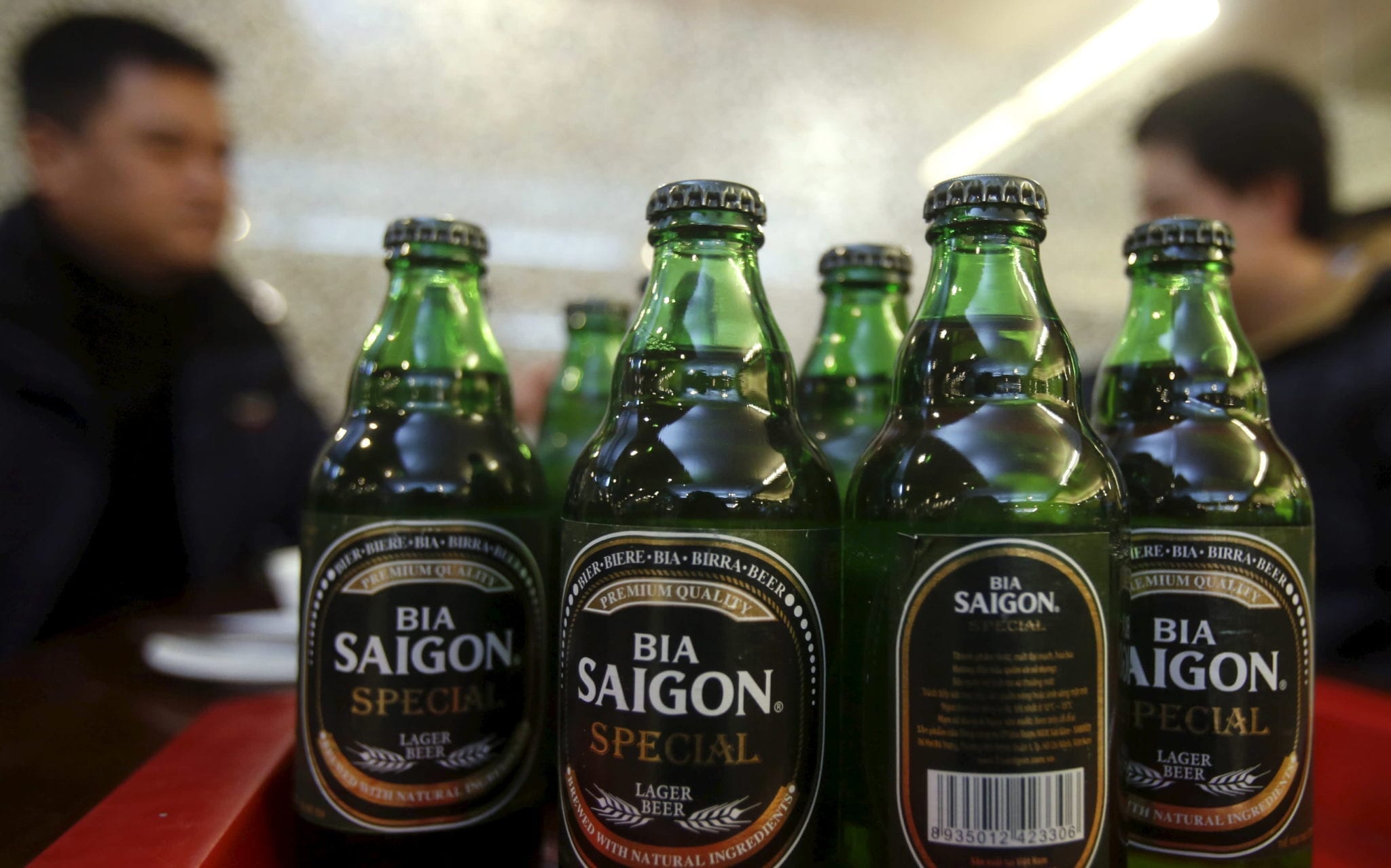
  • Big changes brewing at Vietnam’s top beer maker

    Big changes brewing at Vietnam’s top beer maker

    Under a proposal seeking shareholder approval at the firm’s annual meeting on July 21, Mr. Koh Poh Tiong has been reappointed as chairman. The 72-year-old, who is a director of Fraser & Neave and chairman of ThaiBev and F & N Beer Group, is also on the boards of several other organizations in Singapore, Malaysia, Thailand, and China.

    He is to head a new seven-member board that will have another Singaporean, a Thai and four Vietnamese, according to the proposal.

    Last May the company had replaced three foreign deputy general directors, who had in turn replaced a Vietnamese trio just a month earlier, with Singaporeans Neo Gim Siong Bennett, Teo Hong Keng and Melvyn Ng Kuan Ngee.

    TCC Group, led by Thai tycoon Charoen Sirivadhanabhakdi, had paid VND110 trillion ($4.89 billion) for a 53.59 percent stake in Sabeco.

    According to a report prepared for the company’s next general shareholders meeting on July 21, its profit target for this year has been revised to VND4 trillion (about $173 million), a reduction of 19 per cent from last year’s results.

    The dividend target has been kept unchanged at 35 percent.

    The report says foreign brewers would continue to expand their production capacity, intensify brand promotion and sales support to gain more market share, exerting “great pressure” on Sabeco, especially when the special consumption tax rate has increased from 60 per cent to 65 percent since early th.

    It also says that Sabeco is confident about maintaining its No 1 brewer position in Vietnam, and expects to boost its exports to African and Asian markets (especially East Asia and Southeast Asia), North America, Russia, the Middle East and Europe (Italy, Netherlands).

    Vietnam’s stable growth, increase in average income and rising demand are favorable conditions to stimulate and stabilize consumption while creating good growth in rural markets, where its Saigon Beer brand has reasonable product positioning and a widespread distribution network, the report says.

    Meanwhile, the prices of main items like malt, hops and aluminum have increased significantly, allowing the brewer reduce production costs.

    This year, sabeco targets to produce 1.8 billion litres, increase export volume to 33,2 million liters.

    In April this year, the Ministry of Industry and Trade (MoIT) had asked Sabeco to pay about VND2.5 trillion ($111 million) in undistributed profits to the state budget.

    The demand was made after a government audit report said that money was part of the brewer’s VND2.7 trillion ($120 million) in undistributed profit, which belonged to the government as the major shareholder with an 89.6 per cent stake as of December 31, 2016.

    Local media reported that although Sabeco claimed such a request did not correspond with the Law of Enterprises and Sabeco’s charter, it had already paid the sum. This sum is not mentioned in the report prepared for shareholders, however.

    Currently, within SABECO, there are 26 breweries, 10 trading subsidiaries and has 37 branches nationwide.

    In the first quarter of 2018, Sabeco’s sales reached VND7.8 trillion, about 5 per cent higher than same period last year; while profits of VND1.4 trillion represented a 4 per cent decline.

    On July 18, more than 641 million shares with the sticker SAB declined slightly to VND217,900 ($9.47) each on the Ho Chi Minh stock exchange, for a market value of VND139.7 trillion ($6.07 billion).

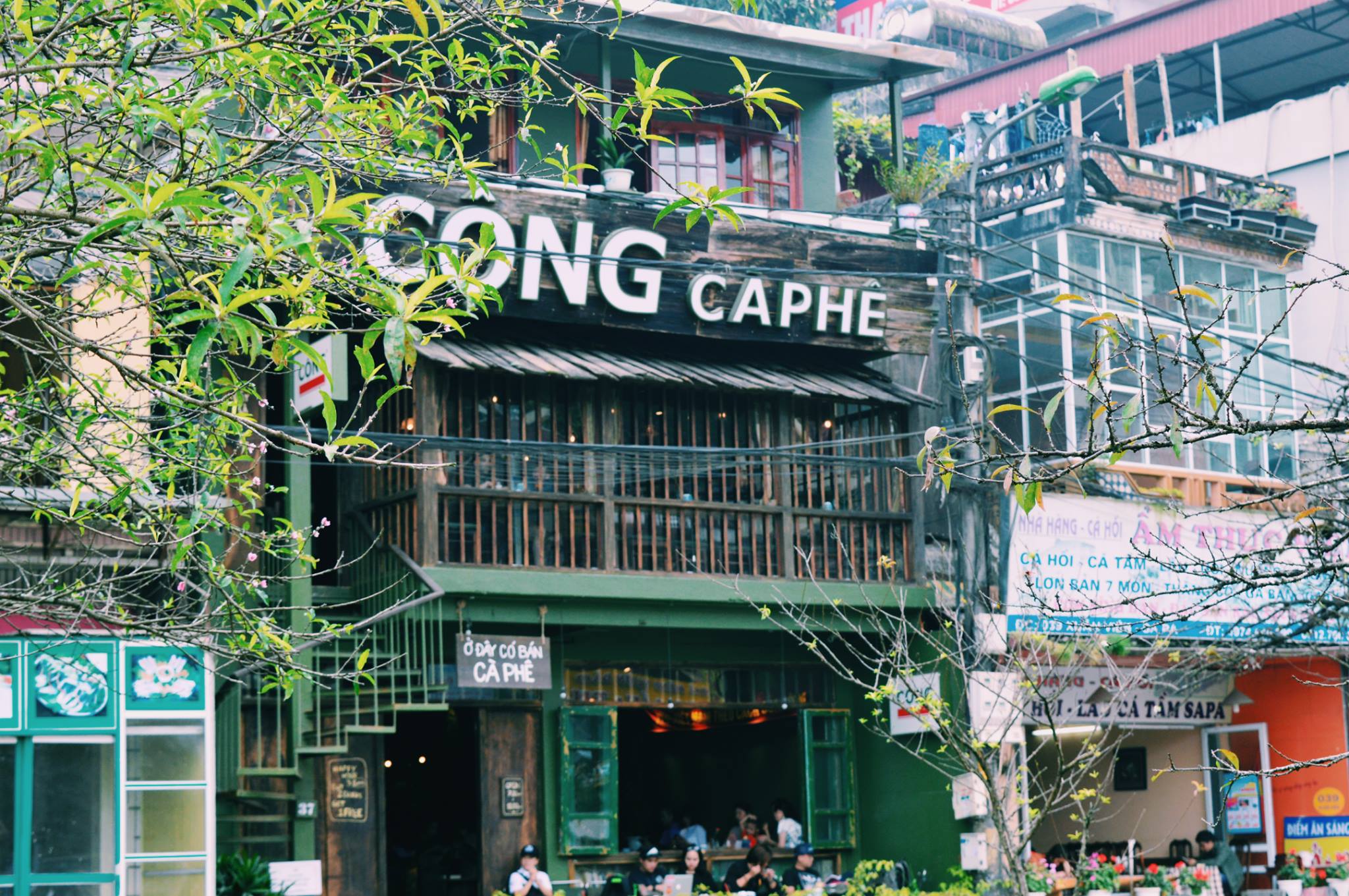
  • Vietnam’s Cong Ca Phe eyes South Korea expansion

    Vietnam’s Cong Ca Phe eyes South Korea expansion

    Vietnamese traditional-coffee chain Cong Ca Phe is opening its first overseas outlet by the end of this month.

    The Hanoi-based chain has appointed a master franchise in South Korea and according to the Cong Ca Phe South Korea Instagram account, the first outlet will open in Yeonnam-dong, a popular destination for local youth.

    According to a report, all staff are being trained in Vietnam, and the main barista is Vietnamese.

    An all-original menu will be served in the Seoul outlet, including Cong’s signature coconut coffee and local Vietnamese snacks such as peanut brittle and sunflower seeds.

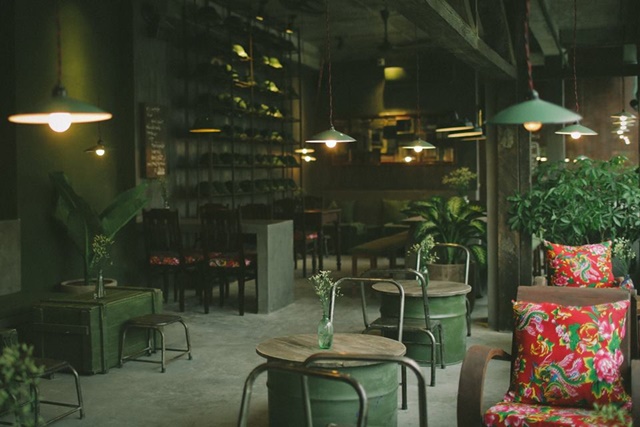
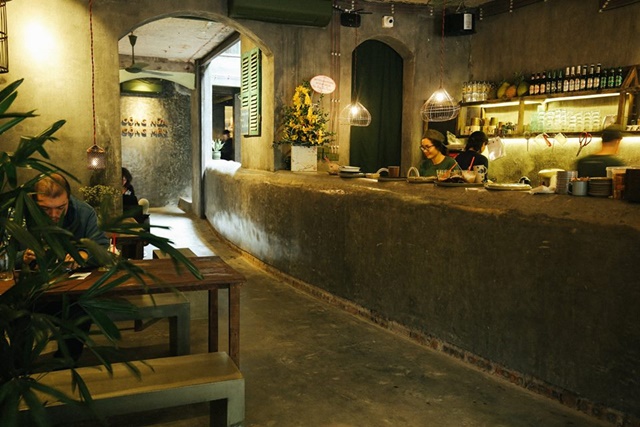
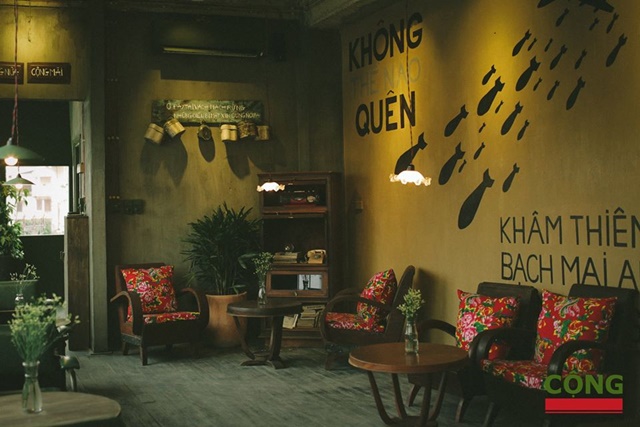
    Founded in 2007, Cong Ca Phe’s interior design is inspired by the 80s in Vietnam, the so-called “subsidy period” with colourful murals depicting old communist-era lifestyle. They usually have wooden floors, mid-tone brown tables, and antique wooden chairs, padded with chinese cotton-print cushions.


    The chain now has more than 50 outlets across Vietnam, both company owned and franchised.

  • Bo’s Coffee Philippines targets to open 200

    Bo’s Coffee Philippines targets to open 200

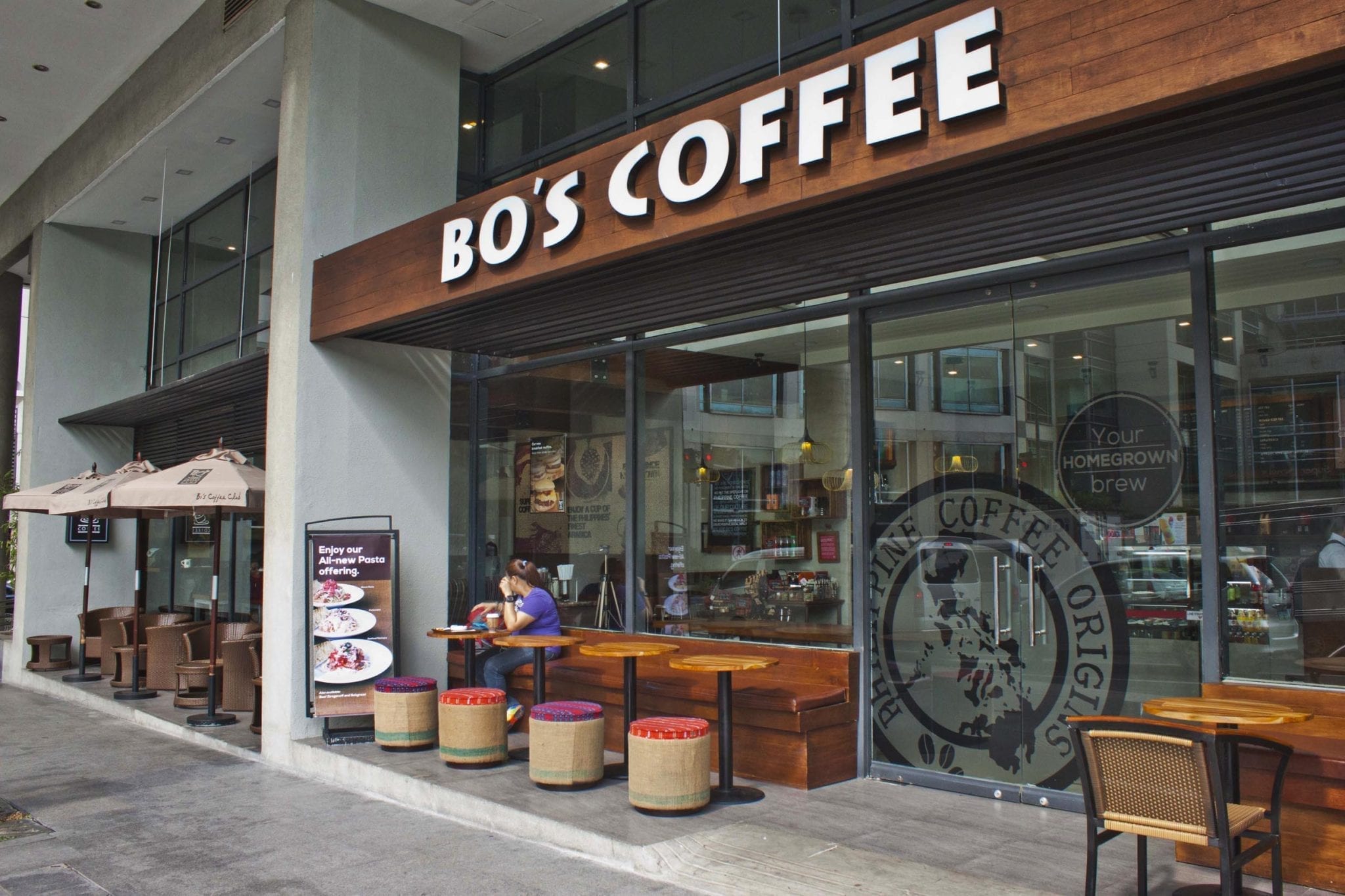
    Philippine coffee chain Bo’s Coffee is planning to operate 200 local stores within two years.

    The plan represents a change in direction for the brand, which opened its first outlet in Qatar recently. Overseas expansion for Bo’s is now shelved until 2020, while the brand’s immediate focus for growth is Luzon.

    Founder Steve Benitez said: “The Qatar opening was long overdue. Finally, we have opened it. Our partners there are planning to open three to five more branches. We are happy to hear that despite minimal marketing, the coffee shop there is doing well. However, the plan is to grow the brand locally before we expand aggressively in other countries.”

    Bo’s Coffee recently announced a change to its franchising system, which now serves both regional and territorial franchisees.