Category: General

Retail News Asia is committed to providing both local and global retailers with the latest General Retail news throughout the Asian market. This on a daily base.

  • A deep dive into Alibaba’s Hema Concept

    A deep dive into Alibaba’s Hema Concept

    The omnichannel buzz word has been omnipresent in most retailers’ vocabulary in recent years. A majority of them are painstakingly trying to integrate multiple online and offline touchpoints from discovery to purchase and services into a seamless and convenient journey for the customer, which is often a costly and difficult job.

    Then in 2017, in a letter to shareholders, Jack Ma announced the “end of E-Commerce as we know it” and the emergence of New Retail, thereby introducing an entirely new buzz word to the world.

    Is New Retail just another avatar of omnichannel or is it something profoundly different? What exactly is New Retail? How does it address customer needs? How does it work? Does it make economic sense? How is it likely to impact our retail environment – if at all?

    To answer these questions, we took a deep dive into Alibaba’s New Retail mothership, the Hema grocery supermarket chain launched in 2016, with its familiar Hippo face logo.

    The Hema concept was developed from scratch by Hou Yi, a brilliant logistics expert hired from rival Jing Dong.

    The Hema store’s value proposition is built on three pillars:

    1.  Superb quality fresh food – particularly seafood – at an attractive price, that you can pick and have cooked to dine in the store or to go.

    2. A completely integrated smartphone-centric experience, from product information (by scanning QR codes on product labels) to automated check-out enabled by RFID tags, to pay through Alipay (although Alibaba was recently forced by regulators to accept other payment platforms and cash).

    3. An extended shopping experience with the download of an application that allows online ordering and free home delivery within 30 minutes within a 3km radius of each store.

    Hema has already opened 88 stores in 14 Mainland China cities and built a customer base exceeding 10 million, generating an average daily revenue per store of RMB800,000 to 1 million.

    Customers love it

    The first thing we looked into was whether customers like the Hema experience. In a nationwide survey of grocery store customers across multiple grocery retailers, we found that the answer was a loud and clear “yes”: They rate Hema above every other grocery chain on almost all criteria: freshness, quality, choice, convenience, service (including in-store cooking and dining), and…. price.

    A lot of this perception is the result of Hema’s smart positioning. A typical Hema store product range is in fact quite limited compared to other grocers, but it is broad in fresh food, particularly in seafood. Also, Hema is a price leader only in fresh (although still 15 per cent higher than at RT-Mart). The company has chosen that as their customer-acquisition weapon focused on health-conscious affluent families.

    Hema is more expensive in almost every other category, yet once a customer is “hooked” on affordable fresh food and downloads the Hema application, they become a regular online customer including for dry food and “long-tail” products (those products that customers don’t buy on a daily basis but often replenish between longer intervals), delivered through Hema’s cloud supermarket platform.

    Customers love that! Hema wins in repeat purchase intention and preference, online and offline, against every competitor. To understand this, we asked a group of customers without Hema experience where they buy their grocery: they nominated a mixture of online and offline retailers, without anyone destination standing out.

    Then we asked the same group after a Hema experience to tell us where they intend to shop for groceries going forward: the answer was an overwhelming 50 percent-plus favoring Hema. Such is the nature of market research, we note these are self-declared intentions and there may be gaps between intent and action. But the message is quite clear: with extended deployment, Hema seems to have the potential to grab massive market share of China’s grocery market.

    First, a Hema store layout is very particular: 50 percent of the store space is dedicated to the “back office” – a huge proportion compared with the 10 percent or so of a traditional grocery store. This back office supports the “front end” store and most importantly the fulfillment of online orders delivered to the local neighborhood. The front end is split between regular retail space and the cooking and in-store dining space, which takes up a third of it.

    Then, there is Hema’s Cloud Supermarket accessible through the Hema application, which gives customers access to a much broader range of products – 20,000+ SKUs, including dry food, non-food and appliances in addition to the stock available in the store. Hema has a next-day delivery promise for these goods, compared with the 30-40 minutes estimate of deliveries from in-store range. Goods from the Cloud Supermarket are shipped from a traditional-style remote warehouse using a similar approach to e-commerce logistics to Tmall’s.

    With this configuration, online is absolutely key to the Hema business model. Based on our analysis, the best-performing Hema stores generate close to 70 percent of their revenue online, compared with about 50 percent for a traditional store.

    Tellingly, based on our estimates, few customers retain an offline-only shopping attitude after experiencing a Hema store. Most of them become omnichannel shoppers and a hefty 25 percent become online-only shoppers. This is an amazing outcome in any retail category: to a retailer, it is a dream come true where you acquire customers using a limited physical footprint and nurture them online!

    Leveraging data

    A disappointing feature of the Hema concept is in the area of leveraging data in order to customize a store offer based on different regional preferences or customer buying patterns.

    In theory, with all the digital integration happening along the Hema value chain, we should see a lot of this… yet we did not. There are no significant differences in stock ranging between stores in different regions, and almost no changes in the products recommended to customers online who adopt different basket habits.

    It is one thing to generate a lot of data, it takes a lot more to dig into it efficiently to create value.

    Many revenue sources

    Thanks to its hybrid business model, Hema has created a broad range of revenue sources: beyond in-store and online retail, Hema generates revenue from processing fresh food, which partially compensates for low margins resulting from its attractive price position. Hema is also offering cooked food and ready-to-eat meals under its private label. And it is generating commission fees from inviting third-party food and beverage brands to operate small stalls on its premises. Already, Hema has collaborated this way with more than 200 restaurant brands, including Starbucks Coffee.

    Beyond retail, Hema has started to leverage its integrated supply chains from farm to store. For example in seafood and pork meat, it has become a B2B supplier to restaurant businesses.

    In future, Alibaba may also start to exploit its comprehensive set of capabilities – cloud computing, software, DC network, ultra-fast delivery, integrated supply chains and access to data to enable better forecasting and planning, etc… then start marketing them to other retailers anxious to enter the New Retail era.

    The profit conundrum

    But how does this all stack up financially? How is Hema performing versus other grocery retailers? And is it making money?

    Based on our analysis, Hema’s best stores are more than twice as productive as RT-Mart’s best-performing stores, and about 50 percent more productive than the average one. Admittedly this is achieved with a different business mix, which includes in-store dining and a large percentage of online sales generated by the store customers.

    However, profitability remains a challenge. Based on our estimates, most of the stores are making a loss before the application of any depreciation and amortization costs. Even best-in-class stores do not generate enough operating margin to absorb their high overheads.

    One of the main reasons is that Hema’s hybrid online-offline business model implies high rent and high labor cost. The rent is high rent because they are basically operating a back-office warehouse in 50 percent of what would otherwise be prime retail space in expensive residential areas. High labor costs because you need a lot of staff to operate a premium retail environment as well as online fulfillment logistics, with a high variable component for deliveries.

    Economies of scale come into play: the larger the online revenue, the better the profitability. As customer density increases within each store’s 3km radius, delivery routes will be able to serve a higher number of customers each trip, thereby reducing the per-delivery cost. But one must expect this customer “densification” will happen at a faster pace than the inflation of labor costs, which is highly speculative. This is an old challenge of last-mile delivery economics.

  • Harvey Norman plans More Expansion in Malaysia

    Harvey Norman plans More Expansion in Malaysia

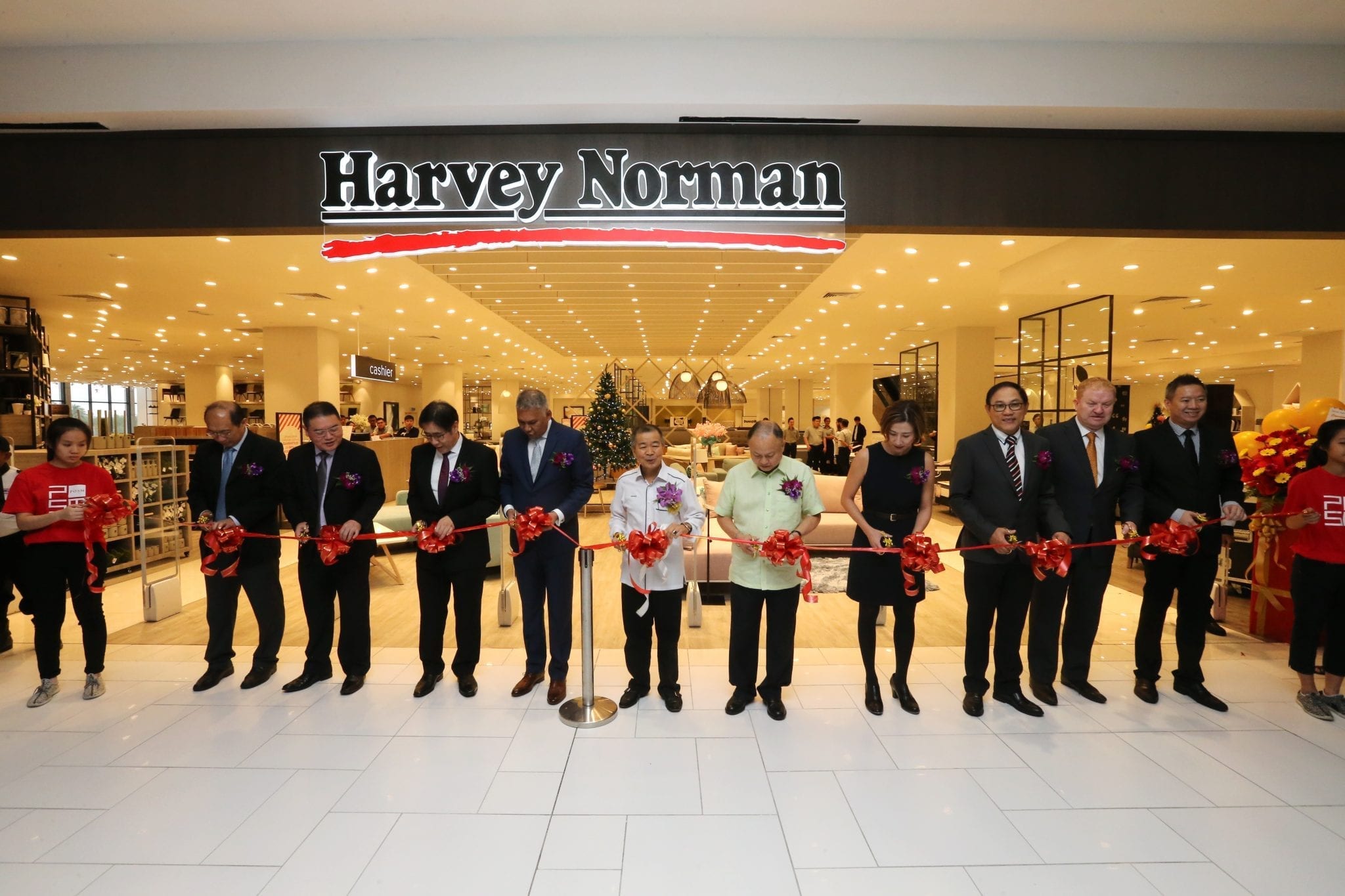
    Harvey Norman Malaysia is planning to open nine stores by the end of next year, taking its network there to more than 50 by the end of 2023. The retailer has expanded into Sarawak with an outlet in Miri Times Square.

    The 40,000sqft store covers a range of products spanning electrical and electronics, as well as furniture and bedding.

    “Harvey Norman has one price point, so regardless of where you buy it in Malaysia, the price is the same and Miri customers will get these benefits,” said Kenneth Aruldoss, Harvey Norman Asia MD.

    “We also cater to Bruneian customers. They can come to Miri and shop at our store, and we’ll give them the same support and quality service including after-sales service.”

    Four other stores – in Tebrau and Southkey (Johor), Ipoh and Kota Baru – will open in the second half of the year.

    Harvey Norman Malaysia sales reached S$152.33mil last financial year, up 10.5 percent year on year.

    “Malaysia is the best-performing country, with Singapore coming in second, in terms of growth and profits (among other indicators),” Aruldoss said.

    After launching in 2003, Harvey Norman Malaysia now has more than 17 stores across the country.

  • Thai Airways celebrates 59 years of operations

    Thai Airways celebrates 59 years of operations

    Thai Airways International has recognized the airlines’ long-serving staff with certificates at a ceremony to mark the 59th anniversary.

    Thai Airways president, Sumeth Damrongchaitham, presided over a ceremony to present certificates and souvenirs to staff who have completed 35 years and 25 years of service with the national airline.

    The certificates were also given to staff who were commended by customers, and staff who made a significant contribution to the airline’s success over the years.

    Thai conducts the ceremony annually to mark the anniversary of its establishment on March 29, 1960.

  • Google Maps is Adding Yelp Features

    Google Maps is Adding Yelp Features

    Over the past couple of years, Google Maps has transformed from a simple navigation app to one of the most powerful information databases for travelers and commuters around the world. Booking a hotel room, reserving a table at a restaurant, or simply checking working hours are all things made increasingly easy through Google Maps with its community-driven spirit. Soon, a new feature will be added to that ever-expanding list that will challenge Yelp.

    Crowd-sourced reviews are nothing new on Maps. As is, the app sends notifications to users, prompting them to rate places they’ve visited, and encourages them to share pictures. However, Google is looking to implement a new, dedicated food review system into the app, thus allowing users to rate individual dishes when visiting restaurants. The system will take a few factors into consideration, such as pricing, quantity, and quality, and will ask users whether they’d recommend the dish or not. And, of course, everyone will be encouraged to snap some photos of the impressive (or otherwise) dishes that they got served.

    Select venues on Google Maps already offer a “Menu” tab that can give you a rough idea of what to expect and how much it will cost, but the update aims to expand this functionality and put crowd-sourced reviews at the forefront. Ultimately, the goal is to have detailed menus for each venue, divided into sub-tabs based on popularity and the type of dish.

    Currently, dishes in the “Menu” tab are presented in a simple list form, but in the future, they will appear in card form alongside user-made photos. You will be able to tap on them to see others’ reviews, leave your own, suggest edits, and so on. Google has already started an initial testing phase of the feature. A wider roll-out can probably be expected in the coming months.

    With the implementation of food reviews in Maps, Google has Yelp in its sights. Both apps have long offered similar features, including restaurant reservations and user reviews, but Yelp had the edge when it came to detailed, crowd-sourced food reviews. With Maps adding this feature to its roster, it has the potential of becoming a viable Yelp competitor on all fronts.

  • Apps that have Revitalised Dated Concepts

    Apps that have Revitalised Dated Concepts

    In the past few years, we’ve increasingly seen businesses use apps to drive revenue either through ad space, paid access to premium features, or even a small download cost.

    The latest information from Statista reveals the scale of the market, with data showing that Android users are currently able to download 2.1 million apps, closely followed by Apple users who can download 1.8 million apps from the App Store.

    Data released by Apple and Mashable has revealed that YouTube was the most downloaded app of 2018, closely followed by Instagram and Snapchat. Meanwhile, in the gaming chart, Fortnite edged out Helix Jump and Rise Up. However, although many people first think of gaming and social media, there are many other successful apps that have revitalised dated concepts in order to gain success. Here, we review three of these.

    Bingo Apps: Bringing Dated Games to the 21st Century

    Online bingo apps have helped to revive what many people considered to be a ‘care home hobby’ to a mainstream form of entertainment. Lessening reliance on bingo halls, apps and websites have allowed people to play from the comfort of their own home (or anywhere in the world) at a time that suits them.

    As well as expanding the target market for bingo users, online bingo has allowed providers to specifically target new users and customers. As part of this, we’ve seen companies such as Buzz Bingo provide a new level of accessibility to draw people into a new experience using their app, which gives players access to over a dozen game variants.

    Transport Apps: Travel at Your Fingertips

    The travel industry has been revitalised by apps and technology. Whereas customers used to be reliant on queuing in taxi ranks or calling operators to try and find an available taxi, apps like Uber have allowed customers to receive all this information in the palm of their hand. From the app, which is now used by 95 million people monthly, customers can find their nearest taxi and assess the cost of their ride before booking directly via the app. Plus, much like with bingo apps, providers such as Uber also offer incentives such as ‘£10 off your first ride’ to help entice customers to the platform.

    To compete with Uber, we’ve also seen public transport catch up with the trend, with numerous rail and bus providers now offering their own apps for direct booking, which has lessened the need for customers to carry cash for journeys.

    Loyalty Cards: Lessening Paper Demand and Offering Targeted Benefits

    Remember the days when your wallet or purse was packed with loyalty cards? Well, thanks to apps, these slips of paper are largely a thing of the past, offering benefits for customers and businesses alike.

    As well as helping customers to keep track of their benefits, these apps allow businesses to generate sales data and audience profiles, helping them know how regularly customers visit, what their favourite orders are and where they usually buy from. This means that they can offer targeted advertisements and promotions aimed at increasing customer loyalty.

    The Starbucks app, for example, allows customers to pay for their purchases, find stores, redeem rewards and even order and pay in advance, allowing app holders to skip the queue.

    Looking to the future, it appears likely that we will become increasingly reliant on apps such as these, and it may only be a matter of time until all aspects of our lives are governed via smartphones. We could, for example, even see electronic voting, which has already been trialled in Australia and Belgium. With additional security measures required, many people see this as the final frontier due to cyber-security concerns, but it appears as though the sky is the limit for what we can do with apps.

  • Sprayground opens Chinese Stores

    Sprayground opens Chinese Stores

    Retailer Sprayground eyes global expansion

    “Creative rebel” travel-and-fashion label Sprayground opened three retail stores in China on May 1, and is eyeing global expansion.

    The brand presents niche offerings as limited-edition collectibles in its capacity as an “authority in fashion-forward backpacks and accessories”.

    With distribution to more than 30 countries and a growing fanbase, the new Chinese locations have already made an impact. The brick-and-mortar stores are in Beijing’s Xicheng district, Hefei’s Shushan district, and the Minhang District in Shanghai – and more than 100 retail stores are set to launch there over the next three years.

    Sprayground’s founder and creative director David Ben David will visit all three stores during the simultaneous grand openings and plans to greet team members and shoppers throughout the initial week before attending China’s very first Sneak-Con, which kicks off on May 18.

    Part of Sprayground’s mission is to expand the creativity to the “creative outcasts of the country” and elevate the game in China by infusing New York-style streetwear and hip-hop.

    Sprayground collaborations have featured some of hip hop’s favorites such as Saweetie, Young Dolph, Young Thug, and Dave East.

  • China ends Lotte Markt Sanctions

    China ends Lotte Markt Sanctions

    Lotte sanctions imposed by the Chinese government two years ago have now been lifted.

    Authorities in Shenyang have allowed South Korea’s Lotte Group to resume work on a US$2.6 billion retail and leisure development in the region following the lifting of sanctions against the firm by the Chinese government last month.

    The Lotte sanctions were imposed two years ago after the group yielded land to a US anti-missile defense system.

    Shenyang, a capital city in China’s Northeast, has now permitted the resumption of work on the Lotte Town development, although Lotte has not yet formally indicated whether or not it intends to restart construction, which has been on hold while the sanctions have been in place.

    The first phase of the project was completed in 2014, while the theme park, flats, and hotel planned for the site remain unfinished following Lotte’s sale of land in Seongju county to the South Korean government to allow the deployment of the US Terminal High Altitude Area Defence system.

    The Lotte sanctions prompted the South Korean company to announce its withdrawal from Mainland China last year, although it now insists that no final decision has been made.

  • Vietnam’s Petrolimex plans Countrywide Convenience Stores

    Vietnam’s Petrolimex plans Countrywide Convenience Stores

    Vietnamese petroleum retailer Petrolimex is planning to build a convenience-store chain.

    After five years of research, the group plans to open stores across its network of 5200 gas locations across the country.

    “Petrolimex will expand into this sector, each store will host 1500 to 2000 products,” a Petrolimex representative said during a conference.

    “Our strategy partner JX Nippon Oil will support us to set up the chain in the most optimal way.”

    Petrolimex has tested the industry with its P-Mart in Hanoi’s Hoai Duc district. The store only sells Petrolimex-branded products such as oils and a limited range of snacks and beverages.

    There is no official information if Petrolimex will base its chain on this concept or build a different one.

    Stepping into the convenience-retailing sector, Petrolimex will compete with experienced players such as Circle K, 7-Eleven, VinMart + and FamilyMart, but none of those brands are affiliated with service stations.

  • Vietnamese good to be displayed at Japanese supermarket chain

    Vietnamese good to be displayed at Japanese supermarket chain

    A week for Vietnamese goods this year will be held at the Aeon supermarket chain in Saitama prefecture and Kanto region in Japan from June 5-12, according to organizers.

    During the week, Vietnamese goods will be highlighted at 40 outlets in the Aeon distribution system, along with many activities such as plant tours, product assessment, and consultations.

    Business-to-business contacts between Vietnam and Aeon importers, the introduction of Vietnamese products and capacity, popularisation of standards for imports, and agreement signing, along with food shows, tourism promotion, and art performances will be held within the framework of the week.

    After the week, enterprises will be supported to connect with Aeon so as to supply their products to the supermarket chain. AEON committed to raising Vietnam’s export turnover through the group’s system to US$500 million in 2020 and $1 billion in 2025, following a memorandum of understanding (MoU) inked between the Japanese group and the Ministry of Industry and Trade.

    In order to help Vietnamese businesses to join the AEON supply chain and become a supplier for the over 1,000 AEON supermarkets around the globe, the group has built a plan including a number of activities to increase the presence of made-in-Việt Nam goods, Yuichiro Shiotani, General Director of AEON Topvalu Vietnam, said at a recent conference in HCM City.

    AEON has also provided technical support to improve the production capability of Vietnamese suppliers and help them access Japanese customers, as well as boost the purchase of Vietnamese goods to sell at its stores in Japan and other countries, he said

  • Little Dip in Hong Kong Retail Sales Last Month

    Little Dip in Hong Kong Retail Sales Last Month

    Hong Kong retail sales in March slipped by a negligible 0.2 percent, a slower decline than the 1.6 percent of January and February combined.

    But figures from the Census and Statistics Department show first-quarter retail sales were still down 1.2 percent year on year.

    After netting out the effect of price changes over the same period, the provisional estimate of the volume of retail sales in March decreased by 0.8 percent compared with a year earlier, and for the first quarter by 1.6 per cent.

    March’s decline was driven largely by the watches, jewelry and valuable gifts sector, which fell by 2.6 percent, and apparel, down by 2.3 percent. Sales of electronic goods fell by 15.6 per cent, of optical shops by 5.7 per cent and of books and stationery by 2.5 percent.

    Conversely, sales by supermarkets increased 3.3 percent, of medicines and cosmetics by 2.5 percent, in department stores by 5 percent, and of food, liquor and tobacco by 3.6 per cent.

    Footwear and accessories sales rose by 7.1 percent, furniture by 4.3 percent and Chinese drugs and herbs by 1 percent.

    A government spokesman said the decline in Hong Kong retail sales in March “reflected the cautious consumption sentiment amid various external uncertainties”.

    He said that looking forward, retail sales business will likely continue to be affected by various external uncertainties in the near term, but the largely stable labor market and the sustained growth in inbound tourism should provide some support.

  • Apple faces a fineof $26.6 billion in antitrust probe

    Apple faces a fineof $26.6 billion in antitrust probe

    The Financial Times reports today that complaints made by music streamer Spotify against Apple will be investigated by the EU competition commission. The issue is the 30% cut of revenue that Apple charges apps in the App Store for using its payment system. Spotify calls this the “Apple Tax” and complains that it gives rival streamer Apple Music an unfair advantage. The complaint was originally lodged in March. While Apple takes 30% from Spotify and other music subscription services, it doesn’t charge other apps like Uber.

    If the EU rules in favor of Spotify, it can force Apple to change its business practices on the continent and fine Apple up to 10% of the company’s global revenue. In Apple’s case, the fine could total as much as $26.6 billion. Most likely, Apple and the EU competition committee will work out a settlement with the company promising to lower or end the so-called “Apple Tax.”

    Both Apple Music and Spotify have similar monthly subscription rates, with both charging $9.99 a month for an individual subscription, $14.99 a month for families with up to six members, and $4.99 a month for verified students. However, because of Apple’s 30% cut, in the App Store Spotify charges $12.99 a month for individuals, $16.99 a month for families and $7.99 a month for verified students. Unlike Apple, Spotify does have a free tier of service that is ad-supported, although it doesn’t allow users to download music or select individual songs.

    Just last week, Spotify announced that it grew the number of its paying Premium tier subscribers by 32% year-over-year during the first quarter. The company now has 100 million paying subscribers and 117 million who use the free ad-supported service. At last count, Apple Music had 56 million paying subscribers worldwide. However, in the states, it is Apple Music on top-barely. Just recently, the Wall Street Journal said that in the U.S., Apple Music has 28 million paying subscribers compared to 26 million for Spotify.

    A lawyer at Clifford Chance that helped Spotify file its complaint, Thomas Vinje, said that there are other music streamers that agree with Spotify’s position. However, Vinje says that these other companies are “too afraid to take on Apple.” Back in March, Apple responded to the charges by pointing out that Spotify used the App Store to grow its business over the years without making any contributions to it in return.

    “After using the App Store for years to dramatically grow their business, Spotify seeks to keep all the benefits of the App Store ecosystem — including the substantial revenue that they draw from the App Store’s customers — without making any contributions to that marketplace. At the same time, they distribute the music you love while making ever-smaller contributions to the artists, musicians, and songwriters who create it — even going so far as to take these creators to court.
    Spotify has every right to determine their own business model, but we feel an obligation to respond when Spotify wraps its financial motivations in misleading rhetoric about who we are, what we’ve built and what we do to support independent developers, musicians, songwriters and creators of all stripes.”-Apple

    Apple has been fined before by the EU’s competition commission. In 2017, commissioner Margrethe Vestager ruled that Apple had to pay 13 billion Euros ($14.6 billion USD) in back taxes. The commission found that a tax deal Apple had with Ireland was actually considered to be illegal state-aid from the country.

  • Vietnamese real estate market attracts Japanese firms

    Vietnamese real estate market attracts Japanese firms

    In an interview with correspondents from the Vietnam News Agency on the sidelines of the TMS Group’s investment promotion workshop in Osaka on April 9, Nakata said that it is not just Vietnam’s real estate market, but those in some Asian countries like Cambodia, Indonesia also have good prospects.

    However, he believed that Vietnam is the most attractive due to its safe and stable investment environment. According to Nakata, the real estate industry in Vietnam has been developing to become the number one investment channel.

    Kako Sasai, head of the business information division of the Japan External Trade Organisation (JETRO), said foreign investment in Vietnam’s real estate could increase in the time ahead.

    She noted that Japan’s investment in Vietnam went up rapidly from 2016 to 2018. The number of Japanese firms investing in the Southeast Asian country has surged, resulting in the increasing demand for offices and houses.

    Most Japanese investors in Vietnam evaluated that the country has lots of potentials and brings stable profits, she said.

    The Vietnamese Government and enterprises have been focusing on attracting more overseas firms to invest in Vietnam beyond the field of real estate, she added.

    According to the latest survey of JETRO, Japan’s direct investment in Vietnam has increased in terms of the number of businesses and the amount of capital. As many as 70 percents of Japanese businesses plan to expand operations in Vietnam, while 88 percent expect their revenues in the market will increase in the future.

    Toru Tomita, director general at the Osaka-based O.M.NET cooperative business association, described Vietnam as a young nation with abundant labor supplies.

    In the future, more Japanese businesses will come to invest in Vietnam, he said.

    The investment promotion workshop in Osaka is part of activities of the TMS Group to introduce the investment environment in Vietnam and seek potential partners in real estate projects that the group is implementing in Vietnam.

    Vietnamese Consul General in Osaka Vu Tuan Hai affirmed that the Vietnamese Government will create an open and equal business environment for Japanese investors.

    The Vietnamese Consulate General will continue supporting and accompanying Japanese businesses in studying, preparing and implementing business investment plans in Vietnam, he said.

    TMS Group has been cooperating with Japanese partners over the past 15 years and it has been serving as a bridge to connect Vietnamese businesses with Japanese partners in the fields of their strengths such as real estate, human resources supply, education-training, trade, services, healthcare, and high-tech agriculture.

  • Facebook is making changes to the App

    Facebook is making changes to the App

    Besides unveiling a new quicker and lighter Messenger app with end-to-end encryption, and new features for Instagram and WhatsApp, Facebook announced today some changes that are being made to its flagship app. The new focus of the Facebook app will be on groups, and FB5 will feature new ways to bring together people offline. With 400 million users subscribed to over ten million active groups, the redesigned app will make it easier for users to access the groups they belong to and find new ones to join. The groups tab will show a feed from all of the groups a member has joined, with recommendations for new groups to sign up with. Starting today Facebook users will see in their News Feed more content from the groups they belong to, and content from the feeds can be sent to these groups.

    Facebook will add new features for certain groups. HealthSupport Group members will be able to make anonymous posts about their medical conditions. Job groups will have a template to allow employers to post job openings; those interested in a particular job can message the employer and apply for the job through Facebook. Gaming groups will have a new chat feature, and Facebook is looking at ways to allow buyers on Facebook Live to find out more information about a product and make a purchase without leaving the live stream. Opting into the Meet New Friends feature will allow Facebook users to meet others that they share a community with like a school, office or city. Facebook has been testing Meet New Friends and a wider rollout is coming soon. Facebook Groups will be integrated so that users can meet people they share similar opinions with.

    The company also announced the expansion of Facebook Dating to 14 new countries. Facebook Dating is available in Colombia, Thailand, Canada, Argentina, Mexico, Philippines, Vietnam, Singapore, Malaysia, Laos, Brazil, Peru, Chile, Bolivia, Ecuador, Paraguay, Uruguay, Guyana, and Suriname. This feature allows you to find potential matches from your Facebook groups, friends of friends and more. Facebook also is launching a Secret Crush feature that allows you to designate up to nine friends as Secret Crushes. If any one of the nine has opted into Facebook Dating, they will receive a notification alerting them that someone has a crush on them. If one of your crushes then adds you to their Secret Crush list, a match is made. If a crush isn’t on Facebook Dating or doesn’t add your name to his/her Secret Crush list, your interest is never revealed.

    Those using Marketplace to sell items will be happy to hear that they will soon be able to ship their wares anywhere in the continental U.S. and get paid on Facebook using a secure platform. And lastly, a new Events tab will show you things taking place around you and even recommend places to go and things to see. The tab will help you make plans with friends to meet up at an event. Some of the new features will be available right away, while others will be found on the app in a few months.

    Last week, we told you that 2.1 billion people use Facebook, WhatsApp, Messenger or Instagram on a daily basis. 2.7 billion use one of these Facebook properties on a monthly basis. The company does expect to be fined $3 billion to $5 billion for failing to comply with an FTC Consent Decree it signed back in 2011. With the latter, Facebook promised not to use member profiles without users’ approval. But during the Cambridge Analytica scandal, 87 million Facebook members had their profiles sold without permission to Cambridge Analytica and the data used to create psychological profiles.

  • Instagram just Added Three New Features

    Instagram just Added Three New Features

    Over 500 million Instagram users now use Stories on a daily basis to freely express themselves and check in on the lives of friends, family, and influencers. Today, with the goal of keeping these users hooked, some additional features have been announced.

    Unless you select the dedicated ‘Type’ mode in Stories, currently the only way of sharing something to Instagram Stories is by taking a picture or filming a short video. But pretty soon this is about to change.

    As part of a new UI, Stories will soon be divided into three separate modes dubbed ‘Live,’ ‘Camera,’ and ‘Create.’ The first, as its name indicates, will offer Instagram’s current live streaming option while the new ‘Camera’ mode will encompass all other features that are available at the moment. This means that Boomerang, Superzoom, Focus, Rewind, and all other quirky options can be found here.

    As for ‘Create,’ this will encourage sharing without taking photos or videos. It’ll offer colorful backgrounds and include features such as Type and Archive, interactive stickers like Polls and Questions, and much more.

    Instagram has confirmed that the new Stories UI and Create mode will be rolling out globally to users in the near future. Joining the revamped Stories are new Donation Stickers. Starting today in the US, Instagram users can raise money for nonprofit organizations by simply adding a sticker to their posts.

    Users will be given a list of nonprofit organizations which displays the ones they currently follow along with a bunch of other organizations that are popular at the moment. If you can’t find the one you’re looking for, a search bar will also be available.

    Once posted, users will be able to swipe up on the Story to view how much money has been donated. According to Instagram, the amount displayed will be donated in full to the chosen nonprofit.

    On an unrelated note, Instagram is also introducing a new feature called Shopping from Creators. As the name suggests, it’ll allow users to purchase products from influencers such as Kim Kardashian, Kylie Jenner, and Gigi Hadid directly. In order to do so, Instagram users simply need to tap on a post and click one of the tagged items. Then it’s as simple as using the built-in checkout process to buy it.

    This new feature will begin rolling out to users next week but will initially be limited to a small group of creators. In addition to the three mentioned above, Kris Jenner, Chiara Ferragni, Camila Coelho, and Katie Sturino will all have access to the tools. Publishers Elle, GQ, HypeBeast, and Refinery29 will also be able to tag products.

    Tagged items can only be from the brands that are participating in the Instagram checkout beta. These include Adidas, Nike, Burberry, Prada, Michael Kors, Mac, Kylie Cosmetics, H&M, and Zara at the moment

  • AirAsia named top airline by passenger growth

    AirAsia named top airline by passenger growth

    AirAsia has been named the Top Airline by Absolute Passenger Growth (Southeast Asia) at Singapore’s Changi Airline Awards 2019 recently.

    This is in recognition of its 4.1 per cent increase in passengers carried to and from Singapore to 4.5 million pax recorded in 2018, up from 4.3 million pax the year before, the low-cost carrier said in a statement today.

    It said AirAsia was also adjudged as having the third-highest airline passenger movements overall in 2018, together with Singapore Airlines Group, Jetstar, Cathay Pacific Airways and Lion Group.

    AirAsia Singapore chief executive officer Logan Velaitham said together with Changi Airport Group (CAG), AirAsia has grown Singapore into its third-largest hub, with around 40 flights per day from cities in Malaysia, Indonesia, Thailand and the Philippines.

    “As the largest foreign carrier operating into Singapore, we will continue to link new cities and give travellers here more options,” AirAsia said.

    In support of CAG’s growth plans, AirAsia launched its first international route from Ipoh to Singapore in 2018, it said.

    The Changi Airline Awards, now in its 14th year, recognises airlines for their contributions to strengthening and growing Singapore as an aviation hub.