Category: Living

Retail News Asia is committed to providing both local and global retailers with the latest Living news throughout the Asian market. This on a daily base.

  • Yogibo bean bags to launch in Korea

    Yogibo bean bags to launch in Korea

    Yogibo bean bags, which started in a Nashua, USA, basement in 2009, is about to launch in Korea.

    The brand has proven a hit in Japan, where 20 of its 50 global stores are located, and now the company has opened a pop-up store in Seoul after appointing a local partner. Yogibo has some 26 stores in the US and others in Jordan and Canada.

    Eyal Levy, founder and CEO of Yogibo, described the response to the pop-up, which opened on November 1, as “incredible”.

    “We are so excited to get into this market and to partner with the founders of Yogibo Korea,” he said.

    Yogibo Korea co-founder David Park is a close friend of Levy. “I knew David prior to this opportunity, and I couldn’t be happier to do this with him. It’s always fun and awesome to create partnerships with people that you know, like, and trust,” said Park.

    The first permanent South Korean store will open at the beginning of 2017. Yogibo is confident South Korea will be a perfect fit due to its overwhelming success in Japan.

    Yogibo stores are known for their bright colors, fun decor, and friendly staff. The stores feature multiple seating areas featuring the company’s line of bean bag chairs and pillows, as well as a variety of the company’s large bean bag furniture, home decor product, and accessories. Each store uses Yogibo’s flagship product, the Yogibo Max, which is a portable, versatile piece of furniture that can be used as a chair, recliner, bed or couch.

    “The word ‘Yogibo’ has meaning in Korean, something we didn’t know when we started the company. It means ‘Look here.’ We think it’ll be a great fit,” said Levy.

    Yogibo opened its first concept store in the Natick Mall in Natick, Massachusetts, in 2010.

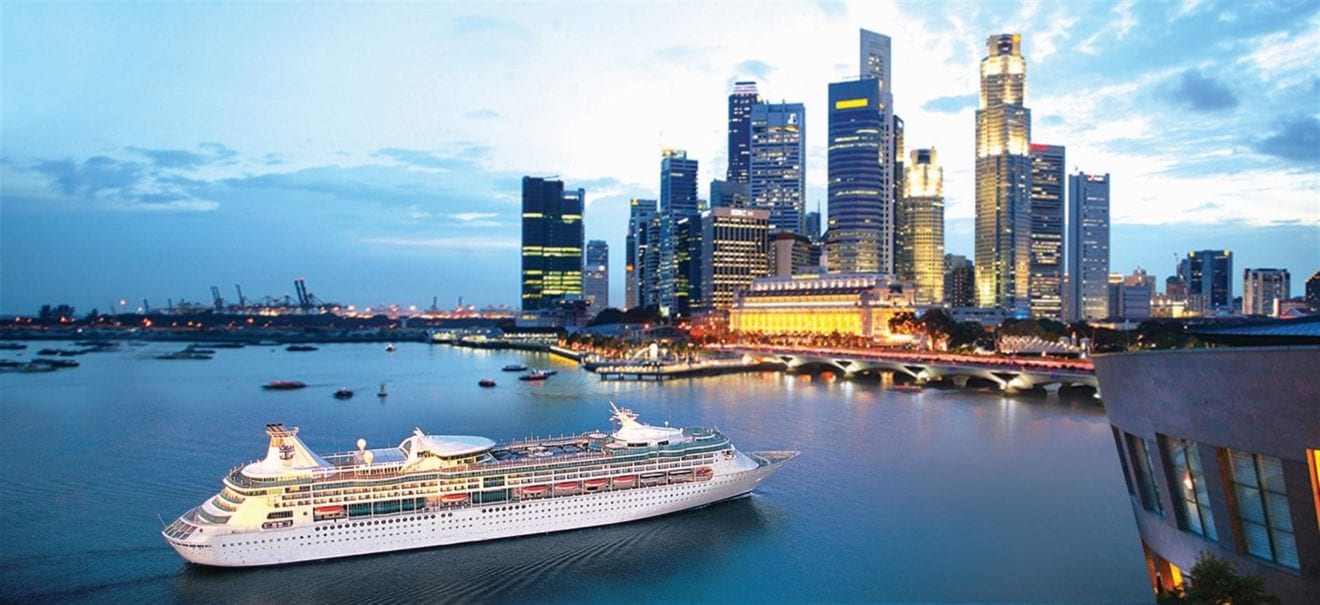
  • Singapore Cruise contract award expected in January

    Singapore Cruise contract award expected in January

    The SCCPL invited interested companies to tender for the development and operation of the duty free and general merchandise concession contract at the Harbourfront and Tanah Merah terminals for a period of five years (with an option to extend for another two years).

    The SCC is investing in the redesign and upgrade of its commercial offer at both terminals, with expansion and reconfiguration of the main retail space in the departures and arrivals areas.

    The SCC also decided to consolidate several separate contracts for the existing duty free concessions (including liquor & tobacco, perfumes & cosmetics, fashion & travel accessories and confectionery), into a single contract, to run for five years with a two-year extension option, commencing 1st April 2017.

    The contract, for which the RFQ deadline was 30 June, will govern 542sq m of retail space, serving over 6.3m ferry passengers and 560,000 cruise passenger annually.

    SCC RECEIVE TWO TOP AWARDS

    As previously reported, the latter incumbent operator, Heinemann opened its third (157sq m) Ocean Duty Free store in Singapore’s HarbourFront Ferry Terminal in January 2015.

    This follows the earlier opening of its first two outlets at the Tanah Merah Ferry Terminal in March 2014.

    “SCCPL does not bind itself to accept any tender nor the highest bid,” the SCC states on its website.

    Singapore received the top cruise destination award at the 10th Seatrade Cruise Awards for the second time in three years in October – following on from September’s separate accolade where it was voted the leading Asian port of call at the Cruise Critic Cruisers’ Choice Destination Awards.

    In March earlier this year, the Singapore Tourism Board (STB) reported that the country witnessed encouraged growth in the cruise and business segments as the Singapore Cruise Centre (SCC) was named the number one cruise port in Asia in 2015.

    Singapore-Cruise-Centre-large

    “SCCPL does not bind itself to accept any tender nor the highest bid,” the SCC states on its website.

    Interestingly, the cruise industry saw a 14% year-on-year increase in cruise passenger throughput last year to more than one million.

    In addition, the country welcomed a total of 385 cruise ships, including international cruise brands such as TUI cruises, and Royal Caribbean, as well as nine maiden calls – new to Singapore and Southeast Asia.

  • Malaysia’s Online Hiring Activity Declines By 12%

    Malaysia’s Online Hiring Activity Declines By 12%

    Online hiring activity across various industries in Malaysia declined by 12% in October when compared to the same month of last year.

    However, the production and manufacturing, automotive and ancillary industries were the only ones to not register a decline with flat growth between October 2015 and 2016.

    According to the Monster Employment Index (MEI) by Monster.com, the retail sector continued to record slower growth for online hiring.

    It chalked up a 23% year-on-year decline in online hiring activity in October.

    Monster.com Asia Pacific and Middle East managing director Sanjay Modi said hiring activity remained sluggish as companies were still very wary of possible economic headwinds brought about by external factors.

    “Other companies are watchful of their budget, laying off workers, cutting salaries and reducing costs all around. But, the government is making great efforts to get more foreign direct investments, which will create better job opportunities,” he said in a statement.

    The MEI also revealed that the retail sector’s online hiring improved by 3% from a decline of 26% recorded between September 2015 and 2016.

    The sector is followed closely by the hospitality industry, which posted a 21% year-on-year decline.

    When looking at specific jobs in Malaysia, sales and business development talent continued to witness the strongest year-on-year demand at 20%.

    Customer service professionals, on the other hand, fared the worst in online hiring in October, exhibiting a 55% annual decline from the 49% recorded in September.

  • Uncertainty Marks The Year End For Thailand

    Uncertainty Marks The Year End For Thailand

    The non-ceasing political disturbance and reigning uncertainty is dominating every aspect of life in Thailand since the King Bhumibol Adulyadej’s death on October 13. The Crown Prince Maha Vajiralongkorn is supposed to appear for an audition as a heir to the throne after he had been invited to become the next King by the parliament. The deeply divided society, depressed under the rule of the military junta, needs reconciliation.

    The macro view from the long-term perspective for Thailand is rather worrying, notwithstanding the country’s status of oil and gas producer. Its own natural resources are not proving to be large enough to count on to satisfy the growing domestic demand. The oil reserves are on the way to extinction, and the capacities of the robust gas production are not sufficient to compensate for overtaking consumption. Thailand has turned into a net gas importer and faces increasing reliance on oil imports as well.

    The import curve reflects an intermittent character of oil cargo inflows, it remains unclear they are at all affected by the event of the King’s passing followed by the mourning period.

    More than a half the crude shipments are originated in the Middle East, with zero contribution by Iran. Although it is predictable that in not so remote a future the once rogue member of OPEC will find its way to squeeze into the Thai market anyway.

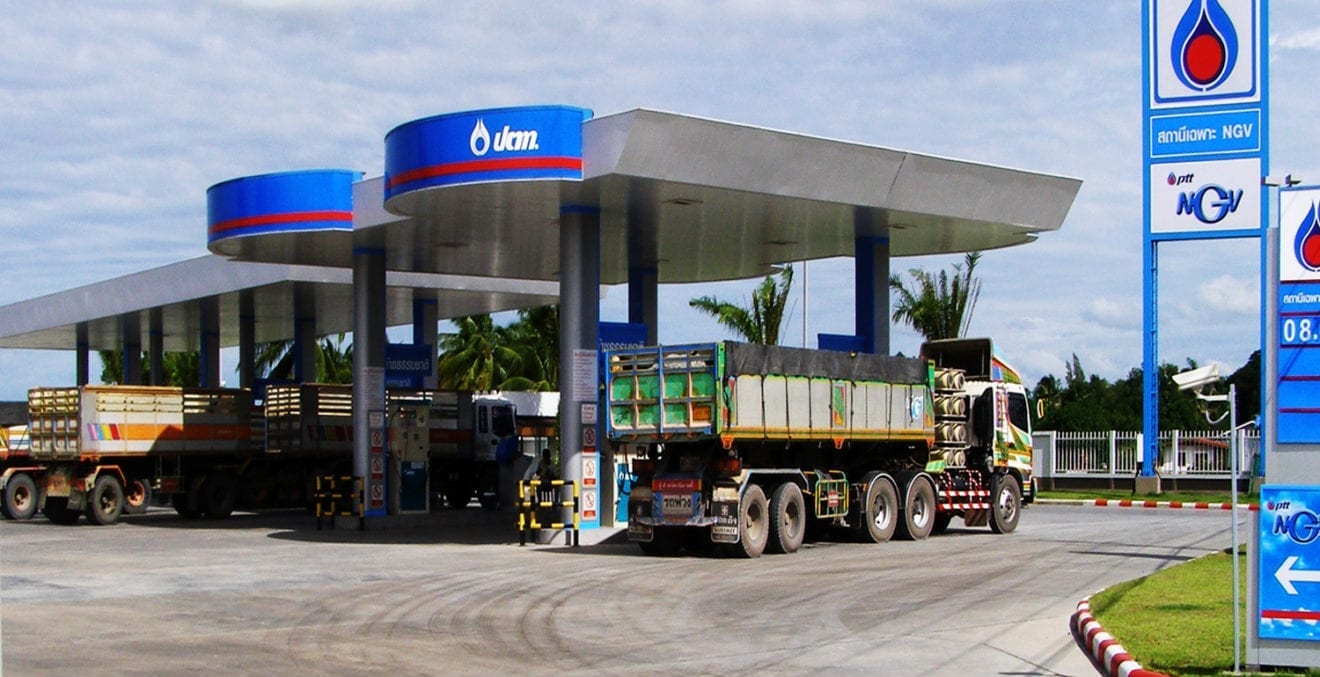
    The state-owned PTT and its refining unit Thai Oil have reported strong 3rd quarter profits, overshadowing the forecasts. Forex gains and favourable refining margins helped to reverse losses suffered in 2015.

    PTT is currently undergoing some restructuring splitting off its retail business unit, which is due to be renamed as PTT Oil and Retail Business Co Ltd (PTTTOR) to be listed eventually on the Stock Exchange of Thailand. The move is aimed to react to shrinking tolerance of fluent markets to inflexibility typical for inert government-controlled institutions.

    In the 1st quarter of 2017, Thai authorities were supposed to open for bids 29 onshore and offshore concessions for gas and oil production. But the first auction since 2007 was postponed again, and will be only completed in 2018. The existing contracts held by Chevron Corp and PTT Exploration and Production are due in 2022 and 2023, respectively.

    Previously, PTT announced plans to sign 15-year contracts with Royal Dutch Shell and BP to secure supplies of liquefied natural gas. The 5 million tons capacity of Map Ta Put LNG import terminal in the Gulf of Thailand will be doubled by March 2017. The current long-term deal with Qatar is ensuring some 2 million tons a year.

    More gas is being pumped in via the ASEAN pipeline from Thai-Malaysia joint offshore development area. This type of cooperation sets an example to follow in a region where territorial disputes have long been the cause of dormancy for many downstream projects.

    However, the Thai authorities will have to lose sleep over the challenging task to pursue the investors’ money. Any wrongdoing might provoke the capital outflow, then it will take a lot of effort to make the country attractive for investment again. To be updated soon.

  • Spa Ceylon opens nine POS operations in Asia

    Spa Ceylon opens nine POS operations in Asia

    Sri Lanka’s Spa Ceylon Ayurveda retail and spa company has opened nine new points of sale in Asia, including business with standalones, kiosks and airlines since it exhibited at last May’s Tax Free Asia Pacific show and it is expecting five more new presences in early 2017.

    Spa Ceylon says this progress follows the debut presence of its range of body, bath, beauty, aroma and wellness products to travel retail, which has been built on ‘success across ten countries with 55 boutiques and spas already in operation in downtown retail’.

    SPECIAL TRAVEL RETAIL OFFERINGS

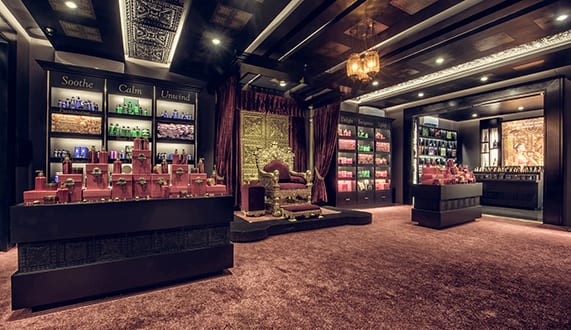
    Commenting on the offering, company management said: “The all natural range of products offer a fresh new aspect to travel retail through Ayurveda-based formulae, using exotic herbs, fruits and minerals from their island home of Ceylon.

    Spa Ceyon has a strong presence at Bandaranaike International Airport in Colombo, Sri Lanka.

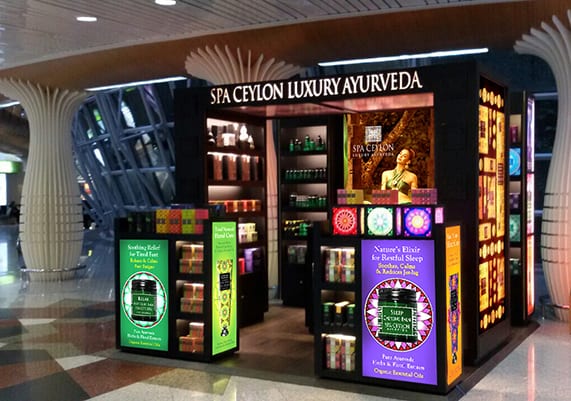
    KLI Airport 2

    Spa Ceylon at Kuala Lumpur International Airport in Malaysia.

    AMBITIOUS EXPANSION PLANS

    “The vibrant packaging in jewel-hued bottles and gift boxes adorned with colourful traditional palace art makes the brand stand out and has soon become a popular gift purchase among travellers.”

    By contrast, the impulse offering comprises the Spa Ceylon Palace Art range which is a collection of lip balms, hand creams, soaps, solid perfumes, coconut butters and balms with rich tropical scents made with fruit butters, herbs and oils.The company describes the core of its travel retail offering based on wellness and impulse. It adds that the wellness ranges such as ‘Sleep, De Stress and Detox’ offer an array of products suited for travel weariness and wellness needs.

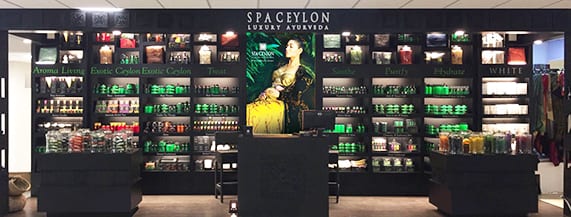
    The Spa Ceylon store in the prestigious Royal Court, in Colombo, Sri Lanka.

    GROWING TR FOOTPRINT IN JAPAN

    Spa Ceylon’s management says it has continued to grow its global foot print within travel retail and downtown retail with the opening of its first retail store in Tokyo in October 2016, followed by a 3,000sq ft flagship store in Tokyo’s premium shopping district in the Ginza in November 2016.

    A further 10 locations are planned in the next calendar year in Japan and Spa Ceylon also intends to expand rapidly over the next 24 months, reaching a milestone of 100 stores internationally by 2018, across 20 countries.

  • Singtel launches Hooq OTT movie and TV services

    Singtel launches Hooq OTT movie and TV services

    Singtel has launched over-the-top (OTT) movie and TV service Hooq to its customers in Singapore, 22 months after the company announced the joint venture with Sony and Warner Bros.

    Hooq has been available for some time as a rival to Netflix via Singtel associates in the Philippines, Thailand, India and Indonesia, but it is now being launched in Singapore to Singtel’s prepaid, postpaid and broadband customers as part of bundled service packages.

    Hooq CEO Peter Bithos said that the service would provide an “ad-free freemium video-on-demand service with the largest catalogue of Hollywood, Asian and kids’ content”. The service has over 20,000 titles in its catalogue, available in Singapore for S$8.98 (US $6.29) a month, “the price of a movie ticket”, said Bithos.

    This is about twice the rate that Hooq charges customers of Globe Telecom in the Philippines, Telkomsel in Indonesia, AIS in Thailand or Airtel in India, where prices range from the local equivalent of $2.99 a month to $3.63.

    Hooq announced in March 2016, the first anniversary of its service launch in the Philippines, that it then reached 100,000 customers. No further figures are available. The five countries where the service is available now have a combined population of 1.6 billion, though the service can only be bought via packages through Airtel, AIS, Globe, Singtel and Telkomsel.

    Goh Seow Eng, Singtel’s managing director of home, consumer, said: “Singtel is always keen to expand our content offerings to enhance our customers’ entertainment experience. They will be pleased with Hooq’s vast selection of Hollywood hits, as well as ethnic movies and TV dramas. As an OTT video service, Hooq is a good complement to our pay TV product, as it allows us to offer an even wider breadth of content over multiple screens – mobile devices, computers and televisions.”

    Hooq does not offer live streaming TV services. At launch, Hooq said that it planned to offer movies such as Spider-Man and Harry Potter and TV series such as Friends and Gossip Girl, as well as Indian, Chinese, Thai, Filipino, Indonesian, Korean and Japanese movies and TV series.

    Singtel is a significant shareholder in Airtel, AIS, Globe and Telkomsel. Hooq is not available via Singtel’s Optus subsidiary in Australia, nor via Airtel’s African operations. Singtel and Airtel are increasingly working together on enterprise services.


  • President calls for serious effort to attract 10 million Chinese tourists

    President calls for serious effort to attract 10 million Chinese tourists

    President Joko Widodo (Jokowi) has called for a serious effort to attract at least 10 million Chinese tourists to visit Indonesia per year.

    “Some 150 million Chinese citizens travel abroad every year. Most of them travel to the US and Europe. I want some 10 million Chinese tourists to visit Indonesia,” he said at a function to familiarize the public with the second phase of tax amnesty program here on Friday night.

    The president said he has signed an agreement with the Chinese government related to Chinese tourists visit to Indonesia.

    “The agreement has been in place. We only prepare flights from China to Indonesia. If the flights are already there, the target of attracting 20 million tourists can be achieved in 2019,” he said.

    The government is developing 10 key tourist destinations expected to attract more tourists, he said.

    “The target of tourist arrivals two years ago was 9 million. We want to increase the target to 20 million in 2019 by all available means including improving our positioning, diversifying products, and building brands,” he said.

    To achieve the target, the government continued to carry out tourism promotion in major cities abroad, he said.

  • One of SEA’s leading banks teams up with Powerman for two duathlon events

    One of SEA’s leading banks teams up with Powerman for two duathlon events

    Maybank, South East Asia’s fourth largest bank, and Powerman Philippines, the Philippine affiliate of the International Powerman Association (IPA), are hosting two duathlon race events in the Philippines this year.

    The first race, which was held last November 20, 2016 at the SM Mall of Asia by the Bay, Anytime Fitness Powerman Philippines Asian Invitational was co-presented by Maybank. Professional duathletes Jason Loh and Su Teoh from Malaysia and Airi Sawada from Japan flew in to be part of the race’s Elite Category.

    Maybank is also the title presentor of the Powerman Philippines World Series which will be held on December 3 and 4 at the Clark Freeport Zone in Pampanga. Ten professional duathletes including Powerman World from all over the globe including the two-time Powerman World Champion and Powerman Philippines Ambassador Gael Le Bellec three-time and defending Powerman World Champion Emma, and defending Powerman World Champion Seppe Odeyn will fly to the Philippines for this race.

    Aside from having a Powerman Short, this event will also feature the Powerman Classic (10 km run– 60 km bike –10 km run), the Powerkids (for kids ages 6-12) and the Powerteens (for teens aged 13-19).

    The Maybank Powerman Philippines World Series is also a qualifying event for the Powerman Duathlon World Championships to be held in Zofingen, Switzerland in 2017. The event attracts a host of professional and highly competitive age-group athletes, seasoned multi-sport athletes who want to take on a different challenge, and athletes who have just started in the multi-sport category.

    “Maybank welcomes this partnership with Powerman Philippines,” according to Richard C. Lim, Executive Vice President and Head of the Retail Business Group of Maybank Philippines, Inc. “Maybank prides itself in being at the heart of the communities we are present in. Being associated with this important sporting event, with almost 3,000 participants in both races, and leveraging on this type of sports sponsorship platform can definitely help elevate our brand in the Philippines. We are excited by the fact that the biggest event, the Powerman Philippines World Series, will be held in Clark where Maybank has one of its largest branches in North Luzon, an area where we have a strong branch network, the largest of any foreign bank in the country.”

    Mr. Lim added, “Endurance sports are gaining popularity in the country and Maybank wants to capitalize on this and become associated with the positive values that sporting events promote.”

    “The inclusion of Maybank definitely adds prestige to both Powerman events this year,” says Owen Gan, President of Powerman Philippines. “Being one of the largest banks in South East Asia, Maybank will definitely help Powerman in gaining popularity in the Philippines, and eventually in the region, especially now that there are more Powerman events lined up for 2017.”

    Part of the proceeds of Powerman will go towards buying bicycles and other gear for the Batang Tri Grassroots program that supports young individuals who do not have the financial means to enter the world of multi-sports.

  • Smart footwear market due for rapid growth

    Smart footwear market due for rapid growth

    More than 6 million units of smart footwear will ship in 2021, up from just 300,000 this year, ABI Research predicts. This would represent a CAGR of 82%.

    “The growing elderly population is driving change in the way healthcare can and will be provided, and remote monitoring is one aspect of the m-health industry that can cut costs and improve care,” said ABI Research analyst Stephanie Lawrence said.

    By supporting sensors within shoes or smart socks, home monitoring and remote patient management applications can track a host of valuable parameters with minimal disruption to those being monitored.

    Lawrence further explained that new home and remote patient monitoring smart footwear devices also grant healthcare providers 24×7 access to in-depth, real-time health updates concerning their patients’ posture and gait.

    “Such detailed reporting used to be constricted to a hospital bed; now healthcare providers can paint a fuller picture of their patient’s health outside of the hospital, ultimately allowing them to better monitor ongoing issues and make more accurate diagnoses,” he said.

    ABI Research said that for remote patient monitoring, companies are already turning to smart footwear as a form factor to support diagnostic medical data collection. This includes companies like Plantiga, FeetMe, and Orpyx.

    For instance, diabetic patients are at risk for peripheral neuropathy, or sensory loss, and often cannot detect dangerous pressure levels in their bodies. Orpyx’s SurroSense RX has insoles that use sensors to detect the amount of pressure that a person places on each part of the foot. The device can then alert the user and his/her doctor to any issues.

    “Rising vendors in the smart footwear market need to develop devices that can detect exactly how a person is walking, and provide accurate feedback concerning any issues,” concluded Lawrence.

    “This will ensure that healthcare workers receive detailed health information about their patients, and will allow the smart footwear market to continue to advance and grow significantly.”

  • South Korea’s LPG sales jump 17% to 6.4 mil mt over Jan-Sep on strong petchem demand

    South Korea’s LPG sales jump 17% to 6.4 mil mt over Jan-Sep on strong petchem demand

    South Korean LPG providers sold 6.4 million mt LPG in the domestic market over January-September, up 17.4% year on year, amid lower retail prices and stronger demand for petrochemical production, company officials said Friday.

    The rise outpaced the 0.8%-increase seen for full-year 2015 sales, when the suppliers sold 7.52 million mt, up from 7.46 million mt in 2014.

    Of the total 6.4 million mt LPG sold over the first nine months, SK Gas, the market leader, sold 2.83 million mt, up 49.7% from 1.89 million mt a year earlier.

    Its market share also increased to 44.3% for the period, up from 34.6% in the same period last year.

    In May, SK Gas started commercial production at its propane dehydrogenation plant that converts LPG into propylene.

    The PHD plant uses 700,000 mt/year of propane as feedstock to produce 600,000 mt/year of propylene.

    SK Gas is run by SK Group that also owns the country’s biggest oil refiner SK Innovation.

    Sales of second-largest supplier E1 Corp. rose 14.1% year on year to 1.54 million mt over January-September, up from 1.35 million mt in the year-ago period.

    E1 Corp. and SK Gas provide LPG to the domestic market through imports, while the country’s four oil refiners produce domestically.

    LPG sales by South Korea’s second-largest refiner GS Caltex fell 8.5% year on year to 741,000 mt over January-September, from 810,000 mt a year earlier.

    Top refiner SK Innovation’s LPG sales also dipped 10.1% year on year to 569,000 mt for the first nine months, from 633,000 mt in the same period last year.

    Third-largest refiner S-Oil Corp. sold 445,000 mt of LPG over January-September, up 3.7% from 429,000 mt, while smallest refiner Hyundai Oilbank’s sales dropped 20.3% to 177,000 mt, from 222,000 mt a year earlier.

    “LPG demand for petrochemical making soared 90% over the first nine months from a year earlier, while demand from industry use jumped 31% year on year in the period, driven by lower domestic prices,” an SK Gas official said.

    But LPG demand for transport has been on the decline over the past few years, falling 4%-7% year on year over January-September due to fewer LPG-powered vehicles while consumption by households and commerce edged down 0.7% from a year earlier, the official said.

    RETAIL PRICES FALL IN Q3

    Retail propane prices averaged Won 1,651 ($1.39)/kg in the third quarter of 2016, down 8.3% from Won 1,801/kg a year earlier, according to state-owned Korea National Oil Corp.

    Retail butane prices also fell 8.1% to average Won 1,863/kg in the third quarter, down from Won 2,028/kg in the year-ago period.

    According to KNOC, which provides data on barrels basis, South Korea consumed 28.83 million barrels of LPG over July-September, up 22.2% from 23.59 million barrels in the same period last year.

    The third-quarter growth slowed compared with a 29.4% rise seen the second quarter when the country consumed 20.11 million barrels of LPG, KNOC said.

    For the first nine months, LPG consumption increased 21.8% year on year to 79.21 million barrels, KNOC said.

    “LPG demand is likely to keep rising later this year unless retail prices rebound,” the SK Gas official said. To meet strong domestic demand, South Korea’s LPG imports jumped 34.1% year on year to 59.18 million barrels over January-September, compared with 44.14 million barrels a year earlier, according to KNOC.

    LPG imports from the US, the biggest supplier, soared nearly three times to 27.83 million barrels for the first nine months, from 9.68 million barrels in the year-ago period.

    South Korea’s LPG demand was sluggish in previous years. The country consumed 89.87 million barrels of LPG last year, unchanged from 89.58 million barrels in 2014, which was down 3.7% from 93.06 million barrels in 2013.

    Amid weak demand, South Korea’s LPG imports fell 2.3% year on year to 62.71 million barrels last year, compared with 63.53 million barrels in 2014, according to KNOC.

    -Charles Lee

  • Frasers Centrepoint Trust buys retail podium of Yishun 10 Cinema Complex

    Frasers Centrepoint Trust buys retail podium of Yishun 10 Cinema Complex

    Frasers Centrepoint Trust has entered into two sale and purchase agreements for the acquisition of the retail podium of Yishu 10 Cinema Complex. The deal is worth $37.8m.

    One of which was with Goldvein Trading Pte. Ltd., for the acquisition of units #01-01, #01-02, #01-04/04A, #01-05, #01-06, #01-07, #01-08 and #01-09 of the retail podium of Yishun 10 Cinema Complex, 51 Yishun Central 1, Singapore 768794 at a consideration sum of S$25.9m

    The other was with Bon-Food Pte Ltd, for the acquisition of unit #01-03 of the Retail Podium at a consideration sum of S$11.8m.

    The acquisition is in line with the strategy of FCT of nvesting in quality income-producing properties used primarily for retail purposes.

    Goldvein Trading Pte. Ltd. and Bon-Food Pte Ltd are whollyowned Singapore subsidiaries of Bonvests Holdings Limited, a company listed on the Main Board of Singapore Exchange Securities Trading Limited.

    The Aggregate Consideration for the Acquisition was arrived at on a willing-buyer and willing-seller basis after taking into account the location, occupancy and rental income generated by the Retail Podium. The independent valuation as at 30 September 2016 of all 10 units of the Retail Podium by Jones Lang LaSalle Property Consultants Pte. Ltd., which was appointed by the Trustee, is S$40m and derived using the discounted cash flow approach and direct capitalisation approach.

    The Aggregate Consideration will be paid in cash to the Vendors on completion of the Acquisition, which is expected to be on 16 November 2016.

  • ‘Forever in Thai Hearts,’ an exhibition hosted by Thailand’s Ministry of Culture

    ‘Forever in Thai Hearts,’ an exhibition hosted by Thailand’s Ministry of Culture

    Thailand’s Ministry of Culture, assigned by the government, joins hand with Siam Paragon to host ‘Forever in Thai Hearts,’ a photo exhibition portraying historical moments of Thai nation to mark the Royal Funeral of His Majesty King Bhumibol Adulyadej. Locals and visitors are invited to join a vowing campaign by recording their pledges to carry on his legacy and royal teaching. All images and video clips are to be included in ‘The People’s Archives’ memorial book. This exhibition runs from 19-30 November 2016 at Lifestyle Hall, 2nd Floor, Siam Paragon.

    On this occasion, General Thanasak Pratimaprakorn, Deputy Prime Minister, presided over the opening ceremony on 19 November 2016. Joining the opening ceremony were Vira Rojpojchanarat, Minister of Culture, Chadatip Chutrakul, Executive of Siam Paragon, Thanpuying Angkarb Boonyatthiti, Khunying Charmaree Snidvongs Na Ayudhya and M.L. Kwanthip Devakul. As the highlight of the opening ceremony, the song ‘Kao Dern Tor Pai ’ or ‘Moving Ahead’ composed by Dolchai Boonyaratavej with the melody written by Pongpoon Pibulkasetkij was performed by Chitralada School Choir to encourage everyone in moving forward with conscience and hope.

    General Thanasak Pratimaprakorn, Deputy Prime Minister, pointed out that “In making a memorial book titled ‘The People’s Archives’ and a documentary ‘Forever in Thai Hearts,’ the government has assigned Ministry of Culture to collect images and video clips contributed by public sectors, various organizations and medias. Aiming to preserve and publish Thailand’s historical moments related to the passing of the late monarch, highly revered by all Thais, we have received great feedback from people across the country. Over 30,000 images and video clips including images reflecting the sense of deepest respect and appreciation to His Majesty the Late King Bhumibol Adulyadej, images of mourners from near and far traveling to pay their respects before the royal remains as well as messages of condolences and heartfelt gratitude were shared via our provided platforms. Hence, we have also chosen images uploaded to Facebook , Line application and email to be exhibited at ‘Forever in Thai Hearts’ exhibition at The Bangkok National Museum since 28 October 2016.

    “To offer wider opportunities for both Thais and foreigners in expressing their boundless gratitude to the late monarch and witnessing these historical moments, Ministry of Culture together with Siam Paragon has organized ‘Forever in Thai Hearts’ exhibition at Lifestyle Hall, Siam Paragon. On this occasion, 100 unseen images are specially curated to be on display.

    Joining the Ministry of Culture, Mayuree Chaipromprasith, executive of Siam Paragon, added, “The passing of our revered King Bhumibol Adulyadej is the greatest loss and despair in the lives of all Thais nationwide. As his royal subjects, we would like to express our deep-felt gratitude and humble loyalty by organising ‘Forever in Thai Hearts’ photo exhibition. This exhibition narrates the story of a deep mutual bond between the longest serving monarch and his people through images and films portraying his lifelong works and devotion. We also would like to invite everyone to join a vowing campaign by recording the ‘do-good-deeds, follow-the-King’s-teaching’ videos, all of which are to be included in ‘The People’s Archives’ memorial book. In this exhibition, each participant will receive a portrait of His Majesty the Late King Bhumibol Adulyadej.”

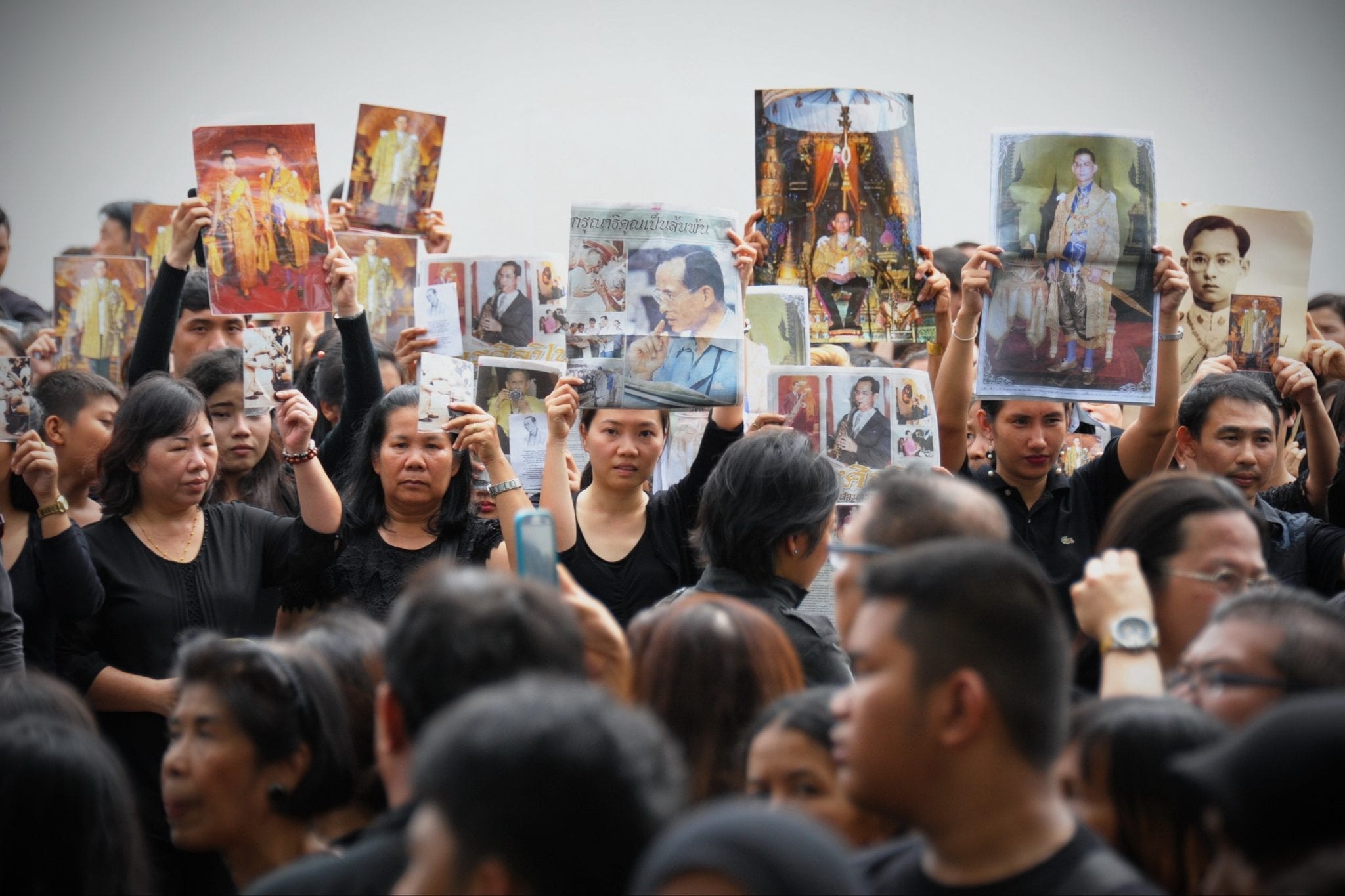
    Nopakun Kunsujarid, the President of Bangkok Photographic Society, one of photographers whose image was included in the exhibition said, “I took this picture on 22 October 2016 when massive mourners filled Sanam Luang to capacity in order to join the historic mass singing event being filmed by MC Chatrichalerm Yukol. That heartfelt tribute to the Late King on that day was another momentous day in our history that Thai people across the nation united as one. From this picture, many mourners are seen holding both new and old portraits of His Majesty the Late King Bhumibol Adulyadej. People were smiling and being helpful to each other. The passing of our revered king united everyone together again. As a photographer, I intended to communicate these emotions as best as I could.

    Adul Tanthakosai, whose image was also on display stated, “This picture was taken on 14 November at the festival of the Illuminated Boat Procession known as the sacred ‘Lai Reua Fai’ festival in Nakon Panom Province. I was impressed by the unity of locals. Not only had they come to participate in the festival, but also to express their profound appreciation to His Majesty the Late King Bhumibol Adulyadej through lighted candles and the formation of Thai number ‘9’. Many people cannot travel to pay their final respect at the Grand Palace in Bangkok, so they took this chance to do their part in this festival as a token of humble loyalty.”

    Tanakrit Kalaseranee, also added, “I wished to take pictures that demonstrate deepest emotion of mourners coming to pay their final respects to the royal remains as well as pictures of those working as volunteers, so I chose to capture moments from a prime spot inside the walls of Royal Palace where the majestic Chakri Maha Prasat Throne Hall stood tall as a background. This image was taken on 15 November 2016 and it truly conveys my true feeling. The image of students assisting elderly people on their wheelchairs portrays the value of togetherness, sincere gratitude and unconditional love we all share.

    Please be invited to witness and be part of ‘The People’s Archives’ in remembrance of His Majesty the Late King Bhumibol Adulyadej by joining the ‘Forever in Thai Hearts’ exhibition taking place on 19-30 November 2016 at Lifestyle Hall, 2nd Floor, Siam Paragon.

  • Chinese mall opens ‘nursery’ room for husbands

    Chinese mall opens ‘nursery’ room for husbands

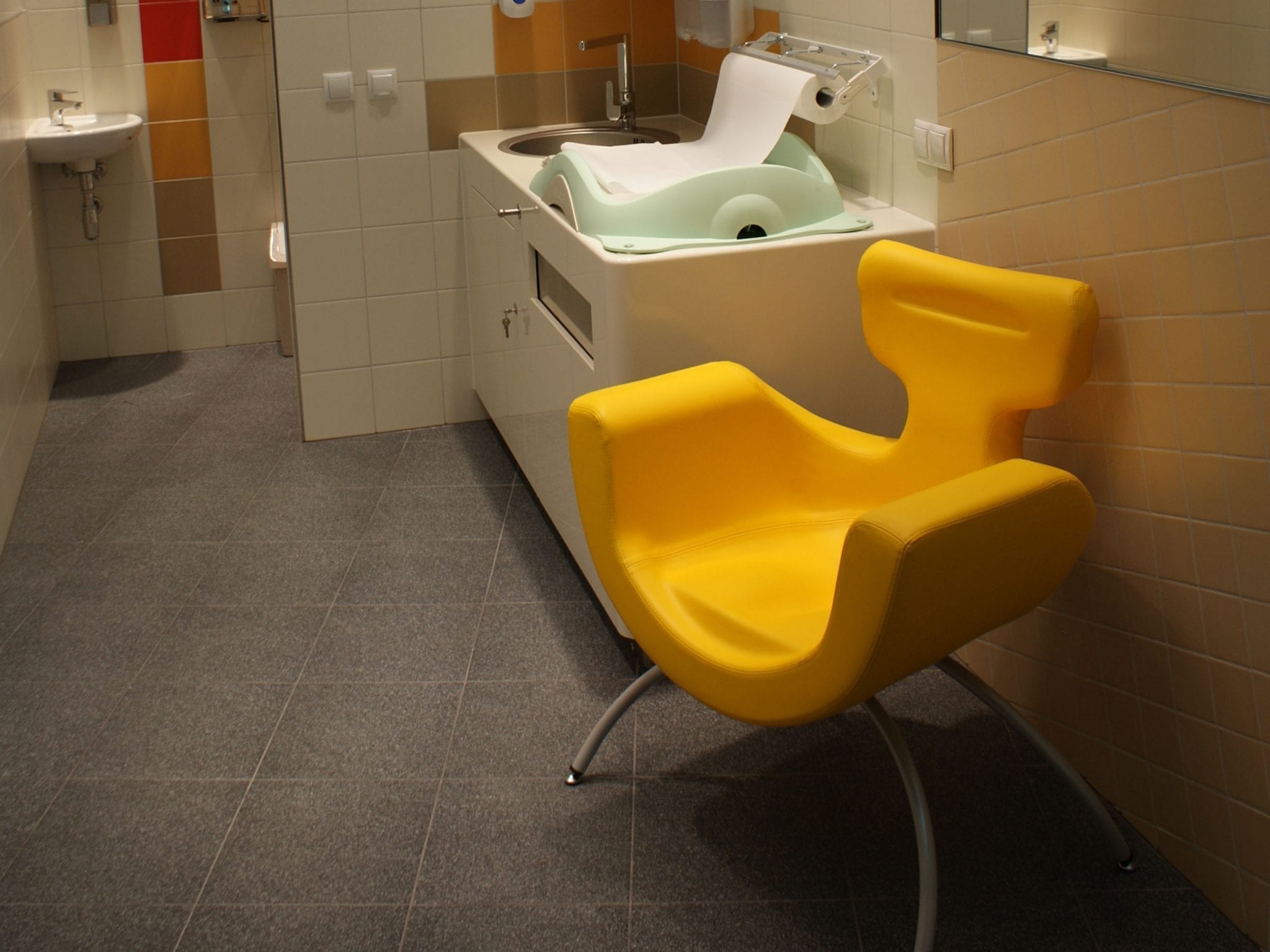
    A new mall in Shanghai has set aside a space for what it is calling a ‘husbands nursery’, where it hopes bored spouses will hang out while their wives are shopping in the mall, China Central Television (CCTV) reported.

    This ‘husbands nursery’, on the third floor of a shopping mall in Shanghai which opened on October 30, “is equipped with multiple leisure facilities, including magazines in its reading area, and a television,” supposedly for men to relax, CCTV said. But what those running the mall may not know is that Chinese men – the mainland’s biggest online shoppers – will likely be racking up credit card debt sitting in the ‘husbands nursery’ and splurging on themselves.

    “Mainland men are more likely to splurge on themselves when making purchases over the internet than women – who focus more on buying daily necessities,” according to a May 2016 survey.

    The survey was conducted by Ant Financial Services, an affiliate of the Alibaba Group that owns the South China Morning Post. Its findings are contrary to popular perception that it is women who go on shopping sprees, buying cosmetics and clothes. And, the study also found that women are buying more daily household necessities, while men are splurging on personal-care products and leisure goods.

    “Male online shoppers prove to be more hedonistic and the level of online spending by men is higher than women,” Ant Financial said in its report published in May.

    The survey said that women still bought a greater number of goods and services on the internet, but that they were buying more daily necessities for household use. Men’s online spending on entertainment, sports, dining and travel was 26 percent higher than the spending of women, and that women’s online purchases were aimed at running more efficient households.

    Ant Financial conducted the survey in partnership with the China Academy of New Supply Side Economics. The survey was based on data collected by Alipay, China’s online payment giant operated by Ant Financial, which has 450 million users.

  • Customised price plans for electricity in the pipeline

    Customised price plans for electricity in the pipeline

    Consumers can look forward to shopping for electricity the way they choose a phone plan. Electricity retailers are preparing a buffet of options for consumers, as the Energy Market Authority (EMA) plans to fully open up the electricity retail market to competition in the second half of 2018.

    For the eco-conscious, there will be plans that guarantee a portion of energy consumed will be linked to renewable energy, such as solar power. And those who work in the day could sign up for options that allow them to take advantage of lower electricity tariffs at night.

    Electricity is cheaper at night as there is lower demand for it.

    Those who are home all day could in turn benefit from schemes that offer varying tariffs for different periods of the day, allowing them to choose to run home appliances when electricity prices are lower.

    There will even be short-term trial packages to entice consumers who are resistant to change.

    “In the initial stage, many consumers will be sceptical about switching for various reasons, like reliability, security and so on,” said electricity retailer iSwitch.

    “iSwitch is planning to roll out price plans, such as short-term trial packages, to increase their confidence in switching,” it said.

    These are just some of the customised price plans that small energy users, such as households and small businesses, could benefit from.

    Currently, only 33,000 commercial and industrial consumers with an average monthly electricity consumption of at least 2MWh – which amounts to a monthly electricity bill of about $450 – are taking advantage of this flexibility. But the remaining 1.3 million consumers, mainly households, will get to benefit with the change, EMA said.

    During this year’s Singapore International Energy Week, which starts today, participants are expected to discuss issues such as green energy and the implications of low energy prices.

    There were just seven electricity retailers in 2013. This has increased to 20, EMA told The Straits Times.

    Industry players say market liberalisation will benefit consumers.

    “Not only will it lead to better value and services (for customers), but it also gives them the opportunity to achieve their other objectives, such as environmental protection in purchasing green energy,” said a spokesman for retailer PacificLight.

    Customers may also enjoy lower tariffs.

    Mr Vijay Sirse, chief executive of Red Dot Power, said: “It is expected that every household will potentially save anything from 10 per cent to 20 per cent of its monthly electricity bill.”

    Associate Professor of Marketing (Education) Seshan Ramaswami, from the Singapore Management University, noted that while it is difficult to say whether prices will definitely go down, customers could benefit in other ways.

    For instance, retailers could try to differentiate themselves by offering bundled or value-added services – such as installing smart home systems or giving discounts on energy-saving appliances.

    Housewife Mastzainah Jalil, 45, likes the idea of being able to time the use of her appliances to when electricity tariffs are the lowest.

    Assistant manager Daniel Govindan, 28, prefers a price plan which incorporates renewable energy and a smart system that sends alerts when energy-intensive appliances are in use when electricity tariffs are high.

    He said: “Renewable energy is the way to go. I think clean air is a public good. So less fossil fuels, more clean air.”

  • Alisports invests $100 million to popularize Rugby in China

    Alisports invests $100 million to popularize Rugby in China

    Alisports is to invest US$100 million over the next 10 years in an effort to popularise rugby in China, World Rugby announced on Wednesday.

    The company – the sporting division of e-commerce giant Alibaba – revealed its plans at a launch in Shanghai.

    The cash will be used to set up the first professional leagues for men and women, and national sevens programmes.

    And a massive mass participation programme will be launched in 10,000 universities and schools in an effort to attract one million new players over five years.

    Development programmes aim to recruit and train 30,000 coaches and 15,000 match officials by 2020, while the firm will launch a nationwide marketing programme and broadcast rugby on its TV and digital channels.

    “Rugby is a great Olympic team sport with strong values, which is why we are so excited about its undoubted potential in China,” said Zhang Dazhong, CEO of Alisports in a statement issued by World Rugby.

    “We have a great partner in World Rugby and together we will work tirelessly to promote the development of rugby in China with a goal of inspiring one million new players in five years.

    “With the support of World Rugby and a strong strategic plan, we believe that rugby in China will take off as an attractive, inclusive mass-participation sport of sportsmanship and character.”

    The country is making a major effort to increase sporting participation at all levels, and businesses have been rushing to get involved.

    And rugby is seen as a sport with huge potential in Asia, especially after its inclusion in the Olympics.

    “World Rugby’s strategic mission is to grow the global rugby family,” said World Rugby chief executive Brett Gosper in the statement.

    “China is central to that mission and we are delighted to be announcing further details of our ground-breaking plans in partnership with Alisports and the China Rugby Football Association.

    “Driven by a common vision, ambitious but attainable goals and an unprecedented investment programme, we are confident that we can build a strong and sustainable platform from which to ensure that China is in the best-possible position to become a major force on the international stage with strong men’s and women’s sevens and 15s teams, sustainable leagues, model development and participation programmes and real major event hosting potential.”

    According to World Rugby, participation in the sport in China has increased by 40 per cent in the past year with 76,000 players.