Category: Research

Retail News Asia is committed to providing both local and global retailers with the latest Research throughout the Asian market. This on a daily base.

  • Vietnam retail sales reported soaring

    Vietnam retail sales reported soaring

    Vietnam retail sales grew at 13 per cent last year, with food and beverage, apparel and household appliances leading the way, according to Savills Vietnam. The country’s Ministry of Industry and Trade has estimated total revenue generated from retail sales and consumer services reached US$191 billion last year. Vietnam retail sales accounted for $143.3 billion of that figure, or more than 75 per cent.

    The highest growth was recorded in precious stones and metals, wood and building materials, food, household appliances, and garments.

    Sales from accommodation and catering services grew by 9.1 per cent to $23.3 billion, accounting for 12.3 per cent of the total retail sales.

    Retail space supply

    The supply of retail space in Vietnam increased by more than 28,000sqm last year with two new shopping centres opening and  several others changing format or closing. Total stock was approximately 1.3 million sqm, up 9 per cent year on year and the average gross rent rose 2 per cent quarter on quarter.

    This year, Savills predicts, new supply in CBD locations will be only 31,700sqm with another 215,000sqm becoming available in non-CBD districts.

    Outlook

    Meanwhile, the ministry predicts total revenue from retailing and consumer services will increase at an average of 13 per cent this year, reaching $255.5 billion.

    Between 2021 and 2025, the predicted growth rate is 14 per cent with total revenue reaching $484.58 billion by 2025.

  • Indian shop fit industry poised for sustainable growth in 2019

    Indian shop fit industry poised for sustainable growth in 2019

    The Indian retail sector is growing faster than ever before and is one of the fastest growing in the world. According to a Deloitte Report, the Indian retail industry is expected to grow to US $1.1 trillion by 2020, registering a CAGR of 8.79 percent between 2000 and 2020. This growth can be attributed to the growing young population of the country, rise in disposable income, change in lifestyle and most importantly, digitization and connectivity.

    Though brands are investing heavily in online retail, traditional retail continues to be their core focus and hence, demand for shop fit designers and manufacturers only continues to grow.

    Changing retail landscape and role of retail shop fitting

    2018 was a redefining period for Indian retail industry. From huge investments by international players to M&A, downsizing of physical stores from traditional players to investing in physical stores by ecommerce players, the retail industry witnessed significant changes.

    As the debate around relevance and profitability of brick-and-mortar stores continues, retailers continue to invest in physical stores and thrive to provide the best shopping experience for customers. The traditional, one-size-fits-all store formats are slowly decreasing and brands are now continuously working towards exploring creative concepts to rejuvenate the look and feel of the store to stay relevant and attract their respective consumer targets.

    Every brand has a different approach in designing retail outlets and so are their shop fit requirements. For example, a sportswear brand store will have a spacious interiors, relaxed furniture for seating, minimum product placement on shelves to create clutter free picking up of products and eye-catching digital display of celebrated sports personalities on the walls to influence customer’s shopping. Whereas, a clothing brand store for infants and children has shop fittings and fixtures of lower height making it easy for kids to select what they want and have popular animated characters all over the store. This is where the expertise of shop fitters come into the picture. Shop fitters play a very important role in building successful retail brands by planning, designing and manufacturing shop fit and fixtures that reflect a brand’s ethos. They closely work with the brands to execute their designs and ideas for Visual Merchandising.

    Growth opportunities for shop fit industry

    A study by JLL suggests that the country is expected to see the highest mall supply in the next three years (2018 – 2020) touching 19.4 million square feet. Due to the radical shifts in the consumption pattern of new-age consumers, brands see tremendous untapped potential in small towns and cities (Tier II and III) they will expand their footprints in these geographies and continue to invest in physical stores.

    Brands continue to focus on integrating online and off-line shopping and the concept of ‘Experiential shopping centers’ will gain importance. Physical stores will double as fulfillment centers to help process online orders. Like in other markets, the concept of BOPIS, i.e. “Buy Online, Pickup In-Store”, which gives customer the flexibility to shop (order) online and visit the nearest store to try the product and collect it may become popular among people. As customer shopping experience, engagement and purpose of the physical store becomes more crucial, brands will regularly invest in store design, interiors, shop fits and new concepts in order to differentiate themselves from competitors. A good fit-out raises a brand’s profile, efficacy and creates a positive perception about the brand. Hence, there is a growth opportunity for shop fitting industry.

    Adding to this, the trend of solo entrepreneurs entering the market and small scale traditional retailers who wish to revamp their business rely on professional shop fitters for retail store design, floor planning, shop fits, etc. which will also give a boost to the shop fit industry.

    Conclusion:

    As organized retail industry continues to grow in the country, it possesses a great opportunity for the shop fit industry. Decisions by brands to downsize the store formats may hurt the shop fit industry’s business and profitability, but there will definitely be significant growth as more brands are now looking to establish their offline presence and also increase their physical presence across markets. In addition to this, with the new rules regarding single brand retail ownership, many new foreign brands will look to enter the Indian market.

    Being an allied industry of the retail sector, the shop fit industry grows hand-in-hand with the retail industry. As brands continue to invest in visual merchandising and store design, they rely on experienced and quality focused shop-fit manufacturers to partner with them. The role of shop fitters cannot be understated in helping the retail brands build their identity, differentiate them from competitors and attract footfall in the store by their innovative designs and store concepts. Shop fitting is an important investment for retail brands and when done right can translate to improved business and performance. Overall, the outlook for the shop fit industry is positive.

  • Retailers to lose US$130 billion from card-not-present fraud: Juniper

    Retailers to lose US$130 billion from card-not-present fraud: Juniper

    Increasingly complex card-not-present fraud will cost retailers US$130 billion globally in digital sales over the next five years. A Juniper Research study predicts that retailers’ slow pace in keeping up with new fraud prevention requirements will allow cybercriminal practices to become more widespread as more and more consumers shop online. It observes that established point-of-sale vendors will need to move towards mobile POS technology in order to expand their reach into fresh markets and reduce their exposure to card-not-present fraud.

    “A layered fraud detection and prevention (FDP) solution naturally helps directly preventing fraud, but it also offers major gains in terms of recovering potentially lost revenue through false positives,” said the report’s author Steffen Sorrell. “This is something about which retailers remain undereducated, and has allowed fraudsters to capitalise on relatively low FDP spend”.

    An implication of the Juniper research is that a low understanding of FDP investment return is causing the low uptake of the technology. the report anticipates digital payment players will be spending $9.6 billion annually on FDP solutions by 2023.

  • Retail trends to look forward to in 2019

    Retail trends to look forward to in 2019

    Retail industry in India is undoubtingly one of the fastest growing retail industry in the world. It is the largest among all industries accounting to 10 percent of the country GDP and employs around 8 percent of the workforce. The retail industry is an experiential motley that is currently going through a robust transformation. Be it employing new technologies or exploring new store formats, revamping business strategies or creating personal experiences; retailers are indeed getting ready for the future by looking beyond conventional retail and evolving along with their modern consumers.

    India is also expected to become the world’s fastest growing e-commerce market, driven by robust investment in the sector and rapid increase in the number of Internet users.

    As the opportunities are immense, let’s take a look what retail trends the stalwarts think will rule in 2019:

    – Customization – The need for customized products and services is increasing thereby pushing the demand for personalized goods and services. With a pragmatic approach, the interface between companies, brands and customers will improve. Social media conversation tracing is going to be trending in 2019, which is a ground-breaking path to the future of handling customer behavior for tailor-made solutions. Also, studies reveal customers come down in favor of personalization — up to a point. They enjoy seeing products and deals personally relevant to them.

    – Brand Experience – It’s not just about selling the products to the customers but also providing them with the best experience too. Most retailers recognize this shift, but the majority struggle with strategies to transform their organization to deliver on consumers’ increasingly demanding expectations. Emerging online brands naturally seek to disrupt traditional ways of doing business and developed digital-first models that have created better experiences.

    On the other hand, established retail brands are burdened with legacy systems that are not optimized for today’s environment. The core – people, service, and experience – are strength to maintain and to satisfy today’s consumer they must integrate the flow of information and resources across the networks of employees, stores and partners.

    Hence, experiences will make a compelling occurance that consumers will always remember and be more than happy to share with one another.

    – Customer Retention – Customer retention is often far more effective and profitable than customer acquisition. An individual shopper want personal recognition. While loyalty programs offer rewards to existing customers the challenge is the acquisition of new customers. Innovation in content is the key to retaining and acquiring customers.

    – Retailers that step up their social media strategies will thrive – The rise of Instagram Stories, Facebook Live and messenger apps will fundamentally change how retailers interact with consumers online. Simply posting photos or updates on a brand’s social media handles won’t work anymore. Retailers will need to up their social media game and use social networks and apps to tell stories and engage with fans in real time.

    – Display – Retail displays is a strategic aspect of the business that can help attract customers, retain their interest, and increase sales. Visual merchandising helps to set a brand apart from competition by creating attractive and fascinating windows that can pull the consumer in to the store. Effective retail displays attract potential customers to the store. When designing displays, choose engaging colours, unique décor and stock arrangements to appeal both the head and the heart of customers.
    Once the brand has attracted potential customers, the brand can Improve chances of making a sale by doing research to see what works in other retail spaces, and keeping an eye on how customer traffic flows through the store.


  • 7 Marvelous Shopify Apps That Can Change Your Life

    7 Marvelous Shopify Apps That Can Change Your Life

    According to https://profitindustry.com/ecommerce-statistics/, there are quite a lot of different ecommerce statistics and trends that you need to pay attention to. Even the slightest miscalculation or a miss could lead to big losses. As there are a lot of different platforms, people need to pick one that suits them the most. At the moment, there is hardly anything better than Shopify. This platform has been around for more than ten years now, but they have become known in the last few years or so.  One of the things that added more fuel to the fire, so to speak, is their constant app improvements. Whether it is an upgrade or something completely new, users can make full use of the advantages of the platform. The number of available apps can be a bit overwhelming. Therefore, we have decided to compile a list of 7 Shopify apps that you absolutely cannot miss!

    EXPORT OrderPro

    Even though reports orders Shopify provides for its users are useful, it was only a matter of time before we saw craving for more information. The more detailed data it is, the easier it is to plan. Everyone who has been in ecommerce for a long time should appreciate this app by MeneLabs. It has been around for a few years and continues to get more praise. With more than 80 different fields of information and live reporting, it would not be a stretch to suggest that this is one of the best apps on Shopify store overall. After all, most users need information on a daily bases. And there aren’t better tools that generate valuable data every day.

    Buymaxx

    Once you have to handle more than a few products in your store, you will begin to realize how difficult it is to deal with pricing. Bulk Price Editor by Buymaxx does exactly what you expect it to do. By using a smart interface you will be able to download the list of your products and quickly change prices, margins, etc. and import it back in without any problems.

    You do not need any coding skills to install the app to your store. It is as quick as it gets.

    Finally, it is also worth mentioning that developers are consistently releasing updates to the app, making it better over time.

    Pushflew

    This push notification app is one of the best on the market. Its main purpose is to inform you whenever there is an abandoned cart or something similar and help you refrain people from leaving the website. Since everyone is using notifications because they are effective, you should do the same. Scheduling, adding images, using the app for multiple domains, support for every browser, and live tracking. Seems more than enough to consider giving this a go, right? Wait no longer and start engaging with your audience and increase the traffic that every other e-shop is after.

    Opinew

    Are you looking to take things to the next level? If that is the case, you might want to consider connecting your shop to the likes of eBay and Amazon. How, you might ask? Well, it is simple. Get Opinew Shopify Product Reviews App and Importer and see the customers rolling in. Your products will showcase the reviews from the biggest online shops in the world. And this information is extremely valuable for people who like to research before clicking the “buy” button. You will be able to improve SEO and customize everything and keep track of how much of the sales occurred because of this app.

    DeepMarkit

    Promoting yourself through more than just sharing on social media is a good way to reach that next level. Of course, it does not mean that you should abandon the idea. Investing in Premium rewards and games the best Shopify conversion app is DeepMarkit. It will be entirely up to your imagination how you are going to manage the whole thing.

    Displaying a discount coupon, promoting a raffle or even coming up with a contest can drive more traffic that one expects. By installing this app you will also access 15 customizable games, another feature that can help you with the venture.

    Conversific

    The fact that there are so many tools for extracting data shows its importance. And since ecommerce is a very complicated thing, you need to gather as much information as possible. Ecommerce analytics from Conversific does just that. And then some.

    This particular app is especially good for those who have not had a lot of experience on Shopify, or managing e-shops in general. The reports are easy enough to understand even for beginners, and the amount of information is not overwhelming.

    As soon as you install Conversific to your Shopify store, you will no longer have to spend time analyzing every trivial thing. That in itself is more than enough to convince you giving this a try.

    Wholesale2b

    Given the number of available products to sell, people who start out tend to struggle quite a bit with making their choice. A possible solution to this? Dropship on Shopify with Wholesale2b.com – add thousands of dropship products to your Shopify store in just minutes. This means that you will be able to pick and add as many as you want. The process is automated, therefore it is easy. The app offers plenty of other great features, including daily updates, profit estimations, updating out-of-stock products, and so on. It is without a doubt a great addition to your Shopify store.

    The list of these 7 Shopify applications should give you more than enough to ponder on. If you are looking to get into ecommerce using one of the most popular platforms, you will need all the help you can get. And apps like these can make all the difference in the world.


  • How the retail industry has fared in 2018

    How the retail industry has fared in 2018

    The overall retail market in India 2018 stood at Rs 43,251 billion and is forecast to grow by 6.4 percent CAGR in 2018-2023. Retailing in India still predominantly takes place in physical stores and shopping behaviour between urban and rural consumers continues to be vastly different. Smaller independents (both grocery retailers and non-grocery specialists) continued to dominate the landscape they faced growing competition from modern outlets opening in out-of-town shopping centres and malls capturing the Tier II & III markets.

    This year, we witnessed modern retailers launch interesting payments schemes and effective pricing strategies to propel the sales. For example, leading retailer Future Group launched its payment wallet Future Pay which can be used in all its retail brand outlets. Retailers also capitalised on growing acceptance of modern retail by developing new marketing schemes and strategies to attract shoppers.

    Additionally, multi-channel strategies remained key for retailers as they are developed online platforms that are also smartphone and tablet compatible to drive Internet sales.

    Furthermore, retailers also increased their new private labels products. This is was done for certain grocery categories like: packaged foods, non-alcoholic drinks, beauty and personal care and home care products.

    Finally, subscription-based retailing practices started to pick up in 2018. Although still relatively niche, and limited only to urban India, the subscription-based model for beauty and personal care and consumer health became quite popular in metropolitan cities.

    What are the retail trends that are going to rule the roost in retail in 2019?

    – Retailing will continue to offer potential for grocery retailers. Convenience stores and forecourt retailers are likely to continue to see healthy growth rates as their format can meet the demands arising from changing lifestyles by offering more convenient shopping solutions, both in terms of location, business hours and product range.

    – Given the rising maturity of retailing in metros/urban areas, retailers have slowly started to focus on the semi-urban consumer base. This has resulted in the slow and steady urbanisation of shopping styles amongst semi-urban consumers.

    – As the labour crunch and high rentals continue to affect the retail landscape in India, hypermarkets are looking to ramp up investment on self-service technology and automation to reduce costs and improve customer experience. Some hypermarkets chains have implemented self-service kiosks at checkout counters, generally with positive results because of reduced waiting times. Investments have also been made into automated ordering systems, which has helped brands reduce storage space at outlets, hence control rental costs. This can be expected to grow during 2019 as well.

    – Furthermore supermarkets are likely to push the broadening of key product categories, such as organic fresh food, soft drinks and packaged food. They are also likely to further narrow the line between foodservice and grocery retailing, with the introduction and integration of new foodservice elements within their stores.

    – Non-grocery retailing will likely be impacted by the growth of internet retailing at the expense of specific store-based retailers and other non-store channels. Consumers are expected to increasingly shop and research products online, with the popularity of smartphones making mobile-optimised sites and shopping apps crucial in attracting consumers. Moreover, social media will be used more often to alert consumers to attractive price promotions and build interest in new product launches. Also, omni-channel strategies will remain key for non-grocery retailers.

    – Non-grocery retailers will increasingly integrate their online brand information with store inventory, as consumers expect to find the same products in both channels. Moreover, to minimise showrooming, players will also need compelling reasons for customers to buy their brands in store, whether in terms of product selection or price competitiveness.

    – The entry of Amazon and Flipkart could stimulate a much-needed increase in the competition, which will bring both opportunities and threats for existing food and drinks retailers in India. Amazon with ‘Amazon Pantry’ and Flipkart with ‘Flipkart Supermart’ eventually launched its online grocery business in 2018. Millennials and affluent consumers were encouraged to change from shopping in physical stores to online in 2018 with convenience and heavy discounts on offer. Also, with increasing investments from player such as Amazon who are expected to buy skate in Future Retail and PayTm who have partnered with BigBasket and Future Group to strengthen its online grocery business, the food and drinks internet retailing is expected to show tremendous growth in 2019.

  • Vietnamese consumers among the most optimistic in the world

    Vietnamese consumers among the most optimistic in the world

    Vietnamese consumer confidence has reached a global high thanks to optimism over jobs and personal finances. The Vietnam Consumer Confidence Index has risen by nine points from the second quarter to reach an all-time high at 129 points in the third quarter of 2018, according to the Global Consumer Confidence Survey.

    The survey results have been released by research association The Conference Board in collaboration with global market research company Nielsen.

    The survey ranks the country in second place in the world in terms of consumer confidence, behind India at 130 points.

    While most Asian economies are vulnerable to the ongoing trade dispute between China and the U.S., Vietnam is a possible exception, as it may attract parts of the global value chain that currently run through China, the report said.

    The rise in the confidence index is also due to greater optimism about employment prospects, personal finances and the level of willingness to spend.

    Eight out of ten Vietnamese surveyed said that they were positive about their job prospects, up nine percentage points from the second quarter.

    Eighty-two percent of respondents expected their personal finances will be good or excellent over the next 12 months, up 6 percentage points from the second quarter.

    The majority of them, 63 percent, said that the next 12 months are a good time for them to buy the things that they want and need, 8 percentage points higher than the second quarter.

    Concerns about having a stable job and health (both at 40 percent) remained the top concerns among Vietnamese consumers. The national economy came in third at 27 percent, 5 percentage points higher than the previous quarter.

    Vietnamese consumers continue to take the lead globally when it comes to saving, the survey found. Seventy-two percent of respondents said that they would save their spare cash, up two percent from the second quarter.

    But Vietnamese people are also more willing to spend on big-ticket items. The percentage of people who would spend their spare cash on home improvements increased 10 percent from the second quarter to 48 percent.

    Over half of them, 53 percent, want to spend the money on new clothes, up 7 percentage points from the second quarter.

    Nguyen Huong Quynh, managing director of Nielsen Vietnam, said that when consumers faced multiple concerns, their purchasing decisions will be affected and businesses should always keep a close track on changes in the spending habits of consumers.

  • Real human call centres still preferred : research

    Real human call centres still preferred : research

    New research reveals 75 per cent of shoppers prefer live-agent support for customer service verses 25 per cent support for self service and chatbots.

    The research, from cloud contact-centre operator NewVoiceMedia, identified consumer concerns about sharing sensitive information, a lack of understanding of bots and their inability to resolve issues.

    “Chatbots can provide customers with quick answers to frequently asked questions or issues, and the survey notes the benefit of chatbots for certain interactions, such as 24-seven service,” the survey’s authors concluded.

    But when it comes to handling sensitive financial and personal information, most customers are more comfortable with a live agent, and just 13 per cent say they would be happy if all service interactions are replaced by bots in the future.

    Foremost among consumer concerns about using chatbots include:

    • A lack of understanding of the issue (65 per cent).
    • The inability to solve complex issues (63 per cent).
    • The inability of chatbots to provide answers to simple questions (49 per cent).
    • The lack of a personal service experience (45 per cent).

    While less than half of the people surveyed (48 per cent) said they would be willing to use chat bots for service – versus the 38 per cent who wouldn’t – 46 per cent also felt that bots kept them from reaching a live person.

    Banks (82 per cent) and medical services (75 per cent) were the businesses that people were least likely to want to deal with bots.

    Customers prefer live agents for technical support (91 per cent); getting a quick response in an emergency (89 per cent); making a complaint (86 per cent); buying an expensive item (82 per cent); purchase inquiries (79 per cent); returns and cancellations (73 per cent); booking appointments and reservations (59 per cent); and paying a bill (54 per cent). However, when asked about buying”a basic item”, 56 per cent would choose a chatbot over a live interaction.

    The top benefit cited for dealing with chat bots was 24-hour service.

    “When a situation becomes emotional or complex, people want to engage with people”, says Dennis Fois, president of NewVoiceMedia. “As businesses add more customer service channels, conversations are becoming more complex and higher value, and personal, emotive customer interactions play a critical role in bridging the gap for what digital innovation alone cannot solve,” he said.

    “For this reason, companies must find the right balance between automation and human support to deliver the service that customers demand. Frontline contact centre teams will continue to be the difference makers on the battlefield to win the hearts and minds of customers, and organisations deploying self-service solutions should ensure that there is always an option to reach a live agent”.

    There is a sense consumers may warm to chatbots in the future, however, given that younger respondents (aged 18-44) were more open to using chatbots overall and across the individual scenarios compared to older consumers (45-60+).

  • Retail sector Korea in future

    Retail sector Korea in future

    Technology and e-commerce trends are reshaping the global retail industry in profound ways, as the rise of online channels threatens to displace more traditional shopping experiences. However, Korea’s retail sector seems to be thriving in the face of this upheaval, with a 6% year-over-year increase in retail sales by Q3 2018. What are the factors fuelling this encouraging retail growth?

    Firstly, improved relations with China and North Korea have energised the retail sector, with duty-free sales registering an impressive 34% year-over-year growth by Q3 2018. While this retail boost can primarily be attributed to the recent surge of Chinese tourists in Korea, it also reflects the growing international popularity of Korean beauty and lifestyle brands.

    E-commerce is also emerging as a key driver of Korea’s retail sector. Online channels have experienced rapid growth since 2010, and will only keep expanding their foothold as Korean consumers start shifting away from brick-and-mortar stores. With Korea’s e-commerce market predicted to grow by 21% this year, traditional retailers will need to find new ways of adapting to this rapidly evolving landscape.

    Some retailers are already turning to artificial intelligence and other Industry 4.0 technologies in an effort to provide consumers with more innovative shopping experiences. For instance, Hyundai Department Store is using Naver’s virtual assistant Clova to answer customer inquiries – whether they relate to store locations or specific purchases.

    Another interesting example is retail giant Lotte Home Shopping, which has developed its own augmented reality system so that customers can visualize how products would look in their home. As these new technologies get ushered into the mainstream, we can expect to see more and more retailers jumping on the AI bandwagon in the next few years.

    However, this doesn’t mean that we should write off the traditional brick-and-mortar experience just yet. Major brands are still banking on attracting consumers with the enduring prestige of high street locations – such as Maison Kitsuné, which recently opened its flagship store in Seoul’s trendy Garosugil district.

    Many global retailers continue to view Seoul, one of the world’s most famous shopping destinations, as a test bed in Asia. With cosmetics brands like Givenchy Beauty and Armani Beauty making their debut in Seoul this year, and renowned F&B brand Blue Bottle Coffee preparing to enter the Korean market in 2019, it’s clear that leasing demand from foreign retailers is still going strong.

    If we look to other segments of the retail industry that are experiencing growth, it’s worth highlighting the surge of fresh food delivery services across the country. With double-income families emerging as a major consumer force, demand for overnight fresh food delivery has also been rising – and major retailers as well as food startups are turning their attention towards this potentially profitable market.

    The rapid expansion of the food delivery market – and of the e-commerce sector in general – is proving to be a windfall for Korea’s logistics industry. Logistics developers are recognizing the need for large-scale modern logistics centers capable of storing and delivering goods nationwide, with faster delivery remaining the market’s key competitive measure. The growing demand for cold chain facilities is expected to fuel a mass redevelopment of older warehouses, especially in the Greater Seoul area.

    So far, Korea’s retail industry has shown remarkable resilience against a backdrop of technological disruption. More brick-and-mortar retailers are offering F&B, AI and entertainment options to differentiate themselves from their e-commerce counterparts; and this trend will only grow as consumers seek out unique shopping experiences. The question is, will Korea’s retail market keep thriving in the long term?  As long as technology continues to enhance – and not supplant – existing retail experiences, we can venture to hope that a bright future is in store for this challenging and dynamic sector.

    -CBRE-

  • Poor customer experience costs retailers in Asia

    Poor customer experience costs retailers in Asia

    Nearly two-thirds (63 per cent) of consumers in Asia will no longer shop with a retailer after just one poor customer experience. That is one of the conclusions of a research study conducted by unified commerce provider Tofugear in partnership with Rakuten Insight. Based on a survey of 6000 shoppers across 12 countries in Asia, the research underlines the importance of delivering on experience for retailers.

    Top frustrations with stores included products being out of stock, long checkout queues and poor service from staff. When it comes to online shopping, consumers were turned off by high shipping costs, inaccurate product information and slow fulfilment speeds.

    Philip Wiggenraad, head of research at Tofugear, says: “The connected consumer in Asia is empowered and not afraid to look elsewhere when their needs are not being met. Retailers need to understand that they often only have one chance to get it right.”

    E-commerce is popular with consumers in the region: 59 per cent prefer to shop online rather than in stores.

    However, there were considerable variations depending on the country. China led the way (88 per cent), while markets such as Hong Kong and Singapore (both 51 per cent) were more evenly split in their preferences between online or stores.

    While millennials are the most prolific online shoppers, with more than half (55 per cent) doing so at least once a week, Gen Z also has a definite lean towards the online channel.

    “Physical retailers expecting a resurgence of the store driven by Gen Z should think twice and continue to look at ways to make their stores relevant in the digital age,” says Wiggenraad.

    Respondents to the survey showed a strong willingness to engage with store technologies in order to make their shopping journey more frictionless. Two-thirds (65 per cent) would use their mobile phone for self-checkout, while 62 per cent were open to using apps in stores as part of a connected retail experience.

    Access the full findings of the Digital Consumer in Asia 2018 report by downloading the PDF here.

  • IGD predicts five trends set to shape retail in 2019

    IGD predicts five trends set to shape retail in 2019

    Seamless in-store shopping experiences coupled with innovative advances in technology are among IGD’s five key retail trends for 2019. “Next year’s biggest trend of all is likely to be the continuation of rapid and radical change in the food and grocery industry,” said Toby Pickard, head of insight, innovation and futures at IGD.

    “We have already seen a significant pivot towards innovative new technology, and there is no sign of this letting up next year. Shoppers’ expectations have changed, and the retail and grocery sectors are working to meet those expectations in every area of business,” he said.

    IGD’s five key retail trends for 2019 are:

    Data dictates the way: This year has seen data become more valuable to the retail sector than ever, with 46 per cent of supply-chain experts now actively prioritising data-driven business. As well as helping to boost sales, accurate data will be vital for tools that allow retailers to understand customer behaviour – and reward their loyalty.

    Through customer datasets, artificial intelligence (AI) and machine learning in-store, retailers can target products and offers more effectively while maintaining appropriate stock levels and improving customer service. Insights gained through closer customer engagement will provide invaluable guidance to retailers looking to grow their businesses: making stronger connections beneficial to both groups.

    Doing good is good businesses: Companies will increasingly take the lead on sustainability while issues such as food waste and plastic pollution make headline news. This has translated to changing attitudes across the generations. Nearly three quarters (74 per cent) of UK shoppers say they have become more aware of the environmental impact of plastic packaging over the past year, and this has led to innovations such as biodegradable wrapping and plastic-free supermarket aisles. Retailers are no longer thinking about just reducing waste, but want to make a positive, tangible contribution. The next wave of innovative and leading retailers and brands will move beyond reducing their impact.

    Seamless stores: Physical stores will offer a much more digital experience next year, by using technology to make it easier for customers to find items and gain more product information. Some 85 per cent of UK shoppers would like to see the roll out of more in-store technologies. This should lead to a faster shop for many, where searching aisles and shelves for the right item is replaced by an app that guides shoppers to where they want to be.

    “Physical stores offer customers a more tangible shopping experience, where they can see products before they commit to purchase,” sais Pickard. “This gives these spaces an advantage over online providers, and we are seeing stores begin to capitalise on that and add in extras to incorporate more of the benefits of online.

    “A recent example of this is Il Viaggiator Goloso, a premium Italian brand, which has enabled its electronic shelf-edge labels to show the online reviews and scores products have received. This gives customers a more informed choice in store.”

    Help me be healthy: Most shoppers aspire to eat and live well, with 85 per cent saying they are actively trying to improve their diet, but aspirations don’t always translate into action. “We believe shoppers will be more health conscious going forward, so supporting them to both look and feel good will be a major priority for retailers and their suppliers. This means that both consumers and businesses will be thinking more about wellness and the role of retail in promoting cleaner living going forward,” says Pickard.

    Anywhere, anytime: IGD expects innovative new social-commerce solutions to emerge throughout next year. Retailers and suppliers will deliver targeted marketing, and new ways to make online shopping more social, instantaneous, and convenient.

    “Next year, we will see retailers think increasingly about making every moment shoppable,” says Pickard. “A recent innovation was EasyJet making it possible for Instagram users to find and book holidays to new destinations, simply by clicking on a photo they have seen. Whether through targeted marketing or simple ways to make purchasing more seamless, shopping is becoming not just more convenient but more instant as well.”

    IGD says shopping will become seamless and omnipresent, with people no longer needing to visit a retailer’s online store. As they look at pictures, watch videos or TV they’ll be able to just add products to a shopping cart.

    “This has the potential to change the way that retailers think about selling in the future.”

  • 8 Easy Startup Ideas For Asia

    8 Easy Startup Ideas For Asia

    We live in the times of so many possibilities. Therefore starting a new business to earn some extra money could be very easy and done very quickly wherever you are – it could even be Asia. People are really into new technologies there at the moment, especially mobile payments through various apps, so you could use the benefits of  this trend for your business idea.

    If you love the idea of making some money on your own, here you’ll find some original ideas you could use for your startup and maybe even start today.

    Specialist Of Education Progress Tracking

    Every parent wants their kid to do well at school and gain the best education possible. That’s why there are so many freelance tutors that help kids and students learn the subjects that they are failing at.

    An education progress tracking will help you reach the best result possible. This is done by tracking the progress of your child and comparing it to other students who are moving up to a similar goal. For example, the same degree in business management or biotechnology. Many criteria need to be evaluated and compared, like grades, honors, certificates, additional skills, and so much more.

    Develop An App For Coworking

    Coworking apps are in demand both for teams in creative and non-creative agencies and also for study groups. Therefore if you are not completely new to coding, you could build an entire network where people could work together on a digital platform. Surely there are already some apps that allow you to share, comment files, and work on projects together, but you can always research your competitors and make an even better product. Simply detect what’s lacking in these apps.

    Print On Demand Business

    Print on demand businesses are getting really popular lately. That is because it doesn’t require any investments and therefore is a perfect startup idea for young people like students. The best part is that you don’t need to be responsible for keeping items in stock, producing it or putting logos on it.

    One of the most popular forms of print on demand business is selling t-shirts. All you’ll need to do is come up with the design. If you want to learn more about how to sell t shirts online – there are POD platforms like Printify that are very easy to use and offer you articles that help improve your business.

    App For Acting

    This could be a similar idea to SnapChat or Instagram Stories, but with a completely different concept. Friends would be able to create short videos with specific timing, for example, 20 seconds. And other friends would have to continue the story. After finishing a story, you could watch it as a single movie clip. To access a group, you should have a special code, link or different kind of key to access. Some groups could be open to everyone thought.

    Job Interviews On Video

    Image credit: Seth Doyle

    Wasting time always means wasting money. Companies and their hiring specialist waste tons of time trying to find the best candidates for one or another job position. It’s hard to imagine, how many time has been wasted on candidates that weren’t a good fit for the company.

    And you could be the one to offer these companies a solution and create a platform with already prepared video interviews. They would be short and very specific – candidates would be asked a few questions and answer it on camera. This could be a really good filter for the hiring specialists.

    Local Social Media Network

    Social media is extremely popular nowadays. But what if you were to create a new platform that would be based only on location? You would be capable of connecting with people, see events and other information related only to the place you are currently in. This would filter out a lot of unnecessary information that we see on our Facebook every day.

    Create An App For Recycling

    Image credit: Paula Brustur

    A lot of people today care about nature and recycling, but really lack knowledge about ecology and how it works. It’s hard to determine what is truly toxic for us and our environment and sometimes we just don’t know how to properly utilize specific products.

    If you were to create a recycling app, it could help people understand recycling more, especially with all the pollution is Asia. For example, if someone would be thinking how to recycle one or another item the right way, they could type the product in your apps search and quickly find an answer.

    Sell Your Own Crafts

    If you have some skills for crafting, you should know that it’s a very trendy thing to do at the moment. Especially things like handmade jewelry and gifts. You could sell your crafts on Etsy, but you can also create your own e-store. All you need is to buy a domain, choose the design and add all needed forms for orders and contacting.

    To save some money, don’t pay the programmers for creating the forms for you, simply use CaptainForm wordpress form plugin that will offer you all the forms your website might need.
     

  • Who is Hong Kong’s new luxury shopper?

    Who is Hong Kong’s new luxury shopper?

    As one of Asia’s leading retail hubs, Hong Kong has long been a mecca for luxury shoppers. Despite being home to APAC’s most expensive retail real estate (second globally to New York City’s 5th Avenue), there’s a reason why large, sprawling luxury shopping malls continue to dominate in a crowded city.

    Hong Kongers will be glad to know, though, that it holds its own when it comes to homegrown luxury spending, which recently overtook foreign consumption at 55% of total purchases.

    This figure is staggering when considering the total population of Hong Kong is roughly 7.3 million people, less than a quarter of the 60 million visitors it hosts each year.

    For these locally based consumers, luxury isn’t a one-off, aspirational purchase — it’s an innate part of their lifestyle, which explains why 93% of shoppers intend to maintain or increase spending in luxury goods in the next five years.

    This holds true especially for the younger millennial shoppers who will be driving the majority of the growth going forward.

    Source: Think with Google

    The evolving nature of consumers is a common challenge for many marketers, and the luxury industry is no exception.

    The task at hand for brands in Hong Kong is to understand this distinct group of younger customers and the behaviors that shape their expectations when it comes making high-value purchases.

    A curious and demanding bunch

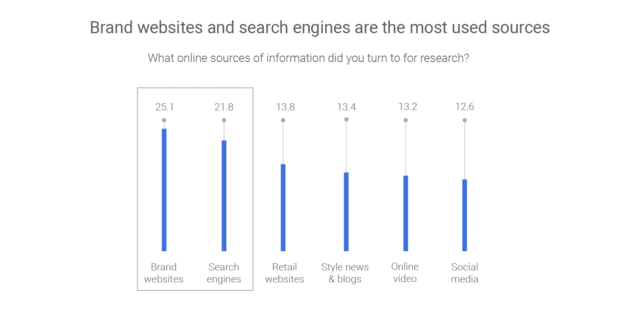
    Reportedly, 90% of luxury shoppers conduct research online before making a purchase, and brand websites and search engines are the two most popular sources people turn to. In fact, they’ve become the digital storefront for this generation of digital natives.

    Source: Think with Google

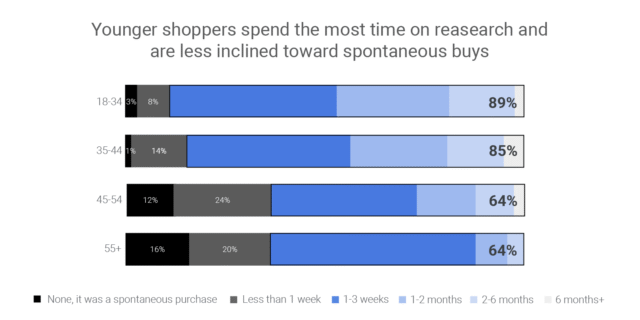
    Having grown up with readily available information online, millennial and Gen Z consumers spend more time on research than ever before.

    In fact, 89% of shoppers aged 18-34 spend up to three weeks researching a luxury purchase. And they’re not alone: 64% of consumers over 45 will spend the same amount of time on research leading up to a purchase.

    Source: Think with Google

    Retailers may have once treated online as a separate channel to physical stores, but this notion is quickly becoming outdated.

    Whether customers are online or offline is a distinction made by businesses, not consumers.

    Online and offline consumer behaviors are increasingly blurring, and the respective experiences need to follow suit, particularly when it comes to the inspiration and research phases.

    In short, consistency across the two worlds is key.

    It’s hard to imagine a luxury label leaving a customer linger unattended to in its boutique, so, by the same token, a customer should never be left unanswered or ignored on Google, YouTube, or social.

    More is more

    With a more exploratory consumer mindset, brand loyalty may be more elusive for brands targeting younger shoppers.

    Engaging potential millennial and Gen Z luxury shoppers constantly by trying to stay top of mind and being always on will be crucial to gaining consideration.

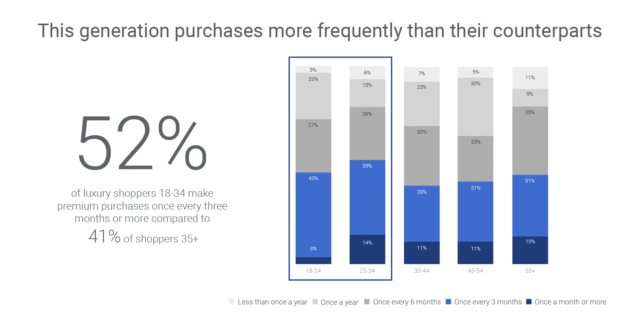
    In today’s environment of fast fashion and overnight style sensations — while couture brands used to produce two collections per year, they now produce five to six — one of every three consumers surveyed said they make luxury purchases to keep up with trends.

    The tendency to shop more often is evidenced among shoppers aged 18-34, of whom 52% reported making premium purchases once every three months, compared to just 41% of shoppers 35+ who did the same.

    Source: Think with Google

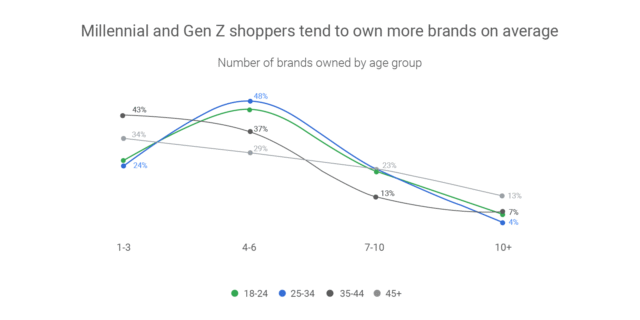
    In addition to a higher frequency of purchase, our research also shows that millennial and Gen Z shoppers are likely to consider a wider breadth of brands. On average, this group owned products from a repertoire of four to six brands; compared to more brand-loyal 35+ shoppers, who owned between one and three brands.

    Source: Think with Google

    Inspiring online with offline

    When it comes to in-store shopping, the aspects that customers value most are: 1) guaranteed authenticity, 2) the ability to touch and feel the product, and 3) personalized customer service.

    How might these values translate online? With 63% of people expecting the same high-touch brand experience online and offline, the challenge is to emulate these qualities and provide satisfying digital experiences.

    Offering free shipping on returns, for example, gives peace of mind to customers wary of counterfeit goods. Similarly, detailed product videos on the brand site or as a pillar of content on YouTube can help shoppers inspect items for quality while engaging them in a rich experience.

    Leveraging customer data, such as previous purchases, to create individualized interactions and recommendations is no longer a nice-to-have, but a must. Just as consumers expect personalized customer service in store, personalization is fundamental for designing a top-notch digital brand experience.

    Source: Think with Google
    The shopping experience begins online for Hong Kong’s luxury consumers.
    Search and brand sites are key because 90% of purchases are digitally influenced.

    Millennial and Gen Z consumers spend the most time on research, so it pays to provide as much information as possible to this group. They also purchase more frequently, and they consider more brands when they do so.

    To stay top of mind, brands should ensure that they are present at as many touch points as possible and that their media strategies are always on.

    Expectations for online shopping are growing higher by the day, and this is especially true for premium brands.

  • Trail Camera Market Inching Closer to Wireless Ubiquity, Global Demand to Grow at 3.5% Volume CAGR

    Trail Camera Market Inching Closer to Wireless Ubiquity, Global Demand to Grow at 3.5% Volume CAGR

    The bullish run in the Trail Camera market continues in 2018, with an incremental growth of 18,000 units over 2017According to Fact.MR’s new study, increasing wildlife exploration and rising demand for higher security and surveillance are instrumental in driving sales of trail cameras. The study opines that demand for trail cameras will grow at a CAGR of 3.5% in terms of volume throughout the period of forecast, 2018-2028.

    Technological advancements have significantly transformed the trail camera space, particularly with respect to connectivity and functionality. Possibility of obtaining thumbnail picture with trail camera has been a remarkable step reflecting a technological novelty in the trail camera marketplace.

    Growing proliferation of novel technologies such as Wi-Fi and Bluetooth in the trail camera marketplace are expected to influence the sales of trail camera, in turn presenting a positive outlook of the overall market. The demand for trail camera is being influenced with growing digitalization, as manufacturers continue to focus on researching and developing their products.

    The demand for wireless trail camera is projected to expand at a substantial rate throughout the period of forecast, says the report. As compared to standard trail camera variants, the Wi-Fi variants are expected to account for a relatively higher market share of the overall trail camera market. User friendly features and enhanced convenience continue to drive the sales of wireless trail camera.

    Cellular wireless trail camera products are estimated to largely contribute to the growth of the market. Sales volume of cellular trail camera are estimated to remain resurgent through 2028, dominating the Wi-Fi trail camera variants, according to the report. Fact.MR estimates that the volume sales of cellular trail camera are likely to maintain a 1.5x lead over Wi-Fi trail camera by end of 2028.

    The demand for trail camera with trigger speed up to 0.25 seconds is expected to gain high traction owing to the reduction in delay time while capturing pictures. Faster trigger speeds allow trail camera to capture moving units efficiently, making trail camera with 0.25 seconds trigger speed a valid candidate for forest exploration. However, the report estimates that the sales of trail camera with trigger speeds within the range of 0.25 – 0.75 seconds are expected to be on an upswing in terms of sales volume throughout the period of forecast.

    The report foresees that the demand for trail camera with low glow flash is expected to increase in the forthcoming years. Increasing volume sales of low glow trail camera can be attributed to its efficient picture quality during night, making them a convenient option for enthusiasts to capture wild life activities at night time. Further, the demand for no glow trail camera is also projected to increase at a higher rate throughout the period of forecast, 2018-2028.

    Trade shows, such as the ATA (Archery Trade Association) show, are expected to influence the trail camera market growth by providing a potential platform for manufacturers of trail camera to promote their offerings. Using trade shows as a significant growth platform, manufacturers can enhance their brand visibility. In addition, this aspect continues to influence the demand for technological robust trail camera, in turn contributing to the growth of the trail camera market.

    Sales volume of trail camera is likely to remain concentrated across developed countries in the North America region, particularly the United States. Use of trail camera in commercial buildings for surveillance remains a key determinant of growth in the US, apart from wide life exploration. The report also estimates that the European countries are expected to showcase significant adoption of trail camera in the forthcoming years on the back of growing wide life monitoring and hunting activities. Overall the market for trail camera is expected to follow a positive growth graph, albeit at a modest pace.

  • Retailers Transforming Distribution, Expanding Online and Turning to the Cloud as They Revolutionize Customer Experience

    Retailers Transforming Distribution, Expanding Online and Turning to the Cloud as They Revolutionize Customer Experience

    As retailers race to deliver more unique and personalized customer experiences, the use of Cloud, IoT and Big Data will accelerate in stores, online channels and distribution centers. However, one quarter of retailers still lag in the process of adopting new technologies and integrating them across operations to present a more integrated customer experience, according to a new report from Vertiv.

    For the report, participants included executives from 50 of the world’s largest retailers, with a combined annual revenue of $953 billion USD in 2017. The study, “Into Uncharted Territory: Retail Transformation and its Impact on Digital Infrastructure”, co-sponsored by Vertiv and DatacenterDynamics, revealed a heightened focus on online retail, as businesses transform their digital resources and capabilities to address changes in customer behavior. Over the next two years, the amount of data center space dedicated to online retail – both on-premise and colocation – is expected to increase by 20 percent, while cloud hosting would increase by 33 percent to support store applications.

    An important part of the retail digital evolution includes a massive transformation of distribution centers. The research suggests the number of distribution centers and warehouses will increase by about 26 percent over the next two years as retail companies increasingly realign operations to meet consumer demand for online purchasing. The amount of data center space dedicated to distribution/logistics is expected to increase by 10 percent and the use of cloud hosting to support distribution will increase by 87 percent.

    “It’s no secret that online retail is driving significant IT investment for retailers. However, as this study makes clear, digital transformation in the retail space is about more than e-commerce,” said Lucas Beran, analyst, data center infrastructure at IHS Markit. “Today’s retailers are striving to improve the IT systems in their stores and distribution centers as they pursue impactful customer experiences across all interactions with their brand. More business-critical online, distribution and in-store environments require new approaches to physical infrastructure to increase IT reliability, speed time to market, hold down costs and reduce management complexity,” Beran added.

    The survey confirms that more computing power is being moved into stores to support edge computing types of applications providing greater customer immediacy and influencing them at the point of use.

    “Retailers are going to move more IT footprint into the stores, to communicate with customers and to influence them closer to the point of decision,” said Martin Olsen, vice president, global edge and integrated solutions at Vertiv. “Our forecast for the next couple of years shows about two dollars going into stores and distribution for every dollar spent in the core data center. And much of that data center investment is being made to support online and stores.”

    To support their transformation, retailers are adopting new physical infrastructure options that provide higher reliability and are easy and fast to deploy. These technologies are based on standardized, modular designs that are scalable with capacity demand and future-proofed for next-generation technological advances.