Category: Research

Retail News Asia is committed to providing both local and global retailers with the latest Research throughout the Asian market. This on a daily base.

  • The age of self service data

    The age of self service data

    A recent EY– Forbes Insights research report  clearly shows the value organisations get from the strategic use of data; the most mature respondents of its survey were found to be considerably more likely to enjoy growth in revenues and operating margins of 15% or more, along with significant improvement in their risk profile.  No wonder all areas of the business are looking to data to support their drive for modernisation and transformation.

    A challenge is that across the organisation there are many different requirements being placed on a company’s data – and until now access to analytics was reserved for either the data scientist or business users needed significant IT support, just to get a limited set of standardised set of reports run at set times.

    So how can an enterprise make sure all these demands are met with the right data at the right time and in the right format, giving each department and job function the ability to use data they need – in short, how can we facilitate the age of self service?

    Let’s take two examples of how requirements can differ, and why opening up an organisation’s data to self service should be a priority.

    It is often the Marketing department that is the first to harness data driven technologies and tools.  Those that are the most mature and comprehensive in their use of analytics, as compared to their peers, have been shown to gain a 56% greater return on marketing investments, and 10 times greater year on year increase in annual revenue. Common initiatives focus on seeking cross channel insights, better targeting of customers in real time with the next best offer, improved customer engagement and ultimately demonstrating how their actions contribute to the bottom-line.

    Other areas of the business are also turning to data for help; take HR, for example. Similar to Marketing, companies advanced in employing workforce analytics consistently outperform competition, increasing revenue per employee by up to 26% and being 2.5 times more likely to improve their leadership pipeline. They are looking for analytics to help them identify the employee skills and strengths that will help make an impact on business performance, understand workforce challenges, and better align people strategies with business strategies, so that they can more easily attract, nurture, and retain top talent.

    While the business roles, goals and use of data are different, there are common themes: the need to use multiple data sources, present data visually in a simple and easily understandable way, and demonstrate business impact. To deliver on these business goals, enterprises must empower staff to self service data so that they can be met without the need for expensive, time consuming and sometimes restrictive technical or IT support.

    What does this mean in terms of how data should be handled and distributed in an organisation? How can the age of self service data be made a reality?

    A driving force for democratising data in the workplace is the cloud.  Making enterprise class analytics available to all and from anywhere, quickly and cost-effectively, it is also bringing new and powerful visualisation technologies into the hands of the business user.

    Able to be deployed as a hybrid solution, new cloud-based analytics capabilities can be linked to data sources which can remain either in place, on-premises, in the cloud or a mixture of on-premises and the cloud, giving massive flexibility.  It helps organisations quickly and easily dip a toe in the water and test out the cloud or undertake a managed transition, thereby avoiding a “big bang” approach. Given that most companies have multiple legacy systems at different stages of their lifecycle, it enables them to gain maximum value from past investments.

    Gaining maximum value from these new investments is also key.  With cloud, it can be all too easy for the different departments to go out and buy in a SaaS solution.  This can lead to there being different solutions in place across the company that do not work together and as a result create new data silos.  As the true value of data is gained, when it can be pooled so that everyone can access it and unexpected correlations made, it is essential that IT has a part in the implementation of these new solutions. That way the entire organization’s analytics needs can be catered for and underpinned by a platform for success.

    The age of self service data is a business need today. The key is to look across the business at each job role or line of business and seek to understand their different requirements will evolve for the future, not just today. This approach will also lead IT to be an enabler for an organisation that maximises value from data in unique and impactful ways.

  • TV as a Service market to reach $1.5b in 2021

    TV as a Service market to reach $1.5b in 2021

    In a recent video software market report, ABI Research evaluates expectations of the new TV as a Service (TVaaS) business model and finds that TVaaS revenues will grow from 10% in 2016 to 35% of video software revenues in 2021. The TVaaS model states that recurring revenues based on video consumption, transactions, or subscriber-related metrics will take over traditional hardware sales, software and IP licenses, and service-related revenues. TVaaS opportunities will grow to $1.5 billion in 2021.

    “Companies that wish to succeed in the TVaaS realm need to commit to customer-oriented solutions, including investing in 24/7 operational capabilities and robust engineering organizations,” said Sam Rosen, managing director and vice president at ABI Research.

    “Solutions need to support the hybrid cloud methodology where they can be deployed in public cloud infrastructure, as well as customer’s own data centers. Also important to operators is the use of microservice-based architectures that allow larger customers to adopt one or two components of a solution around a specific pain point.”

    Most major vendors now demonstrate products with TVaaS components. Major examples include Cisco’s Infinite Video suite, Nagra’s intuiTV product, and Ericsson’s MediaFirst suite. Similar TVaaS trends are also occurring in product lines outside of middleware, including DRM, guide licensing and metadata, transcoding and QoE measurement.

    In terms of readiness to transition to TVaaS architectures and business models, DRM leads the movement at a 56% transition rate by 2021, followed by transcoding and its 36% transition rate within the same time. Middleware, as well as guide licensing and metadata, will only transition to 20% and 12%, respectively.

    “Video software markets are in a period of rapid disruption, highlighted most aggressively by Ericsson’s revelation that its media unit’s operating income showed a loss of 25% of revenues in 2016, accelerating to 33% in the fourth quarter,” said Rosen.

    “To survive the upheaval, these markets must adopt models that showcase a unique balance of service-oriented integration and development offerings, intellectual property (IP) licensing, traditional software licensing and TVaaS.”

  • Asia ahead of the digital engagement curve

    Asia ahead of the digital engagement curve

    Asian economies are more digitally engaged relative to their global peers at similar stages of development, according to Deloitte.

    The company’s second edition of its Voice of Asia series shows that Asian economies are leveraging digital technologies to help them leapfrog development hurdles, resulting in them winning the race on connectivity.

    Asia has become the center of global economic growth and by embracing digital, it will continue to lead global economic growth over the coming decade.Ric Simes, Deloitte Australia Economist explained that, “digital technologies have been synonymous with rapid and evolving change over the past four decades. While we have made significant progress, we are only at the tip of the digital iceberg when it comes to what’s possible in the future. When applied on a global scale, we can see that Asian economies and societies are at the forefront of this revolution. Asia is leading the way in how digital developments can enable individuals, businesses and governments to do things differently and, often, more efficiently.”

    As the fastest growing region in the world and a significant driver of global economic growth over the past decade, Asia is assuming the digital leadership position in the 21st century. According to the Deloitte digital engagement indices for government, business and consumers, Asian economies are ahead in digital engagement terms, with almost all Asian countries above the world average.

    Government and business engagement is high relative to the rest of the world, with individual engagement about average. The Deloitte digital engagement index scores each countries’ Networked Readiness Index (NRI) against GDP per capita, showing that every country in Asia apart from Myanmar has above average levels of digital engagement for the level of their economic development.

    Singapore and Hong Kong are world leaders, while the large population bases in countries such as China, India, Indonesia and Vietnam have considerable opportunities for the future. In middle-income countries in Asia, governments have been able to maintain strong growth agendas based on policies in areas such as trade, infrastructure and savings. Today, these countries are pursuing growth agendas with digital taking a leading role.

  • Eye recognition set to rival fingerprints for biometrics

    Eye recognition set to rival fingerprints for biometrics

    ABI Research predicts in a new report that fingerprint sensors in smartphones will surge to reach a 95% penetration rate of smartphone shipments by 2022.

    This will prompt new opportunities for biometric technologies, such as eye recognition, to be utilized as part of novel identification and payment applications for both the banking and governmental markets.

    “While enterprise markets aggressively adopt vein recognition technologies in physical access control applications, eye recognition technologies will soon be one of the most secure modalities for consumer electronics authentication and secure mobile payments,” ABI Research industry analyst Dimitrios Pavlakis said.

    With each passing market quarter, biometric technologies are extending their reach in consumer electronics, while OEMs in the Asia-Pacific region are aggressively driving new implementations.

    This will fuel an exponential growth in mobile banking and payment apps as banks and financial organizations prove to be less timid when embracing new biometric implementations. ABI Research finds that OEMs and service providers are now actively targeting the emerging IoT, smart home, and automotive segments as future growth areas for biometrics.

    “Vein recognition workforce management software and access control solutions in the enterprise market depict an impressive 18% five-year growth rate, boosted by market leaders like Fujitsu and Hitachi,” concludes Pavlakis.

    “Innovative startups like HYPR are making strides in improving biometric blockchain capabilities, while wearable pioneers like Nymi are triggering a domino effect with heart rate-empowered payments.”

  • What retailers need to know about Artificial Intelligence marketing

    What retailers need to know about Artificial Intelligence marketing

    An influx of new technology and its impact on the retail sector in recent years has given rise to the use of artificial intelligence, bridging the gap between accruing big data and interpreting it for use as a marketing tool.

    According to research firm Emarsys, AI marketing will dominate the industry by mid-2017, meaning digital marketers should be using AI to build a clearer picture of their target audience, boost a campaign’s performance and ROI. And done correctly, it’s all without any extra effort. But, many brands don’t understand what AI is and how they can tap into it.

    What is AI?

    AI uses big data, or the aggregation of large data sets, which are then analysed via machine learning platforms to help identify consumer trends.

    These platforms identify insightful concepts and themes across huge data sets, via algorithms, and fast.  Essentially, the results are an interpretation of emotion and communication, “making these platforms able to understand open form content like social media, natural language, and email responses,” explains Lisa Manthei, marketing communications manager, Emarsys, in a blog post.

    This ensures “the right message is being delivered to the right person at the right time, via the channel of choice,” adds Manthei.

    What does AI look in marketing?

    A major function of AI is using data to break down and understand consumer search engine patterns and algorithms to help marketers identify key focus areas.

    As is, delivering smarter ad content to a brand’s target audience. With more data available, online ads can play off a “shopper’s key word searches, social profiles and other online data for a human-level outcome.”

    Thirdly, a target market –even with common interests and attributes – can be separated, and further targeted, at an individual consumer level. The data can be used to target existing and potential clients, delivering content that is customised to each person.

    Finally, AI plays a role in customer service and retention. Direct-to-consumer engagement channels, namely chat functions, can be run by Bots. Bot-run chat is more efficient and effective as the Bot has access internet data and learning algorithms, something that a human can physically tap in to so easily. With this, AI Bots save on a brand’s human resource power too, so it’s a win-win for brands.

  • Smartphone owners use an average of 10 apps daily

    Smartphone owners use an average of 10 apps daily

    Time spent in apps has surged to nearly 1.7 billion hours during the first quarter, largely a result of an exploding global user base, according to App Annie’s latest Consumer App Usage report.

    The report reveals that despite each operating system having a separate top trending app category, there is actually no one size fits all app category.

    People now manage their lives with apps as an average of 10 apps are used each day. On average, only 25% to 50% of the apps downloaded are used regularly each month.

    Apps from the Utility and Tools category are most used due to them being pre-installed. This is followed by Social Networking, Communication and Social apps – these make up the largest category by average apps used.

    Android users have over 30% more games than iPhone users, however iOS still leads in gaming revenue due to their higher average revenue per user.

    Singaporeans use an average of 40 apps per month, with around 99 apps downloaded onto their phones. This brings the average daily usage to 12 apps per day – higher than the global average.

    Dating and Productivity apps saw the highest average sessions per day with around four minutes, while Finance and Productivity apps were used for less than one minute per session.

    App usage jumped 10% in the first quarter of 2017 compared to the same quarter of 2016, to reach an average of 192 minutes were spent on apps.

    On global average, over 80% of time spent in apps were spent outside of the country’s top app.

    Key learnings for publishers include, first, there is no one size fits all due to the huge variability across categories in user behaviours.

    Second, brands have to define their KPIs based on the app’s specific use by aligning their engagement strategy with their target users.

    Third, consumers prefer to manage their lives through apps and are increasingly becoming a must-have component for many companies across several industries.

    And fourth, Social Network and Communication apps have heavy influence over users, and underscores the continued importance for marketing efforts for all types of apps.

  • BYOD security a key focus for Hong Kong CIO’s

    BYOD security a key focus for Hong Kong CIO’s

    One in three Hong Kong CIOs believe that a lack of employee knowledge and skills around data security is the most significant security risk their organization will face in the next five years, according to Robert Half Hong Kong.

    A survey commissioned by the specialist recruitment consultancy finds that Hong Kong CIOs are stepping up the fight against the security risks posed by the widespread adoption of bring-your-own-device (BYOD) practices.

    With nearly three in four (74%) local CIOs allowing employees to access corporate data on their personal devices, the security risks of BYOD have become a top priority.

    Nearly all (99%) CIOs are taking steps to protect their company from potential data breaches in light of the threat posed by BYOD, the research shows.

    In addition, 57% have deployed mobile device management technologies to enforce enhanced protection on employee mobile devices, 56% require workers to sign an acceptable use policy 51% are providing training to their staff on maintaining security with using their mobile devices and 45% are using authentication software.

    The growing focus on security is meanwhile generating an increased demand for IT security specialists with the niche skills needed to protect companies against data security risks.

    But 98% of Hong Kong CIOs report finding it challenging to source skilled technology professionals, with 23% stating that professionals with mobile security skills are in top demand.

    “With such a highly mobile and device driven workforce in Hong Kong, it is no surprise that companies see potential in boosting productivity and engagement by offering BYOD options,” Robert Half Hong Kong managing director Adam Johnston said.

    “However, these practices pose a significant cyber-security threat and demand that corporate networks and data are protected, that mobile device management strategies are put in place, and that security policies are developed.”

  • Nearly one in five smartphones shipped are fake

    Nearly one in five smartphones shipped are fake

    Nearly one in five mobile phones and one in four video game consoles shipped internationally are fake, according to a new OECD report.

    Trade in Counterfeit ICT Goods finds that a growing trade in counterfeit IT and communications hardware is impacting consumers, manufacturers and public finances.

    Smartphone batteries, chargers, memory cards, magnetic stripe cards, solid state drives and music players are also increasingly falling prey to counterfeiters.

    On average, 6.5% of global trade in ICT goods is in counterfeit products, according to analysis of 2013 customs data. That is well above the 2.5% of overall traded goods found to be fake in a 2016 report.

    The high value of smartphones and ICT accessories and insatiable demand makes them a lucrative target for counterfeiters, and cautions that the number and range of affected products is growing.

    Counterfeit ICT goods entail health and safety risks, service outages and loss of income for companies and governments. China is the primary source of fake ICT goods, and US manufacturers are the most hit by lost revenue and erosion of brand value. Almost 43% of seized fake ICT goods infringe the IP rights of US firms, followed by 25% for Finnish firms and 12% for Japanese firms.

    Counterfeits are goods that infringe trademarks. In an industry that relies heavily on intellectual property rights, ICT counterfeiting preys on consumers’ trust in established brands and poses risks to their health, safety and privacy. Counterfeit phones can contain more hazardous substances like lead and cadmium, while fake phone chargers can mean fire and electric shock risks. Fake intermediary ICT devices and components, including transistors, printed circuits and radio masts, are also being shipped.

    The report estimates the value of global trade in counterfeit ICT goods at $143 billion as of 2013, based on data from nearly half a million customs seizures around the world over 2011-13. Almost two-thirds of counterfeit ICT goods are shipped by express and postal services, significantly complicating the screening and detection process.

    The ICT sector accounted for 5.5% of total value added in the OECD area in 2013, equivalent to about USD 2.4 trillion. World exports of manufactured ICT goods grew 6% per year from 2001 to 2013 to USD 1.6 trillion, with China exporting almost a third of the total.

  • E-commerce forces brick-and-mortar stores to innovate

    E-commerce forces brick-and-mortar stores to innovate

    With e-commerce being fitted into their arsenals, retailers are now aiming to provide new experiences and greater convenience for shoppers. And while bricks-and-mortar stores will continue to exist, they are no longer places exclusively for shopping, but also must function as showrooms and fitting rooms.

    Many modern shoppers now pick what they want online, search for the best price, find a time slot, choose how they want to pay, and wait for the item to be delivered to their home. However, many consumers still prefer the experience of physical stores, which are developing new attractions to keep customers coming back.

    “Today’s consumer no longer goes shopping, but is shopping, all the time and everywhere,” said Willy Kruh, global chair of consumer markets at KPMG International.

    With its new Central 4.0 concept, Thailand’s biggest retail group is aiming to provide a seamless online experience for shoppers inside its stores and anywhere else they may be.

    “Nevertheless, despite the rise of online shopping, e-commerce still makes up a relatively small percentage of total retail spending.”

    According to a report by eMarketer, worldwide retail sales totalled US$22 trillion in 2016, of which only 8.6% or $1.9 trillion was retail e-commerce. By 2020, total retail sales are expected to reach $27 trillion, with e-commerce accounting for 14.8% or $4 trillion.

    Among those adapting to the new reality is Central Group, Thailand’s largest operator of department stores and shopping malls. Its new “Store as a Theatre” concept combines innovation and technology to offer customers more fun while shopping at Central department stores.

    “Consumers nowadays no longer want only the products but they also want new experiences that are current or ahead of the trend. They also want convenience, promptness, support and responsiveness to personalised needs,” said Piyawan Leelasompop, vice-president of marketing at Central Group.

    OMINOUS SIGNS ABROAD

    Retailers in Asia are keeping a close watch on their peers in North America, where e-commerce has eaten into the revenues of many big chains, to the point where some household names have started to close stores by the dozen. The “hollowing out” of shopping malls is another trend being observed in the United States.

    “This is not a cyclical issue,” said Jason Mudrick, whose $1.6-billion Mudrick Capital Management specialises in distressed investments. “It is secular issue, a forever trend. This is the Amazon effect and it is here forever.”

    In 2015 alone, about 6,400 shopping malls closed in the United States. American Apparel, which had $633 million in sales and more than 200 stores in 20 countries in 2013, is now bankrupt and was sold to Gildan, a Canadian apparel company, for $103 million in January this year. Rue21, an American retailer to young men and women with 1,194 locations in 48 states, this month announced plans to close 400 stores. Also struggling are American Eagle, Abercrombie & Fitch and Aeropostale.

    JC Penney, Macy’s and Sears are also turning off the lights in malls across the US as they adjust to changing tastes and the shift to online spending. Macy’s plans to close 68 stores, resulting in 10,000 job losses. JC Penney shrank from 1,104 stores in 2012 to 1,013 at the end of 2016. It plans to close another 138 locations this year.

    Retailers in the US cut 30,000 jobs in February alone, industry figures showed.

    A similar level of technological disruption is on its way to Southeast Asia but some of the region’s retailers are still unaware of the looming threat, says Anson Bailey, leader of consumer markets in Asia Pacific at KPMG in Hong Kong.

    “Everyone has a plan until they are punched in the face,” he said, quoting Mike Tyson, “and you are about to get punched in the face if you don’t do anything.

    “There is a chance that we will see the fall of these traditional players,” he said, although some will manage to successfully “pivot and do things differently” such as adopting an online-to-offline (O2O) strategy and collaborating with new partners.

    “Bricks and mortar is not going to die because consumers still want to go to the store to touch and feel the products. Millennials don’t shop like the older generations but they still treasure that experience and even the e-commerce players are now setting up physical flagships and pop-up stores to gain trust,” he told Asia Focus.

    Mr Kruh agreed, saying: “E-commerce is not an online-only affair. Both online and offline channels are effective in creating consumer awareness and demand, especially when used together.”

    Retailers across Asia are now trying different strategies to survive. E-Mart Inc, South Korea’s largest retailer, last month started streamlining its physical outlets for the first time in 24 years. It will sell money-losing outlets but is also scouting locations for new stores that will perform better.

    China’s major bricks-and-mortar retailers are increasingly adopting internet technologies. Intime Retail (Group), a Hong Kong-listed department store operator, is going private with a new business model after the Chinese e-commerce titan Alibaba acquired a 25% stake for $692 million in bid to expand into real-world shopping.

    Intime will benefit from the inventory control system developed by Alibaba and its direct purchase channels with manufacturers. This will cut out middlemen and allow Intime to reduce prices to match online competitors.

    Central Group, meanwhile, is adopting a two-pronged strategy focusing on both offline and omni-channel. Its Central 4.0 concept aims to provide a 24-hour seamless online experience for shoppers by concentrating on in-house online shopping and the digitisation of its stores.

    “We can no longer just sell products,” said Ms Piyawan. “Central has to sell experiences that cannot be bought online. We have to be malls that people come to live their lives and not just a place to buy things.”

    The company is introducing iPads to sales staff to help them overcome the language barrier they have with tourists. It is also revamping some stores to combine what customers like into more personalised zones.

    For example, manicure and hairdressing services will now be located in the women’s section, while in home furnishings, shoppers will have access to sewing machines to stitch names onto pillowcases and bedsheets.

    In the children’s department, youngsters will be able to play with toys before their parents buy, and floors are being fitted with more child-friendly materials. Every second Saturday is now Central’s Children Day to provide activities as a reason for parents to bring their children to the stores.

    Central last year spent 100 million baht to give its website a more user-friendly interface. It is planning to increase the number of online products from the current 100,000 or so to 500,000 in the next five years.

    “The aim is to increase online transactions from the current 1 million to around 3 million per year and to push online sales to 15% from the current 1% of total sales,” Ms Piyawan said, adding that the goal for this year was 5% of total sales of 47 billion baht.

    The company so far has refurbished two stores in Bangkok — at Central Plaza Bangna and Central Plaza Pinklao — and has set aside another 3-4 billion baht to add a Central department store in Korat and to renovate CentralPlaza Rama III in Bangkok.

    GROWING OPPORTUNITY

    But no matter how attractive department stores are, they are drawing an increasing number of people for “showrooming” — examining and taking pictures of products that they will eventually buy online. This may sound like bad news for bricks-and-mortar stores but there is an encouraging flipside called “webrooming” — doing research and checking prices online before going to a store to buy a product.

    And while millennial consumers are more likely than older consumers to be influenced by online feedback from social media and peer reviews, a surprising finding of the KPMG survey was that they were also more likely to be influenced by offline channels. Millennials are 25% more likely than Baby Boomers to have seen a product in a shop before they buy it online.

    Despite all the volatility in the retail market, the good news is that the long-term prognosis for Asia is still very positive. The Economist notes that in 2005, household consumption in Asia was $7 trillion but is expected to balloon to $33 trillion by 2030. That figure would be equal to the combined total projected for the US and the European Union.

    “I have no plan to move back to Manchester because Asia is where we are going to see the growth,” said Mr Bailey of KPMG in Hong Kong.

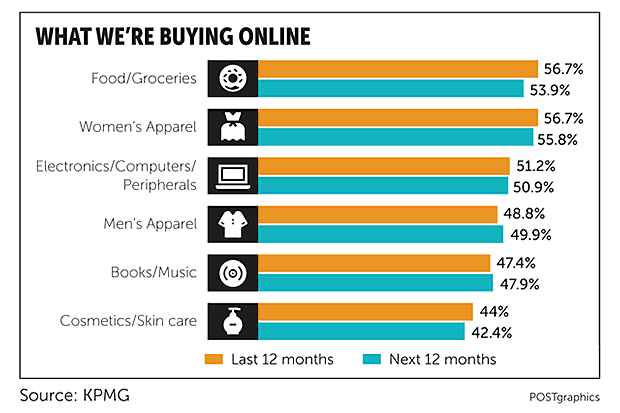
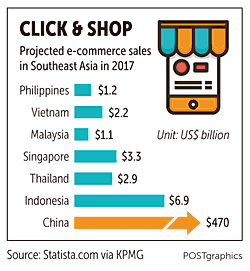
    China is currently leading the way in online spending with 48% of mainland consumers buying things online, followed by 40% of other Asians, well above the 27.9% global average, so the prospects for e-commerce in the region remain bright.

    The middle class in China is also increasing very quickly. The number of high net-worth individuals (people with assets exceeding 10 million yuan or US$1.45 million) is currently around 1.4 million — about four times what it was in 2010.

    Meanwhile, around 120 million overseas trips were made by mainland Chinese in 2016, with Southeast Asia one of their favourite destinations. By 2020, KPMG expects the number will increase to 200 million overseas trips.

    “Are we ready for our retail businesses to serve those future consumers? How can we better serve those future Chinese consumers?” Mr Bailey asked.

    “Consumers are looking for something beyond the shopping experience and as retailers or as landlords, you have to think about how you can develop a new experience for your consumer.”


  • Global vendor revenue from cloud hits $32.6b in 2016

    Global vendor revenue from cloud hits $32.6b in 2016

    Vendor revenue from sales of infrastructure products (server, storage, and Ethernet switch) for cloud IT, including public and private cloud, grew by 9.2% year over year to $32.6 billion in 2016, IDC estimates.

    Vendor revenue for the fourth quarter meanwhile grew at 7.3% year-on-year to $9.2 billion, the research firm said.

    Cloud IT infrastructure sales as a share of overall worldwide IT spending climbed to 37.2% in 4Q16, up from 33.4% a year ago. Revenue from infrastructure sales to private cloud grew by 10.2% to $3.8 billion, and to public cloud by 5.3% to $5.4 billion.

    In comparison, revenue in the traditional (non-cloud) IT infrastructure segment decreased 9.0% year over year in the fourth quarter. Private cloud infrastructure growth was led by Ethernet switch at 52.7% year-over-year growth, followed by server at 9.3%, and storage at 3.6%.

    Public cloud growth was also led by Ethernet switch at 30.0% year-over-year growth, followed by server at 2.4% and a 2.1% decline in storage. In traditional IT deployments, storage declined the most (10.8% year over year), with Ethernet switch and server declining 3.4% and 9.0%, respectively.

    “Growth slowed to single digits in 2016 in the cloud IT infrastructure market as hyperscale cloud datacenter growth continued its pause,” said Kuba Stolarski, research director for Computing Platforms at IDC.

    “Network upgrades continue to be the focus of public cloud deployments, as network bandwidth has become by far the largest bottleneck in cloud datacenters. After some delays for a few hyperscalers, datacenter buildouts and refresh are expected to accelerate throughout 2017, built on newer generation hardware, primarily using Intel’s Skylake architecture.”

    From a regional perspective, vendor revenue from cloud IT infrastructure sales grew fastest in Japan at 42.3% year over year in 4Q16, followed by Middle East & Africa at 33.6%, Canada at 16.6%, Western Europe at 15.6%, Asia/Pacific (excluding Japan) at 14.5%, Central and Eastern Europe at 11.6%, Latin America at 9.9%, and the United States at 0.1%.

  • Most APAC consumers feel safe shopping online

    Most APAC consumers feel safe shopping online

    While online security remains a top consideration for Asia-Pacific consumers, it hasn’t stopped them from opening up their wallets.

    According to the latest Mastercard Online Shopping Survey, eight in 10 of consumers across the region who have shopped online last year intend to make at least one online purchase in the first half of 2017.

    Purchase intentions are strongest in emerging markets including China (97.3%), Vietnam (96.2%), India (92.9%), Malaysia (92.8%) and Thailand (87.1%).

    Findings from the study indicate that while one in two consumers in Asia Pacific feel secure shopping online, providing secure payment facilities (85.9%) remains the most critical to getting shoppers in the region to make such purchases, along with price (85.5%) and convenience (85.1%).

    This consideration resonates most strongly in Indonesia (95.3%), followed by the Philippines (92.2%), Taiwan (91.5%) and Malaysia (91.2%).

    In Asia Pacific, nine in 10 consumers have made an online purchase in the three months preceding the survey, led by those in South Korea (96.7%), India (95.8%), Japan (95.0%), Vietnam (92%) and China (91.8%).

    A majority of consumers in Asia Pacific (53.9%) feel secure when shopping online. This sentiment is felt especially in India (72.1%), Indonesia (66.4%), China (63.5%), Australia (62.2%) and New Zealand (59.8%).

    On the other hand, consumers in Vietnam (34.0%), South Korea (34.6%), Japan (36.6%) and Hong Kong (37.4%) are more wary of online shopping security.

    Indonesian consumers are the most satisfied with existing opportunities and facilities for online shopping (97.1%) in the region. Consumer satisfaction also rings strongly in India (94.3%) and Malaysia (92.6%).

    “The verdict is in – consumers across Asia Pacific want enhanced security and convenience when shopping online. Despite our research showing that the majority of consumers feel safe when shopping online, we cannot stop our relentless focus on developing solutions that address and erase underlying fears about the safety and security of payments across the board,” Mastercard SVP for Digital Payments and Labs, Asia-Pacific Ben Gilbey said.

    “We know the payment experience consumers are looking for, no matter where they choose to shop. As a result, we will not relent on our commitment to work with merchants and key industry players to design, develop and deploy e-commerce experiences that are fast, easy, seamless and safe. Some of these include digital wallets and biometric payments, which are also reimagining and redefining the shopping experience for consumers.”

  • Mobile security a top priority for SEA businesses

    Mobile security a top priority for SEA businesses

    Employee device security and customer experience are top priorities in Southeast Asia for both businesses and IT leaders, a new study indicates.

    The commissioned study on workforce transformation, conducted by Forrester Consulting on behalf of Dell, investigated the key challenges and drivers that businesses are facing in the adoption of workforce enablement technology.

    According to the survey, 81% of respondents are concerned about the legal liability issues arising from Bring Your Own Device (BYOD) policies, while 44% said that organization-wide breaches originate from employee devices.

    The complexity of the IT environment due to diverse devices, coupled with growing sophistication of security threats, outdated security policies and easy information access have made endpoint devices increasingly vulnerable.

    Employees want to work from multiple locations and use several different devices, including their personal devices, at work. Thus, they are demanding faster refresh cycles, enhanced user experience and corporate support for all their devices.

    However, organizations face challenges managing their overall PC lifecycle with 53% of respondents citing complexity from vendor management as an inhibitor for effective management. Meanwhile, the growing sophistication of threats has made old workforce technology vulnerable. 53% of respondents cited that the frequency of security PC breaches is a top concern for firms.

    “The workforce of today is a highly interconnected one with new technologies empowering people to perform at their best. IT and business leaders are embarking on a workforce transformation strategy as they need to equip their workforce with the right devices and software to optimize productivity,” Dell GM of client solutions for South Asia and Korea Rakesh Mandal said.

    “Employee experience is a critical factor in boosting financial revenue and enhancing customer revenue – a continuing priority for Southeast Asia companies as they move into the new age digital economy.”

  • Using artificial intelligence in the supply chain

    Using artificial intelligence in the supply chain

    Leveraging artificial intelligence (AI) for supply chains is an important next step to lower costs, improve productivity and drive growth by helping businesses reduces time-to-market.

    There are many opportunities to utilize AI along the chain from buying raw materials/components, converting them into finished products, selling to customers and delivering to end customers. Supply chains, generally, still comprise large amount of repetitive manual tasks and this is where AI can offer the most value.

    AI can be used in selling to customers using an AI-driven software platform, warehouses, transport, analysis of data and many other areas. AI allows companies to reallocate time and resources to their core business, and other high value, judgment-based jobs by using AI for low value, high frequency activities.

    In an AI-driven selling platform, the chat bots handle many of the sales, customer services and operations tasks traditionally done by humans, for example, interacting with buyers, taking down their orders and passing them on along the supply chain. This way, there is significant reductions in staff costs and also can help to overcome manpower shortage. Moreover, this solution is very applicable to green-field markets where there is explosive growth and multiple languages are required.

    In warehouses, distribution and fulfillment centers, AI can be seen in the use of robotics and sensors for conveying, stacking and retrieval systems, order picking, checking on stock level and re-ordering when stock is low. Furthermore, powerful algorithms also allow AI to automatically adapt in real-time to events in the supply chains, for example the arrival of new orders over the Internet for delivery in a few hours, changes in manufacturing schedules, or even a hiccup in the transportation schedule.

    Amazon is using robotic shelves in warehouses where robots the size and shape of a footstool carry shelves on top. These robots can glide quickly across the floor to rearrange the shelves in neatly arranged rows or bring them over to human workers, who stack them with new products or retrieve goods for packaging.

    Amazon’s robotic shelves also allow more products to be packed into a tighter space. They also make stacking and picking more efficient by automatically bringing empty shelves over to packers or the right products over to pickers. The process is more efficient than having humans walk around, so it also a good example of how automation can be combined with human labor to increase productivity.

    Autonomous vehicles and drones, for example, deploy a combination of sensors and algorithms to perform the complex work of driverless navigating. DHL is using autonomous forklifts and other self-driven equipment in warehouse operations. The next step for autonomous vehicles in logistics is to overcome regulatory and security challenges to deploy them on public roads for goods delivery operations. In the US, the use of drones is governed by the Federal Aviation Administration’s regulation known as Part 107 that went into effect on 29 August 2016.

    Supply chains are generating a huge amount of data and rather than let them go to waste, AI can help businesses make sense of them so that better decisions can be made. AI is able to quickly analyze and organize this data to enable users to see trends, and gain a better understanding of the many variables in the supply chains. Users are thus able to anticipate future scenarios and plan accordingly for uncertainties.

    Driving force of AI

    Powerful algorithms are fueling the rise of using AI in supply chains. Algorithms are instructions to the robots, drones, and autonomous vehicles etc. for calculations, data processing and automated reasoning. In a nutshell, algorithms give instructions on what and how to do in order to reach a specified end goal. More advanced algorithms, rather than follow only explicitly programmed instructions, can even go a step further in allowing AI to learn on its own in what is known as machine learning.

    Using algorithms that continuously and repeatedly learn from new data, machine learning allows AI to find hidden insights without being explicitly programmed where to look. Machine learning is a method of data analysis that automates analytical model building.

    The pioneering technology within machine learning is the neural network, which mimics the pattern recognition abilities of the human brain by processing thousands or even millions of data points. This technology is not just about optimization

    Take the example of supply chains. The algorithms are able to engage in forward thinking to predict all the volatility in the industry, come up with solutions for different scenarios and then base on the available data, choose and execute the most efficient solution. Whenever the AI is faced with a new situation, the algorithms are also adept at making real-time adjustment to pre-programmed instructions. Moreover, compare to humans, the speed and decisiveness of making decisions for AI is so much faster, because for one thing, AI is void of emotion and biasness.

    As a final testament to the power of AI, consider the following example. In January, two researchers from Carnegie Mellon University developed an AI poker player that beat four world champions and won US$1.77 million in poker chips. This is groundbreaking as it signals the ability to deal with incomplete information and to deal with situations that require bluffing and an opponent that generates misinformation.

    AI can process huge amount of possibilities and can outthink humans in terms of unpredictability if the algorithms are programmed correctly.

    AI is the future of supply chains. AI strengthens a company’s core business and opens up new opportunities that can even lead to a new business model.

  • 5G smartphone sales to hit 100m in 2021

    5G smartphone sales to hit 100m in 2021

    About 2 billion mobile phones will be shipped in 2017, a 2% rise from 2016, and this growth rate is expected to continue resulting in a staggering 10 billion mobile phones being shipped over the next five years, CCS Insight estimates

    Smartphones will continue to account for most sales, with an expected 1.53 billion shipped in 2017. This figure will rise to 1.9 billion in 2021, when smartphones will account for 92% of the total mobile phone market.

    “Although total shipment volumes will remain largely flat over the next five years, the proportion of smartphones continues to grow and the technology landscape is changing rapidly,” said Marina Koytcheva, VP of forecasting at CCS Insight.

    The forecast reveals the strong progress that 4G LTE technology has made in mobile phones over the past decade. CCS Insight expects 68% of phones shipped in 2017 to be LTE-capable, climbing to 84% in 2020.

    CCS Insight’s forecast also reveals the emerging potential for 5G-capable handsets, despite the fact that early deployment of 5G networks will focus on providing fixed wireless connections. The analyst firm expects 100 million 5G-capable phones will be shipped in 2021, and leading markets will be North America and developed markets in Asia–Pacific such as Japan and South Korea.

    China will remain the largest global market, with sales reaching half a billion units in 2021. Principal growth markets during the forecast period will be in Africa, India and some other markets in Southeast Asia.

  • 60% of APAC travelers would pay for in-flight Wi-Fi

    60% of APAC travelers would pay for in-flight Wi-Fi

    Over 60% of APAC respondents would be prepared to pay up to $5 to access the internet on planes, according to YouGov’s latest survey on air travel.

    Although only 10% of APAC respondents say lack of connectivity is one of the three worst aspects of flying, many airlines are introducing internet access on flights so passengers can stay connected throughout the air journey.

    Almost one in five APAC respondents have tried in-flight internet access in the past and would like to do again in the future. And almost half of the APAC respondents haven’t tried in-flight internet access before but would consider doing so in the future.

    This should be a good news to airlines as this advancement on planes seem to be very well receiving in APAC. However, budget is also a concern as the majority of APAC respondents (64%) would only prepare to pay up to US$5 to access in-flight internet services, while less than 30% are prepared to pay up to $10.

    To further improve connectivity on flight, some airlines are also proposing new service like making VoIP calls on flight. Over 40% of APAC respondents express interest in making in-flight VoIP calls in the future.

    However, 65% of APAC respondents also think it is irritating to sit next to someone making a VoIP call on a flight. Because of this, almost 80% of APAC respondents think airlines should give passengers the option of sitting in different sections on planes where calls are and aren’t allowed.