Category: Telecom

Retail News Asia is committed to providing both local and global retailers with the latest Telecom & Telco news throughout the Asian market. This on a daily base.

  • Globe expanding LTE network amid growing demand

    Globe expanding LTE network amid growing demand

    The Philippines’ Globe Teleom expects to be generating around half of its mobile data traffic from LTE by the end of the year.

    The operator plans to deploy 600 more LTE cell sites by this time to cater to growing demand, taking its total network of sites up to nearly 5,600.

    Currently around 43% of Globe’s data traffic comes from its LTE network, which operates on the 700-MHz, 1800-MHz and 2600-MHz bands.

    Total mobile data traffic for the first six months of the year climbed 85% year-on-year to 280 petabytes as smartphone penetration increased to around two thirds of the opeartor’s total mobile subscribers, Globe’s latest statistics indicate.

    Globe has been concentrating its LTE rollout on Metro Manila and other densely populated areas.

    But a significant number of its customers are still using 3G SIMs with LTE devices or vice versa, so the operator is encouraging customers to upgrade for a superior experience. Since January the company has migrated around 900,000 customers using LTE devices onto LTE SIMs.

  • Ooredoo Myanmar launches mobile money service

    Ooredoo Myanmar launches mobile money service

    Ooredoo Myanmar has announced the launch of a new mobile money service branded M-Pitesan.

    The new service will allow instant money transfer and payments between local mobile numbers through a dedicated mobile wallet for Ooredoo customers or a store for non-registered users.

    Ooredoo said M-Pitesan is the only mobile money service in Myanmar that offers real-time tracking between CB Bank accounts and the mobile wallet.

    In addition, mobile customers can transfer or receive money through the operator’s network of 2,400 M-Pitesan agents in Yangon, Naypyitaw, Mandalay, Bago and Taunggyi. The company plans to add an additional 7,500 agents to its network in the future, mainly in rural and underserved areas.

    The operator is planning to expand the service in the future to support functionality including QR code payments and bill payments for utilities or municipal services.

    “There is real appetite for mobile money services in Myanmar. I am confident that M-Pitesan will give customer’s access to the digital financial services they have been asking us for, helping support their increasingly digital lifestyles,” Ooredoo Myanmar acting CEO Vikram Sinha said.

    “We have big plans for M-Pitesan and in the months to come will be expanding the service to include additional functionality for customers, banks and businesses alike.”

  • Large Hong Kong enterprises lack cloud expertise

    Large Hong Kong enterprises lack cloud expertise

    Large enterprises in Hong Kong could be losing out on revenue as 84% of IT decision makers say that they don’t have the required cloud expertise.

    Large enterprises across the world are losing out on $258.1 million a year as a result of a cloud skills gap, according to a new report commissioned by Rackspace in collaboration with LSE academics.

    The study also found that this lack of expertise is stifling creativity, with 80% of IT pros saying they could bring greater innovation to their organization with the right cloud insight.

    Beyond innovation and growth, 44% of IT decision makers believe a lack of skills is causing a lag in their organization’s ability to deploy cloud platforms. The wide majority (77%) also believe they need to invest more in their workforce to meet the developmental challenges of cloud computing.

    “While the rise of Artificial Intelligence and automation may cause some to think that human insight is less important, our report shows that this is not the case,” Rackspace CTO John Engates said.

    “With technology and the cloud now underpinning business transformation, the growing technology skills gap means organizations must have a strategy to access the expertise needed. Those that don’t will struggle to be competitive and innovative.”

    The Cost of Cloud Expertise report looks at the wider implications of the cloud skills gap and provides a route for businesses to tackle the realities of modern IT and the resulting skills gap. Consisting of research amongst 950 IT decision makers and 950 IT pros – as well as in-depth conversations with IT leaders – in large enterprises around the world, the study uncovers current and future trends in cloud expertise.

  • Ericsson opens 5G chip design center in US

    Ericsson opens 5G chip design center in US

    Ericsson has opened a new design center in the US focused on microelectronics and accelerating the path to 5G commercialization.

    The ASIC (application specific integrated circuit) design center in Austin, Texas will work with core microelectronics bound for 5G radio base stations.

    It will work closely with major Silicon processor manufacturers in the area to develop dedicated 5G ASICs.

    ASICs are specifically designed for the computation needs of mobile infrastructure, and make up the core of all Ericsson Radio System products. Ericsson said such processors are a hundred times faster, more cost-efficient and less power hungry than general-purpose processors in PCs.

    “We are strengthening our radio design capability in one of the world’s 5G pioneer markets. We’ll be up and running with our first group of designers in Austin by the end of 2017,” Ericsson head of networks development Sinisa Krajnovic said.

    “Along with our ASIC design teams in Sweden and China, we’ll be making faster, better and greener 5G products to bring into the Ericsson portfolio by 2019.”

  • Mobitel launches LTE on 900-MHz spectrum

    Mobitel launches LTE on 900-MHz spectrum

    Sri Lanka’s Mobitel has enhanced its LTE network with the nation’s first deployment of LTE over re-purposed 900-MHz spectrum.

    The operator said the deployment will significantly enhance Sri Lanka’s LTE coverage and make Mobitel the top network for LTE broadband in the nation.

    Mobitel chairman P G Kumarasinghe Sirisena said the deployment will particularly help the operator bring affordable LTE broadband services to rural areas of the country.

    This will also help the Telecommunications Regulatory Commission of Sri Lanka meet its objective of bridging the digital divide between citizens in urban and rural areas.

    Mobitel is a wholly-owned subsidiary of Sri Lanka Telecom. The operator launched Sri Lanka’s first LTE services in the 1800-MHz band in 2013.

  • BT unveils new SD-WAN service for large enterprises

    BT unveils new SD-WAN service for large enterprises

    BT has launched BT Agile Connect, a new software-defined wide area network (SD-WAN) service that aimed at helping large enterprises with their digital transformation.

    The new service, powered by technologies from BT and Nuage Networks, uses software-defined networking (SDN) to determine the most effective route for traffic across a customer’s wide area network.

    According to BT, Agile Connect will give large enterprises greater control and insights over their infrastructure and traffic flows, allowing much faster and simpler set up of new sites with reduced network complexity and lower costs.

    Customers are able to prioritize applications or manage use of access services via an interactive portal. They also gain an improved visibility of application performance. Changes are implemented centrally without the need for expensive local technical support, the UK operator said.

    The new SD-WAN product runs on BT’s global wholesale network infrastructure, with Agile Connect equipment currently live within the networks of several large global organizations.  BT is now rolling the product out for new and existing customers as part of its Dynamic Network Services program.

    Agile Connect includes a BT pre-built controller infrastructure hosted on the internet and on BT’s multi-protocol label switching (MPLS) network. It also uses BT pre-built MPLS Internet gateways to offer simple cloud-based connectivity between internet-connected and MPLS-connected sites.

    “Together, these features save customers from having to undertake time-consuming and costly design, delivery and on-going maintenance of controllers, interconnection gateways, security and monitoring systems critical to the performance of a SD-WAN,” BT said.

    Agile Connect is delivered as a single box located on the edge of their network, with further services added as additional devices. In the future, Agile Connect will support virtual network functions (VNFs), with new services deployed virtually to the Agile Connect device, removing the need to install multiple boxes, BT said.

  • Colocation providers facing escalating challenges

    Colocation providers facing escalating challenges

    As demand for colocation data centers continues to swell, the role of a colocation provider has never been more important, but the challenges they face continue to intensify.

    To understand the future dynamics of the colocation market Schneider Electric partnered with 451 Research to survey 450 end user decision makers of colocation services in the United States, Australia, Europe and China across multiple geographies.

    Providers today are dealing with an ever-changing set of buyers, evolving customer demands and a growing list of emerging technology such as the Internet of Things (IoT), next-generation edge computing and cloud computing.

    Each of these categories pose both an opportunity and a threat to the colocation segment, and the survey results speak to how each is viewed by colocation end users in terms of adoption and importance.

    With 62% of those surveyed saying they have moved IT applications out from colocation data centers and into public cloud within the last two years, colocation providers must look to find ways to entice new and existing customers to consider colocation as a viable option for their businesses.

    “Whether they deliver the services themselves or via partners, successful colo providers are increasingly broadening their service offerings,” said Rhonda Ascierto, Research Director, 451 Research. “Our research identified several value-added services that align with colo customers’ changing needs.”

    It became clear throughout the research that there are many ways to gain and maintain competitive advantage amongst other hosting options. With 82% of respondents saying it was either very or somewhat important that cloud services are hosted in the same data center as their colocated IT infrastructure, colocation providers can turn what may seem like a threat to the segment into an opportunity.

    Many additional statistics within the report offer opportunities for providers to set themselves apart from their competitors.

    For instance, 65% of customers surveyed said they would be more willing to use a provider that had data center infrastructure management (DCIM) deployed. Other technologies such as lithium ion batteries, on-demand prefabricated modular (PFM) capacity, and direct cooling also resonated strongly with customers.

    Meanwhile, 82% of respondents said they were interested in using more remote-hands services from their colocation provider to track or monitor the work being done via an online portal. For providers, this presents an opportunity to either expand or introduce new services and open up revenue opportunities for their business.

    The most successful colocation operators will ensure all of these customer questions and requirements are addressed to ensure they are in a position to take advantage of the 64% of customers who said colocation will play a role in their data center strategy during the next two to three years.

  • Nokia aims to stimulate fixed network innovation with Broadband Access Abstraction project

    Nokia aims to stimulate fixed network innovation with Broadband Access Abstraction project

    Nokia has teamed up with the Broadband Forum (BBF) to lead the new Broadband Access Abstraction (BAA) project, which aims to leverage open source software to drive the adoption of software-defined fixed access networks.

    The BBA project, which was created within the BBF under its Open Broadbandprogram, will define a software reference implementation for an open BAA layer. This will eliminate dependencies on vendor-specific equipment and proprietary software functions by providing standardized interfaces and decoupling implementation from the underlying hardware, Nokia said in a statement.

    Federico Guillén, president of Nokia’s fixed networks business group, said the BBA initiative is driving an agile and collaborative environment that produces reusable software for fixed access operators worldwide.

    “Open source software is a powerful tool that can make us more efficient as an industry. However, one of the biggest hurdles is simply getting started. By opening and standardizing the common, generic part of the network software, we avoid the need to re-write that same software for every technology, every vendor and every node,” the executive said.

    “In turn, we can now focus our efforts on developing new applications and capabilities that make the network faster, better, and smarter: for example, converging fixed and mobile networks; fronthauling 5G over fiber-access networks, automating operations and building self-healing and self-optimizing networks.”

    Guillén said Nokia is the first vendor partner to contribute open source code under the BAA project. The open source code delivers common management functionality, making it easier to operate multi-vendor, multi-technology access networks and letting operators and vendors focus on developing new innovative cloud capabilities instead.

    Robin Mersh, CEO of Broadband Forum, said the new initiative will help reduce the time and efforts needed to achieve interoperability and help operators to develop a framework for cloud infrastructure in the central office.

    “By aligning open source code to industry specifications, the BBF can effectively collaborate with the open source community to aid in development and testing,” Mersh said.

  • RCom-Aircel merger deal collapses

    RCom-Aircel merger deal collapses

    India’s Reliance Communications (RCom) has called off a planned merger of its wireless business with rival Aircel as a result of regulatory uncertainty and opposition from some creditors.

    RCom had been planning to merge its wireless business with Aircel to create a 50:50 joint venture with Aircel parent company Maxis, in a deal aimed at reducing its debt burden by around $3 billion.

    But the company announced on Sunday that its merger agreement with Aircel has now “lapsed by mutual consent” due to “legal uncertainties” and “interventions by vested interests” – referring to creditors to the company.

    RCom will now have to pursue alternative methods of reducing its substantial debt burden of around 450 billion rupees ($6.8 billion).

    LiveMint reports that the operator now plans a fire sale of assets ranging from spectrum to real estate as part of a plan to reduce its debt by around 250 billion rupees. This will partly involve adopting a 4G focus to allow it to monitize its existing 2G and 3G spectrum.

    RCom is also planning to sell its tower business and had been seeking to fetch around 110 billion rupees from the sale, but this will need to be revised now that Aircel’s tenancies will no longer be included in the deal.

  • Legacy networks to hamper hybrid cloud adoption

    Legacy networks to hamper hybrid cloud adoption

    Nearly all APAC IT decision makers (99%) agree that legacy network infrastructure will struggle to  keep pace with the changing demands of the cloud and hybrid networks, according to a survey by Riverbed Technology.

    The global survey, which includes responses from 1,000 IT decision makers across nine countries – including Japan, China, India and Australia — revealed a very high level of agreement that legacy infrastructures are holding back their cloud and digital strategies.

    In addition, 93% of respondents say their organization’s cloud strategy will only reach its full potential with a next generation network, and 98% agree that a next-gen network is critical to keep up with the needs of their business and end users.

    The survey also found there is a current gap in the adoption of next generation technology such as SD-WAN that will accelerate the cloud and digital transformation, however a tipping point is near.

    Of the APAC IT decision makers surveyed, 92% plan to migrate to SD-WAN within the next four years, up from just 6% today.

    Currently, performance pains experienced by businesses in APAC are glaring, as nearly half (48%) report that they experience cloud-related network issues specifically caused by their legacy infrastructure a few times a month or more; and 90% said it impacts their business at least monthly.

    But 85% of these same decision makers say they are still several years away from reaching the full potential of digital transformation, in part due to their legacy infrastructure. This number jumps to 90% for respondents in China and 94% in Japan.

    This gap between realization and actual deployment is consistent from companies across verticals such as financial, manufacturing, retail, energy and utilities, communications and media, and IT services, and could threaten their competitive positions in their respective markets.

    While a current gap exists in the adoption of next-gen technology to support cloud and digital transformation in the enterprise, this is changing quickly. Of those surveyed, 97% agree that within two years SD-WAN technology will be critical in next generation networks to manage cloud and hybrid.

    While only 6% of those surveyed are currently benefiting from SD-WAN today (slightly higher than the global average of 4%), more than half (57%) plan to migrate to SD-WAN within two years, and 92% within four years.

  • Many office LANs reaching performance limits

    Many office LANs reaching performance limits

    Local area networks in many existing office buildings are reaching their limits in terms of performance, according to R&M, a Switzerland-based cabling systems developer and provider.

    Citing a study carried out by market research organization BSRIA, R&M notes that approximately 80% of the office buildings and functional buildings in western industrialized countries were built before 1990.

    The structured cabling in these buildings also usually dates from when the buildings were built. At that time, the LAN was designed for a maximum transmission performance of 1 Gigabit Ethernet.

    “If office networks are to remain usable for the next 20 years, they will require a performance of ten times this at 10 Gigabit Ethernet in future. This is in addition to robust protection against external interference, among other aspects,” commented Matthias Gerber, market manager for LAN Cabling at R&M.

    Gerber gives four decisive factors which, from the point of view of R&M, make a generational change in structured office and building cabling unavoidable:

    Data throughput: If a large number of computer workstations within a company have to quickly access virtual machines, cloud services and software, then an increase in IP traffic is inevitable. “And all at a scale that has never been seen before,” commented Gerber. For productive work to remain possible, the LAN requires greater performance and system reserves.

    Latency: The current trend towards integrated communication with IP-based phone, conferencing and video services requires a latency-free, secure signal transmission. Bandwidth reserves are required in order to be able to ensure these special requirements are met in parallel with normal data transmission.

    Wireless: Nowadays, every commercial building must support mobile communication and its high demand for bandwidth. This requires an increasingly denser network of access points. The many wireless LAN antennas have to be connected to a powerful cabling system. The next generation of wireless access points will require a 10 Gbit/s uplink,” explained Gerber.

    Convergence: The local data network will also cover the needs of IP-based building automation in future. Standardized IP networks and Power over Ethernet are used to integrate virtually every building function as part of the Internet of Things (IoT). Intelligent building management also helps to increase safety and brings added comfort for building users.

    “The Internet of Things with its soon-to-be 33 billion end devices – whether in intelligent buildings or smart cities – needs convergent network infrastructures in order to reach its full potential. Ubiquitous, robust LAN access points are needed,” Gerber said.


  • Vodafone Australia to roll out Massive MIMO from 2018

    Vodafone Australia to roll out Massive MIMO from 2018

    Vodafone Australia has joined rival Optus is testing massive multiple-input multiple-output (MIMO) technology, and plans to start rolling it out from 2018.

    The operator announced a recent successful trial of Massive MIMO in the 1800-MHz FDD band.

    The trial, conducted with Huawei in a suburb of Sydney, used 20 MHz of 1800-MHz spectrum to achieve a peak cell throughput of 717Mbps across eight simultaneous devices.

    Vodafone revealed plans to roll out its FDD Massive MIMO technology to selected mobile sites during 2018.

    “This week’s demonstration is another significant step towards 5G, following our live 5G trial last year which saw speeds of up to 5Gbps,” Vodafone GM of technology strategy Easwaren Siva said.

    “When it is rolled out in an area, FDD Massive MIMO will give the Vodafone network multiple-fold increase in capacity, delivering a consistently high quality network experience, even in times of high usage.”

    Rival Optus last week announced plans to start rolling out Massive MIMO on its mobile network at the end of the year, after completing trials in June that combined Massive MIMO with three carrier aggregation. This trial was also conducted with Huawei.

  • Tata Comms trials live 360-degree video streaming

    Tata Comms trials live 360-degree video streaming

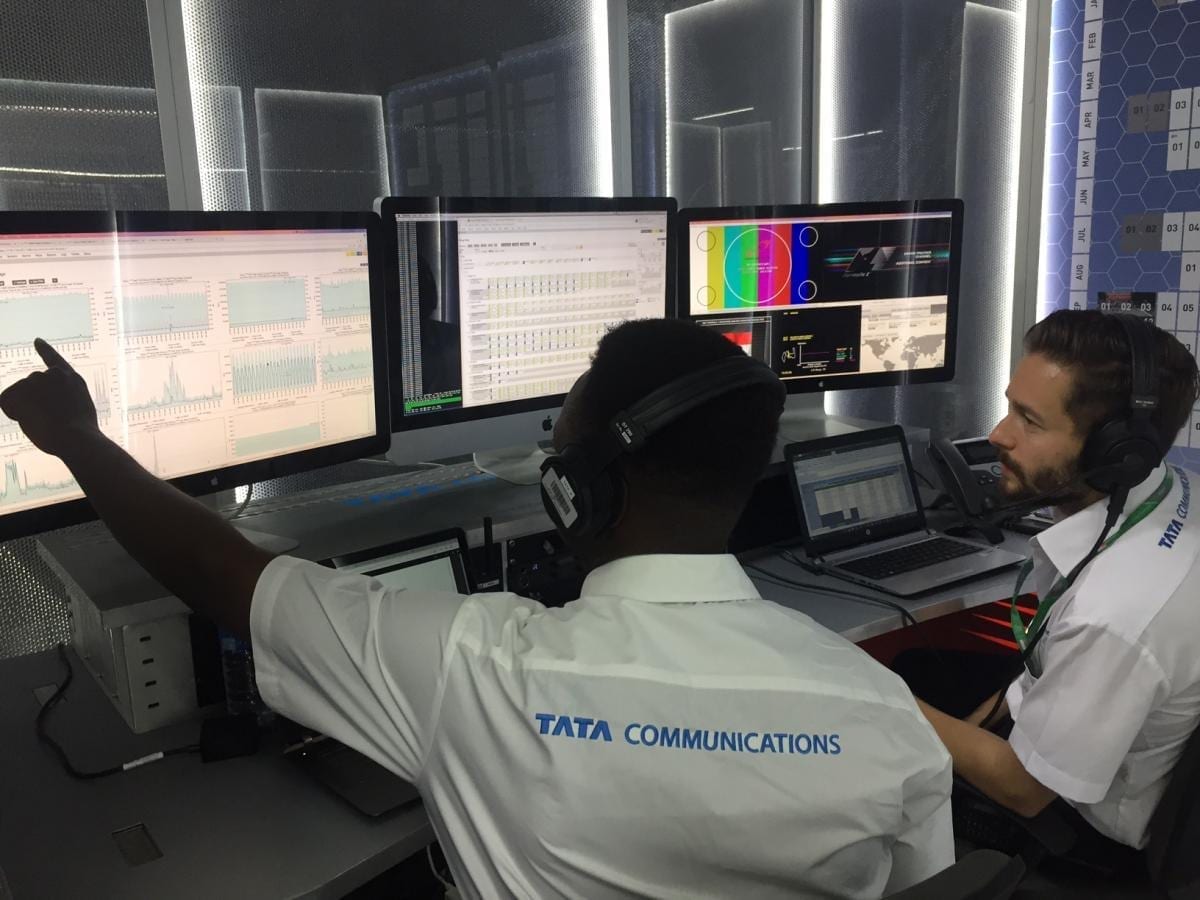
    Tata Communications and Formula 1 have conducted a test of truly live 360-degree video streaming at the 2017 Formula 1 Singapore Airlines Singapore Grand Prix.

    To-date, any 360-degree video experiments in sports have been hampered by a 30-second delay between the 360-degree video and live TV feeds, preventing a widespread adoption of the technology.

    This proof-of-concept by Tata Communications and Formula 1 is the first time when the live 360-degree video feeds and TV broadcast have been shown in complete sync.

    There were two 360-degree cameras at the Marina Bay Street Circuit in Singapore in the trackside and paddock to show how viewers at home could immerse themselves in the world of F1 and experience these exclusive areas through a virtual reality (VR) like environment via the Official F1 App.

    For example, during a Grand Prix build-up, fans could use their tablet to access a live 360-degree video feed from the paddock and see the biggest names in the sport. Or, during a race, as a driver pulls into the pits for a tyre change, fans could complement the action on TV with a 360-degree view of everything that is happening in the pit lane in real-time.

    The live video feeds from the two cameras were distributed from the Marina Bay Street Circuit in Singapore back to Europe using Tata Communications’ Media Ecosystem. This includes the Video Connect service, which brings together traditional video contribution and IP connectivity globally in the cloud, underpinned by Tata Communications’ global network.

    “Eliminating the delay in 360-degree video means that, for the first time, it’s possible to offer fans truly live 360-degree video experiences on a global scale,” said Mehul Kapadia, managing director of Tata Communications’ F1 Business.

    “This will enable sports and entertainment organisations to engage with their audiences in new ways and generate new revenue streams – helping the 360-degree video and VR market achieve its $60 billion potential,” said Kapadia.

  • Telkomcel launches 4G in Timor Leste

    Telkomcel launches 4G in Timor Leste

    Timor Leste’s Telkomcel has launched 4G services using equipment from technology partner Ericsson.

    Telkomcel has deployed Ericsson’s virtual EPC and LTE RAN Ericsson Radio System software to allow it to provide LTE services to its customer base.

    Ericsson also provided a hyperscale data center system for the deployment to deliver a network capable of supporting high-capacity environments and solutions.

    Telkomcel was established in 2012 by parent company Telin from neighboring Indonesia, and now has around 450,000 mobile customers from a total population of 1.2 million. The operator has been a longstanding Ericsson customer.

    “This cooperation represents a significant milestone as it further strengthens our partnership with Telkomcel and is another testament of our commitment to our customer’s success,” Ericsson president for Indonesia and Timor Leste Jerry Soper said.

    “With the availability of 4G subscriber services, the people of East Timor will be able to enjoy even more of the features of smartphones that have significantly influenced the way people live and do business.”

  • Huawei to deploy gigabit network for Brisbane Skytower

    Huawei to deploy gigabit network for Brisbane Skytower

    Honeywell and Huawei, are deploying a gigabit network and a Passive Optical LAN (POL) solution for the Brisbane Skytower in Australia.

    Brisbane Skytower is a landmark building under construction in Brisbane, Queensland, Australia. Located in Brisbane’s central business district, this iconic residential tower will become Brisbane’s tallest building when completed in 2018/2019.

    Honeywell will provide Skytower with its Enterprise Buildings Integrator, a building automation system that takes charge of system integration, covering the Heating, Ventilation, and Air Conditioning, security protection facilities, etc.

    Additionally, Honeywell will centrally manage various building sub-systems, provide a visualized management portal and alarm management and work-order management services, designed to deliver efficient facility management, fast response, and predictive maintenance.

    Huawei will meanwhile deliver the gigabit network to achieve smart network inside the Skytower. In contrast to a traditional complex LAN which limits the performance of bandwidth-intensive applications, using POL technology, an enterprise can combine data, voice, video, and other weak-current systems into one optical network.

    Huawei’s solution will bear all services through a single fiber that will be upgradable to 10G PON while reusing existing cables.

    Prominent features include high bandwidth, high reliability, comprehensive security authentication, easy deployment and Wi-Fi coverage.

    “We’re excited to work with Huawei to build a gigabit network for Skytower, Brisbane’s iconic 270-meter, 90-story residential tower. The network is the first-ever installation to utilize one common fiber optic cable for telephony/data and building services,” Honeywell Building Solutions executive GM Mark Dunn said.