Category: Telecom

Retail News Asia is committed to providing both local and global retailers with the latest Telecom & Telco news throughout the Asian market. This on a daily base.

  • HKT urges reforms to spectrum policy

    HKT urges reforms to spectrum policy

    HKT has publicly criticized the Hong Kong government over its handling of spectrum-related matters, asserting that the region risks becoming “a third-class citizen in mobile service development.”

    In an open letter to the government, HKT expressed concern over a range of issues, including a belief that the government is not doing enough to release more spectrum to the market, the failure to follow up on a pledge to introduce spectrum trading and insufficient public engagement over a planned spectrum reassignment exercise.

    HKT also expressed concern over the fact that spectrum prices have “increased astronomically over the years [to the extent that] Hong Kong spectrum prices are now the most expensive in the world.”

    Such high prices aren’t necessary when the government already has a huge budget surplus, HKT said. The charges are also inevitably passed on to consumers, who could see prices go up by more than HK$12 per month if the government sticks to its current pricing proposals.

    “What Hong Kong needs is a forward-looking, accommodating and holistic approach to spectrum policy, not a simplistic spectrum auction that is purely designed to maximize government revenues at the expense of the spectrum policy objectives,” HKT concluded.

  • Australia’s Thinxtra to launch IoT network in HK

    Australia’s Thinxtra to launch IoT network in HK

    Australia-based pure-play IoT infrastructure provider Thinxtra has expanded into Hong Kong, with plans to launch Sigfox low-power wide area (LPWA) network in the market early next year.

    The company is deploying a territory-wide open IoT LPWA network that connects to other networks based on Sigfox’s network technology in 28 countries.

    Ahead of the launch, Thinxtra has been working with Hong Kong’s Science Park on IoT R&D efforts as well as the design of devices, sensors and services for the network.

    Thinxtra is the exclusive Sigfox network operator for Australia, New Zealand and now Hong Kong, and also has LPWA networks covering 62% of the population in Australia and 73% in New Zealand.  Now the company is pursuing expansion into the APAC region.

    “We’re bringing our expertise and experience to Hong Kong to support its ongoing transformation into a smart city and a leader in IoT adoption and development,” Thinxtra Asia managing director Murray Hankinson said.

    “We also see great potential for Hong Kong to be a world-leading design and manufacturing hub for IoT innovation, and we’re investing here to support this growth.”

    Sigfox is working with partners to roll out a global LPWA network dedicated to the IoT, designed to meet the low energy consumption and long range requirements for IoT devices.

  • DoCoMo joins CAICT’s 5G Promotion Group

    DoCoMo joins CAICT’s 5G Promotion Group

    Japan’s NTT DoCoMo has teamed up with the China Academy of Information and Communication Technology (CAICT) on research and development into potential 5G standards.

    As part of the collaboration, DoCoMo will join the CAICT-initiated IMT-2020 Promotion Group 5G trial. DoCoMo and CAICT will also evaluate possible frequency bands for future 5G networks.

    DoCoMo joined the IMT-2020 promotion group in August to co-operate with major mobile operators and vendors on 5G R&D and standardization.

    The operator has also been conducting joint 5G R&D with vendors including Ericsson, Huawei and others.

    The IMT-2020 Promotion Group was jointly established by three Chinese ministries in early 2013, based on the original IMT-Advanced Promotion Group. It is the major platform to promote research into 5G in China.

    The group is divided into dedicated units covering areas including technology, spectrum, intellectual property and network asrchitectures.

  • TPG wins auction to be Singapore’s fourth cellco

    TPG wins auction to be Singapore’s fourth cellco

    Australian fixed line operator TPG Telecom has won the new entrant spectrum auction to become Singapore’s fourth mobile network operator.

    TPG submitted the winning bid of S$105 million ($72.8 million) for a provisional allocation of 60 MHz of spectrum in the 900-MHz and 2.3-GHz spectrum bands.

    TPG outbid MyRepublic to secure the new license and spectrum.

    Final allocation of the spectrum will require payment of the relevant spectrum fees, and the commencement date of spectrum rights will be scheduled after the planned general spectrum auction to be held in the first quarter.

    Regulator IMDA said the new spectrum rights are expected to commence on April 1 at the earliest. TPG will also be eligible to compete in the general spectrum auction if the operator so chooses.

    As a condition of its bid, TPG will need to provide nationwide street level 4G coverage within 18 months of the new spectrum rights commencing, road tunnels and in-building coverage within 30 months and coverage of MRT underground stations and lines within 54 months.

    Singapore MVNO Circles.Life, which launched earlier this year as the market’s fourth postpaid mobile service provider, has welcomed the move.

    “Circles.Life welcomes IMDA’s on-going efforts to support competition and look forward to TPG Telecom’s entry into the telco space in Singapore… We hope TPG Telecom will continue to support our ambition to bring more innovation and choice to the market,” the company’s co-founder and director Rameez Ansar said.

    “In the short-term, the impact may be limited until TPG Telecom enters the market in about two years from now after building the required infrastructure. Meanwhile, we are focusing on targeting the data savvy segment.”

  • Telstra excluded from Australian 700-MHz auction

    Telstra excluded from Australian 700-MHz auction

    The Australian government will exclude the market’s largest operator Telstra from taking part in a digital dividend auction of 700-MHz spectrum, on the advice of telecoms regulator ACMA.

    ACMA held that because Telstra already owns more than 50% of available low-band spectrum, a victory in the auction would only increase its dominance.

    Communications minister Mitch Fifield has instructed ACMA to set a reserve price for the auction of $1.25 ($0.93) per MHz per head of population covered.

    The terms of the auction will stipulate that no operator can own more than two 20 MHz blocks of spectrum in the 700 MHz band.

    Setting such a cap could allow both Telstra rivals Optus and Vodafone Australia to secure more spectrum to compete against the incumbent. If major fixed line operator TPG chooses to participate the operator would also be better positioned to roll out a fourth 4G network in Australia.

    TPG spent A$13.5 million ($10 million) for 2×10 MHz of 2.5-GHz spectrum in 2013. The operator also recently won the auction to become Singapore’s fourth mobile network operator after securing 60 MHz of 4G spectrum.

    The digital dividend auction will involve 2×15 MHz of the 700-MHz spectrum freed up from the migration from analog to digital broadcasting, but left unsold during the initial digital dividend auction in 2013.

  • AIS to invest $1.1b in 4G expansion

    AIS to invest $1.1b in 4G expansion

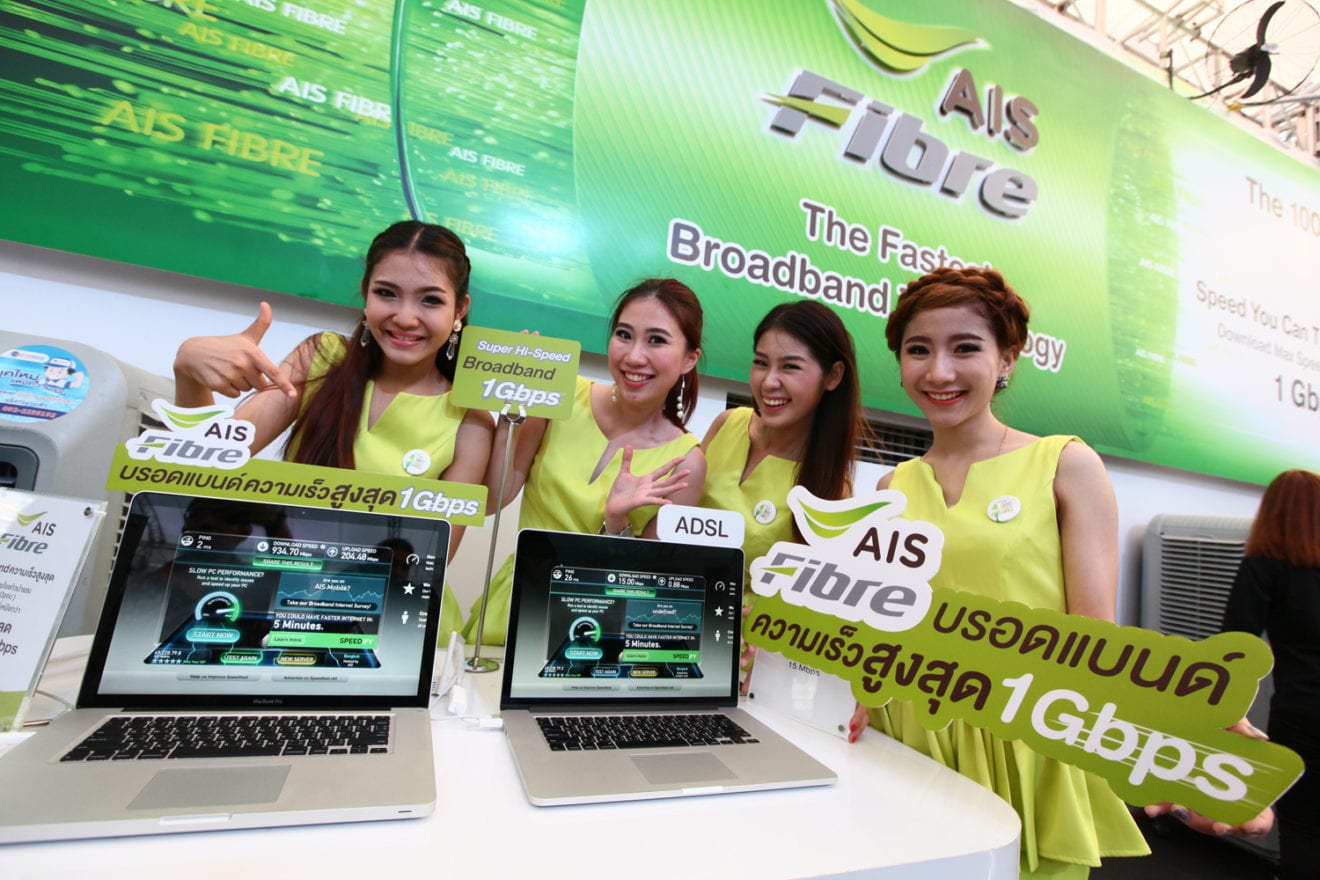
    Thai mobile market leader AIS plans to invest at least 40 billion baht ($1.12 billion) to expand its 4G network to improve take-up and performance.

    AIS has been spending heavily to deploy its 4G network and now expects to achieve 98% population coverage by the end of the year.

    But only around 25% of AIS’ 39.9 million strong subscriber base are 4G users, compared to 25.2 million for 3G.

    AIS aims to increase the percentage of 4G subscribers to 40% by the end of 2017. Take-up has been faster than initially expected, prompting the operator to raise its target.

    AIS launched 4G two years later than key rival TrueMove, but due to it 4G investment strategy has exceeded True’s 4G subscriptions and coverage, the report states.

    The operator is shoring up its network to be able to cope with heavy data usage and the ongoing erosion of voice and SMS usage. Roughly 22% of the company’s 60,000 base stations have been upgraded to 4G.

    This move forms part of a wider strategy aimed at transforming AIS into a fully integrated digital services provider by 2019.

  • Datacloud Asia 2017 Conference & Exhibition Launches Feb 23 in Singapore

    Datacloud Asia 2017 Conference & Exhibition Launches Feb 23 in Singapore

    Having established Datacloud as Europe’s foremost networking and deal-making forum for data center and cloud players, the widely acclaimed event is now scheduled to take place in the growth markets of Asia on February 23, 2017. BroadGroup, the consulting, publishing and professional events firm has announced the early programme for Datacloud Asia 2017, which includes experts from Asia, the US and Europe.

    Set to be the first deal-making forum in the region, the event offers a valuable return on investment for attendees, uniquely bringing together data center operators with IT infrastructure leaders looking to deploy assets across the Asian region; colocation, hosting, cloud services, data center and vendor solution sales are all transacted at the event. Datacloud provides powerful content with an impressive line-up of guest speakers – and is the only event in Asia that attracts top leadership from operating companies.

    The forum concludes with a celebration of the nominees for Asia’s inaugural Data Center & Cloud Awards. Seeking genuine innovation as well as on-going evolution and transformation already underway in Asia, the Datacloud Asia 2017 Awards* will be presented in a refreshing format with all-new award categories at a combined reception hosted by Digital Realty and awards dinner at the prestigious Capella Hotel & Conference Center on Sentosa Island, minutes from Singapore’s business district.

    “Datacloud is unique,” commented Philip Low, chairman of BroadGroup. “You will not find a trade show, but you will find a highly structured networking forum for senior executives complemented by a far reaching programme covering hot topics such as China, blockchain, enterprise cloud strategies, agile infrastructure, finance and investment, location for data centers and more. With the addition of the Awards it makes for an exceptional event.”

    “Asia hubs will be a central theme of this new event with a strong focus on investors, enterprises and doing deals. It also aims to offer inspiring insights for companies seeking a better way of hosting and colocating in the new reality of a data-driven and cloud-connected world,” says Low. “The forum promises to highlight the value of outsourcing data centre, cloud and IT infrastructure across the fast growing Asia region, and is designed to appeal to both users and outsourcers.”

    Sponsors for the event include Schneider Electric, Digital Realty, Telin Singapore, Kingsland Data Center, Datwyler, Lamda Hellix Data Centers, and has a range of industry and media partners including Globeron, Asia Cloud Computing Association, iMiller Public Relations, techUK, European Data Centre Association (EUDCA), BICSI and WiredRE. Lead Media Partner is Data Economy (www.data-economy.com) and Intelligence Partner is Colocation Markets Quarterly (CMQ).
  • Accuris, iPass to offer Wi-Fi solution for cellcos

    Accuris, iPass to offer Wi-Fi solution for cellcos

    Wi-Fi roaming, interworking and service policy enablement provider Accuris Networks has entered a partnership with global Wi-Fi operator iPass to offer mobile operators and MVNOs the ability to integrate carrier Wi-Fi into their service offerings.

    The companies will offer a combined solution enabling mobile operators to access the global iPass Wi-Fi footprint for service delivery and traffic offloading.

    The solution will integrate iPass’ SmartConnect technology into the Accuris Networks Wi-Fi e-client to enable client connection analytics. The solution will support integration with pre-paid service plans and existing billing systems.

    “Not only will this partnership offer our connectivity services to a billion potential end users, but it will also enable MNOs and MVNOs to dramatically accelerate the introduction of cutting-edge Wi-Fi solutions to the market,” iPass CEO Gary Griffiths said.

    “In particular, we see this partnership as integral in delivering on our strategy to connect users seamlessly and intelligently on Wi-Fi and cellular networks.”

    “Mobile operators increasingly see the value in Wi-Fi as a central pillar to their connectivity and mobile broadband strategy, “ Accuris Networks CEO Jeff Brown added.

    “Accuris Networks has proven capability in combining controlled Wi-Fi service to their core service portfolio. Now, by teaming with iPass, which boasts an unparalleled global Wi-Fi footprint and Wi-Fi analytics technology, we can offer our customers a complete mobile-centric Wi-Fi solution.”

  • APT nearing 100% 4G take-up

    APT nearing 100% 4G take-up

    Taiwan’s Asia Pacific Telecom (APT) is nearing 100% take-up of 4G services among existing customers, and expects nearly all its subscribers to have migrated to 4G by the end of Q1.

    APT only has around 100,000 3G users left to migrate to 4G, around 6% of the operator’s total subscriber base. The remaining users are expected to upgrade in the next few months.

    In order to encourage migration and boost interest in the operator’s 4G services among new customers, APT has introduced a new line of plans that offer unlimited broadband and free domestic voice calls even to subscribers of Taiwan’s other mobile operators. The plan starts at TW$999 ($31.39).

    APT chairman Lu Fang-ming told the Taipei Times that the operator has reached the subscriber migration target set when the operator launched 4G two years ago.

    As the operator moves to the next phase, it plans to focus on expanding its customer base to improve ARPU.

    APT also recently announced a new home OTT video service to be delivered to Taiwanese customers in collaboration with Netflix, China’s iQiyi, movie distributor Catchplay and Taiwan Mobile’s myVideo, the report adds.

  • Huawei to supply network for PyeongChang 2018

    Huawei to supply network for PyeongChang 2018

    Huawei announced it has been selected as an official network equipment supplier for the 2018 Winter Olympic and Paralympic Games in PyeongChang.

    As an official supplier, Huawei will deliver a comprehensive network system covering a games, administration and facility network.

    The vendor facilitate the delivery of services including real-time competition data transmission, broadband certification for audiences and stadium security protection.

    A network equipment supply and sponsorship agreement was signed in Seoul yesterday by the PyeongChang Organizing Committee’s (POCOG) president and CEO Lee Hee-beom and Huawei’s enterprise business group president Yan Lida.

    “We are honored to be selected as the Official Network Equipment Supplier of the PyeongChang 2018 Olympic Winter Games,” Lida said at the ceremony.

    “With a wealth of expertise in network construction for large-scale sports events and stadiums, Huawei will provide full support to POCOG in building a cutting-edge network for the Games.”

  • Cellco IoT revenues reach $11.7b in 2016

    Cellco IoT revenues reach $11.7b in 2016

    Mobile operators worldwide earned a combined €11 billion ($11.7 billion) in revenues from the IoT in 2016, but revenues remain relatively low compared to lofty industry projections, according to Berg Insight.

    Despite a significant early install base, low monthly ARPUs are restraining growth, Berg Insight senior analyst Tobias Ryberg said.

    The global monthly ARPU for cellular IoT devices is estimated at €1.40 this year, but with major variations between regions. In some emerging economies ARPUs were less than €0.30, and in some less competitive developed markets, ARPUs exceeded €3.00.

    “Until recently, the principal financial metric for IoT has been projected, not actual, revenues. Now the market has entered a new phase in which hard business facts take precedent over lofty projections,” Ryberg said.

    “Wireless connectivity is now near ubiquitous and there will be half a billion cellular IoT connections in 2017, but revenues are still relatively small.”

    But in the third quarter Vodafone and Verizon each generated €200 million in IoT sales revenues, and next year Berg Insights predicts that a handful of major operator groups will generate over €1 billion each from the IoT.

    Many early operator-led IoT efforts have focused on the automotive market as a starting point, with major players including  AT&T, Vodafone, Verizon and Deutsche Telekom establishing dedicated ventures centered on the connected car.

    But Berg Insight said a better strategy for smaller operators is to develop a broad IoT ecosystem and sell IoT solutions from preferred partners through existing B2B channels.

  • Huawei releases X-Ethernet tech for 5G

    Huawei releases X-Ethernet tech for 5G

    Huawei has proposed a new X-Ethernet technology for 5G bearer networks at the ITU-T 2020 FG Workshop and Demo Day Wireline Technology Enablers for 5G conference in Swizerland.

    The company has also proposed X-Ethernet for integrated fronthaul and backhaul networks to introduce likely 5G requirements including deterministic low latency and end-to-end network slicing.

    Huawei’s Network 5.0 team has developed X-Ethernet to address the problems presented by the high bandwidth, determinacy, low-latency, hard isolation and low-cost requirements of 5G.

    The technology includes innovations including a Layer 1.5 switch based on the native Ethernet kernel and compatible with traditional Ethernet, as well as hybrid multiplex with TDM-like characteristics and a flexible hard pipe based on an SLA-based path optimization algorithm.

    Rival vendor Nokia Networks has meanwhile announced it teamed up with Vodafone to trial cloud-based radio access technology for macro networks as part of a project to evaluate methods to enable a smooth transition from 4G to 5G.

    The trial at Vodafone’s testing facility in Italy used the Nokia Cloud RAN platform to evaluate the performance of centralized 5G-ready architecture.

    “Working with Nokia on this trial we have seen how the application of Cloud RAN architecture can help the network react to changing demands quickly. It speeds up the delivery of services and will help with the transition to 5G,” Vodafone Group head of networks Santiago Tenorio said.

  • Australia plans controversial rural NBN levy

    Australia plans controversial rural NBN levy

    The Australian government is planning to impose a monthly levy on rival networks to the state-funded National Broadband Network (NBN) to help fund the roll out of the NBN to rural areas.

    Communications minister Mitch Fifield said the government will seek to pass legislation that would establish an A$40 million ($30 million) Regional Broadband Scheme.

    This scheme would be funded by a levy of A$7.30 per month for each fixed line connection provided by rival superfast broadband providers, increasing every year into 2022 when it reaches A$8 per month.

    The levy would not apply for small companies with under 2,000 customers. Australia’s largest operator Telstra and main rival Optus will also be exempt because they are transitioning their fixed line operations onto the NBN as part of separate deals with the government.

    But the government’s own advice indicates that such a levy will be passed on to consumers resulting in higher prices.

    High-speed providers have complained that the proposed levy could “cripple” their operations, destroying 30% of their revenue, the report adds. The proposal has also been slammed as extremely anti-competitive.

    The presence of competing fiber networks to the NBN has been a contentious issue since the project was first announced in 2007, with successive governments fearing that the rival services could “cherry pick” the network’s most lucrative customers in dense population centers without needing to invest large sums to reach sparse regional areas.

  • AIS, True must launch low-cost 4G SIMs for poor

    AIS, True must launch low-cost 4G SIMs for poor

    Thailand’s telecoms regulator NBTC has issued an order requiring AIS and True Move to provide low-cost 4G SIMs for disabled and low-income citizens.

    The order is based on the terms of the licenses for 1800-MHz and 900-MHz 4G spectrum won by the two operators in an auction last year.

    As per the order, low-cost 4G SIMs must provide tariffs at least 10% cheaper than the maximum cap on 4G voice and data tariffs imposed by the regulator.

    Caps in the 1800-MHz and 900-MHz bands have been set at 0.69 baht ($0.019) per minute for voice calls and 0.26 baht per megabyte for data services.

    The new low-cost SIMs will need to be available by March, and the operators will be required to design a process to meet this deadline.

    The NBTC is yet to set definitions of disabled and low-income for the purposes of determining eligibility for the discount plans, but has suggested that low-income may be defined as earning less than 10,000 baht ($281) per month.

    According to NBTC secretary-general Takorn Tantasith, last year’s 900-MHz and 1800-MHz auctions had the explicit purpose of bridging the digital divide, and all Thais must be able to benefit from national resources including spectrum.

  • IMDA to ban 2G-only device sales from Jan 1

    IMDA to ban 2G-only device sales from Jan 1

    Singapore’s Infocomm and Media development Authority (IMDA) has announced it will ban the sale of 2G-only mobile devices from January 1.

    After this time, retailers and equipment suppliers will not be allowed to sell 2G handsets for use in Singapore, the regulator said.

    Suppliers with a dealer’s individual license will be able to continue selling the devices, but only for export purposes or overseas use.

    The order applies to devices in the GSM900 and GSM1800 frequency bands, and covers other cellular devices besides handsets including POS terminals and M2M equipment. Retailers and suppliers found to be in violation of the new rules could face financial penalties.

    Singapore’s mobile operators will shut down their 2G networks from April 1 to allow IMDA to re-allocate spectrum for more advanced mobile services.

    IMDA is working with operators to facilitate the migration of remaining 2G users to 3G or 4G networks, allowing subscribers to upgrade their devices while maintaining their plans and monthly subscription costs.

    Singapore is on track to introducing a fourth mobile network operator. Last month, local fiber ISP MyRepublic and Australian fixed line operator TPG Telecom were pre-qualified to take part in a special auction for the fourth mobile license.