Category: Telecom

Retail News Asia is committed to providing both local and global retailers with the latest Telecom & Telco news throughout the Asian market. This on a daily base.

  • Telenor Pakistan hosts “The future of Machine Leaning & Artificial Intelligence”

    Telenor Pakistan hosts “The future of Machine Leaning & Artificial Intelligence”

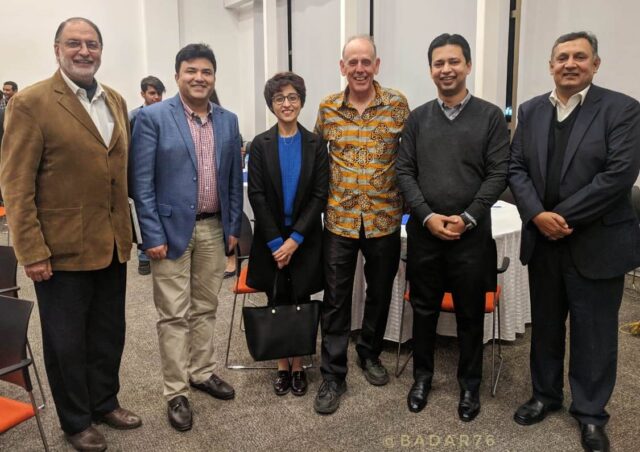
    Stephen Brobst, CTO of Teradata, conducted an enlightening session on the future of Machine Learning (ML) &Artificial Intelligence (AI) at Telenor Pakistan headquarters ‘345’ in Islamabad. The session was attended by Telenor Pakistan employees and executives from across industries including Irfan Wahab Khan, CEO Telenor Pakistan and President OICCI, Haroon Bhatti, Chief Business Officer (CBO) at Telenor Pakistan, BadarKhushnood, Cofounder & VP at Bramerz, QazafiQayyum, Country Manager Teradata, Khimde Ando, CEO Mitsubishi Corporation, Brig. Tahir Mehmood, Director ISPR, AVM Faaiz Amir, Vice Chancellor Air University, Barkaan Saeed, Ex-Chairman PASHA and Retd. Brig. Saleem Ahmed Moeen, CEO SecureTech.

    The participants learned about the future of artificial intelligence, the role of emerging technologies, differences between deep and shallow learning and their application techniques, and the opportunities of using advanced analytics to create high-value outcomes.

    “We have entered a new era of analytics with machine learning and artificial intelligence algorithms beginning to deliver on the long-promised advancement into self-learning systems,” Brobst told the audience. “These approaches allow us to solve previously intractable problems with completely new attack plans.  The appetite of deep learning algorithms for vast amounts of data and the ability to derive intelligence from diverse sets of noisy data allows us to go far beyond previous capabilities in what we used to call advanced analytics,” he added.
    Brobstinformed that in order be successful with the use of new technologieswe need to fully understand their capabilities and limitations. He also stressed the need to develop new skill sets in order to harness the power of deep learning to create business value in an enterprise.

    “In our times of Siri, Alexa, and Google, Machine Learning & Artificial Intelligence are not a part of science fiction anymore; they are our reality,” remarked Irfan Wahab Khan. “For tech companies like Telenor and Terada, the real charm of AI and ML technologies is their ability to recognize patterns and synthesize large amounts of data. Telenor is not only harnessing the strength of AI and Advance Analytics for its own commercial use but is also enabling other organizations to benefit from the technology by offering incisive Market Research insights and ability to run targeted campaigns on its diverse Advertising  assets. The fact that these technologies get smarter with time as increased amounts of data is fed to them makes them acornerstone for all future technologies,” he added.

    Impressive progress is being made in ML & AI technologies globally. From self-driving and learning cars to flying drones circling the skies, the technological advancements of today could already be perceived as something out of a futuristic novel. Gartner, the world’s leading research and advisory company,also predicts that by 2020, AI will become one of the top five investment priorities for at least 30 percent of Chief Information Officers. Being the country’s technology leader, Telenor Pakistan is keeping its people abreast of the latest technological developments to realize its ambition of digitally empowering Pakistan.
  • Korea’s KT 5G bus hits the road

    Korea’s KT 5G bus hits the road

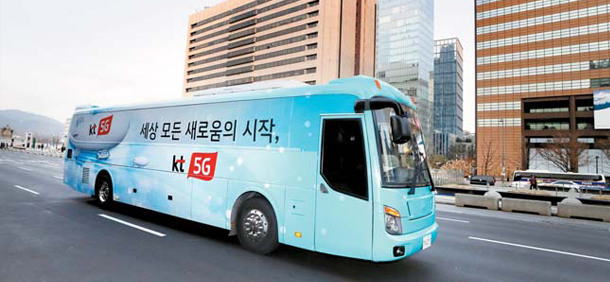
    Are you curious about all the hype over 5G? A ride on a 5G-powered bus may answer some questions. Mobile carrier KT announced Tuesday that people can sign up for free rides on its 5G bus. The bus will be connected to its ultra-fast 5G wireless network and will demonstrate devices that can be used to enjoy new media services like KT’s GiGA Live TV. GiGA Live is a head-mounted display – thick goggles with a screen embedded inside. GiGA Live supports virtual reality (VR) media services, including live sports broadcasts, as well as 360-degree films.

    VR and augmented reality (AR) are commonly cited as the technologies that have the most to benefit from 5G network. Because 5G promises up to 20 times faster speeds than LTE, it can transfer large volumes of data quickly in real-time, which is integral to the proper operation of VR and AR services.

    Those who want to take 30-minute sojourns on the 5G bus can apply online at www.kt5Gbus.com. The bus will run in the Gwanghwamun area from Jan. 15 to 24, and Gangnam Station from Jan. 25 to Feb. 2. Rides will be offered five times a day, excluding Sundays and Mondays.

    “5G network makes it possible to transfer huge volumes of information safely and in real-time,” said Park Hyun-jin, head of KT’s 5G business. “We will continue to offer innovative 5G services that can provide new experiences and value to consumers.”

    Earlier this month, KT added 5G-capabilities to its barista robot B;eat in Samsung Life Insurance’s Seocho District office. The robot, which looks like an advanced vending machine, can now recognize customers’ presence and send real-time footage of orders to human managers.

  • Vietnam’s Viettel seeks to double Myanmar customer base: CEO

    Vietnam’s Viettel seeks to double Myanmar customer base: CEO

    Vietnam’s largest telecommunication company, Viettel, is seeking to double its five million subscribers in Myanmar by the end of the year. Viettel, whose $1.22 billion unit Viettel Global Investment is trading on the Unlisted Public Company Market, has also shown interest in investing in North Korea and Cuba. “The growth seen in Myanmar is rare in the telecom market,” Viettel’s president and chief executive officer Le Dang Dung said on Friday. “We still have room to grow there.”

    Myanmar, where Viettel and its local partners launched a $1.5 billion 4G network in June last year has emerged as one of the most promising markets for the company, Dung said.

    The Mytel network, jointly developed by Myanmar National Holding Public Ltd and Star High Public Co Ltd, has amassed around five million subscribers, a figure which Dung said he expects to double by the end of this year.

    Viettel is also in talks to buy stakes in existing telecommunication firms in Malaysia and Indonesia, Dung said, without giving further details due to the sensitivity of the deals.

    The company will be the first to develop a 5G network in Vietnam, Dung said, in anticipation of rapid development of data services.

    He said Viettel had earmarked $40 million for the development of its own 5G chipset, but was also considering using technology from Ericsson and Nokia.

    The military-run firm, formally known as Viettel Group, has around 60 million subscribers in Vietnam and over 30 million users across 10 other countries – predominantly in Asia and Africa.

    The company is also in talks to buy a 20 percent stake in a European mobile carrier, Dung said, without elaborating.

    Dung said Viettel plans to stop expanding its investment in the African market, however, where the company has struggled to make a profit due to poor economic growth.

    Closer to home, Viettel is looking to invest in North Korea, said Dung, where Koryolink – a joint venture between the North Korean state and Egypt’s Orascom Investment Holdings – has amassed millions of subscribers since its 2008 launch.

    “We first sought permission from North Korea to build a mobile network there in 2010,” he said. “But we’re still waiting for sanctions to be lifted and for the country to open its market to foreign investors.”

  • TikTok plans to expand in Vietnam

    TikTok plans to expand in Vietnam

    Short-form video hosting service TikTok is planning to step up its Vietnam operations, targeting a wider Vietnamese customer base. TikTok, a product of Bytedance, a Chinese software company headquartered in the U.S., offers a short video sharing application, 15 seconds per video for basic accounts. It’s initial content is primarily lip syncing, dancing, or recording with fancy stickers and other effects.

    The TikTok app has quickly attracted the attention of many young people, particularly at school age, but is yet to appeal to older adults.

    Diep Que Anh, national director of communications for TikTok Vietnam and other emerging markets, said that the application is trying to “age” its content to widen its user coverage.

    It has to do this before it can become an advertising platform that can satisfy the demands of its client brands, some experts and industry insiders have said.

    Not revealing specific numbers, Que Anh estimated that Vietnamese users spend an average of 28 minutes per day on TikTok. Its prime time, when the app sees the highest traffic in the country, is 6 p.m.-8 p.m. every Friday and Saturday.

    The platform is still in its ad-free phase. “There have been brands who have approached us regarding advertising, but we do not intend to monetize our service at the present time,” Que Anh said, adding that they were waiting for the market to mature.

    TikTok has opened its first representative office in Ho Chi Minh City with around 70 employees. Que Anh said this number will continue to grow to several hundred employees.

    “After just one year, Vietnam has become our biggest market in Southeast Asia,” she said.

    According to Que Anh, TikTok now covers Singapore, Thailand, Indonesia, Malaysia and the Philippines.

    The Telegraph reported that in October, after receiving an additional $3 billion in capital from firms led by Softbank, KKR & Co and General Atlantic, Bytedance boosted its valuation to $75 billion, officially surpassing Uber to become the most valuable technology startup in the world.

    The Telegraph and many other newspapers call Bytedance a Chinese tech firm, although Que Anh noted TikTok’s headquarters is in Los Angeles, the U.S., and that its products are already in 150 markets.

    TikTok’s strength in the global advertising market is growing rapidly. According to Google’s ‘Best of 2018’ list, TikTok is the only social networking application named in User’s Choice Awards App of the year, while Facebook, Instagram or Youtube are no longer in the list.

    Some reports estimate that the global audience for this app this year is about 500 million.

    In Vietnam, the most successful content trend of the year – the 2018 AFF Cup, resulted in more than 120,000 videos released on the event, which attracted 54.8 million views.

  • Huawei’s woes in U.S. give pause to Korea, too

    Huawei’s woes in U.S. give pause to Korea, too

    The arrest of Huawei’s Chief Financial Officer Meng Wanzhou in Canada has triggered alarms in the Korean telecommunications industry, especially after LG U+ moved onto a fifth-generation (5G) network this month that uses Huawei network devices.

    The Chinese telecommunications giant has maintained a sizeable influence since it first entered the Korean market in 2002. While it was originally focused on the cable infrastructure business, Huawei moved on to offering wireless telecommunications devices in 2007 as local telecommunications companies introduced third-generation wide-band code-division multiple access services.

    In 2013, Huawei received orders for fourth-generation 4G long-term evolution (LTE) wireless base stations from LG U+ for services in Seoul, Incheon, and areas in Gyeonggi and Gangwon.

    The 5G equipment market in Korea is estimated to be worth 10 trillion won ($8.89 billion).

    While Huawei is a leading supplier to the telecommunication industry, concerns about the security of its devices has held the company back. Only LG U+ decided to use Huawei equipment for 5G. Huawei has claimed that it had no such security problems in the 170 countries that it operates in and would follow inspection requests by the Korean government.

    LG U+ signed a deal with Huawei to introduce around 30,000 base stations in the Seoul, Incheon, and the Gyeonggi and Gangwon regions by next March. The deal is reportedly worth around 300 billion won, not including maintenance fees.

    The decision by Korea’s smallest telecommunications company made business sense as it used Huawei equipment for its 4G network.

    Huawei’s equipment, however, will not be installed in areas occupied by United States Forces Korea (USFK) such as in Pyeongtaek, Dongducheon, Yongin in Gyeonggi. The U.S. government has requested that Huawei equipment not be used out of concerns about a Chinese cyberattack. USFK has been suspicious about Huawei equipment. When LG U+ chose Huawei equipment for its 4G network, around 10,000 USFK soldiers switched carriers.

    The current situation has left LG U+ in a difficult position. Its deal with Huawei is already inked, and the 5G service works in sync with the existing 4G system, so it is impossible for the company to simply not use Huawei equipment.

    The recent banning of Huawei equipment by Britain, Australia, Canada, New Zealand and Japan, along with growing worries in Korea, places more pressure on the telecommunications unit.

    A senior LG U+ official expressed frustration at the current situation and the Korean government’s inaction.

    “Our government is just trying to not upset either China or the United States,” said the official. “Shouldn’t the government come forward and clear things up?”

    Meanwhile, the government maintains its stance that the selection of telecommunications equipment is an issue for companies to decide.

    “Inspecting security is the responsibility of the business operator. It is not appropriate for the government to take part in an area that a company should make a decision on,” said Park Jun-guk, an official at the Cyber Security Industry Bureau in the Ministry of Science and ICT.

    “[We] will, however, strengthen security inspections in the form of a technology advisory conference.”

    While 5G has stirred controversy, Huawei has an even stronger presence in the country with its cable and optical transmission equipment businesses. In the cable business, all three telecommunications companies, SK Telecom, KT and LG U+, are customers of Huawei.

    Huawei has also won orders from Koscom, a state-run financial IT solution company, and from electric utility Kepco.

    Last month, the Chinese company won an order with KT to connect the sales network of the National Agricultural Cooperative Federation and the National Livestock Cooperatives Federation worth around 120 billion won.

    According to market researcher IHS Markit, Huawei is the biggest global telecommunications equipment maker, with a market share of 22 percent. While Samsung Electronics holds a strong position in the Korean market, a 45 percent market share, it commands a paltry 4 percent share of the global market.

  • For first few years, Koreans will be biggest users of 5G

    For first few years, Koreans will be biggest users of 5G

    Korea is forecasted to have the highest proportion of fifth-generation (5G) smartphone usage in the world over the next couple of years, a market tracker said on Sunday. According to Strategy Analytics’ Service Provider Group, the adoption rate of 5G smartphones in Korea is expected to reach 5.5 percent in 2019 and 10.9 percent in 2020, which will be the highest level among major global nations.

    The estimate is based on the fact that Korea is to commercialize 5G services next March, making it the first country in the world to do so, with tech giant Samsung Electronics planning to release a model featuring the high-end technology, the market tracker said.

    By 2020, 5G will account for 4.7 percent of total market share in the United States, 5.2 percent in Japan and 2.8 percent in China, Strategy Analytics said, adding that its penetration rate would increase after that date in line with the broader establishment of the network.

    In 2021, the adoption rate of 5G smartphones is expected to begin to surge in major countries, with numbers hitting 27 percent in the United States, followed by 21.3 percent in South Korea, 19.7 percent in Japan and 8.5 percent in China.

    “The 5G standard will become the mainstream of the global network industry in years to come,” said an industry insider.

  • Vietnamese network providers ready for 5G rollout

    Vietnamese network providers ready for 5G rollout

    Vietnamese telecom firms are seeking a head start in the 5G race as the country becomes an early adopter of the technology. State-owned Vietnam Posts and Telecommunications Group (VNPT) recently signed a deal with Finnish telecom firm Nokia to develop 5G solutions and technology for the Internet of Things. The three-year deal is worth $15 million.

    The country’s third largest mobile service provider is seeking permission from the Ministry of Information and Communications for its Vinaphone network to beta test 5G, chairman Tran Manh Hung said at a conference last month.

    He said the test would help VNPT master the technology and prepare to produce 5G equipment, adding Vinaphone is ready to provide 5G services as soon as it gets the ministry green light.

    Military-run Viettel Group has also announced it is ready to beta test 5G next year. Its deputy director, Tao Duc Thang, said its installation of infrastructure for 4G even in remote areas allows Viettel to be ready for the new network.

    5G is said to offer speeds 100 times faster than 4G, primarily used for smartphones and other similar devices. The former is also expected to support new applications like remote medical procedures and autonomous driving.

    Thang said Viettel, the country’s largest mobile service provider, is working with partners to manufacture 5G equipment.

    “I think Vietnamese operators are ready for 5G with the existing infrastructure. When the market, equipment and users are ready, developing 5G will be possible.”

    The company, which has been working on 5G plans since 2015, will start installing infrastructure early next year and introduce the service first in big cities like Hanoi and HCMC.

    The country’s second biggest mobile service provider, MobiFone, which trailed its competitors in deploying 4G, earlier this year signed an agreement with Samsung Electronics for engineering and commercial cooperation on 4G and 5G networks.

    Vietnamobile, a joint venture between Hanoi Telecom and Hongkong-based Hutchison Asia Telecommunications, has also announced its interest in offering 5G services.

    VNPT, Viettel, MobiFone, and Vietnamobile are expected to receive 5G testing licenses in January.

    Last month Minister of Information and Communications Nguyen Manh Hung said at a conference that Vietnam should test 5G next year and ensure nationwide coverage by 2020.

    “Vietnam should be one of the first to launch the network, at least in Hanoi and HCMC.” The country had been one of the last in Southeast Asia to roll out 4G.

    This time Vietnam would be able to produce the required equipment before it launches the network, whereas for 4G the country had to wait for eight years before being able to do so, and for 2G and 3G all the equipment had to be imported, he said.

    “5G is not only an opportunity for connection services and going up the telecommunications ladder, but also an opportunity for developing the country’s information and communications technology industry.”

    The International Telecommunication Union last year ranked Vietnam 115th out of 193 economies in terms of mobile teledensity, but Hung wants the country to have 100 percent subscription by 2020 and be among top 30-50 countries in the world in data spending per capita.

    Vietnam’s telecom market was estimated at more than $16 billion in 2016, with the three state-owned providers, Viettel, MobiFone, and VNPT, accounting for 95 percent of the market.

    Viettel had the largest share with 46.7 percent, followed by MobiFone with 26.1 percent and VNPT with 22.2 percent.

    While MobiFone and VNPT are on the list of state-owned companies slated for privatization by 2020, Viettel will remain in government hands.

  • Telenor Group CEO meets Prime Minister to discusses digitalisation and socioeconomic development

    Telenor Group CEO meets Prime Minister to discusses digitalisation and socioeconomic development

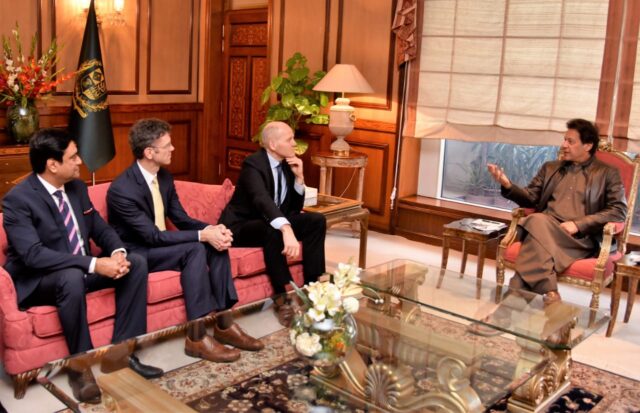
    SigveBrekke, President and CEO of Telenor Group, along with IrfanWahab Khan, CEO of Telenor Pakistan and Petter-Børre Furberg, Executive Vice President Telenor Group met the Honorable Prime Minister of Islamic Republic of Pakistan Imran Khan to discuss the growing and evolving digital ecosystem in the country and Telenor Group’s longstanding commitment to the country.

    During the meeting, Brekke shared Telenor Groups journey to becoming one of the largest telecom and digital services provider in Pakistan. SigveBrekke thanked the Government of Pakistan for its continued support for the telecom sector and for encouraging foreign direct investments into the country.In addition,theydiscussed possible collaborations to bringcontinued socioeconomic development and digitalisation for all. Brekke also highlighted Telenor’s commitment towards financial inclusion and informed the Prime Minister of incoming investment of USD 140mnas a result of the recently announcedpartnership with Ant Financial.

    The Prime Minister appreciated Telenor’s contribution in the telecom sector and said that the Government aims to develop a knowledge based economy in Pakistan and value Telenor as an important partner in developing the ecosystem that supports the Government’s development agenda.

    The Prime Minister reiterated that the Government is committed to transparency and facilitate investors and enable them take full advantage of huge potential existing in the growing economy of the country.

    “Pakistan is a key market for Telenor Group and we remain committed to empowering this nation by connecting our customers to what matters most,” said SigveBrekke, President & CEO Telenor Group, while sharing his thoughts. “We hope that the government will not only encouragebusiness-friendly policies, but will also introduce new reforms to enhance access to life-changing digital services and solutions for all.”

    “Through Telenor Pakistan’s industry-first initiatives in areas of digital products & services, financial inclusion, agriculture, health, and digital entrepreneurship, we are empowering Pakistan through robust ICT solutions,” said IrfanWahab Khan, CEO Telenor Pakistan. “We have 13 successful years to proudly look back to and aim to serve the people of Pakistan even better with all the learning we have gathered during this time. I thank Prime Minister Imran Khan for his time and am confident that his government will extend the needed support to help us materialise our shared vision of a digital Pakistan.”

    During his visit, SigveBrekke also called upon Mr. Asad Umar, Minister of Finance, Revenue and Economic Affairsand Mr. Shah Mahmood Qureshi, Foreign Minister and extended his appreciation to the Government for ensuring positive outlook and improving economic indicators that are instrumental towards attracting investment in the country. Brekke also discussed the role of telecom sector in socioeconomic uplift of the country by bringing widespread connectivity to the people of Pakistan.

    Telenor Group has been operating in Pakistan since 2005 and has made a significant impact on the socioeconomic uplift of the country. The Group has invested over USD 3.5bn, contributed over USD 2.5bn to the national exchequer since 2005 and created over 5,000 direct jobs, in addition tohundreds of thousands of indirect jobs.

  • Factories, tractors and robots benefit from 5G in Korea

    Factories, tractors and robots benefit from 5G in Korea

    All three of Korea’s mobile carriers launched their 5G networks on Saturday, the first day of December, officially kicking off an era of the high-speed network. SK Telecom started transmissions from its Bundang network management center in Seongnam, Gyeonggi; KT from its Gwacheon network control center in Gyeonggi; and LG U+ from Magok Science Park in western Seoul. All of the 5G networks operate on a 3.5-gigahertz (GHz) frequency band.

    5G boasts a 20 times faster data transmission speed than the currently prevailing fourth-generation long-term evolution (LTE). Its competitive edge lies in ultra-wide bandwidth, ultra-low latency and ultra-fast connectivity. Data transmission speed of 5G is more than 20 gigabytes per second (Gbps), meaning a 2.5-gigabyte ultra high-definition video can be downloaded in just one second.

    The network can currently only be accessed by corporate clients, not individual users. Businesses can use the card-shaped mobile routers to pick up the 5G network and convert it into super-fast Wi-Fi.

    Individual subscribers are expected to be able to start using 5G from March, when smartphone devices supporting the new network will become available. Samsung Electronics is expected to unveil its Galaxy S10 smartphone as early as February and may come up with two different versions: one supporting LTE and one that works on 5G.

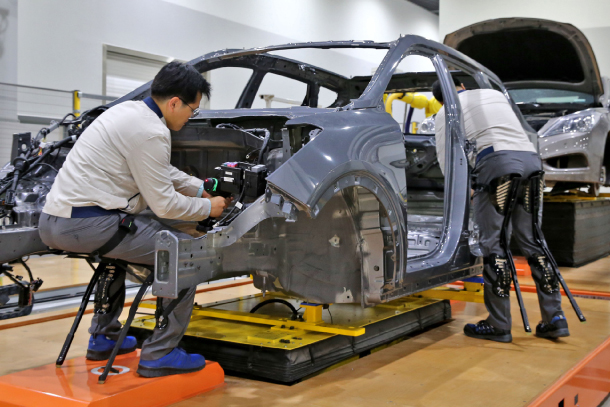
    SK Telecom’s first 5G customer was Myunghwa, a product quality assessment firm in Banwol Industrial Complex in Ansan, Gyeonggi. The company is using the network to process ultra-high definition photos of auto components taken from different perspectives as the products are being moved on a conveyer belt. The images are transmitted using the 5G mobile router to a cloud server, where a high-performance artificial intelligence interface can instantly tell whether a product is faulty.

    SK Telecom also began test operations of its 5G autopilot vehicles in Hwaseong and Siheung, both in Gyeonggi. The vehicles are able to exchange information about their status while on the road with a control center and traffic lights dozens of times per second.

    KT celebrated the launch of its 5G network by having a robot as its first subscriber. The robot, called Lota, will be guiding visitors to the Seoul Sky observatory at Lotte World Tower in Songpa District, eastern Seoul.

    “We chose Lota to show that 5G doesn’t simply mean a generational shift, but will become a platform that will innovate our overall lives and industry,” said KT in a statement.

    KT plans to prioritize 24 major cities nationwide as well as key public transportation routes and university areas, where traffic demand is expected to be high, for 5G installation in the near future.

    LG U+’s first corporate customer is LS Mtron, an industrial machine developer based in Anyang, Gyeonggi. The two companies have jointly developed a 5G remote-controlled tractor, the first in Korea. LG U+ said 5G-based remote-controlled technologies may minimize human engagement in risky working environments, such as the removal of mines and industrial waste disposal.

  • SK’s Chey says group is committed to U.S. society

    SK’s Chey says group is committed to U.S. society

    The chairman of Korea’s SK Group was in Washington on last Wednesday, vowing to make a commitment not only to the U.S. market but also its people and society. Chey Tae-won, who heads Korea’s third-largest conglomerate by assets, formally opened the Washington office of chipmaker SK Hynix in the presence of dozens of American dignitaries, including former U.S. Secretary of State Colin Powell.

    What was initially meant to be an opening ceremony was expanded under the name “SK Night” to provide a platform for Chey to explain the group’s current operations and investment plans in the United States, group officials said.

    “Past years, every different SK subsidiary … opened up their branches in the East Coast and West Coast, Texas … but they never actually [had] real communication with society,” Chey said in a speech.

    “Well this time, we will be investing in the U.S. about more than $7 billion here and there,” he said, citing as an example the planned construction of an electric vehicle battery plant in Jackson County, Georgia.

    “That’s going to be a $1.6 billion investment, and we’re going to hire right now more than 1,400 people,” he added to applause. “But within five years and if the market allows us, then we can expand [investment to] $5 billion and hire more than 6,000 employees there.”

    The plant is to be built by the group’s energy-chemical business, SK Innovation. On Monday, SK Biopharmaceuticals said it has applied to the U.S. Food and Drug Administration to win approval for sales of a newly-developed epilepsy treatment drug.

    Chey has pushed to expand SK’s presence in North America this year to add to business networks in China, the Middle East and Southeast Asia. During his stay here, he met with American business partners and local subsidiaries to help expand their presence on the continent.

    “[By opening up] the Washington office, I’m trying to show our commitment not only [to the] business side but also social value and commitment to society,” Chey said, adding that the group’s target is to “grow together” with U.S. society.

  • Angular 6 & its Features

    Angular 6 & its Features

    Google released a brand new version of Angular in the month of April which was the first major release by Google in 2018 which majorly focuses on the toolchain and has also made the application much easier for the users to create their different applications. This new launch comes packed with a lot of new features and some of the major upgrades. This new version of angular is much faster, easier, and lighter than its former versions and has come out to be a boon for the developers. You can undergo an Angular JS course to have an in-depth knowledge of the newly introduced features.

    Let us discuss a few of the major changes made in Angular 6:

    • Angular Elements: Angular acts as one of the most ideal frameworks for creating Single Page Applications. However, in the former versions of Angular, adding up a new component to any of the existing web pages was not at all an easy task. But in the latest version of Angular, it can be done easily with the input to Angular Elements. Moreover, Angular 6 is the first version release that completely supports Angular Elements.
    • Ivy-The Brand New Rendering Engine: Angular 6 comes packed with the third rendering engine from the Angular team. Ivy can be termed to as the next-gen rendering engine which is capable of increasing the speed and reducing the size of the application.
    • i18n: One of the major changes brought about in Angular in its latest launch is the launch of i18n on the global platform. Angular 6 has introduced i18n with runtime rendering; moreover, Angular would no more round up the currency values with 2 digits. Moreover, Angular 6 also has revealed some new formatting functions publically, such as formatDate, formatCurrency, formatPercent and formatNumber.
    • Bazel Compiler: it is basically a build mechanism which is used to building almost all of the software at Google. Moreover, it rebuilds only what is necessary to be built, neglecting any kind of inapplicable data. Moreover, it does not make any sense to rebuild the whole of the application with every little change as the source code changes very often. Keeping this in mind, Bazel Compiler only rebuilds the changes which have been incorporated and required rebuilding. Ultimately, we shall be capable of achieving faster and incremental builds.

    The above-mentioned are just a few advancements that have been bought about in the latest version of Angular, for a complete knowledge of the working of Angular 6.0 you can easily receive Angular 6 training through offline as well as online portals which will provide you with a wholesome information about the mechanism of this wonderful application.

  • KT subscribers jump ship after fire accident

    KT subscribers jump ship after fire accident

    KT’s week has taken yet another turn for the worse as the fire that caused major telecommunications disruptions in Seoul and the surrounding area has likely left the company with a hefty compensation bill and subscribers looking to take their business elsewhere.

    According to data from the Korea Telecommunications Operators Association on Tuesday, the number of KT’s mobile service subscribers has been shrinking since a fire broke out at the carrier’s Ahyeon telecommunications switching center in Seodaemun District, western Seoul, on Saturday.

    On Saturday, the total number of subscribers to the country’s second-largest mobile carrier fell by 828 people compared to the previous day. This means that the number of people that left KT was larger than those who newly subscribed to the carrier that day.

    On the contrary, subscribers to SK Telecom increased by 246 people and LG U+ 582 people on the day of the accident.

    On Monday, the number of KT subscribers again dropped by 678 people. During the two operating days, KT lost a net 1,506 subscribers.

    Before the accident, the number of KT subscribers was on the rise. On Thursday, KT’s pool of subscribers increased by 69 people and by 83 people on Friday, but that trend was reversed after the fire.

    The troubled company said most fire-affected services have returned to normal on Tuesday, but analyst Kim Hyun-yong from eBest Investment & Securities said, “KT’s sales and brand image can be damaged if the situation is not fixed quickly considering the long hours and broad scope of disruptions [caused by the accident,]” in a report.

    SK Telecom also suffered from problems in its mobile communications services in April and LG U+ last year, but disruptions were resolved in a matter of hours, not days.

    Analysts estimate KT will have to spend at least 23.2 billion won ($20.5 million) in compensation to individual customers as it decided to waive a month’s phone bill for KT subscribers residing in the affected regions. The amount is roughly 1.6 percent of KT’s projected operating profit for this year according to Yang Jong-in, a research fellow from Korea Investment & Securities, Tuesday.

    “We made our assumptions based on KT’s market share in the five affected districts in Seoul,” Yang said.

    Another analyst Kim Joon-sop from KB Securities estimated the amount of compensation to be larger, at around 31.7 billion won.

    As compensation plans for the business losses of small and microbusiness operators have not yet been laid out by the mobile carrier, the amount of compensation could snowball.

    The accident comes at a tragic time for KT, as it was just a week before the carrier expected to introduce its first 5G network-based services. Korean carriers have been preparing to launch their first 5G services in dongle-type devices from December and had scheduled large press briefings this week prior to the official launch.

    KT has now delayed its event. On Monday, the mobile carrier sent notices saying “we decided to cancel our scheduled event to quickly fix telecommunications disruptions caused by the fire,” to reporters.

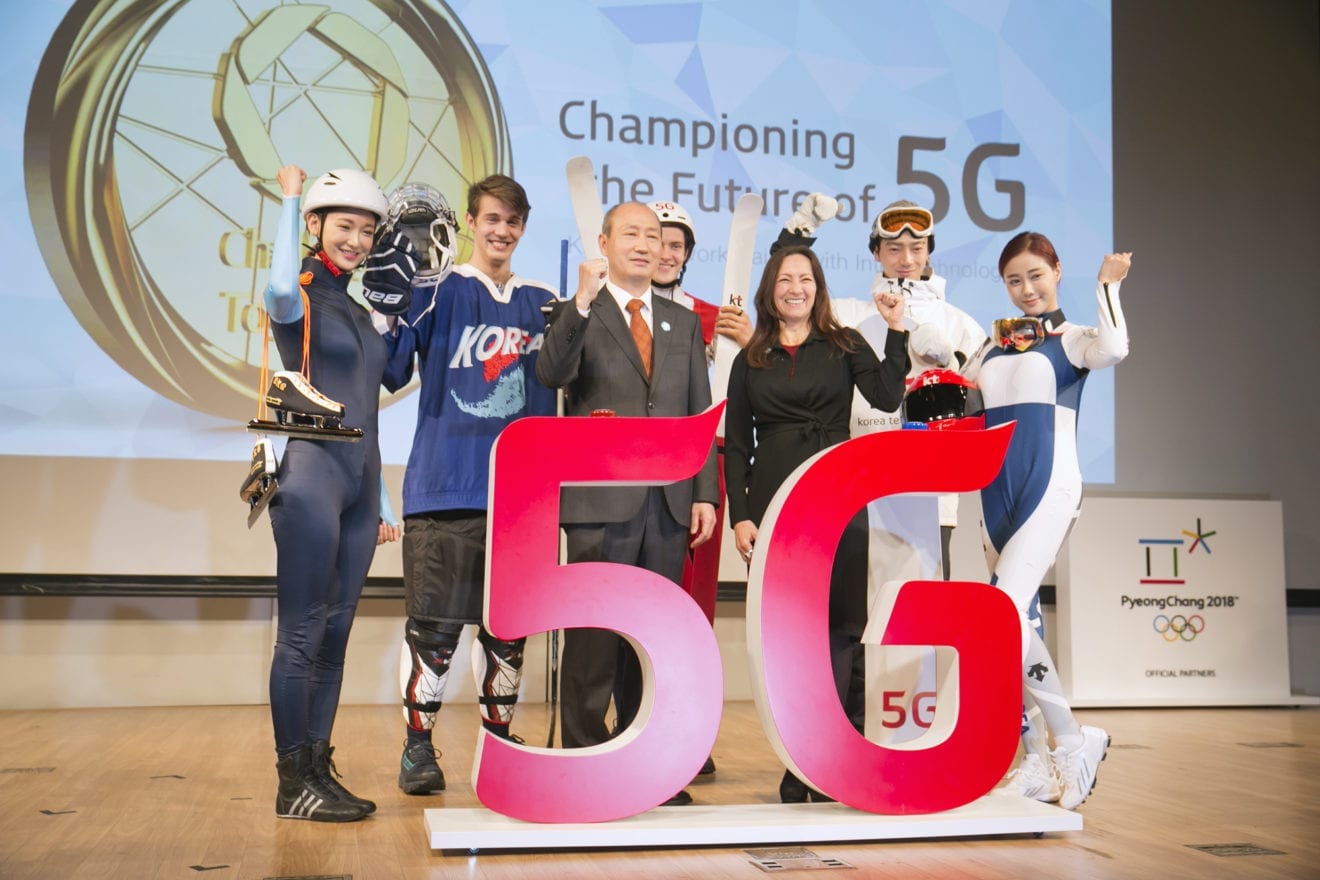
    The 5G network has been KT’s key focus and Chairman Hwang Chang-gyu had promised in September to invest a whopping 9.6 trillion won into its 5G business over the next five years. The company had also cemented its image as a leading 5G service provider by serving as the official telecommunications partner at the PyeongChang Winter Olympic Games earlier this year.

    The latest incident, however, has hampered KT’s latest bid to take a bigger share of the local telecommunications market, which has been in a similar shape for the last decade: SK Telecom taking 50 percent, followed by KT with 30 percent and LG U+ 20 percent.

    “SK Telecom, which boasts a well-established image of offering quality mobile services, and LG U+, which bets on cost-effective services, are likely to take advantage of the latest accident,” an industry insider said.

    Still, KT is trying its best to restore the disrupted network.

    According to KT, 96 percent of its mobile communications service has been restored, while 99 percent of landline internet and 92 percent of fixed-line phone services are repaired as of 11 a.m. Tuesday.

    KT said microbusiness operators still suffering from telecommunications disruptions are those that depend on copper cables rather than more modernized fiber optic cables. While 99 percent of fiber optic cable-based landline phone services are back to normal, only 10 percent of the copper cable-based services have been restored.

    “Copper cables are heavy and thick so they cannot be taken out through manholes for restoration,” KT said in statement. “They can only be recovered after our people are allowed into the tunnel where the fire broke out.”

    To minimize damage to copper-cable users, KT said it will offer 1,500 wireless LTE routers to shop operators so they can use electronic card payment systems. KT is also offering 300 wireless payment devices to convenience stores after discussions with the various franchise headquarters. The carrier has also been rushing to convert copper cables to fiber optic ones in areas with a large number of shops since Monday.

    From the government’s side, the Ministry of Science and ICT created a task force on Tuesday consisting of related government officials and representatives from mobile carriers to discuss how to manage low-level telecommunications facilities like the Ahyeon facility, which was graded D in terms of importance.

  • TM posts RM175m net loss in Q3

    TM posts RM175m net loss in Q3

    Telekom Malaysia Bhd (TM) suffered a net loss of RM175.59 million during the third quarter ended Sept 30 compared with a net profit of RM211.82 million a year ago, due to an impairment loss on network assets recognised during the quarter.

    In a filing with Bursa Malaysia, TM said it recognised a provision of RM934.8 million during the quarter for the impairment of fixed and wireless network assets following the continued pressure from challenging business, industry and economic conditions.

    It said that the impairment losses were projected based on an assessment of the recoverable value in use of the affected network assets at respective entity levels and it will continue reviewing the economic circumstances revolving around these assets in coming periods to reflect any potential impairment or recoverable value.

    Its core net profit, excluding non-operational items, stood at RM266.4 million, a 71% improvement sequentially while revenue for the quarter rose marginally to RM2.95 billion from RM2.94 billion a year ago on the back of higher data as well as other telecommunication related services revenue.

    During the quarter, UniFi recorded a loss of RM808.3 million compared with a profit of RM56.7 million a year ago, due to the impairment loss on network assets while revenue fell 2% to RM1.33 billion from RM1.36 billion a year ago due to lower revenue from voice services in line with a decrease in customer base and usage.

    This was partially offset by higher UniFi revenue in line with increase in customer base at 1.24 million as at end-September compared with 1.04 million a year ago.

    TM ONE recorded a 13.2% drop in profit to RM147.5 million during the quarter from RM170 million a year ago due to high operating costs, including the allocated impairment loss of network assets.

    Revenue for the segment rose 1.9% to RM1.12 billion from RM1.10 billion a year ago due to higher revenue from customer projects.

    As for TM Global, profit rose 9.1% to RM103.3 million from RM94.7 million a year ago due to lower operating costs while revenue rose 2.6% to RM562.8 million from RM548.4 million a year ago due to higher revenue from voice services.

    For the nine months ended Sept 30, net profit plunged 87.21% to RM83.5 million from RM652.74 million a year ago while revenue fell 1.74% to RM8.73 billion from RM8.89 billion a year ago.

    “The recent industry and market challenges have had major impact to the overall revenue estimates and earnings of TM Group in the financial year. TM anticipates that the challenging environment will persist for both our retail and wholesale segments,” the group said.

    In the midst of these challenges, TM said it will continue to focus on strengthening the performance of its core business and operations.

    In a separate filing, TM announced a revised dividend policy of distributing yearly dividends of 40-60% from its net profit, effective from the next dividend declaration.

    The group said that dividends will be paid depending on overall business and earnings performance, capital commitments, financial conditions, distributable reserves and other relevant factors.

  • KT promotes its 5G team to run entire mobile business

    KT promotes its 5G team to run entire mobile business

    Mobile carrier KT announced its annual reshuffle Friday as it actively prepares to gain a strong foothold in 5G-related activities in 2019. The next-generation 5G mobile network is expected to be 20 times faster than the current 4G network. Mobile carriers are working to achieve commercialization of the technology by March next year.

    KT’s 5G business team used to be part of the company’s marketing division. Following the reshuffle, the team is in charge of the carrier’s entire mobile business.

    Its main role will be developing customer services using the 5G network.

    A new 5G Platform Development team will be part of the marketing division. It is tasked with devising services for corporate clients, including those related to smart cities, smart factories and connected cars.

    As for changes at the top, former chief secretary, Kim In-heo, 55, was appointed president of KT. Kim has been noted inside the company for his practical working style and flexibility with regard to fixed customs.

  • Tencent finished Q3 with strong result despite regulation

    Tencent finished Q3 with strong result despite regulation

    Gaming and chat specialist Tencent has reported a strong third-quarter profit despite ongoing issues with Mainland China regulatory authorities over its gaming software. Tencent’s share price has fallen by about one third this year, shedding US$165 billion off its value, although last year its share price doubled. In September the company announced a restructuring program aimed at lessening its reliance on games and expanding its interests into areas such as cloud and industrial services in the transport, fintech and healthcare sectors.

    Tencent profit in the September quarter rose 30 per cent to RMB23.3 billion (US$3.36 billion) which exceeded analysts’ forecasts. This was partly due to fair-value gains from the IPO of food delivery service Meituan Dianping.

    Growth in its gaming division was ahead of expectation, but the company was unable to update shareholders on the status of its negotiations with mainland government officials over a regulatory block which has frozen new game approvals. The government has yet to decide on whether or not to allow Tencent to begin charging for features of its popular PUBG Mobile game. Chinese authorities are concerned that many Chinese are becoming addicted to mobile games.

    Those roadblocks were cited as the reason Tencent’s growth rate – a respectable 24 per cent, nonetheless, to US$11.6 billion – was its slowest quarter in more than three years.

    Sales of smartphone games grew 7 per cent year on year and 11 per cent quarter on quarter, while advertising sales, the company’s single largest revenue source, rose 47 per cent

    Revenue from cloud and payment services (WeChat Pay) helped fuel a 69 per cent increase in Tencent’s “other” revenue category.