Tag: 5G

  • SKT brings 5G workplace to life

    SKT brings 5G workplace to life

    ID cards, laptops and business trips will no longer be necessary, according to SK Telecom, when the 5G network-based smart office environment becomes an industry norm. The mobile carrier showcased its smart office technology test bed in Jongno District, central Seoul, Wednesday. Currently, about 300 SK Telecom employees are working at the space set up roughly a month ago by renting out three floors in the Centropolis building.

    At the entrance to the office, SK Telecom has facial recognition technology manning the security desk. Due to privacy issues, only employees who have agreed to register their biometric information can pass through the gate without an ID card.

    Inside the office, a display panel shows seat reservations. The screen shows all available seats inside the office, similar to the systems seen in university libraries and also shows who is in which seat. When designing the smart office, SK Telecom made it into an open space so employees can freely move around. The display even shows how many toilet cubicles are available for immediate use, although in this case employee names aren’t shown.
    The carrier said it used roughly 2,300 sensors, including on the ceilings, CCTV and even doorknobs in the bathrooms that track relevant data on employees’ work patterns inside the office. The data collected will be used to develop smart office solutions packages for enterprise customers.

    The desks in the office come with desktop computers connected to mobile routers that convert 5G signals into super-fast Wi-Fi. Beside the computer monitor is a docking station for smartphones. The so-called virtual desktop infrastructure enables employees to bring up what they were working on with their personal computers on the desktop computer using the cloud. Unlike simply mirroring a smartphone display, the phones become an authorization medium that allow the computer to verify which work files are downloaded from the cloud.

    At one side of the office is a space for so-called telemeetings that could cut down the need for frequent business trips. SK Telecom said it used its “T real telepresence” technology to invite multiple users into a virtual space where participants can have meetings while watching videos or 3-D designs of game characters and buildings together.

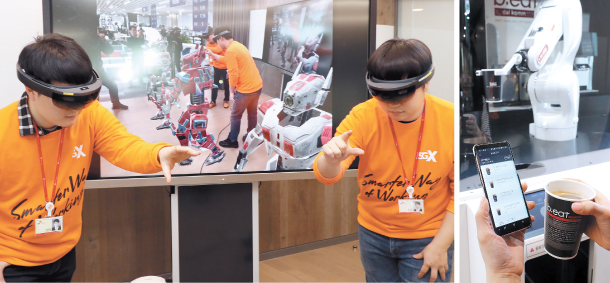
    After donning Microsoft’s HoloLens, this reporter was invited to a telemeeting to discuss the design of a game character.

    Within the virtual meeting, attendees were able to see and walk around a moving 3-D game character while interacting with the avatars of other people in the meeting.

    The experience wasn’t perfect – the field of view was small and constantly looking around was necessary in order to follow everything that was going on, but the potential of the technology to greatly reduce the need for business trips was evident.

    Other technologies already being used in the office included a barista robot and artificial intelligence-based autonomous vending machine, which can track employee purchases with camera sensors.

    Would any of these innovations be possible without 5G network?

    According to SK Telecom, yes. But, while all of these technologies are possible on the existing 4G LTE network, the new high-speed network, touted to be 20 times faster when fully commercialized, offers faster and more stable internet connection even when a million devices are connected at once.

    In essence, 5G ensures that all these systems work seamlessly without their huge data usage interrupting networks or slowing down work.

    “Dependency on landline internet will be reduced and high-capacity data will be delivered fast enough for real-time telemeetings with 5G,” said Shin Seung-ho, a manager from SK Telecom’s media lab under ICT center.
  • Samsung dreams of a future filled with 8K TVs

    Samsung dreams of a future filled with 8K TVs

    Samsung Electronics will expand its lineup of 8K televisions this year, hoping to launch the premium products in 60 countries around the world. 8K televisions have four times more pixels than 4K, which until recently was the most cutting-edge screen a high-end television could have. When compared to a 4K TV, 8K screens are brighter with more color contrast and sharper edges. Samsung released its first 8K television last year.

    Han Jong-hee, Samsung’s president in charge of the visual display business, said in a press conference Friday that he expects 2019 to mark the start of a new era where 8K becomes the new norm in the high-end television market.

    “4K grew to take up 60 percent [of all Samsung TV sales] in five years – I expect 8K to show a similar level of performance, maybe faster considering how tech develops so fast these days in all sectors including content and displays,” he said at the event held in Samsung’s Suwon complex in Gyeonggi.

    The company’s 2019 goal for 8K TVs is to reach a double-digit year-on-year growth rate for market share in the local high-end TV sector. Han says the goal is “reachable,” adding that half of the large Samsung televisions sold in the country after November were 8K. That month, Samsung started local sales of the product.

    Regarding its global business, the QLED 8K started selling in Europe, Korea, the United States and Russia last year. Tomorrow, the company will unveil new models for 2019 at the Samsung Forum, a showcase event for clients that simultaneously takes place in various regions around the world.

    This year’s plan is to launch sales in 60 countries.

    Whereas last year the QLED 8K lineup came with four size variations with the largest at 85 inches, this year there will be six variations with the largest at 98 inches. The new sizes are in line with Samsung’s strategy to continue strengthening its lineup of massive TVs to keep a competitive edge in the high-end price sector.

    It remains to be seen whether Han’s optimistic views on 8K television will come to fruition as quickly as he projects. Even if 8K TVs exist, the higher definition and the high price it comes at won’t be of much use if video content remains at the 4K level.

    “5G networks will spread this year and the demand for 8K content will go up as well,” responded Han when asked about the problem. Han particularly expressed anticipation for the 2020 Tokyo Olympics. Japan’s national broadcaster NHK plans to live stream the games worldwide in 8K.

  • KT CEO talks 5G at World Economic Forum

    KT CEO talks 5G at World Economic Forum

    The head of KT, the country’s leading telecommunications provider, outlined the importance of 5G networks in driving innovation at the World Economic Forum in Davos, Switzerland, last week. KT CEO Hwang Chang-gyu was invited to a meeting of the International Business Council, a community of 100 select highly influential executives around the globe, which was held on the forum’s sidelines.

    Hwang said the adoption of the upcoming network system will play an integral role in processing autonomous driving vehicles and telemedicine systems.

    5G refers to the fifth-generation mobile network that will succeed the current 4G network, which has been prevalent for about seven years. The network is expected to be commercialized in the first quarter of this year, according to KT.

    The global elite meeting also acted as a get-together for the world’s renowned CEOs and academics. KT said Hwang spoke with Apple’s Tim Cook, adding that the Apple CEO pledged to visit Korea or invite Hwang to the United States to learn more about the 5G network. Rafael Reif, the president of the Massachusetts Institute of Technology (MIT), said he expected Hwang will lecture about 5G at the campus.

    The KT CEO also promised to strengthen cooperation with Japan’s telecom NTT Docomo to run 5G during the Tokyo Olympic Games in 2020.

  • Viettel gets one-year 5G trial license

    Viettel gets one-year 5G trial license

    Vietnam’s largest telecommunications company Viettel has received a license to trial its 5G services. The trial is licensed for a period of one year until January 21 next year. Viettel is the first company in Vietnam to receive this license. The military-owned company is allowed to trial the sevices in Hanoi and HCMC at not more than 73 locations and without charging for the services.

    The company had earmarked $40 million for the development of its own 5G chipset, but was also considering using technology from Ericsson and Nokia, its president and CEO Le Dang Dung said.

    Viettel has around 60 million subscribers in Vietnam and over 30 million more in 10 other countries, predominantly in Asia and Africa.

    Speaking at a seminar on telecoms innovations at the end of 2018, Minister of Information and Communications Nguyen Manh Hung had expressed plans to introduce 5G by 2020, which would make Vietnam one of the first countries to deploy this technology.

    5G is the latest generation in of mobile Internet connectivity, and should offer much faster speeds and more reliable connections on smartphones and other devices compared to the current 3G and 4G technologies.

  • Seoul, SKT to add 5G to transport system

    Seoul, SKT to add 5G to transport system

    Sensors on roads will be able to alert cars when people are jaywalking and bus stops will tell buses to slow down in crowded areas when Seoul’s 5G infrastructure is ready, the city’s government and SK Telecom said in a joint statement Thursday. The Seoul Metropolitan Government and SK Telecom have teamed up on an initiative called the Cooperative-Intelligent Transport System, an upgrade of the current transportation system in Seoul. The pilot program will run until the end of 2020 with a budget of roughly 25.4 billion won ($22.6 million).

    Seoul already has a digitized public transportation system with signboards at bus stops telling passengers when the next bus is coming and whether it is crowded, and T-Money cards that enable people to transfer between various means of public transportation with little additional cost. The city aims to use 5G to make that transport system even safer.

    SK Telecom will supply 2,000 5G devices for buses, taxis and traffic signal controllers so they can connect with the 5G network. The mobile carrier said the devices will be co-developed with Samsung Electronics.

    Buses and taxis installed with 5G will constantly share data with bus stops, traffic lights and other traffic infrastructure. SK Telecom and the Seoul government will look for dangerous situations by analyzing the shared data to prevent accidents. As SK Telecom operates the country’s largest navigation app – T Map – the carrier said it will send out warnings through the app to reach the largest number of drivers possible.

    SK Telecom said there are about 30 safety services the 5G-based transportation system can offer.

    Roads installed with 5G sensors can detect jaywalkers, the mobile carrier said. While cars may have difficulty spotting people in the dark or during bad weather, 5G-connected sensors will alert nearby cars and prevent accidents. In 2017, 9,590 accidents were caused by jaywalkers, the largest cause of road accidents for pedestrians, according to data from the Korea Road Traffic Authority.

    The country’s largest telecom company also said 5G connectivity between cars can prevent secondary accidents by sending warning messages to following cars when an accidents occur in areas with poor visibility, such as around a corner or a bend in the road.

    As well as partnering on safety services, Seoul and SK Telecom are also preparing to jointly establish an autonomous driving test-bed in Sangam-dong, western Seoul, by the first half of this year. A self-driving vehicle will run back and forth between Digital Media City Station and buildings in the area. The SK Telecom-operated autonomous vehicle will begin running in the area from June at the earliest.

    “The Cooperative-Intelligent Transport System project is a futuristic business that combines state-of-the-art digital technologies, like 5G, autonomous driving, artificial intelligence (AI) and the cloud,” said Ryu Young-sang, an executive vice president of SK Telecom. “We hope to offer a range of traffic safety data to Seoul citizens using 5G and reduce traffic accidents.”

  • Vietnam wants to excel in IT, telecom

    Vietnam wants to excel in IT, telecom

    Vietnam, which is in a lowly 108th place in the International Telecommunication Union’s ICT Development Index, wants to improve its status. Speaking at a Ministry of Information and Communications (MoIC) conference Tuesday, Prime Minister Nguyen Xuan Phuc emphasized the need for the country to improve its ranking in ICT, one of country’s strengths alongside agriculture and service.

    MoIC Minister Nguyen Manh Hung said the country must use the International Telecommunication Union’s rankings as a guideline and strive to improve to no lower than 50th latest by 2022.

    He stressed that to take the lead in the digital revolution, the country needs to popularize smartphones by licensing 4G and testing 5G technologies to increase capacity, data usage per user and the quality of the mobile network.

    “Vietnam must be on the same line with the world in new technologies. We will not be eight and 10 years behind like we were with 3G and 4G.”

    According to the minister, Vietnam’s development in telecommunications must remain sustainable by shifting resources to explore new markets once the phone market saturates instead of continuing to compete unhealthily on old markets.

    “Mobile money,” which the ministry is trialing now, allows users to transfer money and make purchases through their telecom accounts, and would help bring e-payment to everyone in the country and stimulate economic growth, he said.

    Digital transformation, e-governance and smart cities would be the big stories of 2019, he said.

    “National digital transformation, digital economy and digital society would be the overarching story for decades to come. We need to develop strategies and projects in 2019 to clarify what must be done for each field in the digital economy and the Fourth Industrial Revolution.”

    Speaking about cyber security and safety, he said the Internet, on which the country’s prosperity depends, is itself an unsafe environment.

    “In 2019 there will be no incidents of government agencies’ websites being hacked and having information stolen. Vietnam must become ASEAN’s center for cybersecurity.”

    Vietnam has an opportunity to become one of the world’s major manufacturers of electronic and telecom equipment, he said.

    Globally there are only four major telecom infrastructure and equipment manufacturers — Ericsson, Nokia, Huawei and ZTE – and while China’s Huawei and ZTE enjoy a market share of 60 percent, they are encountering difficulties with the U.S., he pointed out.

    “Vietnam is currently capable of manufacturing 70 percent of telecom equipment [used globally]. With effort, we could become the fourth nation in the world capable of manufacturing and exporting all types of telecom equipment. This must be achieved by 2019-2020.”

    “Vietnamese network operators must use Vietnamese-made equipment if the price and quality are similar.”

    The ministry has set a target of  20-30 percent of operators’ revenues coming from digital content this year instead of the current 6-8 percent, saying the digital content industry is capable of expanding by three or four times to achieve revenues of $3-4 billion.

    “The key to the digital content industry’s growth is that policies must promote it,” said the minister.

  • Korea’s KT 5G bus hits the road

    Korea’s KT 5G bus hits the road

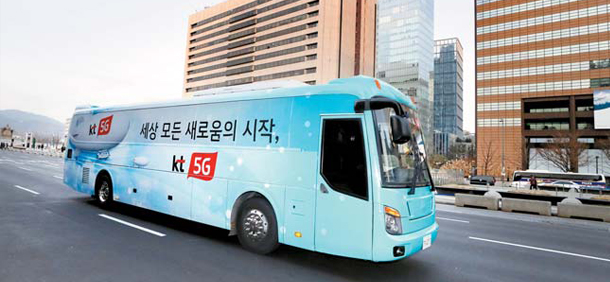
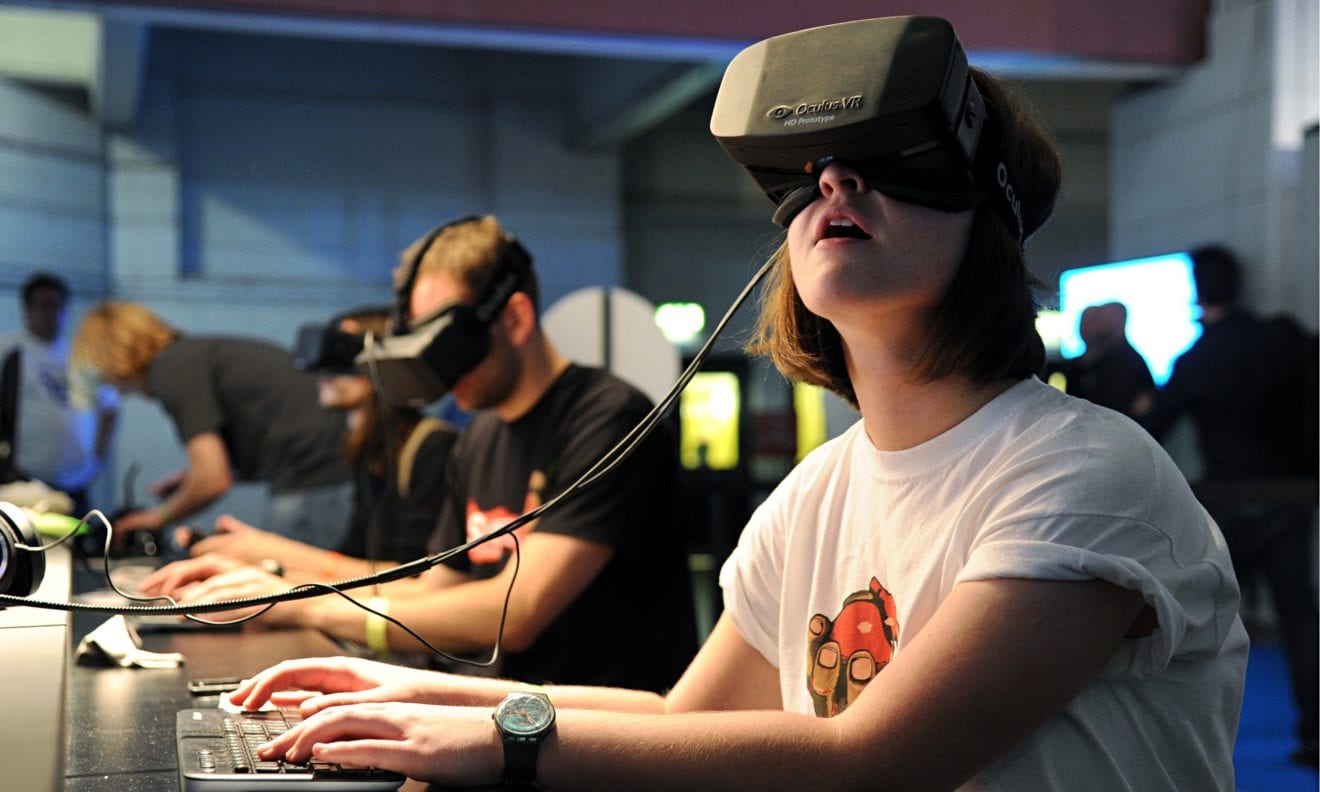
    Are you curious about all the hype over 5G? A ride on a 5G-powered bus may answer some questions. Mobile carrier KT announced Tuesday that people can sign up for free rides on its 5G bus. The bus will be connected to its ultra-fast 5G wireless network and will demonstrate devices that can be used to enjoy new media services like KT’s GiGA Live TV. GiGA Live is a head-mounted display – thick goggles with a screen embedded inside. GiGA Live supports virtual reality (VR) media services, including live sports broadcasts, as well as 360-degree films.

    VR and augmented reality (AR) are commonly cited as the technologies that have the most to benefit from 5G network. Because 5G promises up to 20 times faster speeds than LTE, it can transfer large volumes of data quickly in real-time, which is integral to the proper operation of VR and AR services.

    Those who want to take 30-minute sojourns on the 5G bus can apply online at www.kt5Gbus.com. The bus will run in the Gwanghwamun area from Jan. 15 to 24, and Gangnam Station from Jan. 25 to Feb. 2. Rides will be offered five times a day, excluding Sundays and Mondays.

    “5G network makes it possible to transfer huge volumes of information safely and in real-time,” said Park Hyun-jin, head of KT’s 5G business. “We will continue to offer innovative 5G services that can provide new experiences and value to consumers.”

    Earlier this month, KT added 5G-capabilities to its barista robot B;eat in Samsung Life Insurance’s Seocho District office. The robot, which looks like an advanced vending machine, can now recognize customers’ presence and send real-time footage of orders to human managers.

  • Samsung to release feature-rich phone to take on Huawei

    Samsung to release feature-rich phone to take on Huawei

    Samsung is releasing a phone with robust functions specifically designed to meet the challenge posed by Huawei. It has fast internet speeds — utilizing 5G wireless — is foldable and has an innovative screen design. Last year’s smartphone market can be summarized in one sentence: Apple’s defense, Huawei’s catch-up and the fall of Samsung Electronics.

    According Counterpoint Research, Apple’s share in the super high-end smartphone market, those priced over $900 (880,000 won), was 79 percent in the third quarter of 2018. In the $600-$900 market (660,000 to 880,000 won), Apple (61%) surpassed Samsung Electronics (21%) by a large margin, and in the $400-$600 range (440,000 to 660,000 won), Huawei (17%) was right behind Samsung (25%).

    At this critical moment, Samsung Electronics celebrates the 10th anniversary of the release of its “Galaxy” smartphone. The Galaxy Black came to market in April 2009. A new Galaxy S10, a commemorative issued for the anniversary, will be unveiled at the Mobile World Congress (MWC) 2019 in Barcelona, Spain this February. The name of the new S10 is “Beyond.”

    Samsung’s says it wants to outdo itself with the latest release.

    In the new S10, Samsung’s Infinity-O Display will be embedded. The display has a small hole in the screen for the selfie lens, so almost the entire face of the device is screen. The proportion that is screen is more than in Apple products, which utilize more real estate for the lens.

    The fingerprint-identifying sensor does not require separate hardware, but is found within the screen. The sensor itself utilizes Qualcomm ultrasonic-wave technology, which can identify prints that are less readable due to water or soil on the screen. Instead of scanning the user’s iris, the new model will utilize facial recognition, as is done with iPhones.

    It is expected that Samsung will maintain the 3.5mm-earphone jack, which has been scrapped on iPhones. It will also be 5G capable, allowing for a 1.5-gigabyte movie to be downloaded in less than a second. Samsung announced last month it will supply the world’s first 5G phones to Verizon and AT&T.

    Huawei is expected to release its own 5G phone in the first half of the year.

    Early versions of the new Galaxy S10, to be released in February, will not be 5G capable. It is possible that the S10 with a 5G communications chip will be released separately, as was done with the Galaxy S5 broadband LTE-A model, which was separately released in 2014.

    It was expected that LG Electronics will release its 5G smartphone this April or May, but it changed its goal for release to late March. Apple might not equip new iPhones, which will be released this year, with a 5G-communications chip.

    A telecommunications industry source said, “Apple originally did not really care about the speed of telecommunications that much. Apple might embed 5G in the iPhone in fall.”

    Smartphone competitors are seen pushing foldable phones in 2019. According to market research firm Strategic Analysis (SA), shipments of foldable smartphones globally will increase gradually from 3 million in 2019 to 14 million in 2020, and ultimately to 30 million in 2022.

    Chinese phone market Royole released a foldable first, in October last year, ahead of Samsung Electronics and Huawei. Royole will release its 7.8-inch Flex Pie foldable phone at the 2019 Consumer Electronics Show (CES), to be held in Las Vegas from Jan. 8-Jan. 11. Royole led the market but has received criticism about the quality of its device.

    The Galaxy foldable phone will be released in February. It will have a 7.3-inch screen as well as a 4.58-inch screen. The initial run will be about 1 million units.

  • Samsung signals big 5G equipment push, again, at factory

    Samsung signals big 5G equipment push, again, at factory

    Samsung Electronics Vice Chairman Lee Jae-yong’s first appearance in the field this year was to celebrate the start of production at a 5G network equipment factory Thursday. His field visit comes as the company puts more weight this year on the 5G network-equipment business, which involves components used in 5G networks. These components are supplied to telecommunications companies.

    Lee and several other top executives, including Koh Dong-jin, CEO and president of the IT & mobile division, were present at the celebration ceremony held at the company’s factory and office complex in Suwon, Gyeonggi.

    “The 5G market is a new field, and we have to build competence with the mindset of a challenger,” Lee told employees during the event.

    Lee and the team of executives stopped by the cafeteria of the complex for lunch, resulting in posts on Instagram featuring Lee and employees.

    The manufacturing line for 5G equipment in Suwon is the first in the industry to be designed using “smart factory” principles. It utilizes 5G connections to enhance productivity and reduce the rate of defects.

    The company originally manufactured 5G network equipment in Gumi, North Gyeongsang, but had the production line relocated to Suwon, the site of its R&D center. This was done to help create synergies between the manufacturing and R&D facilities, said a spokesman.

    Samsung signaled last August that 5G connectivity is one of its four growth engines for the future when it announced a plan to invest $161 billion by 2021.

    The business area is receiving considerable attention from global technology companies. 5G connectivity is vital not only to telecommunications in the future, but will also be an essential component of other, related state-of-the-art technologies, such as autonomous cars, AI-powered robots and virtual reality.

    Samsung’s presence in the global telecommunications equipment market is relatively low, with a share of around 11 percent for fourth-generation LTE equipment, according to market research firm Dell’Oro. The larger players include Huawei, Ericsson and Nokia, all with shares of more than 25 percent.

    The company’s current goal is to hit a 20 percent market share in the 5G equipment market next year.

    Samsung has been expanding its client base for 5G equipment mainly in Korea and the United States. Names on the list include SK Telecom, KT, AT&T and Verizon. Samsung hopes to leverage those client relationships to attract other customers.

    The company plans to release the Galaxy S10 in March. It will be its first smartphone to support 5G connections.

    Kim Young-ki, Samsung’s president of network business, said at an event last November that the company will invest a total of $22 billion to develop 5G-network technology.

  • LG U+ says it can download things 10 times faster on 5G

    LG U+ says it can download things 10 times faster on 5G

    LG U+ said Wednesday that it has demonstrated 10 times faster download times compared to 4G LTE on its 5G network. While 4G LTE offers 133.43 megabits per second download speeds on average, according to data from the Ministry of Science and ICT, LG U+ said it realized 1.33 gigabits per second on its 5G network.

    LG U+ claims it is nearly the fastest speed consumers can practically experience on 5G. Next year, when 5G is commercialized for smartphones, the smallest carrier in the country projects data download speeds will increase to as fast as 2 gigabits per second when the 5G network will be coupled with the 4G LTE network.

    LG U+ believes 5G is its chance to move up the mobile carrier ranking, currently dominated by SK Telecom and KT.

  • LG U+ CEO says Huawei gear is not a risk

    LG U+ CEO says Huawei gear is not a risk

    LG U+ CEO and Vice Chairman Ha Hyun-hwoi has made it clear that the carrier does not think there are any security threats related to its use of Huawei equipment in its 5G infrastructure. Ha made the statement during a year-end press briefing on Wednesday in Yongsan District, central Seoul, rebuffing claims by some lawmakers that there is a risk of security leaks through the use of the Chinese tech giant’s equipment in the network. LG U+ currently partners with Huawei as well as Samsung Electronics, Ericsson and Nokia for its 5G infrastructure.

    According to Ha, the Chinese IT company has already applied for security certification of its 5G network equipment from an international certifying body in Spain. The CEO added the public will be able to see how secure the equipment is once the evaluations are complete next year.

    “Security concerns apply to every equipment vendor we partner with, not only Huawei, and we need to thoroughly verify all the equipment [we use] is secure,” Ha said. “There are roughly 170 countries that are already using Huawei’s network equipment, and there hasn’t been any security problems reported so far.”

    Locally, Huawei has set up equipment that abides by over 70 security guidelines set by the Korea Internet & Security Agency, according to LG U+.

    The main reason for the carrier taking the risk of using the controversial equipment is because 5G infrastructure needs to be built in conjunction with the existing network equipment for 4G long term evolution (LTE), some of which LG U+ also bought from Huawei. Ha said price, technological competitiveness and the ability to deliver the equipment in a timely manner were also considered when choosing the vendor.

    LG U+ has built 5,500 base stations to service the next-generation 5G network as of Wednesday, while its local competitors have reportedly established less than 1,000 5G base stations.

    On why the mobile carrier is rushing to establish its 5G infrastructure, Ha said, “It is important to have a head start to have a competitive edge in [5G] services considering the quality tests we need to go through before March [when the high-speed network is commercialized for smartphones].”

    Ha said the company invested roughly 4 trillion won ($3.6 billion) to set up its 5G infrastructure, including at 5G spectrum auctions.

    The company said it hopes to take up a larger share of the market, which is dominated by SK Telecom, with 50 percent, and KT, with 30 percent.

    “In July 2011, when we first began the LTE service, our local market share was 17.7 percent, but the share increased to 21.2 percent over time as of the end of October,” LG U+ said in statement. “We think next year could be the best time to shake up the competing structure.”

    The carrier is preparing a 5G-based smart factory service with its affiliates LG Electronics and IT service company LG CNS, targeting enterprise customers. For individual customers, LG U+ is focusing on augmented reality and virtual reality content that can offer an immersive experience of watching sports games and K-pop concerts at home.

    The CEO also commented on speculations that the carrier will acquire paid TV service operator CJ Hello. Ha said it has opened up its options to cable TV operators other than CJ Hello and plans to finalize the deal within the first half of next year. Industry sources, however, still say negotiations between the two parties have nearly come to a close and final results are likely to come out around March.

  • LG U+ 5G pass self-drive test on expressway

    LG U+ 5G pass self-drive test on expressway

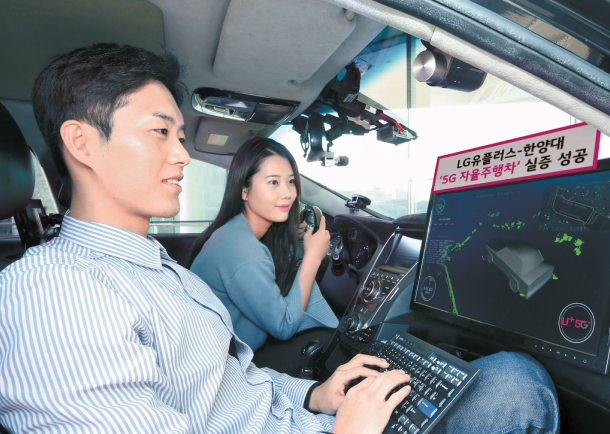
    LG U+ has successfully tested a 5G-powered self-driving vehicle on an expressway for the first time. The mobile carrier announced Tuesday that a self-driving car developed by Hanyang University successfully drove on LG U+’s 5G network for 25 minutes across seven kilometers (4.35 miles) of busy city roads including the Gangbyeon Expressway and Olympic Expressway.

    A low latency video transmitter developed by LG U+ delivered real-time footage of the test drive to Hanyang University. Two cameras attached to the self-driving vehicle recorded the front and rear of the car.

    During the test drive, the vehicle had to react to certain scenarios such as avoiding obstacles and changing course. The vehicle was also tested to see how it reacts to new traffic information such as a blocked parking lot entrance.

    The vehicle was remote controllable, offering added safety measures in case of emergency.

    It was the first time that a self-driving car has completed a test drive on such a scale on an expressway or high-speed road in Korea, according to the company.

    “Self-driving cars that run on the 5G network will make important contributions to solving social problems like traffic volume and accidents,” said Sunwoo Myung-ho, who teaches automotive engineering at Hanyang University.

    “It’s significant that we were able to produce substantial results with self-driving cars through cooperation between industry and academia,” said Kang Jong-oh, who manages future technologies at LG U+. “We will continue to invest our efforts into developing self-driving car technology through cooperation between mobile carriers and the auto industry.”

    LG U+ will continue to work with Hanyang University to polish its 5G-based self-driving car technology.

    Competitors SK Telecom and KT are also actively investing in self-driving technology. KT, for example, successfully tested a self-driving bus at Incheon International Airport last month.

  • Huawei’s woes in U.S. give pause to Korea, too

    Huawei’s woes in U.S. give pause to Korea, too

    The arrest of Huawei’s Chief Financial Officer Meng Wanzhou in Canada has triggered alarms in the Korean telecommunications industry, especially after LG U+ moved onto a fifth-generation (5G) network this month that uses Huawei network devices.

    The Chinese telecommunications giant has maintained a sizeable influence since it first entered the Korean market in 2002. While it was originally focused on the cable infrastructure business, Huawei moved on to offering wireless telecommunications devices in 2007 as local telecommunications companies introduced third-generation wide-band code-division multiple access services.

    In 2013, Huawei received orders for fourth-generation 4G long-term evolution (LTE) wireless base stations from LG U+ for services in Seoul, Incheon, and areas in Gyeonggi and Gangwon.

    The 5G equipment market in Korea is estimated to be worth 10 trillion won ($8.89 billion).

    While Huawei is a leading supplier to the telecommunication industry, concerns about the security of its devices has held the company back. Only LG U+ decided to use Huawei equipment for 5G. Huawei has claimed that it had no such security problems in the 170 countries that it operates in and would follow inspection requests by the Korean government.

    LG U+ signed a deal with Huawei to introduce around 30,000 base stations in the Seoul, Incheon, and the Gyeonggi and Gangwon regions by next March. The deal is reportedly worth around 300 billion won, not including maintenance fees.

    The decision by Korea’s smallest telecommunications company made business sense as it used Huawei equipment for its 4G network.

    Huawei’s equipment, however, will not be installed in areas occupied by United States Forces Korea (USFK) such as in Pyeongtaek, Dongducheon, Yongin in Gyeonggi. The U.S. government has requested that Huawei equipment not be used out of concerns about a Chinese cyberattack. USFK has been suspicious about Huawei equipment. When LG U+ chose Huawei equipment for its 4G network, around 10,000 USFK soldiers switched carriers.

    The current situation has left LG U+ in a difficult position. Its deal with Huawei is already inked, and the 5G service works in sync with the existing 4G system, so it is impossible for the company to simply not use Huawei equipment.

    The recent banning of Huawei equipment by Britain, Australia, Canada, New Zealand and Japan, along with growing worries in Korea, places more pressure on the telecommunications unit.

    A senior LG U+ official expressed frustration at the current situation and the Korean government’s inaction.

    “Our government is just trying to not upset either China or the United States,” said the official. “Shouldn’t the government come forward and clear things up?”

    Meanwhile, the government maintains its stance that the selection of telecommunications equipment is an issue for companies to decide.

    “Inspecting security is the responsibility of the business operator. It is not appropriate for the government to take part in an area that a company should make a decision on,” said Park Jun-guk, an official at the Cyber Security Industry Bureau in the Ministry of Science and ICT.

    “[We] will, however, strengthen security inspections in the form of a technology advisory conference.”

    While 5G has stirred controversy, Huawei has an even stronger presence in the country with its cable and optical transmission equipment businesses. In the cable business, all three telecommunications companies, SK Telecom, KT and LG U+, are customers of Huawei.

    Huawei has also won orders from Koscom, a state-run financial IT solution company, and from electric utility Kepco.

    Last month, the Chinese company won an order with KT to connect the sales network of the National Agricultural Cooperative Federation and the National Livestock Cooperatives Federation worth around 120 billion won.

    According to market researcher IHS Markit, Huawei is the biggest global telecommunications equipment maker, with a market share of 22 percent. While Samsung Electronics holds a strong position in the Korean market, a 45 percent market share, it commands a paltry 4 percent share of the global market.

  • For first few years, Koreans will be biggest users of 5G

    For first few years, Koreans will be biggest users of 5G

    Korea is forecasted to have the highest proportion of fifth-generation (5G) smartphone usage in the world over the next couple of years, a market tracker said on Sunday. According to Strategy Analytics’ Service Provider Group, the adoption rate of 5G smartphones in Korea is expected to reach 5.5 percent in 2019 and 10.9 percent in 2020, which will be the highest level among major global nations.

    The estimate is based on the fact that Korea is to commercialize 5G services next March, making it the first country in the world to do so, with tech giant Samsung Electronics planning to release a model featuring the high-end technology, the market tracker said.

    By 2020, 5G will account for 4.7 percent of total market share in the United States, 5.2 percent in Japan and 2.8 percent in China, Strategy Analytics said, adding that its penetration rate would increase after that date in line with the broader establishment of the network.

    In 2021, the adoption rate of 5G smartphones is expected to begin to surge in major countries, with numbers hitting 27 percent in the United States, followed by 21.3 percent in South Korea, 19.7 percent in Japan and 8.5 percent in China.

    “The 5G standard will become the mainstream of the global network industry in years to come,” said an industry insider.

  • Vietnamese network providers ready for 5G rollout

    Vietnamese network providers ready for 5G rollout

    Vietnamese telecom firms are seeking a head start in the 5G race as the country becomes an early adopter of the technology. State-owned Vietnam Posts and Telecommunications Group (VNPT) recently signed a deal with Finnish telecom firm Nokia to develop 5G solutions and technology for the Internet of Things. The three-year deal is worth $15 million.

    The country’s third largest mobile service provider is seeking permission from the Ministry of Information and Communications for its Vinaphone network to beta test 5G, chairman Tran Manh Hung said at a conference last month.

    He said the test would help VNPT master the technology and prepare to produce 5G equipment, adding Vinaphone is ready to provide 5G services as soon as it gets the ministry green light.

    Military-run Viettel Group has also announced it is ready to beta test 5G next year. Its deputy director, Tao Duc Thang, said its installation of infrastructure for 4G even in remote areas allows Viettel to be ready for the new network.

    5G is said to offer speeds 100 times faster than 4G, primarily used for smartphones and other similar devices. The former is also expected to support new applications like remote medical procedures and autonomous driving.

    Thang said Viettel, the country’s largest mobile service provider, is working with partners to manufacture 5G equipment.

    “I think Vietnamese operators are ready for 5G with the existing infrastructure. When the market, equipment and users are ready, developing 5G will be possible.”

    The company, which has been working on 5G plans since 2015, will start installing infrastructure early next year and introduce the service first in big cities like Hanoi and HCMC.

    The country’s second biggest mobile service provider, MobiFone, which trailed its competitors in deploying 4G, earlier this year signed an agreement with Samsung Electronics for engineering and commercial cooperation on 4G and 5G networks.

    Vietnamobile, a joint venture between Hanoi Telecom and Hongkong-based Hutchison Asia Telecommunications, has also announced its interest in offering 5G services.

    VNPT, Viettel, MobiFone, and Vietnamobile are expected to receive 5G testing licenses in January.

    Last month Minister of Information and Communications Nguyen Manh Hung said at a conference that Vietnam should test 5G next year and ensure nationwide coverage by 2020.

    “Vietnam should be one of the first to launch the network, at least in Hanoi and HCMC.” The country had been one of the last in Southeast Asia to roll out 4G.

    This time Vietnam would be able to produce the required equipment before it launches the network, whereas for 4G the country had to wait for eight years before being able to do so, and for 2G and 3G all the equipment had to be imported, he said.

    “5G is not only an opportunity for connection services and going up the telecommunications ladder, but also an opportunity for developing the country’s information and communications technology industry.”

    The International Telecommunication Union last year ranked Vietnam 115th out of 193 economies in terms of mobile teledensity, but Hung wants the country to have 100 percent subscription by 2020 and be among top 30-50 countries in the world in data spending per capita.

    Vietnam’s telecom market was estimated at more than $16 billion in 2016, with the three state-owned providers, Viettel, MobiFone, and VNPT, accounting for 95 percent of the market.

    Viettel had the largest share with 46.7 percent, followed by MobiFone with 26.1 percent and VNPT with 22.2 percent.

    While MobiFone and VNPT are on the list of state-owned companies slated for privatization by 2020, Viettel will remain in government hands.