Tag: 5G

  • Factories, tractors and robots benefit from 5G in Korea

    Factories, tractors and robots benefit from 5G in Korea

    All three of Korea’s mobile carriers launched their 5G networks on Saturday, the first day of December, officially kicking off an era of the high-speed network. SK Telecom started transmissions from its Bundang network management center in Seongnam, Gyeonggi; KT from its Gwacheon network control center in Gyeonggi; and LG U+ from Magok Science Park in western Seoul. All of the 5G networks operate on a 3.5-gigahertz (GHz) frequency band.

    5G boasts a 20 times faster data transmission speed than the currently prevailing fourth-generation long-term evolution (LTE). Its competitive edge lies in ultra-wide bandwidth, ultra-low latency and ultra-fast connectivity. Data transmission speed of 5G is more than 20 gigabytes per second (Gbps), meaning a 2.5-gigabyte ultra high-definition video can be downloaded in just one second.

    The network can currently only be accessed by corporate clients, not individual users. Businesses can use the card-shaped mobile routers to pick up the 5G network and convert it into super-fast Wi-Fi.

    Individual subscribers are expected to be able to start using 5G from March, when smartphone devices supporting the new network will become available. Samsung Electronics is expected to unveil its Galaxy S10 smartphone as early as February and may come up with two different versions: one supporting LTE and one that works on 5G.

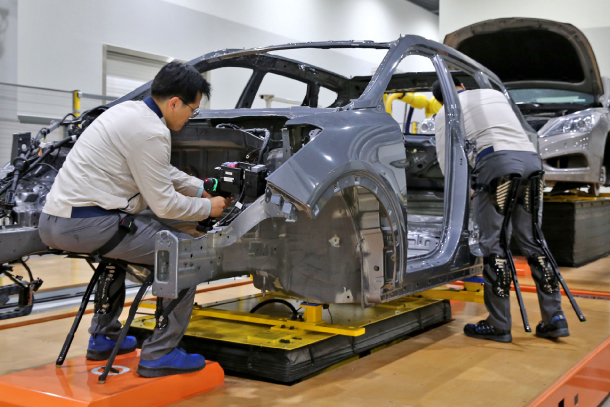
    SK Telecom’s first 5G customer was Myunghwa, a product quality assessment firm in Banwol Industrial Complex in Ansan, Gyeonggi. The company is using the network to process ultra-high definition photos of auto components taken from different perspectives as the products are being moved on a conveyer belt. The images are transmitted using the 5G mobile router to a cloud server, where a high-performance artificial intelligence interface can instantly tell whether a product is faulty.

    SK Telecom also began test operations of its 5G autopilot vehicles in Hwaseong and Siheung, both in Gyeonggi. The vehicles are able to exchange information about their status while on the road with a control center and traffic lights dozens of times per second.

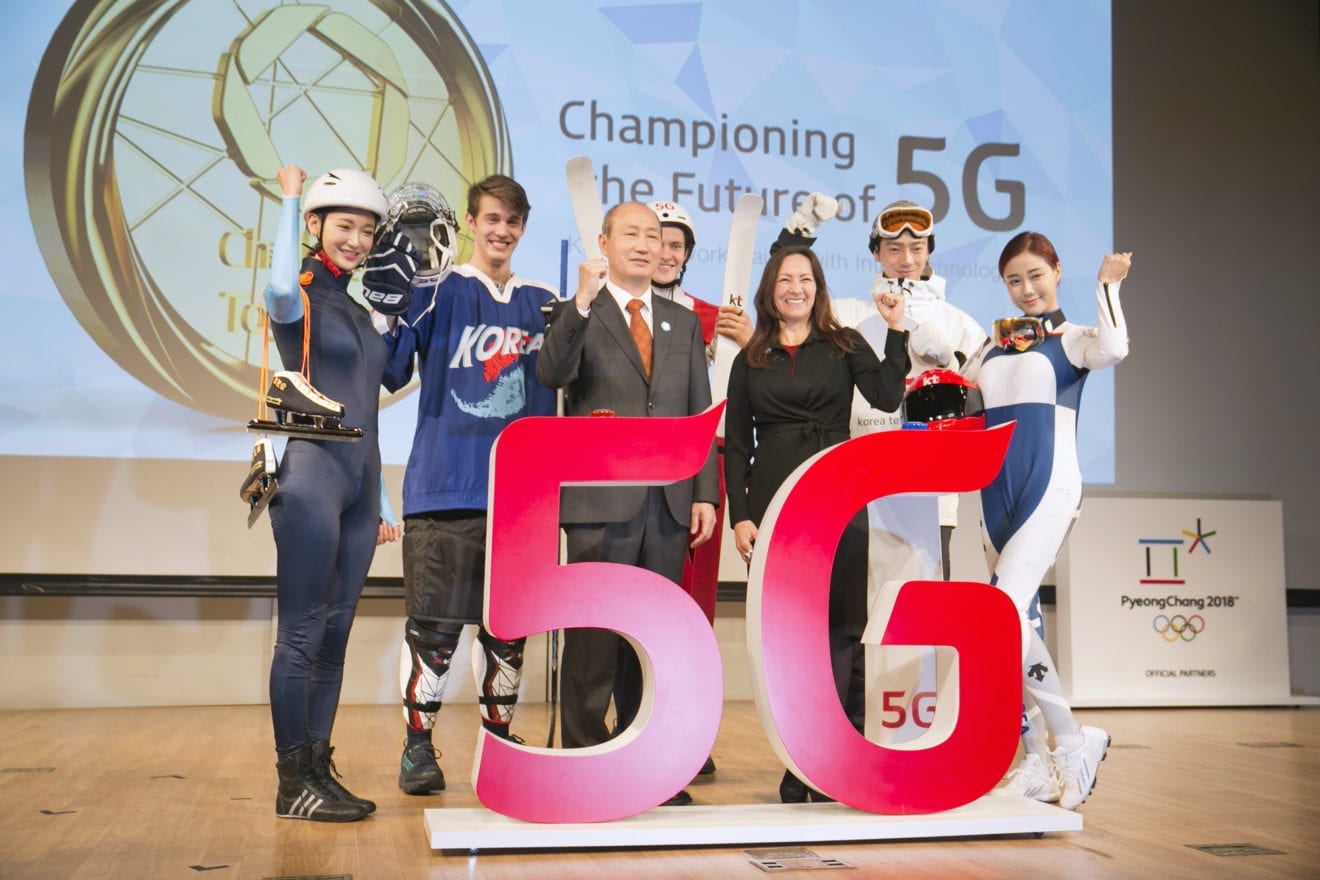
    KT celebrated the launch of its 5G network by having a robot as its first subscriber. The robot, called Lota, will be guiding visitors to the Seoul Sky observatory at Lotte World Tower in Songpa District, eastern Seoul.

    “We chose Lota to show that 5G doesn’t simply mean a generational shift, but will become a platform that will innovate our overall lives and industry,” said KT in a statement.

    KT plans to prioritize 24 major cities nationwide as well as key public transportation routes and university areas, where traffic demand is expected to be high, for 5G installation in the near future.

    LG U+’s first corporate customer is LS Mtron, an industrial machine developer based in Anyang, Gyeonggi. The two companies have jointly developed a 5G remote-controlled tractor, the first in Korea. LG U+ said 5G-based remote-controlled technologies may minimize human engagement in risky working environments, such as the removal of mines and industrial waste disposal.
  • KT promotes its 5G team to run entire mobile business

    KT promotes its 5G team to run entire mobile business

    Mobile carrier KT announced its annual reshuffle Friday as it actively prepares to gain a strong foothold in 5G-related activities in 2019. The next-generation 5G mobile network is expected to be 20 times faster than the current 4G network. Mobile carriers are working to achieve commercialization of the technology by March next year.

    KT’s 5G business team used to be part of the company’s marketing division. Following the reshuffle, the team is in charge of the carrier’s entire mobile business.

    Its main role will be developing customer services using the 5G network.

    A new 5G Platform Development team will be part of the marketing division. It is tasked with devising services for corporate clients, including those related to smart cities, smart factories and connected cars.

    As for changes at the top, former chief secretary, Kim In-heo, 55, was appointed president of KT. Kim has been noted inside the company for his practical working style and flexibility with regard to fixed customs.

  • Foldable phone coming early 2019

    Foldable phone coming early 2019

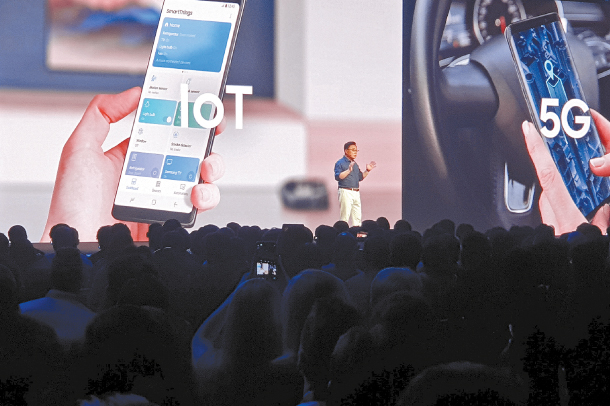
    Samsung Electronics will make its foldable smartphone available by the first half of 2019, with initial shipments estimated at least at 1 million units, according to Koh Dong-jin, president of the IT and Mobile Communications division at the company.

    The comments were made Thursday in San Francisco on the day two of the Samsung Developer Conference, where he discussed the rollout of the new flagship phone with considerable confidence.

    “We will definitely introduce the phone before the end of the first quarter next year, although I cannot pin down the date at this moment,” he said. “And we will maintain the line each year.”

    His comments indicate that Samsung will be adding foldables to its existing two flagship lines, the Galaxy S – released most recently in February – and the Galaxy Note – released in the fall. But the foldables will be released in a limited number of countries, including Korea and the United States. Koh added that Samsung has yet to confirm the name of the lineup.

    Given Samsung’s status as the No.1 smartphone vendor in the world and the fact that its flagship models sell at least 1 million units, Samsung is gearing up to churn out over 1 million foldables from the outset “if the market reaction is positive,” he added.

    Koh’s meeting came a day after Samsung introduced the foldable phone. The company demonstrated what it calls the “Infinity Flex Display,” which measures 7.3 inches diagonally when the phone is open like a book. The screen is slightly larger than the largest smartphone screen and slightly smaller than those of a conventional tablet PCs.

    The company has so far declined to provide additional specifications, including thickness, weight and the battery power.

    “We showcased the display to show off Samsung having reached the stage of commercializing the device,” he said. “We have overcome several barriers, such as making the central hinge through the screen invisible. What remains to be done is working on the user interface to make it more concrete.”

    He went on to say that Samsung distributed the foldable device to developers before the event so that they could help in designing the best-possible user experience.

    Two months earlier, he met with Google CEO Sundai Pichai to launch a task force for foldable user experience.

    Beginning with foldables, Samsung is getting ready to revolutionize smartphone display form factors – to rollables as well as stretchables.

    “As much as foldables will have a huge technological impact, so will rollables and stretchables. That’s why we are studying them,” he said. “But the entire workforce is devoted to foldables at present.”

    Samsung has been grappling with declining sales and revenue from smartphone business. Operating profit for the division during the third quarter fell 29.8 percent year on year to 2.22 trillion won ($1.96 billion), while revenue slid 10 percent to 24.91 trillion won over the same period.

    Chinese rookie Huawei is rapidly catching up.

    Koh mentioned 5G connectivity, artificial intelligence and the Internet of Things as breakthrough technologies that will help Samsung compete.

    “While we have been maintaining leadership with 4G over the past decade, 5G, AI, IoT and augmented reality will offer a new opportunity in 2019.”

    He added that foldables will achieve another leap when such technologies become reality and are combined with the device.

    “Next year will be the 10th anniversary of Galaxy smartphones, and it’s very meaningful to me,” he said. “We will be coming up with an impressive Galaxy S10 as well.”

  • Korea’s KT skips Huawei for 5G

    Korea’s KT skips Huawei for 5G

    KT has chosen Samsung Electronics, Ericsson and Nokia as suppliers of 5G network equipment. As expected, Huawei was excluded from the list.  “In choosing 5G equipment providers, the company considered a wide range of factors: the level of technology, investment costs and management stability based on the compatibility with the existing LTE network,” KT said in a statement.

    The bid results, announced by the company Thursday, come a month after SK Telecom named Samsung Electronics, Ericsson and Nokia as its 5G equipment providers.

    This is the second time Huawei was left out despite having participated in internal tests along with the three selected.

    SKT and KT’s choices were anticipated because both had used equipment from Samsung, Ericsson and Nokia for their 4G LTE networks.

    Compatibility of equipment is an advantage for mobile carriers in terms of cost and maintenance, especially in the early stages when 5G equipment is not fully installed nationwide.

    LG U+ is the only one among Korea’s three mobile carriers that has not yet announced 5G equipment suppliers. The smallest mobile carrier is likely to include Huawei on its list. It partnered with the Chinese company for its 4G LTE network, along with Samsung, Ericsson and Nokia.

    An LG spokesman said Thursday that the company “does not have plans to openly disclose selected bidders for 5G network equipment at the moment,” as it is not mandatory.

    However, LG U+ Vice Chairman Ha Hyun-hwoi gave a strong hint at the parliamentary audit late last month when he gave a positive answer to a lawmaker’s question on whether it was “unavoidable” to use Huawei’s 5G equipment as its 4G equipment was from the same company.

    The biggest advantage of Huawei’s 5G equipment is cost efficiency. The Chinese company is known to charge prices that are 20 to 30 percent lower than other global competitors for high-quality 5G equipment. A factor that argues against Huawei is security concerns.

    Due to its ties to the Chinese government, there have been worries that the company’s equipment is being used for spying. In August, the U.S. and Australian governments banned Huawei from supplying equipment for their 5G wireless infrastructure citing security reasons. Britain said in July it “is less confident” about the integrity of Huawei products.

    The concern is shared by some local customers as well. Online petitions at the Blue House’s official website have been posted since June requesting a stop to LG’s adoption of Huawei’s 5G equipment. Huawei has been denying such allegations.

    In a press release last month, the Chinese tech company highlighted that, despite ongoing security concerns, there has been zero cases of actual information leakage in the past.

    “We have supplied LTE equipment for LG U+ since 2013, and until now, there were no cases of security accidents,” said the statement. “After multiple verifications by the government, it has been proved that there have been no problems.”

  • SKT, Deutsche Telekom sign co-investment agreement

    SKT, Deutsche Telekom sign co-investment agreement

    SK Telecom and Germany’s Deutsche Telekom have signed a strategic cross-investment partnership aimed at strengthening their competitiveness in 5G.

    Under the agreement, SK Telecom will invest in MobiledgeX, a Deutsche Telekom subsidiary focused on edge computing technology.

    Deutsche Telekom will reciprocate by investing the same amount in ID Quantique, an SK Telecom strategic partner in quantum cryptography communication technology.

    The operators have made the cross-investment in a bid to ensure they are in a position to offer specilized 5G services in the upcoming 5G era, supporting the expected development of intelligent services such as connected vehicles, smart factories and wearable devices.

    As part of the collaboration, SK Telecom and Deutsche Telekom are evaluating applying quantum cryptography communications technologies on their respective 5G trial networks.

    The companies are also reviewing using mobile edge computing technologies to reduce data transfer time, for applications such as enabling authorities to conduct on-site monitoring of disaster-affected areas or responding more quickly to traffic accidents.

    The collaboration will also cover initiatives in new business areas such as artificial and virtual reality. SK Telecom is pleased to enter into a cross-investment agreement with Deutsche Telekom as it will serve as a valuable opportunity for us to further solidify our 5G leadership in the global market and drive new growth,” SK Telecom president and CEO Park Jung-ho said.

  • India allocates license-free 5-GHz spectrum

    India allocates license-free 5-GHz spectrum

    The Indian government has freed up spectrum in the 5-GHz frequency band for use in the provision of license free Wi-Fi and short range 5G services.

    The government has issued a notification stating that no license will be required to establish or operate wireless equipment for the provision of low power wireless systems including radio local area networks, in parts of the 5-GHz band.

    The directive covers spectrum in the range of 5150-MHz to 5250-MHz; 5250-MHz to 5350-MHz; 5470-MHz to 5725-MHz; and 5725-MHz to 5875-MHz, and is designed to support short range communications such as for providing coverage for apartment buildings or shopping centers.

    This frequency range is used for the provision of Wi-Fi services worldwide, and can also be used to augment capacity for 5G services, according to SN Gupta, secretary general of the ITU’s APT foundation of India.

    It will support the government’s goal of improving Wi-Fi coverage nationwide. Under the Bharat Net program, the government plans to roll out 10 million Wi-Fi hotspots across the country in rural areas, and is in discussions with the market’s telecoms operators to augment Wi-Fi coverage in urban areas.

  • Ericsson posts first quarterly profit since 2016

    Ericsson posts first quarterly profit since 2016

    Corrupt business practices dating back to 2007 have led to the dismissal of 50 employees and will likely result in a “material” fine for Ericsson once the Justice Department and Securities and Exchange Commission complete their investigation into the matter, the Swedish company said Thursday.

    During an earnings call with analysts, CEO Börje Ekholm said the company found evidence of corruption during an internal investigation and reported those findings to authorities. “We don’t know how the discussions will go, but we think it is likely that some measures will be taken,” he said.

    Top executives at the company were allegedly involved in a bribery scandal in Africa, Asia, Europe and the Middle East. Ekholm said the company has declined to make provisions against the expected financial penalties because it’s unsure of the magnitude of what the ongoing investigation will uncover.

    The tempered admission of guilt on the part of Ericsson overshadowed an otherwise successful quarter for the business, its first profitable quarter since June 2016.

    Investments in research and development along with 18 months of cost reductions are finally contributing to the company’s financial performance, according to Ekholm. The company has laid off 22,000 employees since June 2016 and had a total head count of 95,000 workers at the end of September.

    Strong demand for 5G network equipment in the United States also boosted sales to almost $6 billion during the quarter. “There is strong momentum in the global 5G market with lead markets moving forward,” Ekholm said in a statement. “More work remains, however, to get all parts of the business to a satisfactory performance level.”

    Net sales in North America, the company’s biggest regional market behind Europe, jumped 21% year over year and network equipment sales increased 24% in North America during the same period.

    Ericsson banked a net profit of $304 million during the quarter. Sales in North America reached nearly $1.7 billion during the quarter, representing almost 28% of its entire business. The company forecasts a steady research and development cost during the final quarter of 2018 and says it will primarily focus those expenses in the network division.

  • SKT, Samsung complete 5G NSA call

    SKT, Samsung complete 5G NSA call

    SK Telecom and Samsung Electronics have completed a 5G call using 3GPP non-standalone new radio standards and commercial 5G new radio equipment. The trial at SK Telecom’s 5G testbed at its Bundang office building used end-to-end solutions jointly developed by the two South Korean companies. It utilized 100MHz of 3.5-GHz 5G spectrum and 5G NR, LTE radio and 5G non-standalone core infrastructure.

    The 5G non-standalone new radio architecture has been designed to allow 5G to be supported by legacy LTE infrastructure, allowing mobile devices to be connected to both 4G and 5G for data traffic, and to use the 4G network for non-data traffic  such as exchanging signals for mobility controls.

    This configuration is expected to be one of the promising 5G architectures for initial deployments.

    Sasmsung announced last month that it has secured a contract to deliver 5G equipment including core and RAN technologies for SK Telecom’s 5G deployments, which will commence later this year.

    The companies have been collaborating on 5G development since 2014, and jointly completed the first successful interworking of LTE and 5G new radio utilizing both 3.5-GHz and 28-GHz spectrum during a trial last year.

  • Small Cell Forum puts orchestration, SON on roadmap

    Small Cell Forum puts orchestration, SON on roadmap

    The work program for the Small Cell Forum for the coming year covers “every aspect of densification,” including policy improvements for siting and spectrum, 5G-enabling technologies and the next iteration of its enterprise action plan, according to SCF. One of the work items focuses on the edge computing landscape, which the forum describes as an excellent example of an area where a common framework will be essential to avoid fragmentation—but one where every operator will deploy differently to support different use cases.

    Indeed, the pushing of intelligence, processing and cloud services to the edge of the network is making the small cell into a “gold mine” by adding many more services to the connectivity, according to SCF. Technologies like ETSI’s Multi-access Edge Computing or the OpenFog initiative, which is now the basis of an IEEE standard, are ways to distribute cloud services widely and bring them close to the users, supported along with radios on small cells equipped with processors or in separate miniservers. The distributed topology reduces latency and backhaul costs and improves responsiveness and QoS for users, the forum notes.

    The forum has been bringing operators, vendors and other stakeholders together as part of “Densification Summits” that it has held in the US, China and India over the past 12 months, discussing how to map clear and cost-effective migration paths to dense, software-driven and automated 5G networks. As such, the forum says it has been able to gather a range of requirements from industry and enterprise as to what future networks should enable.

    Another important task for the forum is developing a full road map for orchestration and SON. “Unsurprisingly, on the eve of commercial 5G, many of the issues which operators highlighted relate to that new standard—for instance, how it will interwork with WiFi, and what a 5G small cell for massive IoT applications should look like,” the SCF stated. “And some of the Forum’s most important 4G technologies will be revisited to plot a 5G migration, including the nFAPI interface for virtualized small cell networks.”

    According to the forum, one of the most important foundations of the new work program is the Enterprise, which is based on a year of in-depth discussions within SCF’s Enterprise Advisory Council. It identifies requirements that are common to all sectors and can be addressed by a unified small cell platform, while also drilling down on the specific variations within individual markets such as hospitality, healthcare and commercial property.

    SCF says it has been increasingly engaged with spectrum regulators and national and municipal authorities to help them understand the benefits of densification and how it can be accelerated by the right rules. Activities in 2018-19 will take this work further, to remove more of the barriers that challenge at-scale deployment.

    Last month, the FCC voted to approve rules aimed at speeding up the deployment of small cells and other 5G network equipment by regulating in part the fees and timelines cities and states can impose on wireless network operators and other wireless players.

    US outdoor small cell antenna shipments increased 84% in 2017, according to a report from EJL Wireless Research. The firm is forecasting that US outdoor small cell antenna shipments will increase by 75% in 2018 due to increasing demand from all four US national mobile operators as well as neutral host operators.

  • Huawei launches 5G power solutions

    Huawei launches 5G power solutions

    Huawei has launched what it says is the industry’s first full-range 5G power solutions for global operators to address an expected 100% increase in energy consumption with 5G compared to 4G.

    The 5G Power series of products are designed to deliver an end-to-end, scalable energy solution for both newly built and upgradeable cell sites.

    It has been designed utilizing technology including peak shaving, linked voltage boosting and energy slicing to provide a ‘one site one cabinet’ design.

    Huawei said its research suggests that more than 70% of cell sites will face challenges such as insufficient power, battery and distribution capacity, and more than 30% of sites need grid modernization to match the power demands of 5G.

    Its solution has been designed to help operators reduce capex and opex while improving energy reliability to meet the high reliability and low latency requirements of future mobile applications.

    “Based on deep understanding of pain points carriers are facing in the progress of network evolving, Huawei 5G Power Solution achieve end-to-end synergy from wireless network to telecom energy, which will further enable carriers to build networks quickly, reduce site energy consumption, and maximize their investment value,” Huawei president of telecom energy Tao Hongming said.

    “As a telecom energy supplier who is able to provide end-to-end ICT solutions, Huawei is willing to work with carriers and industry partners on continuous innovation and exploration, and jointly solve the energy challenges in 5G era.”

  • Huawei insists it’s not a 5G espionage risk

    Huawei insists it’s not a 5G espionage risk

    Two Korean mobile carriers are trying to decide whether to choose Huawei as their next-generation 5G network equipment provider, and the Chinese electronics giant sent a press release Monday to downplay potential spying issues.

    Huawei said there has never been any information leakage over its devices and vowed to follow any Korean government demands for security verifications.

    “Huawei’s products and solutions are used by customers and consumers in over 170 countries, Fortune 500 companies and major mobile operators around the world,” said Huawei in the release. “Huawei is doing its best to offer stringent cyber security and has received zero complaints concerning the issue.”

    Huawei is now the world’s second-largest smartphone vendor after Samsung Electronics and the No. 1 maker of telecom network equipment. It noted in the release that it is “abiding by laws and regulations in the regions it offers ICT solutions.”

    The release came as KT and LG U+, the two smaller players in Korea’s mobile market, are set to announce which telecom equipment suppliers they have chosen for their 5G service. Announcements are expected this month.

    Given that LG U+ is already using 4G long-term evolution network devices from Huawei, it is highly likely Korea’s smallest telecom might choose the Chinese manufacturer for compatibility’s sake. It also uses network devices by Samsung, Nokia and Ericsson.

    LG is likely to choose all four, including Huawei, for its 5G networks.

    Sources say KT isn’t likely to opt for Huawei. The second-largest carrier in Korea has been using Samsung, Ericsson and Nokia equipment for its 4G LTE network.

    Deals involving trillions of won in orders were supposed to be closed by August but have been delayed. Korea aims to commercialize 5G network as early as next March, but Korean telecom authorities are in a dilemma over the Chinese issue.

    They realize Beijing could retaliate through trade sanctions if Korea decides not to choose the Huawei equipment.

    Korea’s top telecom, SK Telecom picked Samsung Electronics, Ericsson and Nokia as the suppliers for its 5G network equipment on Sept. 14 despite Huawei’s lower offer. Huawei is known to charge prices that are 20 to 30 percent lower than other global competitors for high-quality 5G equipment.

    Huawei’s security problem stems from its ties to the Chinese government, and the worry that its equipment being used for spying purposes isn’t confined to Korea. Britain’s National Cyber Security Centre said in July that it “is less confident” about the integrity of Huawei products.

    The U.S. and Australian governments in August banned Huawei and ZTE from supplying equipment to develop the country’s 5G wireless infrastructure for security reasons.

    One of the main reasons for the escalating trade war between the United States and China is their desire to win in the 5G race to become a global leader.

    Huawei is already a supplier of 4G networks in Australia and refuted the August decision, saying Canberra should not use the excuse of national security to erect trade barriers.

  • T-Mobile to launch 5G prepaid 5G next year

    T-Mobile to launch 5G prepaid 5G next year

    T-Mobile’s prepaid brand will launch 5G services at roughly the same time the operator launches the technology for its main T-Mobile brand, according to carrier executives.

    T-Mobile’s Chief Technology Officer Neville Ray said the carrier’s pending 5G launch will be sold through all of the operator’s outlets, including its prepaid brand.

    T-Mobile is using equipment from Ericsson and Nokia to build a 5G network across the carrier’s 600 MHz, 28 GHz and 39 GHz spectrum in 30 cities—including New York, Los Angeles, Dallas and Las Vegas—during 2018. However, T-Mobile’s Ray said earlier this year the operator won’t be able to offer compatible smartphones for the service until early 2019.

    And yesterday, T-Mobile rebranded its prepaid service MetroPCS as Metro by T-Mobile. The action is partly an attempt by T-Mobile to tell customers the brand is powered by T-Mobile’s network.

    In conjunction with the rebranding effort, T-Mobile’s prepaid service is also refreshing its pricing options to include Google One cloud storage services and an Amazon Prime account with its $60-per-month unlimited option.

    T-Mobile’s 5G launch in the US will be relatively unique, at least based on operators’ initial commentary around their 5G launch plans. Specifically, T-Mobile plans to primarily use its 600-MHz spectrum for its initial 5G build-out.

    The carrier spent roughly $8 billion on those licenses during the FCC’s recent incentive spectrum auction of TV broadcasters’ unwanted spectrum licenses. To be clear, though, T-Mobile has also said it will use other spectrum bands including its millimeter-wave spectrum holdings for its forthcoming 5G service.

    The upshot for T-Mobile is that low-band spectrum like 600-MHz will allow the carrier to quickly cover large geographic areas of the US with 5G due to the propagation characteristics of the spectrum.

    Meantime, Verizon is initially using its 28-GHz spectrum for its own 5G efforts. Indeed, the operator’s newly launched 5G Home service uses 28-GHz spectrum.

    AT&T also plans to use its own millimeter-wave spectrum holdings for 5G, though the operator has hinted that it will refarm its midband holdings for 5G as well. And Sprint has said its 5G launch will primarily use its vast 2.5-GHz holdings.

  • Huawei says US ban would delay 5G deployment

    Huawei says US ban would delay 5G deployment

    China’s Huawei is now arguing that US regulators should allow the company to sell its equipment to US telecom companies because not doing so could “ultimately delay 5G deployment.”

    The argument is contained in Huawei’s latest filing with the FCC, detailing a series of meetings between top US Huawei executives, including Tom Dowding, SVP of the company’s US wireless business, and FCC officials including Kris Anne Monteith, chief of the agency’s Wireline Competition Bureau.

    “Huawei’s lack of presence in the US would raise prices, harm competition, hinder innovation, and ultimately delay 5G deployment,” the company summarized in a filing to the FCC.

    “Huawei’s entry into the US market provided much-needed competition,” argued Huawei’s Dowding in the filing. “As a result of the lack of competition, equipment prices in the US market in general tend to be about 20-30% higher than they are in other developed regions, for example in Europe. However, various studies have shown that the United States’ telecommunication infrastructure is falling behind those in other developed countries … In [Speedtest’s] 2018 rankings, the US ranked #44 for mobile network speed and #9 for fixed broadband. A 2016 report shows the mobile network speed of United States is about 2/3 of China’s.”

    Huawei’s filing stands as opposition to an attempt by the FCC to block sales of its equipment to US telecom operators that receive government funding. The FCC embarked on a proposal to tacitly block any network operator—big and small—from using Universal Service Funds to purchase equipment from companies that may pose a security threat. That proceeding at the FCC is widely seen as an attempt by the US government to block Chinese network equipment vendors Huawei from competing in the market.

    Critics of Huawei argue that, if the Chinese company sells its equipment to US telecom companies, that would open a backdoor into US networks for Chinese espionage. Huawei, for its part, has strenuously argued against that notion.

    “A blacklist on certain equipment vendors does not address the reality that cybersecurity risks arise from various points of vulnerabilities in an international supply chain,” Huawei wrote in its filing. “In response to a staff question as to the FCC’s role in securing US telecommunications equipment, Huawei emphasized that the global and complex nature of the telecommunications supply chain necessitates a comprehensive security framework to protect against threats. This framework should be developed as part of an inter-agency effort involving government entities with the authority and expertise to consider security issues. Huawei has been active in promoting cybersecurity both internally and alongside government bodies, and welcomes the opportunity to continue contributing to the development and promulgation of security standards and best practices.”

    Importantly, Huawei has noted that roughly half a dozen rural wireless network operators—including United TelCom and SI Wireless—have come out in support of Huawei.

    Huawei’s use of 5G as leverage in its argument is particularly noteworthy considering officials from the FCC and the wireless industry have been warning that China could embark on significant 5G deployments, and would thus beat the United States in the “race to 5G.” Now Huawei, a major Chinese company, is urging officials to allow it to sell its equipment in the United States so that the nation can more quickly build out 5G networks.

    Verizon, AT&T, T-Mobile and Sprint have all announced 5G deployments, using equipment from the likes of Ericsson, Nokia and Samsung.

  • Telstra, Ericsson, Intel claim another 5G first

    Telstra, Ericsson, Intel claim another 5G first

    Australian operator Telstra, Ericsson and Intel announced they have jointly completed the first end-to-end 3GPP non-standalone 5G data call on a commercial network in a multi-vendor setup.

    The trial at Telstra’s 5G Innovation Centre on the Gold Coast used licensed 3.5-GHz spectrum, and Ericsson 5G new radio, baseband and packet core solution, a Telstra SIM and the Intel 5G Mobile Trial Platform.

    The trial involved a network connection to an Ericsson virtualized 5G packet core running on Ericsson’s network functions virtualization infrastructure. The 5G slice was then connected into the existing Telstra mobile network.

    Ericsson and Intel jointly completed the first lab-based end-to-end non-standalone 5G data call earlier this month, and the live demonstration builds on this milestone.

    Demonstrating this 5G data call end-to-end using my own personal SIM card on Telstra’s mobile network is the closest any provider has come to making a ’true’ 5G call in the real world-environment, and marks another 5G first for Telstra,” Telstra group managing director for networks Mike Wright said.

    Previous 5G firsts have included the first 5G data call over 26-GHz spectrum, Australia’s first 5G connected vehicle trial and its first 5G mobile gaming demonstration.

    “We continue to work with global technology companies Ericsson and Intel as well as global standards bodies to advance the deployment of commercial 5G capability in Australia,” Wright concluded.

  • China, Japan and Korea enter 5G alliance

    China, Japan and Korea enter 5G alliance

    The ICT ministers of South Korea, Japan and China have jointly agreed to collaborate on the standardization of 5G technology.

    Korean minister for science and ICT Yoo Young-min, Chinese minister for industry and information technology Miao Wei and Japanese minister for internal affairs and communications Yoo Young-min convened last week to discuss ways to promote cooperation in communications policies and regulations.

    The meeting marked the first ministerial meeting between the three countries in seven years, and the sixth overall.

    The ministers agreed to collaborate on accelerating the commercialization of 5G technology, reducing roaming fees between the three countries and facilitating the deployment of 5G and other advanced technologies for the 2020 Summer Olympics in Tokyo and the 2022 Winter Olympics in Beijing.

    At the summit, more than 200 government and business leaders from the three countries also agreed to cooperate on the development of emerging technologies including 5G, IoT and AI.

    Meanwhile Korea’s ICT ministry has set today as the deadline for applications to participate in South Korea’s first 5G auction.

    The nation’s three mobile operators SK Telecom, KT and LG Uplus are expected to all apply to participate in the auction, which is scheduled to commence next Friday. Spectrum in both the 3.5-GHz and 28-GHz bands will be put on the block.