Tag: 5G

  • Telstra launches 5G-powered Wi-Fi hotspots

    Telstra launches 5G-powered Wi-Fi hotspots

    Australia’s Telstra has launched what it says are the first 5G-enabled Wi-Fi hotspots in the world as part of its ongoing evaluation of 5G technology.

    The new hotspots on the Gold Coast in Queensland will provide locals and visitors with access to free broadband services during the evaluation period. The open hotspots will provide up to 10GB of downloads per device per day.

    They will be managed by Telstra’s recently-launched 5G innovation center on the Gold Coast. Telstra has connected 5G backhaul and related infrastructure in the Southport Exchange in the city to allow connections to the 5G network over Wi-Fi on existing devices.

    “Wi-Fi has limited throughput so a single hotspot alone cannot come close to reaching the limits of 5G at our Innovation Center,” Telstra group managing director for networks Mike Wright said.

    “By using multiple hotspots with potentially hundreds of smartphone users served through a single 5G device we are able to get closer to demonstrating 5G in a real world environment. Our 5G backhaul is capable of delivering download speeds of more than 3 Gbps.”

    Telstra is also using its new 5G innovation center to power a connected car trial using the Intel 5G Automotive Trial Platform.

    Wright said the trial is in the very early stages of development but the company is still achieving download speeds approaching 1Gbps inside the car, which is also equipped with a Wi-Fi access point.

  • KT Korea to launch 5G soon

    KT Korea to launch 5G soon

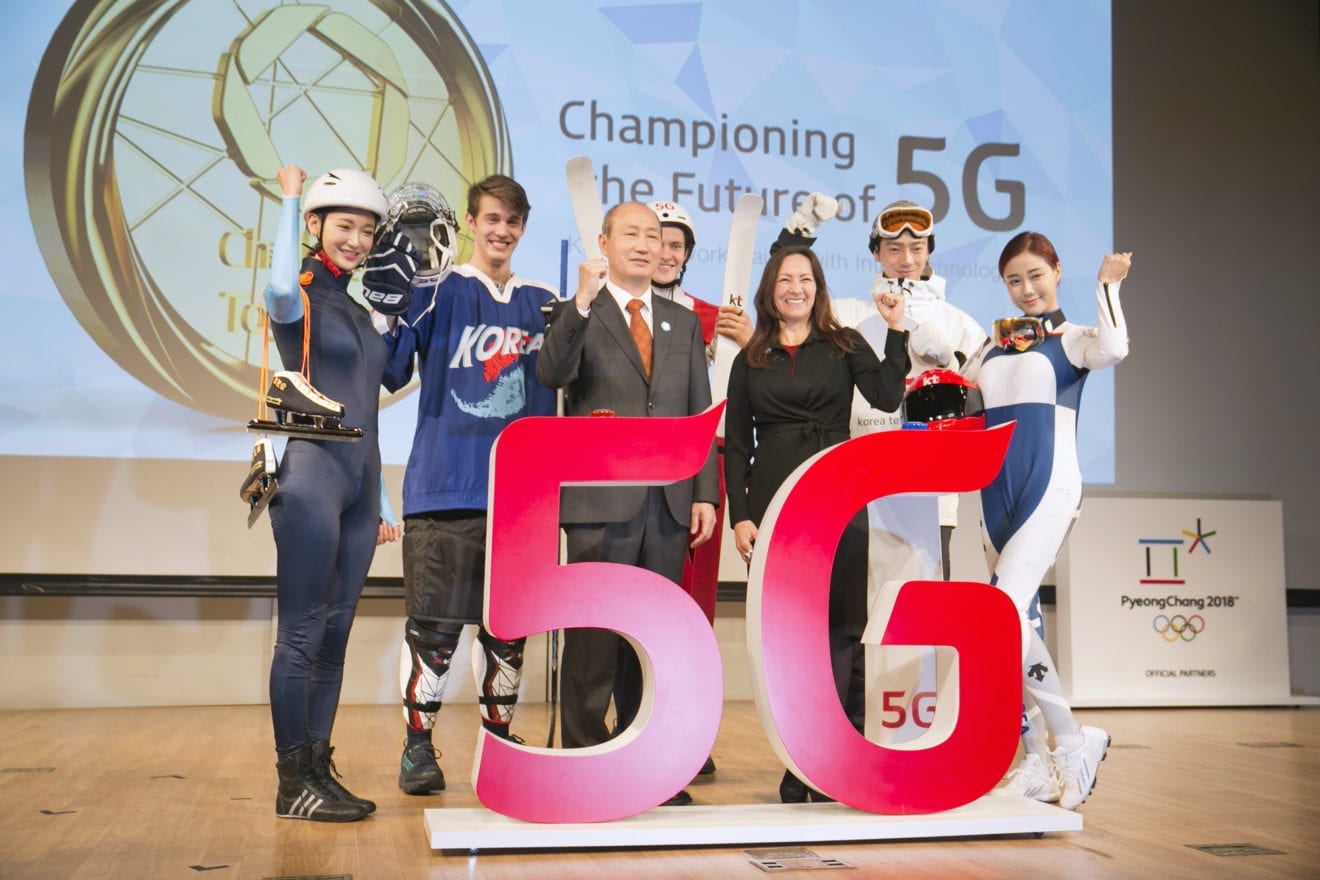
    KT plans to roll out its next-generation 5G network to users as soon as next March after its test run at the PyeongChang Olympics proved a success.

    The country’s second-largest mobile carrier said Thursday that its 5G system will offer true wireless service as opposed to fixed wireless service. Verizon is preparing to launch the first fixed wireless 5G service in the United States later this year. Fixed wireless 5G service requires the use of a router, and can only produce small networks for homes or offices.

    “We are not going to say we have commercialized a 5G network after offering fixed wireless service for homes,” said Oh Seong-mok, the head of KT’s network division, at a press briefing Thursday at the company’s Gwanghwamun headquarters in central Seoul. “We can offer fixed wireless services for those who really need them, like households in rural areas with poor network infrastructure, but it will not be our focus.”

    According to KT, the key to commercializing 5G is making sure users don’t lose connectivity as they move between the ranges of base stations which broadcast the signals.

    A KT spokesperson said that the strategies behind deploying fixed wireless 5G in the United States and Korea differ because of the two countries’ telecommunications infrastructure. The United States still has many areas without the fiber cables that enable broadband service, and laying down the cables is costly. Fixed wireless 5G could prove to be a cheap, efficient alternative, delivering high-speed internet to customers who are currently poorly served.

    KT wants to take the lead in Korea’s advanced telecommunications market by becoming the first company to provide a seamless mobile 5G network. Oh said that though its service will be first rolled out in major Korean cities, it aims to eventually create a nationwide network.

    The company is also working to set up its 5G Open Lab, a research and development center in Seocho District, southern Seoul, that will share 5G technologies with small and medium-sized businesses. KT expects to open the lab within the next few months.

    Even if KT manages to offer 5G by next March, customers will have to wait a little longer for 5G-enabled phones to hit the market. Global manufacturers are expected to launch the first 5G-capable commercial phones by the second quarter of next year.

    KT said its first customers will likely be enterprise clients that can use the 5G network on their own devices.

  • Ericsson unveils 5G small cell solution

    Ericsson unveils 5G small cell solution

    Ericsson has unveiled a new small cell solution designed to meet the indoor mobile broadband performance requirements that will be demanded by 5G.

    The new 5G Radio Dot small cell radio will support the new 5G mid-bands between 3-GHz and 6-GHz, delivering speeds of up to 2Gbps.

    The new solution is also deigned to support emerging 5G industrial applications such as connected factories, connected hospitals and connected mining operations.

    Operators will be able to deploy 5G Radio Dot next to 4G solutions using the same cabling infrastructure, architecture and locations as existing 4G Radio Dot deployments. Radio Dot systems are used in many large buildings including office blocks, shopping malls, hospitals and airports.

    “Now that first 5G standards are here, vendors are going to need multiple radio solutions to help operators roll out their new 5G networks. Ericsson takes an important initial step in this direction by adding indoor small cell 5G solutions to its already existing outdoor 5G RAN portfolio,” Ovum practice leader Daryl Schoolar commented.

    “This new indoor solution from Ericsson is going to be attractive for operators wanting to offer enterprises good indoor performance for enhanced mobile broadband and new industrial applications that can’t be met by Wi-Fi or 5G base stations deployed outdoors.”

    Ericsson head of network infrastructure Nishant Batra commented that adding small cell solutions to its 5G portfolio is a natural part of the evolution to 5G.

    “Enterprises have been asking for first-rate connectivity indoors, as well as higher speeds and capacity to serve advanced use cases that cannot be addressed by traditional indoor systems. Our 5G portfolio, bolstered by small cells, will enable operators to meet these demands,” he said.

    The 5G Radio Dot will undergo trials in late 2018 and will be commercially available in 2019.

  • Nokia wins 5G supply deal with NTT DoCoMo

    Nokia wins 5G supply deal with NTT DoCoMo

    Japan’s NTT DoCoMo has contracted Nokia to supply 5G baseband products to support the operator’s goal of commercially deploying a 5G network by 2020.

    Under the deal, Nokia will integrate its 5G new radio based AirScale hardware into Nokia’s network and further enhancing existing baseband units.

    DoCoMo and Nokia have been collaborating closely on 5G trials and have now agreed on supply of Nokia 5G baseband units to support centralized management for 5G remote radio heads, supporting the evolution of the DoCoMo network from LTE to 5G.

    “We have been collaborating with partners such as Nokia on various 5G technology and use case trials since 2014. With this agreement with Nokia, we are now proceeding to the next step to launch 5G mobile services by 2020, and accelerate co-creation of new services and businesses with vertical industry partners,” DoCoMo CTO Hiroshi Nakamura said.

    Nokia is currently focused on applying the 3GPP-compliant 5G new radio standard in customer trials ahead of expected commercial launches between 2019 and 2020. The first stage of the 5G new radio standard was published in late 2017.

  • ZTE launches 5G core product based on SBA

    ZTE launches 5G core product based on SBA

    ZTE has launched a new 5G core product based on service based architecture (SBA) and fully compliant with the 3GPP Release 15 standard from September.

    The ZTE Cloud ServCore consists of 3GPP network function services and common network function services in the control plane, and distributed media planes supporting flexible deployment and high-performance forwarding.

    These distributed planes interwork with the control plane through Packet Forwarding Control Protocol (PFCP).

    It is based on the micro-service cloud native architecture ad utilizes micro-service components, DevOps tools and containerized deployment.

    The platform uses a fully virtualized architecture decoupled from the underlying cloud platform, and supporting hardware and software acceleration.

    ZTE said it anticipates that China Mobile could adopt the technology as part of its 5G core trials. The China Mobile Research Institute has been conducting joint research with ZTE in its 5G Core Lab and has praised the design of the Cloud ServCore product.

  • Hong Kong to be one of world’s earliest adopters of 5G technology

    Hong Kong to be one of world’s earliest adopters of 5G technology

    Hong Kong will be one of the world’s earliest adopters of next generation 5G mobile broadband services, which will run 10 times faster than existing high-speed mobile internet when the technology is ready for commercial use in 2020, local officials revealed on 1 December 2017.

    The Office of the Communications Authority said the city would “grasp” 5G’s benefits after service allocation details are finalised in 2019.

    The International Telecommunication Union (ITU), a UN body, will convene the World Radiocommunication Conference in 2019 to decide global allocation of the 5G spectrum. Commercial 5G services are expected to roll out the following year.

    The current mobile broadband standard, 4G-LTE, is only capable of download speeds of 1 gigabit per second. The 5G standard is expected to have a maximum download rate of 10 gigabits per second and will have significantly less latency, giving people faster load times for content, such as for full, high-definition videos.

    Information technology sector legislator Charles Mok said once the 5G spectrum is finalised, it would be relatively simple to install on existing 4G-LTE networks, without needing to replacing entire cellular towers.

    Mok expected the 2019 conference to go smoothly because many vendors and developers were already preparing products for 5G as they had an idea which spectrums would most likely be allocated.

    “The ITU announcement will be just a formality because where the industry is going is pretty certain,” he added.

    Meanwhile, the communications authority has set up a licensing scheme for companies that wish to use wireless bands for Internet of Things (IoT) devices.

    IoT products are constantly connected to the internet, collecting data for use on other devices or for companies’ later analysis to develop upgrades or new products.

    The licence would give the government regulatory oversight of products that use wireless communications to generate, exchange and consume data. This would include smart meters, smart waste management systems and autonomous vehicles.

    Two international companies have applied for the licence, according to authority deputy director general Chaucer Leung Chung-yin, but he declined to name them.

  • DoCoMo trials 4K video streaming for cars over 5G

    DoCoMo trials 4K video streaming for cars over 5G

    NTT DoCoMo joined forces with Toyota, Ericsson and Intel on a trial of 5G technologies for automobiles, achieving data speeds of up to 1Gbps in a vehicle traveling at 30km/h.

    The trial of 4K video communications was conducted along Tokyo’s Odaiba waterfront. It involved a moving vehicle mounted with an Intel GO 5G automotive platform terminal equipped with an on-board antenna head.

    The trial environment was constructed by DoCoMo using multiple Ericsson base stations and the Cloud RAN platform. Live 4K video was streamed at data speeds of up to 1Gbps downlink and 600Mbps uplink.

    Further trials will be conducted by the four companies to test the practicality of advanced services for 5G connected cars and other applications.

    The technology will also be demonstrated at the National Museum of Emerging Science and Innovation in Tokyo from November 9 to 11 as part of the DoCoMo R&D Open House 2017.

    NTT DoCoMo parent company NTT Group and Toyota have meanwhile agreed to collaborate on the research and development of an ICT platform for 5G connected cars.

  • DoCoMo achieves URLLC with outdoor 5G trial

    DoCoMo achieves URLLC with outdoor 5G trial

    Japan’s NTT DoCoMo has claimed two new world first with recent 5G trials, including the first successful outdoor trial of 5G technologies for ultra-reliable low latency communications (URLLC).

    The trial, conducted with Huawei in the 4.5-GHz bands, involved a stationary mobile terminal receiving signals at distances of up to 1km from the base station.

    DoCoMo said the trial achieved an over-the-air latency of less than 1ms with a packet transmission success rate of more than 99.999% – both prerequisites for URLLC under 3GPP and ITU-R standards.

    These standards were achieved at distances of 0.3km to 0.6km from the base station when the terminal was moving at around 25km/h. Both tests achieved actual over-the-air latency of around 0.65ms downlink and 0.57ms uplink.

    Separately, DoCoMo conducted a joint trial with MediaTek involves using a self-developed non-orthogonal multiple access (NOMA) chipset designed to increase the spectral efficiency of mobile devices by up to 2.3 times compared to existing LTE technology.

    This marked the first 5G trial using a smartphone-sized NOMA chipset embedded device to increase spectral efficiency, DoCoMo said. The chipset also used MediaTek’s multi-user interference cancellation technology, a prerequisite for NOMA.

    Finally, DoCoMo also announced it has teamed up with Sony to conduct a joint trial involving real-time transition of HD video over 5G to Sony’s experimental New Concept Cart high-tech vehicle (see the picture below).

  • SKT steps up efforts to launch 5G earlier

    SKT steps up efforts to launch 5G earlier

    SK Telecom has accelerated its efforts to deploy 5G services earlier than expected with the demonstration of key 5G enabling technologies in a real-world setting.

    The operator has implemented a 5G relay repeater operating in the 28-GHz and 3.5-GHz 5G-candidate frequency bands at its Bundang office. SK Telecom has deployed a 5G trial network at this office.

    Using the in-building 5G relay repeater, SK Telecom was able to achieve speeds of up to 4Gbps.

    While 28-GHz spectrum has a higher potential capacity than lower-band spectrum radio waves in this band are more likely to move in straight lines, meaning they are blocked more sharply by obstacles and have significantly shorter radio coverage. This effect is particularly strong inside buildings where areas are divided by walls.

    The 5G repeater is aimed at improving the quality of indoor service, a key prerequisite for the development of a 5G service.

    SK Telecom has also worked with SK Telesys to develop an in-building relay repeater capable of delivering 5G radio signals over 3.5-GHz using a building’s existing mobile infrastructure. The station uses the existing antennas for 2G, 3G and LTE services, reducing the time needed to build an indoor network for 5G.

    SK Telecom has also demonstrated a 360-degree virtual reality video call using a tablet size device over the trial 5G network between SK Telecom’s Seoul headquarters and an area nearby.

    The demonstration was performed in the CBD and used expected 5G technologies including beamforming as well as network virtualization.

    “The success of 5G wireless communications in the real-world environment will give us momentum to accelerate our effort to roll out 5G service earlier than expected,” SK Telecom SVP and head of network technology R&D Park Jin-hyo said.

    “We at SK Telecom will continue to develop our capabilities to rollout 5G networks in order to offer differentiated services to our customers.”

  • Nokia launches 5G-ready Smart Plan Suite

    Nokia launches 5G-ready Smart Plan Suite

    Nokia has launched a new real-time charging, policy control and customer engagement suite specifically designed for advanced digital experiences.

    The cloud-native, 5G-ready Nokia Smart Plan Suite uses continuous delivery principles and DevOps automation to stay constantly updated with the latest capabilities.

    The suite is designed to allow service providers to deliver personalized and contextualized offers to enhance subscribers’ digital experiences, and can integrate with webscale offerings including Google’s Mobile Data Plan Sharing API.

    It forms part of a wider monetization portfolio covering mediation, digital sales, real-time decision making and machine learning powered analytics software. Nokiaasserts that the portfolio can help operators increase subscriber campaign take-up rates by more than 400%.

    Nokia president of applications and analytics Bhaskar Gorti said the portfolio is designed to allow operators to engage with their customers in ‘digital time’.

    “This means delivering the right service through the right channel the moment they need it. We do this by providing ‘connected intelligence’ — we connect insights, people, processes and technologies to help service providers monetize their services, push the limits of automation and delight their customers,” he said.

    “Service providers need a new approach if they are to deliver the personalized, contextualized and immediate experiences consumers have become accustomed to from leading webscale companies. Most revenue management systems in use within telcos today are monolithic in nature and weren’t designed to support such modern experiences,” Analysys Mason senior analyst John Abraham commented.

    “The industry needs to adopt a different approach, and solutions based on a cloud-native architecture such as Nokia’s Smart Plan Suite are key to helping CSPs cross the chasm in enabling a new class of innovative and engaging customer experiences.”

  • China – the world’s biggest 5G market in 2025?

    China – the world’s biggest 5G market in 2025?

    According a study conducted by GSMA Intelligence and the China Academy of Information and Communications Technology (CAICT), China is set to become the world’s largest 5G mobile market in 2025.

    The China 5G study predicts that 5G connections in China are expected to reach 428 million by 2025, accounting for 39% of the 1.1 billion global 5G connections expected by that point.

    The country’s three major mobile operators – China Mobile, China Unicom, and China Telecom – are stepping up their efforts towards 5G deployment, with plans to run a phased testing period for 5G networks from 2017 to 2019 before launching commercially in 2020.

    China Mobile, for example, early this year started conducting the first phase of its 5G field trials in five major cities across the country with Datang, Huawei, ZTE, Nokia and Ericsson. The first phase of the trial will focus on PoC system field trials this year and the operator will move to pre-commercial trials for interoperability tests in 20 sites or cities next year, said Wang Xiaoyun, general manager of technical department at China Mobile.

    The trial is expected to expand to over 100 sites or cities in 2019, before the rollout proceeds to the commercial launch stage in 2020, Wang told reporters at Mobile World Congress Barcelona in February. China Mobile has also set up what it claims is the world’s largest 5G field trial in Huairou district in northern Beijing, he said.

    Together with these partners, China Mobile has conducted trials of key technologies including massive MIMO on the 3.5GHz band, as well as carried out performance testing of mmWave spectrum on different frequency bands, such as 15GHz, 28GHz and 73GHz, said Wang.

    China Unicom and China Telecom also plans to test capacity and performance across six cities over 2017-2019 before a commercial launch in 2020.

    Chinese cellcos go for “standalone” 5G deployment

    The study further points out that the three Chinese mobile carriers are expected to deploy ‘standalone’ 5G networks, which will require the construction of new base stations to site 5G equipment, backhaul links and a core network.

    That said, 5G investment in China will follow a more gradual path compared to elsewhere in Asia and over a longer timeframe than 4G, roughly seven years, from 2018 to 2025-with capex not expected to account for more than 25% of operator revenue prior to commercial launch.

    The rate of 5G network deployment and adoption in China is also expected to be slower than it was for 4G, which Chinese operators were able to deploy rapidly earlier this decade within a mature 4G ecosystem. In their early phase, 5G networks will concentrate on boosting the capacity of 4G networks to support rising cellular data traffic demands.

    Though some services will require devices with new form factors, the smartphone is expected to remain the principal 5G interface at launch. Enterprise is considered to offer operators the largest incremental revenue opportunity. Key vertical markets for 5G applications include automotive and transport, logistics, energy and utilities monitoring, security, finance, healthcare, industrial and agriculture.
  • SKT unveils Wi-Fi tech with 5G speeds

    SKT unveils Wi-Fi tech with 5G speeds

    SK Telecom has unveiled a self-developed Wi-Fi technology capable of delivering speeds of up to 4.8Gbps.

    The Wi-Fi technology and access point  is based on the new IEEE 802.11ax standard. It can deliver speeds nearly four times faster than the 1.3Gbps achievable with 802.11ac gigabit Wi-Fi

    The technology uses four antennas to transmit data over 160 MHz of bandwidth – twice that of 802.11ac, operating in both the 2.4-GHz and 5-GHz frequency bands.

    In addition, the Wi-Fi technology supports orthogonal frequency-division multiple access (OFMDA), multi-user MIMO (MU-MIMO) and dynamic sensitivity control (DSC) technology to improve the efficiency of the network.

    SK Telecom plans to start deploying access points for the next generation Wi-Fi next year, concentrating on high traffic density areas. Handsets with chipsets compatible with 802.11ax will be able to benefit from the technology.

    The operator has constructed a Wi-Fi testbed within its R&D center in Bundang to test performance of the technology in various deployment scenarios, and is working on upgrading access points to be commercially deployable by the end of 2017.

    SK Telecom SVP and head of network R&D Park Jin-hyo said the next-generation Wi-Fi technology is expected to be an important complement to 5G networks.

    “By introducing the technology for the next generation Wi-Fi that can deliver as fast as 5G technology, we at SK Telecom have successfully laid foundation to offer better mobile services,” he said.

    “We are thrilled to work on the preparation on commercializing the technology and continue to innovate our capabilities to provide differentiated services to our customers.”

  • LG U+, Huawei validate 4G-5G dual connectivity

    LG U+, Huawei validate 4G-5G dual connectivity

    South Korea’s LG U+ has collaborated with Huawei to complete technology verification for 4G-5G dual-connectivity technology.

    The field test involved linking a 3.5-GHz base station with a 28-GHz base station to allow terminals to simultaneously connect to both, achieving a peak downlink rate of around 20Gbps.

    It involved the use of two base stations at a LG U+ 5G testbed in Seoul. The operator had already verified the technology in a laboratory environment.

    LG U+ director of 5G strategy Kim Dae Hee said dual connectivity technology will provide the foundation for 4G-5G heterogeneous networks.

    “By demonstrating ‘Dual-Connectivity’ technology, which will play a key role in multi-operation of 4G and 5G wireless base stations, we will develop various next-generation technologies to provide a 5G service.”

    LG U+ and Huawei have been collaborating on 5G development since the two companies signed a 5G collaboration agreement in July 2015. Last month, the companies completed the first phase of an urban field test of 5G over the 28-GHz band.

    The companies pledged to continue to carry out 5G technical cooperation and verification activities in advance of the planned commercial deployment of the technology in time for the 2018 Winter Olympics in PyeongChang.

  • ZTE launches total pre 5G solution

    ZTE launches total pre 5G solution

    ZTE has announced the launch of what the vendor is calling a total pre5G solution designed to allow existing 4G subscribers to experience 5G-like services.

    The solution combines 5G enabling technologies and architectures including pre5G massive multiple input multiple output (MIMO) and 4×4 MIMO.

    The pre5G portfolio also includes ZTE’s Cloud ServCore, a cloud native NFV-based 5G network functions management solution and its Cloud RAN product.

    In addition, 5G-oriented service applications including high data rate services such as ultra HD and virtual reality streaming and massive IoT applications based on narrowband IoT and enhanced machine-type communications (eMTC).

    Announcing the new offering, ZTE said 4G is expected to continue to dominate the market for up to a decade even as 5G deployments get underway. As a result, 4G network evolution and 5G rollouts will continue in tandem, so pre5G configurations will likely co-exist with full 5G deployments.

    The company said its pre5G related products and solutions have so far been deployed in more than 60 networks across more than 40 countries, including China, Japan, Austria, Belgium, Spain, Singapore, Malaysia, Thailand and Indonesia.

  • Operators stepping up preparations for 5G

    Operators stepping up preparations for 5G

    Many operators have accelerated preparations for the arrival of 5G, and are increasingly looking to the enterprise as well as the consumer market as potential customers, research from Ericsson indicates.

    A survey of operators that have publicly announced intentions to deploy 5G shows that 78% are conducting 5G trials, up from just 32% during a similar survey last year.

    In addition, 28% of the respondents plan to deploy 5G next year. Operators have meanwhile further evolved their business strategies for 5G services to extend beyond the consumer market.

    “In the 2016 survey, 90% of the respondents pointed to consumers as the main segment in their 5G business planning,” Ericsson head of 5G commercialization Thomas Noren explained.

    “This year, it is an even split between three segments and operators have identified business opportunities not only in the consumer segment but also with enterprise users and specialized industries.”

    With operators considering the consumer market to be becoming saturated, 5G planning has been more evenly distributed across specialized industry segments (58%), business users (56%), and consumers (52%).

    The industry segments considered to have the most potential include media and entertainment, automotive and public transport, with energy and utilities as well as healthcare being considered other attractive potential markets.

    The survey also found that a clear majority of operators believe that the IoT will play an important role in the 5G ecosystem.