Tag: Alibaba

  • How China’s Alibaba spends $18 billion investing in companies

    How China’s Alibaba spends $18 billion investing in companies

    The Chinese e-commerce giant acquired eight companies and invested in 15 overseas businesses in 2015.

    Alibaba Group Holding Ltd. is not just an e-commerce company that can create $14 billion in online sales in 24 hours. With near-constant investments, the Hangzhou-based company has evolved into a business empire, aiming to serve more consumers beyond its current 400 million active users.

    Alibaba spent about $18.3 billion to invest in 65 companies, including acquiring eight companies and investing in 15 overseas businesses, according to China-based market data company IT Orange.

    Alibaba’s major investment sectors are e-commerce, entertainment, finance, enterprise solution & technology, and online to offline, according to IT Orange. In China, O2O or online to offline, refers to a way for Internet companies to develop mobile apps that connect local services, such as a dry-cleaner, with online users.

    Alibaba continued to invest in the technology vendor sector, but total spending in this sector was still small, IT Orange says. Alibaba also reduced investments in healthcare and travel companies in 2015, compared with 2014.

    Alibaba in 2014 invested in 40 companies by spending more than $17 billion, including stakes in two healthcare companies and two travel companies, according to IT Orange.

    Those 65 companies—including Chinese ride-hailing app Kuaidi, travel site Wanzi.com, Hong Kong-based newspaper South China Morning Post, China-based shipping company YTO Express and Chinese film studio Bona Film Group—operate in various industries but could help Alibaba build a more diversified business to offer more services more efficiently.

    “Alibaba has been a giant online corporation with diversified businesses ranging from marketplaces, retail and payment to travel, entertainment, transportation and other businesses. Alibaba doesn’t need to focus (on one) as it knows all those industries from its home market,” Ralf Gladis, founder and CEO of payment firm Computop Inc., tells Internet Retailer.

    Take YTO as an example. YTO says its shipping network covers 2,300 Chinese cities and about 43% rural villages. The company says the partnership with Alibaba helps it improve efficiency and expand into rural areas and global market. The company says it delivered 3.3 billion parcels in 2015, compared to 2.1 billion in 2014. 70% parcels delivered by YTO were generated by e-commerce orders and about 70% of those e-commerce parcels came via Alibaba Group businesses.

    In 2015, YTO reduced delivery time by investing more in air transportation. The company purchased three Boeing B737-300 airplanes to further reduce some cross-province delivery times from three days to one day. YTO also worked with many regional shipping companies to build an international network that covers eight countries, including Japan, Korea and Germany.

    YTO says Alibaba’s support also includes data and information. Alibaba sends feedback from online shoppers to YTO so the shipper can find and fix the problem faster than before.

    In 2015, Alibaba increased its strategic investments in 20 large companies. Some investments have topped several hundred million dollars, including investing in The Postal Savings Bank of China; Suning Commerce Group, No.3 in the Internet Retailer 2015 China 500; and Chinese smartphone maker Meizu, No. 168.

    Alibaba also acquired eight companies, including the Chinese version of YouTube, Youku.com. Youku.com says videos played on its site have topped 600 million times per day in 2015. Alibaba bought Youku.com for $4.67 billion.
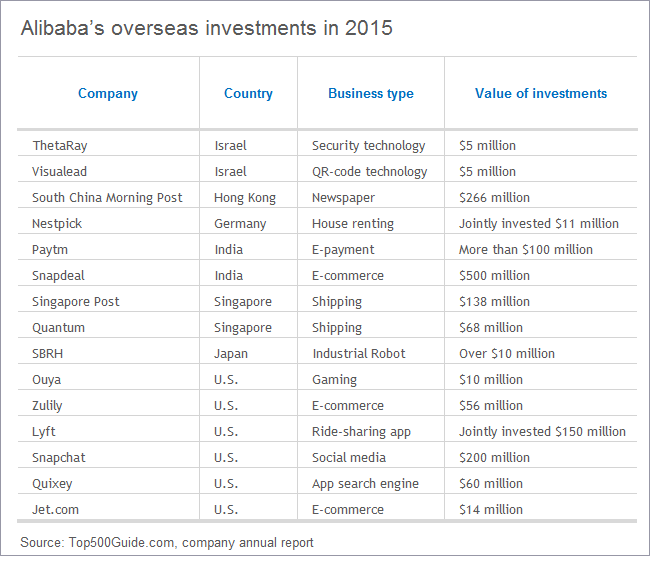
    Alibaba’s 15 overseas investments in 2015 mainly focus on e-commerce, entertainment and technology. IT Orange estimates Alibaba spent about $2.5 billion for stakes in those companies, including e-commerce companies Jet.com and Zulily.com.

    Alibaba declined to confirm the information from IT Orange but says the company may have invested in more than 65 companies in 2015 because it also invested in many small startups.

    Alibaba’s investment goal is to learn the best practices from others and then use them to improve its operations in China and global markets, according to Alibaba’s IPO filing document.

    “Alibaba is just trying to get insight into the next big thing with the goal of eventually importing the tech back home where they have the world’s largest Internet audience. They’re investing in U.S. companies because this is where tech innovation is happening,” Laura Swanson, senior consultant at omnichannel consulting firm FitForCommerce, tells Internet Retailer, “Essentially they’re giving themselves a front-row seat to watch these companies so that by the time certain products or services reach China, Alibaba will have the control.”

    Alibaba already leads in some areas. “Alibaba is not only bigger than Silicon Valley companies, it is also more innovative in many areas. Working with both PayPal and Alipay, we know by experience that Alipay is far ahead of PayPal when it comes to payment innovations. For instance, Alipay customers can use their (mobile) wallet in many bricks-and-mortar retail stores, and they get excellent services including hassle-free tax-return services when they shop abroad,” Gladis says.

    By investing in U.S. e-commerce companies like online marketplace Jet.com, Alibaba could understand consumer behavior on both ends of the world to help U.S. merchants selling to Chinese consumers as well as help Chinese merchants selling to U.S. consumers, Gladis says.

    For more Chinese e-commerce data, please click here for Internet Retailer 2015 China 500.
  • Cross-border deals, connected shoppers, and mobile payments

    Cross-border deals, connected shoppers, and mobile payments

    Black Friday, the day after the Thanksgiving holiday in the US (celebrated on the fourth Thursday in November), and Cyber Monday, the first Monday after Thanksgiving, mark the start of the year-end holiday shopping season.

    Figures from the United States National Retail Federation shows that over 151 million consumers made purchases online and in physical stores during the most recent Black Friday and Cyber Monday shopping seasons.

    The trend, however, is becoming global. In Asia, where connected shoppers are constantly searching for the best deals, often crossing physical and geographical boundaries, Black Friday and Cyber Monday have been integrated into the retail experience. This, despite the popularity of China’s own Single’s Day online shopping festival that is also being adopted by many retailers across the region.

    Warren Hayashi, President, Asia-Pacific, Adyen, said this is partly due to the growth of cross-border e-commerce, which is giving Asian consumers access to both US and European retailers, who market Black Friday and Cyber Monday promotions in the region and ship to Asia.

    The trend has also been driven by the growing reach of US e-commerce giants like Amazon, which has meant that e-commerce companies based in other markets, such as Lazada, Qoo10, Rakuten, Alibaba, and Zalora, are rolling out similar promotional periods.

    “An interesting effect of this trend is that rather than adversely affecting transactions during the non-promotion period, we are seeing that seasonal shopping promotions actually expand the size of the market. They provide consumers with even more opportunities to shop,” he explained.

    Ayden’s data shows that in Asia, sales volumes increased by 170 percent in a year-on-year comparison over the course of the Black Friday weekend. Meanwhile, shoppers in China spent twice the amount during Black Friday 2015 as compared to the same period in 2014. In Japan, the average transaction value increased by 50 percent.

    Interestingly, the payments industry for online and offline retail is also innovating to keep up with these developments in the retail scene. Ayden sees that companies are also going global with a payments first approach.

    “For example, we have Asian merchants expanding into Europe with their English-language website and local payment methods, such as iDEAL in the Netherlands (which accounts for over 60 percent of transaction volume in that market), SOFORT in Germany, and so on,” Hayashi shared.

    “Likewise, we have global customers selling in Asian markets from their global website, but offering targeted payment methods such as Alipay, which are dynamically offered at the checkout stage according to the shopper’s geographical location. This is a huge opportunity for retailers to expand globally,” he added.

    Interestingly, he said one of the most innovative payments technologies that is changing the user experience is the zero-click transaction – which takes place in the background, without any action required by the customer. An example is how Uber is accepting payments.

    “When passengers take an Uber, they do not need to take any specific action for the payment to be made, everything happens in the background. This kind of frictionless connectivity brings businesses closer to their customers and will spread rapidly,” he explained.

    In 2016, Hayashi sees the retail landscape in the region as going more on mobile, especially in the area of payments.

    Citing Ayden’s own data – tracked quarterly through the Mobile Payments Index – shows that Asia-based payment methods such as Alipay, UnionPay, and JCB have among the highest proportions of mobile payments globally.

    “With everything they do around payments, retailers should simply be asking themselves, how does this improve the customer experience? One key goal should be to provide a frictionless payment experience across channels,” he said.

    “For mobile, along with optimizing the size of the page, many merchants find that a “less is more” approach drives conversion increases, with page layout minimized to ensure the smoothest possible payment flow,” he continued. “It’s also important to remember that the checkout stage of the shopper should be the beginning of an on-going relationship with the consumer. Merchants that have created a frictionless checkout experience, regardless of the channel, see sustained increases in their repeat customers and purchases.”

  • Alibaba Beats, Changyou Beats on Earnings

    Alibaba Beats, Changyou Beats on Earnings

    Markets experienced another volatile week, gaining and losing on alternate days ahead of the Lunar New Year holidays next week. The Shanghai Composite Index declined on Monday after the official purchasing managers index suffered its sixth consecutive monthly fall. The benchmark index increased on Tuesday, moving up 2.3% after the People’s Bank of China moved to raise liquidity in the financial system.

    The Shanghai Composite Index moved lower on Wednesday as investors turned cautious and oil prices declined heavily. The benchmark index increased 1.5% on Thursday closing at its highest level since Jan 25.

    Alibaba Group Holding Ltd. reported third-quarter fiscal 2016 (ended Dec 30, 2015) earnings of 73 cents per share, which exceeded the Zacks Consensus Estimate of 70 cents. Changyou.com Ltd. reported adjusted fourth-quarter 2015 earnings of 73 cents per share, which exceeded the Zacks Consensus Estimate of 54 cents.

    Last Week’s Developments

    Last Friday, the Shanghai Composite Index surged 3.1%, reducing its monthly loss to 23%. Despite the day’s gains, the decline for the month was the worst since Oct 2008. Stocks moved up for the first time in four days following speculation that the worst selloff in over a month was excessive in nature. Industrial and financial stocks led gains.

    Additionally, China’s central bank announced it will undertake open market operations on every working day around the Lunar New Year holiday. The number of these operations will be increased from their normal biweekly pace to increase liquidity in the banking system ahead of the holiday. This statement also boosted stocks.

    The CSI 300 added 3.2%. A gauge of brokerages and banks increased 3.2%. A measure of industrial shares increased 3.6%, the highest among the 10 industrial sectors. The Hang Seng increased for a third day, moving up 2.5%. The Hang Seng China Enterprises Index increased 2.7%. The H-share index increased after the Bank of Japan lowered interest rates into the negative zone in order to stimulate its flagging economy.

    Markets and the Economy This Week

    The Shanghai Composite Index declined 1.8% on Monday, increasing January’s selloff. The official purchasing managers index declined to 49.4, the sixth consecutive monthly fall. This is the lowest level experienced in three years. Additionally, the country’s most established companies issued warnings about a fall in earnings.

    Among other economic reports, official non-manufacturing PMI fell from 54.4 in December to 53.5 in January. In contrast, Caixin China Manufacturing PMI increased from 48.2 to 48.4 in January.

    The CSI 300 declined 1.5%. A sub index of energy stocks declined 2.8%, emerging as the largest decliner among the 10 industry groups. PetroChina Co. lktglost 2.8% after stating that falling crude and gas prices would hurt full year earnings.  The Hang Seng declined for the first time in four days, falling 0.5%. The Hang Seng China Enterprises Index moved down 1.2%.

    The benchmark index increased on Tuesday, moving up 2.3% after the People’s Bank of China moved to raise liquidity in the financial system. The central bank injected 100 billion yuan ($15 billion) into the country’s banks via reverse repurchase agreements ahead of the new year holidays.

    Tech and industrial stocks led gains. A measure of tech stocks rose to its highest level in seven days. The CSI 300 advanced 2.1%. All of its sub-indexes increased while measures of tech and industrial stocks increased by a minimum of 2.7%.  The Hang Seng declined 0.8% The Hang Seng China Enterprises Index moved down 1.1%.

    The Shanghai Composite Index lost 0.4% on Wednesday as investors turned cautious and oil prices declined heavily. A measure of energy stocks declined 1.6% as oil prices moved to around $30 a barrel following the steepest two day decline in seven years. PetroChina declined by 1.4% in Shanghai and lost 4.2% in Hong Kong.

    Positive economic data provided little comfort to investors. The Caixin China Services PMI increased to 52.4 in January from 50.2 in December. This was the highest level witnessed since July. A measure of energy stocks declined 1.6% due to the drop in oil prices.

    A sub-index of property stocks increased 0.4% on the Shanghai exchange. This was primarily due to the central bank’s decision to reduce down payments on mortgages for first time home buyers. The CSI 300 declined 0.4%. The Hang Seng fell for a third successive day, declining 2.3%. The Hang Seng China Enterprises Index sank, losing 2.5 percent, to its lowest point in more than a year.

    The benchmark index increased 1.5% on Thursday closing at its highest level since Jan 25. Commodity stocks surged and the People’s Bank of China intensified its efforts to reduce shortage of cash before markets close for the new year holidays. A gauge of energy stocks moved up from record low levels following the longest rally in crude futures in nearly two weeks.

    The central bank pumped 80 billion yuan ($12 billion) into the monetary system utilizing reverse repurchase agreements lasting 14 days. This open market operation is part of the monetary authority’s efforts to control rising borrowing costs even as capital outflows and demand for funds rise.  Meanwhile the People’s Bank of China increased yuan fixing by the highest extent in two months.

    The CSI 300 added 1.2%. A sub-index of material stocks within the CSI 300 gained 2.8%, the highest among its industry groups. PetroChina gained 0.6% during the session. The Hang Seng China Enterprises Index rebounded, moving up 1.5%.

    Stocks in the News

    Alibaba Group Holding Limited reported third-quarter fiscal 2016 (ended Dec 30, 2015) earnings of 73 cents per share, which exceeded the Zacks Consensus Estimate of 70 cents. The adjusted figure excludes one-time items but includes stock-based compensation expense.

    Alibaba reported revenues of RMB34.54 billion (US$5.3 billion), up 55.8% sequentially and 31.9% year over year, driven by strong mobile revenues. Also, revenues surpassed the Zacks Consensus Estimate of $5.08 billion.

    Total China retail marketplaces GMV came in at RMB964.0 billion (US$149.0 billion), up 23% year over year. China retail marketplaces had 407 million annual active buyers in the 12-month period ended Dec 31, 2015, representing a 22% year-over-year growth.

    Mobile GMV was RMB651.0 billion (US$101.0 billion), a 99% year-over-year surge. Mobile GMV accounted for 68% of total China retail marketplaces GMV as against 62% last quarter and 42% in the previous year. Mobile MAUs grew to 393 million, improving 48% year over year, driven by increased promotion of mobile apps.

    Changyou.com Ltd. reported adjusted fourth-quarter 2015 earnings of 73 cents per share, which exceeded the Zacks Consensus Estimate of 54 cents. This was also a significant improvement over earnings of 21 cents per share reported in the same period last year. However, this was lower than the adjusted earnings of $1.55 cents reported in the third quarter of 2015.

    Changyou.com reported revenues of $162 million, down 14% from third quarter 2015. Additionally, revenues declined 25% compared to the same period last year. Revenues from online games came in at $127 million, falling 31% on a year-over-year basis.

    For fiscal year 2015, Changyou.com reported revenues of $762 million, an improvement over 2014’s figure of $755 million. Revenues from online games came in at $637 million, declining from $652 million reported in 2014. .

    TAL Education Group reported adjusted third-quarter 2015 earnings of 12 cents per share, in line with the Zacks Consensus Estimate. This is marginally lower than the 13 cents reported in the year-ago period. However, this is significantly lower than the adjusted earnings of 72 cents reported in the second quarter of 2015.

    TAL Education Group reported revenues of $142.2 million, representing a 43.1% increase over the same period last year. However, revenues declined significantly from the $173 million reported in second quarter 2015.

    For the nine months ended Nov 2015, TAL Education reported revenues of $ 444.9 million, which represents a 43.2% improvement on a yearly basis. During this period, total student enrollments increased by 53.4% on a yearly basis.

    JD.com, Inc. has inked an agreement with DHL per which they will collaborate across a number of cross border supply chain activities. These initiatives will utilize each company’s unique capabilities, of ecommerce and logistics and widen their existing relationship.

    Earlier, in July last year the two companies had revealed that DHL was becoming the preferred logistics service provider for delivery of certain orders made on the Chinese ecommerce giant’s U.S. Mall. The agreement related to deliveries would pertain to those products delivered to China as well as across that country.

    DHL will be the preferred logistics provider for JD.com’s International Business Group per the terms of the new agreement. This unit concentrates on consumers placing orders from outside China. Further, JD.com will now be a strategic customer per the Fast Growing Enterprises initiative of DHL. This will provide the ecommerce company access to a number of logistics solutions from all of DHL’s business units.

    CNOOC Ltd. said it has started production at two offshore projects. These are the Weizhou 12-2 oilfield joint development project and the Weizhou 11-4 North oilfield Phase II project. Both of these projects are located in South China Sea’s Beibu Gulf Basin.

    With an average water depth of around 36 meters, the Weizhou 12-2 project has three oilfields. Production facilities include three wellhead platforms, including 18 wells on all of which production has started. Total production has touched a daily rate of 16,000 barrels, achieving the peak production of its overall developing plan.

    The Weizhou 11-4 North Project’s average water depth is around 40 meters. It has two wellhead platforms and 15 producing wells. At present, one well is producing oil at a daily rate of 500 barrels and is projected to touch peak production of 8,000 bpd by end 2016.

    Performance of Most Actively Traded US-Listed Chinese Stocks                              

    The table given below shows the price movements of 10 Chinese companies with the highest three-month average trading volume on U.S. exchanges. Price movements over the last five days and during the last six months have been included.

    Ticker Last 5 Day’s Performance 6-Month Performance
    BABA -9.2% -19.6%
    JD -7.2% -30%
    VIPS -6.4% -41.3%
    CTRP -5% +1.6%
    SFUN -5.3% -19.2%
    BIDU -5.5% -10.1%
    YOKU -0.1% +41.3%
    JMEI -8% -67.9%
    QIHU -0.8% +12.4%
    TSL +1.2% +4.6%


  • Alibaba Group conquers China slowdown

    Alibaba Group conquers China slowdown

    Going into this quarter the main concern for Alibaba was that a slowdown in Chinese economic growth would damage its performance.

    Fortunately, this has not materialised with very solid uplifts in its Chinese retail marketplace proposition underpinning a respectable 32 per cent rise in overall revenues.

    Some of this uplift was undoubtedly aided by the company’s very strong performance over the Singles Day shopping festival in November. During this time, it attracted over 115 million visitors to its marketplaces and processed some 467 million orders across all of its platforms during a 24-hour period. The fact that its systems and infrastructure coped well with this volume, which is around 10 times more than the usual daily average, is a testament to Alibaba’s technological prowess, especially in areas like cloud computing.

    This focus on technology is also helping Alibaba to understand the habits and preferences of Chinese consumers as they browse and navigate the group’s various sites, news feeds, and entertainment options. This understanding puts Alibaba in a prime position when it comes to helping Western brands expand into China. In many ways Alibaba and its marketplaces are the ideal conduit through which foreign retailers can target and reach appropriate audiences. In our view this remains one of the main sources of commercial advantage for the company.

    Despite its success at home, Alibaba has struggled to gain traction in already established markets like the US. While this was once a stated ambition, and perhaps remains a long term goal, it is clearly not the main agenda for the year ahead. Indeed, over the latest quarter the proportion of revenue from international operations shrunk by 1 percentage point and the growth rate of 17 per cent, while respectable, was well below that of the Chinese operation.

    As much as this will no doubt come as a relief to many Western retailers, it is the right decision. Despite its dominance in the country, Alibaba’s growth potential in China remains enormous – especially as it expands operations into more rural areas. As such, chasing lower margin, profit eroding international gains for the sake of vanity makes little sense.

    That noted, over the longer term Alibaba would like to become more international. The route it will take, however, is likely to be one of investing in, and partnering with, local players in order to grow its share and presence. The company clearly has the financial muscle to undertake such corporate activity and we expect to see more of this in 2016 and the years beyond.

  • China’s Alibaba seeks sporting gold

    China’s Alibaba seeks sporting gold

    Chinese e-commerce giant Alibaba is looking to turn its hundreds of millions of users into sportsmen as it seeks to cash in on the country’s growing sporting market, an executive said.

    The comments by Zhang Dazhong, chief executive of its Alisports unit, come as Chinese football clubs rank second only to English in spending during the winter transfer window and President Xi Jinping harbours dreams of winning a World Cup, and with the country set to host the 2022 Winter Olympics.

    Alibaba, which owns a 37 per cent stake in Asian football champions Guangzhou Evergrande Taobao, launched Alisports in September to develop the sporting economy in “an innovative way with digital thinking”, according to its website.

    “Alibaba would like to convert their nearly 500 million people or users into sportsmen and to utilise its strengths to help them,” Zhang told Hong Kong’s South China Morning Post newspaper.

    “Consumption power in China is huge and gigantic — the consumption of sport is about to burst in China,” he said.

    Alibaba in December agreed to buy the English-language newspaper in Hong Kong for USD 266 million.

    In the months since its establishment, Alisports has signed deals to stream NFL American football games in China, sponsor FIFA’s Club World Cup, and partnerships with both world amateur boxing body AIBA and the governing organisation for basketball FIBA.

    Zhang also met with football agent Jorge Mendes and his client, former Chelsea manager Jose Mourinho, in Shanghai last month to discuss partnerships, the SCMP said.

    adidas-Women_running

    The Chinese government said in 2014 that it aimed to grow the country’s sports market to more than five trillion yuan (USD 760 billion) by 2025 to become “a vital driver for sustainable economic and social development”.

    Many Chinese companies are seeking to ride the wave, with high-profile deals including property behemoth Wanda’s acquisition of Swiss sports marketing group Infront and a share of Spanish football club Atletico Madrid, as well a consortium led by state-backed China Media Capital buying a USD 400 million stake in Premier League giants Manchester City.

    But Zhang told the SCMP that Alisports would prefer to sponsor a big league as a whole: “It’s not our direction to buy a club or team, but to create a platform for clubs and teams.”

    Alibaba’s sports drive can help modernise the industry in China and fulfil Xi’s hopes for the country to qualify for a World Cup, host one and win one, he added.

    “I believe the World Cup will definitely come to China sooner or later. With the emergence of Alisport (that) dream… will come even earlier,” the paper quoted him as saying.

  • Alibaba and Amazon China gear up for the Chinese New Year

    Alibaba and Amazon China gear up for the Chinese New Year

    Feb. 8 will be the most important holiday this year in China, as it marks the Chinese New Year. Family members will come together to celebrate with holiday feasts and most workers will enjoy a one-week vacation, many returning to their rural homes from big cities for the festivities. A lack of delivery personnel during this period is leading many sellers on China’s biggest e-commerce marketplaces to shut down, but Amazon China says it will keep delivering in big cities.

    Many merchants on Alibaba Group Holding Ltd.’s marketplaces Taobao and Tmall have announced that they will stop taking orders Feb. 4-Feb. 14 because shipping companies are unable to deliver orders.

    But Alibaba, whose online marketplaces account for more than three-quarter of online retail purchases in China, organized a major promotion in advance of the New Year’s vacation, the Ali Chinese New Year Shopping Festival, which lasted from Jan. 17-23.

    Alibaba reports consumers purchased 2.1 billion holiday items from its websites during the sale, mostly food and gifts. 15% of the orders came from rural residents, a focus of the promotion, and sales at the 12,000 Taobao service centers in rural areas were 331% higher than average, the company says.

    “By hosting this online shopping event, we enabled rural customers to access an extensive range of New Year goods from home and abroad, while making agriculture products from rural China more available among urban customers.” Alibaba Group CEO Daniel Zhang said at the event kickoff meeting.

    Meanwhile, Amazon China, No. 5 in the Internet Retailer 2015 China 500, says it will continue to fulfill orders during the holiday period in 20 big Chinese cities, including Beijing, Tianjin and Shanghai. In fact, the largest overseas e-retailer operating in China says it will extend delivery hours to midnight during the holiday in order to allow Chinese online shoppers to get their orders on time.

    Amazon China operates 13 fulfillment centers in China and employs its own fulfillment staff. The subsidiary of Amazon.com Inc. offers same-day delivery in 123 Chinese cities and second-day delivery in over 1,400 Chinese cities and towns.

    For a fuller report on the openings for foreign companies to sell online in China, see “Open Door Policy” in the November 2015 issue of Internet Retailer magazine.

  • Alibaba Beats Profit, Sales Estimates on Rural China Push

    Alibaba Beats Profit, Sales Estimates on Rural China Push

    Alibaba Group Holding Ltd. beat analysts’ estimates for revenue and profit after an online-sales extravaganza and expansion into rural China helped the nation’s biggest e-commerce operator defy a slowing economy.

    Sales rose 32 percent to 34.5 billion yuan ($5.2 billion) in the three months ended December, the company said Thursday, compared with the 33.2 billion-yuan average of estimates compiled by Bloomberg. Net income more than doubled to 12.5 billion yuan, topping estimates of 10.3 billion. Shares rose more than 5 percent in premarket trading in the U.S.

    Record revenue during November’s annual “Singles’ Day” promotion drove transaction growth as Alibaba captured more sales from mobile e-commerce, which is replacing shopping from computers. Billionaire Chairman Jack Ma is trying to tap the spending power of the countryside with the Internet expected to blanket all of rural China by 2020, according to the China Academy for Rural Development at Zhejiang University.

    “Alibaba continues to grow as urbanization and an ever more ambitious middle class continues to drive up China’s cost of living and consumption,” said New York-based Brian Buchwald, chief executive officer of Bomoda, a consumer intelligence company with a focus on the Chinese market. “At the heart of it, is continued investment in mobile and simplifying payments for virtual and actual purchases.”

    Mobile Monetization

    Longer-term, Ma is investing in video content, media, on-demand services and cloud computing to generate new sources of income as he takes the e-commerce company global. Shares of Alibaba closed Wednesday at $69.54 in New York. The stock has declined 14 percent this year after a 22 percent slump in 2015.

    Gross merchandise volume in its China retail marketplaces rose 23 percent to 964 billion yuan in the quarter, while mobile GMV almost doubled to 651 billion yuan.

    More than half the purchases through Alibaba’s e-commerce platforms were done from mobile devices. While it’s crucial that Alibaba serve the growing ranks of consumers acquiring a taste for shopping through smartphones and tablet computers, smaller mobile screens typically generate less advertising revenue.

    “Alibaba is on track to gain more shoppers in rural areas and smaller cities in China,” said Li Yujie, an analyst at RHB Research Institute Sdn in Hong Kong. “The sales promotion in November also gave the company a boost.”

    The Nov. 11 Singles’ Day promotion logged a record 91.2 billion yuan in sales, a 60 percent increase from the year earlier. A third of buyers made purchases from merchants and brands outside of China during the one-day event.

    Overseas Push

    Ma has set a goal of getting 50 percent of the company’s revenue from beyond China with Michael Evans, a former Goldman Sachs Group Inc. partner, named president in August to lead the global push.

    Cloud computing revenue rose 126 percent to 819 million yuan, Alibaba said. Its AliCloud unit is staking $1 billion on the belief that demand for processing and storage from governments and companies will boost growth during the next decade as its tries to compete with Amazon.com Inc. in computing services. It plans to work with Nvidia Corp. on services and artificial intelligence, recently opened a second U.S. data center and plans its first in Europe this year.

    Alibaba is also expanding in the online-to-offline services market. Tencent, Alibaba and Baidu Inc. are competing for supremacy in a local-services industry primed for growth as more people turn to their smartphones or the Web to order food, schedule beauty treatments or hire domestic helpers. Users of those services could rise 29 percent to 400 million by next year, with sales expected to reach 7.28 trillion yuan by 2017.

    Last year, the company backed the merger of Didi and Kuaidi to create China’s biggest ride-hailing application.

    Investors have highlighted escalating scrutiny about the sale of counterfeits on its websites, such as Taobao Marketplace, as a key risk for 2016. Though the company has said it’s committed to combating fakes, cleaning up its image next year is crucial to Alibaba’s goal of winning the trust of merchants and shoppers overseas.

    In December, the U.S. Office of the Trade Representative warned the company it had to do better to stay off the “Notorious Markets” blacklist it escaped only in 2012. The federal agency issued a stern warning that Alibaba’s efforts to fight piracy and respond to complaints would be monitored in the coming year.

  • Competition that hit Alibaba down

    Competition that hit Alibaba down

    Alibaba appears to be facing increasingly stiff competition from rival JD.com, which like Alibaba has worked to boost sales from foreign retail companies in China. While Alibaba has talked in recent months of the potential of reaching consumers in rural China, JD.com has focused on reaching the more affluent shoppers in urban areas.

    While it’s true that e-commerce is increasingly important in more remote areas of China, income there remains low, as does spending, and China’s recent economic turmoil is likely slowing down growth.

    In addition to its focus in more rural areas, Alibaba continues to face problems over sales of counterfeit items, more so than JD.com, an issue of increasing important not just to retailers abroad and the U.S. government, but also to wealthier Chinese shoppers.

    And JD.com enjoys a positive, Amazon-like reputation for fulfillment.

    “[JD] have faster shipping speeds, and the quality is more trustworthy,” Zoe Li, who works at a tech start-up in Beijing.

  • Hong Kong Indian entrepreneur out to build ‘the next Alibaba’ in Mumbai

    Hong Kong Indian entrepreneur out to build ‘the next Alibaba’ in Mumbai

    Akanksha Hazari’s parents were relieved when she announced in 2013 that she was moving to Mumbai on her own.

    “After Palestine, India was fine,” says her mother, Anjali. “Akanksha wanted to go to Africa originally, but her father and I managed to convince her that it was probably not a good idea.”

    Home for the 32-year-old former Middle East strategist turned star technology entrepreneur is Hong Kong, the city she moved to with her Indian parents when she was eight. She attended West Island School,and became so good at squash she was selected to play for Hong Kong in her teens.

    “For me, Hong Kong is very much home … I am an Indian-Hong Kong girl,” she says.

    Hazari is the founder of m.Paani, a phone-based customer loyalty platform that helps to bring together small retailers andconsumers in emerging markets.

    It may sound esoteric, but as she explains in her parents’ Mount Davis flat, this is just the first step in building a global business that can help the world’s underserved “offline” population access important services from which they have been excluded. In short, she wants m.Paani to be the next Alibaba.

    Her ambition is matched by an iron will that has seen her take on a large American charity co-founded by Hollywood star Matt Damon, and win.

    In 2010, Hazari was studying for an MBA at Cambridge University and formed a team to enter an annual competition for business students run by the Hult Prize Foundation. That year, participants were asked to submit business plans that could help address water scarcity issues, and Damon’s Water.org was brought in as an adviser. Hazari’s team came up with m.Paani (paani means water in Hindi), a mobile phone-based customer loyalty programme that encourages the supply of clean water to low-income families in India. When they won, Hazari – the only team member who wanted to launch the start-up for real – asked for the US$1 million prize money she believed they had been promised. Water.org, however, was under the impression that the US$1 million was going to its own projects.

    Our goal was to support Hult in its efforts to teach about the urgency of this issue among students and the need for innovation,” writes Rosemary Gudelj, the charity’s senior manager, global advocacy and office of the CEO, in an email. “However, we also knew that these students only had two months to develop ideas. While we were hopeful that the winning case or other cases would be actionable by Water.org, we clearly were not comfortable committing to implementing the winning idea.

    “When [Hazari’s] team won, we offered to have her and her team work with Water.org on looking into and developing the group’s idea to probe further, and see how this concept could be applied to local needs and circumstances. However, her request was to receive the full US$1 million grant to fund the organisation she launched.”

    In the end, Water.org kept the US$1 million and the Hult family gave Hazari a separate grant of US$300,000 that allowed her to widen m.Paani’s business.

    “At the time, Hult Prize thought it a better strategy to partner with a non-government organisation to help the winners manage and deploy the prize capital, rather than to directly give the money to a young student team. But once the US$1 million was transferred to Water.org, they kept it. That’s why I couldn’t start m.Paani straight away. It took me two years to get the money, which Philip Hult privately gave me,” says Hazari.

    That tenacity helped her secure most of the funding she needed to set up the business in Mumbai around 18 months ago. Today, the loyalty point network has around 200 merchants and 10,000 customers.

    “Think of it as something like air miles or credit card points. You earn points when you buy your groceries at your neighbourhood m.Paani corner shop. The shopkeeper taps in your mobile phone number – that’s your m.Paani account number – and your point balance is updated in real time,” says Hazari. The points can be used to pay for items or to redeem practical gifts from the m.Paani gift shop: water filters, English language textbooks or small appliances, for example.

    While m.Paani has a social agenda – to leverage the often-neglected purchasing power of lower-income households and to boost the competitiveness of small, independent retailers that make up about 70 per cent of India’s US$600 billion a year retail market – it is very much a for-profit business.

    It makes money by charging shop owners a commission for each transaction recorded. In return, previously offline mom-and-pop shops get a customised website, mobile app and digital transaction histories, and a consumer database.

    The latter is key to Hazari’s ultimate goal: for m.Paani to become a “big data” player. The idea of data collection may be anathema to many internet users concerned with privacy, but she says those who do not have any data to offer get left behind.

    “These shopkeepers tend to write everything down in a notebook. They can’t get insured, or apply for a bank loan, because there is no data about their business,” she says.

    The same goes for the customers. Without any credit history, they are not likely to get bank loans or access other financial services. From this year, m.Paani will start scoring individuals and businesses on their creditworthiness, a first step in utilising their shopping records.

    Hazari says small retailers with no online presence will struggle to compete against the growing presence of international chains such as Wal-Mart and Tesco as India gradually liberalises its retail sector. Online giants such as Amazon are also expanding aggressively in India. Issuing loyalty points helps rope in their customers.

    The next step for m.Paani is to go national, and eventually spread to Africa and Southeast Asia.

    “I want to build an Indian company that’s international,” she says. “For me there’s a lot of pride in that. Why can’t the next Google come out of India? That’s why Alibaba is such an exciting company. It’s the first company to do that out of our market.”

    After earning a degree in politics and Middle Eastern studies from Princeton, Hazari worked for the Aspen Institute, encouraging Israeli and Palestinian joint business ventures as a way to promote peace. It meant living in Jerusalem and crossing the border every day to manage operations such as a hospital and a power plant in Gaza.

    “Her time in the Middle East meant months of sleeplessness for me,” says her mother. “But I’m very proud of her.”

    After two years,Hazari decided that business had a lot of power to change people’s lives and immersed herself in the corporate world, becoming a consultant in clean energy at Booz & Co. in the US and Dubai. That was followed by a year of designing environmentally sustainable services and information technology applications to help rural Indian families, and then the MBA in Cambridge.

    Hazari’s parents had settled in Hong Kong so that their children could have access to better education, and a better quality of life (dad Ajay is a director in a shipping company, and mum Anjali teaches at an international school). But for her, the opportunities lie in India and beyond.

    I think we have a desire to be a part of that story, of building our country and taking it forward.

    Akanksha Hazari

    “For my parents, or people like them in India and mainland China, the dream was to get their kids to go out. That’s not the case for us any more. These countries are no longer the same. We see so much opportunity to do something bigger than just go the West and get a job. If we come home we can actually build something of our own. And also, I think we have a desire to be a part of that story, of building our country and taking it forward. We are shaping the future of that country, and that’s a huge opportunity,” says Hazari.

    The start-up in India has yet to make her a billionaire (“We’ve been surviving by bootstrapping, she says). But it has already earned her valuable international recognition. On March 9, she is receiving an award from the Vital Voices Global Partnership, the NGO set up by Hillary Clinton and former secretary of state Madeleine Albright, at a gala celebrating women leaders around the world.

    Investors are also beginning to see m.Paani’s potential. “We’ve just closed series A [funding]. Our user numbers are growing 20-40 per cent month-on-month and investors are starting to see this as a proper business,” Hazari says. Their backers include an Indian venture capital firm and a select group of Indian angel investors.

    She is not surprised that Hong Kong – once known as a breeding ground for entrepreneurship – has failed to produce many start-ups that grab the world’s attention.

    “There’s a lot of pushback here for those who want to set up their own business. You have to be a very strong personality to do it anyway. I didn’t take any money from my parents. I knew the decision I was making meant I would not have a great lifestyle but I was OK with that. You need to be ready to deal with the negative pushbacks… and work a lot harder to prove your point and make sacrifices,” she says.

    Besides, Hong Kong is fundamentally a very small economy and very focused on financial services, which means that young people who want to pursue big ideas tend to have to go abroad, or to China. And she expects more people will.

    “Our generation is more purpose-driven than it is pay-cheque driven. The time is right – we are very educated and have the luxury of thinking about what values we want in life and not just how much money we want to make. I think it’s a fundamental shift,” she says.

  • Sales soar 32% at Alibaba Group in Q4

    Sales soar 32% at Alibaba Group in Q4

    For the three months to December 31, 2015, sales at Alibaba Group Holding Limited soared 32 per cent year over year to RMB 34,543 million or $5,333 million.

    Of this, in the fourth quarter of 2015, China retail marketplace revenue totaled RMB 28,714 million or $4,433 million, an increase of 35 per cent over the fiscal ago quarter.

    As per an Alibaba press release, in the same quarter, mobile revenue from China amounted to RMB 18,746 million or $2,894 million, up a massive 192 per cent year on year.

    “Annual active buyers on our China retail marketplaces increased to 407 million, a rise of 21 million from the prior quarter, while mobile MAUs in December reached 393 million, a growth of 47 million over the previous quarter,” it said.

    In the reporting quarter, GMV transacted on its China retail marketplaces was RMB 964 billion or $149 billion, up 23 per cent in the year ago quarter, with mobile GMV accounting for 68 per cent of total GMV.

    Alibaba further said that Koubei, the local services joint venture it recently established with Ant Financial, is gaining strong momentum and winning market share.

    The joint venture generated RMB15.8 billion or $2.4 billion in GMV transacted through Alipay during the quarter, with daily transactions averaging more than 5 million in December.

    Its cloud computing and internet infrastructure business continued its rapid expansion, with revenue surging 126 per cent over the fourth quarter to RMB 819 million or $126 million in the quarter under review.

    “In the fourth quarter of 2015, non-GAAP free cash flow totaled RMB 23,719 million or $3,662 million,” the online retail giant added in the press release.

    “Alibaba Group had an outstanding quarter, reaching a milestone of over 400 million annual active buyers and continuing our unrivaled leadership in mobile,” Daniel Zhang, CEO of Alibaba Group said.

    “Our proven ability to deliver an unparalleled consumer experience and to help merchants attract, engage and retain buyers will drive future growth in our core business,” he too added.

    “We remain focused on our top strategic priorities, including global imports, rural expansion, increasing our footprint in first-tier Chinese cities and building a world-class cloud computing business,” Zhang noted.

    “We achieved impressive revenue growth as we are increasingly monetising the user activity on our marketplaces, particularly on mobile devices,” CFO Maggie Wu also said.

    “In this quarter, revenue grew 32 per cent year over year and China retail marketplace revenue grew 35 per cent year on year,” Wu informed.

    “Meanwhile, we generated strong free cash flow of $3.7 billion this quarter and so the fundamental strength of our core business gives us the confidence to invest in our strategic priorities,” she observed.

  • Why Should Alibaba Be A China Macro Play? Nomura Sees 30% Upside

    Why Should Alibaba Be A China Macro Play? Nomura Sees 30% Upside

    Alibaba Group lost about a third of its value in the last year mainly because it is “deemed as a China proxy due to its size and high profile,” according to Nomura Securities in a new China Internet anchor report.
    But Alibaba is by no means Bank of China. Nomura sees China’s e-commerce to grow at an impressive annualized 33% over the next two years, far outpacing China’s sub-7% “crawl.”

    First, China’s retail sector is a lot resilient thanks to the growing middle class. Consulting firm BCG estimates China’s domestic consumption will grow by an annualized 9% through 2020.

    Second, and more importantly, e-commerce will grow a lot faster than physical retail, thanks to China’s vast rural population coming online. Currently, China’s online shoppers are still concentrated in the more affluent tier-1 and tier-2 cities, accounting for more than 80% of the 500 million online shoppers.

    But the rural population is huge. As of June last year, China’s rural population was 619 million, or 45% of the total. Just imagine them starting to shop on Taobao! And the rural population is getting richer, especially now that Beijing allows them to sell their land. Rural consumption expenditure rose from 32.5% of the urban total in 2013 to 42% in 2015.

    Alibaba Group knows where the growth is:

    Ali’s rural e-commerce solution is a two-way model, ie, selling to and by farmers. On the one hand, farmers are also selling local produce or handmade crafts via Taobao to customer nationwide.

    The Taobao-based entrepreneurship is thriving in some rural areas. The number of socalled “Taobao Villages” or clusters of rural online entrepreneurs who have opened shops on Taobao Marketplace has increased from three in 2009 to 211 by end- 2014, according to Alibaba.

    Alibaba will report its December quarter earnings next week, before the US market opens on January 28. Nomura’s Jialong Shi is more bullish than the street, expecting the e-commerce to report 30% revenue growth, versus the street consensus of 26%. It has a price target of $91, implying 28.7% upside to yesterday’s close.

  • Ele.me may go to Alibaba

    Ele.me may go to Alibaba

    As more people start using their smartphones or the internet to order food, China’s eCommerce leaders are in a battle for supremacy.

    Now a food-delivery startup backed by Tencent Holdings, Ele.me, is planning a fast funding round of at least $1.25 billion, in a deal led by competitor Alibaba Group Holding, reports Deal Street Asia. It is aiming to close the round next month.

    If it goes ahead, Alibaba will become Ele.me’s controlling shareholder. It values the service at about $4.5 billion, and the deal could be announced before the Lunar New Year holiday starting on February 8, according to an insider.

    Earlier merger talks between Ele.me and group-buying site Meituan.com fell through, and Caixinpreviously reported that Ele.me was in discussions with Alibaba to raise funds.

    Meanwhile, Tencent and Alibaba are battling with China’s largest search company Baidu for front position as the local-services industry gains traction with more people going online or using mobile technology to order food, schedule beauty treatments or hire domestic helpers. Users of these services are predicted to rise 29 per cent to 400 million by next year, with sales expected to reach 7.28 trillion yuan ($1.1 trillion).

    Chinese internet companies have been the subject of $91.6 billion in acquisitions and investments over the past 12 months, according to Bloomberg data. Meanwhile, Tencent shares have fallen 1.7 per cent in Hong Kong to HK$133.10 ($17.08) – the lowest in almost four months.

    Alibaba and its financial affiliate, Zhejiang Ant Small & Micro Financial Services Group, have formed a joint venture called Koubei, in which each has agreed to invest three billion yuan to help the company expand into neighbourhood services.

    Baidu last year said it would invest $3.2 billion over three years in its own provider of local services,Nuomi.

  • China retail consumption to jump 50%

    China retail consumption to jump 50%

    China’s total retail consumption will jump 50 per cent to $6.5 trillion by 2020, with online transactions accounting for half of that growth, according to new research.

    Seventy per cent of those e-tail purchases will be conducted via mobile devices. Over that same five-year period, cross-border eCommerce will have grown so high – to $152.1 billion – that it will represent one-third of the country’s total foreign trade.

    So say think tanks and research firms watching the world’s second-largest economy as it transitions from its former manufacturing base to one driven by consumption. The predictions were issued by Alibaba Research Institute, the research arm of Chinese eCommerce giant Alibaba Group, as part of its inaugural “Think Tank Summit on the New Economy” held last weekend in Beijing.

    The new annual event brought together over 600 thought leaders to look at ahead at the next five years in Chinese commerce. A panel of judges surveyed research from the 40 participating organisations and picked “10 Forecasts for the New Economy,” which focused not only on the importance of eCommerce but also the impact the internet will have China’s manufacturing, logistics, rural economy and society.

    The use of data, culled from billions of transactions as Chinese consumers buy and sell goods and services online, will also play a key role.

    “China today is in the midst of transforming from an industrial-driven economy to a data-driven economy,” Gao Hongbing, dean of AliResearch and vice president of Alibaba Group, said in a statement.

    “These 10 forecasts are a small part of our observation and thinking, and we hope they can play a part in stimulating further deliberation on the society’s future development.”

    Bain & Company predicted that China’s online retail market would reach $1.52 trillion, accounting for 22 per cent of the country’s retail industry, with maternity and baby products being the strongest category and third-and fourth-tier cities driving a significant part of the growth. The Boston-based management consultancy also said that mobile Internet would make up 70 per cent of all online sales.

    Bain put the total figure for cross-border eCommerce in China at $152 billion, with AliResearch in a separate prediction saying it expects cross-border eCommerce to make up one-third of China’s foreign trade in five years. The China Center for International Economic Exchanges said “e-international trade” will change how trade overall is done and that it will account for account for 30 per cent to 40 per cent of total world trade by 2025.

    Boston Consulting Group estimated that China’s consumer market will climb $2.3 trillion, or 50 per cent, to $6.5 trillion by the close of the decade. Online will account for 42 per cent of that growth, the management consultancy said.

    The internet would also penetrate all rural areas of China, according to Zhejiang University’s China Academy for Rural Development. As a result, the Information Research Department of the State Information Center of China said the sharing economy will rise to full prominence given this full penetration of broadband coverage in China. The Institute of Information Society Studies said China would have a “soft law” system providing a framework for Internet governance by 2020 as well.

    The other predictions included one from the Information Society 50 Forum & Department of Sociology and Anthropology at Peking University, which said that data will digitise how consumers are assessed, say, in providing individual recommendations. The Information Society also noted that the vast reams of data collected as consumers buy and sell goods online will as a result erode some of their privacy.

    ZenCoo, meanwhile, predicted that social measurement and cognitive experiments will replace statistical sampling, revolutionising the fundamental theories of many disciplines including psychology, sociology, economics, and communications.

    And finally, according to the Data Center of China Internet, the 3D printing market will reach $15.2 billion, with households using them the most.

  • Jack Ma versus George Soros: who do you trust on China’s economy

    Jack Ma versus George Soros: who do you trust on China’s economy

    No one really trusts China’s official statistics. In the past ten days since the government announced the economy grew at the much-slower-but-still-solid pace of 6.9 per cent last year, a roll-up of economists and money managers have been putting forward their own best estimates for growth.

    Billionaire investor George Soros raised Beijing’s ire by claiming last week the current growth rate was probably around half the official figure at 3.5 per cent and said a hard landing was “unavoidable.”

    Other economists say growth is somewhere between four and six per cent, which leaves investors looking around for alternative measures of the economy.

    When it comes to a gauge for consumption, it’s hard to go past the profit result for China’s biggest e-commerce company, Alibaba, which now accounts for about 80 per cent of the online retail market.

    And there was much to cheer about in Alibaba’s better-than-expected third-quarter results, released on Thursday in the United States.

    Revenue jumped 32 per cent to 34.5 billion yuan ($7.4 billion) compared to the same period a year earlier, while profit more than doubled to 12.5 billion yuan, largely driven by consumers shopping on their mobile devices.

    Despite the strong result, there were some signs of China’s slowdown.

    The value of overall product sold across Alibaba’s retail platforms – the so-called gross merchandise revenue (GMV) — rose 23 per cent to 964 billion yuan, much slower than this time last year.

    Still, it’s a strong result and the smaller increase in GMV might be partly due to the company’s efforts to crackdown on the sale of counterfeit goods on its platforms.

    Alibaba said China’s growing middle-class was driving sales especially to younger people, who are more likely than their parents and grandparents to spend money rather than save.

    Alibaba’s founder Jack Ma set up the company in his Hangzhou apartment, an hour’s train trip from Shanghai, in 1999. At the time, it was an online listings service, connecting Chinese manufacturers to potential customers. But four years later he launched Taobao, revolutionising China’s online retail market. He followed Taobao with Tmall, which allows global brands such as Nike and Gap to sell direct to consumers and the company listed on the New York Stock Exchange in 2014.

    More than 400 million people are now active buyers on Alibaba’s retail marketplaces.

    The company is also investing in financial services, video and media content and cloud-computing to diversify its earnings.

    Investors had been betting against Alibaba this year because of China’s economic woes, pushing its shares down 14 per cent before the result came out. Alibaba fell 3.8 per cent to $US66.92 in New York on Thursday.

  • Alibaba’s Q3 sales grow 23% and profits double

    Alibaba’s Q3 sales grow 23% and profits double

    Alibaba reported consumers bought 964 billion yuan ($149 billion) worth of goods on its Chinese online marketplaces in the quarter ended Dec. 31, an increase of 23% from the gross merchandise value, or GMV, of sales in the same quarter of 2014. Shoppers made 68% of those purchases on mobile devices.

    The value of purchases on Alibaba’s China marketplaces during the 12 months ended Dec. 31 totaled just under $449 billion, well above anticipated U.S. e-retail volume for 2015 of around $350 billion. Alibaba’s China sites accounted for about 76% of the $589 billion in China 2015 online retail purchases reported recently by China’s National Bureau of Statistics.

    “We had excellent results this quarter. We achieved impressive revenue growth as we are increasingly monetizing the user activity on our marketplaces, particularly on mobile devices. In this quarter, revenue grew 32% year over year and China retail marketplace revenue grew 35% year-over-year,” says Maggie Wu, chief financial officer of Alibaba Group. “Meanwhile, we generated strong free cash flow of US$3.7 billion this quarter. The fundamental strength of our core business gives us the confidence to invest in our strategic priorities.”

    Alibaba attributes the growth mainly to more consumers shopping its online shopping sites. Alibaba said active buyers, those who purchased in the past year, increased to 407 million in this quarter, a 22% increase from 334 million a year ago. Mobile active users who shop every month in December reached 393 million, up 48% from the prior-year period.

    While Alibaba derives most of its revenue from its big China web marketplaces—Taobao, Tmall and Juhuasuan—it also reported growth in international ventures.

    One of those is the Tmall Global marketplace, launched last year to allow foreign companies without a business license in China to sell online to Chinese consumers. Sales on Tmall Global increased 179% in the recent quarter, though Alibaba did not report the actual sales. Plus, more foreign companies that have obtained China business licenses opened branded stores on the main Tmall.com site. Among the more than 200 international brands opening flagship stores on Tmall during the quarter were Coca-Cola, Starbucks and Lululemon, Alibaba says.

    Alibaba also sells to online shoppers around the world through its AliExpress.com retail marketplace. Revenue from selling products to overseas consumers, mainly on Alixpress.com, totaled 632 million yuan ($97 million) in the quarter, an increase of 14% from 554 million yuan in the same quarter of 2014.

    Like U.S. e-retail powerhouse Amazon.com Inc., Alibaba’s fastest-growing business is its cloud computing service. AliCloud, which grew its sales to 819 million yuan ($126 million), representing a year-over-year increase of 126%, Alibaba said.

    “Alibaba reported results mostly above expectations, highlighted by strong revenue growth and impressive mobile monetization improvement,” Colin Sebastian, a senior research analyst at investment firm Robert W. Baird & Co., said in a note to investors today. “While slowing GMV growth is a potential yellow flag, we believe concerns about the effects of China’s macro conditions on Alibaba are largely overblown. Overall, we view these results as largely reinforcing a positive view of Alibaba, even in the face of a transitioning China economy.”

    For the fiscal third quarter ended Dec. 31, Alibaba also reported:

    • Revenue was 34.543 billion yuan ($5.333 billion), an increase of 32% year-over-year from 26.179 billion yuan in same period 2014.
    • Mobile revenue was 18.746 billion yuan ($2.89 billion), an increase of 192% from 6.42 billion yuan in same quarter of 2014.
    • Net income of 12.456 billion ($1.923 billion), a 108% increase compared to 5.983 billion yuan in the same quarter of 2014

    For the 12 months ended Dec. 31, Alibaba reported:

    • Chinese retail transactions increased 29.4% year over year to 2.95 trillion yuan ($448.71 billion) from 2.28 trillion yuan in 2014.
    • Revenue grew 33.3% year over year to 94.39 billion yuan ($14.35 billion) from 70.81 billion yuan in 2014.
    • Net income reached 66.44 billion yuan billion ($10.10 billion), a 146% increase from 27.05 billion yuan in 2014.