Tag: Alibaba

  • Zalora Thailand and Vietnam to be offloaded

    Zalora Thailand and Vietnam to be offloaded

    Rocket Internet is selling its Zalora Thailand and Vietnam eCommerce fashion sites.

    This follows the Alibaba Group investing in Rocket Internet’s Lazada, valued at US$1.5 billion. Zalora, which raised more than $250 million, was once on an equal footing with Lazada, according toTechCrunch.

    Southeast Asia did not have service from Amazon or eBay when Rocket started Lazada and Zalora in 2012, but the two outlets have posted heavy losses and experienced slow market growth.

    Zalora, part of the Global Fashion Group (GFG), covers 11 countries across Asia Pacific, including Australia, Indonesia and Taiwan. While its revenue rose 78 per cent to US$234 million last year, its net loss blew out 36 per cent to $105 million.

    Meanwhile, Rocket has announced a new strategy that takes it back to its roots, launching early-stage startups. It sold India-based Fab Furnish this month and Foodpanda Vietnam last year, and is said to be seeking buyers for Foodpanda India and eCommerce site Jabong.

  • Alibaba Cloud AI aims to predict singing contest winner

    Alibaba Cloud AI aims to predict singing contest winner

    Alibaba Cloud’s “Ai,” an artificial intelligence program was put on the spot to predict the winner at the grand finale of “I’m a Singer,” the popular Chinese reality television produced by Hunan TV.

    The competition is major annual event and attracts significant public participation in China. Ai predicted the winner by using neurological networks, social computing and emotional perception.

    Min Wanli, chief scientist for AI at Alibaba Cloud said the result was jointly created by TV audience, public judges, as well as the seven contestants.

    “It is very random and almost impossible to predict using human intelligence, and we aim to achieve real-time prediction by Ai,” said Min.

    “In a previous round, Ai predicted two of the top three winners on April 1,” said Min. “We believe that it will achieve a better performance after learning and evolving over the past week.”

    The program has the potential to understand human emotions, gather insights in real-time, and evolve through strong computing and machine-learning capacity.

    With this capability, Ai identified and assessed factors that may affect the result, including popularity of the songs, the singers’ voice pitch and energy, audience response and online discussions, to name a few.

    The program created and used a dynamic computer model to predict the result by computing both fact-based logical data and subjective emotion-based data.

    Ai’s prediction and the judges’ voting were processed independently and did not affect each other.

    In the future, Ai will be applied to areas such as personal assistance, weather analysis, smart cities and social trend predictions.

  • Jack Ma’s grand eCommerce plan

    Jack Ma’s grand eCommerce plan

    Alibaba Group executive chairman Jack Ma wants to knock down barriers to global eCommerce by creating a business-driven, Internet-based platform that will function something like the World Trade Organization – but without all the controversy.

    Speaking at the Boao Forum for Asia, the founder of the world’s largest eCommerce company called for the establishment of “a new platform on which we are not debating, not having disputes, we are sharing trade,” Ma said.

    “On this platform we are promoting technologies as well as inclusive financing, so all [small businesses] and young people can enjoy the benefits of trade, so we are connecting the world with trade.”

    Ma’s ultimate goal is the creation of a virtual, borderless economy not constrained by politics. He calls the vehicle for achieving this the World e-Trade Platform, or eWTP. As envisioned, the eWTP would be set up primarily to formulate international rules to eliminate barriers to eCommerce and help small businesses and consumers everywhere participate in cross-border trade. The online platform would be open to a wide range of stakeholders including SMEs and would not be dominated by governments and multinational corporations.

    At the Boao forum – a business, government and academic leadership conference held annually on China’s Hainan Island – Ma said the WTO, which promotes free trade through lower tariffs and other trade barriers, “did a great job” in the last century in fostering a more global economy.

    China in particular after its accession to the WTO in 2001 experienced tremendous economic growth, he noted.

    But globalisation’s benefits have accrued unevenly and the WTO’s current rulemaking round, called the Doha Development Round, has been stalled for the last 15 years, largely over differences between developed and developing nations, Ma pointed out.

    The eWTP’s purpose is to help “the 80 percent of companies and developing countries that cannot participate in world trade,” he said, adding, “It is not the purpose of the eWTP to destroy the WTO, but to try to destroy trade protectionism.”

    Ma, who said last year he wants to help 10 million small businesses outside of China sell into global markets, stressed that he saw the proposed body as “complementary to the WTO … [so that] more nations that are poor like China was 15 years ago, let them enjoy the trade.”

    “Let’s make trade simpler, let’s take out some of the rules and laws that are not working, to move trade faster,” Ma said. “Let businesses drive it with governments and NGOs and other organisations participating.”

    During a Boao panel discussion focusing on Ma’s eWTO proposal, Indonesian trade minister Thomas Lembong and Luis Alberto Moreno, president of the Inter-American Development Bank, expressed support for the initiative.

    The explosive worldwide growth of eCommerce is spawning new business models and has the potential to spark fundamental changes in the way international trade is conducted by eliminating costly layers of intermediaries and shortening global supply chains. At the same time, the borderless, relatively frictionless nature of Internet trade offers small-and medium-sized businesses everywhere unprecedented access to global markets.

    “It’s hard to comprehend how fast things are changing, how fast things are moving,” Lembong said. “We really are talking about the dawn of a new era alongside the old one.”

    The eWTP could speed these changes, Lembong said, calling it “an intriguing concept.”

    “To me, eCommerce is an oasis of freedom in a world that threatens to be over-regulated and politicized” by protectionist trade barriers, he said, comparing the current trade regime to “a traffic jam.”

    Ecommerce “is an antidote to the poison of protectionism,” Lembong said. “Technology is a great equaliser, the best tools are available to the smallest companies. Now, thanks to technology and the mobile Internet, anybody with a mobile phone can become an entrepreneur.”

    Moreno noted that international eCommerce faces a number of challenges. Products can’t be consistently delivered quickly across borders because of inefficiencies in international logistics and customs procedures.

    “For a product to enter a country there might be 10 agencies you have to deal with,” Moreno said.

    Boao panelist Kasper Jakobsen, CEO of US-based infant formula maker Mead Johnson, agreed that global import regulations needed greater uniformity.

    “The biggest barrier to expanding [trade] platforms across boundaries is so many products have to comply with different regulations in all the markets they are sold in,” Jakobsen said.

    A clue to what reduced barriers with eWTP might look like can be seen in China’s efforts to boost cross-border eCommerce by setting up free-trade zones and bonded warehouses where certain goods ordered by Chinese consumers from overseas companies are subject to lower tariffs and receive expedited customs processing.

    “We have to ramp up and get ready for that platform Jack is inviting us to join,” Moreno said.

    Panelists also agreed backing should be sought for the eWTP proposal from world leaders at the upcoming G20 summit, scheduled to be held in September in Hangzhou, China, where Ma’s Alibaba Group is headquartered.

  • K-beauty spreads worldwide

    K-beauty spreads worldwide

    The ‘K-beauty’ market is expanding its sphere of influence beyond Asia, and reaching out to other global markets.

    According to Aju News, a Korean newspaper, Korean cosmetics brands are exploring new markets worldwide. As the global interest in K-pop and K-dramas is rising, women all over the world are now looking at K-cosmetics.

    Amore Pacific has been eyeing the international market since the 1990s. After establishing factories in France and China, the company continued to expand its influence worldwide, with products now being sold in the U.S., Malaysia, Indonesia, Vietnam, Canada, Thailand, the Philippines, Singapore, Myanmar, and Japan, generating global sales of 1.26 trillion won.

    Able C&C’s cosmetics brand Missha is following the lead, spreading K-beauty all over the world. Missha stores can now be found in Brazil, Germany, Mexico, Venezuela, Turkey and Spain. The Brazilian market in particular is expected to generate strong sales growth, as reports show that the local cosmetics market is the fourth largest in the world.

    LG Household & Health Care’s The Face Shop is focusing on the Middle Eastern market, opening 55 stores in five countries – Jordan, Saudi Arabia, UAE, Oman and Armenia.

    Cosmetics brands are using a number of different marketing strategies to aggressively target overseas markets.

    In areas where natural ingredients and safety are important, such as Europe and the US, businesses are attracting customers with their ‘natural’ brands. Some brands promote elements of Korean tradition to attract western consumers. Many are ‘blending in’ with the locals through collaboration with local businesses.

    To boost overseas expansion, the Korea Trade Promotion Corporation (Kotra) is taking steps to boost sales of Korean cosmetics through American and Chinese online shopping sites.

    Kotra will host a ‘K-beauty summit’ to help Korean cosmetics brands export their products. The agency’s ‘online export incubating program’ will be introduced, and is expected to help businesses sell their products through Amazon.

    Kotra is also seeking to secure new trading opportunities in China in collaboration with the online shopping site TaoBao, operated by Chinese eCommerce behemoth Alibaba. The two parties plan to host a K-beauty expo in China during the first half of the year.

    Innisfree store in Shanghi

    The cooperation with TaoBao is only the start, as Kotra is also planning to work with other online shopping portals such as JD.com.

    Officials at Kotra emphasise the importance of making inroads in the American and Chinese markets to prolong the popularity of the K-beauty trend. They expect to draw the attention of young consumers who are sensitive to fashion and style trends and familiar with online shopping.

  • Alibaba taps VR to enhance shopping experience

    Alibaba taps VR to enhance shopping experience

    The global virtual reality market to grow at a rate of 96% by 2019, according to a new report made available by Research and Markets.

    VR is being adopted in a wide variety of applications ranging from healthcare, gaming devices, public entertainment, prototype creation to military exercises.

    Chinese e-commerce giant Alibaba has now set up a research lab as it looks to use VR to enhance the shopping experience for its 400 million users.

    The company is also exploring how VR technology can be applied to its other services, including online games and video streaming, according to reports.

    Head-mounted displays have created opportunities for VR in a number of applications. A head-mounted display consists of an image source, collimating optics, and a mechanism to mount the device on the head.

    The device is wearable, and projects images and information relative to the user’s line of sight in front of the user. A report on the HMD market predicts growth of 49% over the next five years.

    Virtual reality devices, which are compatible with smartphones, can help users by providing specific information about their requirement on-the-go, without pulling out their portable devices. This technology is expected to commercialize in 2016 and could be worth $2.30 million in 2016.

    Alibaba has already created three-dimensional visuals for hundreds of products and will issue standards for merchants to create VR-enabled shopping options. It is also said to be working on creating music and videos.

  • JD.com Dominating The Rapidly Growing Chinese Online Retail Market

    JD.com Dominating The Rapidly Growing Chinese Online Retail Market

    Rapidly Growing Online Retail Market

    There are multiple dimensions through which the Chinese online retail market is growing such as growing Internet users and expanding middle class. Unlike developed countries with largest online retail markets such as the UK, the US, and Germany, the penetration of online retail is fairly low at a meager 12.9% (2015) of the country’s overall retail sector. Despite that, China is the largest e-commerce market in the world, which is also growing rapidly. Chinese consumers spent 33.3% more on online shopping last year. And the expanding middle class is making the market lucrative for e-commerce players in the B2C segment, which was an unprofitable prospect a few years ago due to unscalability. This is where the two fiercest competitors JD and Alibaba’s Tmall are fighting to capture a larger chunk of the growing pie.

    JD.com or Jingdong is the second-largest e-commerce player in China, only behind Alibaba. BABA provides marketplaces for businesses (Alibaba.com), consumers (Taobao), and brands (Tmall), along with technological support and services; it generates revenues primarily through advertising and commissions. On the other hand, JD is more of an online retail pure-play with a lion’s share of revenues generated from direct sales; however, it also hosts third-party sellers. JD operates in the B2C segment and directly competes with BABA’s Tmall.

    Why Invest In JD.com?

    Largest logistics infrastructure

    This is the key differentiator between the two. JD operates its own logistics network while BABA provides these services to its merchants through a group of logistics service providers called Cainiao. JD has been aggressively investing to expand the largest fulfilment network operated by an e-commerce company in China. Its last mile delivery distinguishes it even from Amazon, resulting in the fastest and reliable delivery as evident from the nearly 80% orders fulfilled on the same day. While BABA has stepped up its efforts in building several large-scale logistics centre, it would still rely on third-party delivery personnel. Even though the strategy is better in terms of its less labour-intensive nature, it lacks control on the quality of service.

    Rising revenues in non-core areas

    One of the reasons JD started building its logistics network in 2007 was to attract third-party sellers. Its strategy has been successful as evident from the y-o-y jump of 101% in revenues from marketplace fees, ads, and logistics services. Third-party sellers find JD more attractive as the company doesn’t ask for exclusivity, unlike Tmall. Additionally, the company has seen strong growth in the apparels and shoes segment. JD was a consumer electronics and home appliances focused retailer, but the segment’s 66% growth was outpaced by the 92% y-o-y growth in general merchandise/other segment during Q4 2015.

    Increasing market share

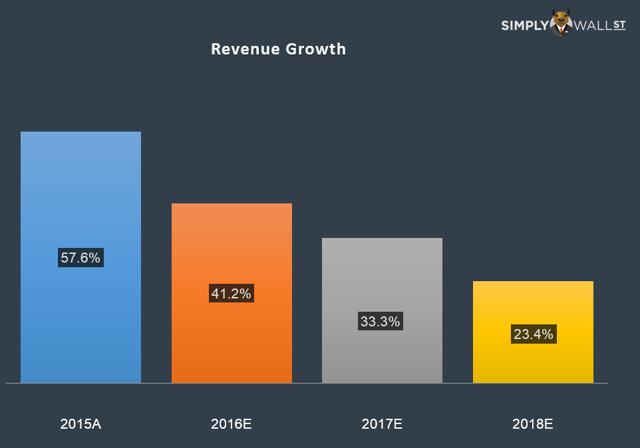
    JD’s revenue growth of 57.6% (in US dollars) during 2015 was well above the industry’s growth rate (33.3%). It indicates that the company increased its market share which accounted for the incremental growth. During early 2015, analysts at William Blair highlighted that during Q4 2014, JD gained 5% market share in GMV compared to a 2% decline experienced by Tmall. During the first three quarters of 2015, JD’s market share increased to 23.2% from 18.6% at the start of the year compared to Tmall’s contraction to 54% from 61.4%.

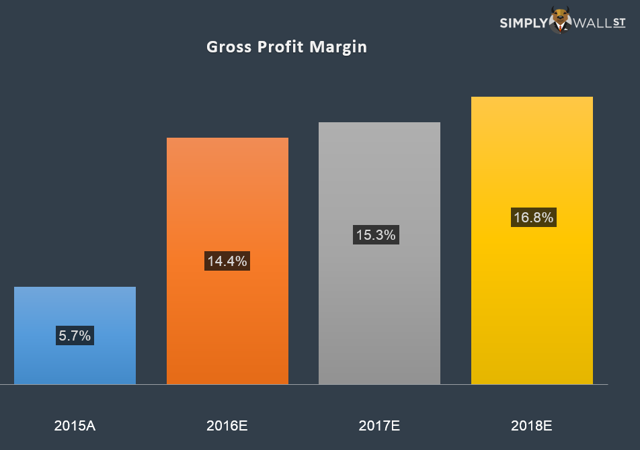
    Improving gross margin

    Source: Simply Wall St

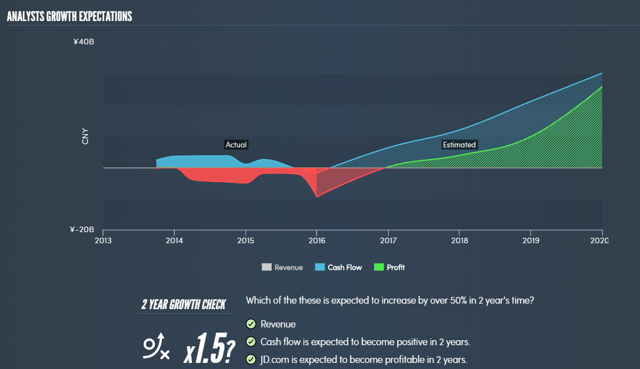
    JD was unprofitable last year. More than 85% of the loss was related to impairment charges (Paipai platform) and acquisitions; however, the company is expected to deliver positive earnings in 2016 and sizable earnings growth thereafter. JD’s improved utilization of infrastructure – growth in marketplace, ads, logistic services revenues – and increase in higher-margin product mix – general merchandise/other segment – will start reflecting in improved gross margin. Its loss doesn’t come as a surprise, as the management clearly stated in early 2015 that it is in investment mode, and this year’s target was to grow its market share and expand infrastructure.

    Source: Simply Wall St

    Smart money and the strategic partnership

    As per Bloomberg, the hedge fund holdings in the company increased from less than 4% at the start of 2015 to over 18% at the end of Q2. Q3 saw a decline, but the smart money increased its stake by nearly 7% during Q4. One of the key reasons behind hedge funds’ interest was JD’s strategic partnership with Tencent, the operator of China’s largest messaging service: WeChat. This has allowed JD to tap into the fastest-growing customer network as evident from the 61.4% sales coming from mobile devices during 2015 compared to nearly 36% in Q4 2014.

    Source: Simply Wall St

    Source: SEC 13-F filings, National Bureau of Statistics China, company fillings, S&P Capital IQ, WSJ.com, Simply Wall St

  • Alibaba likely to surpass Walmart as world’s top retailer

    Alibaba likely to surpass Walmart as world’s top retailer

    Chinese e-commerce giant Alibaba is expected to surpass the US multinational firm WalMart soon as the world’s largest retail platform with its total trading volume this fiscal year set to exceed USD 463.3 billion, an official media reported today.

    Chinese e-commerce giant Alibaba is expected to surpass the US multinational firm WalMart soon as the world’s largest retail platform with its total trading volume this fiscal year set to exceed USD 463.3 billion, an official media reported today.

    An official announcement by Alibaba Group Holding Ltd expected to be made at the end of this fiscal year on March 31.

    WalMart Stores Inc posted net sales of USD 478.6 billion for its fiscal year ending Jan 31, while the latest trading volume figure for Alibaba amounted to three trillion yuan (USD 463.3 billion), the company said yesterday.

    It is equivalent to China’s Sichuan province’s gross domestic product (GDP) last year, when the province’s GDP ranked sixth on the Chinese mainland, state-run China Daily reported today.

    Zhang Yong, the company’s CEO, said in Hangzhou that the figure was recorded on the company’s business-to-customer platform Tmall, consumer-to-consumer platforms Taobao and Rural Taobao, and group-buying site Juhuasuan.

    Zhang said he expected the company will achieve an annual trading volume of six trillion yuan by 2020 (about USD 980 billion) and that “in 2024, we wanted to be a business platform serving 2 billion consumers and tens of millions of enterprises at home and abroad.”

    According to Zhang, the company will strive to combine cloud computing and big data technologies with the Internet and the Internet of Things, as well as consumer terminal equipment, to spur its development.

    The Internet of Things is the network of physical objects devices, vehicles, buildings and other items embedded with electronics, software, sensors and network connectivity that enables these objects to collect and exchange data.

    Citing the National Bureau of Statistics and McKinsey & Co figures, Gao Hongbing, director of AliResearch, said that of Alibaba’s 3 trillion yuan in total trading volume, about 660 billion to 1.17 trillion yuan is newly increased consumption.

    “Online shopping has been an important engine to promote consumption, which meets the nation’s strategy of promoting domestic demand,” Gao said.

    Last year, Chinese consumers’ willingness to spend reached the highest level since 2012, despite the economic slowdown, according to a study published in February by The Nielsen Company.

    “This is a result of China’s commitment to shifting from an investment-driven to a consumption-driven economy,” said Kiki Fan, managing director of Nielsen China, China Daily reported.

    “Booming online shopping provides more variety and convenience to customers, thus fuelling their spending desire,” the Daily quoted Fan as saying.

    Despite its economic growth falling below 7 per cent (USD 6.9 per cent) for the first time since 2009, China surpassed the United States last year to become the largest e-commerce market in the world, according to statistics from multinational consultancy Forrester Research Inc.

    Chinese government has fixed 6.5 to seven per cent GDP target for this year.

  • China’s Alibaba signs 5-year loan deal

    China’s Alibaba signs 5-year loan deal

    China’s Alibaba Group Holding Ltd  said it has signed a deal for a $3 billion five-year loan, which will help the e-commerce giant as it snaps up stakes in companies within China and overseas.

    Alibaba, led by founder Jack Ma, has been expanding in areas beyond its core e-commerce base, such as online video, as volume growth in its online shopping business slows.

    The firm said in a filing to the US Securities and Exchange Commission (SEC) that it had signed the syndicated loan deal with a group of eight lead arrangers. It added that the amount could increase if there was steep demand.

    “The loan, which is subject to upsize through over subscriptions in syndication, has a five-year bullet maturity and is priced at 110 basis points over LIBOR,” the company said in the filing, referring to the benchmark interest rate used by many global banks when making loans.

    Alibaba added that the loan would be used for “general corporate purposes”, without expanding on what this meant.

    The Wall Street Journal cited sources last month saying Alibaba was in talks with several banks to borrow up to $4 billion to fund expansion plans, including acquisitions.

  • Apple Pay launched in China

    Apple Pay launched in China

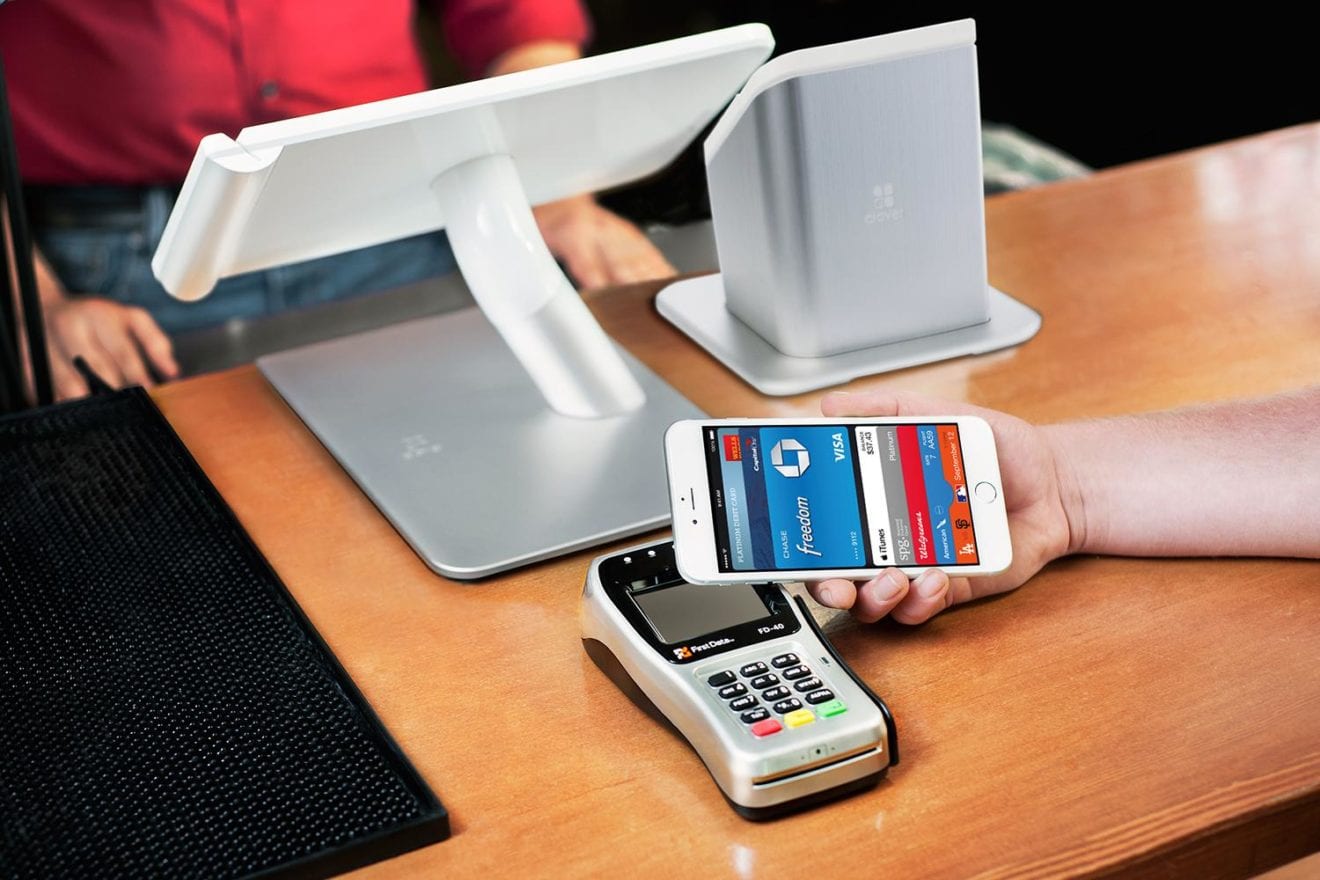
    Apple has confirmed that its alliance with China’s state-owned bankcard association, China UnionPay, will allow the lender’s cardholders to use Apple Pay from 3rd week of February.

    The union between Apple and UnionPay was announced late last year, but was subject to various approvals.

    Shoppers around the world are being encouraged to use smartphones instead of cards to pay for in-store purchases.

    Alibaba’s Alipay currently dominates China’s electronic payments market.

    Apple confirmed its expansion into China on its website.

    “You can now support Apple Pay for your customers in China, providing an easy, secure, and private way for them to pay using their China UnionPay credit and debit cards,” the firm said.

    Apple’s head Tim Cook later announced the launch of Apple Pay in China early on Thursday via his Weibo account.

    Several reports have indicated that as many as 20 China-based lenders will be supporting Apple Pay, including the Industrial and Commercial Bank of China (ICBC).

    ICBC had not responded to written inquiries on Thursday, however.

    Growing market

    There has been a rapid take-up of smartphones in China, with an estimated 68% of the population now owning one – and digital wallets are becoming a more popular way to pay for goods and services.

    UnionPay’s alliance with Apple is an extension of its plans to make the most of that growing market.

    However, analyst Bryan Ma of research firm IDC told the BBC that Apple was likely to garner a smaller user base in China compared to competitors like AliPay and Tencent’s WeChat Payment.

    “This is in part because Alibaba and Tencent payment systems are used for more things, like money transfers, whereas Apple Pay might be limited to just retail point-of-sale and possibly App Store transactions for now,” he explained.

    “There will be a natural, gravitational pull though for some people to Apple Pay – particularly people in big cities – because of Apple’s brand. So they will be able to attract a selected customer base that way.”

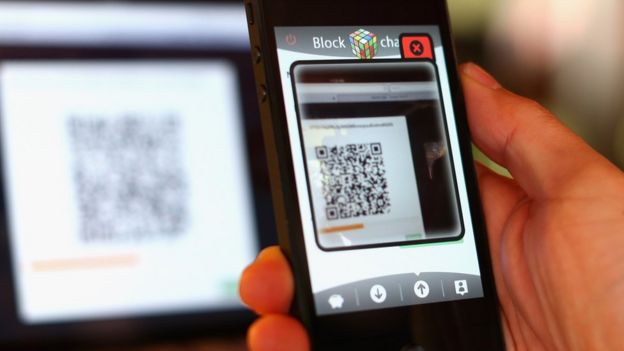
    Mr Ma said another issue was that Apple Pay would use the Near Field Communication (NFC) method of contactless communication, rather than the barcode-like method of electronic payments using QR codes.

    QR codesImage copyrightCameron Spencer
    Image captionQR codes are used by a wider market because more phones can read them compared to phones that can read NFC tags, IDC’s Bryan Ma said

    QR codes were widely used by Apple Pay’s China-based competitors like Alipay, Mr Ma said, and could reach a wider market because more phones could read them compared to phones that could read NFC tags.

    By 2017 it is estimated the global mobile payments market will be worth some $1tn (£650bn).

    In addition to Apple Pay, Google’s Android Pay is available at more than one million locations in the US, while Samsung Pay was launched in South Korea in August, followed by a launch in the US the following month.

  • Tmall driving more than sales for top beauty brands

    Tmall driving more than sales for top beauty brands

    Scores of high-end cosmetics companies are setting up shop on Alibaba Group’s Tmall.com online marketplace as eCommerce continues to gain ground as a critical marketing and sales channel for reaching China’s increasingly sophisticated consumers.

    At the recent Tmall Beauty Awards ceremony in Shanghai, which celebrated the top cosmetics brands operating on the eCommerce platform, Alibaba announced that 29 well-known Western brands and 37 from Japan and Korea had storefronts on Tmall at the end of 2015, including more than 10 joining the platform last year alone such as Lancôme, Bobbi Brown, La Mer, Anessa and Avene. Another 20 cosmetics companies are planning to launch their own presence on Tmall this year.

    Alibaba also announced a cooperation agreement with Korean cosmetics maker AmorePacific Group to expand the latter’s Tmall presence. AmorePacific will add two more storefronts exclusively on Tmall for the Sulwhasoo and IOPE beauty brands in the following months. AmorePacific already operates the Laneige, Innisfree, Mamonde and Etude House e-shops on Tmall, and about 800,000 Chinese consumers have purchased goods from Laneige’s shop over the past three years, according to Alibaba. The brand also sold about 45,000 BB creams, or blemish balms, during Alibaba’s 11.11 Shopping Festival, bringing in US$1.4 million from that product alone.

    Alibaba has similar cooperation agreements with Procter & Gamble, Estée Lauder, L’Oréal and domestic retailer Shanghai Jahwa Corp.

    The eCommerce push by cosmetics companies comes amid strong growth in high-end cosmetics purchases by Chinese consumers. A report from Chinese research firm CBNData, released in conjunction with the awards, noted that total sales of cosmetics products in China climbed nearly 20 per cent to $74.1 billion last year from 2014. Citing independent researchers, CBNData’s report also said that online channels accounted for 36 per cent of that, or $27 billion, with Tmall controlling about a 70 per cent share of the B2C market. Alibaba Group is an investor in CBNData parent China Business Network.

    Tmall Cosmetics GM Mike Hu said total sales generated on all business-to-consumer retail websites in China currently account for 12 to 15 per cent of the entire cosmetics market, and he predicts those channels will grow by another 30 per cent to 50 per cent over the next two to three years.

    Hu stressed that Tmall offers more than just another sales channel to brands. It’s also a platform to promote new products, build a connection with customers and increase business both online and off. According to Hu, over 20 brands have introduced about 160 versions of products that were exclusive to Tmall shoppers, and the brands have launched more than 100 new products via the website in 2015.

    “Two or three years ago, eCommerce played as a sales channel since its significance grew and it helped enhance business,” said Gary Chu, online general manager at Estée Lauder China, said at the awards ceremony. “Now what we are thinking about is how to integrate brand property, content and products into our presence in Alibaba’s ecosystem to meet the needs and demands of the brand.”

    To that end, Estée Lauder has been engaging customers via its so-called Fans communities within the Tmall mobile app. One brand, Bobbi Brown, opened its Fans page last November and now has more than 640,000 followers. It offers make-up tips and sample trials, among other initiatives, to tackle customers’ most common inquiries in order to educate and interact with shoppers, while serving as a bridge to the Bobbi Brown storefront. In addition to the Fans page, the company also used Instagram-like photo sharing on Tmall to generate buzz about Bobbi Brown lipstick ahead of Chinese New Year earlier this month, and Estée Lauder regularly uses the Tmall mobile app to help launch new products.

    Alibaba Group CEO Daniel Zhang said Estée Lauder’s efforts are prime examples of ways brands can engage shoppers with content and convert interactions into business opportunities.

    “All the brands and merchants are the best content producers, and merchants should incorporate products into content that consumers are willing to read and eager to buy,” he said.

    Brands are also using their Tmall storefronts to boost their online-to-offline (O2O) business. So far 54 of them, including Estée Lauder, La Mer and Laneige, have integrated their online and offline membership programs and now allow users to make appointments for skin care treatments in brick-and-mortar stores online.

    Tmall will continue to promote O2O retail to “achieve the goal of same product, same service and same membership” online and offline, Hu said.

    Here are the winners from some of the biggest award categories from last Friday’s ceremony. The winners were chosen based on search popularity, interaction with shoppers, customer reviews, trial reports, sales and services among millions of customers and thousands of brands on Tmall in 2015.

    Most popular brands online: Laneige, Lancôme, Innisfree, Maybelline

    Hot search brands: Bobbi Brown, Avene, Sulwhasoo (which launched on March 1)

    Favorite brands among customers born in the 1990s:Sekkisei, The Face Shop, Hanhoo (Chinese domestic brand)

    Favorite brands among customers holding Alibaba Passport (shoppers spending more than RMB 100,000 ($15,270) annually on Alibaba’s platforms): Shiseido, Whoo, L’Oréal, Clarins, Innisfree

    Favorite brands among male shoppers: JVR (Chinese domestic brand), L’Oréal, NIVEA

    Best-selling brand: Pechoin (Chinese domestic brand)

    Outstanding and popular group: Estée Lauder Group
  • Alibaba plans stake in China business magazine

    Alibaba plans stake in China business magazine

    The publisher of one of China’s most respected business magazines, Caixin, said today it was seeking new investors following reports e-commerce giant Alibaba plans to take a stake in the company as it looks to expand its media empire.

    Alibaba founder Jack Ma is seeking to diversify beyond the core business of providing online retail platforms and in December bought Hong Kong’s premier English-language newspaper, a move that raised concerns about media independence.

    Caixin Media provides financial and business news through its flagship magazine and several other platforms under the editorial leadership of Hu Shuli, who has received international attention for her brand of investigative journalism within the boundaries of the Communist-ruled state.

    Bloomberg News said today that Alibaba’s financial services unit Ant was in talks to invest in Caixin Media, but gave no size or price for the stake.

    China’s TMTpost, a business technology information provider, reported that the deal had already been signed.

    Caixin Media said in a statement it was about to bring in “several high-quality institutional investors”, without identifying them.

    “The new investors, like the original shareholders, respect Caixin Media’s principal of editorial independence which is not influenced by the business interests of shareholders,” it said.

    A spokesman for Alibaba declined to comment.

    The December purchase of Hong Kong’s South China Morning Post for $266 million has sparked fears the newspaper will lose its independent voice, in what analysts see as part of a gradual erosion of press freedoms after the semi-autonomous city was returned to Chinese rule in 1997.

    Others have compared Alibaba’s media push under Ma to that of Amazon founder Jeff Bezos, who bought the respected Washington Post newspaper two years ago. Ma’s net worth is now around $27.3 billion, according to Bloomberg Billionaires.

    Caixin’s biggest shareholder is China Media Capital, a Shanghai-based media and entertainment investment firm, which in December bought a $400 million stake in Premier League football giants Manchester City.

  • China to ‘completely dominate’ global eCommerce

    China to ‘completely dominate’ global eCommerce

    In the retailing business, it’s fairly common knowledge that China is home to the world’s most prolific online shoppers.

    Last year almost 419 million mainlanders made purchases via the web, more than any other country.  And they spent more online than consumers elsewhere by a wide margin (US$672 billion, nearly twice the total US online spending in 2015).

    If these facts suggest to you that eCommerce in China has matured and growth is running out of steam as the country’s economy slows, think again. China retail consumption in general continues to increase briskly and online shopping in particular continues to boom. Analysts reckon this is due to a combination of potent demographic and cultural trends that show no signs of abating: the growing spending power of upper middle class and affluent households; the coming of age of a generation of college-educated consumers; rising aspirations among hundreds of millions of people in China’s less-developed cities and rural areas; a powerful shift away from shopping at brick-and-mortar stores to mobile eCommerce driven by widespread smartphone adoption.

    Will China still be on top at the close of the decade? A recent forecast on global eCommerce sales through 2019 by independent research firm eMarketer says yes, emphatically so. Below, charts adapted from eMarketer’s report show how the country is set to become an even more dominant eCommerce force in coming years.

    In 2019, China will spend more online than any other country: nearly $2 trillion, more than 3.6 times as much as the US.

    Retail_E-comm_Sales_worldwide

    China will also have the most online shoppers.

    e-shoppers Worldwide, by country

    Yet only half of China’s population will be shopping online in four years, leaving room for more growth (it’s a very big market).

    E-Shop_Penetration_Selected_Countries

    In 2019, one out of every three of China’s retail dollars will be spent online, the highest ratio in the world.

    Retail_e-Comm_Sales_percent_total

    Still, online sales will continue to grow, and at a world-beating rate.

    Retail_Ecomm_Sales_Growth_Leaders

    Looking at eCommerce as a global market, China will account for the largest share of worldwide online shoppers in 2019. By far.

    Countries_Largest_Share_E-shoppers

    And 55 cents of every dollar spent online around the world will come from a Chinese consumer. That’s dominance.

  • China’s Retail Sector Emerged as a Bright Spot in Slowing Economy

    China’s Retail Sector Emerged as a Bright Spot in Slowing Economy

    China’s retail sector shines

    China is facing an economic downturn, but Chinese consumers are hopeful about its economy. According to Boston Consulting Group, China’s total retail sales are forecasted to grow by 50% to $6.5 trillion by 2020 with online transactions growing by nearly 25%.

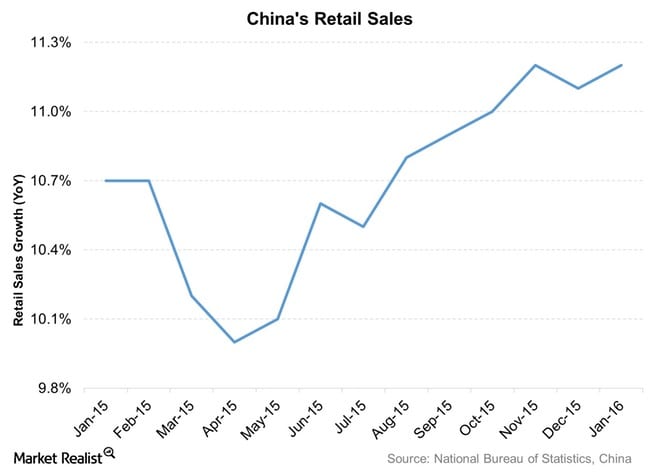
    Retail sales were up by 11.2% in January 2016 due to Lunar New Year holiday shopping. In 2015, retail sales grew by 10.7% YoY to 30.09 trillion yuan, slower than the 12.0% increase recorded in 2014. Urban retail sales of consumer goods were up by 10.5% YoY to 25.9 trillion yuan.

    Rural areas have become a major source of retail sales growth. Retailers are focusing on rural China to increase the penetration of e-commerce. In 2015, rural retail sales were up by 11.8% to 4.19 trillion yuan.

    Chinas Retail Sales 2016-02-28Enlarge Graph

    E-commerce played a major role in driving up retail sales. In 2015, the national online retail sales of goods and services grew 33.3% YoY to 3.88 trillion yuan, according to the National Bureau of Statistics of China. Some of the leading players in China’s e-commerce segment are Alibaba Group Holdings (BABA), Baidu (BIDU), JD.com (JD), NetEase (NTES), and 58.Com Inc. (WUBA).

    According to Fortune Character, a luxury product consulting firm, Chinese consumers accounted for 46% of global sales of luxury products in 2015.

    Transition from export-oriented economy to consumer-driven economy

    After a slowdown in demand and rising debt levels in the manufacturing sector and reduced dependence in the export business, China is shifting its focus to a consumption-driven economy. Although this transition would be painful in the near-term, it has the potential to deliver robust growth to China in the long term.

    Mutual funds such as the Templeton China World Fund (TCWAX) and the Fidelity Advisor China Region Fund – Class A (FHKAX) have exposures of 31.3% and 21.5%, respectively, to the consumer discretionary and consumer staples sector combined. These funds stand to gain immensely due to positive performance in the retail sector.

    After having a brief overview of China’s macroeconomic indicators, let’s begin our assessment of China-focused mutual funds.

  • Alibaba Group’s Quest for China’s $100 Billion Retail Drug Market Stalls

    Alibaba Group’s Quest for China’s $100 Billion Retail Drug Market Stalls

    Alibaba Group Holding Ltd. has sailed into headwinds in its plans to conquer China’s medical market by prescribing and selling drugs through an online platform. Chinese officials shut down a government-owned drug tracking system that was created and operated in partnership with Alibaba’s health-care division, Alibaba Health Information Technology Ltd.

    The news saw the unit’s shares take a hit, falling 14% to 4.10 Hong Kong dollars (HKD) on Monday, before rising slightly to close at 4.17 HKD Tuesday.

    The system is owned by China’s Food and Drug Administration, which helps it monitor drugs’ manufacturing, regulatory, expiration and composition data. However, the FDA suspended the system due to complaints from pharmaceutical companies that are jittery over Alibaba’s involvement.

    Meanwhile, the FDA has said that it is reviewing drug-monitoring rules to accommodate the dissenting voices, reported Wall Street Journal.

    Alibaba teamed up with a private-equity startup linked with its founder, Jack Ma, known as Yunfeng Capital Ltd to purchase a controlling 54 percent share in Citic 21CN, which dealt in management of pharmaceutical products data. The new company, Ali Health, subsequently started dealing in Alibaba’s e-commerce sales of over-the-counter drugs.

    It also created an app that links patients with hospitals and community doctors.

    Cure for Country’s Ailing Healthcare Industry

    Ali Health has touted itself as the cure for most problems ailing China’s health-care industry, which is characterized by overcrowding in public hospitals and too much reliance on drugs.

    Data by management consulting firm Bain & Co. shows hospitals in mainland China rely on sales of drugs for 80 percent of their revenues, opening a loophole for corruption to thrive.

    Ali Health ensures local pharmaceutical industry players maintain standards of drug safety as it strives to gain an early market lead over potential rivals should China allow retailers to sell drugs through online platforms.

    This fact hasn’t escaped the eye of drugs firms, who have increasingly expressed dissatisfaction over Alibaba’s participation.

    A provincial pharmacy chain Yontinhe Group sued China’s FDA in January, saying it was creating an uneven playing field by co-operating with Ali Health. It cited provision of big-data view of all medicines produced by all pharmaceutical firms in China to Ali Health as one area it was favoring the latter in, among other accusations.

    Responding to Yontinhe’s claims, the FDA issued a statement on Jan. 26, saying that it backed the drug-monitoring system. Nonetheless, it appears to be responding to the complaints with its decision to seek views of all market participants concerning how to review the drug-monitoring system.

    China’s prescription drugs market is estimated to register sales valued at $100 billion, according to a study by consultancy firm Deloitte.

    Ali Health attributed its involvement in the tracking system for almost all the revenue of US$4.8m (37m HKD) it earned in the year through March 31, 2015. It says its role is to operate the system, while the FDA owns it in a partnership aimed at eliminating counterfeits in the Chinese health-care market.

  • Alipay, WeChat drive China Jo-Jo sales

    Alipay, WeChat drive China Jo-Jo sales

    China Jo-Jo Drugstores, the US listed, China-based multichannel pharmaceutical and healthcare retailer, says customers are embracing Tencent’s WeChat and Alibaba’s Alipay to buy its goods from mobile phones.

    In the third quarter, Alipay mobile transactions with China Jo-Jo grew 84 per cent quarter on quarter, while sequential traditional payment transactions such as City Health Insurance payment transactions grew 27 per cent.

    According to research firm Analysys, Alipay and WeChat currently dominate mobile payment in China with 45 per cent and 19 per cent of the market respectively.

    “Integrating these mobile payment platforms is an important growth initiative for China Jo-Jo as consumers in China, especially the young and growing middle-class, have been keen to actively adopt mobile payment as the method of choice for their integrated mobile and physical retail store shopping experience,” the pharmacist said in a statement.

    “Providing customers this convenient and familiar mobile payment platform is helping to drive overall transaction growth in both our retail and online pharmacies.”

    Since launching Alipay’s mobile payment service in November 2014, China Jo-Jo has been initiating novel marketing campaigns including in-store sales and bonus promotions in order to attract and customers while promoting premium branded products. Payment transactions and marketing initiatives under WeChat Payment which launched in July 2015 have also been successful in growing China Jo-Jo’s customer base and overall transactions.

    Chairman and CEO Lei Liu says mobile payment platforms have had immense success in China providing consumers with a fast, secure and novel means of paying for both online and offline pharmacy goods and services that is becoming the standard method for paying for goods and services in China.

    “Mobile payment platforms now account for more and more of China Jo-Jo’s online payment transactions and is playing an integral role in the push to drive adoption of China Jo-Jo’s business model.”

    As of December 31, China Jo-Jo had 59 retail pharmacies in Zhejiang Province, China.