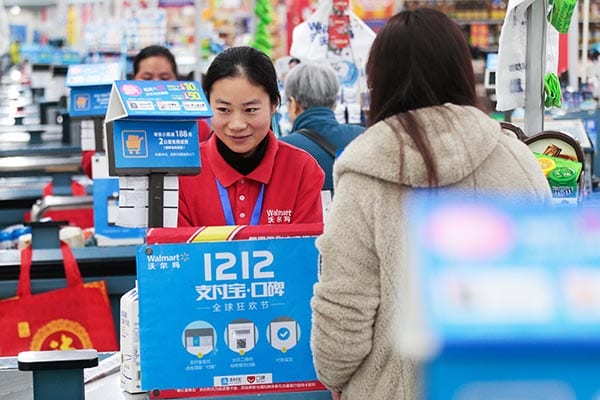
American retail giant Wal-Mart Stores has further increased its stake in China’s second-largest eCommerce firm JD.com.
It now has a 12.1 per cent shareholding, up from 10.8 per cent, and comes about three months after the Arkansas-based retailer disclosed it had almost doubled its holding in JD.com from 5.9 per cent.
Like Amazon, a large part of JD.com’s income comes from selling products it holds in its own inventory. Its logistics network has also helped it win more users through speedy shipping, says Deal Street Asia.
With about 400 physical stores in China, Wal-Mart struck a swap deal with JD.com last June, selling its fully owned Chinese eCommerce player Yihaodian to JD.com in return for a 5 per cent stake in JD.com, worth around $1.5 billion. This gave Wal-Mart access to JD.com’s nationwide logistics and warehousing networks, as well as its 150 million users.
Meanwhile, JD.com is better able to compete with Alibaba in the online grocery business, which is expected to grow to nearly $180 billion by 2020, according to data from food research body IGD.
In October, Wal-Mart invested $50 million in Chinese online grocery and delivery firm New Dada. This will help it gain more foothold by offering shoppers faster delivery times. At the time, New Dada had more than 25 million registered customers. It delivers in more than 300 cities.
Amazon India has applied to the government to invest US$500 million in a wholly owned venture that will allow the US eCommerce giant to stock locally produced food items and sell them online.
If successful, it would become the first foreign retailer to enter the segment.
Amazon already has an eCommerce marketplace in India, but while 100 per cent overseas capital is permitted for such platforms, they cannot sell products of their own. Last year, the government allowed for 100 per cent foreign investment in the retailing of processed foods made in India.
Amazon has filed its application with the Department of Industrial Policy & Promotion (DIPP), which handles foreign investment in retailing and eCommerce. The company plans to invest $500 million over five years and could start selling locally produced food items within six months of obtaining approval, says an insider.
“We are excited by the government’s continued efforts to encourage foreign direct investment in India for a stronger food-supply chain,” says an Amazon spokesperson. “We have sought an approval to invest and partner with the government in achieving this vision.”
Only Indian grocery delivery companies BigBasket and Grofers have applied under
the category, prompting the government to invite companies including CP Foods (Thailand), Heinz, Nestle and Walmart to provide feedback and investment plans.
This followed the minister for food-processing industries Harsimrat Kaur Badal visiting London with a team of officials last year to meet representatives of such companies as Cobra Beer, Harrods, Marks & Spencer, Sainsbury’s and Tesco to drum up support for the policy.
Amazon’s current online platform is open to Indian-owned entities, and similar platforms are run by Flipkart, the country’s largest eCommerce company, and Snapdeal.
Amazon Web Services (AWS) is maintaining its dominant share of the burgeoning public cloud services market at over 40%, new fourth quarter data from Synergy Research Group showed.
The research firm also said that the three main chasing cloud providers – Microsoft, Google and IBM – are gaining ground but at the expense of smaller players in the market.
In aggregate, the three have increased their worldwide market share by almost five percentage points over the last year, helped by particularly strong growth at Microsoft and Google, and together now account for 23% of the total public IaaS and PaaS market.
The next ten cloud providers in the ranking have slipped off the pace a little, though this group does include Alibaba and Oracle who continue to grow at impressive rates. There is then a very long tail of small-to-medium sized cloud service providers, whose collective market share has now dropped to just 18%.
With most of the major operators having now released their earnings data for Q4, Synergy estimates that quarterly public cloud infrastructure service revenues (including both public IaaS and public PaaS) have now reached well over $7 billion and continue to grow at almost 50% per year.
If managed private cloud services are included, quarterly cloud revenues are now well over $9 billion. The cloud providers and rankings are very different in the managed private cloud, where IBM continues to lead while Rackspace and traditional IT service providers feature more prominently than they do in public cloud.
“While a few cloud providers are growing at extraordinary rates, AWS continues to impress as a dominant market leader that has no intention of letting its crown slip,” Synergy Research chief analyst and research director John Dinsdale said.
“Achieving and maintaining a leadership position in this market takes huge ongoing investments in infrastructure, a continued expansion in the range of cloud services offered, strong credibility with the large enterprise sector, consistently strong execution, and the wholehearted and long-term backing of senior management. AWS is checking all of those boxes and any serious challengers need to do likewise.”
Amazon is usually a retailer that operates at full volume, the noise of its sales growth a clarion call in an often muted retail sector.
However, this quarter that volume seems to have been turned down a couple of notches. While the latest Amazon results show impressive growth, and is a long way above the retail sector overall, by the high benchmark the company has set, the latest numbers have a certain softness. Revenue totalled US$43.7 billion, up 22 per cent year-on-year, below analysts’ expectations.
Some of the loss in momentum comes down to a more unfavorable exchange rate. On a constant currency basis, Amazon’s overall growth is a more respectable 24 per cent; while its international growth leaps to 23 per cent from 18 per cent, once the impact of the strong dollar is factored out. Even so, these upticks still leave a gap in growth compared to what Amazon delivered over the first three quarters of the fiscal.
Part of the softness comes down to shipping-related revenue, which grew by its slowest pace in over a year. This has placed a little downward pressure on the revenue line. More worryingly it means that shipping revenue from consumers is now strongly adrift from Amazon’s shipping costs. In the final quarter, the former grew by 29 per cent, while the latter surged by 35 per cent to just over $5.6 billion. This is one of the reasons the company missed its profit forecasts, and why operating profit came in at 2.9 per cent of sales versus 3.1 per cent over the same period last year.
Arguably, low cost and fast delivery are a fundamental part of Amazon’s appeal to consumers. However, they are also its Achilles’ heel – and with Prime becoming more popular, and with a greater focus being put on speedier shipping times, we have concerns that Amazon could see further profit erosion as it enters its new fiscal year. This view is supported by Amazon’s own guidance for the next quarter, which suggests profit will come in well below last year.
As niggling as these points are, they do not diminish Amazon’s success in other areas. Over the holiday quarter, the company saw demand for its devices, including the Echo product, boom. This helped Amazon to a very strong performance in electricals at a time when the overall market was struggling with a lack of newness and innovation. It also aids Amazon to extend its ecosystem to more households, something we believe will yield fruit over the coming years as it becomes a more integrated and critical part of people’s lives.
The AWS (Amazon Web Services) division is also a success story. Here revenue grew by 47 per cent off the back of a very strong prior year comparative. This part of the business is helpful as its relatively strong profitability gives buoyancy to Amazon’s balance sheet.
As much as this quarter has been more subdued, Amazon remains firmly on the front foot in terms of innovation. This alone will continue to make it a retail outperformer, at least in sales terms, over the next year and beyond.
At first glance, eBay’s final quarter numbers look relatively subdued – with growth across every line sequentially worse than the prior quarter.
However, digging beneath the headlines reveals a slightly better picture, if only because the strength of the dollar has deflated sales. On a currency neutral basis, gross merchandise volume increased by 5 per cent, and net revenue jumped by 6 per cent. While these numbers are not ultimately reflected in the accounts, they show that eBay’s underlying performance is not quite as bad as it first seems.
All that noted, when put into a wider context the gains remain fairly unspectacular. Indeed, eBay’s growth remains well below that of total eCommerce sales growth across the markets it serves. As well as losing market share, its performance is also anemic when contrasted to that of online peers such as Amazon – which had a stellar holiday season. This is especially so in the sale of physical products from the marketplace (which excludes the more buoyant StubHub part of the business) where revenue rose by just 1.1 per cent over the prior year.
As much as eBay did enough to meet market expectations, the results are disappointing in that they show the various improvements the company is making are not, as of yet, generating significant traction with consumers. This includes the use of more structured data to make listings easier to find and view, and an increase in the number of full-priced products available from the site.
As sensible as these steps are, they are really about correcting deficiencies rather than putting eBay on an innovative footing.
eBay needs to go much further in revamping the whole online experience in order to allow it to compete more effectively with rivals. This includes trying to create some stickiness around the brand and proposition, in the way that Amazon has done by creating a whole ecosystem of products and services. Admittedly, this is a very tough ask, but it is the direction in which eBay needs to travel if it is to win back market share.
In looking at ways to improve, eBay needs to focus its attention on younger shoppers, among whom brand perception and site usage have weakened. From Conlumino’s data, younger demographics – while active digital consumers – do not have the affinity with eBay that the generation before them did, or that older consumers do. In this regard, eBay has lost out to players like Etsy which these consumers believe to be more authentic, and more likely to offer innovative and interesting products.
Looking ahead, there is no overly negative forecast for eBay: the company is addressing its issues and is making steady progress that will continue to aid results. However, it is one of the slower players in the fast-paced digital arena and to date there are very few visible signs it will move into the fast lane in its new fiscal year.
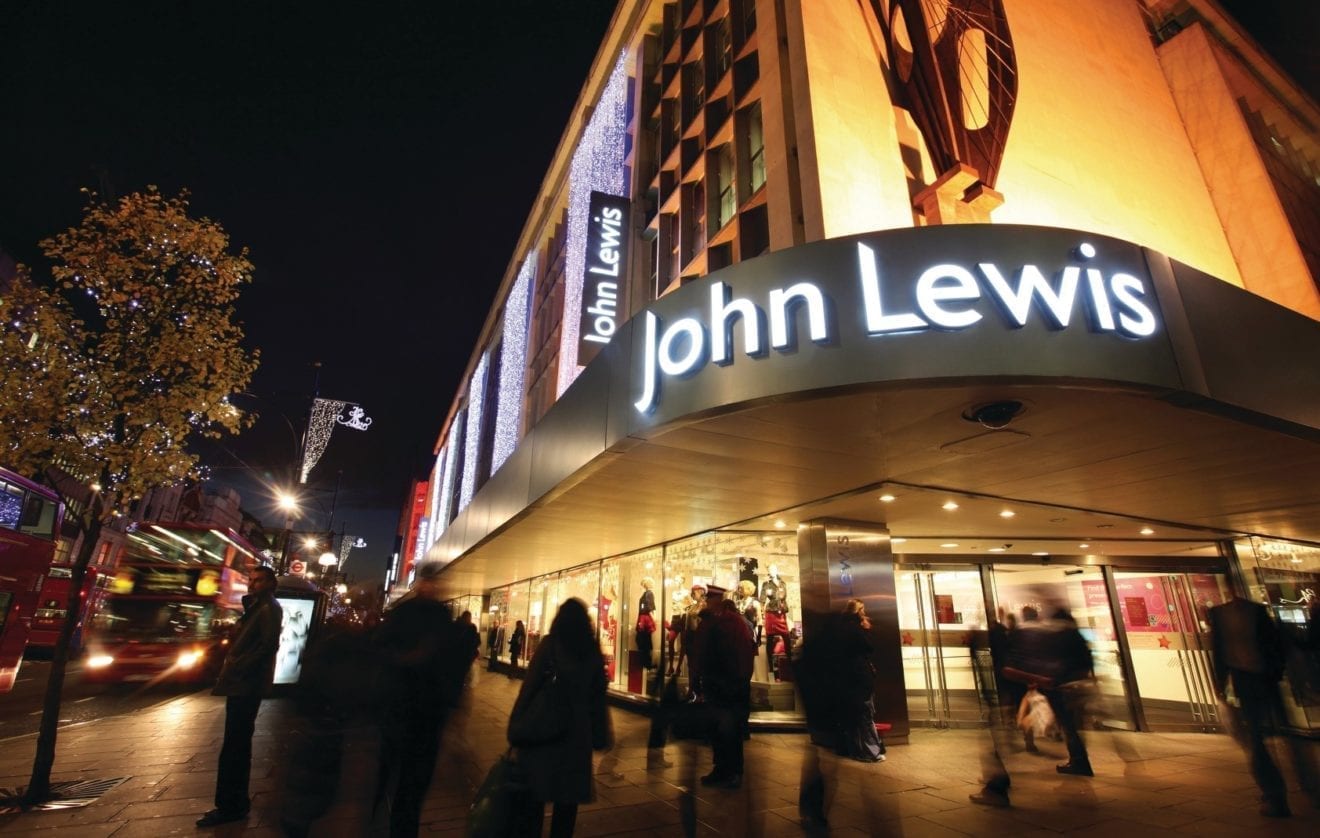
John Lewis fashion sales rose a tremendous 7.2 per cent over Christmas – eclipsing the UK department store’s rivals, even robust performances by Debenhams, M&S and House of Fraser.
Own brand collections continued to strengthen throughout 2016, with the inclusion of Modern Rarity filling a gap in its private label brand portfolio by appealing to a stylish, design-led shopper and taking Cos on as a direct rival. John Lewis should consider taking this brand into menswear, given the outperformance of menswear in 2017 versus other clothing sectors, and the current gaps in the market for brands targeting the 30-45 year old male shopper.
Its Electricals Home & Technology division was up against the strongest comparative, rising 4.8 per cent against a 9.6 per cent rise last Christmas. The department faced huge discounting pressure from rivals Amazon, Argos and Dixons Carphone, particularly over Black Friday when promotions were offered over a week ahead of the main event. However, John Lewis’ strategy of selling the latest models across technology categories will have limited its exposure to the breadth of discounts available elsewhere.
As one of the leading players in selling affordable smart home technology, John Lewis can expect to see a greater uptake in demand in 2017 following its significant investment in the department during 2016 and increasing consumer awareness.
Home reported the slowest sales growth at 2.7 per cent against a 5.1 per cent rise last year, though this is outperforming both the home and furniture markets and is resilient given the fall in housing transactions.
Paula Nickolds takes over the reins this month from Andy Street, marking the start of a new era for the department store. Nickolds’ understanding of the business will ensure Street’s legacy and strategy will be carried forward, but her new appointment begins at the start of what will be a challenging and unpredictable three year (at least) period, so new initiatives will be important to stimulate demand.
Amazon continues to push the envelope as a supply chain and logistics disrupter with the granting of a patent in late December for what has been dubbed a giant ‘flying warehouse’.
The Amazon Technologies Inc. filing describes ‘airborne fulfillment centers’ (AFCs) comprised of large and robust flying drone made up of numerous smaller drones, designed to make long-distance flights or to carry heavy packages. By comparison, the average quadcopter drone — a design that incorporates four propellers — can typically fly continuously for up to 30 minutes and transport up to 4.5 kg.
It also describes the use of unmanned aerial vehicles (UAV) to deliver items from the AFCs to users.
According to the patent, filed 19 February 2015 and granted 29 December 2016, individual modules could detach from the collective drone body once they were no longer required, and operate independently to deliver smaller burdens.
The filing stated: “For example, the AFC may be an airship that remains at a high altitude (for example, 45,000 feet) and UAVs with ordered items may be deployed from the AFC to deliver ordered items to user designated delivery locations.
“As the UAVs descend, they can navigate horizontally toward a user specified delivery location using little to no power, other than to stabilize the UAV and/or guide the direction of descent. Shuttles (smaller airships) may be used to replenish the AFC with inventory, UAVs, supplies, fuel, etc. Likewise, the shuttles may be utilized to transport workers to and from the AFC.”
The filing continued: “An AFC may navigate to an area based on various positioning factors. For example, a temporal event (e.g., a football game) may be expected to produce a demand for certain types of items (for example, sporting paraphernalia, food products, etc.).
“In advance of the event, the items may be delivered to the AFC in a quantity sufficient to satisfy the expected demand and the AFC may navigate to a position such that UAVs deployed from the AFC can safely navigate to the location of the event and deliver the items, thereby satisfying the demand.
“In some implementations, the AFC may navigate to a lower altitude and provide advertising for the temporal event or for other occasions (e.g., product announcements, product releases, sales).”
In a separate patent filing, Amazon was granted a new patent at the end of last month to protect its drones from possible threats and attackers with drawings detailing the possibility of a drone being fired upon by a bow and arrow.
After securing dominance in its home market, China’s Alibaba Group Holding is racing to conquer the still nascent e-commerce market in Southeast Asia. Although the size of the market in Southeast Asia pales in comparison with China’s, it is expected to grow 32 percent on average each year through 2025, according to one industry executive.
US-based Amazon.com Inc also has its sights set on the region, making a face-off with Alibaba all but certain. Alibaba got to the Southeast Asian market first, but its victory is far from assured. Experts said there is no silver bullet for success, especially in an evolving e-commerce market facing difficulties of its own.
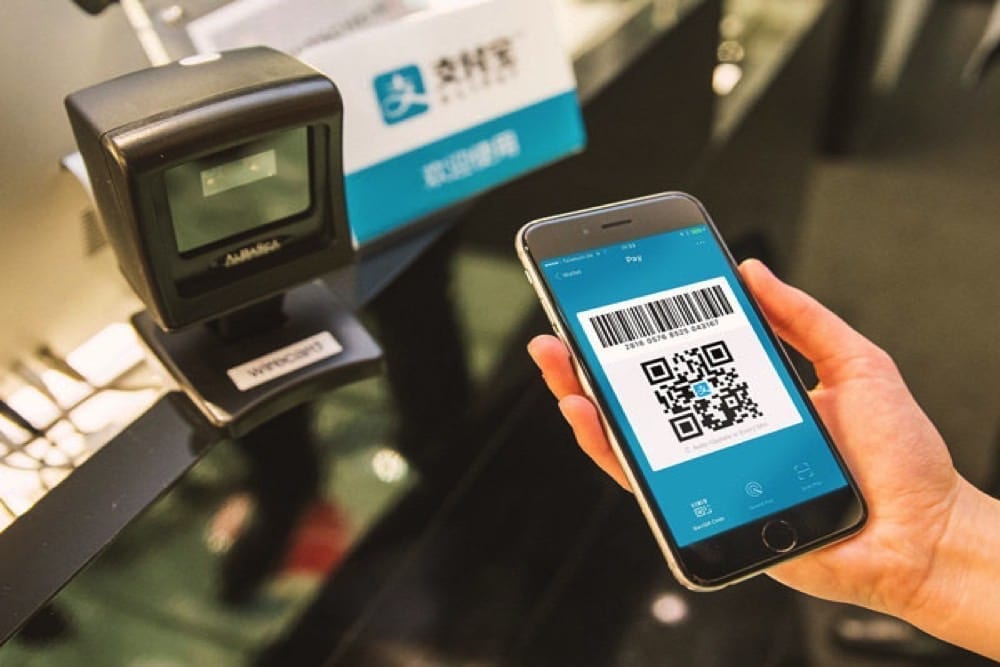
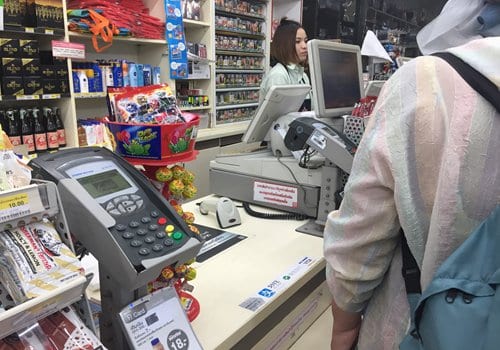
A 7-Eleven convenience store in Phuket, Thailand, that accepts Alipay.
Among the glossy, green trees in Phuket, the largest island in Thailand, the landscape is dotted by many 7-Eleven convenience stores that accept Alibaba Group Holding’s mobile payment application Alipay.
“Alipay is available in almost all 7-Eleven convenience stores here, and people are encouraged to use it with random discounts,” an employee at a 7-Eleven store on Thanon Patak Road in Phuket, who declined to be identified, told the Global Times on Saturday.
7-Eleven has added Alipay to its payment options at more than 9,000 outlets across Thailand since April.
Alibaba’s move to get Alipay into Thailand is widely perceived as a way to attract Thai smartphone users and technology-savvy consumers as it expands into Southeast Asia in 2016.
In April, the Chinese e-commerce giant acquired a controlling stake in Lazada, considered the Amazon of Southeast Asia, for $1 billion.
In November, Alibaba furthered its expansion by taking over the Singaporean online grocer RedMart via Lazada.
Alibaba’s CEO Zhang Yong said several times at press conferences in 2016 that the company’s next major goal is to help merchants on its platform enter the Southeast Asian e-commerce market.
However, expanding into Southeast Asia might be easier said than done. In the region, many people are familiar with the concept of e-commerce by name only and don’t have much of an inclination to try it.
A new frontier
A 20-something resident in Phuket surnamed Kung was surprised when she heard that Chinese shoppers spent 120.7 billion yuan ($17.4 billion) on online purchases via Alibaba’s bazaars on November 11 alone.
“My friends and I seldom shop online and do not really intend to do so because we can get whatever we need in the market or at nearby convenience stores,” Kung told the Global Times on Friday.
The woman’s biggest concern is quality. She dislikes that she can’t feel the texture of clothing sold online and worries about unwittingly buying knockoffs.
The poor reception for online shopping is reflected on the streets of Phuket, where few express deliverymen can been seen – unlike in China, where they are commonplace.
Lazada Thailand CEO Alessandro Piscini acknowledged on Thursday that Southeast Asia has a small e-commerce industry.
At a press conference with about 200 Chinese reporters in Phuket on Thursday, Piscini cited the region’s 3 percent online retail penetration rate (as of November 2015), which represented about $6 billion in sales. By comparison, China had an online retail penetration rate of 14 percent and online sales totaling $293 billion during the same period.
Still, Piscini was optimistic, saying that the small penetration rate shows that Southeast Asia has a large untapped market for e-commerce. He predicted that the region’s e-commerce market will grow by 32 percent annually to more than $200 billion by 2025, thanks to local government encouragement for the digital economy and urbanization, as well as the region’s rapidly growing middle class.
By 2020, Southeast Asia’s GDP is expected to grow by an average rate of 5.5 percent a year, Piscini said. Middle-class consumers around 35 years old will account for 60 percent of the region’s overall population, which will grow to 668 million from the current 644 million, according to latest estimates by the global statistical information provider Worldometers.
Looming rivalry
Amazon.com reportedly plans to launch in Southeast Asia in the first quarter of 2017, meaning that Alibaba and its US-based competitor will soon clash in the region.
Amazon’s entry into Southeast Asia will be done via Singapore, where “the level of customer spending and consumer culture is more closely aligned with Western markets,” TechCrunch reported in November, citing unnamed sources.
The grocery store business is shaping up to be the first battleground in the region between Amazon and Alibaba, according to the report. The rivalry between the two tech mammoths in the Southeast Asian market seems unavoidable as both have stepped up their international expansion.
“The two account for a huge amount of their home e-commerce markets, with Alibaba holding about 80 percent of online sales in China and Amazon controlling about 60 percent of the US market, so competing for new territory is a logical move,” Lu Zhenwang, founder of Shanghai Wanqing Commerce Consulting, told the Global Times on Sunday.
Alibaba should not be fazed by the potential threat of Amazon, experts said.
The Chinese company has an edge on the shopping side, but also got an early start with logistics and payments via acquisitions, experts noted.
In November, Alibaba’s financial arm Ant Financial signed an investment deal with Ascend Money, a leading online payment firm in Thailand, which also operates in Indonesia, the Philippines, Vietnam, Myanmar and Cambodia. It also snapped up a stake in Singapore’s Singpost, which is experienced at delivering parcels across Asia.
Dearth of development
Alibaba may have got to Southeast Asia ahead of Amazon, but being first doesn’t guarantee victory.
“Southeast Asia is a varied e-commerce market and full of challenges that need to be overcome,” said Liu Dingding, a Beijing-based independent analyst.
In addition to weak market reception, delivery is also perceived to be a tough issue.
Lazada Thailand CEO highlighted the complexity of delivery in Southeast Asia during Thursday press conference, citing the region’s underdeveloped infrastructure.
Liu agreed, noting that the underdeveloped infrastructure hindered the inter-city cargo or parcels delivery, which harmed users’ experiences.
According to Kung, residents in Phuket usually need to wait for one to two weeks to get their online purchases. In China, this usually takes about three days.
Against this backdrop, the e-commerce ecosystem in the region is still evolving, giving anyone a possibility to lead the market as long as it can find the right local partners, Liu said.
“Amazon, though a latecomer to Southeast Asia, still has the chance to win because it has more experience than Alibaba in expanding its business in the international marketplace,” Liu told the Global Times on Sunday.
In a bid to knock online marketplace Flipkart from its leadership position in India, eCommerce giant Amazon has injected Rs2010 crore (US$296 million) into its Indian unit.
Regulatory filings show that the move takes Amazon’s total capital investment in India to more than Rs7000 crore in the past one year.
“We will invest what it takes to become the customers’ preferred choice in India, and are encouraged that we are India’s largest and fastest-growing eCommerce marketplace,” says an Amazon India spokeswoman.
A report in The Economic Times says Amazon is estimated to have spent more than Rs1000 crore last month to woo customers with special offers and discounts for the festive season, and is losing about Rs600 crore every month.
Amazon entered India three years ago, introducing some of its global programs this year including its Prime service, which offers quicker deliveries and early-access deals.
Last week, it announced Prime Video services for India offering Hollywood and other international movies and TV shows – plus launching nine original Indian shows, making it the largest Indian original line-up on an OTT (over-the-top) platform.
Earlier this month Amazon announced the launch in India of its global program for start-up products, Launchpad, and in October it launched Global Store, offering products from its US online store that are not available in India.
Meanwhile, Flipkart’s Sachin Bansal is seeking government help in the battle against Amazon.
About 17 per cent of discounts offered during China’s multi-billion-dollar Singles’ Day online sale event were not real, claims a state-backed consumer group.
It is calling on the government to intervene and punish platforms and merchants for promoting fake Singles’ Day discounts.
Alibaba and Amazon are among companies the Chinese Consumers Association (CCA) alleges are guilty of hiking prices before the annual November 11 shopping festival in an effort to lure customers with sharp “discounts”.
“There is a large number of false discounts and other misleading behaviour about prices,” says the CCA, which has referred the cases to relevant government departments, recommending “severe punishment for price violations and price dishonesty”.
Ahead of the shopping event, China’s top business regulator last month warned firms including Alibaba, Amazon and JD.com against falsifying figures and selling counterfeit goods.
Alibaba recorded 120.7 billion yuan ($US17.4 billion) in Singles’ Day sales this year, and is being investigated by the US Securities and Exchange Commission over accounting practices related to its figures for the event last year. The US-listed firm has denied any wrongdoing.
“We have strict measures in place to crack down on false sales discounting,” says an Alibaba spokeswoman. She claims the company penalises merchants, depending on the severity of the falsified discount.
The CCA study recorded price changes on 12 platforms between October 20 and November 25. Of all the “discounted” products surveyed, 35 per cent of them on Amazon still cost more than regular retail prices, the highest of any platform. JD.com followed at 26.8 per cent, then Alibaba’s Tmall at nearly 19 per cent.
Hong Kong logistics startup Easyship has raised an undisclosed amount of pre-series A funding from 500 Durians, a fund managed by Silicon Valley’s venture capital major 500 Startups.
Easyship is an online platform providing crossborder logistics services for eCommerce companies, claiming to have access to more than 80 shipping companies and offering visibility on delivery time, cost breakdown, reliability and tracking.
To date, it has raised aggregate funding estimated at US$2.5 million. The latest round will help it expand into Southeast Asia via Singapore, following the validation of its business model and building of traction in the Hong Kong market.
Its expansion to Singapore provides strategic access to Southeast Asia and leverages off the city-state’s logistics infrastructure and networks – just as US eCommerce giant Amazon is establishing a presence there.
The venture originates from problems with international shipping encountered by co-founders Tommaso Tamburnotti and Augustin Ceyrac when they were trying to build the crossborder business of Rocket Internet’s Lazada, as reported. At the time, Lazada was trying to attract more vendors to its platform in China and Hong Kong selling into Malaysia, Singapore, Thailand, and the Philippines.
However, Lazada’s rapid sales growth was inhibited by a “very unstructured and fragmented” logistics industry. Easyship streamlines this process, providing an end-to-end process for packaging, labelling and tracking goods with couriers. It charges no fees for these services, with sellers paying the couriers. Revenue is generated from courier commissions.
Easyship claims its saves its 1000-plus clients in Hong Kong up to $20,000 a month on shipping fees.
French retailer Carrefour has expanded its eCommerce access in China by launching online shops and apps for Suzhou and Wuxi.
It already covers Beijing, Chengdu, Kunming and Shanghai with plans for further expansion. Wuhan is next on the list, expected to come on line before the end of this month.
Carrefour has rolled out its eCommerce offerings internationally, going up against such rivals as Amazon in Spain.
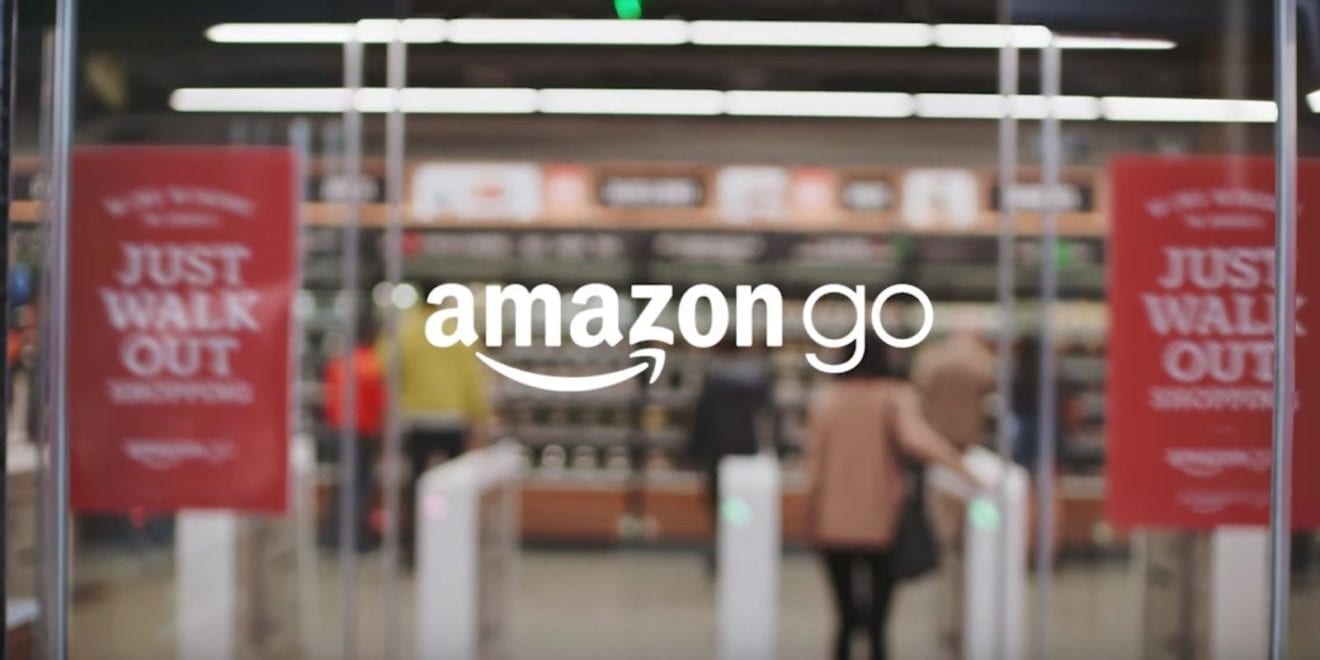
Amazon.com is using machine learning to try to change the shopping experience and the retail industry in general. Amazon employees are testing a new brick-and-mortar store, called Amazon Go, in Seattle that lets customers using an app bypass the checkout line.
Using a combination of machine learning, computer vision, sensors and deep learning, the smart store is designed to keep track of what users take off and return to shelves so it can track their purchases in a virtual cart. When they’re done, customers can just leave the store with their purchases; Amazon will charge their account and send them a receipt.
“We created the world’s most advanced shopping technology so you never have to wait in line,” the company said on its site. “With our Just Walk Out Shopping experience, simply use the Amazon Go app to enter the store, take the products you want, and go! No lines, no checkout. (No, seriously.)”
The 1,800-square-foot store, located at 2131 7th Ave. in Seattle, is in beta testing now so only Amazon employees are able to use it. The company expects it to be open to the general public in early 2017.
The store sells pre-made meals for breakfast, lunch and dinner and snacks made by on-site chefs and local bakeries. It also stocks milk and bread, along with meal kits, local chocolates and artisan cheese.
Customers only need an Amazon account, a smartphone and the Amazon Go app.
“Four years ago we asked ourselves: what if we could create a shopping experience with no lines and no checkout?,” Amazon said in its statement. “Could we push the boundaries of computer vision and machine learning to create a store where customers could simply take what they want and go? Our answer to those questions is Amazon Go and Just Walk Out Shopping.”
Patrick Moorhead, an analyst with Moor Insights & Strategy, said he’s intrigued by the concept and a bit surprised that a major retail brand already ensconced in brick-and-mortar stores didn’t come up with it first.
“Automatic checkout is absolutely a characteristic of the store of the future,” said Moorhead. “But I can see Amazon doing this to drive even more growth by going brick-and-mortar. The only way to be successful in brick-and-mortar is to change the game, and in this case, changing the game with checkout.”
He also noted that this is a good use of smart technology.
“This is the ultimate way to use this technology in retail,” said Moorhead. “The challenge with all technology like this is accuracy. What if the system charges you for something you didn’t take? That could be the big challenge to the system.”
Continuing its focus on expansion in China, online retailer Amazon has opened a showroom in Beijing’s Sanlitun Square.
Designed to look like a giant shipping container, the Amazon Beijing showroom displays imported goods from Amazon’s UK and US websites. As well as browsing, testing and consulting experts, customers can buy items via Amazon’s Chinese site by scanning a product’s barcode with their mobile device, reports PYMNTS.com.
A section of the showroom is dedicated to the Amazon Prime service, which had its China debut in October. Chinese Prime customers are offered free shipping on orders for overseas products with a minimum purchase of US$29.50. Goods sold in China have free shipping. Prime membership is $57 in China, compared with $99 in the US.
Amazon is the preferred marketplace for Chinese e-tailers seeking to sell internationally, beating out AliExpress by 62 to 40 per cent.
Amazon’s flagship unit in India Amazon Seller Services has more than doubled its revenues in the year ended March, leading rival Flipkart’s similar firm in terms of revenues.
Amazon Seller Services’ turnover for the last fiscal rose 116% to Rs 2,217 crore while Flipkart Internet’s sales increased 153% to Rs 1,952 crore during the same period.
Both units earn revenues through commissions, advertisements and shipping fees that they charge to sellers.
While the Amazon unit outpacing Flipkart Internet is a significant development, both companies operate through a complex structure which makes total revenues of their units hard to conclusively interpret.
Flipkart India, which runs the wholesale arm of the Singapore-registered etailer, posted 34% increase in revenues for FY16 with sales of Rs 12,818 crore, compared with Rs 9,351.7 crore a year ago.
Amazon India’s wholesale unit has not filed its numbers for the financial year yet.
Experts feel Flipkart’s retail sales could be at least 15-20% higher than its wholesale revenues after including margins. Flipkart didn’t disclose profit or loss figures. It made a loss of Rs 837 crore in 2014-15.
Doubling of revenues of both the ecommerce giants indicates the rapid pace of growth in the ecommerce market aided by billions of dollars in overseas funding even as brick and mortar peers struggle.
Flipkart India’s turnover is now nearly double the country’s organised wholesale market that has players such as Wal-Mart and Metro Cash & Carry. Experts, though, feel the numbers are minuscule compared to other markets.
“Given the potential of the market, the numbers are still not huge and the pace of growth has come down. Even within the overall organised retail market, their contribution is just a fraction despite spending aggressively to gain market share,” said Harminder Sahni, founder of retail consultancy firm Wazir Advisors.
“Flipkart will have a tough time going forward in terms of funding as well as competing with Amazon,” he said.
The financial performance numbers are also reflective of the change of pace in investments by both the etailers. Amazon India has ramped up investment since 2015 as it looks to increase its market share, even as Flipkart has been focused on cutting its cash burn rate.
Flipkart Marketplace, a Singapore-based subsidiary and investment holding company which owns 99.74% stake in Flipkart Internet, received equity infusion of Rs 1,629 crore in fiscal 2016, significantly down from Rs 5,456 crore in the preceding year.
In comparison, Amazon Seller Services received capital infusion of Rs 7,463 crore in fiscal 2016, up from Rs 1,888 crore in the previous year.
The rivalry will only intensify — Amazon has committed $5 billion to the Indian market, and is outspending Flipkart by 3-4 times by investing aggressively in areas like video and grocery delivery. An Amazon India spokesperson said it is now the largest as well as fastest growing online marketplace.