Tag: asia

  • China leads Nike sales growth

    China leads Nike sales growth

    Nike boosted earnings by 20.1 per cent in its latest quarter, on sales up a much more modest 5 per cent.

    While the bottom line was impressive – aided by a substantial reduction in costs – the top line growth trailed Adidas’ impressive 18 per cent growth achieved in 2016.

    In the three months to February 28, Nike sales totalled US$8.4 billion, up 7 per cent on a currency-neutral basis. Of that, the Nike brand accounted for $7.9 billion, driven by 15 per cent growth in Greater China, 10 per cent in Western Europe, 12 per cent in emerging markets and 8 per cent in Japan.

    Sales at Converse were up 3 per cent to $498 million.

    “The power of Nike’s diverse, global portfolio delivered another solid quarter of growth and profitability,” said Mark Parker, chairman, president and CEO of Nike.

    “To expand our leadership and ignite Nike’s next phase of growth, we’re delivering a relentless flow of innovation through performance and style, increasing speed throughout the business and creating more direct connections with consumers leveraging digital and membership.”

  • Mavenir unveils new cloud platform

    Mavenir unveils new cloud platform

    Mavenir has launched its cloud-based Rich Communication Services (RCS) Platform and Hub, further expanding its suite of flagship RCS solutions.

    The firm said the solution currently supports tens of millions of subscribers worldwide.

    It added that with its new RCS Platform and Hub, Mavenir provides communications service providers (CSPs) with an innovative approach to quickly and efficiently deploy secure and advanced communications, while capitalizing on new monetization services but without the high costs and complexity associated with large-scale network infrastructure projects.

    The Mavenir RCS Platform can be easily deployed either directly in the operator network, as a Mavenir-hosted model or managed across a hybrid model that results in a combination of both.

    This approach, allows CSPs to decide which functionalities they want to remain in their network, such as customer data – bringing back control to the operators and expanding their role in the digital economy.

    These new additions to Mavenir’s suite of RCS solutions, provides CSPs with greater control over their RCS deployment options, driving openness and interoperability, the company further said.

    Mavenir’s unique offering in RCS solutions is underpinned by its dedication to driving an industry-wide ecosystem, open to any business who plays a part in advanced communications. This will support the roll out of richer experiences to device users and provide CSPs with access to new monetization channels from enterprise application to person (A2P) flows to dynamic mobile marketing and chatbot frameworks.  Such a capability is critical, as CSPs move to NFV environments, and start to support Internet of Things (IoT) and 5G network traffic.

  • Jabong adds American fashionwear brand Forever 21 to its product portfolio

    Jabong adds American fashionwear brand Forever 21 to its product portfolio

    India’s leading online fashion portal Jabong has announced the addition of American fashionwear brand Forever 21 to its product portfolio. The brand, which is the 5th largest specialty retailer in the United States, will be available on Jabong in variants across the apparel, accessories and footwear categories such as play-in tops, dresses, t-shirts, cosmetics, intimates and shoes with prices ranging from Rs.499 to Rs.2400. 

    “At Jabong, we continuously strive to offer the best of global fashion brands to our shoppers. Forever 21 is a pioneer and global leader in the fast fashion category and its addition will strengthen the comprehensive line of finely curated international portfolio on Jabong,” said Gunjan Soni, Head of Jabong.

    “We are thrilled to launch on Jabong, which has carved a unique niche among the upmarket fashionistas of India who swear by the hottest international designs. The combined strengths of Jabong and Myntra help us cover a major share of the online fashion retail market and uniquely curate our products to cater to the shopper preferences on each platform. This complements our aggressive offline strategy and we are excited to herald a long association with Jabong,” said Abhinav Zutshi, India Business Head, Forever 21. Since 1984, Forever 21 has redefined fashion for the youngsters and has expanded its footprint in more than 47 countries worldwide. 

    With Forever 21, Jabong has now added 20 new brands on its platform in March itself and will be taking the number to 35 by the end of this month. Brands added to Jabong this month include New Era Caps, WROGN, Mothercare, Roadster, Cover Story, AAY, Zivame and Mast and Harbor among others. Jabong now has approximately 2000 brands in its product portfolio, out of which 50 brands have been launched in 2017 alone. Jabong’s Head, Gunjan Soni adds, “We are super-charged with an array of top label launches on Jabong this month, which has injected fresh energy in our team. We have more compelling labels in the offing and will continue to delight our shoppers with the latest and hottest in fashion.”

    Jabong is known to have introduced a multitude of fashion brands in India in the past such as TOPSHOP, TOPMAN, Dorothy Perkins, Missguided, Next to name a few.

  • Invapay, World First team on cross-border payments

    Invapay, World First team on cross-border payments

    Payment technology firm Invapay has teamed up with World First to allow clients making payments on its platform will be able to take advantage of purportedly favorable exchange rates and faster payments.

    Invapay has integrated World First’s API into its payments platform, so customers have real-time visibility of exchange rates. Allied to the Cashflow and Treasury optimization features of its existing platform, it is expected to give greater control and flexibility to company finance and treasury departments.

    “We identified a significant problem facing companies today and responded by developing a unique and exciting cutting edge solution which will bring huge and real benefits,: said Neil Radley, Director at Invapay.

    “We are delighted to have worked with the World First team, who share our belief in minimising transaction costs, to develop this unique solution which will benefit the 84% of companies who are dissatisfied with their current processes and foreign exchange costs.”

    Seth Harvey, Global Head of Partnerships at World First, commented: “We are delighted to be partnering with Invapay to offer a new solution that allows businesses to save money when making international payments. Invapay has demonstrated innovative thinking within the business to business payments space and our combined approach will offer companies a seamless service that removes the hassle of payments when trading internationally”.

    A day following the Invapay-World First partnership, the CEOs of Invapay and Optal announced an agreement to sell Invapay to Optal,  a provider of Mastercard payment products.

    “The acquisition of Invapay enables Optal to deliver a one-stop-shop for corporate B2B payables needs. Combined with our existing highly successful virtual payment solutions including virtual account numbers or VANs, Invapay completes our product offering, enabling us to offer genuine ‘pay anyone, anywhere’ capabilities,” said Optal CEO Rob Bishop.

  • Nokia, Facebook set transatlantic efficiency record

    Nokia, Facebook set transatlantic efficiency record

    Nokia and Facebook have announced they have set a new spectral efficiency record over a transatlantic subsea cable using Nokia Bell Labs’ new probabilistic constellation shaping technology (PCS).

    During the trial involving a 5,500km subsea cable between New York and Ireland, shaped 64 quadrature amplitude modulation (64-QAM) was used to achieve record spectral efficiency of 7.46 b/s/Hz.

    PCS uses shaped QAM formats to flexibly adjust transmission capacity to near the physical limits of a fiber link.

    The results showed an increase of nearly 2.5 times more capacity than the stated limit of the system, indicating the potential to upgrade the cable to 32 Tbps per fiber.

    Transmission tests validated the successful transmission of 8-QAM wavelengths running at 200 Gbps and 16-QAM wavelengths running at 250 Gbps, a first for a transatlantic transmission.

    “Facebook wants to increase the pace of innovation and adoption of next-generation optical technologies,” Facebook global optical network architect Dr Stephen Grubb said.

    “This field trial with Nokia demonstrates that the scalable optical technology of PCS together with narrow linewidth laser sources can achieve capacities extremely close to the Shannon limit. This ensures that we are both maximizing our investment in submarine cable systems, as well as continuing to drive the cost per bit of submarine transport lower.”

  • China’s Geely doubles earnings as Volvo tech boosts sales

    China’s Geely doubles earnings as Volvo tech boosts sales

    China’s Geely Automobile Holdings posted its biggest profit growth in eight years on Wednesday, as improved product design and engineering following its 2010 purchase of Sweden’s Volvo helped propel it to record sales.

    Geely, which also owns the maker of London’s black cabs, has already forecast a 31 percent jump in sales for the current year as affordable models introduced after the Volvo acquisition, such as its GC9 sedan and Boyue sport-utility vehicle, exceed initial estimates.

    Long seen as a no-frills brand, Geely has transformed itself into an automaker with up-market aspirations, using its Volvo research-and-development advantage to climb the sales table in the world’s largest auto market where it ranks around seventh.

    Come next year, Geely plans its next phase of expansion as it aims to become China’s first automaker to market its own brand – new Volvo collaboration Lynk & Co – in developed markets, beginning with Europe and the United States.

    Entering major markets with an unknown Chinese brand is an expensive risk, analysts say, but investors are unperturbed: Geely’s share price has trebled over the past 12 months.

    “It’s a total turnaround story,” said a fund manager at a Taiwan-based investment firm that bought a significant amount of Geely stock last year.

    “Before it was just a normal domestic brand, but after several new product launches it successfully elevated its brand image,” said the person who was not authorized to speak publicly on the firm’s investments and so declined to be identified.

    Geely’s China sales grew 50 percent last year to 766,000 vehicles, powered by the GC9 and Boyue, as well as small cars featuring Volvo technology. It aims to top 1 million this year, though could sell far more depending on market conditions, a Geely official with direct knowledge of the matter told Reuters.

    For 2016, net profit more than doubled to 5.1 billion yuan ($741 million), its strongest growth since 2008. The figure is set to rise 37 percent to 7 billion yuan in 2017, showed a Reuters poll of analyst estimates prior to Geely’s Wednesday filing.

    Geely shares were down 1.2 percent in early afternoon trading after the earnings release.

    OVERSEAS GAMBLE

    To be sure, growth has come at a cost. Geely and parent Zhejiang Geely Holding Group have spent 10 billion yuan on R&D in each of the past three to four years, or about 15 percent of current revenue, said spokesman Victor Yang.

    That compared with 2 billion yuan in 2015 at domestic rival BYD.

    But Geely’s domestic growth spurts could lessen as expansion in China’s overall passenger car market slows following the reduction of subsidies for small-engine vehicles, adding impetus to any international push.

    “The current focus of our work is firstly the pace of development in China and increasing our share of the Chinese auto market, then next we can focus our work abroad,” Geely Chairman Li Shufu told reporters in Beijing earlier this month.

    But entering markets where the brand is unknown is a gamble, and it could take years to gain traction, said James Chao, Asia-Pacific chief of consultancy IHS Markit Automotive.

    As there is plenty of room for growth in China, however, there is no need to be concerned about the move abroad, said fund managers at two investment firms that hold Geely stock.

    “If they do well abroad it’s a bonus, and if they don’t then it’s not a big reason to worry,” one of the managers said.

  • China Telecom revenue grows 6.4% in 2016

    China Telecom revenue grows 6.4% in 2016

    China Telecom has reported a 6.4% increase in operating revenue for 2016 to 352.28 billion yuan, as the company doubled its 4G subscriber base.

    Net profit for the year fell 10.2% to 18 billion yuan, due to the positive impact in the prior year associated with the sale of its tower assets to telecommunications infrastructure joint venture China Tower. Excluding this impact, profit would have grown 11.7%.

    Service revenue increased 5.6% to 309.64 billion yuan, with mobile service revenues up 10.5% to 137.61 billion yuan.

    Total mobile customers grew by 17.1 million to 215 million, giving China Telecom a mobile market share of 16.2%. Total 4G users doubled to 122 million, representing a penetration rate of 57% and giving China Telecom a total 4G market share of 16% – up 1.9 percentage points from end-2015.

    As a result of this growth, total 4G data traffic meanwhile increased by 130% during the year and mobile data revenues grew by 43%.

    Fixed service revenues meanwhile increased 1.9% to 172.03 billion yuan, with wireline broadband revenues up 3.3% over the prior year.

    China Telecom added 10.06 million fixed broadband subscribers during the year, taking its total to 123 million. FTTH subscribers accounted for 106 million of these customers, with total subscribers up 35%.

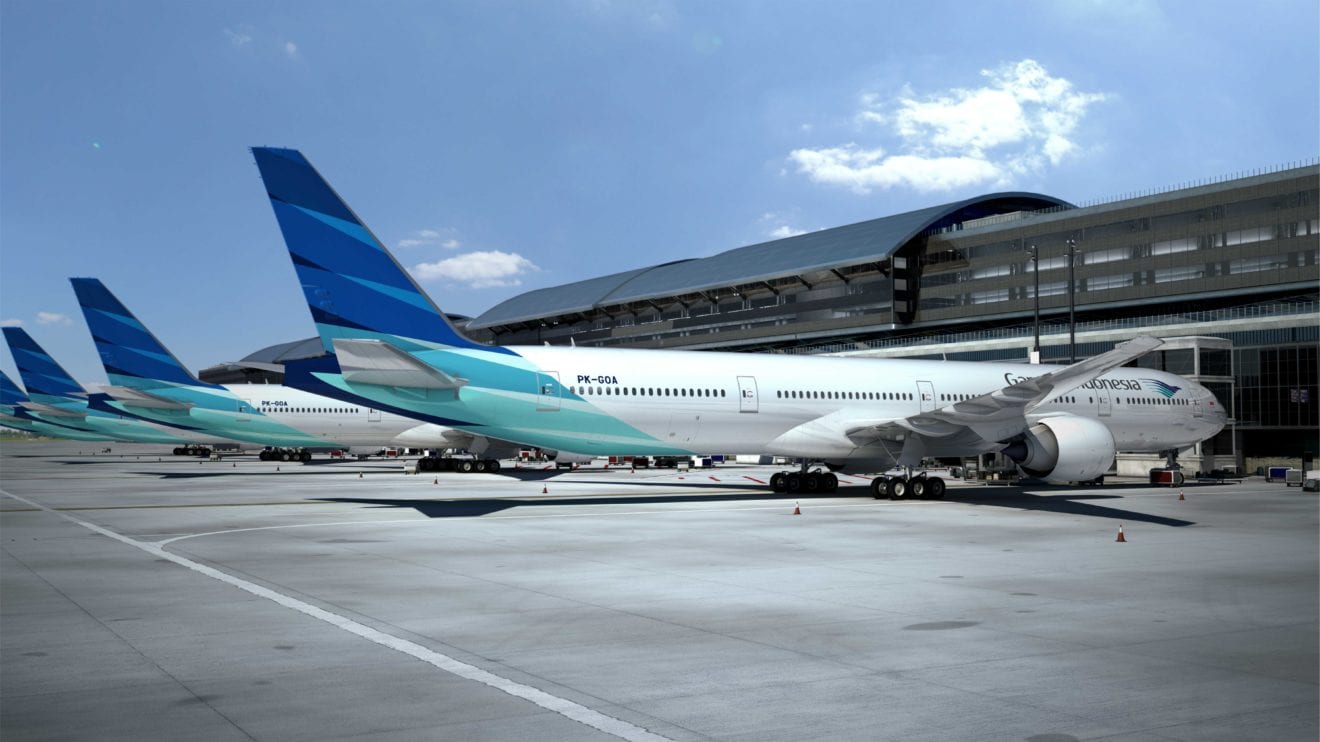
  • Garuda Indonesia Keeps Expanding Despite 89% Profit Slide

    Garuda Indonesia Keeps Expanding Despite 89% Profit Slide

    Indonesian flag carrier Garuda Indonesia will continue expanding despite a lackluster performance last year during which profit dropped by 89%, President Arif Wibowo said on Wednesday.

    Garuda posted $8.1 million in net income in 2016, from $76.5 million the year before. Wibowo said the decline was “manageable,” and attributed it in part to the company’s increased flights on existing routes and the opening of new ones. Garuda last year started connecting Indonesia’s resort island, Bali, with a few Chinese cities, and commenced flights to Mumbai.

    Its available seat kilometers — a measure of passenger-carrying capacity — last year was up by 13%. Wibowo said he expects a similar increase this year.

    “First half of 2016 was loss-making due to the expansion,” Wibowo said. “But that is part of a growth strategy that I must take. In 2017 we’ll keep maximizing our capacity growth, by 10-12%.”

    To achieve this, Garuda will increase its service to less-connected, underdeveloped eastern Indonesia regions. For international destinations, China will remain a focus, though Garuda is also working on flying to the U.S. and Russia.

    Profit was also dragged down by declining passenger yields — measure of average fare paid per mile — which dropped from 9.6 U.S. cents in 2012 to 6.2 U.S. cents in 2016 industrywide in Asia Pacific.

    Garuda’s low-cost subsidiary, Citilink, was especially hit hard by declining yields. It posted a net loss of $9.7 million last year from a $3.5 million profit it made in 2015, despite an 18% growth in passengers to 11 million.

    Garuda saw its passenger numbers grow just 1.4% in the same period. The group’s market share in the country shrank slightly from 43.5% to 41.7% for domestic flights, and from 27.1% to 26.9% for international ones.

    “It’s very tough competition in the aviation industry over the past five years. Passenger traffic has increased, but there has been tremendous pressure on yields,” Wibowo said.

    He added that the state-owned company is approaching the government to increase lower tariff limits for airlines operating in Indonesia, citing increasing fuel prices, to prevent a price war.

    GMF AeroAsia, which offers maintenance services for aircraft, was the best-performing subsidiary last year with a 60% profit increase to $57.7 million. Wibowo said the consistently good performance makes GMF a candidate for an initial public offering. Garuda is mulling the sale of 20% of GMF share to the public, which may happen this year.

    The airline is also pushing the growth of its cargo business after the establishment of a special division for cargo last year. Director of Cargo Sigit Muhartono said he would focus on expanding e-commerce delivery for the higher yields. Garuda delivered 416 tons of cargo last year, an 18% increase year-on-year.

  • PLDT launches “Fibr city” in Cebu

    PLDT launches “Fibr city” in Cebu

    PLDT has ramped up its FTTH rollout with the launch of what it calls its first “Fibr City” in Cebu, which provides residents of Toledo City with speeds of up to 1Gbps.

    The initiative, named after PLDT’s Home Fibr branded FTTH service, has been conducted in collaboration with the Toledo City government.

    PLDT has invested $6 billion over the past ten years to roll out 150,000km of fiber infrastructure, and its FTTH services had a footprint of around 2.8 million premises by the end of last year.

    Last month, the operator announced plans to expand the reach of the network by around 80% this year, taking the total number of premises passed to around 4.4 million. The operator has also started adopting hybrid fiber technologies such as G.fast to boost data rates significantly over existing copper connections.

    By next year, PLDT aims to ensure that all its subscribers are accessing smart home services enabled by the fiber network.

    The company selected Toledo City to pioneer the Fibr City concept as part of its expansion plans in Central Philippines, the report states.

  • Cloud components market to hit $41b by 2021, says report

    Cloud components market to hit $41b by 2021, says report

    Ongoing customer build-outs of hybrid environments is fueling cloud components growth as IT vendors modernized hardware and software portfolios.

    According to a report from Technology Business Research (TBR) the cloud components market, which encompasses the foundational building blocks for on premises cloud environments, will grow from an estimated $27 billion in 2016 to $41 billion in 2021 at an 8.4% CAGR.

    Cloud hardware components revenue will generate most of total cloud components revenue; however, we expect long-term market growth will be sustained by cloud software components as hybrid cloud demands rise and underlying cloud infrastructure becomes commoditized, TBR said.

    Sanjay Medvitz, TBR cloud analyst, said, “Enterprise hybrid IT environments continue to grow, increasingly encompassing disparate on-premises and cloud assets as well as infrastructures from multiple vendors, driving up the importance for software solutions that provide efficient management, orchestration and cloud services capabilities to ease complexities.”

    “Accordingly, vendors such as IBM and Oracle are shifting focus to cloud software businesses that offer high-value opportunities for long-term success,” Medvitz said.

    From a hardware perspective, customers’ ongoing migrations to public cloud services and software-defined storage-enabling hyper converged platforms will render standards-based servers as critical aspects of cloud computing environments across a range of customer segments.

    Meanwhile, TBR notes that customers will invest in flash storage capabilities, along with gradual build-outs of virtualized network implementations to further accelerate performance, simplicity and reliability of their hybrid and heterogeneous cloud data centers.

    Industry stalwarts Hewlett Packard Enterprise, IBM, Dell EMC and Cisco held top market share among cloud components vendors in 2016, leveraging legacy hardware and software strengths and large install bases alongside investments in private and hybrid cloud-enabling technologies such as hyper-converged to win customer modernization engagements.

    Market leaders will continue to modernize legacy assets, innovating hardware and software together to create common architectures and building out cloud based versions of traditional solutions to promote flexible cloud on-ramps and meet evolving customer hybrid IT needs.

  • Polaris Industries to recall about 19,200 ATVs

    Polaris Industries to recall about 19,200 ATVs

    Polaris Industries Inc is recalling about 19,200 all-terrain vehicles due to fire hazard and risk of injury, the U.S. Consumer Product Safety Commission said on Tuesday.

    Polaris will recall all model year 2015 and 2016 Sportsman 850 and 1000 all-terrain vehicles, the U.S. consumer-safety regulator said.

    The right side panel heat shield in the ATVs can melt, posing burn and fire hazards to riders.

    In addition, the exhaust springs can stretch and damage the exhaust seal in 2015 Sportsman 1000 ATVs, resulting in exhaust leaks that could pose burn and fire hazards.

    Polaris has received at least 793 incidents, including reports of warped, melted or burned side panels, 47 fires and four minor burn injuries, the regulator said.

  • Philippines forges agri deals with Thailand in Duterte visit

    Philippines forges agri deals with Thailand in Duterte visit

    The Philippines on Monday signed agricultural deals with Thailand, three months before it scraps a quantitative restriction on rice imports under an agreement with the World Trade Organization (WTO).

    The agricultural agreement encompasses information exchange concerning best practices in irrigation, livestock and fisheries, and technology for soil and water conservation, said President Rodrigo Duterte in a joint statement with Thai Prime Minister Prayut Chan-o-cha.

    “The Philippines and Thailand have vibrant economic relations with a trade value of almost $8 billion in 2016. We have yet to reach the limit of our potentials. That is why we also recognize the importance of cooperation in agriculture…our agricultural sector should drive national growth,” he said.

    Thailand is one of the Philippines’ primary sources of imported rice. In December, the National Food Authority (NFA) said private traders would import 284,780 tons of rice from Thailand. This is in addition to 250,000 tons that the NFA bought in August last year from Vietnam and Thailand.

    Agriculture Secretary Emmanuel Pinol said last year that he would need 2 more years to strengthen Filipino rice farmers’ capacity to compete with their peers in Vietnam and Thailand.

    While cheaper imports would bring down retail costs of the country’s staple grain, it would pose a threat to Filipino farmers’ livelihoods, because production costs in those countries are cheaper and output more plentiful.

    The Philippines is set to host the Association of Southeast Asian Nations’ (ASEAN) Second Meeting of the Joint Agricultural Working Group in 2019.

    Aside from agriculture, the Philippines also forged agreements with Thailand regarding tourism, and the promotion of exchanges that aim to enhance their capacities for science and technology.

    The two countries also agreed to ensure security and stability in the region, and address issues particularly terrorism, sea piracy, and illegal trafficking of drugs and people.

    They also stressed the need to maintain peace and stability in the region, including the South China Sea.

    “We emphasize the need for the full and effective implementation of the Declaration of Conduct of Parties in the South China Sea, and express determination to complete the Framework of the Code of Conduct in 2017,” Duterte said.

    Duterte visited Myanmar on Sunday, before he flew to Thailand on Monday.

  • Pandora officially opens new factory in Thailand

    Pandora officially opens new factory in Thailand

    The new factory, which opened operationally on October 1, 2016, was officially inaugurated today (March 22) and revealed to the world’s press and key members of the global Pandora team.

    Taking design inspiration from the brand’s signature charm bracelet, the manufacturing facility is primarily optimised for the production of the more time-consuming products in Pandora’s portfolio.

    The facility, when at full capacity, will employ up to 5,000 members of staff and aims to “set new standards for the jewellery industry in terms of scale, size, green profile and modernity.” The overall aim is to incorporate flow principles and semi-automation to reduce lead times by up to 50%.

    According to the brand, the factory is a flagship green facility for the international company. Built to LEED (Leadership in Energy and Environmental Design) standards, it consumes 18% less energy and 45% less water than conventional jewellery crafting facilities.

    Pandora2

    Pandora’s new crafting facility

    Guests, including Pandora chief executive Anders Colding Friis, view the new facility on the official opening day

    Speaking at today’s factory launch, chief executive officer for Pandora Anders Colding Friis said: “It’s a proud day. I was thrilled to see how it would look and it looks even better in reality and is a reason to congratulate all of us.

    “This factory plays an important role in Pandora’s future. We need to be agile and flexible and this new factory will provide this service. We need to expand in necklaces, earrings and rings and into new markets.

    “We are one of the world’s most loved jewellery brands and this is a true statement for our future […] It’s really incredible, a state of the art centre.”

    The Lamphun factory forms part of a larger capacity project for Pandora that will potentially double the brand’s output capacity to more than 200 million pieces a year by the end of 2019.

    The project also includes building a new crafting facility in Gemopolis in Bangkok, and optimising the brand’s existing factory located in the Gemopolis region.

    In addition to the official factory opening, the Danish jewellery behemoth has also used today to officially launch its new SS17 campaign, #DOPANDORA.

    The campaign is a change in direction for Pandora with the new lifestyle imagery capturing moments in time.

  • Route to success

    Route to success

    CEO Nguyen Thi Phuong Thao, who created the concept of bikini-clad flight attendants, told local media that she wants to make Vietjet become the “Emirates of Asia”.

    Such goals are admirable, and insiders believe the IPO will bring further success to the “bikini airline”.

    Taking off

    After five years of operations, Vietjet has had a level success that other airlines would envy.

    Vietnam’s only private airline ordered 100 new jets from Boeing in May last year, worth $11.3 billion, and signed a contract in September to purchase 20 A321 aircraft from Airbus, witnessed by State President Tran Dai Quang and French President François Hollande.

    With the two contracts, it continues to drive towards its goal of having a “Red Revolution” in Vietnam’s aviation sector and becoming a global airline.

    The five-year-old Vietjet surpassed national flag carrier Vietnam Airlines in domestic passenger transport during the recent Tet holidays, according to the Civil Aviation Authority of Vietnam (CAAV).

    Over the six-day holiday, Vietnam Airlines carried 175,146 passengers and Vietjet 209,179, for market shares of 35 per cent and 42 per cent, respectively.

    The only competitor of Vietjet Air is low-cost carrier Jetstar Pacific, a subsidiary of Vietnam Airlines. But Vietjet Air far outstrips Jetstar Pacific in revenue and market share.

    While Vietnam Airlines, in which the State owns more 90 per cent, found it quite difficult to find strategic partners, Vietjet attracted 26 foreign investors after announcing its plan to conduct an IPO.

    Vietjet has also closed the gap with Vietnam Airlines in terms of profit.

    While Vietjet’s pre-tax profit increased 91.6 per cent in 2016 to VND2.3 trillion ($101.9 million), Vietnam Airlines’ pre-tax profit was VND2.5 trillion ($110 million), up 140 per cent and 7 per cent higher than the annual plan.

    And its share price is much more attractive than Vietnam Airlines’.

    According to the Hanoi Stock Exchange (HNX), Vietnam Airlines’ shares trade on the UPCoM Market with a reference price of VND28,000 ($1.2) and are expected to reach VND40,000 ($1.7).

    Vietjet’s reference price, meanwhile, has been predicted to stand at VND90,000 ($4).

    “The capital raised by Vietjet in the offering will help support the expansion of its international routes and the enlargement of its fleet, which are critical for it to compete in the Asian aviation market – one of the fastest growing and most dynamic aviation markets in the world,” said Mr. James Grandolfo, a Partner in the Hong Kong office of Milbank, which is the advisor in Vietjet’s IPO.

    The appeal of Vietjet is its low cost, as budget airlines have become the key driver of Vietnam’s fast-growing aviation market and transported 55 per cent of domestic passengers in 2016.

    Budget airlines are rapidly increasing their market share, with an annual growth rate of 15-20 per cent, according to Mr. Lai Xuan Thanh, Head of CAAV.

    Given the strong development of low-cost airlines, Vietjet, the dominant player in Vietnam’s low-cost market, quickly captured a 40 per cent share of the local market and will likely surpass Vietnam Airlines within the next few years as Vietnam’s largest domestic carrier.

    So who will benefit from Vietjet’s IPO? Obviously, it’s a win-win for Vietjet and its partners.

    The economy, according to many economic experts, will also be a winner from the deal.

    “A sizable capital source will be mobilized, in particular funds from foreign financial institutions,” said Mr. Nguyen Hoang Hai, Deputy Chairman of the Vietnam Association of Financial Investors.

    “The IPO will be a test of how much foreign capital Vietjet can rally by promising continued expansion and rising profits, banking on the past few years of impressive growth that have turned it from a startup to a major carrier that is expected to soon hold the largest market share in Vietnam.”

  • IoT adoption in retail set to take off

    IoT adoption in retail set to take off

    Retailers will connect 12.5 billion business assets such as products, digital signs and Bluetooth beacons to IoT platforms by 2021, up from 2.7 billion in 2016, Juniper Research has predicted.

    The company has argued ‘next-gen’ processes, such as personalized retail, could be achieved by integrating enterprise software and emerging technologies, with data from connected IoT assets.

    Juniper forecasts that software spend for enterprise resource planning (ERP) systems to integrate this data would reach $11.3 billion annually in 2021, from $1.5 billion in 2017.

    The research firm also predicted that radio-frequency identification (RFID) will re-emerge as the industry’s ‘killer app’ becoming the key factor in the IoT retail ecosystem.

    RFID tags, used to identify and locate retail assets in real-time, are now at a low enough price point for mass deployment and integrate well with new IoT systems and analytics. New services, such as dynamic pricing or enabling promotional offers via in-store digital signs are also poised for growth.

    “Innovative retailers such as Rebecca Minkoff have combined RFID with smart mirrors,” said research author Steffen Sorrell. “Integrating these systems allows real-time information to improve the store experience and bridge physical and virtual worlds – in this case, the concept drove a 200% increase in sales.”

    Juniper believes that physical retail spaces still have many benefits, not least in terms of being able to avoid the sterility of online shopping. It predicts online retailers’ focus would be on technologies such as machine learning to provide digital assistance, or digital performance management.