Tag: asia

  • Canadian fund buying into Pavilion Dalian mall

    Canadian fund buying into Pavilion Dalian mall

    In a third investment deal in retail real estate in China within in two weeks, the Canadian Pension Plan Investment Board (CPPIB) has signed up to acquire a 40 per cent interest in the Pavilion Dalian shopping mall for $162 million.

    This takes the period’s spending to $684 million for Canada’s largest pension fund. Its latest acquisition is fully leased with the usual mix of local and international brands as well as international eateries.

    “Acquiring a stake in Pavilion Dalian is consistent with our real-estate strategy of investing in high-quality, well-located retail assets with leading partners” says CPPIB head of real-estate investments for Asia Jimmy Phua.

    CPPIB acquired its stake in the retail complex from Malaysia’s Pavilion Group, which opened the mall last year. The deal comes just 14 days after CPPIB put up $147 million for a 49 per cent stake inLongfor Properties’ West Paradise Walk. The six-level shopping mall in the western Chinese city of Chonqing had has a 99 per cent occupancy rate for the past two years.

    Also within the last fortnight, CPPIB invested more than $375 million for a 25 per cent stake in CapitaLand’s Raffles City China Investment Partners III fund. The $1.5 billion investment vehicle targets mixed-use developments in China’s gateway cities.

    A few years ago, CPPIB invested $202 million for a stake in Times Paradise Walk in Suzhou.

  • Richemont sales woes prompt radical response

    Richemont sales woes prompt radical response

    With Chinese shoppers buying fewer watches, Richemont sales continue to slide, prompting the luxury brand owner to announce uncharacteristically radical moves.

    While continuing to cull its store network, Richemont has axed its CEO role, placing more accountability in the roles of its brand executives.

    Richemont, which counts luxury timepiece brands Vacheron Constantin and IWC in its 35-strong portfolio, says trends are improving in Mainland China, Hong Kong and Macau. But with more of its portfolio in watches than rival corporate fashion groups LVMH and Kering, it is more exposed to current market trends and less resilient. Richemont also owns Cartier, Chloe, Dunhill, Giampiero Bodino, Jaeger-LeCoultre, Lancel, Montblanc, Officine Panerai, Piaget, Peter Millar, Purdey, Roger Dubuis, Shanghai Tang and Van Cleef & Arpels.

    Profits fell 43 per cent (including exchange rate effect) to €798 million for the six months to September, and the company has expressed its concern at overcapacity in the Swiss watchmaking industry. A large factor in the poor result was the €249 million buy-back and destruction of excess products to reduce overcapacity in the distribution chain.

    Sales were down by 13 per cent to €5.1 billion, but significantly this was led by Japan and Europe, rather than Hong Kong and Macau as in past reporting periods. Mainland Chinese buyers still played their part in the decline, however: fewer are visiting Europe due to concerns over terrorism, and the depreciation of the yuan has impacted on spending in Japan.

    The company closed 25 shops globally during the first half and another 25 are scheduled for closure by December 31. It did not reveal the locations of these stores.

    The end of the CEO post coincides with the retirement of outgoing chief Richard Lepeu and finance director Gary Saage. The company’s founder, South African-born Johann Rupert, will remain in the role of executive chairman and will take over supervising a group of division directors.

    Richemont has a reputation for managing for the long-term and resisting the sort of knee-jerk reactions typical among listed companies ever-concerned about satisfying shareholders.  “The significance of such a dramatic break with the past can’t be overstated,” observed an analyst with Bloomberg.

    “They indicate that it doesn’t expect conditions to get any easier any time soon, so it needs a fresh approach. It just might work. And it’s not as radical an idea as it might seem,” wrote columnist Andrea Felsted.

    She suggests the company may need to fix or divest underperforming brands

    “It also needs to control the cost base by addressing headcount, which it has already started to do, and slimming the store estate. The danger is that the new management structure is cumbersome, lacking cohesion, and is ripe for internal power struggles. Rupert will remain the constant, and is likely to take greater control as a result of the radical revamp. He says his role is that of ‘an arbiter of egos, akin to a soccer manager’.”


  • Trump Victory Effect Only Temporary Visible in Asia

    Trump Victory Effect Only Temporary Visible in Asia

    Coordinating Economic Minister Darmin Nasution believes that the impact of the US presidential election on Indonesia’s economy is only temporary. Darmin said that the government would anticipate changes in the market after Republican presidential candidate Donald Trump won the election.

    “We shouldn’t be worried about the election. There will be an impact on the economy, but it’s only for a short term,” Darmin said at his office on Wednesday.

    The election results announced today showed that Donald Trump gained 288 votes, exceeding the minimum winning threshold of 270 votes. His rival from the Democratic Party Hillary Clinton obtain 215 votes.

    Industry Minister Airlangga Hartarto echoed Darmin’s comment saying that the US presidential election would not have direct impact on the national industry. Instead, Airlangga suggested that the US presidential election would have a significant impact on the capital market.

    However, Airlangga warned that the election results could affect the Fed rate revision in December. In addition, Airlangga said that he would revisit the plan to join the Trans Pacific Partnership.

    During his campaign, Trump revealed his plan to cancel all trading agreements that could cause losses to the US. Trump also criticized the TPP as a danger for the US. Trump further called for cancellation of the North America Free Trade, since it would have negative impacts on job opportunities in the country.

  • Philippines to hold auction for 3rd telco in mid-2017

    Philippines to hold auction for 3rd telco in mid-2017

    The Philippines’ telecoms regulator NBTC plans to hold a spectrum auction for a third entrant into the mobile market in mid-2017.

    The spectrum surrendered by incumbents Globe and PLDT as a condition of their acquisition of San Miguel’s telecoms assets will be bundled together for the auction.

    According to the report, spectrum in the 700-MHz, 2500-MHz, 800-MHz and 3500-MHz bands will be put on the block.

    Several groups have already expressed an interest in potentially participating in an auction to create a third operator. Conglomerate San Miguel had originally intended to fulfil this role, but negotiations with Australia’s Telstra to form a joint venture for the purpose fell through earlier this year.

    San Miguel subsequently sold off all its telco assets to the two incumbent operators for around $1.5 billion. The main motivation was to gain a part of the 700-MHz spectrum band, which San Miguel held the exclusive rights to.

    But as a condition of the acquisition Globe and PLDT were required to relinquish part of the 700-MHz band – as well as spectrum in the 850-MHz, 2500-MHz and 3500-MHz bands – to allow for the potential entry of a third competitor.

    Advocacy groups have expressed concern that the bundle of spectrum due to be put up for auction will not be enough to sustain a major third player, noting that PLDT and Globe between them own nearly 80% of the total available spectrum. Parts of the remaining 20% will be unusable due to the presence of guard bands.

  • Singtel Q2 revenue falls 2.3%

    Singtel Q2 revenue falls 2.3%

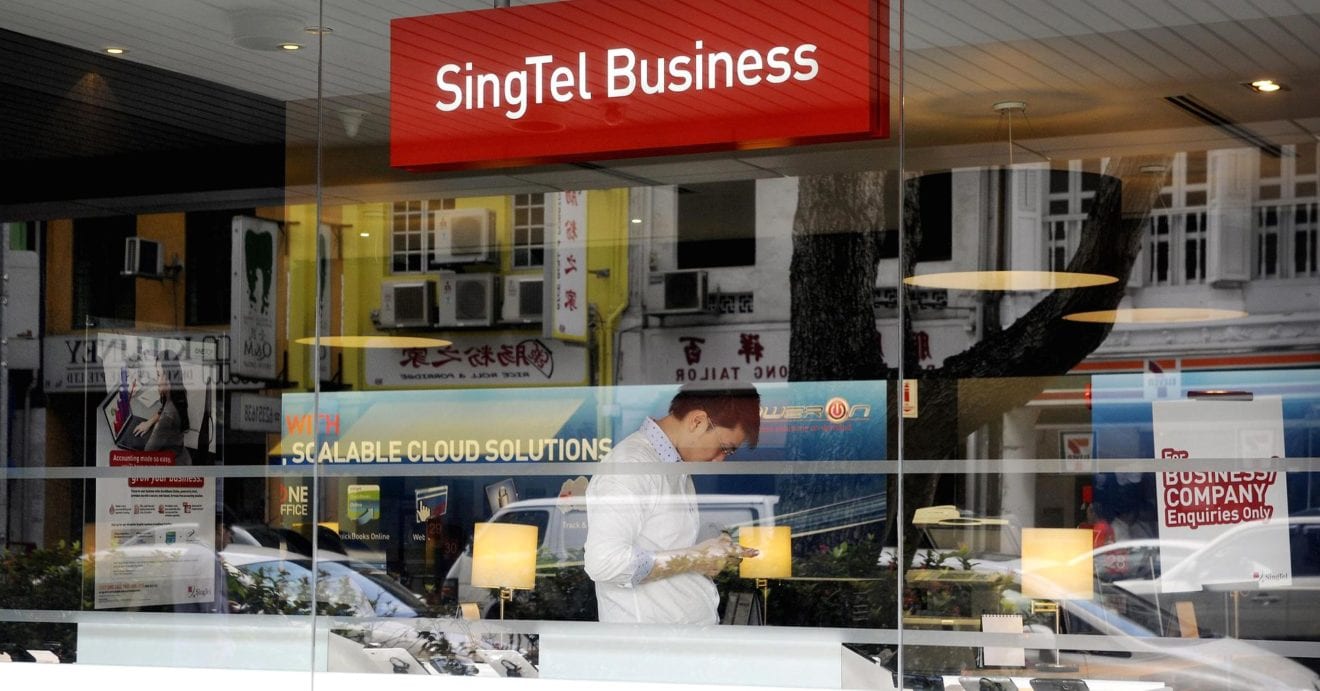
    Singtel has reported a 2.3% decrease in group revenue for its fiscal second quarter to S$4.08 billion (2.89 billion), as the company felt the impact of regulatory changes in Australia.

    Australian competition regulator ACCC’s decision last year to cut termination rates from 3.6 to 1.7 cents per minute impacted the performance of Singtel’s wholly-owned Australian subsidiary Optus. Excluding this impact, revenue would have grown 2% to S$4.28 billion.

    The impact of the rate cut contributed to Singtel reporting an 8% decline in its group consumer revenue, covering both Singapore and Australia. In Singapore, revenue fell 3% due largely to lower handset sales and a rise in penetration of lower-priced Android handsets.

    Group enterprise revenue by contrast grew 5% on the back of strong demand for cyber security and international data services.

    Net profit fell 6% year-on-year to S$972 million, due to exceptional gains recorded by Indian mobile affiliate Airtel in the previous corresponding quarter.

    Underlying net profit by comparison was stable for the quarter and up 3% for the first half of the financial year.

    Regional mobile associates’ pre-tax profit contributions grew 7% to S$679 million as a result of strong operating results from Airtel and Indonesia’s Telkomsel. The latter’s pre-tax profit jumped 22% as it reaped the results of investments in its voice, data and digital businesses.

    The group’s total customer base – including its mobile affiliates – grew 3% to 629 million subscribers.

    Singtel is currently projecting a low single digit decline in group operating revenue but stable ebitda for the full year.

  • Ooredoo to deploy Ericsson cloud-ready revenue system

    Ooredoo to deploy Ericsson cloud-ready revenue system

    Ooredoo Group has signed a five-year contract with Ericsson to implement the Swedish vendor’s revenue management system across the group’s operations in the Middle East, North Africa and Southeast Asia.

    Ericsson Revenue Manager, a cloud-ready convergent charging and billing system, provides Ooredoo with a number of advantages as the telco group updates its product portfolio and drives the development of digital innovation across its markets.

    Simple configuration reduces dependency on technical departments, makes it easier and faster to launch new services with tailored pricing and packages. This enables Ooredoo companies to offer customers new services and the products they need in minutes, rather than months, the companies said.

    The solution will also help Ooredoo more easily create digital services that spans beyond telecoms and integrates with partners from different industries.

    “Across our footprint, Ooredoo is aiming for data experience leadership, and placing renewed emphasis on empowering our customers and giving them the services they need when they need them,” said Waleed Al Sayed, deputy CEO at Ooredoo Group.

    Through this agreement with Ericsson, we will enable every Ooredoo operation to deliver fast, customer-oriented offers and launch new data products and services that support our growing portfolio of digital services and enables the growth of the Internet of Things.”

    Ooredoo will begin rolling-out the solution for Indosat Ooredoo, its largest operation in Indonesia, over the next month, before deploying across its other operations later this year and 2017.

    Upon the completion of the project, Ooredoo is expected to realize significant cost savings from replacing its existing systems and local agreements with a pioneering new group-wide license model.

  • Toyota says production of C-HR model begins in Turkey

    Toyota says production of C-HR model begins in Turkey

    Toyota Motor Corp launched production in Turkey on Wednesday of its C-HR compact SUV crossover and said the model would be exported to all global markets including North America.

    In a statement, Toyota said production was beginning with an initial investment in Turkey of 350 million euros ($390 mln).

  • Rhenus opens its first office in South Korea

    Rhenus opens its first office in South Korea

    The Rhenus Group is opening its own business operations in South Korea at the beginning of November. The logistics specialist also founded the national company known as Rhenus Logistics Korea at the same time. The office in the South Korean capital Seoul will organise sea and air freight operations, third-party logistics and domestic transport services in future.

    “The primary motive for opening the business site in South Korea is to continue consolidating our Asian network; we’ve been continually expanding this during the past few years. Seoul forms the centre of South Korea and is the focal point of the Sudogwon metropolitan district.

    “More than 25 million people live there and this accounts for half of the population of the country; it therefore provides an excellent starting point for our range of logistics solutions,” says Tobias Bartz, who is responsible for the logistics specialist’s Asian business on the Rhenus Management Board, citing the reasons for the latest developments.

    The Rhenus Group is particularly aiming to establish itself as a partner for transporting, handling and storing raw materials, semi-finished products and industrial and consumer goods in the South Korean market with its complete range of services. Rhenus Logistics Korea then plans to develop the individual solutions for specific sectors, combined with local expertise.

    Much of the country’s trade takes place with Europe – but the new company will also focus on transport between different Asian countries. In terms of its infrastructure, South Korea provides excellent conditions for sea and air freight services for the new national company with Incheon International Airport, one of the largest in Asia, and the port of Busan, which is one of the top 10 in the world according to the number of containers handled. “We also envisage further growth in this market in future after completing the starting phase in Seoul,” says Bartz.

  • Mobile financial services booming in emerging markets

    Mobile financial services booming in emerging markets

    The total transaction value of mobile financial services in emerging markets will reach $500 billion in 2021, up from $198 billion in 2016, Juniper Research estimates.

    The estimates include revenue from domestic money transfers, deposits on loans, insurance products, and savings accounts.

    The research argues that by introducing insurance offerings, operators had the opportunity to substantially reduce churn levels.

    It cited the example of Telenor Suraksha life insurance scheme in India, which has seen nearly 50% of its 45 million user base sign up since its December 2015 launch.

    “The model underpinning the Surakhsa scheme – requiring consumers to top-up airtime on a monthly basis to receive the insurance cover – should be widely replicated. It enables operators to maintain average revenue levels within low-income, low-ARPU prepaid environments and allows consumers to reap the benefits of micro-insurance cover,” said Lauren Foye, research analyst, Juniper Research.

    However, the research cautioned that a key challenge would be tailoring financial service products to the needs of individual markets. It cited the case of several early implementations of mobile financial services in markets such as India, the Philippines and Nigeria achieving limited adoption where products were often ill-suited to their target audience.

    Opportunity in New Markets

    The research also highlighted the Asia-Pacific as a region which, while currently under-served due in part to the complexity of national regulations, has strong potential for future product launches.

    Whilst restrictions have been in place previously, largely due to cultural beliefs, Juniper found that attitudes are changing in under-served regions, with Indonesia acquiring its first ever microloans product Kashmi in 2017.

    Additionally, specialized products have been launched to address religious requirements, such as Achuwat in Pakistan which provides interest free loans to meet Sharia requirements.

  • GO-JEK acquires Pune-based mobile app developer Leftshif

    GO-JEK acquires Pune-based mobile app developer Leftshif

    Indonesia-based leading startup GO-JEK on Tuesday announced that it has acquired Pune-based mobile application developer Leftshift for upscaling its product development, design and engineering platforms.

    This is the fourth Indian start-up acquisition by the Indonesian startup.

    “Our partnership with Leftshift over the last one year has been an amazing experience, they are arguably among the best mobile app developers in the country. We look forward to their team becoming a part of the GO-JEK family,” said Sidu Ponnappa, Managing Director, GO-JEK Engineering India, in a statement.

    Leftshift was started in 2007 with the intent of creating “loveable apps” that people would find easy and convenient to use.

    “The opportunities and challenges at GO-JEK are beyond thrilling. Our resources and technology would certainly complement and accelerate product development at GO-JEK,” added Sudhanshu Raheja, founder and CEO, Leftshift.

    According to GO-JEK, it intends to continue shoring up its India operations as it eyes more talent for key processes like data science, mobile, security and DevOps.

    The financial details of the acquisition were not disclosed.

  • Government Push Google to Pay Tax

    Government Push Google to Pay Tax

    Director General of Tax Ken Dwijugiasteadi confirmed that Google Asia Pasific Pte Ltd will settle their tax debts by the end of 2016. The government has decided to negotiate with the company instead of filing a report to the police. “Google must pay their tax debts this year, the company and the government will release a statement after the investigation,” Ken said on Monday.

    Ken had met with Google representatives last week. According to the Director General, Google has the right to file their objection towards the tax investigation results as long as an agreement has not been made. The company however, will be required to pay off their debts based on the investigation’s closing conference.

    In response to the issue, Google spokesman Jason Tedjakusuma refused to provide any comment. Jason also refused to respond to questions related to the results on last week’s meeting. “No comment,” Jason said briefly.

    The government estimated that Google Asia Pacific’s revenue, based on service and product sales in Indonesia, had reached Rp 5.5 trillion. On the other hand, Google representative office in Indonesia only generates revenues from advertising services.

    Google Indonesia had been registered at the Tanah Abang Tax Office as a foreign investment company since September 15, 2011. However, state officials cannot collect the company’s taxes because Google is not registered as an Indonesian legal entity.

    Yustinus Prastowo, Executive Director of Center for Indonesia Taxation Analysis doubted the government’s ability to force Google to pay their taxes by the end of 2016. “Even if there is a payment, it wouldn’t be as large as it was expected,” Yustinus said.

  • TrueMove deploys Procera’s ScoreCard

    TrueMove deploys Procera’s ScoreCard

    Thai mobile service provider TrueMove has deployed Procera’s ScoreCard technology to monitor the quality of experience (QoE) its network is delivering to subscribers across 2G, 3G, and 4G LTE.

    ScoreCard is being used for raw QoE KPI intelligence and the visualization of network performance, thereby helping to guide capex investments and better service planning.

    TrueMove’s management can quickly use the data and visualization to further aid business investment decisions, maximize ROI, and reduce churn among the subscriber base.

    “Mobile operators are increasingly differentiating their offerings by delivering a differentiated experience to subscribers,” said Viriya Upatising, CIO at TrueMove.

    “Procera’s solutions enable TrueMove to see the actual experience delivered to their subscribers in real-time, and ScoreCard provides unique QoE KPIs and visualization that is ensuring the experience is a good one for all subscribers.”

    As higher bandwidth mobile devices, connected cars, and the Internet of Things (IoT) continue to proliferate, TrueMove needs better intelligence about the QoE delivered to subscribers to maximize the return on investment for its capex.

    ScoreCard has been deployed across TrueMove’s network to measure the quality of mobile broadband delivery. No Personally Identifiable Information (PII) is collected from the subscribers, but the overall quality of the broadband service is measured and fed back to a centrally deployed Procera Insights system.

    ScoreCard has already identified several areas of investment that will improve the QoE of the TrueMove network, and action has been taken to enhance the subscriber experience based on ScoreCard’s recommendations.

  • Singapore Post launches eComm Log Hub

    Singapore Post launches eComm Log Hub

    Singapore Post has launched its Regional eCommerce Logistics Hub (eComm Log Hub) at Tampines Logistics Park.

    Costing S$182 million (US$131 million), the hub is SingPost’s largest eCommerce logistics investment in Singapore to date.
    Officially opened by Singapore’s deputy-Prime Minister and Co-ordinating Minister for Economic and Social Policies Tharman Shanmugaratnam, the three-storey hub comprises two warehousing floors, 150 simultaneous loading bays and an office block. The total built-up area covers 553,000 sqft (51,375 sqm).

    On the ground floor is a fully automated parcel-sorting unit that can handle up to 100,000 packages a day, while the second floor has the automated warehouse. End-to-end sorting, shipping and returns management capabilities enable quicker order fulfilment.
    The eComm Log Hub will process parcels for delivery within Singapore and those to be shipped internationally.
    “The opening of our Regional eCommerce Logistics Hub is another milestone in the expansion of SingPost’s eCommerce logistics network, which now spans 19 markets across Asia Pacific, Europe and the US,” says SingPost chairman Simon Israel. “Singapore’s regional connectivity makes it ideally positioned to be a centre for eCommerce.”

    He says everything in the new building is scalable, “which means we can keep upgrading it to meet the needs of the future”.
    Also at the opening ceremony, SingPost launched its Centre of Innovation (COI). This was set up last year with support from the Economic Development Board to research logistics and postal services and products, in collaboration with research institutions.
    Initiatives from the SingPost COI include:
    * Enhancements to the eCommerce logistics platform to help support smart logistics;
    * A new version of the Self-service Automated Machine (SAM) platform to enhance customer experience and provide a seamless omni-channel experience encompassing the kiosk and the digital postal office;
    * Taking the online and offline world of retail shopping to the SingPost mall, allowing retailers to experiment with customer interaction;

    • Digitally transforming the post office so customers can conduct transactions faster and easier;
    • Innovating last-mile delivery options through building next-generation PopStations and experimenting with drone delivery.
  • Privacy is paramount to online consumers

    Privacy is paramount to online consumers

    More than half (55%) of consumers globally have decided against buying something online due to privacy concerns, a recent KPMG International survey indicates.

    The survey also revealed that less than 10% of consumers feel they have control over the way organizations handle and use their personal data. Respondents in most countries say privacy controls are more important than the potential convenience gained from sharing personal data.

    “An executive would be at risk of being fired if half their customer base disappeared after they made a crucial business decision,” said Mark Thompson, Global Privacy Lead at KPMG.

    “Failure to embed privacy into the DNA of their business strategy could ultimately lead to the extinction of a business given how closely consumers and regulators alike are paying attention to how organizations collect, store and use personal data.”

    The survey further revealed that 82% are not comfortable with the sale of their data to third-parties in exchange for the speed, convenience, product range, home delivery and price comparison that online shopping offers.

    Over two-thirds of people are not comfortable with smartphone and tablet apps using their personal data. In all markets but one, at least 75% of respondents said they were uneasy with their online shopping data being sold to third-parties.

    About 55% said a free fitness tracking device that monitors the well-being of users and produces a monthly report for them and their employer is also crossing the line.

  • Lippo Group betting on e-money in digital age

    Lippo Group betting on e-money in digital age

    Indonesia’s Lippo Group is turning e-commerce, electronic money and other information technology-related enterprises into a new pillar of its business, closely monitoring spending trends to gain a better foothold in the greater Southeast Asian market.

    The next phase for the banking and real estate conglomerate “will be the fourth industrial revolution,” CEO James Riady told The Nikkei Tuesday on the sidelines of the 18th Nikkei Global Management Forum here.

    Lippo Group was founded as a banking institution by Mochtar Riady, the current CEO’s father and a former head of Bank Central Asia. It branched out into real estate in the 1990s when subsidiary Lippo Karawaci developed a plot outside Jakarta that the group collected as collateral. Lippo Group has since also developed retail and hospital operations, which help boost property value. It now has more than 20 listed subsidiaries and rings up a total of about $7 billion in annual revenue.

    But the fall in resource prices and China’s economic slowdown have dealt a blow to the Indonesian economy, including to its real estate sector. Lippo Karawaci suffered a 23% drop in sales last year to 9.19 trillion rupiah ($702 million), as well as a 79% plunge in net profit to 535.3 billion rupiah.

    Business of the future

    Meanwhile, the proportion of smartphone users in Indonesia has risen from about 20% of the population in 2014 to almost 40% — about 100 million people — in 2015. “We must have inward creative disruption so that we can be transformed into a new area of growth, which is the digital economy,” James Riady said.

    In addition to its communications and media businesses, Lippo Group launched e-commerce site MatahariMall in September 2015. One of the platform’s strengths is that it can use Lippo Group’s retail network throughout Indonesia to move and distribute products — a definite plus in the face of competition from Lazada Group, a subsidiary of Chinese titan Alibaba Group Holding, and Tokopedia, in which Japan’s SoftBank Group has a stake. It was revealed in October that Japanese trading house Mitsui & Co., bullish on MatahariMall’s growth potential, was investing in the site’s operating company.

    Riady considers e-money his new focus. The goal is to get Lippo Group’s 120 million customers on board by allowing them to pay at hundreds of retail locations using the service. He plans to expand the group’s e-money offerings to other Southeast Asian countries, as well as include such services as depositing and transferring e-money. Riady sees a complete transformation in the way banks do business.

    Lippo Group and Singaporean ride-hailing company Grab agreed in July to cooperate on launching a mobile payment platform. The service will roll out in earnest at the end of the year.

    Following trends

    The spread of e-money will allow Lippo Group to closely track spending by its customers at retailers, e-commerce sites and other outlets. Riady hopes to use the service to bolster overseas expansion of the group and improve products and services associated with retail operations.

    Lippo Group is currently operating real estate businesses in Singapore and Hong Kong. But it will target Southeast Asia in the future to win over the region’s young, eager consumers. “What matters is how we can capture the [Association of Southeast Asian Nations] population of 600 million into our e-money accounts and world of services,” Riady said.

    In terms of Lippo Group’s real estate business, Riady expressed his interest not just in property development but in creating entire communities spanning retailers, hospitals and schools. The group has already built hospitals in Myanmar, and the CEO said the company is looking into Vietnam and Laos as well.