Tag: asia

  • Anta Sports shows positive result

    Anta Sports shows positive result

    Anta Sports Products is planning more than 1000 new stores this year after revealing another record profit. The Hong Kong-listed Chinese sports apparel and footwear manufacturer operates more than 11,600 stores in Greater China and beyond under its own Anta brand, and banners like Fila and Descente, for which it owns regional rights.

    In September last year it led a takeover bid for Amer Sports, which owns Salomon, Wilson, Arc’teryx, Suunto, Peak Performance and Precor, among other brands – a deal likely to be completed as early as next month.

    This year’s net profit was the fourth consecutive annual record and reflects growing popularity of sport and fitness in Mainland China and a strengthening of its online offer.

    The company’s profit jumped 32.9 per cent to RMB 4.103 billion ($613.13 million) last year on sales up 44.4 per cent to RMB 24.10 billion (US$3.597 billion).

    In a stock exchange filing, Anta said it was “cautiously optimistic” about the prospects of the business in China in the coming year, despite reduced business confidence across the region. It plans to open more than 1000 Anta-branded stores on the mainland this year along with up to 250 Fila, Fila Kids and Fila Fusion stores on the mainland and in Hong Kong, Macau and Singapore.

    Anta-branded products saw a mid-teens increase in retail sales in the latest quarter compared to the same period last year, however sales in stores bearing other banners rose between 85 and 90 per cent.

    Anta Sports, was founded in 1991 as a manufacturing supplier to the footwear industry. Since then it has grown to become China’s largest domestic sportswear brand, and industry analysts estimate it is the world’s third largest by market capitalisation after Nike and Adidas.

  • Coty sales, profit best estimates despite supply chain woes

    Coty sales, profit best estimates despite supply chain woes

    Coty Inc announced  its second-quarter results for fiscal 2019, confirming it expects to make in a net profit for the period, despite overall sales taking a dive and supply chain issues. The New York-based cosmetic and luxury fragrance company said net revenues for the second quarter came in at $2,511.2 million, for a decrease of 4.8%, while like-for-like revenues grew 0.7%.

    The company said it was helped by higher sales in its luxury segment, with strong holiday demand for the Gucci, Marc Jacobs and Burberry brands.

    That said, the maker of luxury perfumes recorded a net loss of $960.6 million compared to $109.2 million in the prior-year.

    Adjusted net income was $181.9 million, a decline of 23%, “driven by the lower adjusted operating income and the $41.8 million positive foreign tax settlement in the prior year,” said Coty in press release.

    Excluding certain items, the company earned 24 cents per share, topping expectations of 22 cents, and sending its shares up 20%

    “I must stress that while we are confident that we can return Coty to a path of sustainable growth, we are also realistic that it will take time to achieve this outcome,” Coty’s recently appointed Chief Executive Officer Pierre Laubies, said in a statement.

    Revenues in Asia, Latin American, the Middle East and Africa (ALMEA) totalled $567.4 million, to make up 23% of total revenues. Coty said the region showed solid growth despite impacts from supply chain disruptions. Revenues decreased 5% as reported, but grew 4% LFL, fuelled by strong growth in Luxury and Professional Beauty.

    However, Coty’s consumer beauty Max Factor declined in China.

    North America revenues were unchanged at $742.2 million, or approximately 29% of total net revenues, while Europe remained Coty’s largest market, accounting for close to half of company revenues at $1,201.6 million, down just 1% on last year.

  • 7-Eleven Malaysia predicts improved trading conditions

    7-Eleven Malaysia predicts improved trading conditions

    7-Eleven Malaysia CEO Colin Harvey believes the company can do ever better this year after a modest improvement in sales last financial year. The company’s revenue crept up 1.3 per cent last year to RM2.22 billion (US$546 million), with after-tax profit up 2.4 per cent to RM51.3 million ($12.6 million). Harvey says sales growth was driven by new stores and an improvement in same-store sales and consumer-promotion activity.

    “We continue to see opportunity for improvement. We are confident that our strategy roadmap focussed on strengthening the key areas of assortment, supply chain, operational excellence, store base, and digitally enabling the organisation will bear fruit in terms of financial performance, and overall customer shopping experience.”

    7-Eleven Malaysia’s board believes the trading conditions for the next quarter will improve,  driven by domestic demand and anticipated heighted consumer sentiment. The group plans to “continue to refresh the 7-Eleven brand in the mind of the customer” through innovative promotions, products and pricing.

  • Vietnamese beer sales now drive revenues for Sabeco’s new Thai owner

    Vietnamese beer sales now drive revenues for Sabeco’s new Thai owner

    Vietnamese brewery Sabeco has contributed 46 percent of the revenues of Thai parent ThaiBev in the first quarter of 2018-19. For the quarter ended December 31, 2018, it reported sales of VND13 trillion ($560.58 million) as ThaiBev announced net profits of VND5.54 trillion ($238.83 million) on total revenues of VND54.28 trillion ($2.34 billion), 35 percent and 60 percent up year-on-year.

    Beer products became its revenue driver for the first time with sales of VND24.84 trillion ($1.07 billion). Though spirits sales saw strong growth, their share of revenues dropped from 54 percent to 43 percent.

    In terms of sales by market, the group reported 52 billion baht ($1.66 billion) in Thailand, down to 71 percent from 96 percent last year. The other significant amount was Vietnam’s VND13 trillion or 23.9 percent.

    ThaiBev said while consumption in Southeast Asia is generally slowing, Sabeco has sustained impressive growth.

    Two months ago the Thai group became the majority shareholder in the Vietnamese brewer with a 53.59 percent stake following a debt-to-equity swap.

    It believes the acquisition of Sabeco would help its expansion in Vietnam, which has a youthful population, extensive distribution network and the strongest beer market growth in the region.

    Sabeco, formally known as Saigon Beer Alcohol Beverage Corp, reported a 5 percent rise in revenues last year to more than VND36 trillion ($1.56 billion).

    It has a 42.8 percent share of the Vietnamese beer market, according to the Ho Chi Minh City Securities Corporation.

    According to the Vietnam Beverage Association (VBA), the Vietnamese beer market is worth $3.4 billion.

    Securities company FPT Securities predicts the market will grow by 5-6 percent a year.

  • JD to hire 15,000 new employees

    JD to hire 15,000 new employees

    Chinese e-commerce giant JD has announced it plans to recruit up to 15,000 staff this year – just a week after saying it would let go 10 per cent of its senior executives. The majority of positions expected to be filled this year will be in logistics, with up to 10,000 delivery and low-level management positions being recruited. Other staff will be hired to improve user experiences in the firm’s retail arm.

    JD pledged in its announcement to promote competent staff and offer more leadership training to young people as part of its contribution to society. The firm currently hires around 170,000 full-timers, according to last year’s estimates, and is moving to extend its supply network throughout every one of China’s county-level territories.

    Some 20,000 R&D staff were hired last year in an RMB8.64 billion (US$1.29 billion) investment in technology research.

  • Avon 2018 sales dip, culls sales reps globally

    Avon 2018 sales dip, culls sales reps globally

    Avon reported its fiscal 2018 results earlier in the month, saying revenues declined as the beauty giant continued to cull it sales representatives across the globe. The London-headquartered company said total revenue decreased 2% for the twelve months, while like-for-like revenues decreased 3% in constant dollars. The number of Active Representatives declined 5% with decreases reported in all segments, said Avon, with Ending Representatives declining 8% with decreases reported in all segments.

    On a positive note, Avon’s average order increased 10%, while on a like-for-like basis, average orders increased 2%, primarily driven by increases in South Latin America, North Latin America and Asia Pacific, said Avon in a press release.

    Avon reinforced the positives of its “Open Up Avon” strategic plans, addressing falling levels of its representatives.

    “We are in the initial stages of our turn-around plan with fourth-quarter results showing sequential improvement in revenue trends in 4 of our top 5 markets, as well as some early signs of progress against our core strategies,” said Avon’s CEO, Jan Zijderveld.

    “As we look over the course of 2018, we are seeing tangible signs of increased productivity by our Representatives, with sequential increases in Average Representative Sales, Net Price Per Unit and e-commerce.”

    Avon made several cost-reducing decisions in 2018, including the announced sale of its China manufacturing facility. The cosmetic giant more recently announced its intention to reduce the global workforce by an additional 10% in 2019, on top of its already completed 8% reduction in 2018.

    “We have begun to identify repeatable business models in training and recruiting, while reducing our cost structure and taking steps to simplify our business infrastructure,” added Zijderveld.

    Avon reported a diluted loss per share of $0.10. Like-for-like diluted earnings per share was $0.01, compared with $0.06 for 2017.

  • Malaysia’s Kedai Ayamas Eatery plans 100 more stores

    Malaysia’s Kedai Ayamas Eatery plans 100 more stores

    Kedai Ayamas eatery operator Kara Holdings is looking to establish 100 outlets within four years through its new franchising program, predominantly within peninsular Malaysia. The move into franchising should elevate the company’s finances by 10 per cent this year to about RM40 million (US$9.85 million). Nine franchises have opened so far, with 20 more targeted within the year.

    “As Johor Corp’s wholly owned subsidiary, we complement the KFC business in terms of maximising the use and distribution of poultry products at the farm,” said Kara’s executive director Abd Rahman Md Dawi. “The poultry-relating business has always been a high-demand market for the food and beverage sector in Malaysia.

    “Last year, we registered a revenue of RM35 million [$8.6 million]”, he added. “With the additional franchise business, hopefully, it will amplify our revenue this year, coupled with Kara’s technological adoption of food delivery services such as Foodpanda and Grab-Food.”

    According to Dawi, the company is open to franchisee acquisition of Kara’s 40 corporate outlets. Six of the nine new franchises were acquired from the firm.
    “There are certain criteria that will be considered for us to sell our own shops, but we encourage the newcomers to open a new shop,” he said.

    Kara’s franchising program costs between RM100,000 and RM400,000 ($24,600–98,450), and includes management and operational training sessions.

  • English learning app co-founded by Vietnamese raises $7 million

    English learning app co-founded by Vietnamese raises $7 million

    ELSA has raised $7 million in a Series-A round from Google’s AI Fund Gradient Ventures and other U.S. investors. The investment round for ELSA, a mobile app that uses artificial intelligence and speech recognition technology to help language learners improve their English pronunciation, was led by Gradient Ventures, Google’s AI-focused venture fund.

    According to tech news provider Engadget, the Google fund will also offer “technical mentorship” to AI startups. ELSA will gain access to Google itself, including prominent figures such as investor and futurist Ray Kurzweil, design mastermind Matias Duarte and X lab leader Astro Teller.

    U.S. fund SOSV and Singaporean Monk’s Hill Ventures, strategic investment funds from the previous investment round, also invested in the app. In three years after its establishment, ELSA has successfully attracted $12 million through funding rounds in Silicon Valley, the U.S. and Asia.

    CEO and co-founder Van Dinh Hong Vu revealed that this round of funding will help the startup continue to recruit computer engineers and computer scientists in AI, and to explore new markets like Japan, Indonesia and India.

    ELSA currently has 4 million users from 101 countries worldwide, making it one of the top 5 AI applications with the most users. In 2018, the application recorded an increase in student enrolment by 350 percent over the previous year.

    Vietnam has been the fastest growing market for ELSA. ELSA grew its business fourfold in Vietnam in 2018 and expects to grow at a faster pace in 2019.

  • Lotte Mart Vietnam expands in Hanoi

    Lotte Mart Vietnam expands in Hanoi

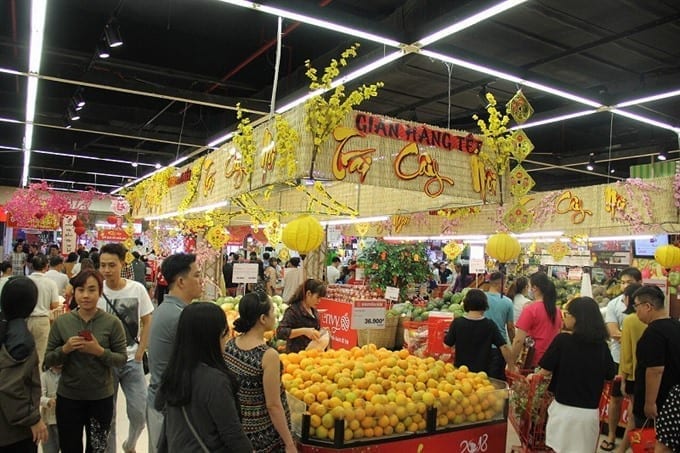
    Lotte Mart Vietnam has opened its third Hanoi store in Cau Giay District. The South Korean retailer’s new 2776sqm branch is located in the urban district, near seven local universities. Targeting local students, the branch will offer trendy but inexpensive products. There will be an international zone that sells products from Korea, the US and Europe and  a ‘Delica’ corner will offer baked goods and easy-to-cook food.

    About 35 per cent of the fresh-food products will include harvests from farms near Hanoi to maintain freshness.

    Lotte Mart Vietnam head of overseas business Kang Min-ho said the firm is planning to expand its business in the country, mainly focusing on Hanoi and Ho Chi Minh City.

    Lotte Mart now has 14 stores in Vietnam.

  • Korean wave fuel 25% growth in Korean e-commerce exports

    Korean wave fuel 25% growth in Korean e-commerce exports

    South Korea’s online exports surged 25 percent in 2018 from a year ago on the back of growing demand for K-beauty and K-pop related items such as album records and stationery supplies, government data showed. According to Korea Customs Service, Korea’s electronic commerce (e-commerce) exports or reverse overseas direct purchase volume reached US$3.25 billion last year, up 25 percent from a year earlier. The total number of online export cases also jumped 36 percent to 9.61 million during the same period.

    E-commerce growth is staggering when compared to the modest 5 percent annual growth in total Korean exports last year.

    The customs agency said that the rapid growth of online exports comes amid growing demand for Korean items on the back of hallyu or Korean Wave, as well as simplified retail procedure, and aggressive overseas marketing integrated with offline stores.

    By item, apparels and cosmetics accounted for 69 percent of total online export. In particular, the number of export cases for clothing surged a whopping 162 percent last year from a year ago, becoming the top pick after beating out cosmetics. Online exports of cosmetics jumped 43 percent last year from a year ago, recovering to average level after falling in 2017 as a result of diplomatic tension between Korea and China over Seoul’s deployment of U.S. anti-missile system.

    The customs agency said that exports of K-pop related items such as albums and stationery items surged significantly last year amid hallyu or Korean Wave overseas. In particular, sales of items related to K-pop icon BTS rose sharply.

    Data from Korea Customs Service, meanwhile, showed that overseas direct purchases of foreign goods amounted to US$2.75 billion last year, up 31 percent from a year ago. There were a total 32.25 million purchases last year, up 37 percent from a year ago.

    By region, the United States accounted for the largest 50.5 percent of Koreans’ direct purchases, followed by China with 26.2 percent, European Union with 12.5 percent, and Japan with 8 percent. The U.S. share fell from the previous year’s 56.4 percent while that of China jumped almost 10 percentage points from the previous year’s 17.3 percent.

  • Starbucks Reserve® Roastery Tokyo opened door

    Starbucks Reserve® Roastery Tokyo opened door

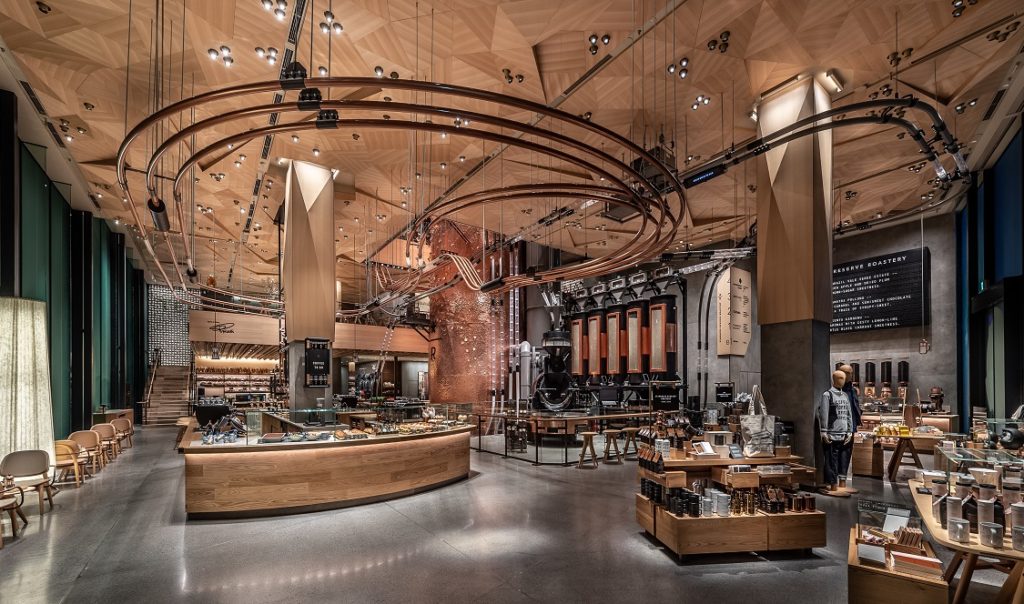
    This week, Starbucks celebrates the opening of the Starbucks Reserve® Roastery Tokyo, a four-story tribute to premium coffee quality, innovation and human connection. This will be the fifthRoastery globally, opening to the public on Thursday, February 28, at 7 a.m. JST, reaffirming the company’s 23-year commitment to Japan. The Roastery pays tribute to the important role that Starbucks Japan has played in shaping the foundation of the Company’s international growth. The Roastery introduces customers to more than 100 unique coffee and tea beverages and merchandise, as well as a menu of artisanal Princi Italian fare for the first time in Japan.

    It also celebrates the Japanese culture of connection and craftsmanship through the first AMU Inspiration Lounge –from the Japanese “amu,” meaning “knit together”–to host community gathering events and is planned to become Starbucks first Specialty Coffee Association certified training location in Japan.

    “As the first international market outside of North America, Starbucks Japan has contributed 23 years of innovation for the company globally,” said Kevin Johnson, CEO, Starbucks Coffee Company.

    “The opening of the Tokyo Roastery will further amplify what Starbucks Japan has done across all stores in the market for more than two decades—innovating and delivering the finest quality coffee one person, one cup and one neighborhood at a time.” Takafumi Minaguchi, CEO, Starbucks Japan, added, “The Roastery will amplify and inspire coffee passion across all Starbucks stores, and will serve as a catalyst for a new wave of growth centered on the customer experience and passion for coffee and service. Beginning with the “Make it Yours” campaign that will commence at every store in Japan upon the opening of the Roastery, customers will be invited to experience the first Starbucks coffee roasted exclusively in Tokyo, for Japan, and available in a variety of coffee beverage styles.”

    Collaborative Design Highlights Japan’s Natural Beauty

    Located in Tokyo’s vibrant and creative neighborhood of Nakameguro, the Roastery’s enchanting design was inspired by the famous cherry blossom trees lining the Meguro River.

    The building’s glass walls and terraced floors seamlessly fold into the fabric of the neighborhood, bringing visitors eye-level with the cherry blossoms and the four seasons of the river to reflect the natural beauty and sense of harmony found across Japan.

    The Tokyo Roastery is the only Starbucks Roastery location designed in collaboration with a local architect from the ground up.

    The exterior was brought to life in collaboration with renowned Japanese architect Kengo Kuma. Envisioned by Liz Muller, Starbucks chief design officer and lead designer for all five Roasteries globally, the Roastery highlights the work of local craftsmen and women to create an enchanting destination for coffee exploration and discovery.

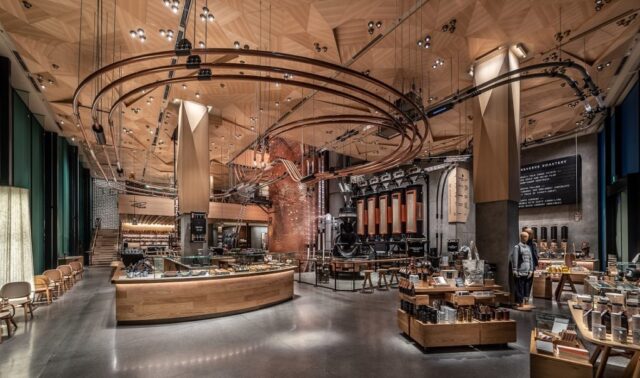
    The Tokyo Roastery merges traditional and modern design to deliver a unique and inspired experience across all four floors. Upon entering the Roastery, customers are greeted by the world’s largest Starbucks Roastery coffee cask, four-stories and over 55 feet of blush-tinted copper adorned with hand-crafted copper cherry blossoms, which changes hues throughout the day in different lights.

    The expansive cask was built using the technique of tsuchime, a tradition of copper beating, where each person involved in the building of the Roastery was offered the chance to hammer a portion to create its texture and pattern. The cask’s unique color is balanced against the light wood which has been carried into the interior to give the store a brightness found throughout traditional Japanese architecture.

    Throughout the Roastery, local craftsmen and women were brought together to incorporate their expertise and traditional craft into the design elements.

    The wood-tiled ceiling was inspired by the art of origami, providing a stunning visual experience. The light and airy space carries the light wood used on the exterior to the inside, giving the experience an enchanting aura.

    The wood, sourced locally, has been treated throughout with a traditional technique which prevents it from aging, ensuring the brightness is maintained inside and outside in the years to come.

    Enchanting Immersive Coffee, Tea and Mixology Experience

    The coffee journey at the Reserve Roastery Tokyo is an immersive experience and education in coffee, and its process—from green bean to cup—which begins at the Main Bar on the first floor.

    The open floor plan draws customers into the immersive experience, introducing them to the skilled art of roasting, brewing and hand-crafting beverages. The Reserve Roastery serves the freshest cup of coffee and it is here on the first floor that customers can taste Reserve coffee beverages such as Barrel-Aged Cold Brew.

    The Princi bakery serves handcrafted, authentic artisanal Italian fare that is baked fresh in the Roastery throughout the day. For the first time in Japan, customers can enjoy freshly-baked breads, cornetti, focaccias, pizzas, salads and more.

    An airy staircase leads to the second floor, where customers will be transported into the tradition of Japanese tea at the world’s largest Teavana Bar.

    Exclusive tea beverages, such as the Pop’n Tea Sakura Jasmine, featuring a vibrant hibiscus and cherry popsicle atop a floral jasmine tea, will delight customers with their charming appearance, Japanese ingredients and unique flavor combinations, modernizing the tea experience. On the terraced third floor, Starbucks Japan’s first cocktail bar, Arriviamo™, puts innovation, mixology and cocktail craft on full display.

    The two walls of spirits bring together the Arriviamo menu, featuring coffee and tea-inspired cocktails only available at the Tokyo Roastery, including the Nakameguro Espresso Martini made with chestnut liqueur, crème de cacao and espresso, then paired with decadent chocolate  from Nakameguro’s “green bean to bar CHOCOLATE” brand. Wine, beer and classic mixology beverages will also be available.

    Conversations with an Impact

    Starbucks Japan has more than two decades contributing to the communities it serves.

    The fourth floor of the Starbucks Reserve Roastery Tokyo is home to AMU Inspiration Lounge–a dedicated space for the community to gather for hosted social impact conversations. The concept of “AMU,” which means “to knit together” in Japanese, is founded on human connection and passions coming together, something Starbucks has long believed in. For the first time at any Starbucks location in the world, this intimate space will serve as a platform to host change-makers and creative thinkers from across Japan. The first event in April will celebrate the role of women leaders in Japan.

    The Roastery is planned to become Starbucks first certified Specialty Coffee Association (SCA) location offering training for coffee professionals in the near future.“We believe that where passions connect, the future is sparked, and we will offer the Tokyo Roastery as a gathering space to spark new ideas and create an impact,” said Minaguchi.

    “The Roastery signifies our commitment to fostering moments of human connection over a cup of coffee and using these moments to create positive social impact in the communities we serve.”

    With more than 37,000 partners who proudly wear the green apron across Japan’s 47 prefectures and 250 at the Roastery itself, Starbucks Japan will amplify coffee craft and innovation by freshly roasting small-batch coffees from around the world every day in Tokyo and introducing new beverages, concepts and inspiration to all 1,400 stores across Japan. This amplification will begin with Tokyo Roast coffee, a Starbucks Japan-exclusive coffee, available throughout the market on opening day.

  • Esprit’s loss in line with forecast

    Esprit’s loss in line with forecast

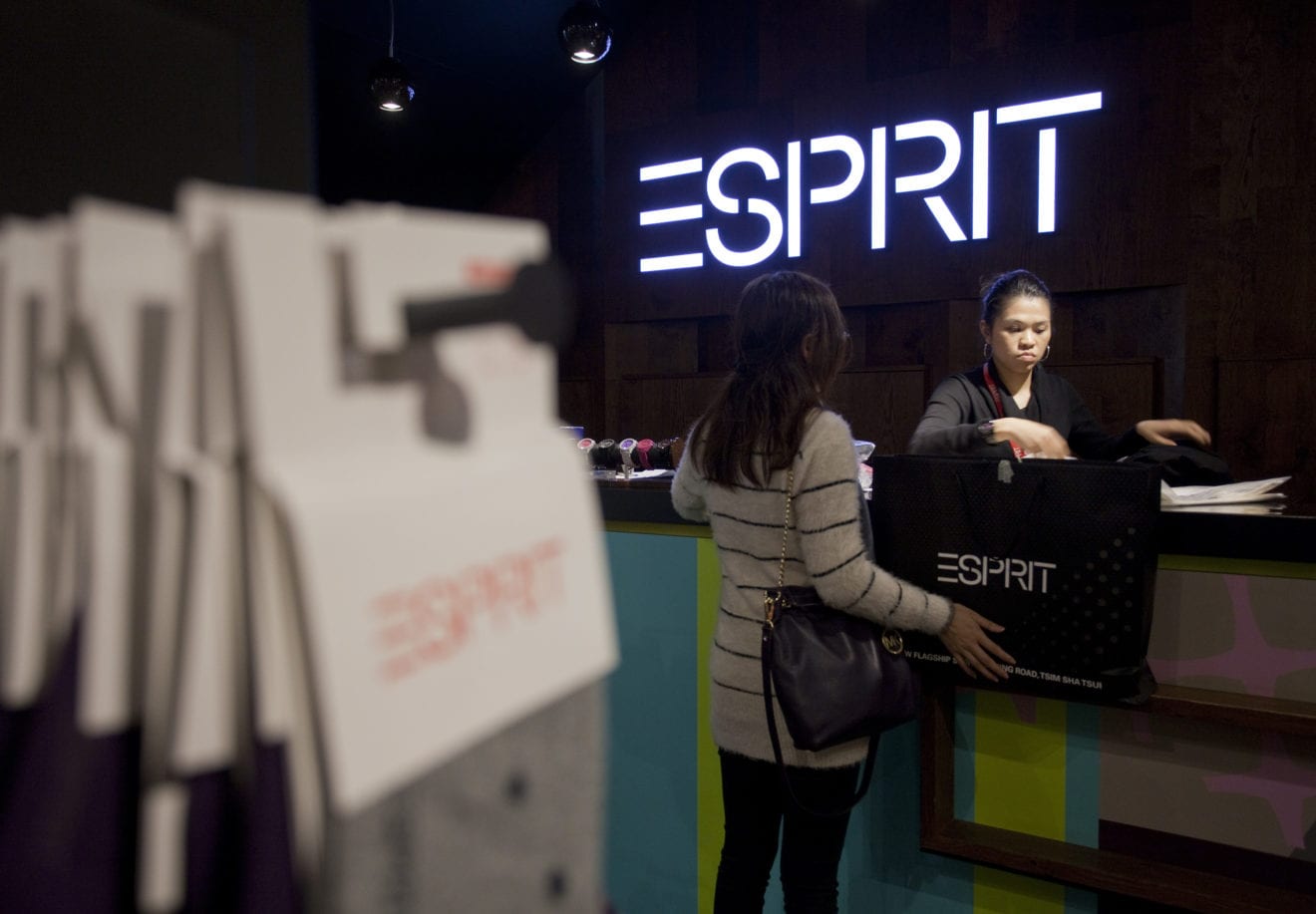
    Fashion retailer Esprit shuttered 91 stores in the six months to December and recorded a loss of HK$1.773 billion (US$225.876 million). While the loss is massive, it is within the estimates Esprit provided at an investor presentation last November when it unveiled its rescue strategy for the embattled Hong Kong-listed brand. The 91 stores closed during the fiscal half year come on top of another 50 in the half year preceding it. More closures are to come as the company trims its network to meet falling consumer demand for its range and save on rent.

    Esprit’s revenue for the half year fell to $6.766 billion, down 14.4 per cent in local currency terms, due to fewer stores and “reduced customer traffic across the distribution channels due to the weakness in brand identity and product appeal,” the company said in a stock exchange filing.

    The company’s share price fell from $2.04 to $1.83 (US 23 cents) as the results were released, before recovering a little this morning despite the results being inline with the company’s forecasts last November.

    Esprit “has a clear strategy plan in place setting forth bold changes to build a powerful organisation and restructure the cost base and develop a new model for the future,” the company reiterated in its filing. That plan includes becoming a leaner and more efficient organisation, eliminating loss-making areas of the business, sharpening the Esprit brand identity and putting the customer at the centre of everything the group does, and

    improving the product offer and its relevance to consumers.

    “The execution of the strategy plan is progressing well and is on track. While the group is encouraged by the initial progress and [has] a committed team in place to see the execution through, it is important to appreciate that it will take time to see this translate into a positive business performance, as most initiatives are still at this stage a work-in-progress and it will require time to make the corresponding improvements in brand and product visible to our customers for attracting them back into Esprit stores.”

    Included in that process is the reduction of between 35 and 40 per cent of non-store employees, already completed in Asia and on track in Europe.

    Meanwhile, the company said that while revenues continued to decline in the first half, the rate of decline is slowing. In the three months to September, sales in local currencies fell by 16.2 per cent, while in the following three months, sales fell by 12.5 per cent.

    Asia Pacific – comprising mainly China, Hong Kong, Singapore, Malaysia, Taiwan, Macau, Thailand, India and the Philippines – accounted for just 10.4 per cent of the group’s total revenue, or $698 million. That was down 26.6 per cent, in part affected by the closure of the Australia and New Zealand Esprit businesses last year.

    Transition period

    Esprit says it expects the next two years to be a period of transition for the company and its brands

    “Revenue is expected to see further decline in the next two financial years due to closure of loss-making stores, before reverting to growth to be driven by impact from product and brand initiatives. Overall, the group expects revenue to increase at a compound annual growth rate of a mid-to-high single-digit percentage in local currency between FY19/20 and FY23/24.”

    It reiterated its earlier forecast of breaking even in two to three years time.

    A “low double-digit” decline in topline sales is expected in the second half of the current financial year.

  • 8 trends set to shape Southeast Asian e-commerce

    8 trends set to shape Southeast Asian e-commerce

    Southeast Asia’s e-commerce market is set to exceed US$102 billion by 2025, according to a study by Google and Singapore’s Temasek. As more and more consumers are attracted to shopping online for convenience and they build trust in the channel, investors in the e-commerce industry are gaining confidence and seeking opportunities. That helped startups raise and estimated $9.1 billion in the first half of last year, almost as much as for the whole of 2017.

    If last year was dubbed ‘The Year of E-commerce’ for Southeast Asia, what can the industry expect this year? We speak to industry leaders to discover the anticipated trends for online retailers and brands in Southeast Asia.

    1. Brands shift their focus from data gathering to data use

    The biggest differentiator between online and offline retail is the ability to track, collect, monitor, and manage information, all in real time. Through online channels, brands are able to access customer data through chats, social media, and their own websites. This information can be used to devise online strategies. Globally, 73 per cent of brands plan to allocate their e-commerce budget on data and analytics services this year.

    However, despite general agreement of its importance, many brands have no concept of how to use data to their advantage.

    “Even today, not all retailers have embraced data fully to the point where they think of themselves as data companies, and this might be why many companies are suffering,” observes Harvard Business School Professor Srikant M Datar.

    Data collection is easy but having and optimising the analytics capability to use it is a completely different ball game.

    A survey by ecommerceIQ identified data analysis as one of the most difficult skills to find among the digital talents in Southeast Asia. Brands are constantly searching for data aggregators to consolidate information into one place for convenient retrieval and use to target, retarget, and personalise products and services.

    Reagan Chai, head of regional business intelligence and business development at Shopee said that data acquisition enables the company to map out and optimise buyer and seller user experience while pre-empting customer demand and anticipating future potential. The company has seen an increase of website traffic in the past year that even surpasses the other regional players.

    In China, Alibaba and JD have taken this a step further by using the data gathered online to improve inventories and experiences at their physical stores. Alibaba chief marketing officer Chris Tung said the company wants to help brands find the right consumers by tracking them throughout Alibaba’s system.

    “We’re finding all data that has to do with people, their behaviour, what they like, what they buy and binding this online data to real people,” concluded ChrisTung.

    Last year, the region’s leading brand ecommerce enabler, aCommerce, launched a data analytics platform BrandIQ to enhance their capabilities as a data partner to help brands centralise their customer data and offer customised products or services to each target group.

    This leaves brands with two options: find an economical way to use the data or continue looking for a needle in a haystack.

    1. Social-commerce channels are brands’ new sales outlets  

    Social commerce in this region boomed before the rise of e-commerce as we know now. Facebook groups have long established as an online space where people connect to buy and sell goods, even before the launch of Facebook’s Marketplace feature. The rapid growth in Southeast Asia is propelled by the mobile adoption and smartphone, where 90 per cent of the online population access the internet via smartphones. For some, Facebook even defines the internet itself.

    With multitudes of potential customers gathered via social media platforms, brands naturally saw alternative sales channels. Following Facebook’s footsteps, social platforms like Instagram and Pinterest have also developed their own shoppable features.

    “Brands will miss out if they don’t have a social media presence. The best way to get feedback from consumers is by having a direct conversation,” Deb Liu, VP at Facebook Marketplace in an interview with Forbes.

    Line recently acquired social-commerce management startup Sellsuki in Thailand, where it has the second-biggest user base, to build a strong foundation for its e-commerce business. The company has also formed a joint venture with three local banks to offer personalised loans to SMEs.

    A few big brands like L’Oreal have already equipped their social media page with ‘Shop’ feature that allows consumers to purchase the order directly on the page and it is only a matter of time before more brands activate the platforms as one their sales channels and remove another layer between them and the consumers.

    1.  E-marketplaces launch new services to differentiate

    Looking at the successful existing e-commerce players in more developed markets, one thing they have in common is full control over their supply chain.

    JD’s investment to the development of its own supply chain allows it to scale its technology and offer a Retail-as-a-Service proposition to help other retailers or brands sell online. Alibaba is unrivalled for its extensive ecosystem beyond commerce, including its logistics network Cainiao and payment firm Ant Financial, not to mention its recent foray into the entertainment industry.

    The same practice has infiltrated down to Southeast Asia where Alibaba subsidiary Lazada has strengthened its logistics arm FBL (Fulfilled by Lazada) post-acquisition, and although no concrete plans have been disclosed, Shopee has expressed an intention to build its own logistics network.

    More e-marketplaces are coming up with new services to get more sellers onboard. Singapore’s Qoo10 is set to launch its blockchain-based ecommerce site QuuBee this year, using blockchain technology to eliminate the transaction and listing fee which in turn increase the retailers’ profit margin and make a more sustainable commerce approach.

    In Indonesia, Tokopedia is set to offer “Infrastructure-As-a-Service” with a fresh funds injection of $1.1 billion. It also plans to use AI for customer-care services and to run credit checks on merchants seeking loans to expand their businesses.

    Facebook is also showing more intention to jump onto the region’s e-commerce bandwagon. The social network has launched Marketplace feature in Thailand and Singapore without much fanfare, but its recent partnership with Kasikorn Bank in Thailand to allow in-app payments might be the start of the company’s effort to bulk up its commerce capabilities and cater to those that use the platform for their business.

    The practice is not exclusively done by the general e-marketplaces. Fashion e-marketplace Zilingo scored $226 million in funding due to its focus on building a fashion supply chain network that any merchant – small or large – can tap into.

    “It is imperative for us to build products that introduce machine learning and data science effectively to SMEs while also being easy to use, get adopted and scale quickly,” said Zilingo CTO Dhruv Kapoor in an interview with TechCrunch.. “We’re rewiring the entire supply chain with that lens so that we can add most value.”

    In a bid to recruit more brands to sell on their platforms, we anticipate that e-marketplaces will continue to go head-to-head with each other through new services, acquisitions, and partnerships. But are the e-marketplaces ready to burn more cash to win in this battle?

    1. Brands to reinforce reviews and fund user-generated content to win e-commerce consumers

    E-marketplaces in Southeast Asia have been upscaling and building add-ons which provide consumers with the utmost convenience. The search for better technology and assistance for the consumers is constant and never-ending.

    Online consumers begin their online purchasing journeys by searching for product information or reading reviews, usually on e-marketplace platforms, before making their purchase decision. They are looking for real opinions and user-generated reviews to validate the products.

    The habit of leaving product reviews on an e-commerce platform is not as common in Southeast Asia as it is in the US where Amazon even has a dedicated page for its most prolific reviewers. When they do, the reviewers usually left little information about the product and more about the other aspect of the purchase (for example, comments about the delivery time or packaging).

    Platforms like ReviewIQ are used by brands to increase their ratings and reviews engagement on their e-marketplace listings to help consumers make their decision. While the use of chatbots is an increasingly popular solution to help smooth the online customer experience, it is more suitable for generic questions such as “where is my order?” or “is this product available?” instead of personalised questions such as “will this lipstick look good on a yellow-undertone skin?”.

    Community-crowd models like one popular with travel platforms such as Airbnb might also be suitable for e-commerce in the region, to help consumers overcome their apprehension about online shopping. This is something that Edouard Steinert, aCommerce Thailand’s director of channel management, is investigating to help the company’s clients as this model has proved to save time, increase results, and keep costs low.

    “Consumers today want to hear genuine feedback and reviews about a product and they are becoming more averse to hard-sell methods. User-generated reviews, especially from people who share the same passion with them, drive better conversion for the brand,” he adds.

    1. Brands use direct-to-consumer strategies to acquire direct consumer data

    Some 89 per cent of companies are now competing mostly on a customer-experience playing field. The direct-to-consumer (DTC) approach is becoming more important for these brands because it allows them to gain insights into their end users and anticipate their needs.

    One trend observed among brands to promote DTC is e-commerce subscriptions. From a consumer perspective, subscriptions offer a convenient, personalised, and often cheaper way to buy what they need. For brands, it is a subtle method to create customer loyalty in the digital landscape.

    One brand adopting subscription e-commerce in the region is Nescafe Dolce Gusto, which offers free coffee machines in exchange for a minimum 12-month subscription of coffee. Besides witnessing sales growth, Nescafe Dolce Gusto also noticed that consumers continued to purchase goods from its brand despite dropping out of the subscription plan.

    “They may have dropped out of the subscription, but not the brand,” says Bhuree Ackarapolpanich, brand director & digital expert at Nescafe Dolce Gusto. “They still buy capsules from different channels: e-commerce websites, online marketplaces and supermarkets. A subscription strategy is not just a long-term consumption enabler but also a consumer acquisition channel for the whole brand,” he says.

    Acommerce’s regional director of project management, Mandy Arbilo said e-sampling is a popular strategy used by brands to evaluate demand, especially for e-commerce.

    While normal sampling techniques used by offline retailers are expensive, e-sampling saves brands up to 40 per cent as well as providing essential customer data.

    As DTC becomes widely adopted, consumers will see brands coming up with attractive gimmicks using digital tools to gain insights and entice consumers to spend more on their brands.

    1. This year will finally see regulation of e-commerce across the region

    E-commerce has remained largely unregulated across the region until now, but as the industry grows, it is only a matter of time until governments step in to tax this fast-growing segment, levelling the playing field for foreign companies to offer digital services and goods locally.

    Discussion of the implementation of e-commerce tax regulations in Southeast Asian countries has been noticeable since the beginning of last year but nothing concrete has yet materialised.

    Late last year, economic ministers from ASEAN signed an agreement to facilitate cross-border e-commerce transactions within the region.

    While nothing has yet been written in stone, predictions abound concerning the impacts of an e-commerce tax on goods imported into the region. In Indonesia and Thailand, e-commerce tax is predicted to bolster the growth of social commerce because, unlike marketplaces, they are uncontrolled.

    “If tax regulations restrict e-commerce platforms, making selling in Bukalapak complicated, there will be an exodus of people who prefer selling on Instagram and Facebook,” said Bukalapak co-founder and CFO Muhamad Fajrin Rasyid. “These platforms are uncontrolled and not chased for tax because they sell through the back door.”

    Singapore might also see a decrease in cross-border shopping as prices increase with the introduction of GST)on goods and services bought online from overseas. Currently, 89 per cent of all cross-border transactions in Asia Pacific are conducted by Singaporeans.

    Another e-commerce market with strong potential, India is to introduce new e-marketplace laws that indicate the prohibition of marketplace “owners” to sell products on their own marketplace through vendor entities in which they have an equity interest. It also prevents marketplaces from making deals with sellers that grant the marketplace exclusive rights to the product. Could we see such laws be applied in Southeast Asia?

    Regardless, brands will have very little influence on how the new tax policies take root but they will be behoven to anticipate the ruling and adjust online strategy accordingly to mitigate the impact of a shift in customer behaviour. This ASEAN agreement will encourage more local entrepreneurs to create new products and venture online to access a larger and more diverse market. Brands will now need to be nimble and innovative to adapt to local nuances and preferences.

    1. Grab and Go-Jek challenge logistics providers to capture e-commerce and online food delivery

    Since Uber’s Southeast Asian exit last March, Grab has inherited a monopoly in countries like Thailand, the Philippines and Malaysia, leading to complaints about falling service standards and increasing prices.

    But with the recent regional expansion of Indonesia’s Go-Jek, the competition between the two will only get more fierce. Go-Jek has successfully carved niches in Vietnam, Singapore and Thailand last year alone. In addition, Grab’s competitor in Malaysia, Dacsee, has also hinted at  expanding into Thailand.

    Neither company is racing to be the best ride-hailing provider; they are aiming for something much bigger: superapps. Go-Jek has secured $1 billion in funds from Google, Tencent and JD, already halfway towards its goal of raising $2 billion for the venture. Meanwhile, Grab recently secured a $200 million investment from Thailand’s Central Group, boosting its valuation to $11 billion to date.

    This year, these two competitors will steer towards the same goal of food and e-commerce delivery, which Google and Temasek predicts will grow 73 per cent on a CAGR basis this year. By 2025, they predict online food delivery growth of 36 per cent CAGR with online transport only growing by only 23 per cent.

    “We will be expanding our GrabFood and delivery business and deepening our relationships with restaurant merchants and key partners in some markets,” said Grab’s head of regional operations Russell Cohen.

    Same-day delivery providers can expect more competition during the next year. The impact of Grab and Go-Jek on market vibes will definitely raise the bar for the logistics and delivery sector.

    1. Brands and retailers will double down on omnichannel as Southeast Asians prefer pure-play e-commerce

    The omnichannel shopping experience is not a new concept, but companies do have diverse interpretations of the concept. Headlines reveal that online retail behemoths such as Amazon and Alibaba are moving into physical retail.

    Alibaba’s decision to venture offline reflects its determination to solve core problems of the shopping experience, such as scattered operations and lack of payment transparency.

    JD, meanwhile, pipped Alibaba in Indonesia by opening the first unmanned convenience store in the region. Its goal was to use and refine its enormous database by offering beneficial insights to brands such as the best products to stock and advertise. Through their joint venture with Central Group in Thailand, JD Central is planning a similar concept there this year.

    Pure-play e-commerce retailers and brands recognise drawbacks in online marketing channels with fragmented infrastructure and a limited pool of shoppers. That is why they began to promote offline as an attractive option to push sales growth.

    Elsewhere in Southeast Asia, companies are slowly but surely adopting this strategy across all categories. E-commerce fashion players like Thailand’s Pomelo and Singapore’s Love, Bonito have opened physical stores in their respective countries.

    Last year, Pomelo opened five new outlets, initially away from Bangkok’s prime shopping areas before moving into CBD locations like Asoke and residential areas like Bangna, once it refined the model. Love, Bonito has 17 retail outlets spread across Singapore, Malaysia, Indonesia and Cambodia.

    Rachel Lim, co-founder of Love, Bonito said, “Data can tell you what’s selling but being on the ground tells you why something is not selling and what the customer is looking for.”

    Visiting shopping malls is a popular social activity in Southeast Asia and this trend is not set to disappear anytime soon.

    Brands should take advantage of dual physical and online presence.

  • Amorepacific facing painful dilemma

    Amorepacific facing painful dilemma

    For Amorepacific, the last year has been painful in terms of both sales and brand development. The cosmetics giant saw its operating profit halve to 549 billion won (US$491 million) in 2018, just two years after it joined the “1 trillion-won sales club” in 2016 for the first time as a cosmetics maker. With its glory falling to the past, Amorepacific has been outpaced by rival LG Household & Healthcare. LG Group’s cosmetics arm became the newest member of the 1 trillion-won sales club last year, cementing its No. 1 status in terms of market capitalization, which totaled 23.1 trillion won as of June last year.

    In the fourth quarter of 2018, Amorepacific’s operating profit came to 16.4 billion won, down 82 percent on-year.

    The company had many reasons to blame for its profit decline, including a rise in the minimum wage, weak performance of its budget cosmetics brand with the advent of numerous competitors at health and beauty stores, e-commerce and even home shopping channels.

    This has put the brakes on Amorepacific’s drive to construct a beauty industrial complex in Yongin, Gyeonggi Province. In 2017, the cosmetics giant had unveiled its plan worth 163 billion won for the complex to develop cosmetics and beauty products.

    But the company announced last month that it would scrap its complex project due to dwindling profits as well as fierce opposition from local residents.

    Market watchers voice concerns that this year will be a make-or-break period for the group, as a continued sales downfall will make it harder for the company to recover from its ongoing slump.

    “Profit recovery from the domestic beauty market as well as pulling up sales among Chinese customers will be the major points for Amorepacific to overcome this year,” said Na Eun-chae, a researcher from Korea Investment and Securities.

    Sulwhasoo vs. History of Whoo

    Although South Korea-China ties started mending last year after the detrimental diplomatic and economic fallout from the deployment here of the US Terminal High Altitude Area Defense missile system in 2017, the China comeback is still not so evident.

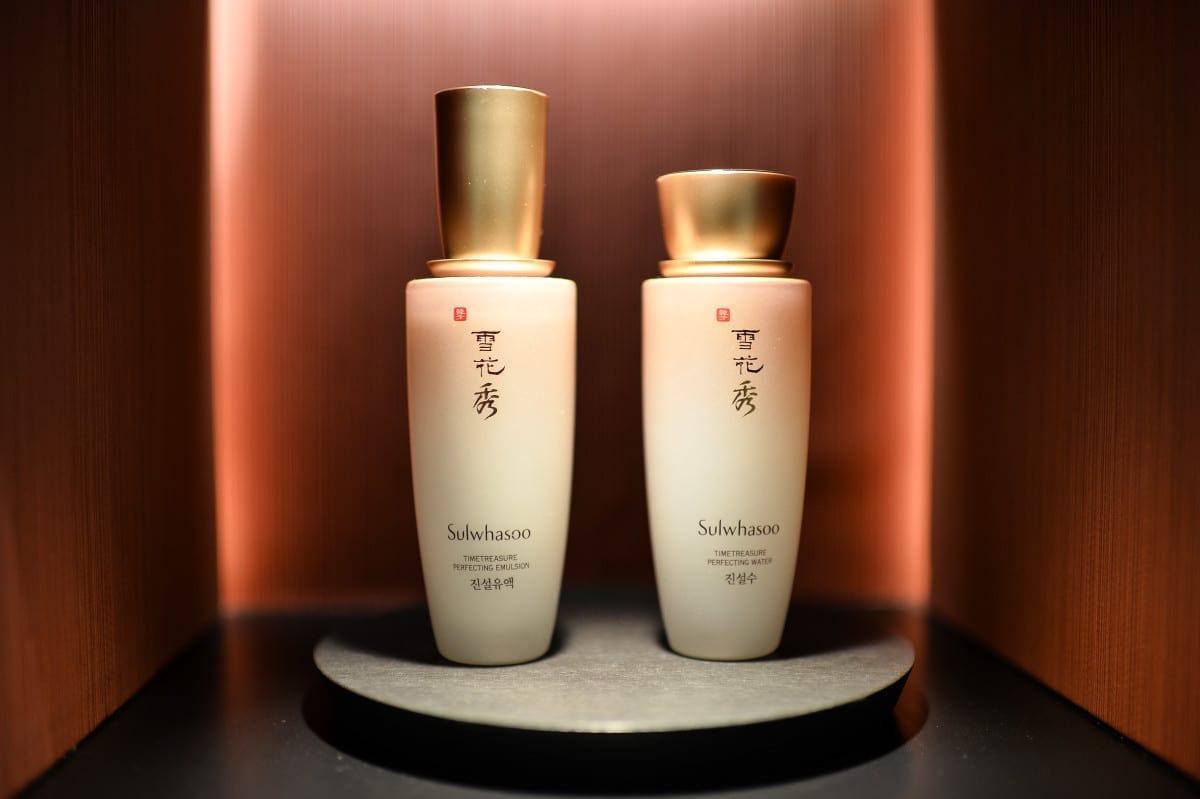
    Amorepacific’s Sulwhasoo, the company’s flagship luxury skin care brand, had been the most favored brand among Chinese tourists in the past few years. Market data showed that mainland China accounted for at least 10 percent of Sulwhasoo’s total sales, followed by Hong Kong at 6 percent and Taiwan with 0.5 percent as of 2018.

    But The History of Whoo, the latecomer in herbal cosmetics, has now taken the limelight.

    Whoo, a luxury skin care brand by LG Household & Healthcare, posted high sales at duty-free shops largely backed by Chinese consumers. This led Sulwhasoo to hire actress Song Hye-kyo as its global brand ambassador, seeking a breakthrough. It was Sulwhasoo’s first-ever attempt to have a celebrity promote its products.

    In terms of sales, Whoo has outpaced Sulwhasoo by recording 2 trillion won of sales last year. Whoo has also made a 40.8 percent on-year increase. Sales of Sulwhasoo had been around 1 trillion won since it peaked in 2015.

    “It is not an exaggeration that Sulwhasoo is the only, but very strong, cash cow of Amorepacific Group. It is the most important department in the entire company. Employees, especially in that department, feel grave responsibility and pressure about having to pull up the sales,” an insider said.

    According to the group, around 55 percent of the company’s sales come from its luxury cosmetics brands. Of them, Sulwhasoo is responsible for 36 percent.

    Market insiders said budget cosmetics brands are also enduring fierce competition in the “red ocean” market, with more consumers looking for luxury, premium brands as the beauty trend now centers on anti-aging efforts.

    Industry experts see the causes of Sulwhasoo’s lackluster performance as coming from its brand positioning and sales strategy at duty-free stores.

    “In the luxury cosmetics market, Sulwhasoo has only focused on its simple, basic skin care products, whereas Whoo diversified its luxury product lineup and upgraded all the products of the brand,” said an industry insider surnamed Jung, who has been in charge of overseas sales for a cosmetics brand for 30 years.

    Amorepacific also restricted Chinese shoppers, or “daigou,” from purchasing in bulk at duty-free stores, he added.

    “As a result, Amorepacific could not stabilize its supply chain in China. But LG, unlike Amorepacific, rolled out flexible rules for daigou and increased their demand,” Jung added.

    Others added it may simply be the product design and brand concept that work better for Chinese customers, who prefer gold, royal and fancy images.

    “To Korean customers, design and concept of Whoo may be regarded as ‘too much.’ But Whoo wisely focused in the concept that can appeal to Chinese customers. Hiring Lee Young-ae as its main model was also very clever, because Hallyu stars like her are still very influential in the Chinese market,” said an industry insider who is very familiar to exporting cosmetics to China.

    Is overseas sales expansion only way?

    To overcome the situation, Amorepacific plans to once again focus on strengthening its luxury brand lineup, including cosmetics brand Amorepacific, which is a luxury skin care brand named after the company.

    The brand rolled out only 2,000 limited edition facial creams last year, priced at 750,000 won per bottle.

    The reason is largely due to weak sales of budget cosmetics brands such as Innisfree and Etude in the domestic market, as well as in China.

    In 2012, the company launched budget cosmetics brand Innisfree in China. It now operates 512 stores in cities like Hangzhou and Shanghai. As of last year, 50 percent of sales of Amorepacific’s Chinese corporation came from Innisfree.

    But sales had been on a decline amid competition with local players that launched brands like One-leaf with similar concepts — natural and clean.

    “There are already too many budget cosmetics in China. That’s why Chinese tourists coming to Korea are now looking for luxury, premium cosmetics that they cannot find in their market,” said a market insider, adding that the trend is especially evident among Asian countries.

    The company said it will renew the Innisfree brand and debut Primera to China this year, aiming for 601 billion won in operating profit by the end of the year. It will also accelerate Sulwhasoo store openings in additional Chinese cities, and expand touch points in online retail in major e-commerce sites such as VIP.com and JD.com.

    Earlier this year, the cosmetics giant announced the business goal of securing a 10 percent increase in sales and a 24 percent increase in operating profit this year. The group said it would focus on investing in innovative beauty sectors such as customized cosmetics or overnight beauty items based on developing the customer experience.

    “The company believes in the value of traditional Korean beauty. It is also Chairman Suh Kyung-bae’s business philosophy to create beauty products that can instill Korean beauty, products with value that can last for a century,” said a company insider.

    Overseas expansion actually did pay off for Amorepacific last year. Despite its increased investment in overseas markets, both sales and operating profits inched up by 8 percent to 1.9 trillion won and 6 percent to 2.6 trillion won, respectively.

    But some say it is time for Amorepacific to bring in a new cash cow for practicality, referring to LG Healthcare & Household’s budget brand The Face Shop that bought Avon’s manufacturing facility in China last year.

    “It is time for Amorepacific to make the bold move and seriously consider active M&A ideas. M&A can offer positive opportunities in terms of global market expansion and investment for future. Especially when global beauty companies like Loreal and Unilever are buying Korean beauty brands, it is important for the company to take a strategic position to diversify brand portfolio for global competition,” said a researcher at Euromonitor International.

    Seo Yong-koo, a professor of business at Sookmyung Women’s University, said Amorepacific should not put all its risk in the Chinese market.

    Seo said since Amorepacific saw aggravating sales following its downfall in the Chinese market, the company experienced that its market portfolio is important. He added the group should also take the Muslim market into consideration, which will add up to 1.8 billion customers.

  • Vietnam Jan-Feb FDI inflows up 9.8 pct to $2.58 bln

    Vietnam Jan-Feb FDI inflows up 9.8 pct to $2.58 bln

    Vietnam received $2.58 billion in foreign direct investment (FDI) in January-February, up 9.8 percent from the same period a year earlier. FDI pledges, which indicate the size of future FDI disbursements, were more than 2.5 times higher than the same period last year, climbing to $8.47 billion, the Ministry of Planning and Investment said in a statement on Tuesday.

    Of the pledges, 81.8 percent are to be invested in manufacturing and processing, while 5.6 percent would go to real estate, the ministry said.

    Hong Kong was the top source of FDI pledges in the period, followed by Singapore and South Korea.

    The Southeast Asian country reported a record high FDI inflows of $19.1 billion last year, up 9.1 percent.