Tag: asia

  • Businesses in Vietnam close down at increasing rate

    Businesses in Vietnam close down at increasing rate

    The number of enterprises closing down in the year to date hit 67,000, double the number in the same period last year. Chu Tien Dung, chairman of the HCM City Business Association said that this number is unusually high but can be explained by problems that have existed for years.

    The government’s target of having 1 million enterprises by 2020 is to blame in no small measure since it has led to policies that encourage quantity rather than quality, he said.

    Typically, this has seen sole traders registered as one-man limited companies and a big start-up movement in major cities such as HCM City and Hanoi.

    “The procedures for setting up a limited company have been greatly simplified so that anyone can become a boss. If within a few years or even months the owner finds the business line to be unsuitable or does not like the company name, it is not difficult to dissolve and establish a new business.”

    Statistics from the Department of Business Registration show that of the enterprises closing down each month the rate of those with charter capital of below VND10 billion ($426,350) is overwhelming.

    The reason lies primarily in the fact that small and medium- sized enterprises (SMEs) lack resources and also have difficulty accessing credit.

    The liberalization of the law on investment is being used by some to profit illegally, he said. Many enterprises have announced insolvency due to heavy losses.

    According to the World Bank, starting up in Vietnam now involves only eight steps which can be completed in 17 days while it takes 26 days on average in East Asia and the Pacific to complete formalities and enter the market.

    Tran Thi Hong Minh, director of the Department of Business Registration, said: “Dissolution and bankruptcy is the natural, objective law of the economy. The market will eliminate and purge weak businesses to replace them with those of better quality.

    “Vietnam is considered a dynamic economy with rapidly developing science and technology and so the pressure on businesses is of an equivalent magnitude.”

    Pham Chi Lan, former chairwoman of the Vietnam Chamber of Commerce and Industry (VCCI), said business owners had expressed concern the business climate had not improved much.

    Even in the case of single-door administrative procedures, where all documents are meant to be submitted and received at one office, an applicant has to go through many other doors, she said.

    “While we are talking about creating new tools and policies, old, defunct procedures are still not scrapped. As such, Vietnamese businesses are very worried about their future.”


  • Olympic athlete Ayumu Hirano named as new Uniqlo brand ambassador

    Olympic athlete Ayumu Hirano named as new Uniqlo brand ambassador

    Japanese global apparel retailer Uniqlo has announced a new partnership with professional snowboarder Ayumu Hirano as its newest Global Brand Ambassador. Hirano was a two-time gold medalist in the men’s superpipe competition at the Winter X Games and winner of consecutive silver medals in the half-pipe competition at the 2014 and 2018 Winter Olympics.

    Chairman, president and CEO of Fast Retailing Tadashi Yanai said: “We are greatly inspired by [Mr. Hirano’s] achievements, his creativity and his style – not just on a snowboard, but also in his sense of fashion. His flair and imagination when competing go well beyond expectations, so we will look past conventional wisdom together to achieve something truly unique through this partnership.

    “We look forward to supporting him with special LifeWear items featuring advanced technologies, helping him to reach even greater heights in future,” he said.

    Hirano’s primary role as global brand ambassador is to promote the Uniqlo and LifeWear brands. The partnership will provide opportunities for Hirano to engage in the development of custom products and materials for his performance wear, while also assisting in the design process for LifeWear.

  • Kakao profit falls in Q3 as investment costs rise

    Kakao profit falls in Q3 as investment costs rise

    Kakao, the operator of Korea’s top mobile messenger, KakaoTalk, said Thursday its third-quarter operating profit fell 35 percent from last year due to increased costs from new businesses. Operating income reached 30.7 billion won ($27.3 million) in the July-September period from 47.4 billion won a year ago, the company said in a regulatory filing.

    Sales rose 16 percent on-year to a quarterly record high of 599.3 billion won, the company said.

    Kakao said its operating income plunged due to increased investments in new businesses, such as Kakao Mobility, that the company recently launched in an effort to secure new growth engines.

    Kakao said the revenue from its content platform remained steady at 306.7 billion won, with the figure representing a 17 percent year-on-year increase.

    Advertising sales grew 10 percent year on year to 167.1 billion won over the cited period on the back of mobile advertising revenue growth.

    Music content sales increased by 11 percent year on year to 136 billion won in the third quarter due to steady revenues from the Melon streaming service.

    Kakao said it will keep up efforts until the end of this year in order to expand its foothold by wrapping up a merger with its entertainment affiliate, Kakao M. The tieup will allow the company to move forward on various business collaborations.

    Kakao said the decision is aimed at bolstering its entertainment content based on the users of Melon, which is currently operated by Kakao M.

  • Viettel’s foreign market earnings up in Q3

    Viettel’s foreign market earnings up in Q3

    Viettel earned gross profits of $57.25 million from overseas markets in Q3, a year-on-year increase of 8 percent. Its overseas investment arm, Viettel Global, reaped net revenues of nearly VND4.43 billion ($188.71) in the third quarter, up 5 percent over the same period last year.

    Accumulated net revenues reached VND12.43 trillion ($529.7 million) between January and September.

    The revenues include nearly VND5.61 trillion ($238.94 million) from African countries, including Cameroon, Tanzania, Mozambique and Burudi, VND4.54 trillion ($193.68 million) from Southeast Asia countries, including Cambodia and East Timor, and VND1.69 trillion ($71.82 million) from Latin America.

    The company’s revenues from its three continents rose 3-11 percent, with Latin America registering the greatest increase.

    The increase is attributed to the company’s development of 4G services, digital wallet and other information technology projects serving overseas businesses and governments.

    Viettel Global is providing 4G services in 9 overseas markets, and digital wallet services in 8 markets.

    Also, Viettel Global’s sales expense and management costs reduced 4 percent and 12 percent respectively in the first 9 months of this year, compared to the same period last year.

    Viettel Global was established in 2006 to spread Viettel Group’s presence in foreign markets. Eight out of Viettel Global’s 10 overseas markets have begun earning profits. It has taken up the largest market share of the telecommunications sectors in Laos, Cambodia, and Timor Leste.

    It plans to expand its overseas operations in the Southeast Asian region and foreign markets that share similar population sizes as Vietnam this year. The company also aims to achieve a 10-15 percent year-on-year increase in terms of the number of subscribers by the end of 2018.

  • Unmanned medical clinic opened in China

    Unmanned medical clinic opened in China

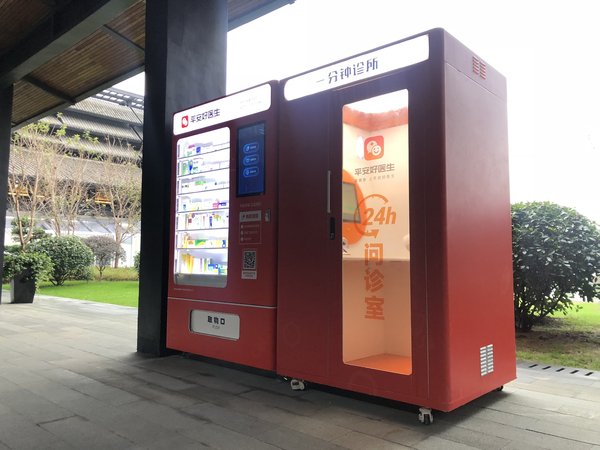
    Chinese one-stop healthcare platform Ping An Good Doctor has announced the world’s first commercially operational unmanned medical clinic. The firm’s “One-minute Clinic” has been formally unveiled in a scenic area in Wuzhen. It will provide a high-speed, convenient, one-stop-shop for medical and healthcare services for nearby residents, visitors to the scenic area and guests of the 2018 World Internet Conference.

    The clinic includes two major functional modules, an “Independent Advisory Room” and a “Smart Medicine Cabinet.” Patients consult with a cloud computing doctor in the advisory room to receive a preliminary diagnostic suggestion, and may purchase prescribed medicine from the medicine cabinet afterwards. The clinic stocks more than 100 common drugs. Unavailable medicines may be purchased online using the Ping An Good Doctor smartphone application, receiving the drug from nearby pharmacies with a one hour delivery service.

    During a one week trial, the daily average advisory volume approached 100 visitors.

    The firm plans to popularise the clinics in public areas such as pharmacies, communities, enterprises, schools, scenic areas, markets, highway service stations, and so on. Combined with Ping An Good Doctor’s offline network of 3100 new hospitals and more than 60,000 neighbourhood clinics, the clinic is expected to quickly meet real-time medical and healthcare needs of city residents.

    Ping An plans to expand to 1000 units across China by the end of the year.

    A spokesperson for Ping An Good Doctor revealed that the clinic’s AI doctor was researched and developed by a team formed from over 200 world-class artificial intelligence experts, trained using data from over 300 million visits and consultations. More than 2000 common diseases are covered by the AI’s data set.

    A back office staffed by expert physicians are engaged to verify the diagnosis and advice of the AI doctor.

    Overcrowded hospitals are part of the cause behind the present difficulty in obtaining quality healthcare in China.

    Information from a third-party research institute shows that, in 2016, including transport and waiting-in-line times, Chinese patients consume an average of three hours per medical visit, although the actual time for diagnoses averages only eight minutes per visit.

  • Indonesia’s Queenrides Uses Road Safety to Drive Women’s Empowerment

    Indonesia’s Queenrides Uses Road Safety to Drive Women’s Empowerment

    Iim Fahima Jachja cannot operate a vehicle and relies on a driver to get around Jakarta, but that did not stop her from putting road safety at the heart of her women’s empowerment startup.

    Since launching in late 2016, Queenrides has attracted 200,000 members to join its website.

    Aside from reading articles about lifestyle and financial management, members can also gather in person for workshops covering topics like sexual health and family planning.

    But road safety has been a focus from the beginning said Iim, a mother of two.

    “When you are safe on the road, you can be the best you want to be,” she told the Thomson Reuters Foundation by phone from Jakarta.

    Road deaths are high in Indonesia, according to the Ministry of Transportation, which counted 162,000 fatalities last year, compared with 136,000 in 2015.

    In a country undergoing rapid urbanization as incomes increase, more people are buying vehicles, putting stress on the road network.

    Many drivers avoid taking tests by paying corrupt officials for driving licenses, Iim said.

    She added that the road risks are rising for women in particular, because changing social attitudes mean that more of them are working and commuting.

    At the same time, relatively few women have taken driving lessons and tests to acquire licenses, she said.

    Only about 20 percent of 7,500 Queenrides members surveyed said they had taken a driving test.

    “This is a major issue – this is a crisis – but people haven’t noticed the situation,” Iim said about the number of road deaths in Indonesia.

    Low-income countries have fatality rates more than double those in high-income countries, according to the World Health Organization (WHO).

    There were 104 million registered vehicles in Indonesia, according to the WHO’s latest report on road safety published in 2015.

    Driving Safely

    As well as enabling its members to exchange views and learn more about road safety online, Queenrides arranges workshops with input from the transportation ministry and the traffic police.Participants have gone on to take driving lessons and tests, Iim said.

    That trend could make Indonesia’s roads safer, said Liviu Vedrasco, a road safety expert at the WHO in Bangkok.

    “There are some studies that suggest women are more careful and follow the rules better than men,” he noted.

    One of the Sustainable Development Goals set by the United Nations in 2015 is to halve the global number of deaths and injuries from road traffic crashes by 2020, Vedrasco said.

    As the number of female drivers increases, Indonesia’s transportation ministry has stepped up efforts to reduce crashes involving women by working with outside partners, said Budi Setiyadi, director of land transportation at the ministry.

    “Queenrides is needed for women riders in Indonesia to be given a good education in driving safely because women have a primary role,” Budi said in an email. “They can educate their children, their families, and the surrounding environment.”

    Growing

    As more Indonesian women join the workforce and take to the roads, Queensrides can also help them assert control in other areas of their lives, Iim said.

    For example, about 30 members gathered last month in a child-friendly cafe in Jakarta to discuss family planning and strategies for educating their teenaged children about sex.

    United States-based Johns Hopkins University sent experts to the workshop part of a program targeting “married women of reproductive age,” according to Dinar Pandan Sari of the university’s Center for Communication Programs in Jakarta.

    “The fact that in just two years, Queenrides has been able to grow from an idea to 200,000 women joining their movement is remarkable,” Sari added.

    Queenrides teams up with other organizations to provide information on issues such as women’s rights, while members can also receive financial planning advice from institutions, including Bank Mandiri.

    As Queensrides’ membership grows, revenue from advertising on the website should increase as well, allowing the startup to expand its program, Iim said.

    She said she aims to attract 5 million members over the next three years, making Queenrides the biggest women’s empowerment platform in Southeast Asia.

    “If you can conquer Indonesia, it is easy to conquer any other area in the world,” Iim said. “Conquering Indonesia is like conquering five countries at the same time.”

  • When robot take over Hotel management

    When robot take over Hotel management

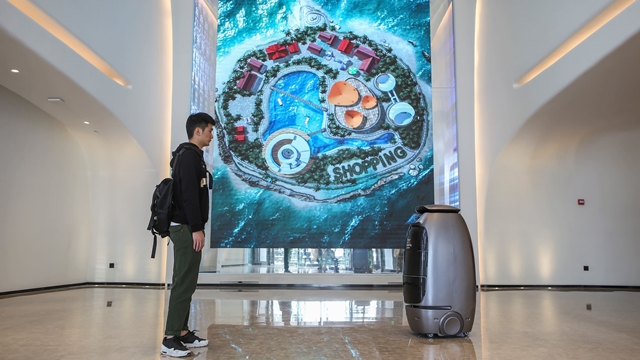
    An automated Alibaba hotel is set to open in Hangzhou. The move showcases the e-commerce giant’s technological capacity and serves to diversify its scope of business – with a view to demonstrating and selling its data-driven innovations. The company has claimed the hotel will be more efficient than manned properties within a comparable price range.

    The Alibaba hotel, which has already accepted bookings, features robotics, facial recognition, smart speakers, voice-activated lighting and room service, and automated alerts for cleaning. Hotel guests will be able to purchase any item featured in the rooms on Alibaba’s website.

    The hotel’s features are well in advance of similar voice-command technologies recently offered to the hospitality industry by Chinese search engine Baidu, although a similar hotel was launched by Shenzhen firm Smart LYZ in Chengdu earlier this year.

    A statement from the company read: “The solutions deployed at Alibaba’s Future Hotel can be used to streamline the operation of [China’s] hospitality sector while improving the experience of guests.”

  • Vietnam 19th best country in the world for expats: HSBC survey

    Vietnam 19th best country in the world for expats: HSBC survey

    Vietnam has climbed four places to 19th in the list of best countries for expats to work and live, an HSBC survey found. With an average annual income of $90,408, nine out of 10 expats said in Vietnam they are as happy as or happier than at home, according to the 11th annual Expat Explorer issued by HSBC on Wednesday.

    Foreigners enjoy working in Vietnam for many benefits: 55 percent of respondents said they take more holidays, 41 percent live in a better home and 39 percent have more household staff compared to their home country.

    Fifty-seven percent said their employment contracts include an annual allowance to fly home or to another place, higher than the global average of 17 percent.

    Forty-two percent get an accommodation allowance while the global average is 18 percent, and 73 percent receive health and medical allowances compared to 43 percent elsewhere.

    Vietnam ranks first in the world with 72 percent saying moving to Vietnam helps them save more and 72 percent also saying they have more disposable income than they did in their home country.

    Both are higher than the global average: 52 percent for savings and 56 percent for disposable income.

    There are also some downsides for foreigners living in the country, respondents said. While more than half of expats across the world said they enjoy the better overall quality of life, only four out of ten foreigners in Vietnam said so.

    Organizing finances is difficult for expats, with only 27 percent of foreigners saying it is easy to open a bank account, buy insurance or pay taxes, while the global average is 43 percent.

    Just more than a third had no difficulty in experiencing healthcare services, but this figure is 46 percent globally.

    Raising a child in Vietnam poses challenges, with just 18 percent saying the quality of child care is better than in their home country, compared to the global average of 38 percent.

    Forty-seven said Vietnam is a good place for expats who want to progress their career, while the global average is 56 percent.

    There are financial issues that concern expats in Vietnam, with 37 percent being worried about restrictions on moving money out of the country and 22 percent each concerned about less favorable exchange rates and job security.

    Sabbir Ahmed, head of retail banking and wealth management at HSBC Vietnam, said: “The survey shows Vietnam is a promising host country for expats who are seeking both opportunities and challenges to boost and develop their careers.

    “We expect Vietnam to improve several areas to enhance the experience of expats and their families by developing further the environment, educational programs and financial services.”

    The ranking listed Singapore as the best place in the world for expats for the fourth year in a row, followed by New Zealand, Germany, Canada, and Bahrain.

    The survey polled 22,318 people from 163 countries and territories through an online questionnaire.

  • Auntie Anne’s to make debut in Myanmar

    Auntie Anne’s to make debut in Myanmar

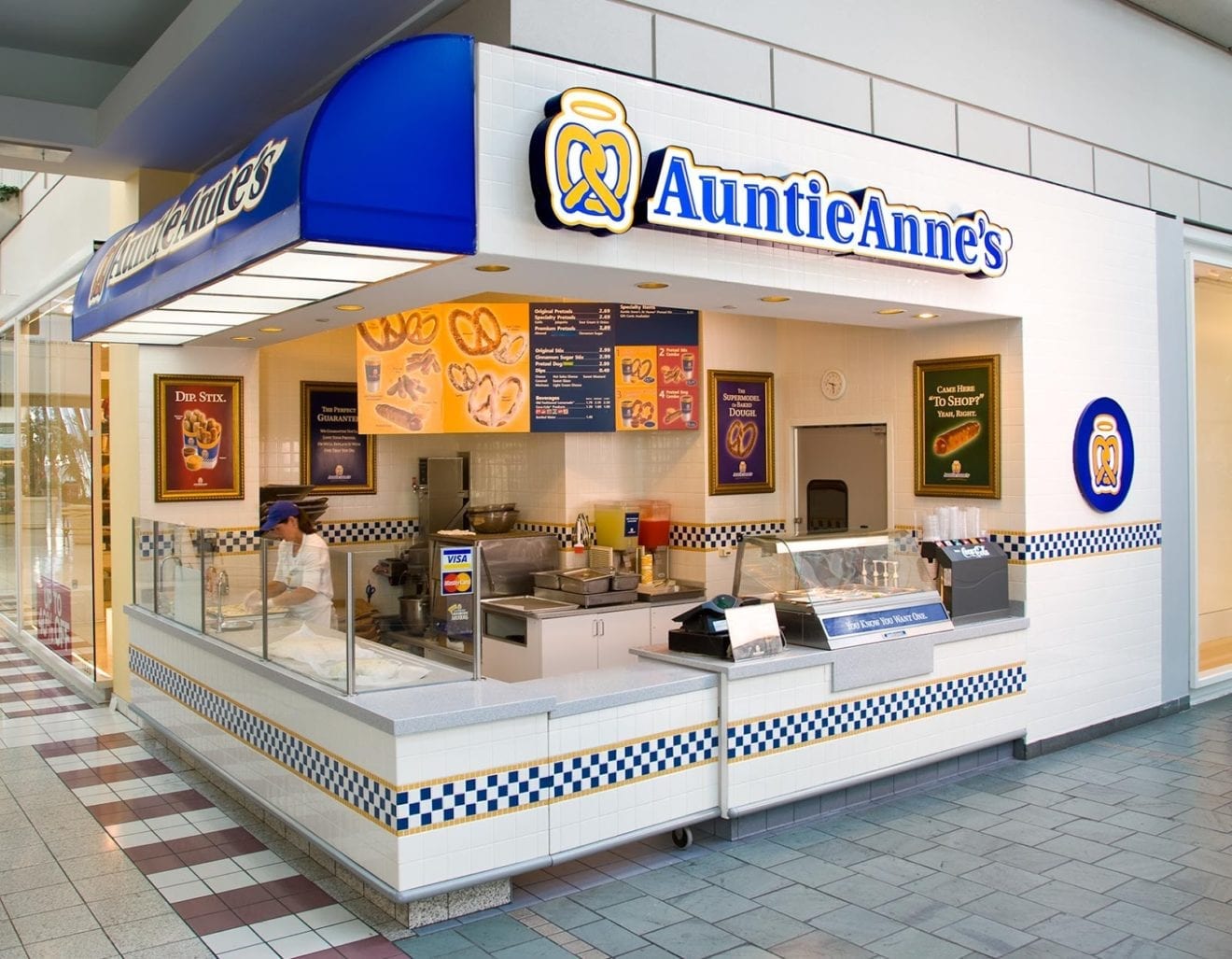
    Yoma Strategic and the parent company of pretzel franchise Auntie Anne’s – Focus Brands – are to bring the popular hand-rolled soft pretzel store to Myanmar. Myanmar’s first Auntie Anne’s outlet is scheduled to open in Yangon in the coming months with a more ambitious expansion planned over the next five years.

    Auntie Anne’s recently celebrated 30 years of operations and currently has more than 1800 outlets in 30 countries, including more than 600 locations outside of the US. The brand has established a strong presence in Asia.

    Yoma Strategic CEO Mr. Melvyn Pun said the company was seeing considerable growth in the market for freshly baked goods.

    “While many street vendors do offer traditional Myanmar alternatives, the addition of an iconic international brand will only enrich the local foodscape. It is also a big opportunity for a global brand to come in and offer consumers an exciting new twist on the current offerings in this sector.”

    Yoma F&B’s franchise portfolio also includes KFC and Little Sheep Hotpot. Yoma F&B is targeting the shifting consumption patterns and the rising discretionary disposable income of Myanmar’s expanding middle class, a group forecasted to reach 10 million by 2023.

  • Indonesia’s Third-Quarter GDP Growth Slows as Consumer, Export Sectors Struggle

    Indonesia’s Third-Quarter GDP Growth Slows as Consumer, Export Sectors Struggle

    Indonesia’s economic growth slowed in the third quarter, losing momentum from the previous three months and pointing to tougher conditions for Southeast Asia’s biggest economy, which has struggled with capital outflows and weaker exports and household spending.

    Gross domestic product expanded 5.17 percent in the July-September quarter from a year earlier, the Central Statistics Agency (BPS) said on Monday, compared with a 5.15 percent expansion expected in a Reuters poll and the second quarter’s 5.27 percent. The April-June quarter pace was the fastest since late 2013.

    The slowdown was largely due to softer household consumption in the third quarter and a negative contribution from foreign trade.

    Although the expansion was a notch faster than expected, economists warn growth may weaken further.

    “We think growth will tend to be slower in the coming future due to the impact of weakening rupiah,” said Fakhrul Fulvian, a Jakarta-based chief economist of Trimegah Securities. He expects GDP to grow 5.13 percent in 2018 and 5 percent in 2019.

    The rupiah is down around 9 percent this year, making it the second-worst performing currency among emerging Asian markets.

    Though a weaker currency has not stoked inflation, the central bank has raised interest rates five times since May to slow capital outflows in a measure analysts say could dampen domestic demand.

    Alex Holmes, Asia analyst at Capital Economics, said growth will probably stay around 5 percent over the next couple of years.

    “A key drag on growth over the next year is likely to be the export sector,” Holmes said in a note, adding that weaker global growth and subdued commodity prices could hold back export revenues.

    Weaker coal and palm oil prices have been a drag on Indonesia’s exports, with the fall in the local currency unable to offset the hit to revenues from the softer commodity prices.

    The export sector’s contribution to GDP in the third quarter was wiped out by imports. BPS chief Suhariyanto blamed this on declining non-oil and gas commodity prices as well as slower growth in main trading partners like China and Singapore.

    Stronger investment and government spending also failed to mitigate slowing household consumption, which accounts for more than half of Indonesia’s GDP.

    While a trade war between the United States and China is expected to hurt economic growth in the region, most analysts say Indonesia, which is less integrated into global production supply chains than its regional peers, will not be among the worst hit.

    However, the trade war could pressure the Indonesian economy through its financial markets.

    In addition to Bank Indonesia’s rate hikes, the government has delayed infrastructure projects and raised tariffs for a wide range of consumer goods, which could further hurt growth.

    Barclays economist Rahul Bajoria said tighter fiscal policy next year also clouds growth outlook.

    While the government’s official GDP growth target this year is 5.4 percent, Finance Minister Sri Mulyani Indrawati last month told the House of Representatives that 2018 growth was more likely to be 5.14 percent.

    The government projects growth at 5.3 percent for next year.

    Bank Mandiri economist Andry Asmoro said the third-quarter growth figures were unlikely to affect the central bank’s monetary stance.

    “The global challenge is still huge and prioritizing stability over growth remains relevant in the current environment,” he said.

  • Bangkok’s IconSiam launches tonight

    Bangkok’s IconSiam launches tonight

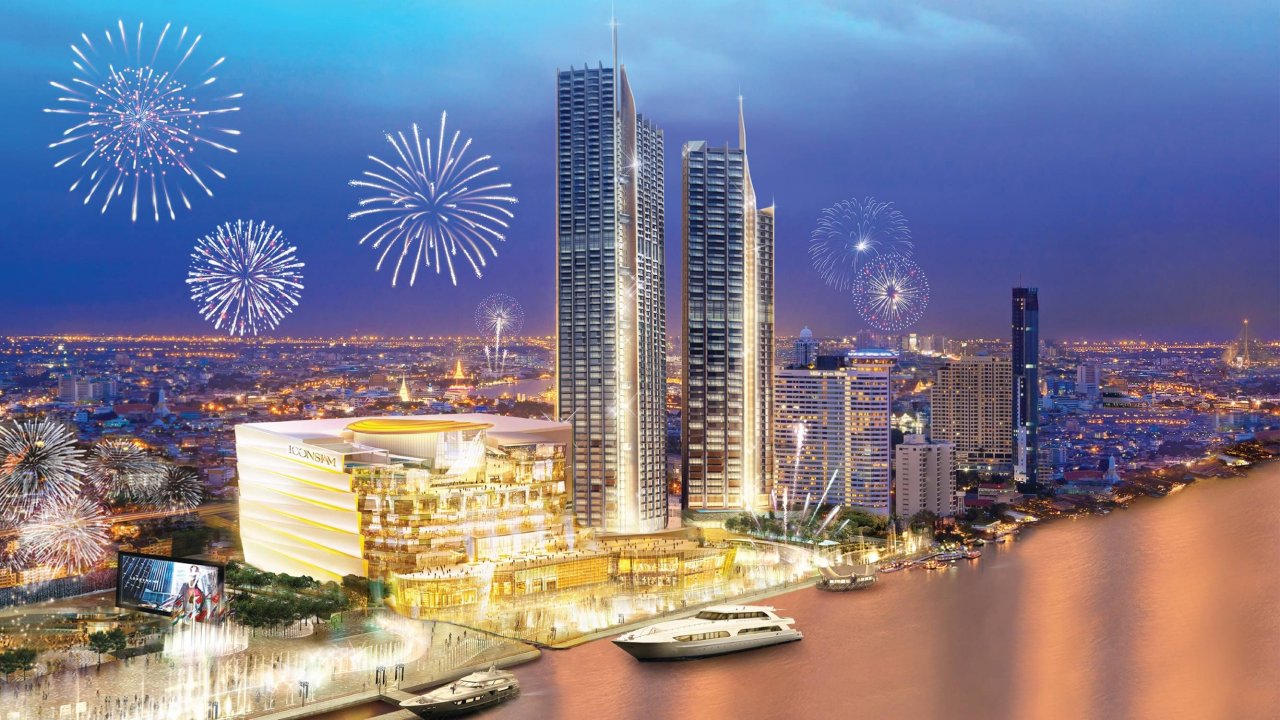
    Six years in design and construction, Bangkok’s US$1.6 billion IconSiam development will finally be officially launched tonight before opening its doors to the public tomorrow morning. With 500 stores, more than 100 restaurants and 14 cinema screens, a luxury apartment tower and a Mandarin Oriental hotel, the ambitious development is probably the most significant addition to Asia’s retail landscape in decades.

    Tonight, 10,000 businesspeople, retailers, media and guests have been invited to an opening ceremony which kicks off a weekend of festivities costing US$30 million. A fleet of 1500 drones organised by Intel will take to the sky above the Chao Phraya River and a “famous US singer” whose identity is being kept a closely guarded secret, will perform on stage somewhere along the 400-metre riverfront promenade of the building.

    Tickets to the invitation-only event, which also features a raft of Asian entertainers, fireworks, light and water shows, have been trading online for 10,000 THB (US$300), despite never being sold in the first place.

    Tomorrow, thousands of Thais are expected to visit the 750,000sqm venue, with stores offering rewards for early customers – like H&M issuing a 20,000 THB voucher to its first – and Apple is expected to draw long queues for its first official retail outlet in Thailand.

    About 80 per cent of the stores at IconSiam will be open for business tomorrow, the balance opening in ensuing weeks as fitouts are completed and approved by offshore head offices. But the project is still not complete. Several stories above the retail and dining area remain under construction, scheduled to open in July. They will house a world-class 6500sqm River Museum, a 3000-seat concert hall and other community facilities.

    Defining IconSiam is not easy.

    “It’s not a mall. It’s not a mixed use project,” IconSiam MD Supoj Chaiwatsirikul said last night. “It’s a destination.”

    The story of how IconSiam investors acquired the 8.8 hectare riverfront site gives an insight into how the project evolved into much more than a shopping centre. The owners of the land had been approached many times over the years, including by cashed up foreign developers. But they wouldn’t sell – until Siam Piwat CEO Chadatip Chutrakul talked to them, promising to create something that could showcase Thai culture and history to the world and be something all Thais could be proud of.

    Since then, IconSiam’s operational team have worked with Thais literally the length and breadth of the country to involve them in the project. Artworks and sculptures have been selected from 100 artists, mostly Thai, to appear throughout the complex, a 1.6 hectare space called SookSiam (“a city of Thai happiness”) will feature products and cultural heritage of the nation’s four regions, showcasing their handicrafts, performing arts, food, beverages “and local wisdom” in a single destination promised as “immersive, emotional and entertaining”.

    “IconSiam inaugurates a globally innovative model for destination development that moves the project away from being a mall or a mixed-use complex to being an inspiring destination,” explains Chutrakul.

    “It’s a place to regenerate and refresh, to be inspired and seek new ideas, and a place to discover the best of Thailand and the best on offer from around the world.”

    Unprecedented coordination has taken place with city and government authorities to enhance the transport system surrounding the site. A new skytrain track – aptly called the Gold Line – is under construction linking two other rail routes and which ultimately will make it a 20-minute railway journey from downtown Bangkok to the river. The company has built its own wharf in front of the building and worked to enhance a network of 73 river piers making it easier to reach the venue. Some 45,000 Thais travel along the river using public transport every day and they are starting to find that more convenient than ever.

    Work is continuing with landowners and hotel properties along the waterfront to create a public walkway, opening up the riverfront to the people for the first time in centuries.

    SiamPiwat’s Siam Paragon shopping centre which, when neighbouring properties Siam Center and Siam Discovery are added, create the city’s largest single shopping destination, attracts about 250,000 visitors on a typical weekend day. The company expects IconSiam to draw as many as 400,000 once the project is fully operational. About 60 per cent of those will be Thais, the balance tourists, although it is obvious from the size and scale of the luxury duplexes facing the river – bearing brand names including Louis Vuitton, Gucci, Cartier and Hermes – that the ratio will be quite different zone-by-zone: This part of the project is very clearly designed to appeal to the growing legions of Chinese tourists heading to Thailand.

    Another key retail drawcard of IconSiam will be the country’s first Takashimaya department store spread over several levels and including a comprehensive food and grocery offer as well as fashion and accessories.

  • Trail Camera Market Inching Closer to Wireless Ubiquity, Global Demand to Grow at 3.5% Volume CAGR

    Trail Camera Market Inching Closer to Wireless Ubiquity, Global Demand to Grow at 3.5% Volume CAGR

    The bullish run in the Trail Camera market continues in 2018, with an incremental growth of 18,000 units over 2017According to Fact.MR’s new study, increasing wildlife exploration and rising demand for higher security and surveillance are instrumental in driving sales of trail cameras. The study opines that demand for trail cameras will grow at a CAGR of 3.5% in terms of volume throughout the period of forecast, 2018-2028.

    Technological advancements have significantly transformed the trail camera space, particularly with respect to connectivity and functionality. Possibility of obtaining thumbnail picture with trail camera has been a remarkable step reflecting a technological novelty in the trail camera marketplace.

    Growing proliferation of novel technologies such as Wi-Fi and Bluetooth in the trail camera marketplace are expected to influence the sales of trail camera, in turn presenting a positive outlook of the overall market. The demand for trail camera is being influenced with growing digitalization, as manufacturers continue to focus on researching and developing their products.

    The demand for wireless trail camera is projected to expand at a substantial rate throughout the period of forecast, says the report. As compared to standard trail camera variants, the Wi-Fi variants are expected to account for a relatively higher market share of the overall trail camera market. User friendly features and enhanced convenience continue to drive the sales of wireless trail camera.

    Cellular wireless trail camera products are estimated to largely contribute to the growth of the market. Sales volume of cellular trail camera are estimated to remain resurgent through 2028, dominating the Wi-Fi trail camera variants, according to the report. Fact.MR estimates that the volume sales of cellular trail camera are likely to maintain a 1.5x lead over Wi-Fi trail camera by end of 2028.

    The demand for trail camera with trigger speed up to 0.25 seconds is expected to gain high traction owing to the reduction in delay time while capturing pictures. Faster trigger speeds allow trail camera to capture moving units efficiently, making trail camera with 0.25 seconds trigger speed a valid candidate for forest exploration. However, the report estimates that the sales of trail camera with trigger speeds within the range of 0.25 – 0.75 seconds are expected to be on an upswing in terms of sales volume throughout the period of forecast.

    The report foresees that the demand for trail camera with low glow flash is expected to increase in the forthcoming years. Increasing volume sales of low glow trail camera can be attributed to its efficient picture quality during night, making them a convenient option for enthusiasts to capture wild life activities at night time. Further, the demand for no glow trail camera is also projected to increase at a higher rate throughout the period of forecast, 2018-2028.

    Trade shows, such as the ATA (Archery Trade Association) show, are expected to influence the trail camera market growth by providing a potential platform for manufacturers of trail camera to promote their offerings. Using trade shows as a significant growth platform, manufacturers can enhance their brand visibility. In addition, this aspect continues to influence the demand for technological robust trail camera, in turn contributing to the growth of the trail camera market.

    Sales volume of trail camera is likely to remain concentrated across developed countries in the North America region, particularly the United States. Use of trail camera in commercial buildings for surveillance remains a key determinant of growth in the US, apart from wide life exploration. The report also estimates that the European countries are expected to showcase significant adoption of trail camera in the forthcoming years on the back of growing wide life monitoring and hunting activities. Overall the market for trail camera is expected to follow a positive growth graph, albeit at a modest pace.

  • DFS Group Launches “GIVE JOY” Holiday Gifting Campaign For 2018

    DFS Group Launches “GIVE JOY” Holiday Gifting Campaign For 2018

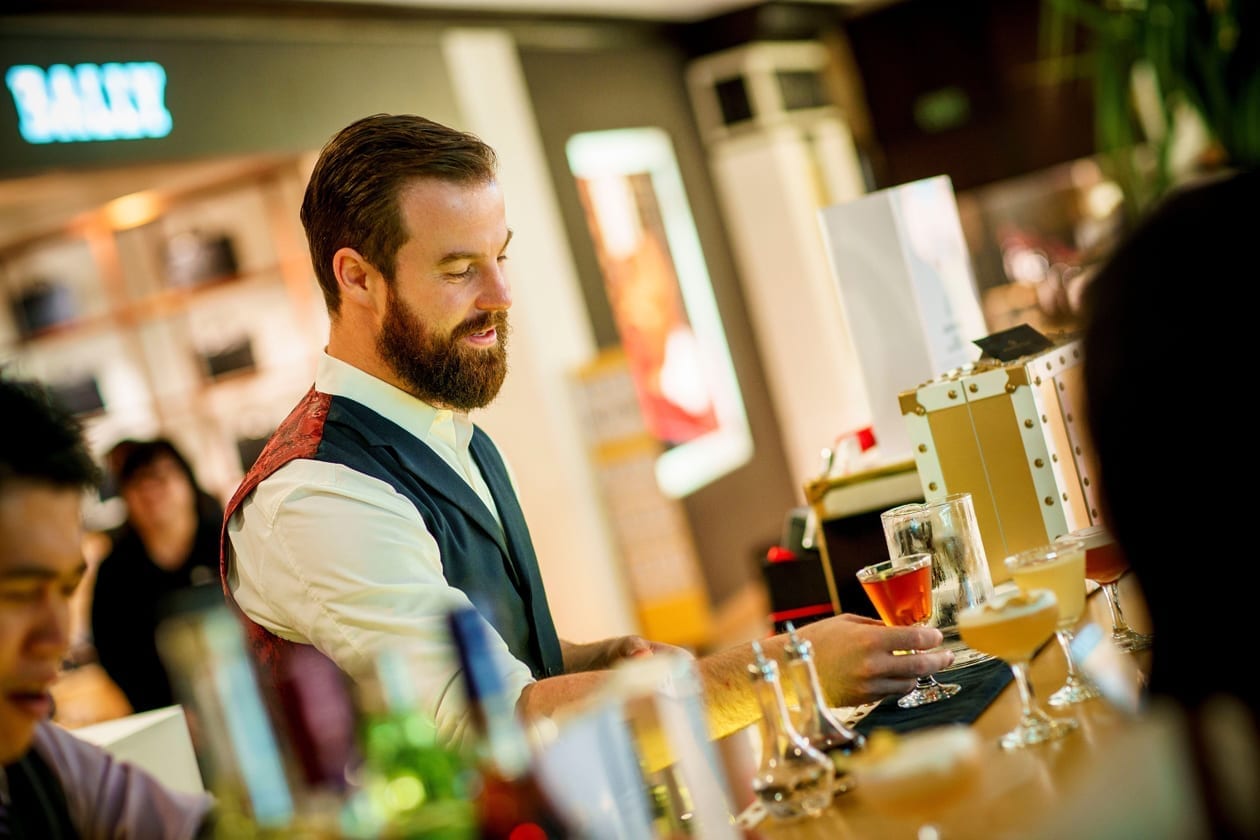
    DFS Group, the world’s leading luxury travel retailer, is launching its 2018 seasonal gifting campaign, “Give Joy”, to celebrate the spirit of the festive season and the gift of giving. From November 15, 2018 to January 1, 2019, customers will be able to add unique touches to exclusive products available at DFS’ first ever ‘Personalization Gift Shop’ concept. Boasting an assortment of specially curated luxury gifts, alongside an array of dedicated brand pop-ups, branded personalization stations and personalization services, the concept is designed to delight DFS’ discerning traveling customers and enhance their festive shopping experience in 13 T Galleria and airport locations worldwide.

    DFS is also launching the latest edition of its annual and much-anticipated “Give Joy” Holiday Gift Guide, offering customers a curated selection of personalized products. This year, the Holiday Gift Guide features DFS’ own employees as gifting experts, sharing their advice with customers on how to bring the festive season alive through the joy of giving. Showcasing an extensive selection of 143 incredible gifts from 108 world-famous brands across all of DFS’ luxury categories – from Fashion and Accessories and Beauty and Fragrance to Watches and Jewelry, Spirits, Wine and Food – shoppers will be spoiled for choice to treat their loves ones and themselves to something special.

    A stellar line-up of brands will also feature in DFS’ exclusive pop-ups during the “Give Joy” campaign:

    • Dior will host a special ‘Charms Bar’ offering customers the chance to create their own couture-inspired lucky charms accessory with a choice of four colors of ribbon and eight iconic Dior gold lucky charms.
    • Moët Hennessy will offer customers the opportunity to use elevated technology to write a tailored message in golden ink on champagne bottles on the spot.
    • Jo Malone London will offer a photograph transfer service on a beautiful Jo Malone classic gift box. Customers can choose from a personal favorite or an iconic city photograph, making it the perfect personalized gift for this holiday season.

    The exquisitely decorated Personalization Gift Shop will feature a life-size gift box, bringing an exclusive and enticing experience to DFS customers with personalization and the gift of giving. Holiday ribbons available in gold, silver and red and made especially for DFS allow customers to personalize their gifts with special greeting messages in six languages; superb leather goods can be made unique with on-the-spot monogramming; and t-shirts and tote bags can be adorned with limited-edition emoji iron-on patches so that customers can mix and match to create one-of-a-kind designs.

    “We’re excited to bring a sense of fun and individuality to our customers this festive season with our exclusive pop-up gift shops, offering a wonderful array of products from some of the best brands in the world,” said Ariel Gentzbourger, DFS Group Executive Vice President Merchandising. “We hope to enhance the pleasure of giving by offering our customers many ways to delight their friends and family, making the shopping experience a joy in itself.”

    Full serviced DFS’ Personalization Gift Shops will be available in the following locations:

    T Galleria by DFS, Hawaii, T Galleria by DFS, Okinawa, T Galleria by DFS, Guam, T Galleria by DFS, Saipan, T Galleria by DFS, Singapore, T Galleria by DFS, Angkor, T Galleria by DFS, Sydney, T Galleria by DFS, Bali,T Galleria by DFS, Hong Kong, Canton Road, and T Galleria by DFS, Macau, City of Dreams.

  • Marie France Van Damme opens first store in the Middle East

    Marie France Van Damme opens first store in the Middle East

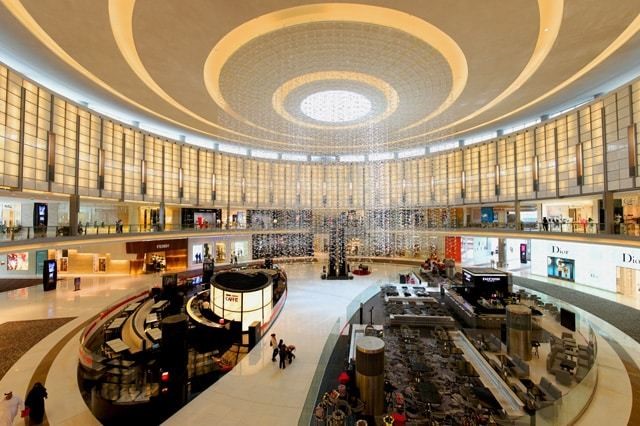
    Marie France Van Damme, the Hong Kong-based designer known for her globally influenced line of luxury resort, swim, and ready-to-wear, continues to expand her presence worldwide with the opening of the brand’s first store in the Middle East in November 2018 in Dubai, its thirteenth boutique worldwide. With boutiques in some of the world’s most iconic luxury travel and shopping capitals, Marie France Van Damme’s new store will be located in downtown Dubai in the exclusive Dubai Mall, the world’s largest luxury shopping destination.

    Situated within Fashion Avenue of The Dubai Mall (Financial Center Rd, Dubai, United Arab Emirates) a section that’s home to more than 200 luxury shops including Cartier, Chanel, and Valentino, the new 1000 square-foot boutique will offer Marie France Van Damme’s extensive luxury resort, Beach Bridal, and ready to wear lines and range of accessories, including evening dresses, resort wear, and caftans.

    As Marie France Van Damme only introduces limited productions of her collections each season, each store in itself is unique, with exclusive items at each location you won’t find anywhere else. With a focus on exclusive pieces inspired by the Dubai lifestyle, the new boutique will offer the best of both worlds: luxe day resort wear and chic evening wear.

    Made for Dubai and the elegant, modern Middle Eastern lifestyle, Marie France Van Damme’s striking collections are a return to the glamorous roots of resort wear with a muted palette of silver and gold, hand embroidery and opulent fabrics, from French lace to metallic-toned Italian weaves and featherweight Chinese silks. Signature pieces such as the Boubou caftan provide instant glamour. New this season is an exclusive “Black Gold Rose” jacquard collection of delicate evening dresses crafted in the softest crinkle silk chiffon; and short jackets, and skirts designed to be layered with long metallic blouses and worn from city to resort and from day to night, a perfect mix-and-match wardrobe.

    Collections are not distinguished by season, but relevance. Whether it’s evening wear or day dress; a silk caftan, city pajama or swimwear, Marie France Van Damme’s philosophy remains the same: “What you wear should always give you glamour. Glamour without the fuss and bother,” says Marie France Van Damme.

    We are excited to open our first boutique in the Middle East in The Dubai Mall,” says Marie France Van Damme. “I could not have imagined a better location to provide our clients with an exceptional atmosphere in one of the most beautiful shopping destinations in the world. We have many clients in Dubai including those who travel to here to shop. Like me, our customer travels around the world, and she needs to find things that will look beautiful day as well as night. Our collection was made for Dubai and the elegant, modern Middle Eastern lifestyle, from day to evening, poolside to dinner.”

    The new boutique will incorporate Marie France Van Damme’s signature aesthetic, which blends subtle Asian influences and elegant simplicity with marble floors, teak wood, bronze panels, and embossed crocodile leathers with textiles and finishes that can be found in the designer’s home as well as her flagships in Hong Kong and London.

    Marie France Van Damme will join The Dubai Mall’s 3.77 million square feet of leasable space and 1,300 retail outlets, including Galeries Lafayette, Cartier, Chanel, Valentino, Balenciaga, Gucci, Lanvin, Saint Laurent, and many more. The Dubai Mall, a luxury shopping destination that welcomes 80 million visitors each year, also has dining, entertainment, and leisure attractions including the Dubai Aquarium & Underwater Zoo, the Olympic-sized Dubai Ice Rink, and adjoining five-star hotels, including the Armani Hotel Dubai. In addition to Fashion Avenue, there is also The Souk, the open-air walkway The Village, and more.

    Marie France Van Damme has rapidly expanded since its inception in 2011 to include an impressive range of ready-to-wear, resort wear, swimwear, sunglasses, perfume, and candles. The designer just announced her twelfth boutique opening this October at the Wynn Las Vegas. She recently opened her eleventh boutique in Miami at Bal Harbour Shops and a store in Marrakech at La Mamounia in January 2018, a Los Angeles boutique in September 2017 at the Peninsula Beverly Hills, a boutique in Bangkok’s luxury shopping and entertainment complex Gaysorn Village in 2017, and her seventh store in December 2016 in Hong Kong’s prestigious Elements shopping mall, which is Marie France Van Damme’s second Hong Kong store. The company opened its very first store in Hong Kong’s acclaimed International Finance Centre (IFC) mall in September 2013. Five years later, Marie France Van Damme has twelve stores worldwide, proving that small curated stores are still very relevant. The company currently has 100 retail locations in some of the world’s most desirable shopping destinations.

  • ShopBack: More people aware of 11.11 this year

    ShopBack: More people aware of 11.11 this year

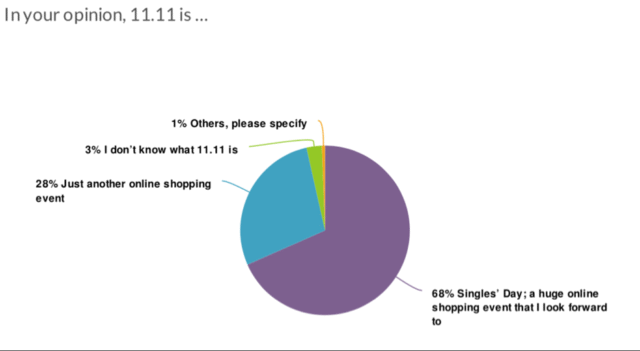
    Leading Cashback platform ShopBack conducted a survey recently and found the awareness level towards 11.11 Singles’ Day among Malaysian online shoppers has grown to 96% this year, from 69% in 2016. “In a 2016 survey to 2,000 Malaysian online shoppers, 69% answered they know what Singles’ Day is and 31% said they don’t. This year, 96% answered it is a huge online event (68%) or just another online shopping event (28%); only 3% from 2,000 respondents said they don’t know what 11.11 is, and 1% indicated that day has other meanings to them. This is an approximately 40% increase compared to 2016,” Alvin Gill, Country General Manager of ShopBack Malaysia says.

    According to Alvin, Alibaba’s investment in Lazada and massive promotions rolled out via multiple online and offline channels, as well as education efforts done by reward partners throughout the years likely contributed to the awareness growth. “Alibaba’s Taobao and Tmall have been collaborating with ShopBack on a regional level to boost market performance via cash rewards and multimedia educational efforts since 2014, of which include multi-lingual contents, digital and on-ground marketing exposures, as well as customer service support to encourage purchases through either Taobao, Tmall or Lazada’s Taobao collection, whichever suits their needs,” he adds.

    “While it is encouraging that a majority of them are looking forward to 11.11, online sellers should also target those who feel 11.11 is ‘just another shopping event’ via better product and promotional strategy. 98% of respondents said they are willing to make more purchases if the products they need are available with greater offers online. The top three offers that would encourage them to spend are high product discounts, free shipping/delivery, and promo codes/coupon,” Alvin points out.

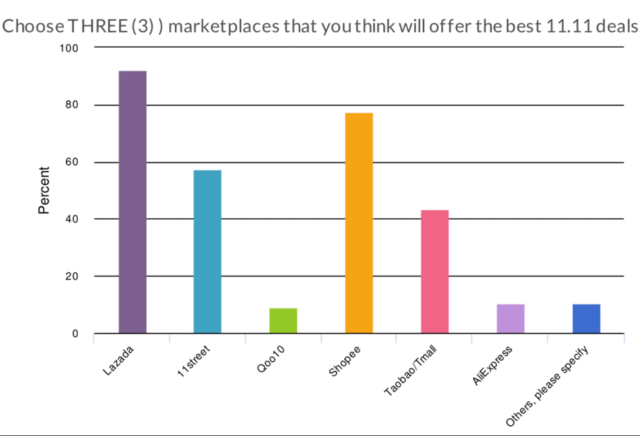
    When asked to choose three online marketplaces that they feel would provide the best 11.11 deals this year, Lazada emerged as the top choice, followed by Shopee and 11street.

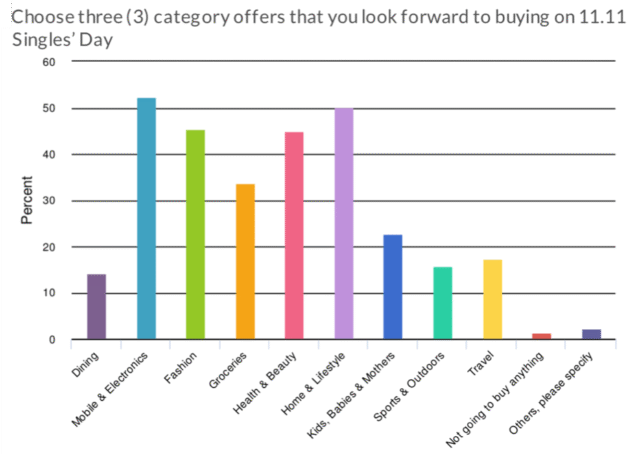
    The survey also reveals that online shoppers prefer their shopping to be affordable, fast and safe. “Mobile & Electronics emerges as the most popular category for 11.11 without surprise; the second is Home & Lifestyle which suggests shoppers could be looking for items to make over their living spaces before the New Year, followed by Fashion as well as Health & Beauty.”

    The 2018 ShopBack 11.11 online shopping survey covered views from 2,000 of ShopBack’s active online shoppers, of which 98.7% are aged 21 years old and above and around 85% have RM2,000 monthly income and above. 68.1% of the survey respondents use credit/debit card to make online payments while 25.4% select online banking as the preferred method, followed by cash on delivery 3.3%, Paypal 2.8%, and others 1.3%.

    “We witnessed 10 times more than usual web traffic directed to our partner’s sites on 11.11 in 2017, more than RM6 million worth of transactions were made through our platform and over RM200,000 cashback saved by using ShopBack. Together with our partner merchants, ShopBack Malaysia has tailor-made the 2018’s 11.11 campaign according to shopper’s needs and we aim to break the record by doubling our performance as well as cashback number this year,” Alvin says.

    Currently, more than 1 million Malaysians are using ShopBack for their daily purchases. The company works with online sites like Lazada, 11street, Taobao, Tmall, Booking.com, Expedia, Traveloka, ZALORA, Hermo, etc to give up to 30% cashback as a loyalty reward to online shoppers. Besides Malaysia, ShopBack also operates in Singapore, Indonesia, Philippines, Thailand, Taiwan and Australia. Over RM25 million worth of cashback has been given to its Malaysian users thus far. The cashback savings can be transferred out to a user’s bank account upon validation.