Tag: asia

  • Jeju Air net profit falls 3.7% due to the high cost of oil

    Jeju Air net profit falls 3.7% due to the high cost of oil

    Jeju Air, Korea’s biggest low-cost carrier by sales, said Tuesday its third-quarter net profit fell 3.7 percent from a year earlier due to high oil prices. Net profit for the three-month period that ended on Sept. 30 reached 31 billion won ($27.6 million), compared with 32.3 billion won ($28.7 million) a year earlier, the company said in a regulatory filing.

    The budget airline said high oil prices are to blame for the decline in net profit.

    Jet fuel prices came to $87.3 per barrel in the third quarter, up 45 percent from a year earlier.

    Operating profit fell 6.5 percent to 37.7 billion won ($33.5 million) in the July-September period from 40.3 billion won ($35.8 million) a year ago. Sales were up 31.3 percent to 350 billion won ($311 million) from 266.5 billion won ($236.8 million) during the same period last year, it said.

  • Ralph Lauren results concerning even after its anniversary celebration

    Ralph Lauren results concerning even after its anniversary celebration

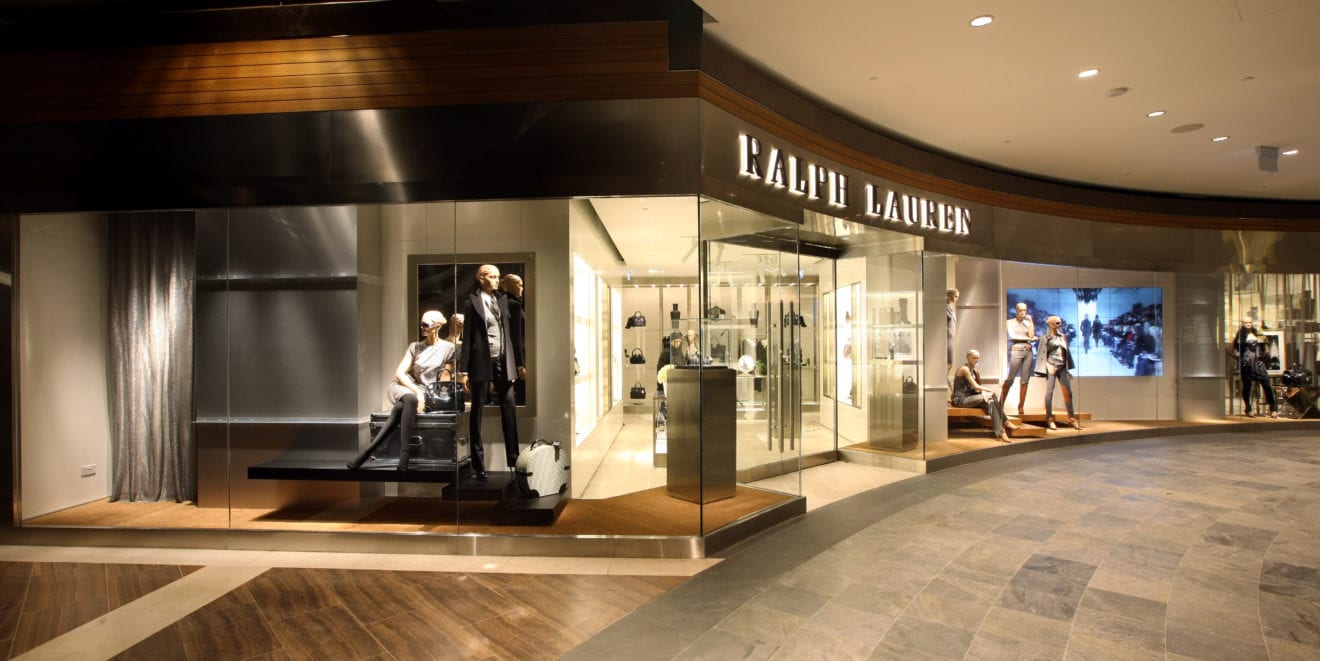
    As Ralph Lauren pulls out all the stops to celebrate its 50th anniversary, its second-quarter results do not reflect the upbeat note of the festivities. Indeed, if anything the Ralph Lauren results are rather anemic and are characteristic of a brand that is still not entirely confident about its place in the fashion world or its future direction.

    While growth of 1.6 per cent in overall revenue and a 1.4 per cent uplift in North America are positive, the decline of 0.8 per cent in Europe is disappointing as is the flat comparable-sales result. This mixed bag shows that the brand is only firing gently on some cylinders rather than powering ahead.

    While in growth, Ralph Lauren’s North American division is still underperforming. The relatively flat revenue result, which is underpinned by an anemic 1 per cent increase in comparable sales, comes against the backdrop of a robust consumer economy where spend on luxury and higher-end goods is increasing. It has also been delivered at a time of elevated marketing spend. That Ralph Lauren could not engineer a better performance underlines the fact that the brand has a lot more work to do to connect and resonate with consumers.

    One of the unresolved issues at Ralph Lauren is in having a clear brand proposition that is carefully targeted at customers. While numbers show that general brand perception of Ralph Lauren has improved over the past year, the number of people agreeing that it, or its sub-brands, are ‘made for people like them’ has remained flat. This is worrying and underlines that there is still a lot of repositioning and redefining required before Ralph Lauren can deliver better numbers.

    None of this should suggest the company has been inactive or passive; it has not. With the Polo brand, for example, a lot of new items have been introduced and products have been enhanced with embellishments such as embroidery and added functionality. These have helped to drive some better numbers and suggest that the company is innovating, but the improvements are hampered by a lack of progress on overall brand perception, especially among younger shoppers. It will clearly take time for the various changes to drive overall perception.

    One area of progress is on the digital side of the business, where comparable sales in North America rose by 9 per cent. While this is below the overall rate of growth for online luxury, it is a sign of progress and is a reflection of the various investments Ralph Lauren has made in its digital channels – including the marketing efforts on social media. Ralph Lauren now needs to apply this thinking to driving traffic in stores, where North American sales fell by 1 per cent on a comparable basis.

    Outside of North America, performance in Europe was poor. While total revenue fell by 0.8 per cent, comparable sales slipped by 4 per cent. Part of this is down to inventory issues at outlet stores and part is the result of lower consumer confidence in key markets like the UK. Even so, it is disappointing given the various investments, including in digital, that Ralph Lauren has made in the region.

    Overall, Ralph Lauren is gently moving in the right direction. However, the brand vision remains rather murky. It needs to be simplified and retooled so that it is clear and compelling. A young brand like Maine’s Kiel James Patrick is the perfect example of a well-curated and authentic lifestyle label that Ralph Lauren needs to emulate. Ralph Lauren has yet to prove it is up to this task.

  • IKEA to create 10,000 jobs in Maharashtra India over next 3 years

    IKEA to create 10,000 jobs in Maharashtra India over next 3 years

    Swedish furniture giant IKEA is planning to hire 10,000, both direct and indirect, in Maharashtra over the next two to three years, a senior company executive has said. According to a report: The company opened its first store in Hyderabad in August this year and the Navi Mumbai will be the second store in the country.

    “Next year, we are opening the Navi Mumbai store, for which we are planning to recruit 5,000 directly and an equal number will be hired indirectly over the two to three years,” Anna-Carin Mansson, People and Culture Manager, IKEA India said.

    This will include directly hiring 1,000 by mid-next year and 1,500 indirectly for services, including assembly among others, she said adding as per the IKEA policy, 50 percent of this recruitment will be of women at all levels.

    “We believe in equality and providing a balanced, safe and secure work environment for all employees. We are also open for recruiting from the lesbian, gay, bisexual and trans (LGBT) communities,” she further said.

    The world’s largest furniture chain is looking to hire people in e-commerce, sales, logistics, digital and Human Resource’s and mostly they hire locals, she said.

    “With our employee friendly policies, we are expecting to keep the attrition levels very low. We believe in value- based recruitment, where the core values of an individual is considered and not what is said in the CV. We provide equal opportunities to all our co-workers, help them grow and enable them to follow their passion,” she said.

    IKEA has several employee friendly policies, such as day care facilities, parental leave policy, transport policy, competence development, mentoring, pension plan among others.

    “Maharashtra is an important market for us. We have been sourcing from the state for many decades and now we are ready to enter the market in 2019 with our full offer to be able to serve all the customers,” Per Hornell, Market Manager for Maharashtra, IKEA India said.

    IKEA opened its first store in the country in Hyderabad in August, where it employs 1,000 people.

    The company is the first major single brand retailer to get FDI approval and plans to open several stores and multiple touch points across the main cities over the next 10 years .

    IKEA has four land sites in Telangana, Maharashtra, Karnataka and Delhi/NCR, and continues to look for more in other major cities.

    IKEA operates 423 IKEA stores in 50 countries with a sales volume of 38.3 billion euros.

  • New president for Issey Miyake appointed

    New president for Issey Miyake appointed

    Japanese luxury label Issey Miyake has appointed a new company president, following the internal promotion of Takahiko Ise to the top spot. Previously the fashion brand’s head of production, Ise replaces former president Masakatsu Nagatani, who will remain in the company as an advisor.

    The change over was effective since October 1, according to Japanese media reports.

    Ise came to work for Issey Miyake in the early eighties and has continued to establish a flourishing career in planning and production.

    The fashion veteran spent the past 30-plus years working across Issey Miyake lines such as Pleats Please Issey Miyake, Me Issey Miyake, Homme Plissé Issey Miyake and Bao Bao Issey Miyake.

    Ise’s promotion, which coincides with the appointments of Koji Usui and Keisuke Harukiya as managing directors, signals a shift in focus for Issey Miyake.

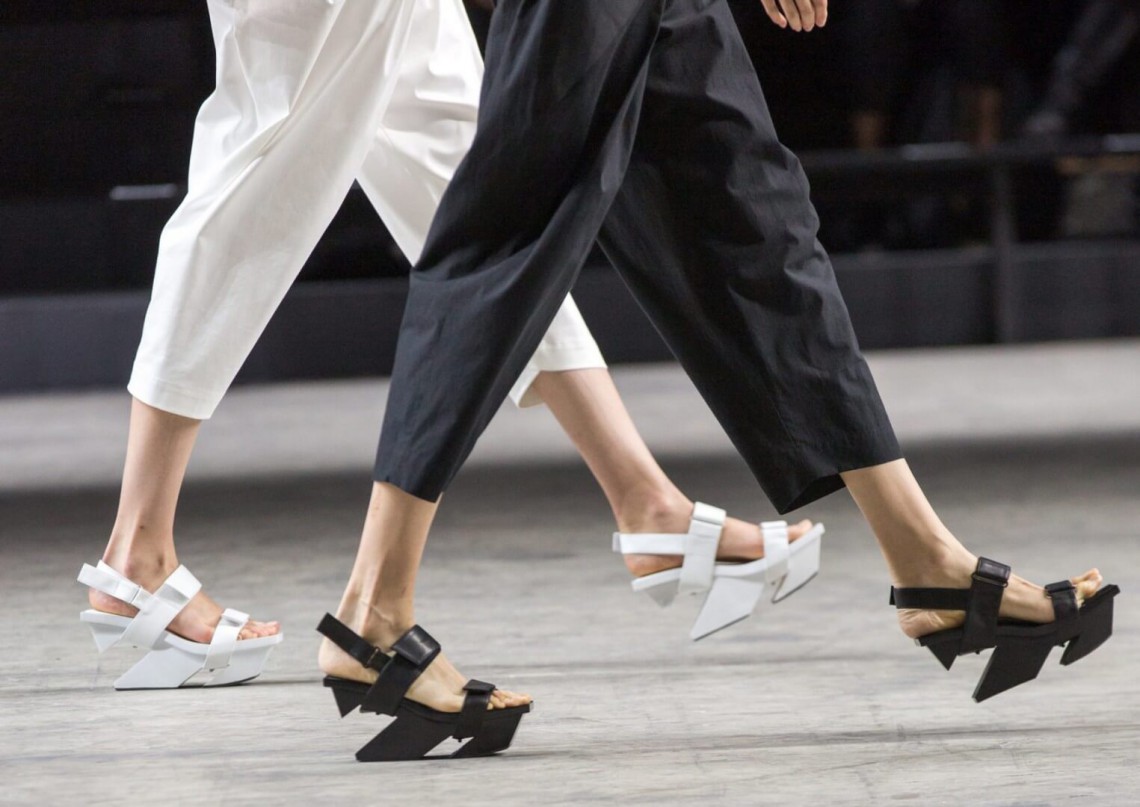
    The Tokyo-based label, renowned for its experimentation with fabrics and textile innovation, remains focused on technology to an even sharper degree moving forward, with strategies set on innovation, new technology and proprietary techniques.

    Founded by Hiriohima-born Issey Miyake in 1971,the company’s overall creative direction has been led by designer Yoshiyuki Miyamae and his team since 2012.

    Issey Miyake has approximately ten flagship stores globally, with three in its local Tokyo (Shibuya, Chuo and Minato), as well as a store in Osaka and one in Hyogo.

    International stores can be found in Paris, London, New York and Milan and Zurich.

  • Samsung steps up Microsoft cooperation

    Samsung steps up Microsoft cooperation

    Samsung Electronics Vice Chairman Lee Jae-yong met with Microsoft CEO Satya Nadella in Seoul Wednesday and vowed to increase cooperation with the U.S. company in artificial intelligence and cloud computing. Nadella is visiting Seoul this week for the first time in four years and delivered a keynote speech at Microsoft Korea’s “Future Now” artificial intelligence (AI) conference Wednesday.

    The two met in the morning before the conference and agreed to step up partnership in artificial intelligence, cloud computing and big data, said a Samsung spokesman.

    Microsoft currently uses Samsung’s semiconductors for cloud servers, and Samsung could sell more of its chips to the American partner in the near future.

    Media reports in Seoul say, as a result of the meeting, some Samsung devices, including smartphones, will be embedded with Microsoft cloud services in the future. Samsung already uses Azure, a Microsoft cloud computing platform, for its system air conditioners to collect data on the surrounding environment, including temperature and humidity, so the machines run more efficiently.

    The two executives might meet on a regular basis and exchange ideas on tech development, according to reports. The two leaders met in Seoul four years earlier.

    During his keynote speech at the conference at a hotel in western Seoul, Nadella mentioned Samsung as one of several Korean companies that had developed offerings based on Microsoft’s Azure platform.

    “Take the example of Samsung Electronics’ IoT [Internet of Things]-based air conditioner that runs on Azure. By taking into account environmental factors, like the number of people, the smart air conditioner can save up to 25 percent in energy and 30 percent in costs,” he said.

    Other sections of the Microsoft CEO’s speech were centered around the need to use artificial intelligence responsibly.

    “We need to ask ourselves not only what computers can do, but what computers should do,” he said, addressing an audience of over 1,500 programmers and businesspeople.

    He also spoke of the necessity to find ways to develop AI for “people who don’t have the ability to participate” in the digital economy.

    As an example, Nadella shared the case of Korea University Prof. Lee Seong-whan using Microsoft’s deep learning Cognitive Toolkit. Lee, who heads the brain and cognitive engineering department, analyzes brain signals in the development of computer systems that amputees can use to move prosthetic arms or robotic arms.

    Earlier on Tuesday, Samsung hosted “Tech Forum 2018,” an event for developers in Silicon Valley. Around 150 developers and designers were invited to the Samsung Research America center there.

    Kim Hyun-suk, president and CEO of Samsung’s consumer electronics division, said in opening remarks that the company was developing many “unfamiliar acquaintances,” which he believes will shape Samsung’s future innovation.

    “Samsung encounters a vast number of customers, rapidly changing technologies and new staff from various backgrounds,” he said. “Our strength is in selling more than 500 million consumer devices a year. We will expand contact points with our customers to reach into the smallest corners of their living spaces and bring innovation to their lifestyles in general.”

    Kim added that in terms of working with various employees, the company will continue to develop a corporate culture where global staff can cooperate and freely suggest ideas. Samsung also introduced the company’s developments in future technologies and held open discussions.

  • COSMOAI Opens Flagship Store at Imperial Hotel Tokyo

    COSMOAI Opens Flagship Store at Imperial Hotel Tokyo

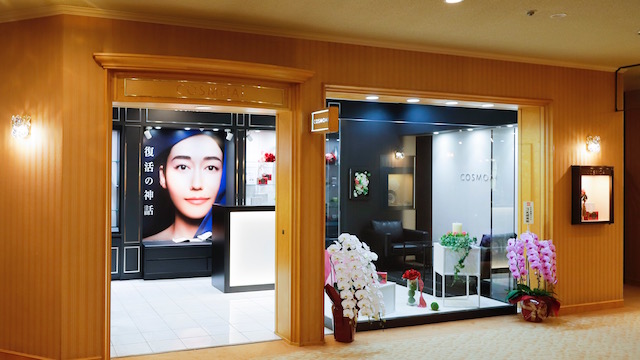
    Japanese skincare brand Cosmoai has opened its Tokyo flagship store at Imperial Hotel Tokyo. The new store covers an area of 59sqm and showcases the company’s signature products to business and mid- and upper-class customers. It is the second Cosmoai store in Japan following its first flagship store in Nagoya.

    Cosmoai’s CEO Takayuki Inoue said the store provides an opportunity to introduce Tokyo customers to premium product lines and enable them to try them out.

    Cosmoai specialises in skincare solutions and enabling anti-aging skin repair and revival. Coinciding with the new store is the launch of a new hair care product, 18-Hair Care EX, a pill taken orally that addresses the problem of hair loss and improves hair health.

    The company’s products are now available in Tokyo, Nagoya and Hong Kong and online.

  • Public Bank launches all-in-one digital payment platform

    Public Bank launches all-in-one digital payment platform

    Public Bank Bhd, in partnership with Revenue Group Bhd, today launched the all-in-one digital payment terminals. This all-in-one digital payment terminal has been piloted at selected merchant outlets of Public Bank and will be made available tomorrow.

    Public Bank managing director and CEO Tan Sri Tay Ah Lek said the first all-in-one digital payment terminal in Malaysia, developed by Revenue, will simplify the payment acceptance process as it will enable the physical retail merchants to accept both card payments and mobile wallet payments in a single digital payment terminal thus providing convenience to them.

    As at end September 2018, Public Bank has more than 60,000 electronic data capture terminals nationwide.

    Tay said it will continue with its strategy of increasing its merchant base and adding on more new acceptance services.

  • What is Singles’ Day like in the Philippines?

    What is Singles’ Day like in the Philippines?

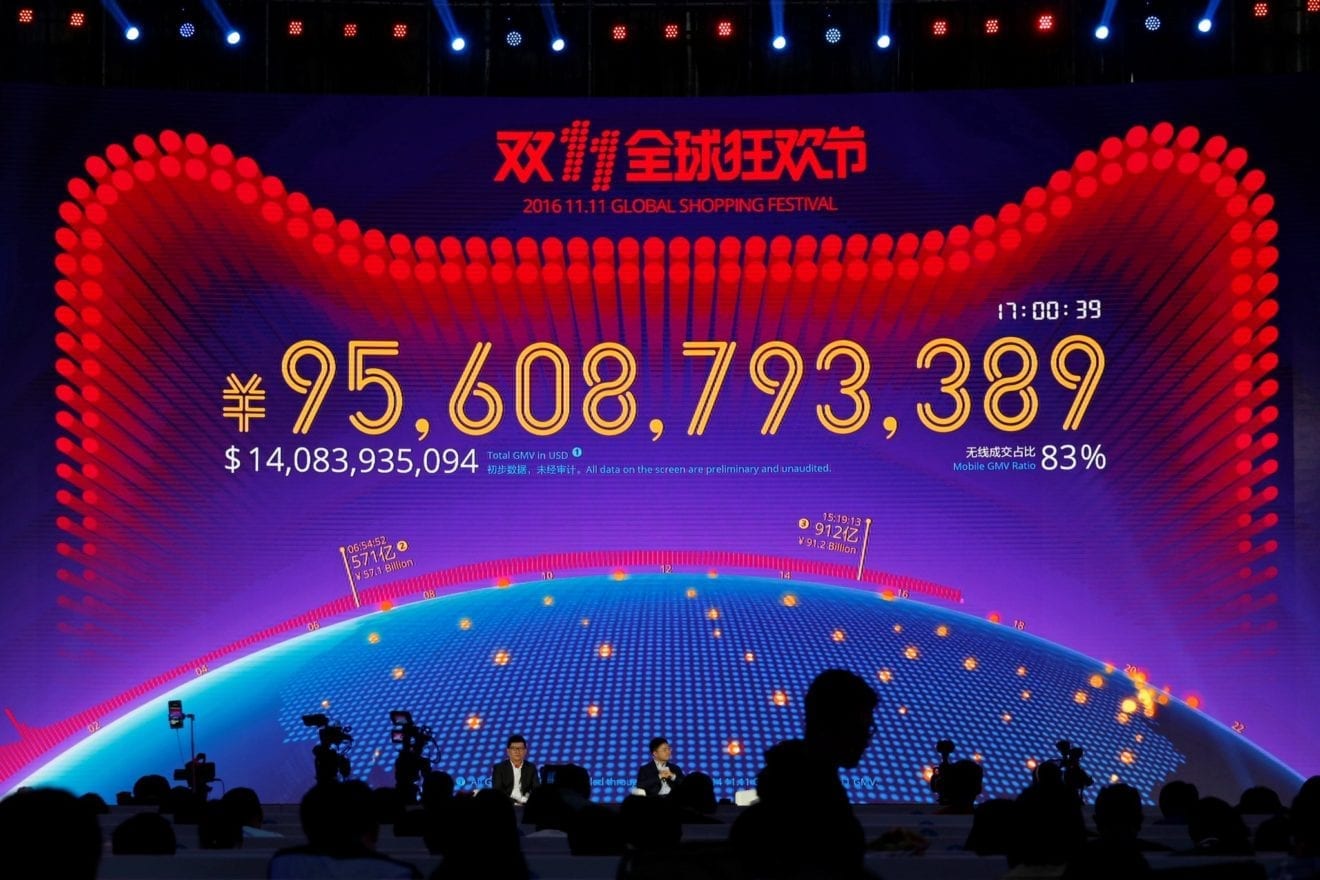
    It all started with a few students from Nanjing University who decided to break away from the monotony of being single for one day. They chose 11.11 because of the solitary implications of the number 1 which symbolize being single. However, this simple celebration turned into one of the largest shopping days in the world.

    It turns out that this event gained great interest also in Southeast Asia.

    According to Google, in Philippines the popularity of Singles’ Day has increased more than four times in the last five years.

    Who’s taking part in Singles’ Day? What are the behaviours of consumers on that day? 

    Shopping therapy for the young and lonely

    Who shops on Singles' Day

    So, who exactly takes part in Singles’ Day?

    57% are actually women.

    In accordance with the event’s name, three out of four consumers are single.

    Of course, not only singles went on a shopping spree.

    An increase in interest, although not as significant as among singles, can also be noted in the group of people in relationships.

    The interest in Singles’ Day is especially apparent among young Filipinos.

    Compared to a regular day, the number of transactions on Singles’ Day among people aged 18-24 grew by 1022%.

    However, getting great discounts is not restricted to younger people as there is a noticeable interest in this shopping festival among all age groups.

    The day for singles to indulge themselves

    What and how Filipinos buy on 11.11

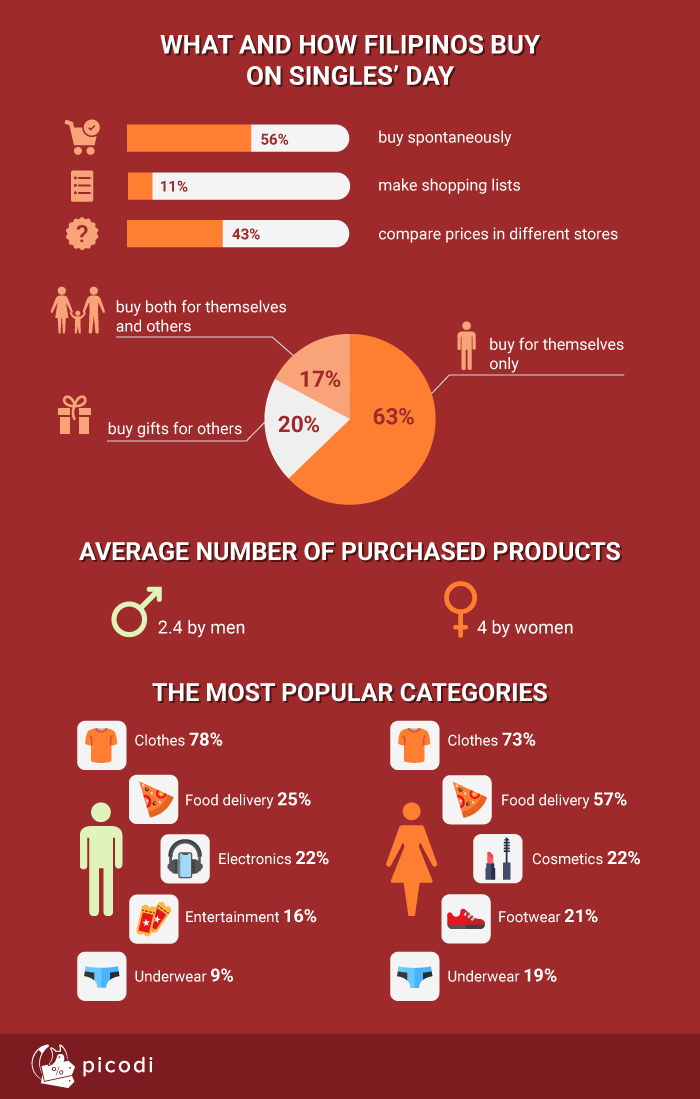
    More than half of Filipinos do not prepare for the Singles’ Day shopping craze but buy impulsively on that day.

    43% compare the prices in different stores while 11% make lists before shopping.

    It looks like most people treat 11.11 as an occasion to meet their desires rather than an opportunity to execute a well-thought-out shopping plan.

    On top of that, more than 60% of consumers buy things just for themselves and only one-third buy gifts for other people on that day.

    An average man buys less than an average woman—2.4 and 4 products respectively.

    The most desirable items among men are clothes, delivery food and electronics. Similarly, women buy mostly clothes, delivery food and cosmetics.

    Shopping fever in the middle of the day

    Shopping behaviours on Singles' Day

    It’s not surprising that Filipinos buy more than usual on Singles’ Day.

    The number of online transactions increased significantly with 970% more purchases compared to a regular day.

    On average, a Filipino is willing to spend 3050 PHP on a Singles’ Day shopping spree and sales reached a peak right in the middle of the day, at 1 PM.

    Mobile users far behind

    Singles' Day: Devices types and brands

    70% of consumers use desktops when doing their shopping on Singles’ Day.

    Only 26% of Filipinos make their purchases on mobile phones.

    Most of the transactions are made on Apple devices, followed by Samsung, OPPO, Asus and Huawei appliances.

  • Lenovo opened an unmanned store in Beijing

    Lenovo opened an unmanned store in Beijing

    Lenovo China has launched an automated store in Beijing based on facial recognition technology. The Lenovo Go store also features a mobile payment system. A blog post put out by the Taiwanese tech giant reads: “Shopping at the store is quite simple. You walk up to the door, cameras recognise your face, you browse the aisles, pick out what you want as usual, then – and here’s the magic – you just walk out, and your account is automatically settled via your mobile payment.”

    Lenovo’s head of research and technology Daryl Cromer said: “We can now understand some of the technologies and challenges our customers face, allowing us to make better devices and tailored solutions.

    The store becomes a powerful pilot program for technologies that move beyond the Lenovo campus.”

    Lenovo plans to use data gathered at the store to power future technologies, such as an espresso machine that can brew coffee to individual preferences based on facial recognition.

  • Vingroup acquires mobile phone retailer Vien Thong A

    Vingroup acquires mobile phone retailer Vien Thong A

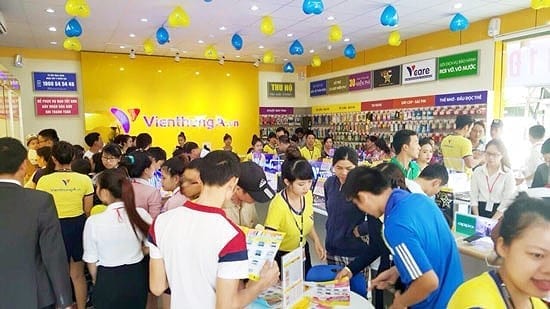
    Vietnam’s biggest private conglomerate Vingroup has officially confirmed its acquisition of major tech products retailer Vien Thong A.

    In its financial statement for the third quarter of 2018, Vingroup lists Vien Thong A Import Export Trading Production Corporation as a fully-owned subsidiary.

    On September 14, Mai Thu Thuy, board member of the Vincom Retail Joint Stock Company and Chairwoman of the Vincom Mega Mall Royal City, was appointed legal representative of the acquired company.

    Established in November 1997 in Ho Chi Minh City, Vien Thong A is the oldest retail technology chain in Vietnam. It has nearly 200 stores, including independent shops and a “shop-in-shop” model in BigC supermarket, CoopMart, and 100 service centers.

    In early 2017, Vien Thong A CEO Hoang Ngoc Vy revealed plans to restructure the company and seek investors to expand its business.

    Last month, VinCommerce, a member of Vingroup, bought Fivimart from domestic company Nhat Nam JSC and Japanese retailer AEON, which held 70 percent and 30 percent stakes, respectively.

    In the first nine months of this year, retail sales of Vingroup reached VND12.89 trillion (nearly $555 million), a 41 percent year-on-year surge.

    Vingroup, Vietnam’s biggest property conglomerate, dominates the housing and property markets with Vinhomes.

    It has also entered the healthcare market with Vinmec, runs a chain of supermarkets called Vinmart, and entertains tourists at Vinpearl resorts.

  • Apple’s India profit zooms 140 pc to Rs 896 cr in FY18

    Apple’s India profit zooms 140 pc to Rs 896 cr in FY18

    Tech giant Apple’s India unit registered 140 percent jump in its net profit at Rs 896.3 crore for the fiscal ended March 2018, as per regulatory documents filed by the company. According to a report: The iPhone maker, which competes with the likes of OnePlus and Samsung in the premium smartphone category in India, had registered net profit of Rs 373.3 crore in 2016-17, the documents filed with the Corporate Affairs Ministry showed.

    The company saw its total income (including other income) rising about 12 percent to Rs 13,097.6 crore in FY2018 from Rs 11,704.3 crore in the previous financial year, documents sourced by business intelligence firm Tofler showed.

    During the company’s earnings call in July, Apple CFO Luca Maestri had stated that Apple was witnessing great momentum in emerging markets and that it had established new June quarter records for Mac sales in India.

    Earlier in the year, Apple CEO Tim Cook, too, had emphasised the importance of the Indian market. He had said the company plans to launch all its initiatives, including retail, in India where it has an extremely low overall market share but offers huge opportunities. The CEO also stated that Apple was putting a lot of energy in India and working with the carriers in the market.

    The company has also been steadily increasing its market share in the burgeoning Indian smartphone market. According to Counterpoint Research, the company had a 25 percent market share in the premium category (Rs 30,000 and above) — after OnePlus (30 percent share) and Samsung (28 percent share) — in the third quarter of 2018.

  • Smartphone parts makers struggling

    Smartphone parts makers struggling

    Korea’s smartphone parts industry has been in decline. Squeezed by price-competitive Chinese producers and a saturated market, it is losing sales and workers. The difficulties faced by suppliers just add to Korea’s manufacturing concerns, as profits slump at automobile companies and as the semiconductor supercycle seems to be coming to an end.
    An analysis published on Nov. 4 based on responses from 42 locally-listed smartphone parts producers indicates over 3,700 jobs and 2.6 trillion won ($2.3 billion) in revenue have been lost in the business over the past five years. The analysis compared financial statements issued in the first half of 2013 with those from the first half of 2018 by producers of smartphone covers, cameras, circuit boards and touch screens.

    Combined revenue for the 42 firms in the first half in 2018 stood at 5.69 trillion won, down 31.4 percent over the past five years from 8.29 trillion won. Twenty-six of them, or 61.9 percent, reported a drop in revenue over that time. Combined operating profit at the 42 companies collapsed, falling from 497.8 trillion won five years ago to a loss of 6.3 trillion won in the first half of this year. Net margins for the group was negative 0.11 percent. Nineteen of the companies, or 45.2 percent, are reporting operating losses.

    The trend is in line with the results at major electronics companies. LG Electronics’ mobile communications division has been reporting operating losses for four consecutive years.

    Smartphone components producers have faced significant job losses, with total employment falling from 20,613 to 16,818. Only four companies, or 9.5 percent of those surveyed, reported a rise in revenue, operating profit and jobs over the five-year period.

    SMAC, a Kosdaq-listed supplier for Samsung Electronics of touchscreen modules for smartphones, recorded 26.5 billion won in revenue in the first half. That is about 10 percent of the revenue it posted in the first half of 2013. Operating loss for the first six months of this year was 5.8 trillion won.

    “Our earnings results were challenged as the average period in which people switch smartphones lengthened from two to three years and technological changes came quickly,” said an executive at the company.

    People & Telecommunication, another Kosdaq-listed manufacturer, was the victim of embezzlement by its majority shareholder of as much as 20 billion won last month. Once the country’s leading phone cover producer, it is now suspended from trading on the exchange.

    Experts say that local smartphone producers failed in solidifying their position as the market stagnated.

    According to Strategy Analytics, smartphones shipments will total 1.48 billion units this year globally, retreating for the first time since 2007, the year Apple introduced its first smartphone. Samsung is projected to ship 298.5 million smartphones this year, according to the market researcher, registering a figure below 300 million for the first time since 2013. LG Electronics is facing weakness except in North America.

    Rapidly advancing technologies are weighing on component producers. Smartphone used to have thin-film-transistor liquid-crystal display panels, but now, organic light-emitting diode panels are utilized.

    Even though smartphones are adding more cameras – two or three at least – smaller players in Korea are pressed to keep innovating.

    “Even before we have finished depreciating production facilities, we have to invest again in new facilities,” said an executive at a camera module producer. “Profitability is feared to be damaged.”

    Samsung Electronics is having Chinese manufacturers assemble its medium and low-cost models for the Chinese market, with the goal of maintaining its global smartphone market share of 20.2 percent.

    Samsung is scheduled to release Galaxy A6s this month in China, which has been developed and produced by Wintech, a Chinese company.

    “Even though Samsung said that the Chinese-manufactured models are only for the Chinese market, it means parts made by China will naturally increase,” said an executive at one of the parts producers.

    Smartphone parts makers are trying to find new business or diversify their supply channels. Kim Hak-kwon, CEO of Jaeyoung Solutec, a smartphone camera optical components maker, says he has pinned hopes on the resumption of operations at the Kaesong Industrial Complex. The components require sophisticated manual labor, and using skilled North Koreans is seen to improve the situation.

    Others are looking towards developments on the software side of the business.

    “Smartphone Cinderellas – software-based start-ups – are supposed to be a breath of fresh air for the industry,” said Sohn Dong-won, professor of business administration at Inha University.

  • Post-Instagram age : What’s next?

    Post-Instagram age : What’s next?

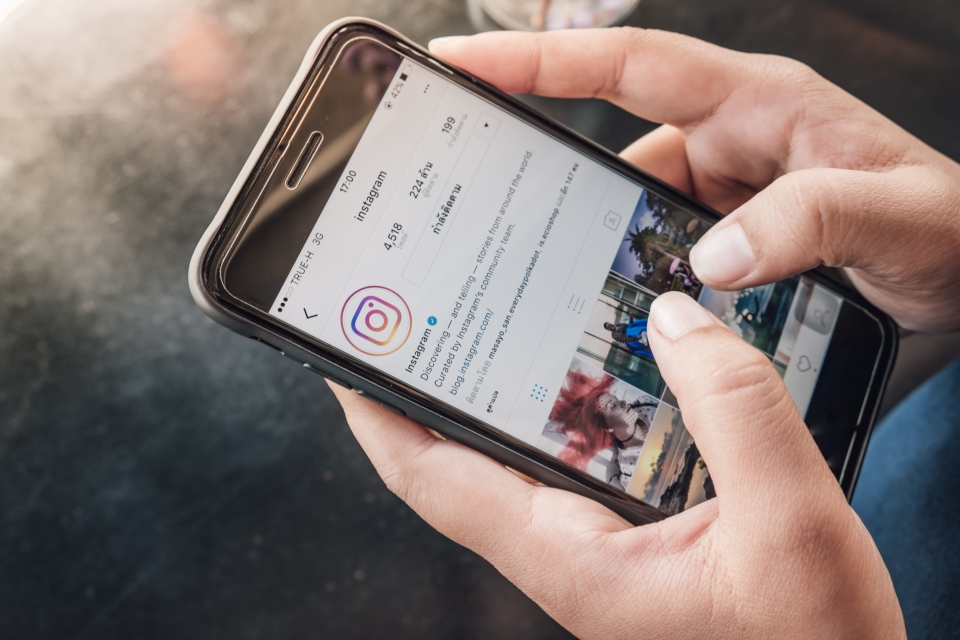
    Oscar de la Renta was early to Twitter, early to Tumblr and, yes, early to Instagram. So in July 2013, when the American fashion house debuted its fall advertising campaign via the app, the industry was hardly surprised. It was a little thing. An experiment. After all, the Norman Jean Roy-shot images would still run in the September issues of every major fashion magazine.

    Actually, it was a “really big deal,” recalled Jason Wagenheim, a former Condé Nast publishing star who was, at the time, Teen Vogue’s chief revenue officer.

    “That was a real tipping point for fashion,” said Wagenheim, who left the legacy publisher in 2015 and is now chief revenue officer of Bustle Digital Group.

    “Here is this expensive luxury brand and their fall campaign, which everyone looked forward to seeing in the print pages of Vogue; and yet everyone is talking about the engagement — the bajillion likes within hours — that the campaign got on Instagram. It foreshadowed that this could be bigger than any fashion magazine.”

    In reality, each of the Oscar de la Renta advertising images attracted not much more than 1,000 likes within the first hour of their posting.

    But the campaign was indicative of a much wider shift that has transformed fashion, changing how publishers publish, how brands brand themselves, and how consumers consume.

    Brands have closed, stores have shuttered, magazines have folded — and both survivors and upstarts alike are fighting for consumer dollars in a new world where the formula for success is not nearly as clear as it is once was.

    And no single entity has had as lasting an effect on the fashion ecosystem as Instagram, the photo-sharing service let loose on Apple’s App Store on October 6, 2010.

    Three years later, when Oscar de la Renta drip-dropped those images down its feed, traditional print magazines like Vogue were still the arbiters of style.

    It feels like a long time ago. But back then, their authority remained intact and largely unchallenged, despite the rise of independent publications that operated outside of the traditional publishing industry and the emergence of digital brands that sold directly to consumers.

    But it’s 2018 now, and times have changed.

    Instagram, which was acquired by Facebook for $1 billion in 2012, is where people now go to discover fashion content and, increasingly, to shop, with 72 percent of users saying they have made fashion, beauty or “style-related” purchases after perusing the app, according to a 2017 study of 2,000 Instagram users.

    Instagram claims that more than 90 million users tap to see tags on shopping posts each month.

    In some ways, it was inevitable.

    Americans spend only 4 percent of their media-technology consumption hours with print, compared to 20 percent on personal computers and 28 percent on mobile.

    Many of them are spending their mobile phone screen time on Instagram.

    In June 2018, the app surpassed the billion-users-a-month mark, up from 800 million users in September 2017. More than 400 million people use Instagram Stories — the app’s more casual slideshow feature — every day.

    Rival Snapchat had 186 million daily active users in its most recent quarter, down from 191 million at the beginning of the year.

    As of August 2017, Instagram users under the age of 25 spend more than 32 minutes a day on the app.

    But the number dips only slightly to 24 minutes for those older than 25. That’s length of a sitcom…or a scan of a magazine.

    Of course, fewer and fewer consumers are buying those magazines. And brands have responded by following consumers online and shifting their marketing budgets from print to digital.

    In 1998, US print advertising revenue was $61 billion.

    In 2008, it was $54 billion, just a 12 percent decrease despite rising internet usage.

    But in 2018, it’s set to clock in at under $15 billion — down a staggering 75 percent from 20 years ago.

    Brands are increasingly using Instagram — via both organic and paid posts — to communicate directly with consumers.

    “Given the rising importance of social media for luxury brands — especially in the context of millennial’s growth — we believe Instagram data can no longer be ignored as a data point for luxury investors, to help them pick the winning brands,” Swiss investment bank UBS said in a recent note, going on to say that high Instagram engagement was a dependable reflection of brand heat.

    There is an unmistakable correlation between the size of a brand’s Instagram following and its retail sales.

    So it’s no surprise that, in the second quarter of 2018, global advertising spend on Instagram was up 177 percent year on year, significantly ahead of Facebook, which saw 40 percent growth in the same period.

    While Facebook still generates the majority of the company’s revenue, which hit nearly $41 billion in 2017, analysts estimate that Instagram will generate $8 billion to $9 billion in 2018.

    Projections predict that Instagram will account for about a third of its parent company’s overall ad revenue — and 70 percent of its new revenue — by 2020.

    In some ways, Instagram is to fashion what Napster was to music.

    You still can’t download a dress, but Instagram has fundamentally rewired the industry, replacing print magazines as the primary way in which people discover fashion.

    It’s the foundation on which the industry has built everything from new labels to an influencer economy worth $1.6 billion in 2018.

    All of Fashion Uses Instagram

    Consumers were quick to embrace Instagram, thanks to its simple user experience and flattering, colour-washed filters that made even grainy images look a little bit more perfect.

    They posted photos of their food, their travels and, yes, their outfits. Fashion brands picked up on this quickly, realising that creating content on Instagram — a highly visual platform — would allow them to reach more customers, and soon found themselves locked in a race for followers.

    Even luxury houses like Chanel, which has resisted selling core products online, took it seriously, using the service to post runway looks, campaign outtakes and inspiration boards.

    Some — from Proenza Schouler to Kith — have used the platform to tease their latest collections instead of waiting for a live Fashion Week moment.

    Earlier this year, Dior used Instagram as the main vehicle for the promotion of the relaunch of its classic saddle bag, tapping more than 100 influencers to spread the word.

    While the campaign proved controversial — several of the influencers did not disclose that they were paid to post on behalf of Dior — it was a blockbuster success.

    The #DiorSaddle hashtag drove $3.4 million in earned media value in the third quarter of 2018, beating #PFW, which garnered $2.6 million in earned media for the same time period.

    But it goes beyond the legacy players. “Instagram brands” — mostly independent startups with minimal capital — have caught the eye of major retailers looking to woo increasingly discerning customers.

    Why? Because their audiences are highly engaged, using Instagram stories to shop and direct message — “DMing”, in Instagram parlance — with the brands themselves.

    Labels like Doen, Cult Gaia and By Far boast little-to-no presence at major fashion weeks or within the traditional fashion system, and yet they are the brands industry insiders are most curious about because of the communities that they’ve built on Instagram.

    While Los Angeles-based bohemian apparel line Doen has just about 140,000 followers, it DMs with members of its community every day.

    The result? The brand regularly sells out of its peasant blouses and prairie dresses, creating an online frenzy.

    Cult Gaia, another Los Angeles-based label, may only have 317,000 followers on the platform, but the company says that it is on track to generate $15 million this year: far more than many independent high-end fashion brands with, in some cases, millions of followers.

    Through Instagram, we’ve built our own community.

    Instagram influencers are also launching brands, many with great success.

    Arielle Charnas, the influencer behind the account Something Navy, sold more than $4 million worth of product on the launch day of her collection with Nordstrom.

    In fact, the American department store has released multiple influencer collections, all of which are promoted via Instagram.

    Then there is the creative community, including relatively unknown artists, illustrators and photographers — from Gucci collaborator Jayde Cardinalli to artist Suzanne Jongmans, who has worked with Valentino’s Pierpaolo Piccioli— whose work now has global reach.

    But for Charles Porch, Instagram’s head of global creative programs, the platform’s crowning fashion moment came in October 2015, when American Vogue editor-in-chief Anna Wintour held a dinner during Paris Fashion Week in honour of Instagram co-founder and chief executive Kevin Systrom.

    Together, they celebrated the “Instagirls,” or models who earned or boosted their fame through Instagram, including Kendall Jenner and Gigi Hadid. Donatella Versace was there. So was Pat McGrath. They, too, were hooked.

    “To see the biggest designers, models, people in the industry talking about how much they love the platform, giving their feedback and, actually, huge people being able to talk about the product in depth … seeing their passion for a tech product … that really clicked for me,” Porch said. “They’re in so deep.”

    Earlier that year, Porch had wooed Eva Chen, an Anna Wintour protégé and the former editor-in-chief of now defunct Condé Nast shopping title Lucky, to lead fashion partnerships at the company.

    If Instagram is the modern equivalent of a fashion magazine, then you could call Chen its de facto editor-in-chief.

    Her personal brand — warm, friendly and, yes, democratic — aligns almost too perfectly with that of the platform itself. With more than one million followers, she has developed her own hashtag, written a children’s book, set to be published later this autumn, and earned a seat on the YNAP’s board of directors.

    Part of Chen’s job is to convince fashion industry stars like Kate Moss and Donatella Versace to join and use the app. But most importantly, she helps brands, image-makers, publishers and influencers get more out of their Instagram accounts.

    Chen travels the world to help fashion brands, holding master classes — filled with executives from brands like Madewell, Birchbox and Ralph Lauren — where she offers step-by-step instructions on how to take a good photo, how to get the most out of Instagram Stories, how to use hashtags without spamming people. All things that, if done well, can help improve engagement — and potentially increase sales.

    She also advises them on how to spend their advertising money on the app, although, like a traditional editor-in-chief, she is not cutting the deals and is more focused on organic marketing.

    “Instagram has made fashion more accessible,” Chen said recently one late Friday afternoon at the company’s New York city offices, wearing a pair of brown Gucci loafers and a checked blazer, the sort of off-duty look preferred by many of her friends who remain in print media.

    The Collateral Damage

    In many ways, Instagram has helped to modernise the fashion industry.

    But what about the collateral damage left in the wake of its success?

    Brands are not only pulling advertising from print, but also from legacy publications in general.

    While traditional publishers are still earning a part of the digital pie, brands are splitting up their marketing spends differently than they used to.

    Today, they might devote a certain percentage of budget to influencer marketing, and another slice to advertising directly on Instagram and other social media platforms.

    Oscar de la Renta has been using Instagram as an organic marketing tool for years, but it wasn’t until recently that it began spending a significant amount of its budget there.

    Three years ago, less than 5 percent of the overall budget was dedicated to digital advertising.

    For the spring 2019 season, it will be at least a third, said chief executive Alex Bolen, a portion of which will be spent on Instagram.

    Some brands are taking even bigger swings.

    About 55 percent of Gucci’s total 2018 media spend will go to digital efforts — mostly native advertising and paid social — per a report released by the Kering-owned brand in June. That is up from 44 percent in 2017 and 33 percent in 2016.

    And digital retailer Net-a-Porter has eliminated all national print advertising for 2018 bu for a few ads which will still run in local publications.

    Critically, the retailer also has its own newsstand-available magazine, Porter, that serves as a several-hundred-page advertisement.

    But moving away from print was not a small decision.

    “Instagram is where our customers expect to find us,” said Net-a-Porter managing director Matthew Woolsey.

    “Social media platforms certainly rise and fall, and while our outlook is agnostic, we are going to the platforms that enable us to have the brand conversation that we want to have and emotionally connect. Instagram does enable that.”

    Then there’s the talent drain.

    Image-makers and writers who would have normally held positions within legacy publications are now fleeing to digital-first publishers as well as brands, which are creating more content in-house to populate social channels.

    Many are also working independently as free agents, using Instagram to promote their projects.

    What’s more, declining advertising revenue means that there is less job security within traditional editorial.

    Today, editors might have to work across multiple publications within a company without any sort of raise or recognition. Going it alone often makes more fiscal sense.

    Legacy publications that cater to an older, affluent audience still have clout.

    As do those that still resonate with the industry.

    Doen — known for dreamy imagery and romantic silhouettes, created in limited-edition batches that often sell out — credits Instagram with much of its success.

    But it uses traditional media as a way to communicate to the trade.

    “Those are more of a tool to establish us as a brand within the fashion community,” said Doen co-founder Katherine Kleveland.

    “Through Instagram, we’ve built our own community.”

    But what happens if that community goes away?

    Testing Instagram’s Staying Power

    Eventually users will abandon Instagram.

    The question is when.

    Digital consumers can easily switch from one platform to another, making loyalty low.

    How long can Instagram keep them entertained?

    In September, the company made two significant announcements that could impact that answer.

    First, there was the introduction of new shopping features that make it easier for users to transact via the app.

    Then, just a week later, co-founders Kevin Systrom and Mike Krieger, who had carefully guided the business since its inception, announced their resignations.

    Reports in The New York Times and technology site Recode suggested that the two founders felt that parent company Facebook was moving too fast to change — and commercialise — the product, sacrificing the simplicity that made Instagram so popular in the first place.

    As Instagram has become the ultimate browsing tool, it has also become increasingly transactional.

    The company encourages this behaviour by making it easier for paying advertisers to link out and run targeted advertising both within the feed and Instagram Stories.

    Business accounts can also link out through Instagram Stories and tag products within posts.

    The addition of these tools is a natural — and welcome — progression, said Lauren Price, director of client strategy for luxury and special retail at research firm Gartner L2.

    “It doesn’t feel like it’s a huge divergence from the way that brands and consumers have used Instagram from the get-go,” she added. “The intention [to shop] has always been there.”

    After rumours that it would launch a standalone shopping app surfaced, Instagram announced that it would instead introduce a shopping channel on its “Explore” page, populated with products from brands the user follows, but also brands surfaced by its recommendation engine.

    While it is not yet possible to shop within the app, the company has linked up with major e-commerce providers including Shopify to ensure that the transition from post to check-out cart is as frictionless as possible.

    “Personalisation is a key principle,” said Layla Amjadi, Instagram’s product lead on Shopping. “In Explore, we want to make sure it’s your personalised mall.”

    Instagram insists that its focus remains on the user. That discovery is still the soul of the product.

    “Shopping is an inspiration-first product,” Amjadi said. “It maps to your interest, leans into relationships that you have… and is fantastic opportunity to help with consideration.” By “consideration” she means, “Should I buy this?”

    But as Instagram becomes more transactional, does it risk losing some of its magic?

    “I think it’s fine [for shopping] to be a part of the functionality,” said L2’s Price. “If you’re following a brand, you’re aware that it’s a brand.”

    The trouble comes in if Instagram integrates too deeply with Facebook and turns more into a pay-to-play platform.

    Right now, 93 percent of brands that advertise on social media advertise on Facebook, which prioritises advertising and organic posts from friends and family over organic posts from brands in its algorithm.

    “I advise the brands that we work [with] to get the most value out of that organic growth on Instagram in case it does change,” Price added.

    New Instagram head Adam Mosseri, the former vice president of the Newsfeed at Facebook, one of the platform’s most successful — and polarising — products, is said to have been Systrom and Krieger’s choice to lead the app into this next phase.

    But Mosseri has quite a bit of work ahead of him.

    Social networks fade as users grow tired of relentless promotions and frustrating user experiences.

    “You could certainly argue that there is an inherent scaling to the point of collapse in a social newtowrk,” said Benedict Evans, a partner at Silicon Valley-based venture capital firm Andreessen Horowitz.

    “But there isn’t an obvious next thing.”

    On the fashion front, competitors like YouTube and Snapchat are also hip to the success Instagram has seen with Chen, hiring fashion insiders Derek Blasberg and Vogue editor Selby Drummond, respectively, to head up fashion partnerships.

    And brands are likely to find it increasingly difficult to stand apart on Instagram, where they are competing for attention not only within their peer group, but with brands of all price points, quality and missions.

    The cost of advertising on the app will likely increase, as will the investment brands need to make on quality organic content.

    What if Facebook’s drive to squeeze more revenue out of Instagram makes it a less-fun experience?

    What’s more, if this “time well spent” movement actually catches on, how will this affect the new world order?

    Special interest groups are lobbying the government and private companies to better regulate the technology that powers social media.

    Instagram itself has contributed to this conversation, testing a feature that allows users to monitor their time on the app.

    Overall, fashion is still bullish on Instagram and eager to see what an easier shopping experience can do for its top line.

    For instance, the app’s bookmarking tool could be used, like Pinterest — a platform many brands still spend marketing dollars on — as a shopping list.

    If consumers continue to seek out Instagram for the fun stuff, and if Instagram can contain more of that fun stuff within the app, it could lead to more content creation, more talent discovery and more sales.

    “I don’t think Instagram is going anywhere,” Bustle’s Wagenheim said. “I feel like there’s a big opportunity to open the gates.”

    Of course, right now, fashion doesn’t really have a choice but to hope that’s the case.

  • WeWork signs deal to open office in Busan next year

    WeWork signs deal to open office in Busan next year

    WeWork, a global shared work space provider, said Tuesday it has signed an agreement with Busan to make inroads into the country’s second-largest city next year. The company signed a memorandum of understanding (MOU) with the southeastern port city on Monday with a plan to open its first Busan branch in the Seomyeon area by the first half of next year, it said.

    WeWork said more locations, including in Centum City and Busan Station, will be launched down the road.

    “WeWork will contribute to creating jobs and global business opportunities as well as revitalizing the startup ecosystem in Busan,” Matthew Shampine, General Manager of WeWork Korea, said.

    Established in New York City in 2010, WeWork currently has over 300 offices in 23 countries, including 10 in Seoul. The first Korean WeWork office opened in 2016.

  • Genting Malaysia will act to mitigate impact of higher casino licence fee, duties

    Genting Malaysia will act to mitigate impact of higher casino licence fee, duties

    Genting Malaysia Bhd is assessing the full implications of additional taxes announced in Budget 2019 and will take appropriate action to mitigate their impact. The action includes a review of its marketing expenditure as well as cost structure, it told the stock exchange.

    Genting Malaysia said it has been advised by the Finance Ministry that the annual casino licence fee will be revised from RM120 million to RM150 million and casino duties will be revised to up to 35% of gross collection.

    “The increase in casino duties represents a 10 percentage point increase over existing duty rates. The amendments will take effect from Jan 1, 2019,” it added.

    On Bursa Malaysia today, Genting Malaysia closed 3 sen or 0.83% higher at RM3.64 after hitting limit down on Monday.