Retail News CRM

Tag: banks

  • India’s Banks Set to Thrive Amidst Margin Challenges and Rising Costs

    India’s Banks Set to Thrive Amidst Margin Challenges and Rising Costs

    According to Fitch Ratings, India’s banking sector is on a promising trajectory, poised for growth bolstered by enhanced asset quality, robust capital reserves, and a stable profitability outlook. As banks maneuver through the financial landscape, analysts suggest that credit metrics will largely hold steady into fiscal year 2026, although earnings could be impacted by cyclical pressures on margins and credit costs.

    Slowdown or Steady Forward March?

    Currently, the sector is experiencing its slowest loan growth in four years, hovering at just 10.6%. Lending to non-bank financial institutions (NBFIs) and unsecured retail customers has particularly softened, a shift attributed to stricter regulatory oversight and challenging funding conditions. However, optimism remains. Fitch projects a rebound in loan growth to between 12% and 13% in FY2026, fueled by an accommodating monetary policy and gradually easing funding constraints.

    Deposits and Ratios: The Balancing Act

    Despite this optimistic outlook, banks must enhance their deposit mobilization to sustain the nearly 120 basis points improvement in loan-to-deposit (LDR) ratios they have achieved. A notable decrease in the impaired loans ratio, falling by 60 basis points to 2.2% in FY2025, indicates a positive shift. Bad loans saw a decline of 12%, further painting a brighter picture for the sector as a whole.

    A Brave New Banking Era?

    Fitch emphasizes that the impaired-loan ratios and credit costs for most banks have likely hit their lowest point. There remains potential for gains as some banks might improve their standings through write-offs of legacy bad loans, which would further shrink the outstanding bad loan stock. In Fitch’s eyes, the Indian banking sector’s strong performance is not merely a flash in the pan; expectations are set for sustained progress, contingent on banks maintaining solid core financial metrics that enhance their resilience against economic fluctuations.

    Questions & Answers

    What does Fitch Ratings predict for India’s banking sector in FY2026?
    Fitch Ratings forecasts a rebound in loan growth to 12% to 13% in FY2026, supported by an accommodative monetary policy and improved funding conditions, while projecting that credit metrics will remain stable.

    Why is the current loan growth considered the slowest in four years?
    The current loan growth rate of 10.6% is primarily due to tighter regulatory scrutiny and tougher funding conditions impacting lending, particularly to NBFIs and unsecured retail customers.

    What improvements have been observed regarding banks’ impaired loans?
    The impaired loans ratio has fallen by 60 basis points to 2.2% in FY2025, accompanied by a 12% reduction in bad loans, indicating a trend towards better asset quality in the banking sector.


  • Thai Banks Anticipate 9% Earnings Decline in Q2 Amid Rising Credit Costs

    Thai Banks Anticipate 9% Earnings Decline in Q2 Amid Rising Credit Costs

    Thailand’s banking sector is bracing for a challenging second quarter in 2025, with expectations of a 9% year-on-year drop in earnings driven by rising credit costs and diminished pre-provisioning operating profits. According to UOB Kay Hian (UOBKH), the banks under its analysis are likely to report a combined net profit of about $1.47 billion (THB 48.6 billion), reflecting a notable decline of 9% year-over-year and 17% quarter-on-quarter.

    Credit Costs on the Rise

    Analyst Thanawat Thangchadakorn highlighted that excluding provision expenses, pre-provisioning operating profit is projected to experience a decline of 9% year-on-year and 11% quarter-on-quarter. The anticipated uptick in credit costs during Q2 compared to Q1 is expected to range from 11 to 151 basis points.

    Individual Bank Insights

    Among individual lenders, Kiatnakin Phatra (KKP) is forecasted to see an increase in credit costs, largely due to the uneven recovery in the automotive market. Meanwhile, SCB X is also predicted to report heightened credit costs as a precautionary measure in provisioning.

    Additionally, Tisco Financial Group is expected to follow suit with rising credit costs, having previously set a 2025 target of 100 basis points for credit expenses. Banks are advised to adopt a more cautious lending approach to preserve asset quality, as emphasized by Thangchadakorn.

    With the banking landscape evolving, who knows? Perhaps we’ll see a renaissance in creative financial products that actually excite consumers!

    Questions & Answers

    What is the projected profit decline for Thailand’s banking sector in Q2 2025?
    The banking sector is expected to experience a 9% year-on-year decline in earnings, resulting in a combined net profit of approximately $1.47 billion.

    Which banks are expected to increase their credit costs?
    Kiatnakin Phatra, SCB X, and Tisco Financial Group are all anticipated to report higher credit costs due to various market conditions and cautious provisioning strategies.

    How are banks expected to adjust their lending practices?
    Banks are likely to adopt a more cautious approach to lending in order to maintain strong asset quality amidst rising credit costs.

  • Thailand Unveils Three Winning Bids for Exciting New Virtual Banks!

    Thailand Unveils Three Winning Bids for Exciting New Virtual Banks!

    In a significant move for Thailand’s financial landscape, the Bank of Thailand (BOT) has approved three applicants to launch virtual banks. This recent development heralds a new era of banking innovation as the country shifts towards digitalization.

    Meet the New Players in Thailand’s Banking Scene

    The approved entities include AMC Holding Company Limited; a consortium made up of Krung Thai Bank, Advanced Info Service, and PTT Oil and Retail Business Public Company Limited; and another group featuring SCB X, WeTechnology Limited, and Kakaobank Corp.

    Leading the charge is SCB X, the parent company of Siam Commercial Bank (SCB), the oldest bank in Thailand. Alongside them, KakaoBank, a thriving digital bank from South Korea, and WeTechnology, the Hong Kong arm of WeBank—the first digital bank in China—are set to make waves.

    Partnerships That Spark Change

    The consortium formed by Krung Thai Bank—a state-owned institution—teams up with Advanced Info Service, Thailand’s largest mobile operator, and PTT Oil, a key state-owned oil and gas player. This diverse mix signals a push towards integrating financial services with existing consumer bases and technology.

    Countdown to Launch: June 2026

    The clock is ticking for these virtual banks, which must commence operations within one year following the Thai Finance Minister’s approval on June 19, 2025. The BOT emphasizes that these companies need to structure themselves as public limited entities and successfully undergo assessments to qualify for their banking licenses.

    Setting a New Standard in Banking

    As part of their qualification process, the BOT and the Ministry of Finance will evaluate each applicant’s business strategy and capacity to introduce “new value propositions” to financial services. The aim is clear: enhance existing processes and deliver improved service via digital channels—the bank of the future is just around the corner!

    So, who’s excited about virtual banks in Thailand? These innovative players are sure to shake up the status quo in banking. Who knows, maybe your next transaction will involve a banking chatbot powered by AI!

    Questions & Answers

    What is the deadline for the new virtual banks to begin operations? They are required to start business operations by June 2026.

    Who are the approved applicants for virtual banking in Thailand? The BOT has approved AMC Holding Company Limited, a consortium including Krung Thai Bank, Advanced Info Service, and PTT Oil, as well as a group consisting of SCB X, WeTechnology Limited, and Kakaobank Corp.

    What must applicants demonstrate to qualify for a virtual bank license? Applicants must showcase their business plans and ability to deliver innovative financial services that improve efficiency through digital channels.

  • SG Digital Banks Venture into Investments and Loans to Drive Profit Growth

    SG Digital Banks Venture into Investments and Loans to Drive Profit Growth

    Digital banks in Singapore are striding confidently into the future by expanding their portfolios with higher-margin products like investments and loans, but two years after their debut, they still face significant challenges. A recent report from Simon-Kucher highlights that while these digital entities have garnered attention, they remain in the red due to high acquisition costs clashing with a troubling number of inactive accounts.

    Curiosity versus Commitment

    One major hurdle for these banks is the surprising number of accounts that remain dormant. “Many customers open accounts out of curiosity but fail to fund them—especially in Singapore, where the process is streamlined with tools like Singpass,” explained Simon-Kucher managing partner Silvio Struebi, alongside partners Alan Lim and David Lielacher. This scenario underscores the challenge of transforming casual curiosity into active engagement.

    Expanding Offerings to Boost Engagement

    In a bid to attract a more engaged customer base, digital banks are broadening their service offerings. MariBank, for instance, has recently unveiled investment options, becoming the first digital bank in Singapore to do so. This innovative move is expected to pave the way for Trust and GXS to introduce similar features in 2025. Simon-Kucher suggests that integrating investment solutions into a more comprehensive, customer-centric product lineup could help digital banks deepen their impact.

    Building Broader Ecosystems

    Many digital banks are already nested within larger ecosystems, like Trust Bank’s partnership with NTUC or GXS’s collaboration with Grab and Singtel. However, the report emphasizes that to truly grow, these banks must seek expansion beyond their initial ecosystems. Recognizing this necessity, GXS and MariBank are now reaching out to sole proprietorships and micro-businesses, often overlooked by traditional banks.

    These small enterprises share some characteristics with retail clients but typically come with heightened risks and costs for established banks. “We observe a financing gap in the MSME and SME segment, where business customers struggle to access loans at reasonable rates,” the report noted. Digital banks, buoyed by their tech-driven models, could potentially offer more affordable options, sidestepping the liquidity constraints that traditional lending platforms often face.

    Moreover, digital banks possess a unique advantage in monitoring customer payment behaviors, which helps them gauge the liquidity health of MSME clients. By also providing supplementary services—ranging from payment terminals to invoicing solutions and cybersecurity offerings—they can carve out a valuable niche in this underserved market.

    As digital banks navigate this complex landscape, they hold the promise to not only expand their own foothold but also empower a wealth of small businesses in Singapore.

    Questions & Answers

    What challenges are digital banks in Singapore currently facing?
    They are contending with high acquisition costs and a significant number of inactive accounts, which has kept them in the red for the past two years.

    What strategies are digital banks employing to attract customers?
    Digital banks are expanding their product offerings to include investments and wealth management services to engage customers more effectively.

    How are digital banks serving micro and small businesses?
    They are reaching out to niche markets such as sole proprietorships and micro-businesses, offering tailored financial solutions and ancillary products to meet underserved needs.

  • S&P: Chinese Banks Show Resilience Amid Trade-Related Challenges

    S&P: Chinese Banks Show Resilience Amid Trade-Related Challenges

    China’s banking landscape is currently holding up under the strain of tariff-related challenges, but not all financial institutions are created equal. According to S&P Global Ratings, while the larger megabanks are expected to bolster their financial defenses thanks to government support, regional banks situated in coastal provinces may face a tougher road ahead. This could lead to more pronounced pressures for these smaller institutions as they navigate the economic fallout.

    The Strength of Diversity

    S&P noted that most rated banks benefit from portfolio diversity across the country, which serves as a stabilizing factor in uncertain times. The government’s recent injection plan is set to enhance the loss buffer for megabanks, allowing them to maintain strong capitalization levels even amid economic turbulence.

    Challenges Among Small Enterprises

    However, the bank ratings agency cautioned that their stress scenario paints a sobering picture for inclusive micro and small enterprises (MSEs). These businesses, characterized by tight profit margins and limited financial flexibility, are expected to bear the brunt of economic turbulence with a projected 20% nonperforming asset (NPA) ratio for MSE loans. Furthermore, trade finance may see challenges as well, with the NPA ratio for discounted bills lending estimated at 5%. Although normally low, this figure is worrisome given that defaults in this lending category are usually minimal because the counterparties involved are financial institutions. Yet, the bright side is that a significant portion of discounted bills stems from domestic trade, which remains relatively insulated from the impacts of increased U.S. tariffs. Who knew tariffs could be so picky in their effects?

    Forecast Ahead

    In light of these mixed signals, banks will need to employ strategic methods to shield their assets and support their SMEs effectively. The resilience of China’s banking system will be tested as it adapts to a rapidly changing landscape, balancing pressures from tariffs against the inherent strengths found in diversity and domestic trade.

    Questions & Answers

    What is the expected impact of U.S. tariffs on Chinese banks?
    Most banks are anticipated to withstand tariff-related strains, although megabanks will likely benefit more from government support than regional banks.

    Why are regional banks particularly at risk?
    Regional banks in coastal provinces may experience greater pressure due to their reliance on small enterprises, which face challenges in maintaining profit margins amid economic fluctuations.

    How are nonperforming asset ratios expected to vary?
    S&P predicts a 20% NPA ratio for MSE loans and a 5% ratio for discounted bills lending, underscoring the challenges posed by small enterprises and trade financial dynamics.

  • Private Banks Surge as Client Assets Shatter Milestone Barrier

    Private Banks Surge as Client Assets Shatter Milestone Barrier

    Last year proved to be a remarkable period for Swiss private banks, as they reveled in impressive results bolstered by favorable financial markets and substantial net new money inflows. This surge in assets under management (AuM) occurred amid a backdrop of shrinking institutions.

    Double-Digit Gains Across the Board

    A recent study by consultancy PwC reveals that in 2024, all segments of Swiss and Liechtenstein private banks enjoyed double-digit growth in their assets under management. PwC’s analysis covered 74 banks, categorizing them into small (AuM 50 billion francs).

    Market Optimism Fuels Growth

    So what fueled this growth? It was a combination of robust markets and an uptick in investor confidence, particularly in the United States. All banks reaped the benefits of favorable market shifts, with several even hitting record highs in client assets. This wave of market confidence also spurred strong net new money inflows.

    Large Private Banks Struggle to Keep Up

    In a notable twist, while large private banks collectively surpassed the 3 trillion francs mark with a total of 3,025 billion francs, their contribution to overall net new money growth was relatively tepid at just 2.2 percent. In contrast, their smaller and mid-sized counterparts showcased impressive inflow rates of 4.5 percent and 4.9 percent, respectively.

    PwC attributes the standout performance of specific banks to their consistent strategic execution, successful client transitions from major competitors, sharp business positioning, and targeted geographical strategies. However, PwC cautions that early market turbulence in 2025 may cloud these promising figures.

    Net New Money Inflows Projected to Slow

    Looking ahead, while private banks are likely to continue attracting net new money, PwC anticipates a moderation in inflow rates due to intensifying competition. 2024 marked a pivotal moment as interest income, which surged in 2023 due to rising interest rates, began to decline by March 2024, putting pressure on margins.

    The traditionally strong revenue driver for private banks—fee- and commission-based income (Net Fee and Commission Income, NFCI)—has returned to the forefront. NFCI margins on assets held steady, and overall NFCI saw an increase of 7-9 percent across all peer groups, helping to compensate for lower interest income.

    Small Banks Feel Interest Rate Pinch

    An average look over three years reveals that client deposits constituted about 16 percent of AuM at small banks, 11 percent at mid-sized banks, and 10 percent at large ones. This dependency on interest income is underscored by loan exposure, with loans typically representing 8 percent of volumes at small and mid-sized banks and 5 percent at large institutions.

    Facing Margin Pressures

    Since 2022, NFCI margins have flattened, reflecting heightened price sensitivity among clients and fierce competition. The industry also faces structural challenges: increased IT expenditures, shifting client expectations, ongoing digitalization, and new regulatory demands are putting traditional business models to the test and driving up operational costs.

    Embracing Consolidation

    The landscape of wealth management banks has shrunk dramatically, dropping from over 150 to fewer than 90 in recent years, with expectations that it may soon dip below 60. Yet, this consolidation isn’t all doom and gloom. PwC suggests that “fewer but stronger banks will shape the market,” as those that remain are proving their adaptability in this ever-evolving environment.

    Questions & Answers

    Which sectors of Swiss private banks saw the most growth in assets last year? All customer segments, including small, mid-sized, and large banks, recorded double-digit growth in assets under management.

    What was a key factor driving net new money inflows in 2024? Investor optimism, particularly in the U.S., alongside positive market developments, greatly contributed to net new money inflows.

    What challenges do private banks face heading into 2025? Intensifying competition and declining interest margins pose significant challenges, with higher operational costs further complicating traditional business models.

  • Google Wallet now supports even more banks and credit unions in the U.S.

    Google Wallet now supports even more banks and credit unions in the U.S.

    Google Wallet has recently expanded its reach in the financial sector by adding support for 26 new banks and credit unions across the United States. This brings the total number of supported institutions to over 4,700, making Google Wallet a more accessible and versatile payment option for many users.

    The newly added institutions span a wide range of states, including California, Colorado, Illinois, Indiana, Kansas, Michigan, Mississippi, New York, Ohio, Pennsylvania, Texas, Washington, and Wisconsin. Several other banks without a specific home state have also been included in this expansion.

    Some notable additions include:

    • Achieva Health Savings
    • Blackhawk Engagement Solutions
    • Casey State Bank (IL)
    • Citizens State Bank (Lena, IL)
    • Commercial Bank and Trust of PA (PA)
    • Conway Bank (KS)
    • Direct Express
    • Elektra Go
    • Equals Money
    • Farmers State Bank of Calhan (CO)
    • First Family Federal Credit Union
    • HealthPlus Federal Credit Union (MS)
    • Hendricks County Bank and Trust Company (IN)
    • International Bank of Amherst (WI)
    • Ixonia Bank (WI)
    • Kaw Valley State Bank & Trust Company (KS)
    • LoadPay
    • Northwest Plus Credit Union (WA)
    • Paymentus
    • Pine River State Bank (MN)
    • Savannah Bank, NA (NY)
    • Settlers Federal Credit Union (MI)
    • Spentra/AAA
    • The Farmers and Merchants Bank (OH)
    • The First State Bank (TX)
    • The Southern Bank Company (CA)
    This latest expansion marks another milestone in Google Wallet’s journey towards becoming a ubiquitous payment platform. By partnering with over 4,700 banks and credit unions, Google Wallet is not only making digital payments more accessible but also contributing to the broader trend of financial inclusion.
    Furthermore, Google Wallet integrates with other Google services, such as Gmail and Google Maps, making it easier for users to track their spending, manage their finances, and discover new places to shop and dine.
    As Google Wallet continues to expand its network of supported institutions, it is poised to become an even more integral part of the digital payment landscape. With its user-friendly interface, robust security features, and growing list of partners, Google Wallet is a viable alternative to traditional payment methods for many consumers.
  • Singapore banks intensify wealthy client checks after $2.2B money laundering case

    Singapore banks intensify wealthy client checks after $2.2B money laundering case

    Citigroup, DBS Group Holdings and other banks involved in Singapore’s historic S$3 billion (US$2.2 billion) money laundering scandal, are increasing scrutiny of their rich customers to prevent involvement with illegal money flows.
    Citi has instructed its wealth bankers to complete training on warning signs of money laundering within a month, people familiar with the matter told Bloomberg News.

    These signs include clients from China’s Fujian and Guangdong provinces who do not speak English but hold “golden” passports from countries like Turkey, Saint Kitts and Nevis, or Vanuatu.

    Significant transfers labeled as “loan repayments” to Citi customers from Hong Kong-based firms with no online presence are another red flag.

    Swiss investment bank UBS Group, which acquired lender Credit Suisse in 2023, is also providing additional staff training.

    Credit Suisse and Citigroup’s local unit held the largest amounts on deposit for the convicted in the scandal.

    Singapore’s largest bank DBS Group, which had about S$100 million in exposure, is tightening its processes for vetting major client transactions.

    Additionally, private bankers across several institutions are undergoing extra training to detect methods used by criminals to conceal their backgrounds and sources of funds.

    Lenders in Singapore are voluntarily enhancing controls to close loopholes that allowed a group of criminals from China to launder more than S$3 billion in proceeds from online gambling through at least 16 financial institutions in the city-state’s largest-ever money laundering case, which came to light in August 2023, The Straits Times reported.

    The Monetary Authority of Singapore (MAS), the country’s central bank, recently completed on-site inspections of some banks that were involved in the case.

    Banks that had extensive dealings with the criminals through deposit accounts, loans, and other financial services are expected to face fines and other punitive measures from the financial regulator once the review concludes.

    MAS will also evaluate whether these institutions have implemented adequate and appropriate safeguards against money laundering and terrorism financing and take action if they have not met the required standards, The Business Times reported.

    The regulator also requested that banks not linked to the case have their know-your-customer (KYC) measures reviewed by external consultants.

  • Banks see massive layoffs

    Banks see massive layoffs

    Faced with difficulties that are expected to linger, large western banks are slashing costs by downsizing their payrolls and increasing the use of artificial intelligence.

    Deutsche Bank has said it is laying off 3,500 employees, or 4% of its workforce, to reduce costs by 2.5 billion euros (US$2.7 billion) a year by 2025.

    One of the ways the German lender has chosen to cut costs is to promote “simplified workflows and automation,” and so most of the jobs will be shed in the back office. Its pre-tax net profit fell by 14% last year to 4.9 billion euros ($5.3 billion).

    Deutsche Bank is the latest of a number of lenders to announce layoffs in recent months. UBS is cutting 3,000 jobs in Switzerland, where it is headquartered.

    Citibank, the third largest American bank, last month said it would cut 20,000 jobs in the next two years, equivalent to 10% of its global workforce, to save $2.5 billion in the long term.

    January was also when the U.S. financial industry laid off the most workers, 23,238, since Sept. 2018, according to a report by recruitment company Challenger, Gray & Christmas.

    The layoff announcements continue in early 2024 amid massive downsizing by the global financial industry.

    Major banks around the world axed more than 60,000 jobs in 2023, among the highest in a year since the financial crisis.

    Citibank started sacking workers in November 2023.

    In the U.K., a number of lenders, including Barclays, Lloyds and Metro Bank, announced staff reduction at around the same time.

    Some banks cited increased automation and the use of artificial intelligence as reasons to reduce their payroll.
    Lloyds is eliminating certain roles and only hiring data and technology personnel.

    The downsizing is also intended to prepare for a more difficult business environment as rising interest rates impact the economy.

    Deutsche Bank said it had increased provisions for potential bad debts by 300 million euros to 1.5 billion euros ($1.6 billion) in 2023, which reflected “the continued challenging impact of macro-economic and interest rate conditions.

    Investment banks, which had to slash wage costs last year, are expected to continue downsizing.

  • Insurance sales at banks boom

    Insurance sales at banks boom

    More than a dozen lenders achieved bancassurance revenues of over VND1 trillion ($42,633 million) from new customers last year, according to Vietcombank Securities.

    Bancassurance refers to insurance products sold through banks.

    Premium income from new customers increased by 45% during the year, and overall premiums at by 16%.

    Military Bank led with more than VND2.1 trillion from new customers. It was followed by VIB, Sacombank, Vietcombank, Techcombank, VPBank, HDBank, and VietinBank, who all achieved premiums of more than VND1 trillion.

    Banks have an advantage over conventional insurance agents thanks to their existing customer base and financial know-how.

    Bancassurance contributed 40% of the insurance industry’s revenues from new customers last year, and this is expected to increase to 50% in the next two years.

  • Whatsapp Hunters Seeking New Financial Sector Game

    Whatsapp Hunters Seeking New Financial Sector Game

    After imposing fines on large banks UBS and Credit Suisse for using unsecured communication channels, the US Securities and Exchange Commission is now aiming for another industry.

    Now, US fund behemoths Blackstone and Blackrock are in the sights of the US Securities and Exchange Commission (SEC), which announced months ago it wanted to investigate other financial firms after taking on the banks.

    The company said Blackstone was contacted by the SEC back in October to release information about its retention of electronic business communications and text messages. Blackrock reported that it would respond to a Securities and Exchange Commission request concerning an industry-wide investigation. Both companies said they would cooperate with regulators.

    Earlier, financial investors Apollo Global Management, Carlyle Group, and KKR reported a request from the agency to do so.

    Last year, after months of investigation, the SEC fined a total of 16 financial firms, including Wall Street titans Goldman Sachs, Bank of America, Citigroup, Morgan Stanley, and JP Morgan. Credit Suisse and UBS also had to pay $200 million each.

    The fines resulted in the banks imposing stricter controls on private phone use.

    JP Morgan recently took a new approach to ensure compliance rules were followed in employee communications, phasing out the company smartphone in the process.

    According to a media report, it is relying on a company smartphone app to ensure communications are compliant. Bankers and traders have been asked to hand over their company cell phones and install a monitoring app on their private devices instead that allows monitoring of work-related messages.

    Swiss banks have precise regulations on which channels and in what form professional communication is allowed and what the documentation requirements are. At UBS, there are clear guidelines of which employees are regularly reminded

  • Banks Are Increasingly Victims of Data Theft

    Banks Are Increasingly Victims of Data Theft

    Cybercriminals who want to obtain a large amount of valuable data quickly are increasingly attacking financial institutions. Data breaches can be very expensive for banks.

    Credit Suisse seemingly cannot escape the negative headlines. After numerous scandals and annual results deeply in the red last year, a former employee is now making new negative headlines for the bank. An IT employee is alleged to have stolen personal data from Credit Suisse employees over the years.

    While the data was taken, there is so far no evidence of it being used maliciously.

    We have taken and are continuing to take steps, including legal remedies, to contain the incident adequately. To date, there is no evidence of any onward transmission or intent to use the data in any way,» according to a statement from Credit Suisse.

    Still, the security incident is seen as further damaging the image of the crisis-hit financial institution.

    Data security must be a top priority in a bank’s security concept since financial data contains some of the most sensitive information on individuals. Should cybercriminals get hold of such data, it can have devastating consequences for customers who have placed their trust in a financial institution that lacks adequate security measures.

    Financial institutions have been a popular target for data breaches and theft for years. The vast amount of data residing in banks on accounts, credit cards, and securities holdings is a juicy target for those with ill intent.

    According to a study by the security company Proxyrack that evaluated data breaches since 2004, the financial sector is the third most frequent target of hackers, with Citigroup a popular target. It was victimized by three hacker attacks since 2004, resulting in 4.4 million records being stolen or compromised.

    According to Proxyrack, only companies in the Web and healthcare industries have been affected more frequently than financial institutions. The top three causes of security incidents are hacker attacks, inadequate security measures, and lost or stolen data.

    Cybersecurity firm Flashpoint comes to a similar conclusion. According to its data, the financial sector recorded the second-highest number of data breaches globally after government agencies in 2022. US banks were the most affected, followed by institutions in Argentina, Brazil, and China. At least 79 US financial institutions reported data breaches affecting 1,000 or more customers last year.

    Data leaks and data theft can be very expensive. According to an IBM report on the cost of data breaches in 2022, the US financial sector recorded the second-highest average cost per security incident after healthcare. While the average cost of data breaches in healthcare reached a record high of $10.1 million, up over 40 percent since 2020, it was just under $6 million for financial firms.

    The largest known data breach to date involving a financial institution was at First American Financial Corp. In 2019, security specialist Brian Krebs discovered 885 million First American documents posted online that contained information such as account numbers, bank statements, tax records, and wire transfer receipts. The data of millions of customers was freely accessible.

    The US financial services provider Equifax also experienced a similar breach. In September 2017, the company informed its customers that cyber criminals had accessed 147 million accounts. Equifax had learned about the security breach a month earlier but failed to inform its customers immediately, resulting in a $700 million fine from US authorities.

    The third largest data breach also involved a US company when in 2009, Heartland Payment Systems announced it was the victim of a security breach in its processing system in 2008. A web form on the company’s website gave access to the corporate network allowing Russian hackers to gain to over 100 million credit and debit card numbers.

  • Swiss Banks See Opportunity From Google and IT Layoffs

    Swiss Banks See Opportunity From Google and IT Layoffs

    Tech giants such as Google, Meta, and Microsoft are cutting tens of thousands of jobs worldwide. Swiss financial service providers, desperate for IT talent, are now positioning themselves.

    We are seeing candidates with careers at the big tech groups looking for new employment,» observes Stephan Surber.

    This should greatly boost the active job market for these sought-after forces, the Switzerland head and senior partner of executive recruiter Page Executive said.

    The Swiss financial industry waited a long time for this to happen. Until now, it has been practically impossible to poach IT talent from Google, which has around 5,000 employees in Switzerland. Banks were not only outdone in terms of coolness but also in terms of wages.

    But now the winds are shifting. American companies Amazon, Microsoft, and Google parent company Alphabet are planning to lay off 40,000 employees worldwide in the next few months. The Facebook group Meta is said to be cutting 11,000 jobs.

    The technology giants are not only correcting the exuberant job growth during the Corona crisis but responding to business model headwinds. Rapid growth has become more difficult in the face of a weakening economy. Investors are not as flush with cash as they once were since the central banks ended loose monetary policies.

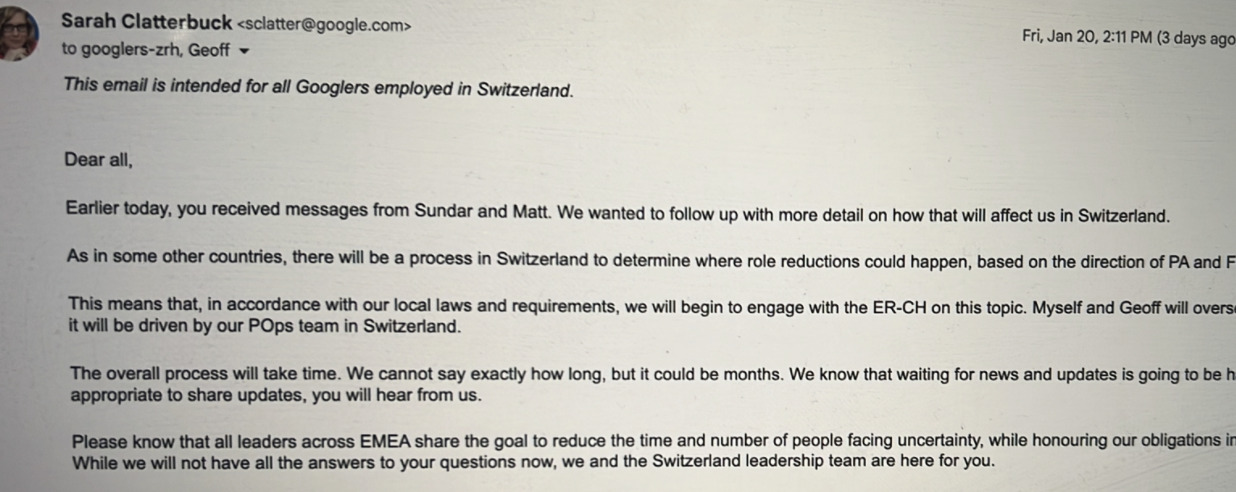
    As the financial portal Inside Paradeplatz reported, the wave of layoffs is hitting one of the country’s most sought-after employers: Google Switzerland. According to internal e-mails, management is preparing the workforce for possible job cuts. However, they said this could only take effect in a few months.

    Swiss Banking is keeping its ear to the ground, according to Reto Jauch, a managing partner at Zurich-based executive search firm Schulthess Zimmermann & Jauch.

    Downsizing at tech firms is already an issue at many Swiss banks, he says. Boards and managements are assuming they can attract talent.

    This comes after financial institutions struggled to attract up-and-coming technology talent, like most Swiss industries desperate for IT expertise. A survey conducted by the industry association Arbeitgeber Banken in 2021 showed IT is the only area in which the institutions still plan to create jobs in the next few years, amidst a declining employment trend for the profession as a whole.

    Even if the job cuts in tech offer a golden opportunity to poach experts, this will not be a cakewalk for the banks. It is by no means enough to place advertisements. «A clear positioning is needed; these forces demand purpose and a destination from their employer,» says headhunter Jauch.

    The search for purpose in one’s work, is often laughed off as a fad by veteran bank managers. UBS CEO Ralph Hamers, a fan of digitization who coined the term in Swiss banking, is seen by more than a few as an irritant because of it.

    But the country’s largest bank is not letting anything go to waste in the battle for IT talent. Not only does UBS advertise a culture of engineers it also beckons with continuing education for IT specialists and internal awards. Borrowing from tech industry practices and depending on their level of training, employees can call themselves Certified Engineer, Distinguished Engineer or even Technology Fellow.

    It remains to be seen whether UBS will be able to score points with these titles given the cutbacks at Google & Co. For Oliver Berger, partner at search boutique Witena in Zurich, this means that at most one battle has been won, but not the talent war.

    This has just started and will continue for the next ten to 15 years, says the executive recruiter. What we are seeing at the moment are just the precursors, he . That’s because he said Switzerland has too few skilled workers, trains too few, and lets too few cross the border.

    Accordingly, the layoffs at tech companies are also likely to be short-lived before the market picks up again, he warns. We’re kind of experiencing a bull market rally in a bear market here.

  • Digital Banks Are Not Making it in Singapore

    Digital Banks Are Not Making it in Singapore

    They got here late and when they did arrive, they faced fierce rivalries from strongly entrenched incumbents. And given that they have to follow all the regulations traditional banks do, they are not getting a break from regulators either.

    It was just a short while ago, in December 2020, after months of waiting, that the Monetary Authority of Singapore (MAS) announced four successful digital bank applicants, GXS Bank, owned by Grab and Singtel, MariBank, a unit of gaming and e-commerce group Sea, ANEXT, part of China’s Ant Group; and Green Link Digital Bank (GLDB), held by a consortium comprising Greenland Financial, Linklogis Hong Kong and Beijing Co-operative Equity Investment Fund Management.

    And, they appear to be experiencing much the same fate that neobanks have elsewhere. In short, they won’t put any incumbents out to pasture anytime soon.

    That same view now appears to be forming in the city-state itself, with The Business Times on Thursday also clearly telegraphing the fact in a stark headline that the four new digital entrants are not the game changers they initially promised to be. Their impact on the market has turned out to «be underwhelming, with limited utility for the average consumer», the newspaper indicated.

    From the outset, Singapore intended to avoid any market disruption and regulators required digital banks to provide clear value propositions. Moreover, besides using innovative technology, they also needed to reach under-served segments of the Singapore market.

    That has limited their availability – and impact. GXS Bank, for example, solely takes deposits from a select group of employees and customers, and MariBank is only available to employees of its parent company, Sea.

    Another kind of digital bank, Trust Bank, is showing more impact, which is likely because it is supported by industry incumbents. It has a full bank license and is owned by Standard Chartered and FairPrice Group and only started to take deposits this past September, yet it was in a position to report 400,000 customers by the time the BT article appeared.

    Moreover, another issue could potentially be in one of the key strategies used by digital entrants. Initially, in order to take a larger chunk of the market, Trust Bank and GXS tried offering higher interest rates than the main industry players.

    But they quickly came up against one of the largest interest rate pivot cycles in recent memory, with more restrictive central bank policies worldwide forcing the wider financial industry to successively ratchet up rates in short order.

    Not only have they been too late to the market, but the fact is that most traditional banks have significantly improved their digital offerings in the past two years. Any innovations offered by the new digital banks, such as financial planning and cheaper foreign exchange transactions, have become increasingly common.

    Simon-Kucher’s banking lead in APAC, Silvio Struebi said in the earlier article that digital banks have accomplished a great deal, but that they are not going to be great disrupters.

    It has just provided more options for consumers and prompted vast improvements in traditional banks, Struebi said.

  • Swiss Banks Face a Tense Future in China

    Swiss Banks Face a Tense Future in China

    President Xi Jinping’s report to the 20th Communist Party congress hints at more tax and regulatory measures aimed at reducing wealth disparities.

    In the last two decades, the Swiss wealth management sector has been forced to directly confront and contend with the vagaries of the world’s two largest economies in the world – China and the US.

    In the case of the US, it has been anything but a delicate balancing act. Most of the wealth management industry has been manhandled into coughing up material fines for abetting tax evasion attempts by American citizens.

    China has been different. The wealth management sector has seen the country as the greatest new market of our time. For decades, bankers have returned wide-eyed from trips to Beijing and Shanghai, effusively spouting about this wide-open, boundless future full of promise. Many have been able to benefit copiously, from the unheard-of growth rates that country has experienced since the turn of the millennium.

    The two major Swiss banks have built onshore presences. And the smaller private banks and wealth managers that haven’t can still catch any passing outflows from the wealthy Chinese with their booking centers in the proximate cities of Hong Kong and Singapore.

    Although the political and economic differences between the US and China are indescribably wide, there is one striking similarity. They both tax citizens on their worldwide income. In China, almost all nationals are defined as being domiciled in China unless they live in Hong Kong, Macau, or Taiwan.

    That similarity could be a very significant inflection point for private banks and wealth management. And that looks likely to continue unhindered, at least according to President Xi Jinping’s report to the 2022 party congress on Sunday. In a translated transcript published by Nikkei Asia that was provided to journalists covering the event, he indicated:

    We will enhance the roles of taxation, social security, and transfer payments in regulating income distribution. We will improve the personal income tax system and keep income distribution and the means of accumulating wealth well-regulated. We will protect lawful income, adjust excessive income, and prohibit illicit income.

    That message has already been made very clear to China’s celebrities and influencers who were fined late last year for tax evasion.

    It is going to be very tough going for anyone trying to bank what many would consider the core target client base for a wealth manager or a private bank.

    That view seems to be borne out more generally, with Hong Kong’s daily English newspaper, the South China Morning Post , writing on Thursday that the wealthy Chinese could face a rocky road ahead.

    All of this, taken together, puts wealth managers in a double bind. Not only are they going to have to parse carefully and regularly review and re-review their client base for possible tax discrepancies, but they are going to have to go to pains to make sure that they are not making anyone excessively wealthy, at least not in the eyes of the Chinese government.

    What that means in practice is anyone’s guess. But for an industry traditionally known for privacy and discretion, it is a very big ask.