Tag: E-tailing

  • Soo Kee Group plans to sell diamonds online

    Soo Kee Group plans to sell diamonds online

    Singapore listed jeweller Soo Kee Group is planning to become the first bricks and mortar store in the city to start selling gold and diamonds online.

    Soo Kee operates a network of more than 60 retail stores under the brands Soo Kee Jewellery, SK Jewellery and Love & Co in Singapore and Malaysia.

    In an interview published in the Straits Times newspaper, CEO Daniel Lim said his company has already launched the first of three planned online stores, choosing its namesake brand for the online debut. He said the site was designed to improve service to local customers by showcasing its entire range online before they visit a physical store.

    “Some of our customers live in Indonesia, Malaysia and Myanmar, and with this eCommerce platform, we can better target and attract them,” he told the newspaper.

    Sites for the other two retail brands will follow later.

    Lim acknowledged that while consumers are happily embracing online shopping in most categories, when it comes to jewellery there is a reticence to buy online due to security and the importance of trust and personal experience in selecting purchases.

    The company is strategically positioning its websites as complementary to the physical retail store experience.

    Earlier this year, Soo Kee Group executed an IPO, raising $31.6 million. Those funds are being used to expand the business via new store openings, development of eCommerce and developing new products.

  • Homelane.com India seeks $20m funding

    Homelane.com India seeks $20m funding

    Homevista Decor and Furnishing, parent of Homelane.com India, is seeking $20 million in a fresh round of capital raising.

    The cash will be used to fund an extensive advertising and marketing program to raise the online brand’s awareness and expand its market penetration.

    Homelane.com offers a furniture design and ordering service online for six Indian cities, including Mumbai, Delhi, Hyderabad and Pune.

    “We don’t have any plans to expand to new cities but to grow deeper in the existing ones,” co-founder Srikanth Iyer said in an interview.

    “We are looking at investing in creating a brand.”

    Homelane.com was founded just a year ago by Iyer and his business partner Rama Harinath. In that time it has raised funds in two rounds, the latest $4.5 million from Sequoia Capital and Arin Capital last February.

    According to Ken Research, India’s furniture market is expected to grow at around 13 per cent annually until 2018.

  • Internet of Things China gains momentum

    Internet of Things China gains momentum

    The Chinese are appearing quick to embrace the Internet of Things, in turn driving demand from businesses and app developers for enabling technology.

    Jasper, a global Internet of Things (IoT) platform leader, says three months after it made its enabling software available in China, more than 500 enterprises have activated trial accounts on the China Unicom Control Center IoT platform.

    The enterprises, serving a growing demand for Internet of Things China services, included retail, connected cars, theft prevention and wearables.

    A large number have already converted their trial accounts into paid accounts enabling them to deploy their IoT services to customers across China.

    “We see significant appetite across China to capitalise on the Internet of Things,” said Cindy Patterson, chief customer officer at Jasper.

    “The response and market adoption illustrate the demand for an IoT platform that can help enterprises rapidly and cost-effectively launch, manage and monetise their IoT services throughout China and globally.

    “Forward thinking companies across industries have been quick to adopt the Control Center IoT platform. These innovators are seizing the opportunity to transform their businesses with IoT services in ways that add value for their customers while growing their revenues,” she said.

    “The diversity of industries represented by these companies is remarkable and it is exciting to see this level of activity in such a short time period.”

    The combination of China Unicom’s mobile network and Jasper’s IoT service platform enable fast time-to-market for businesses, and provides a flexible, turnkey solution that can be configured to meet the specialised needs of businesses across any industry. For example:

    • Several major retailers have selected the IoT service platform from China Unicom and Jasper to deliver wireless POS and mobile payment services.
    • Jasper’s Control Center is being used to connect aftermarket theft detection devices to enable more robust theft prevention services nationwide.
    • Two of China’s 10 largest auto manufacturers are now using Control Center to cost-effectively deliver connected services in cars. One manufacturer is using Control Center to enable a new line of budget-friendly vehicles, giving more people access to value-added connected services in their cars.
    • A large provider of consumer hotspots, which wanted powerful nationwide connectivity and mobile service management, provisioning and real-time diagnostics, chose to deploy on Control Center to ensure the best service for its customers.
    • Several aftermarket telematics service providers have selected Control Center to deliver connected IoT services to vehicles in China.
    • Personal health device manufacturers are leveraging Control Center to transform their hardware-based businesses to service businesses.

    China Unicom is the only operator in China using the same 3G and 4G technologies as the majority of mobile operators worldwide, enabling seamless entry into the Chinese market for multinational enterprises. Jasper partners with 27 mobile operator groups worldwide, representing over 100 mobile operator networks – enabling enterprises to configure their services on Jasper’s platform once and easily turn on services on other operators worldwide.

    Jasper describes itself as a global Internet of Things (IoT) platform leader. It has designed a cloud-based IoT platform to enable companies of all sizes to rapidly and cost-effectively launch, manage and monetise IoT services on a global scale.

  • Asos China braces for losses

    Asos China braces for losses

    Online fashion retailer Asos is budgeting for losses as it breaks into the China market.

    Announcing a pretax profit of £47.5 million for the year to August 31, the company offered an overview of its future plans geographically, including a lessened focus on the Australian market.

    New CEO Nick Beighton said China was a “key market” for Asos moving forward but the company was still in startup mode there.

    “It’s all about planting the seeds for future growth.”

    He said Asos expects losses of £5 to £7 million over the next 12 months in China as it builds its offer.

    In the year ahead, Asos will be focusing more on the UK – which remains its biggest market, Europe, the US and China.

    Last year, global sales rose 17 per cent to £1.12 billion. UK sales rose 27 per cent while international sales were up 11 per cent.

    Beighton said the online retailer’s mission to be the number one fashion destination for twenty-somethings, remains the same. The new CEO won’t be changing the Asos culture or the way the business does things, but he acknowledged the world Asos plays in is changing fast.

    “It’s more about mobile, it’s more about social, it’s more about content,” he said.

    The online retailer’s strategy is made up of four key pillars: great fashion at a great price, be awesome on mobile and, deliver engaging content and experience, supported by best in class service (ie. a friction-free experience from logistics through to customer care).

    “This really has been another year of mobile,” Beighton said.

    “In the last 12 months mobile penetration has increased throughout our business. In August 60 per cent of our global traffic came from mobile devices alone.” He added, just in the UK in August, 50 per cent of orders – not traffic – came from mobile devices.

  • SCMP Group tries on retail e-commerce with Hong Kong’s My Dress

    SCMP Group tries on retail e-commerce with Hong Kong’s My Dress

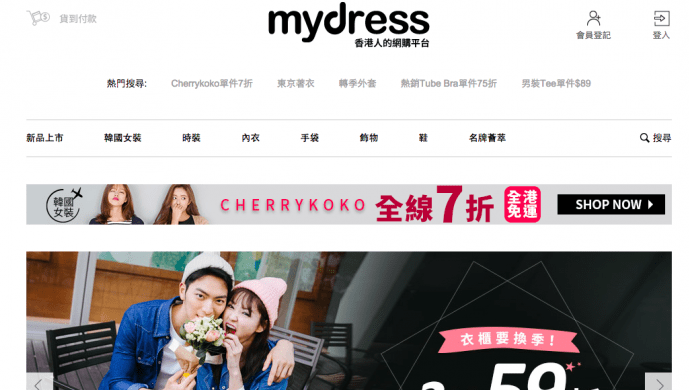
    SCMP Group Ltd announced today that it is acquiring a majority stake in MyDress Holdings Ltd, operator of MyDress.com.

    SCMP Group acquired a 56.65 per cent share of MyDress Holdings Limited with its investment of HK$39.7 million (US$5.12 million), according to a company disclosure.

    E-commerce platform MyDress was launched in 2013 and sells an affordable selection of fast fashion apparel and accessories for men and women, from undergarments to bags, sourced from over 50 brands.

    Google has ranked MyDress as the most searched fashion e-commerce website on mobile devices in Hong Kong.

    Co-founders and key executives of MyDress, Edmund Wong and Leon Lai, will continue to runMyDress and manage its daily operations while working with SCMP on further development.

    “I initially started MyDress as a fashion and content portal, where people could post pictures of outfits. After two years, I met Leon, who is experienced in the e-commerce industry [in] Hong Kong,” Wong, Co-founder and Director of MyDress told e27. 

    “We thought that there should be an e-commerce platform for Hong Kong people, which is why we started selling clothing. Initially, we were only selling women’s. We only started selling men’s wear about four months ago,” he added.

    At the moment, MyDress website content is only in Chinese, but the English version will be launching later this week.

    Wong said talks with SCMP were made about 18 months prior to the official acquisition.

    Through a joint venture partnership with Hearst, SCMP Hearst publishes the Chinese editions of Cosmopolitan, CosmoBride, Harper’s BAZAAR, Esquire, ELLE, ELLE and operates Cosmopolitan.com.hk,amongst others, in Hong Kong.


  • Stradivarius China goes online

    Stradivarius China goes online

    Inditex brand Stradivarius has opened its own online store in China to complement its existing online store on T-Mall.

    Stradivarius, a sister brand to Zara, has 65 bricks & mortar stores in China. The direct site went live last month, less than six months after the brand made its T-mall eCommerce debut in the world’s most populous country.

    A formal launch event took place at Shanghai’s Union Building, dubbed “The Event Paper: Asia edition”. From its rooftop terrace, the guests were able to enjoy stunning views of the Bund, the Chinese financial capital’s most cosmopolitan district.

    The party was attended by international top model Liu Wen and Cate Underwood, the star of the brand’s FW15 collection campaign.

  • Alibaba seeks Youku Tudou buyout

    Alibaba seeks Youku Tudou buyout

    Alibaba is bidding to buy the remaining shares in Youku Tudou, dubbed ‘China’s Youtube’ in a deal which values the company at US$5.2 billion.

    The eCommerce already owns 18.3 per cent of the online video on demand service and says it will pay cash for the balance from its cash assets.

    Youku Tudou is publicly listed and Alibaba has offered a premium of 30.2 per cent over the pre-offer share price. The bid already has the support of the site’s founder Viktor Koo.

    Alibaba CEO Daniel Zhang said digital products, especially video, “are just as important as physical goods in eCommerce”.

    “Youku’s high-quality video content will be a core component of Alibaba’s digital product offering in the future,” he said.

  • Lazada promises ‘biggest ever’ online sale

    Lazada promises ‘biggest ever’ online sale

    eCommerce giant Lazada plans a month-long mega sale in six Southeast Asian countries under its now annual promotion ‘Online Revolution’.

    Lazada, part of Germany’s Rocket Internet group, says more than 10 million products will be offered to 550 million consumers in six countries, in partnership with a raft of international and local brands.

    The Online Revolution will launch in full scale in Singapore, Indonesia, Malaysia, the Philippines,Thailand and Vietnam on November 11 and culminate in a three-day finale ending on December 12.

    Brands and merchants in Southeast Asia and other international markets such as China, Hong Kong, the US and the UK will join the sale to offer goods across 13 categories. These categories include new additions such as groceries, liquor and automotive in some markets as well as current favorites such as electronics, home & living, health & beauty, fashion, kids & toys, and travel. Brands that have signed up include Microsoft, Xiaomi, Philips, Tefal, Pierre Balmain, Desigual, Spektre Sunglasses, Date Sneakers and Gas Jeans.

    “We are going to bring the most exciting selling month of 2015 to Southeast Asia. With flash sales, best deals, exclusive promotions and app-only incentives, Online Revolution will give plenty of reasons for consumers to tune in and stay engaged,” said Maximilian Bittner, CEO of Lazada Group.

    “It is a unique opportunity for brands and merchants to reach a large audience and accelerate their growth. We are thrilled to have the strong endorsement from thousands of partners – from sellers and service partners, to banks, and telecoms companies. And, we welcome more to join us in spreading the benefits of online shopping to consumers through Online Revolution,”  said Bittner.

    During the month-long Online Revolution campaign, Lazada will feature weekly product category highlights, a curated brands’ showcase and exclusive promotions with partner banks, on top of daily deals. Beyond online, it will run a TV advertising campaign to keep the Online Revolution branding on top of consumers’ minds.

    To help sellers maximise revenue, Lazada says it has been introducing new and improved services. Its ‘Fulfillment by Lazada’ (FBL) is a network of fulfillment centers, hubs, delivery fleet and service specialists that takes care of the fulfillment of a customer’s order through to delivery, efficiently. This lowers cost for the sellers and allows them to focus on marketing and boosting their business. Lazada, recently, also rolled out a Seller Center Android app. The app comes with enhanced search, notifications and language support, on top of all the Seller Center features to help marketplace sellers manage their business on-the-go.

    Small and medium business owners will also receive support through training, such as in stock planning and packaging capacity, to prepare them for a smooth operation with the expected spike in orders. Last year, sales from Lazada’s Online Revolution on December 12 alone hit more than 10 times that of a normal day.


  • The new niches in China’s ecommerce market

    The new niches in China’s ecommerce market

    Alibaba’s sales is only 5 percent of total retail in China and JD.com’s sales of electronics products represent about 2 percent to 5 percent of total electronics retail as well, according to Dangdang.com’s CEO Li Guoqing.

    If you only look at the Chinese ecommerce giants’ recent financial report, most people would agree that the competition has settled because Alibaba alone has accounted for about 80 percent of the market share in online shopping sales. The combined sales from Alibaba and JD.com have close to about 90 percent of the Chinese online retail market.

    However, at least one executive of a Chinese e-retailer thinks the position of those leaders is not secure. “The size of the business is not equal to competitive advantage and competitive threshold.  The market will be settled only if the marketing leaders have some unique edges and generate difficult barriers to entry,” says Li Guoqing, cofounder and CEO of Dangdang.com, in a speech in One Thousand Ecommerce Professionals Seminar in China:

    Alibaba’s sales only account for about 5% of retail sales of China and that is not a enough barrier to entry. At same time, JD.com’s electronics sales only represent 2% to 5% sales of electronics products in China. If some companies get a right new business model, there are still plenty of chances to beat those current leaders.

    Li says people seldom know Vipshop, the number 4 internet retailer China 500, and Yhd.com, the number 7 internet retailer China 500, three years ago, but now they have become ecommerce leaders in their categories in China.

    In other words, new horizons may be coming for niches within China’s ecommerce market in the same way that we see companies like Warby Parker and Zappos coming up in the USA. Keep on a lookout for these small well-branded niche companies in China, while you look past the big guys like Alibaba and JD.

  • Alibaba announces 11.11 global shopping festival

    Alibaba announces 11.11 global shopping festival

    Alibaba has officially launched its 11.11 Global Shopping Festival this year in a ceremony at its headquarters Hangzhou, China.

    The e-commerce giant said its push for this year’s festival is for Alibaba to serve as  the “gateway to China” for brands worldwide. Representatives from 39 countries, more than 40 partnering international brands, and nearly 30 fresh food associations from around the world attended the launch.

    “There are currently 300 million middle class in China, and that number will rise to 500 million in 10 to 15 years. This will be an opportunity for every nation,” he said. “China’s consumption power will rise quickly and that will not only drive China’s economy but also the world’s economy.”

    Alibaba CEO Daniel Zhang, who was instrumental in creating the first 11.11 sales event in 2009 when he led Tmall.com, said that the sales event has evolved from a marketing event for online shopping into a global phenomenon that involves consumers in China and around the world.

    “This year’s 11.11 will focus on four key themes: omni-channel, mobile, logistics, and globalization. It showcases the scalability and power of Alibaba’s entire ecosystem,” he said.

    This year’s 11.11 is also expected to bring to life Alibaba’s overall globalization strategy outlined by Michael Evans in his first public appearance as president of Alibaba.

    More than 40,000 participating merchants, 5,000 participating international brands from 25 countries, and more than 6 million products available for purchase in this year’s one-day shopping frenzy.

    Last year, the 24-hour festival generated $9.3 billion in gross merchandise volume, dwarfing Cyber Monday in the US.

  • Yi Hua signs cross-border eCommerce pact

    Yi Hua signs cross-border eCommerce pact

    Yi Hua Department Store Holdings has entered into a strategic purchasing pact with China Merchants Food to jointly develop cross-border eCommerce and bonded merchandise business.

    Yi Hua operates a group of retail businesses in Mainland China, including supermarkets, department stores, electrical appliance retailers and furniture stores, and provides consulting and planning services. Since August this year, the company has started importing merchandise and developed a cross-border eCommerce business.

    Integrating with its bricks and-mortar imported merchandise direct sales stores, this online-to-offline (O2O) business model uses its fully-fledged sales channels and comprehensive online network for the sale of imported goods, the company says.

    Under this week’s pact, Yi Hua will entrust the purchase of imported merchandise to Hong Kong-based China Merchants Food, which will provide logistics, storage, and distribution as well as customs clearance and inspection services.

    Most of the cooperation will centre around two imported merchandise direct sales stores opened in Zhongshan City and Jiangmen City since August. The Yi Hua board believes combining its retail and distribution network with the overseas purchasing network and superior financial strength of China Merchants Food, will lower purchasing costs, ultimately resulting in a win-win situation for both companies.

    Furthermore, Yi Hua will be able to widen its merchandise purchasing channels.

    “These will build a firm foundation for the group to quickly develop cross-border eCommerce and imported merchandise direct sales experience stores in the next step,” the company said in a statement.

  • Japanese beauty e-tailer takes slice of Vanitee

    Japanese beauty e-tailer takes slice of Vanitee

    The Japanese online beauty retailer @Cosme has bought a stake in Singapore website Vanitee, described as a “digital marketplace for beauty artists”.

    Neither the value of the investment, or the size of the stake acquired was disclosed by either party.

    Vanitee was founded just 12 months ago by Douglas Gan, Kuik Xiaoshi and Choy Peng Kong. It has already secured investment funding from Luxasia Group, amongst others, amounting to several million Singapore dollars.

    With a database of about 3000 customers already, Vanitee is now looking to expand further into Asia, especially in the north.

    @Cosme, a subsidiary of Japan’s istyle inc, has physical retail stores in Tokyo and Osaka and runs eCommerce websites and and an online spa guide. Besides its focus on the Japanese market, istyle is increasingly targeting customers in Greater China.

    CFO Kei Sugawara says the Vanitee investment marks the company’s first expansion into Southeast Asia

    “We are thrilled to work with Vanitee to stretch the @Cosme footprint beyond Japan. We will focus our efforts to revolutionise how consumers in Singapore and Southeast Asia purchase and experience cosmetics and beauty products and services.”

    Gan, who is Vanitee’s CEO, said the company has been successful in securing investment because of its ability to communicate its vision, and business goals.

    “[Investors] love entrepreneurs with big ideas who have the humility to get their hands dirty and get things done.”

  • JD.com opens US office

    JD.com opens US office

    JD.com, China’s largest online direct sales company, has opened its first US facility, a new research and development center located in Silicon Valley.

    Situated in Santa Clara, the new office will focus on developing and enhancing new and existing technologies that will improve the user experience for its customers in China and boost the company’s offerings.

    The facility will also allow easier interactions between the company and US retailers, partners and brands seeking to establish or expand their presence in China on JD’s shopping platforms.

    “Given the scope and strength of American brands, products and capabilities, the US was the obvious choice as we sought a location for our first office outside of Asia,” said Richard Liu, founder and CEO of JD.com.

    Chen Zhang, senior vice president of JD.com and head of R&D for JD Mall will initially oversee the new office, which will focus on areas such as cloud computing, mobile applications and big-data infrastructure, and will provide both rotational job possibilities for engineers in China and opportunities for certain skilled technical workers in the area.

    Last July JD.com launched US Mall on its website, dedicated exclusively to meeting the demand in the Chinese market for authentic imported American products.

  • China Jo-Jo online sales soar 438 per cent

    China Jo-Jo online sales soar 438 per cent

    China Jo-Jo online sales soared 438 per cent in the last half year as more shoppers chose to buy direct rather than on the company’s Alibaba shop front.

    Sales on Alibaba rose 130 per cent year on year.

    China Jo-Jo Drugstores, listed on the US Nasdaq exchange, says sales on its site www.dada360.com, set a record consolidated gross profit margin of 25 per cent.

    China Jo-Jo’s online sales are principally driven by four categories of products including: medical devices, OTC drugs, toiletries and nutritional supplements through the presence of six ePharmacy platforms online, including the company’s official branded website and marketplaces in Alibaba andJD.com.

    The company’s online pharmacy sales for the last four years has been led by Jo-Jo’s flagship store through Alibaba’s marketplace, however for the month of September, 2015, sales from China Jo-Jo’s own B2C website surpassed sales from the flagship store, “which is indicative of the great demand for online pharmacy services in China,” the company said in a statement.

    Sales from China Jo-Jo’s eCommerce platforms represent 30 per cent of the overall sales from its physical retail stores, which increased by 10 per cent year on year.

    Primary reasons for the rapid growth in China Jo-Jo’s ePharmacy business are the unmet demand for competitively priced shopping alternatives for which the Company carries roughly 8000 products across its retail and online businesses.

    “For the half year period, a major contributing factor to adoption of online sales is the web traffic driven to our B2C sites from “private insurance card” member holders. Private insurance cards are a fast growing segment of the company’s business whereby member incentives for card holders include discounts, promotions and prescription reimbursements from large private insurance carriers in China. The number of qualified customers using commercially available private insurance cards in this period was up 20 per cent to roughly 220,000 participants, while the variety of products available online increased 50 per cent year over year,” the company said.

    Qi Li, president of China Jo-Jo commented:, “2015 has ushered in a new era in China and the launch of nascent but rapidly growing online pharmacy industry. We expect continued success as the industry matures, creating an evolved ecosystem to service the needs of our customers for many years to come.”

  • More Indian consumer use social media for feedback than Japanese

    More Indian consumer use social media for feedback than Japanese

    Indian consumers are more digital savvy for reporting and resolving customer service experiences over social media than their counterparts in Japan and Hong Kong, says a survey by American Express.

    According to the American Express Global Customer Service Barometer (CSB), which did a random online survey of 1,000 respondents each in the three Asian countries this year, 71% Indians use social media to get a customer response, same as last year but significantly up from 54% in 2012. In Japan, only 29% used social media for customer response while in Hong Kong the number stood at 29%.

    While 41% Indians said they always receive resolution of their customer service issues through social media, for Japan and Hong Kong the numbers stand at 12% and 18%, respectively.

    In selecting a company to do business with, consumers in India and Japan give top priority to ‘good product’ followed by ‘good value for the price’, while the order stood reversed in the case of Hong Kong. All three countries ranked ‘excellent customer service’ third in importance, the survey said.

    While most consumers are willing to give a company at least one more chance after receiving poor service before they consider switching, 33% immediately consider switching after initial poor customer service experience.

    Indians customers are the most reactive with 73% having dropped an intended purchase or transaction due to poor customer service as compared to 56% and 40%, respectively, for Hong Kong and Japan.

    As for sharing their experiences, on an average, consumers tell 39 people about their good experiences (41 in 2014), and 42 people about their bad experiences (48 in 2014), the report said. As much as 98% talk about their good customer service experiences at least some of the time.