Tag: ecommerce

  • 3 Things Investors Should Know About Singapore Post Limited Now

    3 Things Investors Should Know About Singapore Post Limited Now

    Singapore Post Limited is a postal and logistics services company. Its business is currently organised into three major segments: Mail, Logistics, and Retail & eCommerce.

    Here are three things about the company investors may want to know:

    1. Latest results

    Singapore Post had released its fourth-quarter and full-year results just last week. For the fiscal year ended 31 March 2016 (fiscal 2016), the company’s revenue had jumped by 25% to S$1.15 billion while the profit attributable to shareholders had grown by 58% to S$249 million.

    Singapore Post’s top-line had benefitted from new acquisitions and organic growth in its Logistics and Retail & eCommerce segments. The even faster profit growth meanwhile, had come on the back of one-off divestment gains. If that were stripped away, the company’s underlying net profit in fiscal 2016 would have been 4.1% lower than in the previous year.

    It’s worth noting too that Singapore Post’s cash flow performance had deteriorated from fiscal 2015, with both operating cash flow and free cash flow falling.

    2. Dividend history

    Singapore Post has had a long history of paying an annual dividend, which goes back all the way to fiscal 2003, the year it got listed. In fiscal 2003, Singapore Post paid a dividend of S$0.042 per share and has been paying an annual dividend ever since.

    The company’s dividend in fiscal 2016 is S$0.07 per share, which gives it a yield of 4.6% at its current share price of S$1.535.

    Singapore Post total dividend per share
    Source: Singapore Post

    3. Valuation

    Singapore Post is currently trading at a price-to-earnings ratio of 14. For perspective, the company’s valuation had reached a peak of 31 in the last five years.  In addition, the PE of 14 is also near the lower end of Singapore Post’s valuation range over the last five years.

  • 11street Academy is the First E-commerce Certification Programme in Malaysia

    11street Academy is the First E-commerce Certification Programme in Malaysia

    11street (www.11street.my), one of the largest online marketplaces in Malaysia, launched ‘11street Academy’, the first ever e-commerce certification programme in the nation, targeting to help at least 1000 sellers and entrepreneurs to grow their businesses online.

    According to Hoseok Kim, Chief Executive Officer of 11street, this initiative aims to impart every facet of e-commerce knowledge to help sellers expand their online businesses. “We have been receiving overwhelming response to 11street’s existing and basic training courses, which is an introductory level of e-commerce training session for the past one year. Majority of our sellers who took up the basic courses has purportedly reported a hike in month-on-month sales.”

    “As a result, they have been yearning to deepen their knowledge in e-commerce to explore untapped opportunities in hopes of maximizing their online businesses. Hence, with the launch of 11street Academy, we will be offering up to advance level of e-commerce-related education to reinforce many more local sellers with in-depth knowledge, expertise and know-hows to achieve significant growth and success in e-commerce,” Kim added.

    Photo 1_Low Res

    11street Academy will kick start by offering a well-structured education program with a comprehensive syllabus to enhance sellers with state of art knowledge. This includes essential marketing skillsets offered by our partners, Google AdWords and Facebook, which allow online sellers to proceed to the next level as the market matures while fulfilling their drive in finding more effective ways to excel in e-commerce.

    Kim further shared, “Working hand-in-hand with Malaysia Digital Economy Corporation (MDEC), Google AdWords and Facebook, we are committed to fuel the success of Malaysian online sellers by providing top-notch e-commerce trainings offered only by industry leaders in which we strongly believe will help our sellers’ businesses bloom and generate greater revenue.”

    “11street Academy’s strategic collaboration with the partners, including MDEC is the forefront of an emerging informative e-commerce community, which intends to empower Malaysian SMEs and entrepreneurs to grow their business, and coherently boost the economic growth in Malaysia,” said Chief Executive Officer of MDEC, Datuk Yasmin Mahmood.

    Denise Gamo, Head of SMB Marketing at Google Malaysia also said, “According to Google’s Consumer Barometer study, Malaysia is a mobile-first nation with a 70% smartphone penetration and 1 in 3 Malaysians exclusively using their mobile device to access the Internet. By attending the workshop, the audience will better understand Malaysia’s digital landscape, consumer behaviours and learn about platforms such as Google My Business and Google AdWords on Search, YouTube, and on the Display Network. With these, the sellers will be geared with knowledge, tools and online presence that is crucial in reaching their potential customers.”

    Facebook will provide custom Blueprint Training that will include extensive e-learning modules, offering sellers an opportunity to learn more effective ways to leverage Facebook advertising to drive real business results.

    Sandhya Devanathan, Group Head of e-commerce, Retail, Financial Services and Travel, for Facebook in Southeast Asia added that, “Mobile News Feeds are the new storefront for retailers looking to reach Southeast Asia’s mobile first consumers. We know that 94% of Malaysians discover products and brands on Facebook while 62% make a purchase after discovery. There’s an unprecedented opportunity for businesses in Malaysia to connect with the 18 million people on Facebook – 94% of them connecting through mobile devices. We’re committed to helping support and educate partners similar to these workshop sessions that will ultimately help e-commerce companies in Malaysia build and grow their businesses.”

    Apart from the basic syllabus, the advanced courses established under 11street Academy will also cover a large breadth of topics such as ‘Marketing, Advertising & Promotion’, ‘Shipment & Inventory Management’, ‘Product Photography – Theory & Practical’, ‘Sale & Online Supply Chain Management’ and many more.

    Learning the Ropes of E-commerce with 11street

     With no fees required, 11street Academy will be opened to all Small and Medium Enterprises (SMEs), businesses owners, and individual online sellers aged 18 and above and it only targets 100 participants per batch every month.

    Participants are required to attend 5 classes to complete the full course within 4 weeks. To graduate with certification, attendees are required to pass its qualification exam, complete the given assignments with a set minimum class attendance.

    The certification programme is open for registration from 16 May 2016 onwards on a first come, first served basis, whereby shortlisted candidates will be informed via email. For those who are interested, please register at https://bit.ly/registeracademy.

    Kim also shared, “11street Academy is our long term commitment to build a strong seller ecosystem because we value their contribution and we view sellers as the strongest support to the evolution of entire e-commerce market when it comes to providing the best products and services to local consumers. The programme is scheduled to operate for at least 12 months and shall be extended as we foresee an overwhelming response from our sellers.”

    “By supporting them to grow via the most recent 11street Academy’s e-commerce certification programme, we hope that our sellers will be able to grow their businesses and increase sales by implementing effective online retailing strategy and practices,” Kim concluded.
  • Lazada opens m-commerce tech hub in Thailand

    Lazada opens m-commerce tech hub in Thailand

    Southeast Asian e-commerce company Lazada Group has opened a tech hub in Bangkok, Thailand to drive strategic mobile development initiatives.

    The Lazada Tech Hub in Thailand will focus on advancing the design and engineering of Lazada’s mobile shopping and selling sites and apps for Southeast Asia.

    With almost 30 million app downloads and more than 60% of its GMV represented by mobile sales by the end of December 2015, Lazada Group has been investing in m-commerce through new app and mobile site initiatives.

    In the next few months, Lazada Tech Hub aims to hire more than 50 staff, including iOS and Android developers, Go Programming Language developers, and Quality Assurance automation engineers. The tech hub team will operate from EmQuartier in Central Business District Bangkok.

    Lazada Group opened its first tech hub in Ho Chi Minh, Vietnam in November 2012. A second tech hub was opened in Moscow, Russia in February 2015. Together, the three tech hubs are dedicated to driving product engineering and technology infrastructure.

    “Mobile innovation is a discipline any serious online player must build, and having the best talent is critical to designing products and solutions that are not only intuitive but improve the quality of experience and life for our consumers and sellers,” Lazada CTO for operations Ifor Evans said.

    “We believe that Thailand attracts a highly-skilled talent pool. And, as the leading shopping and selling destination, Lazada is both enviably-positioned and committed to raising the bar for mobile and tech development in the region.”

  • China still driving Alibaba sales

    China still driving Alibaba sales

    In posting its strongest revenue growth for the past four quarters, Alibaba has rounded off its fiscal year on a positive note.

    Although growth at the international division picked up strongly, it is China that has underpinned the group’s success.

    Alibaba sales jumped 39 per cent to 24.2 billion yuan (US$3.7 billion) in the three months ended March. Net income rose 85 per cent to 5.3 billion yuan.

    Despite the more challenging economic headwinds in China, Alibaba’s revenue from its various retail platforms in the country surged by 41 per cent over the quarter. Part of this is down to the growing audience, with active buyers across the various marketplaces growing by 16 per cent to an astonishing 423 million customers. Mobile platforms also saw growth with the number of monthly active users rising by 17 per cent to just over 410 million.

    This uplift was boosted by the rise in average revenue per buyer which increased by almost 11 per cent over the same period in the prior year. For mobile users the increase was even sharper, up by just under 109 per cent on the prior year.

    Much of this success can be attributed to three main factors:

    The first is reach. Here, Alibaba’s investment is allowing it to reach large swathes of the Chinese population – including in rural areas through its Rural Taobao platform – in a way that other eCommerce firms struggle to do. That it now has a presence in over 14,000 rural villages is a major advantage when it comes to growing its user base.

    The second factor is customer engagement and understanding. While many of its platforms are based around eCommerce, they are much more than just distribution systems. Taobao, for example, has a strong community element where consumers can look for news, understand trends, and interact with brands. This helps to drive up activity and user engagement which, in turn, aids sales conversion.

    The third factor is the group’s continued success with Western brands expanding into China. Arguably Alibaba is now the Chinese partner of choice for foreign firms, both because of its distribution network and its capability in providing intelligence and insight into consumer trends and habits. This ability to attract Western brands has made Tmall the destination for many Chinese shoppers. It is notable that in March alone, more than 100 new international brands joined the Tmall Global platform.

    As successful as Alibaba is in China, it has found international more challenging. However, the group is now taking a more selective approach to expansion, focusing on embryonic or underdeveloped eCommerce markets where its expertise can drive growth. The stake acquired in Lazada, an eCommerce platform in Southeast Asia, is typical of this strategy. Expect more such investments over the coming year.

    Despite its dominance in China, Alibaba’s growth prospects remain good – especially as it builds its content and entertainment business, and expands into services like cloud computing.

  • Shopee Holds Young Entrepreneur Program

    Shopee Holds Young Entrepreneur Program

    Singapore-based marketplace company, Shopee, has been holding Young Entrepreneur Program. The program–which has been started from March 2016–is carried out to find Indonesia’s new young business talents.

    “Some 230 students have been participating in the program,” said Chris Feng Shopee’s CEO on Wednesday in Indonesia Convention Exhibition, BSD, Tangerang.

    The student only event has been participated by 89 universities from 19 cities in Indonesia. It has been held by Shopee to encourage more youth to get involved in business or to become entrepreneurs.

    According to Chris, when starting a business young entrepreneurs are faced with three challenges, namely business knowledge, technology and capital. To face the challenges, Shopee is determined to help them by establishing Campus Competition and Shopee University.

    Shopee provides photography and digital marketing classes to enhance business knowledge. Whereas to tackle capital issue, Shopee is holding a competition with a commitment value of Rp100 billion.

    The Rp100 billion fund is used for investment of trainings and capital aid. It will also be used to help young entrepreneurs to develop online businesses.

    “We have selected three candidates to win a prize of capital aid,” Chirs said. The three candidates will be judged and the winner will be announced end of April.

  • Trade Minister Warns about E-Commerce Funding Crisis

    Trade Minister Warns about E-Commerce Funding Crisis

    Trade Minister Thomas Lembong asked Indonesia e-commerce companies to be careful in assessing risks posed by the e-commerce business.

    “What would happen if the funding stopped? In the United States, tech business boom has started to decline,” Thomas said at the Indonesia E-commerce Summit & Expo in BSD, South Tangerang, on Wednesday, April 27, 2016. “I’m always paranoid. As a risk manager, I always ask ‘what if’.”

    Thomas added the natural selection in online business would determine which companies would continue exist. According to him, a business with a fast downturn will have a short cycle. Therefore, Thomas suggested business owners to prepare for “rainy days”.

    The Trade Minister revealed that other ministers in President Joko “Jokowi” Widodo’s Working Cabinet were proud with Indonesia’s e-commerce rapid growth. Thomas said that he wanted his ministry to learn from former US President Bill Clinton’s administration that supported the development of the Internet. Thomas explained Clinton improved the Internet with ‘light touch’ and refused the temptation to regulate everything on the Internet.“Innovation can thrive without restrictions. There has to be a space to develop. Innovators are usually rebellious,” Thomas added.

  • KinerjaPay Establishes Wholly-Owned Subsidiary in Jakarta

    KinerjaPay Establishes Wholly-Owned Subsidiary in Jakarta

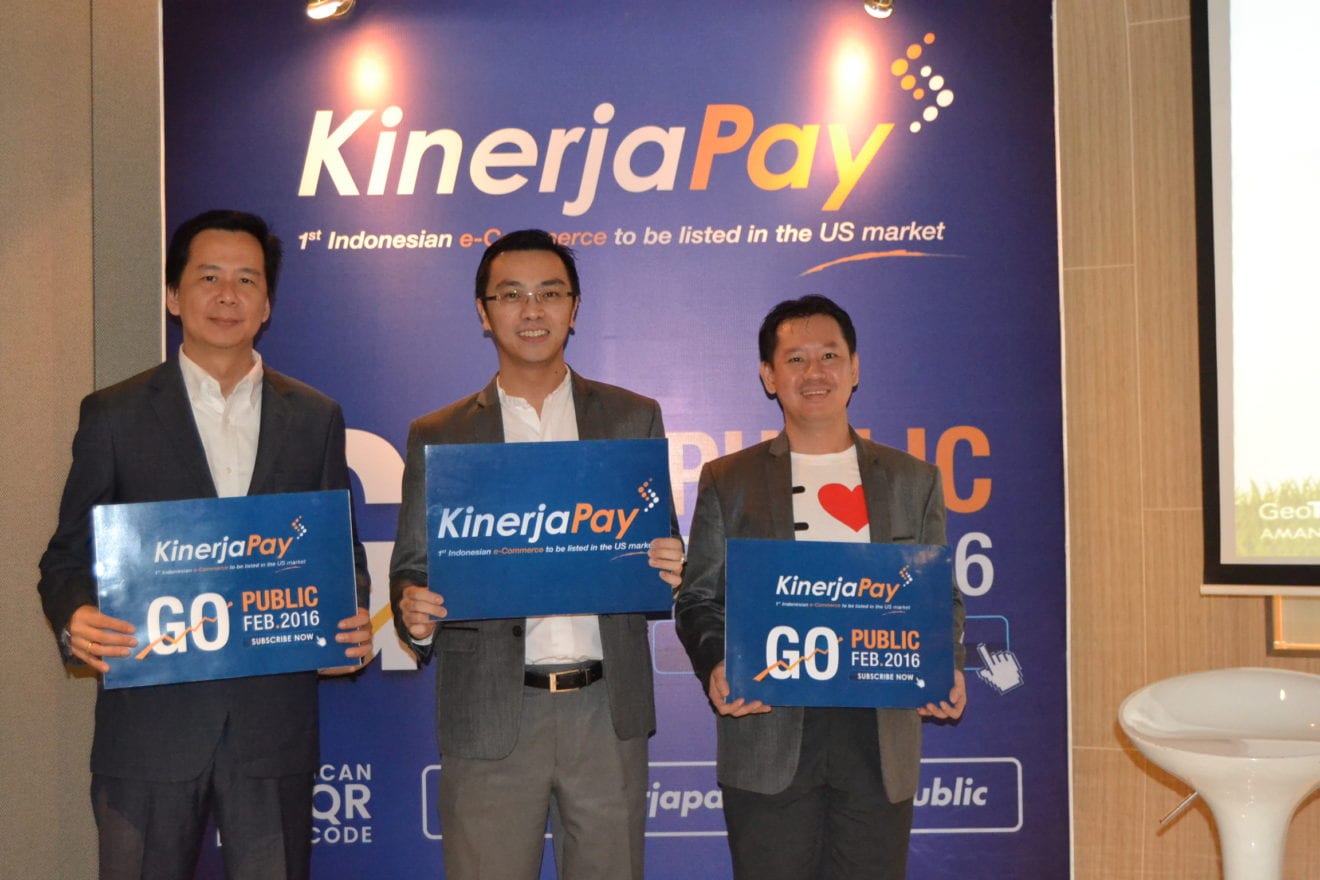
    KinerjaPay, today announced that it established its new wholly-owned subsidiary, PT Kinerja Pay Indonesia, with offices located in Jakarta city, Indonesia. The new Subsidiairy was organized under Indonesian Incorporation Law Article No.34, dated 14 April 2016, and Principal License from Indonesia Investment Coordinating Board (BKPM) No.909/1/IP/PMA/2016 dated 06 April 2016. The Company has also appointed Mr. Deny Rahardjo as Chief Executive Officer (CEO) of PT Kinerja Pay Indonesia.

    Mr. Edwin Ng , Chairman and CEO for KinerjaPay Corp. stated. “We are extremely excited that Mr. Rahardjo accepted his appointment as CEO of our new subsidiary, PT Kinerja Pay. With his extensive experience in Information Technology and Business Management, Mr. Deny Rahardjo is the right person to manage and expand Kinerja Pay’s business operations in Indonesia. With Deny Rahardjo at our helm, we plan to grow our business and become one of the largest mobile payment and eCommerce providers in Indonesia. Since 2015, we have registered more than 35,000 active users with total of 170,000 transactions to date. We fully believe that Mr. Rahardjo, formerly a Microsoft, Polycom, and Telstra Executive in Singapore, will truly revolutionarize eCommerce in Indonesia and enable Kinerja Pay to become the most highly used and popular online payment solution/platform within the next several years, as well as expand its business opportunities throughout the SE Asian marketplace.”

    Mr. Ng further stated that “we chose to establish our initial business operations in Indonesia due to several economic factors, including its population size (est. 260 million according to Worldometers), user demographics, which consists of younger generations, and its ever-growing eCommerce market, which is expected to reach USD $3.8 billion by 2019.”

    With the growing trend of online shopping, Kinerja Pay will offer its users with convenient shopping experience as well as secure payment option. The Company also expects to launch several other applications to complement its mobile eWallet business by entering into other eCommerce verticals such as travel industry, fashion, online games, time-saver application, and many more.

    Notice Regarding Forward-Looking Statements

    This press release may contain forward-looking statements, about KPAY’s expectations, beliefs or intentions regarding, among other things, its product development efforts, business, financial condition, results of operations, strategies or prospects. In addition, from time to time, KPAY or its representatives have made or may make forward-looking statements, orally or in writing. Forward-looking statements can be identified by the use of forward-looking words such as “believe,” “expect,” “intend,” “plan,” “may,” “should” or “anticipate” or their negatives or other variations of these words or other comparable words or by the fact that these statements do not relate strictly to historical or current matters. These forward-looking statements may be included in, but are not limited to, various filings made by KPAY with the U.S. Securities and Exchange Commission, press releases or oral statements made by or with the approval of one of KPAY’s authorized executive officers.

    Forward-looking statements relate to anticipated or expected events, activities, trends or results as of the date they are made. Because forward-looking statements relate to matters that have not yet occurred, these statements are inherently subject to risks and uncertainties that could cause KPAY’s actual results to differ materially from any future results expressed or implied by the forward-looking statements.

    Many factors could cause KPAY ‘s actual activities or results to differ materially from the activities and results anticipated in such forward-looking statements, including, but not limited to, the factors summarized in KPAY ‘s filings with the SEC. In addition, KPAY operates in an industry sector where securities values are highly volatile and may be influenced by economic and other factors beyond its control. KPAY does not undertake any obligation to publicly update these forward-looking statements, whether as a result of new information, future events or otherwise. Please see the risk factors associated with an investment in our securities which are included in our Annual Report on Form 10-K as filed with the U.S. Securities and Exchange Commission on February 11, 2016.

  • WearYouWant advises start-ups to add profitability to execution strategy

    WearYouWant advises start-ups to add profitability to execution strategy

    WearYouWant, Thailand’s leading online fashion and beauty marketplace is advising start-ups to have a clear strategy toward profitability as investors are now demanding it and that the e-commerce space in SE Asia is currently experiencing an exciting time.
    At the Last Mile Fulfilment Asia (LMFAsia) Conference & Exhibition 2016 held in Singapore last month which brought together  retailers, e-commerce businesses, logistics and parcel industry professionals, CEO and Co-Founder of WearYouWant Martin Toft Sorensen said there was considerable discussion on how start-ups should focus beyond just team, product and market to become successful.
    “Start-ups should have a clear path and strategy towards achieving profitability by scaling the business without forgetting the life time value of the customer versus cost per acquisition,” pointed out Sorensen.
    “If e-commerce businesses simply follow a desire to climb user acquisition heights quickly without keeping an eye on the ROI, there is a higher risk of a greater fall. Penetration from online platforms can go far, wide and deep but the trajectory needs to be based on running a business that brings money for investors, shareholders and other stakeholders in the near future.”
    Echoing this advice is Thailand’s e-commerce guru, Pawoot Pongvitayapanu, CEO and Founder at efrastructure inc. and Managing Director and Founder of TARAD.com, who also attended the business platform event. 
    Sorensen advises that in addition to creating a viable business model that balances cost of acquiring customers with the ability to monetize the lifetime value of a customer, start-ups should also be creative in how to attract and keep customers. 
    While many e-commerce sites are reporting high sales growth, the reality is that they may not be showing any profitability, said Sorensen. 
    “In Thailand, we have yet to see any e-commerce companies proving they can scale and yet become profitable.
    The recent acquisition of Rocket Internet’s fast growing, yet loss-making e-commerce site Lazada by Chinese e-commerce giant Alibaba, and Zalora (Thailand and Vietnam) by Central Group, has definitely created waves in the e-commerce industry”.
     Martin (left) and Pawoot (right) at LMF Singapore Mar2016_RS
    Sorensen says that while Lazada will pave the way for Alibaba to penetrate into SE Asia in a market leader position, it remains to be seen whether Zalora’s acquisition by a traditional offline retailer will kick start true omni-channel experiences in Thailand.
     
    Sorensen adds that this is an exciting time particularly for e-commerce companies and start-ups in general, as well as for investors. 
  • Alipay extends partnership with Uber

    Alipay extends partnership with Uber

    Uber has teamed up with Alipay to allow passengers from China to pay for international Uber rides in Chinese yuan using their Alipay accounts.

    Alipay has been available as a payment option for Uber in China since 2014. However, Chinese travelers who wish to use the Uber service outside of mainland China require dual currency credit cards or currency conversions.

    The new deal aims to make the Uber service more accessible to Chinese travelers by doing away with this requirement.

    Uber’s head of business for Asia Pacific Eric Alexander told Economic Times that the partnership with Alipay will enable Uber to cater to the growing number of Chinese travelers who use Uber internationally. Alexander expects the integration to grow the number of rides taken by 9 to 10 times globally. Alipay’s userbase numbers 450 million.

    Alipay’s parent company, Alibaba, is an investor in Didi Kuaidi, Uber’s competitor in China.

    The partnership is also expected to affect Uber users from India due to Alipay’s partnership with Paytm, a mobile wallet and e-commerce operator in India.

    The latter is expected to integrate the Uber app into its own mobile app in the coming month.

    With the Paytm integration, riders in India will be able to use the Paytm app to hail Uber rides globally and pay for the service in their domestic currency.

    The integration is targeted at enabling passengers with no credit cards to use the Uber service internationally.

  • BookMeds invited to move into Malaysia

    BookMeds invited to move into Malaysia

    Hyderabad-based startup BookMeds, which allows customers across India to order medicines online and have them delivered from their nearest pharmacy, may move into Malaysia.

    Launched in December 2013, BookMeds is now the third-largest online pharmacy chain after Apollo and Medplus. With a presence across 18 cities, it serves more than 15,000 customers and 400-plus pharmacies.

    Now BookMeds has been chosen by the Malaysian government’s Magic Accelerator program to explore entry into Malaysia.

    “The pharma-retail model in Malaysia is similar to that of India, offering BookMeds a great opportunity,” says BookMeds founder/CEO Mohammed Abubakr.

    Apart from finding workspace and accommodation, Magic provides advice on setting up a working model for Malaysia. “Initially, we will be targeting the urban population of Kuala Lumpur, then expand across Malaysia,” says Abubakr.

    Meanwhile, BookMeds is in discussions with venture firms to raise $2 million for its continuing expansion across India, with more than 50 cities as targets. Previously, the company raised seed funding from Flipkart VP Ravi Krishnaswamy and Xtream IT CEO Javed Sikander, along with angel funding from Back Office Associates CEO Krish Datta.

  • Awakening giant: E-commerce in China

    Awakening giant: E-commerce in China

    With the largest population and the most Internet users of any country in the world and the rise of its middle class, it is not surprising that China is also the world’s largest and fastest-growing e-commerce market. However, capitalizing on this huge market is becoming increasingly difficult for a variety of reasons.

    Recently, McKinsey, the consulting giant, released a new report on this burgeoning market that holds “enormous potential”.

    A growing market

    Two years ago, China’s online retail market overtook the United States’ online retail market. In 2015, China’s online retail market was approximately USD $630 billion of sales, the world’s largest and nearly 80 percent bigger than the US’.

    E-commerce in China accounts for 13.5 percent of all of its retail spending.  Although in the near term Chinese e-commerce is forecast to increase significantly, McKinsey’s survey shows that companies need to prepare for major changes in the Chinese market.

    Major changes coming

    From new customer segments to new product categories and sales channels, China’s online market is set for huge future growth. Representing 30 percent of total retail sales, the categories of consumer electronics and small appliances are well-established online categories, as is apparel.

    On the other hand, Food (including packaged and fresh food), is a category that faces more challenges and opportunities. Though 50 percent of respondents have purchased some food online, online spending represents only five percent of the total food spending.

    The category of food holds promise for companies that can attract consumers to do their regular grocery shopping online stand to capture a lot of business.

    Online-to-Offline (O2O)

    Consumers in China are accustomed to buying through O2O services companies—they are attracted to the website or app, then buy offline. The top sectors for O2O seem to be travel, dining, and mobility, where respondents who use O2O vendors report spending much more than they did before.

    Huge Opportunities

    McKinsey’s survey of China’s digital consumers tells us that growth in e-commerce and O2O is shifting to new areas. “Succeeding in this market is a matter of keeping pace with changes that are playing out across geographies, product categories, and channels.”

    The opportunities are huge for companies willing to look closely into these aspects of the market to find them, then move quickly to take advantage of them before their competitors can.

  • LF Logistics opens giant Singapore e-commerce facility

    LF Logistics opens giant Singapore e-commerce facility

    LF Logistics has opened a 1-million-square-foot logistics facility in Singapore, the largest automated and customs bonded distribution warehouse in the city state that will target surging e-commerce growth in Asia.

    The nine-story center is located in West Jurong and is the company’s largest distribution facility in Southeast Asia, able to store up to 130,000 pallets with a throughput of 550 pallets per hour, aimed at meeting the fast-changing needs of brands and retailers in the region.

    “Our logistics business has been a bright spot with double-digit growth,” said Spencer Fung, the CEO of Li & Fung group. He did not provide an investment amount.

    According to the recent Asia Pacific Online Retail Forecast, 2015 To 2020, total online retail revenue will nearly double in Asia Pacific from $733 billion in 2015 to $1.4 trillion in 2020, a compound annual growth rate of 14.3 percent over the next five years.

    The total online retail revenues in just five markets of Asia Pacific — China, India, Japan, South Korea and Australia — surpass the combined figure for online retail in the U.S. and Western Europe combined.

    Joseph Phi, president of LF Logistics, said cross-border trade was expected to rise even faster with the establishment of the Association of Southeast Asian Nations Economic Community and the pending Trans-Pacific Partnership.

    “Our new logistics facility is well positioned to serve Singapore, as well as the broader Asia region and beyond. We see this facility as a gateway to the world,” he said.

    Although China dominates the e-commerce headlines, Southeast Asia is one of the markets of the future, said Steven Li, director of strategic partnerships for Cainiao, the logistics platform of Chinese online giant Alibaba Group.

    “Alibaba merged with Lazada recently, the largest online marketplace in Southeast Asia, and we believe the e-commerce market in the Philippines, Indonesia and Thailand will explode in two or three years,” he said at the Cargo Facts Asia conference in Hong Kong.

    Following the opening of the LF Logistics facility, Beh Swan Gin, chairman of the Singapore Economic Development Board, also highlighted the potential of the region.

    “The burgeoning middle class in Southeast Asia will drive consumer demand for more sophisticated products and services,” he said. “This new LF Logistics facility in Singapore is well-placed to address this opportunity. It will also enable the company to harness Singapore’s strong base of supply chain expertise to build differentiating competencies in e-commerce and omni-channel logistics.”

    Singapore Post has been quick to jump on the e-commerce train, and over the past two years, the group has been ramping up its regional logistics capabilities with new or expanded facilities, including the development of a $145 million fully integrated regional e-commerce logistics hub in Singapore that is expected to start operating in mid-2016. SingPost currently has more than 20 warehousing and fulfilment centers in the region.

    Alibaba Group has invested more than $200 million in a partnership with SingPost through a series of initiatives aimed at expanding its e-commerce logistics platform across Asia-Pacific. Alibaba increased its equity stake in the group to 14.51 percent.

    In a second initiative, Alibaba last year acquired a 34 percent stake in SingPost subsidiary Quantium Solutions International for $68 million, with SingPost holding the majority 66 percent share. QSI is a provider of end-to-end e-commerce logistics, warehouse and fulfilment services in Asia Pacific with a network spanning 10 countries.

  • Indonesian online retailer Bhinneka plans IPO to fund expansion

    Indonesian online retailer Bhinneka plans IPO to fund expansion

    Indonesian online retailer PT Bhinneka Mentari Dimensi is planning an initial public offering (IPO) in 2018 to widen its reach, one of its directors said on Thursday, as the e-commerce battleground heats up in Southeast Asia’s biggest economy.

    The e-commerce market in the country of 250 million people is ripe with potential but it is fragmented and comes with complex regulatory and logistical barriers.

    “Our objective to go public is for scaling,” director Andi Boediman said, adding that the company plans to expand its store network and strengthen its supply chain while investing in technology and marketing.

    The company operates online through Bhinneka.com, with customers able to have purchases delivered to their homes or its physical stores, which also serve as retail outlets for the electronic goods specialist.

    Bhinneka is in a good position to attract investors, Boediman told reporters on the sidelines of a conference in Jakarta.

    “We are an online retailer that is focused and reasonably sizeable,” Boediman said, adding that revenue “at least doubled” last year and that he expects a strong performance in 2016.

    Bhinneka decided to pursue an IPO in Indonesia because it can be a dominant player on its home ground, Boediman added. He declined to disclose how much the IPO is expected to raise or the company’s financial figures.

    The company’s domestic rivals include SoftBank-backed Tokopedia, Blibli and Indonesian conglomerate Lippo Group’s MatahariMall.com. Lippo is also considering an IPO for its e-commerce business, a director said in February

    The Indonesian market is still growing while being supported by a large consumer base, said David Rimbo, managing partner for transaction advisory services at Ernst & Young in Indonesia.

    “I think the timing is right for Indonesian players to actually realize basically decent valuations,” he said.

  • E-Commerce to Take Up 20% of the Indonesian Retail Market

    E-Commerce to Take Up 20% of the Indonesian Retail Market

    The Trade Ministry said that the e-commerce business has a chance of capturing 20 percent of the conventional retail market. The scouring of conventional retail markets is likely to happen given the fact that customers are now more familiar and accustomed with online shopping, due to its time and budget efficiencies.

    “This phenomenon must be supported by adequate policies and infrastructure,” Srie Agustina, the ministry’s acting director general of domestic trading, said during the Indonesian E-Commerce Summit and Exhibition in Serpong, Banten, yesterday.

    Srie estimated that the e-commerce industry will take over 20 percent of the conventional retail market share in the next four years. Right now, e-commerce’s share in the conventional retail market is five percent.

    At the E-Commerce Summit opening yesterday, President Joko Widodo warned local e-commerce businesses about the “attack” of foreign players. According to the President, the acquisition of Southeast Asia’s popular online shopping site Lazada by China’s e-commerce giant Alibaba two weeks ago is something that industry players must keep an eye on. “It’s a warning for everyone.”

    Alibaba announced that it has acquired Rocket Internet’s stake in Lazada worth US$1 billion (Rp13 trillion). The takeover strengthens Alibaba’s position in the e-commerce markets of Asia and the world. The acquisition allows Alibaba to reach 560 million online consumers in Southeast Asia, including Indonesia.

    To boost the quality the domestic e-commerce industry, the Trade Ministry will mandate online trade sites to register with the ministry.

    The Indonesia E-Commerce Association (IDEA) is planning for an accreditation of e-commerce sites, in a bid to improve the quality and credibility of local e-commerce players. The accreditation assessment will begin in June carried out on 200 sites online sales-and purchase businesses. The assessment categories include operational sites, clarity payment, and customer service aspects.

    Earlier, Minister of Communications and Informatics Rudiantara expressed his optimism that the retail e-commerce business this year can record a transactions deals total of US$20 billion or around Rp260 trillion.

  • Rakuten drones to deliver from May 9

    Rakuten drones to deliver from May 9

    Japanese eCommerce giant Rakuten will launch the Sora Raku drone delivery service for general consumers on May 9.

    The  Rakuten drones will make their debut on a golf course, where they will deliver golf equipment, snacks, beverages and other items to players at pickup points.

    Using the service, players can use the dedicated Android app to place orders, confirm the total possible order quantity, and receive push notifications when preparations begin for dispatch and when the drone commences its journey. To use the service players will need to log in using their Rakuten Member IDs, and can choose to pay by either credit card or with Rakuten Super Points.

    Drone rakuten


    On the operator’s side, once an order has been received, staff waiting at a dedicated depot pack the goods into a delivery box and load it onto the drone. The staff then initiate the delivery process from the control screen on a dedicated tablet, and the drone flies to the pickup point autonomously. After landing, the drone automatically releases the load and returns automatically to the takeoff point.

    The drone to be used in the service is the “Tenku,” a dedicated drone developed specifically for Sora Raku by Rakuten and Autonomous Control Systems Laboratory Ltd. (ACSL), which Rakuten invested in in March this year, based on an existing ACSL drone. In addition to the new load-release feature, the drone also uses image recognition technology from the Rakuten Institute of Technology for landing. Tenku is equipped with an autopilot system developed domestically by ACSL and boasts highly stable flight performance, even in strong winds. The drone also employs a design that makes it highly visible even on a golf course.

    Drone rakuten 1

    Initially, the service will be offered for a period of one month at the Camel Golf Resort, a golf course in Chiba Prefecture. Based on user feedback and analysis of the operation, Rakuten will look into the continuation and expansion of the service, as well as its implementation at other golf courses.

    By offering the Sora Raku drone delivery service at golf courses,  Rakuten hopes to provide a new shopping experience and make drones more widely accepted among consumers. In addition, Rakuten is looking into the use of drones for deliveries in sparsely populated areas and mountainous regions, in transporting supplies during disasters and in its eCommerce businesses, including Rakuten Ichiba, and aims to accumulate technical and operational expertise through running the service and put it to use in developing further innovative drone delivery services.