Tag: ecommerce

  • Kao Group partners with Chinese e-tailer

    Kao Group partners with Chinese e-tailer

    Japanese consumer products group Kao Group has formed a strategic partnership with China’s largest online direct sales company, JD.com.

    Included in the deal is the opening of Kao Group’s cross-border flagship store on JD Worldwide in May, which will initially stock maternal and children’s products, with other product lines expected to be introduced later.

    Founded in 1887, Kao Group owns a range of consumer brands including Attack, Biore, Laurier and Merries. JD.com started co-operating with Kao China in 2014 for categories covering baby and maternity products, personal-care items and cleaning products.

    Leveraging JD.com’s bonded warehouse and self-built delivery network, customers of the new flagship store will be offered efficient delivery of Kao products directly from Japan.
    “JD.com is known for its authentic products and efficient logistics network,” says Kao Group senior managing executive officer Toshiaki Takeuchi.

    “The JD Worldwide platform will provide the safest and most reliable channel for Chinese consumers to buy Kao products, while helping group expand its reputation and footprint in the China market,” says JD.com FMCG business unit president Carol Fung.

    Since launching in April last year, JD Worldwide has attracted brands and merchants from more than 40 countries and regions, and features more than 2.5 million SKUs from 2000 international brands.

    With a history of more than 120 years, the Kao Group is engaged in business in Asia, Japan and Europe with bases in 33 countries and regions. It established a subsidiary in Shanghai in 1993.

    JD.com has seven fulfillment centres and 213 warehouses in 50 cities across China, as well as 5367 delivery pick-up stations.

  • Asos gives up on the Chinese market

    Asos gives up on the Chinese market

    Asos has made the decision to remove its Chinese operations as the retailer found expansion of the business too costly.

    Instead of holding stock in China, Asos will serve it Chinese customers through its global platform and ship clothes from Europe. Asos will also be discontinuing its Mandarin website. Chief Executive Nick Beighton noted that the closure of the Chinese website would “remove the drag on earnings and a £60m to £70m operating loss”.

    Due to complex restrictions on clothing commerce in China, the fashion etailer has found it is easier to ship to China from the UK. Certain difficulties Asos has encountered within China are regulations on clothing labels and cultural issues such as selling one seasonal range in a country with diverse climates throughout.

    As well as these, Asos struggled to attract Chinese consumers away from etail behemoth Alibaba which dominates 75% of the ecommerce market.

    The CEO stated that the company’s decision to pull the plug on Asos.cn was part of its strategy to concentrate on less regions.

    “Getting eyeballs on our product has proven more difficult than we thought. There are always challenges as a start-up in a country, but there are additional challenges to being a start-up in China,” Beighton said.

    “We are simply serving our growing customer base there in a more efficient, less costly manner”.

  • Funding boost for FashionValet

    Funding boost for FashionValet

    Malaysia-based eCommerce fashion company FashionValet has received a “multi-million-dollar” funding from Start Today, which runs Japanese online fashion mall ZozoTown.

    FashionValet co-founder/CEO Fadzarudin Anuar says the move is “clearly more than a financial investment”, and that Start Today’s experience in building ZozoTown will prove invaluable as FashionValet charts its next stage of growth around the region.

    “FashionValet has done an amazing job of developing high-demand brands and products from local designers,” says Start Today CDO Koji Yanagisawa. “We feel there is a lot we can share with them with respect to back-end operations.”

    Founded in 2010 by Fadzarudin and his blogger wife Vivy Yusof, FashionValet sells fashion apparel, shoes and accessories, and in 2014 alone had total revenue of more than $1.2 billion. Over the past 12 months it claims to have doubled its revenue, and set up a presence in Indonesia and Singapore. The company has more than 500 Southeast Asian brands, with half from Malaysia and 180 from Indonesia, and 40 per cent of its online sales come from international customers.

    It first physical store was in Kuala Lumpur, with a second scheduled to open along Singapore’s Orchard Rd this year.

    Start Today’s investment in FashionValet comes exactly a year after the startup’s Series A round, led by Silicon Valley-based Elixir Capital. Internet company MYEG also invested in the company in 2012.

    Founded in 1998, Start Today is based in Chiba, Japan.

  • “11street’s Shocking Deals Come to Life”

    “11street’s Shocking Deals Come to Life”

    With intentions to localise and grow the business, 11street (www.11street.my), one of the largest online marketplaces in Malaysia, will be forming strategic alliances with Celcom as part of the company’s business expansion plans this 2016 with key focus on its revamped shocking deals section and enhanced online shopping mobile app .

    As 11street marks its first full year of business operation this April, the e-commerce giant would like to announce its latest synergy with Celcom at the media conference, tackling the following topics:

    • What is Celcom’s prepaid expansion strategy? How would 11street fit into the plan and vice versa?
    • How could Celcom grow its prepaid subscriber base through an e-commerce strategy?
    • How could the collaboration with Celcom benefit and impact 11street’s business?
    • What are the other 11street’s business expansion plans to Malaysianise the brand?

    Present at the conference is Mr Hoseok Kim, CEO of 11street who will be accompanied by the Chief Marketing & Sales Officer of Celcom Axiata, Zalman Aefendy Zainal Abidin. With this, we would like to cordially invite you to 11street’s Shocking Deals Come to life media conference as the leader in Malaysia’s e-commerce and telco industry discloses their strategies to localise and grow its business in 2016.

    Apart from that, 11street will be officially unveiling their new brand ambassador Zizan Razak, prominent actor-cum-entertainer and Elizabeth Tan, Youtube sweetheart-turned-singer, with irresistible deals through 11street’s 11 Days of Shocking Giveaway.


  • South Korea’s online shopping keeps double-digit growth

    South Korea’s online shopping keeps double-digit growth

    Online shopping in South Korea maintained a double-digit monthly growth as consumers increasingly prefer purchases online rather offline amid widespread penetration of smartphones, a government report showed Monday.

    Combined retail sales, including those online and offline, reached 29.18 trillion won (25.46 billion U.S. dollars) in February, up 2.9 percent from a year earlier, according to Statistics Korea.

    Online shopping jumped 22.7 percent from a year earlier to 4.69 trillion won in February, while mobile shopping through smartphones surged 54.0 percent to 2.39 trillion won.

    The figures showed consumers preferring purchases in cyberspace to visiting offline stores in one of the world’s most Internet-connected country.

    In 2015 when the Middle East Respiratory Syndrome (MERS) outbreak weighed down on South Korea’s private consumption, online shopping posted a double-digit monthly growth. Mobile shopping through smartphones surged more than 40 percent every month last year.

    In February, online sales of bags, cosmetics, furniture and leisure items recorded a double-digit increase compared with a year earlier.

    Main items purchased through mobile phones in February were baby products, shoes, clothing and cosmetics, which accounted for about two thirds of total mobile shopping in February.

  • Farah China to launch next year

    Farah China to launch next year

    Perry Ellis International has signed an agreement with MRH SpaRotica Groupe (MRH) to introduceFarah China next year.

    The brand will be launched in department stores, free-standing stores and specialty outlets as well as online with third-party eCommerce platforms such as Tmall. The first free-standing Farah store is planned to open early next year.

    With street credibility, the Farah has creative brand ambassadors from art, music and modern culture who are empowered to become product developers, storytellers and educators inspiring millennials. The products are sold internationally through major retailers and company-owned stores, as well as online.

    “This is our first agreement for Farah in greater China and represents a major step in the expansion of the brand outside of the United Kingdom and Europe,” says Perry Ellis International chairman/CEO George Feldenkreis.

    MRH president/CEO Richard Kisembo says the company is confident of the impact Farah can make in China. “We believe in brands that make emotional connections with consumers, and Farah will stand out for its modern classics.”

    Perry Ellis International is a designer, distributor and licensor of men’s and women’s apparel, accessories and fragrances. It owns a portfolio of brands including: Axist, Ben Hogan, Cubavera, Grand Slam,  Jantzen, John Henry, Laundry by Shelli Segal, Manhattan, Original Penguin by Munsingwear, Perry Ellis, Rafaella and Savane. The company also licenses trademarks from third parties, including Jag and Nike for swimwear, and Callaway, Jack Nicklaus and PGA Tour for golf apparel.

    Based in Shanghai, MRH curates and invests in brands through acquisition and licensing. It has retail stores, distributes merchandise through franchisees, and runs eCommerce websites.

  • ShopBack explores giving Cashback for everyday activities

    ShopBack explores giving Cashback for everyday activities

    In a bid to venture beyond its core offering of paying people to shop online, ShopBack Singapore has conducted a weeklong public polling exercise to find out what are the everyday activities that Singaporeans would like to get paid for.

    shopback 1

    Since ShopBack’s establishment in September 2014, the start-up has given almost SGD2,000,000 in Cashback to shoppers’ preferred bank or PayPal accounts. Currently, the Singapore market has a base of over 250,000 shoppers.

    “Apart from getting Cashback for shopping online at any one of our 500 over retailers, we’ve learnt that some of our customers hope to get paid for their daily actions as well,” said Ms. Josephine K Chow, Country Head, ShopBack Singapore. “So we ran a poll to consolidate the top actions that Singaporeans do, and really wanted to get paid for.”

    “One of the popular picks is getting Cashback for passing through Electronic Road Pricing (ERP) gantries. Perhaps Singaporeans will be more forgiving towards ERP, satellite-based or not, if there’s Cashback available?” she quipped.

    2

    A weeklong poll was conducted from 21 March 2016 to 28 March 2016. Over 300 responses have been captured.

    “We’re still in the midst of sorting out the results and discussing feasibility of giving Cashback for the suggested daily actions. The top five actions will be announced at 10.00AM this Friday,” said Ms. Chow.
    Other crowd favourites include getting Cashback for getting matches on dating apps, paying penalty for bringing durians on MRT and catching bosses for swearing.

  • Indonesia is ASEAN eCommerce sleeping giant

    Indonesia is ASEAN eCommerce sleeping giant

    Indonesia is the most-promising ASEAN eCommerce market, according to Hong Kong-based consultant Paul McKenzie.

    He told a seminar in Bangkok, organised by brokerage and investment group CLSA, that Indonesia has the greatest potential because of its developing infrastructure and private equity advantage.

    Thailand is a little behind, he said, with the eCommerce landscape growing but not to the same scale as Indonesia.

    “It’s simply too early right now for The Philippines – there are not enough big and efficient companies in the market, and Malaysia’s market is just too small,” said McKenzie. However, Malaysia had less of a potential void for eCommerce as offline retail penetration was even higher than China.

    His talk focused on the “e-liftoff”’ of ASEAN countries, corresponding with a CLSA report published last year, and he predicted that the ASEAN eCommerce market would grow in terms of IPO, which would make it more appealing for investors.

    He also spoke about the Line app being essential to eCommerce in the ASEAN region. “More than 60 per cent of Thais 14 years and older are on Line, and mobile is the future of online shopping.”

    He predicted that within the next few years, mobile will be even more important in ASEAN than it now is in China. He said a third of online transactions were made on mobile, and 50 per cent of online browsing was done on mobile, lagging behind China by only a year.

    He said further progress was being hindered by slow data speeds, with users complaining about transactions being dropped and pages not loading. Another problem was that most shoppers in the region did not have credit cards.

    McKenzie said ASEAN countries had being doing well with delivery in the main centres, which meant there was a market for more warehouses or logistical services.

    Meanwhile, 1200 retailers, eCommerce and fulfilment company representatives gathered at the two-day Last Mile Fulfilment Asia conference in Singapore. Speakers included CEO Paul Srivorakul and CLO Mitch Bittermann from the Thai eCommerce solutions provider aCommerce Group, which has started expanding in Indonesia.

    “The changes in the Indonesian market are happening much faster when compared to other regions in Southeast Asia,” Srivorakul says on a company blog. “A lot of investment is taking place in Indonesia’s eCommerce infrastructure, cash-on-delivery networks and third-party logistics (3PL) systems.”

    The company has a presence in four countries in Southeast Asia: its home market as well as Indonesia, The Philippines and Singapore. Of its 200 clients, 120 are in Indonesia. Major clients include BerryBenka, Blibli.com, Elevenia, Mitra Adi Perkasa and L’Oreal. The company has about 500 employees in Indonesia, and runs two multi-client fulfilment centres as well as a 5000 sqm fulfilment centre for Lippo Group’s eCommerce arm MatahariMall.

    The company is also preparing to launch a four-level fulfilment centre in the next two months, which will increase the country’s warehouse capacity by 17,000 sqm, bringing the total to 32,000 sqm.

  • Foodpanda Hong Kong eats up rival

    Foodpanda Hong Kong eats up rival

    Foodpanda Hong Kong has just bought rival Delivery.com’s local operation to consolidate its leadership in the local food delivery market.

    The move is the latest by the five year old, 49 per cent Rocket Internet-owned startup to streamline its international operations, focusing on core Asian areas. Just a year ago, Foodpanda operated in 40 countries around the world. Now having exited Africa, Latin America and even some Asian countries, like Vietnam, the company is focusing on 24 in Asia, the Middle East and Eastern Europe.

    Foodpanda Hong Kong has paid an undisclosed amount to buy the Delivery.com business, which focused more on the corporate sector and office workers. Besides taking a competitor out of the market, the deal will add depth to the flow of business during the day, adding more daytime turnover to the night-time, largely residential trade, where it is already strong.

    In a statement, Didier Bensadoun, president of Delivery.com Hong Kong, said the two businesses were the first two entrants into the maket, in 2014.

    “Working together we will continue to solidify a position of leadership.”

    Delivery.com marks Foodpanda Hong Kong’s third acqisition: It has already swallowed by local startups Dial a Dinner and Koziness.

    The company’s strategy is to acquire rivals to consolidate its market share. Where it cannot do that –in Vietnam, for example – it withdraws.

  • Singapore Post Ramps Up China E-commerce Push

    Singapore Post Ramps Up China E-commerce Push

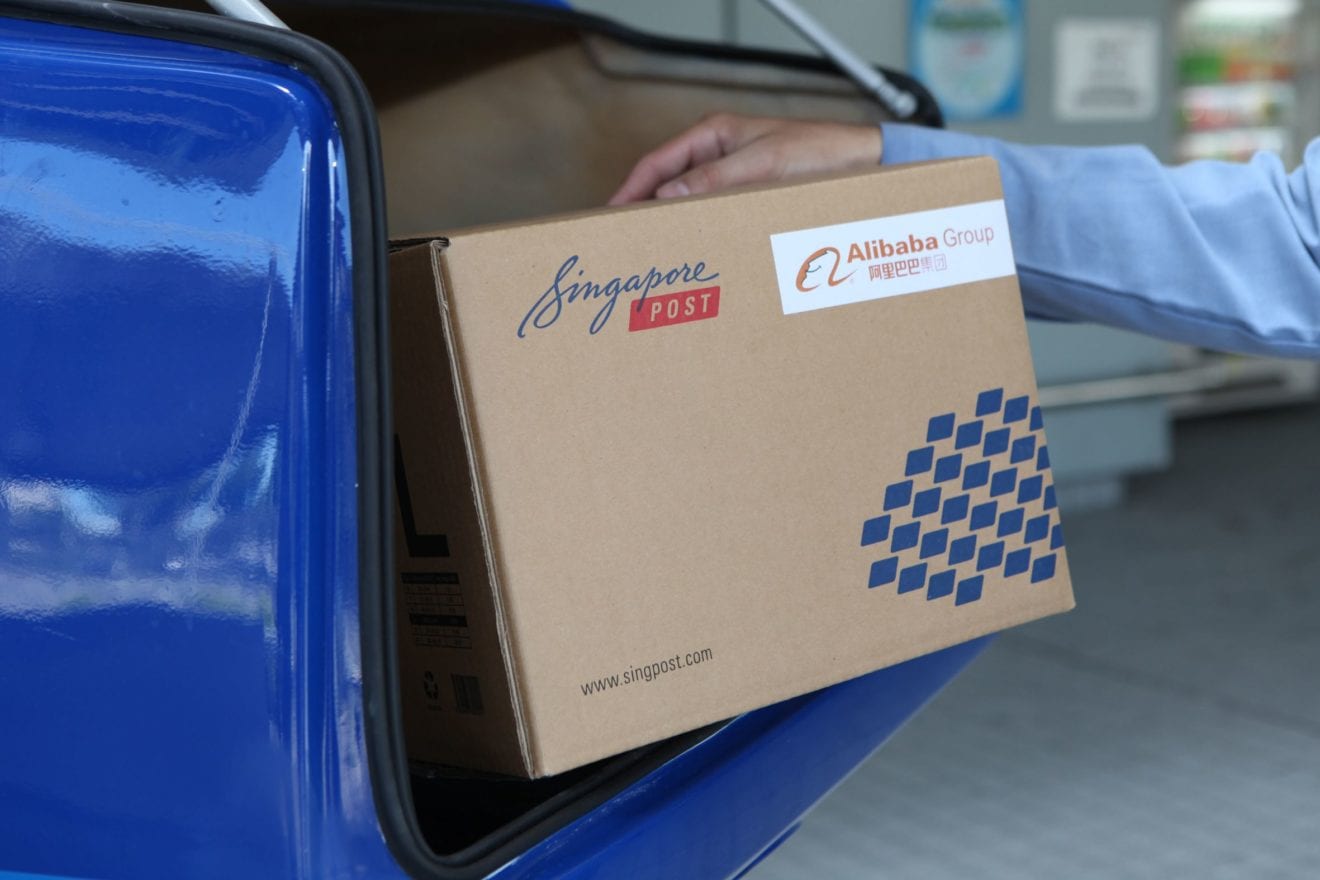
    Despite signs of a slowdown of imports into China, Singapore Post (SingPost) remains bullish on the prospects for e-commerce flows into Asia’s largest economy. The postal agency has upped its stake in Shenzhen-based e-commerce provider 4PX Information Technology.

    SingPost forked out US$25.6 million to acquire an additional 17.91% position in 4PX, one of China’s top e-commerce cross-border players, whose scope of services ranges from forwarding, express delivery and warehousing to software and consulting services for e-commerce vendors. The postal operator now holds a 36% stake in the Chinese firm.

    4PX runs warehouses in China, Australia, UK, Germany and the US, employing north of 2,600 staff. The company has over 20,000 customers in more than 50 locations in China and globally.

    “The additional investment in 4PX, with its extensive logistics capabilities in warehousing, express delivery and freight forwarding, is a key part of SingPost’s strategy to strengthen our integrated end-to-end e-commerce logistics solutions and to leverage on the rapid growth in China’s e-commerce activities,” said Goh Hui Ling, deputy CEO (international mail) of SingPost.

    With general cargo growth in the doldrums, logistics providers are keen on developing a footprint in e-commerce, which promises rich pickings and robust growth momentum. According to one estimate, global B2C volume is expected to reach US$2.26 trillion a year by 2020, with an annual growth rate of 15 to 20%.

    International carriers are particularly gung-ho on China, citing Chinese consumers’ rising cravings for international brands. Anselm Eggert, head of e-commerce at Lufthansa Cargo, stated that they are showing strong interest in European brands, especially health and beauty products.

    Freighter leasing firm Airborne Global Solutions invested US$16 million last September for a 25% stake in the nascent United Star Express, a new Chinese freighter operator that is expected to take to the skies halfway through this year. Its partners in the venture are Chinese Boeing 737 operator Okay Airways, a developer and an investment company, and Vipshop, the third-largest e-tailer in China, according to AGS president Rich Corrado.

    Postal agencies are pushing aggressively into this arena, their eagerness intensified by a need to make up for the ongoing shrinkage of their traditional letter mail business. With their delivery networks they have a strong advantage over competitors in the critical final-mile segment in their home markets, but they are also increasingly targeting international flows to other markets.

    Japan Post established its own website in China last autumn to offer Japanese merchandise to Chinese consumers. Orders are consolidated and moved by ocean vessel to Shanghai for overland distribution.

    China Post has been in hot pursuit of e-commerce business, which is reflected in the rapid growth of China Postal Airlines. According to one source, China Southern Airlines’ decision last year to bring two parked 747-400 freighters back into service was prompted by the Chinese postal agency.

    To develop its traffic from the postal agencies of Hong Kong and China, Cathay Pacific has implemented barcode scanning of mail at its stations in China and in Hong Kong. This enables the electronic transmission of departure, transit and arrival information. In a second phase, the airline is looking to integrate various IT interfaces – from booking to space management and mail warehouse transit management – to establish real-time data flow, said Mark Sutch, the airline’s general manager of cargo sales and marketing.

    For now many airlines view postal business as the biggest inroad into B2C e-commerce, but this will likely change. Eggert envisages greater involvement from carriers down the road. At this point Lufthansa is studying the market in order to be able to develop more targeted options later on.

    “I think in the future we will go beyond mail. I think the industry needs to think how to work together with partners,” Eggert said. This will require closer alignment, including some degree of IT integration. In light of the fact that the air cargo industry does not have a stellar track record in developing joint solutions, this will be a challenging avenue for operators to pursue, he added.


  • Huawei moves further into mobile payments

    Huawei moves further into mobile payments

    Apple and Samsung recognize that revenue from the sale of mobile devices, alone, cannot keep shareholders happy.

    With the vendors venturing into what is arguably one of the most exciting spaces in the financial services space – payments – it begs the questions of who will follow suit and whether the market can afford multiple payment providers.

    Not to be left behind, Chinese mobile phone device manufacturer, Huawei, is accelerating its payments ambition in 2016 with two significant announcements in the first quarter of 2016.

    The first is an agreement with Bank of China to jointly co-develop what the two organizations are claiming to be the next mobile based payment system under the Huawei Pay label. This was followed by a separate announcement with China UnionPay, the country’s state-run bank-card processor.

    This is not Huawei’s first foray into payment. Unofficially, Huawei Pay debuted in China with the launch of the company’s latest flagship smartphone – the Mate S in December 2015 following a test run of the payment service in September 2015. Using NFC technology, placing the Mate S in close proximity to a China UnionPay POS terminal with Quick Pass function will launch the Huawei Pay service.

    Users can complete the transaction via fingerprint authentication. The partnership with UnionPay holds the promise of extending Huawei Pay across China to a broader spectrum of Huawei handset users – mostly smartphones equipped with fingerprint sensors and an NFC chip simply by downloading the Huawei Pay app.

    China UnionPay, which holds a monopoly on bank-card payments in the country, also works with Apple Pay, which was launched in China last month.

    Local market research firm iResearch estimate that third party mobile payment transactions reached 2.42 trillion yuan in the third quarter of 2015, a 64% jump from Q2 2015. The China Internet Network Information Center estimated mobile payments to have risen to 357 million, up 60% from the previous year.

    The Chinese mobile payment market is expected to get very crowded rapidly with other mobile device manufacturers, including Xiaomi, ZTE and Lenovo, rumored to be developing their own mobile payment service. Xiaomi is doing so following its acquisition of a local payment company – Jiefu Ruitong in early 2016.

    According to iResearch China’s mobile payment is dominated by Alipay (70%) and WeChat Wallet (19%). To compete in this market Huawei plans to secure the assistance of more banks as part of its smartphone launch strategy. Without releasing details the company said it is designing more payment scenarios for its smartphone users.

  • Hong Kong luxury ambitions wane

    Hong Kong luxury ambitions wane

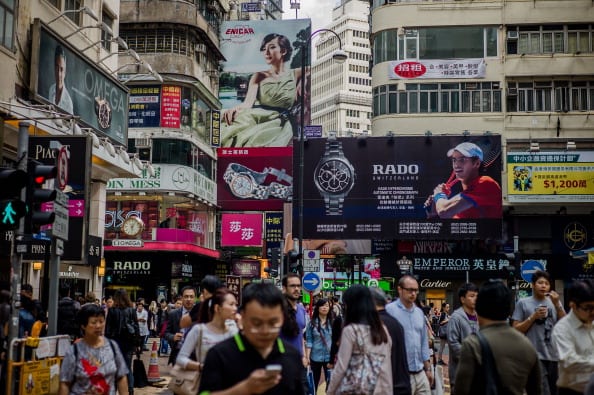
    New consumer research suggests the Hong Kong luxury market is set for another challenging year.

    While 42 per cent of consumers surveyed in China are looking to spend more on luxury items, in Hong Kong the figure is only 25 per cent. That marks a five percentage point drop from 30 per cent of last year, according to the seventh edition of the China Luxury Forecast, released by PR company Ruder Finn and Asian market research company Consumer Search Group (CSG).

    The report says the results further reinforce last year’s conservative approach to retail spending by Hong Kong consumers.

    Growing wealth has led to consumers broadening their international horizons, with spend on travel still the top luxury category for both mainland China and Hong Kong. More than half (53 per cent) of consumers on the mainland say they intend to spend more on luxury travel in the coming year, up from last year’s figure of 50 per cent. This is expected to drive more growth in luxury markets outside China.

    In Hong Kong the luxury travel picture again paints a decrease in purchase intention, down by 5 per cent compared to last year.

    Bright spot

    Meanwhile, eCommerce continues to be the bright spot for luxury brands, with online purchases by mainland Chinese and Hong Kong customers amounting to 26 and 20 per cent respectively of luxury spending.

    Surveying 1040 consumers from more than 120 cities in China and 301 from Hong Kong, the forecast covers people from tier 1, 2 and 3 mainland cities. For first-tier cities it interviewed 300 consumers, 400 from second-tier cities and 340 from third-tier cities. Their average annual household income was RMB 833,509 (US$128,293.35) in the mainland, and HK$957,006 (US$123,340.22) in Hong Kong.

    When it comes to online purchases, accessories and beauty are the favoured products, and official brand websites the most preferred digital channels. Customers have also indicated higher confidence in spending online without having first visited physical stores, with an average number of two visits, down from 2.3 and 2.6 visits last year in China and Hong Kong respectively.

    Word of mouth is the key influencer for product choice, surpassing celebrities, luxury communities and key opinion leaders.

    Hong Kong and China customers also value “Chinese” elements differently when it comes to buying products or services. On the mainland, 58 per cent of respondents said that “embedded Chinese elements” were “extremely or very important”, compared to sentiment in Hong Kong, at just 11 per cent. Also, 55 per cent of Chinese consumers said they appreciated “elements symbolising good luck” compared to 25 per cent of Hong Kong consumers.

    Most valued by Hong Kong consumers (44 per cent of respondents) were elements reflecting Chinese heritage, which were second-most appreciated by Chinese consumers (52 per cent).

    Travelling to shop

    China’s luxury travel market continues to grow, with Chinese respondents taking four domestic and three international trips, while in Hong Kong luxury consumers take 3.7 international trips annually. Japan, Taiwan and China are the top three destinations for those from Hong Kong, while Hong Kong tops the list for mainland travellers, followed by France and Japan.

    For mainland consumers, culture and history were the main reasons for destination choice (63 per cent), while Hong Kong travellers most valued transportation convenience (50 per cent). Shopping was the second most popular motivation in both markets (46 per cent and 47 per cent in China and Hong Kong respectively).

    Most luxury consumers in both Hong Kong and mainland China have a budget for shopping when travelling abroad. As many as 57 per cent of Chinese consumers and 46 per cent in Hong Kong know in advance what brands they will buy.

    “While the demand for luxury remains strong in mainland China, Hong Kong luxury consumers are showing lesser intent in luxury purchase,” says CSG Hong Kong executive director Simon Tye.

    “Hong Kong customers are still interested in discovering new luxury brands and experiences. They are very discerning customers who know and appreciate quality products.”

    Travel and beauty show the most significant growth in the luxury sector, according to Ruder Finn Asia GM for luxury Gao Ming.

  • Alibaba taps VR to enhance shopping experience

    Alibaba taps VR to enhance shopping experience

    The global virtual reality market to grow at a rate of 96% by 2019, according to a new report made available by Research and Markets.

    VR is being adopted in a wide variety of applications ranging from healthcare, gaming devices, public entertainment, prototype creation to military exercises.

    Chinese e-commerce giant Alibaba has now set up a research lab as it looks to use VR to enhance the shopping experience for its 400 million users.

    The company is also exploring how VR technology can be applied to its other services, including online games and video streaming, according to reports.

    Head-mounted displays have created opportunities for VR in a number of applications. A head-mounted display consists of an image source, collimating optics, and a mechanism to mount the device on the head.

    The device is wearable, and projects images and information relative to the user’s line of sight in front of the user. A report on the HMD market predicts growth of 49% over the next five years.

    Virtual reality devices, which are compatible with smartphones, can help users by providing specific information about their requirement on-the-go, without pulling out their portable devices. This technology is expected to commercialize in 2016 and could be worth $2.30 million in 2016.

    Alibaba has already created three-dimensional visuals for hundreds of products and will issue standards for merchants to create VR-enabled shopping options. It is also said to be working on creating music and videos.

  • China’s web shoppers want more

    China’s web shoppers want more

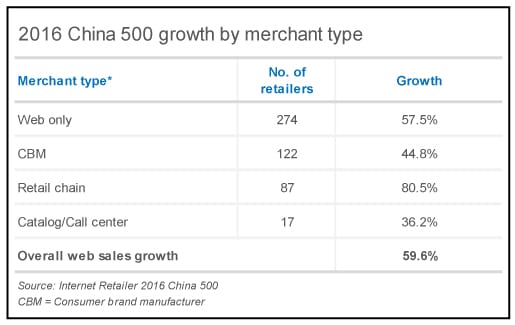
    China’s growing middle class craves imported goods and that’s driving big opportunities for overseas brands and retailers. China’s 500 largest web retailers grew combined sales by 60% in 2015, according to the all-new Internet Retailer 2016 China 500, which ranks the 500 leaders of the world’s largest and fastest-growing e-commerce market

    China’s slowdown to only 6.9% growth in gross domestic product in 2015, one of the lowest increases in decades, has been blamed for hurting the economies of trading partners in other countries. But China’s growing middle class keeps buying more online, and its thirst for foreign goods creates a big opportunity for overseas retailers and brands.

    Chinese consumers purchased $589.61 billion worth of goods online in 2015, an increase of 33.3% from a year earlier, according to the National Bureau of Statistics in China. By comparison, U.S. online retail sales grew roughly 15% per year from 2011 to 2014 to $304.9 billion, according to the U.S. Commerce Department.

    China’s 500 largest e-retailers grew their combined online sales by a stunning 60% in 2015 to $198 billion, according to the all-new Internet Retailer 2016 China 500, which ranks and provides a wealth of financial and operating data on the 500 leaders of the world’s largest and fastest-growing e-commerce market. And the data contained in Internet Retailer’s newest research report on e-commerce in China shows that the world’s biggest online market is rapidly consolidating, with the 500 largest competitors now controlling 33.6% of China’s e-retail market, up from 28% just one year ago.

    Retailers and brands based outside of China shared in that growth. The 52 U.S.-based retailers ranked in the China 500, for example, grew online sales 24.3% to $17.77 billion last year—the bulk of that coming from Chinese customers. The 79 retailers based outside China, including those in the U.S., grew sales by 24.0%, to $21.31 billion in 2015.

    The growing online retail sales for brands and retailers based outside of China is not surprising given the strong demand among middle-class Chinese for foreign goods, from Apple Inc. iPhones to food and household goods from Wal-Mart Stores Inc. Alibaba Group reported that 33% of Chinese consumers bought items from international brands during the 24-hour Singles’ Day event Nov. 11, with U.S. goods in the top spot. Singles’ Day is a marketing initiative that Alibaba created to spur single consumers to buy goods online for themselves, as opposed to other marketing days where consumers buy gifts for loved ones.

    Among the factors driving online sales growth are increasing sales from consumers in China’s villages, and the steady growth in the number of Chinese shoppers who can access the web through mobile phones.

    “In China, the major market drivers in the past year have been cross-border e-commerce, mobile shopping, omnichannel and e-commerce in villages,” China E-commerce Research Center senior analyst Zhang Zhouping says.

    There were 668 million Internet users in China by June 2015, and about 89%, roughly 594 million consumers, could access the web through mobile devices, according to China Internet Network Information Center. During Alibaba’s Singles’ Day sale, Chinese consumers purchased $14 billion worth of products, and 70% of sales were generated on mobile devices, according to Alibaba.

    Rural areas, where there are few bricks-and-mortar stores, also present huge potential for online merchants. There were 186 million Internet users living outside of cities as of June 2015, and 60% of them had never bought products online, according to China’s Ministry of Commerce. To encourage rural shoppers to order online, e-commerce firms are rapidly improving their facilities in those areas. Alibaba, whose big marketplaces Taobao and Tmall account for about 75% of China’s online retail sales, has helped about 14,000 merchants with small stores in rural China sell their wares on Taobao, the company says. Alibaba is aiming to establish up to 100,000 such service centers among about 570,000 villages in rural areas of China.


  • JD.com Dominating The Rapidly Growing Chinese Online Retail Market

    JD.com Dominating The Rapidly Growing Chinese Online Retail Market

    Rapidly Growing Online Retail Market

    There are multiple dimensions through which the Chinese online retail market is growing such as growing Internet users and expanding middle class. Unlike developed countries with largest online retail markets such as the UK, the US, and Germany, the penetration of online retail is fairly low at a meager 12.9% (2015) of the country’s overall retail sector. Despite that, China is the largest e-commerce market in the world, which is also growing rapidly. Chinese consumers spent 33.3% more on online shopping last year. And the expanding middle class is making the market lucrative for e-commerce players in the B2C segment, which was an unprofitable prospect a few years ago due to unscalability. This is where the two fiercest competitors JD and Alibaba’s Tmall are fighting to capture a larger chunk of the growing pie.

    JD.com or Jingdong is the second-largest e-commerce player in China, only behind Alibaba. BABA provides marketplaces for businesses (Alibaba.com), consumers (Taobao), and brands (Tmall), along with technological support and services; it generates revenues primarily through advertising and commissions. On the other hand, JD is more of an online retail pure-play with a lion’s share of revenues generated from direct sales; however, it also hosts third-party sellers. JD operates in the B2C segment and directly competes with BABA’s Tmall.

    Why Invest In JD.com?

    Largest logistics infrastructure

    This is the key differentiator between the two. JD operates its own logistics network while BABA provides these services to its merchants through a group of logistics service providers called Cainiao. JD has been aggressively investing to expand the largest fulfilment network operated by an e-commerce company in China. Its last mile delivery distinguishes it even from Amazon, resulting in the fastest and reliable delivery as evident from the nearly 80% orders fulfilled on the same day. While BABA has stepped up its efforts in building several large-scale logistics centre, it would still rely on third-party delivery personnel. Even though the strategy is better in terms of its less labour-intensive nature, it lacks control on the quality of service.

    Rising revenues in non-core areas

    One of the reasons JD started building its logistics network in 2007 was to attract third-party sellers. Its strategy has been successful as evident from the y-o-y jump of 101% in revenues from marketplace fees, ads, and logistics services. Third-party sellers find JD more attractive as the company doesn’t ask for exclusivity, unlike Tmall. Additionally, the company has seen strong growth in the apparels and shoes segment. JD was a consumer electronics and home appliances focused retailer, but the segment’s 66% growth was outpaced by the 92% y-o-y growth in general merchandise/other segment during Q4 2015.

    Increasing market share

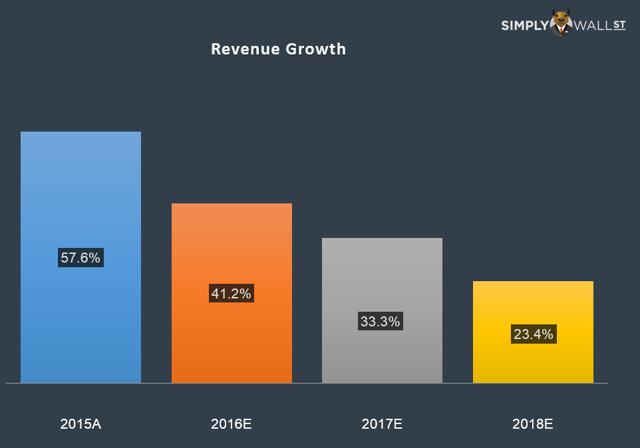
    JD’s revenue growth of 57.6% (in US dollars) during 2015 was well above the industry’s growth rate (33.3%). It indicates that the company increased its market share which accounted for the incremental growth. During early 2015, analysts at William Blair highlighted that during Q4 2014, JD gained 5% market share in GMV compared to a 2% decline experienced by Tmall. During the first three quarters of 2015, JD’s market share increased to 23.2% from 18.6% at the start of the year compared to Tmall’s contraction to 54% from 61.4%.

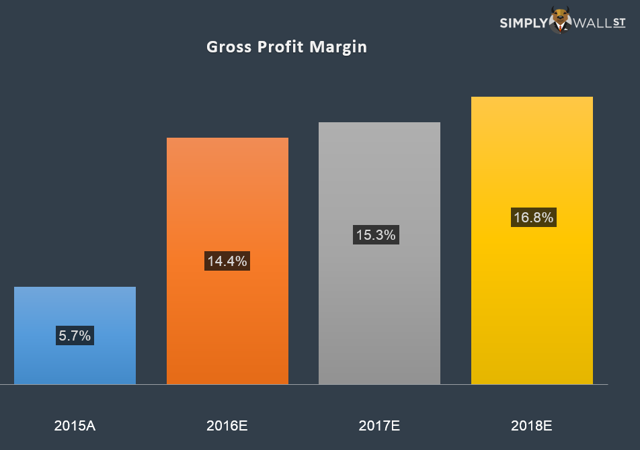
    Improving gross margin

    Source: Simply Wall St

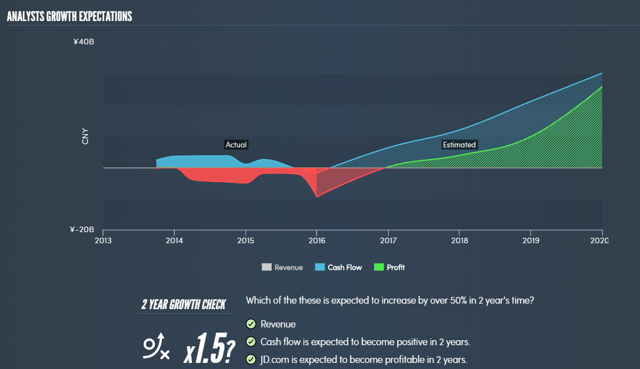
    JD was unprofitable last year. More than 85% of the loss was related to impairment charges (Paipai platform) and acquisitions; however, the company is expected to deliver positive earnings in 2016 and sizable earnings growth thereafter. JD’s improved utilization of infrastructure – growth in marketplace, ads, logistic services revenues – and increase in higher-margin product mix – general merchandise/other segment – will start reflecting in improved gross margin. Its loss doesn’t come as a surprise, as the management clearly stated in early 2015 that it is in investment mode, and this year’s target was to grow its market share and expand infrastructure.

    Source: Simply Wall St

    Smart money and the strategic partnership

    As per Bloomberg, the hedge fund holdings in the company increased from less than 4% at the start of 2015 to over 18% at the end of Q2. Q3 saw a decline, but the smart money increased its stake by nearly 7% during Q4. One of the key reasons behind hedge funds’ interest was JD’s strategic partnership with Tencent, the operator of China’s largest messaging service: WeChat. This has allowed JD to tap into the fastest-growing customer network as evident from the 61.4% sales coming from mobile devices during 2015 compared to nearly 36% in Q4 2014.

    Source: Simply Wall St

    Source: SEC 13-F filings, National Bureau of Statistics China, company fillings, S&P Capital IQ, WSJ.com, Simply Wall St