Tag: Finance

  • UBS Sees Uninterrupted Client Momentum

    UBS Sees Uninterrupted Client Momentum

    Switzerland’s largest bank reports strong transactional activity in its core business and expects to achieve its objective of $100 billion in net new assets by the end of the year.

    UBS is turning the upheavals and drama of 2023, and its fraught government-prompted takeover of Credit Suisse, into a dim national memory receding in the rearview mirror of Swiss business history.

    In its third-quarter ad hoc announcement released on Wednesday, the bank reported an underlying pre-tax profit of $2.4 billion, which it said was an ample indication of the strength of its client franchises.

    Overall, group revenues were up 5 percent year-on-year but gained 9 percent on an underlying basis, with the aforementioned transactional activity recurring fee income more than offsetting the expected headwinds impacting net interest income after key central banks started cutting interest rates in the quarter.

    Invested assets were up 15 percent at $6.2 trillion as it experienced «continued client momentum» with $25 billion in net new assets in its core global wealth management business, putting it on «on track» to deliver its ambition of bringing in $100 billion in net new assets for the whole of 2024.

    Overall, the market environment remained constructive in the third quarter but also showed «signs of dislocation and volatility».

    UBS generated $15 billion in net new fee-generating assets and saw strong discretionary mandate sales in all regions despite continued pricing discipline.

    It also recorded strong transactional activity in global wealth management and the investment bank, with the former’s revenues up almost a fifth (19 percent) with the latter gaining by practically a third (31 percent).

    The high levels of transactional activity came from both private and institutional clients, with global wealth management seeing strong momentum in all regions led by the Americans and the Asia Pacific (APAC).

    In its investment bank, the global markets business saw gains also coming from all regions, but «particularly» in the Americas. The global banking business experienced strong M&A performances in Asia and the US. In UBS’s Swiss home market, it granted or renewed around 35 billion francs in loans.

    Beyond that, it indicated that many facets of its integration with Credit Suisse, the country’s erstwhile second-largest bank, remained on track. It completed the first wave of client migrations in Luxembourg and Hong Kong this month. Singapore and Japan are expected to be finalized by the end of the year, with Switzerland up in 2025.

    It is on target to reach the expected $7.5 billion in cost cuts this year after it managed to realize an additional $800 million in savings in the third quarter, with a further $5 billion in risk-weighted asset reductions in non-core and legacy ahead of plans.

    As a result, it expects to be in a position to save about $13 billion (gross) by the end of 2026.

    It also maintained that it would complete $1 billion in share repurchases in the fourth quarter and it intends to keep making them in 2025 although that will depend on the country’s review of its capital regime requirements.

    It also announced several AI initiatives to benefit clients and employees, including a new proprietary AI assistant for 20,000 employees in Switzerland, Hong Kong, and Singapore with «easy» access to product information and investment research.

    In the investment bank, it is piloting a proprietary AI algorithm that researches and compiles M&A buy-side targets.

    UBS indicated that it expects a continuation of the current market trends in the fourth quarter given expectations for a soft landing in the US economy despite macroeconomic conditions remaining clouded elsewhere in the world.

    In the fourth quarter, we anticipate a mid-single digit decline in net interest income in Global Wealth Management and a low single-digit decline in Personal & Corporate Banking. Non-core and legacy is expected to generate a quarterly pre-tax loss in line with our earlier guidance, the bank indicated.

  • Saxo Bank Aims for the Crown in Switzerland

    Saxo Bank Aims for the Crown in Switzerland

    Saxo Bank Switzerland is launching a new platform, introducing new products, and enticing customers with special offers during the U.S. elections, all in a bid to dethrone Swissquote. This move adds fresh competition to an already highly contested market.

    Since the collapse of Flowbank, it has become clear that competing in the Swiss digital banking market is no easy feat.

    Founded in 2020, Flowbank was closed by the Swiss Financial Market Supervisory Authority (FINMA) this past June due to insufficient capital and the management’s inability to meet minimum capital requirements. By the end of last year, FINMA noted significant and serious violations of these requirements.

    To succeed in Switzerland, financial institutions need resilience and significant capital. While incomes in Switzerland are high compared to neighboring countries, the market is small, especially in wealth management. Providers are relying on low fees and sophisticated software to attract clients, enhancing user experience, which demands substantial investment. In simple terms: size equals success.

    Saxo Bank Switzerland, led by CEO Stanislav Kostyukhin and Deputy CEO/COO Oliver Buomberger, is now turning up the heat in this battle. Saxo’s client base has grown by 43 percent, though the bank has not disclosed exact numbers. The firm also introduced a product initiative and showcased its new platform, described by Kostyukhin as a «robust Volvo» rather than the «Lamborghini» of its predecessor. The platform offers a simplified interface aimed at investors making informed decisions without the advanced tools often requested by traders. Additionally, Saxo has launched AutoInvest, enabling clients to set up automated ETF investment plans without fees for ETF purchases, monthly charges, or minimum deposits.

    New clients can also trade the 100 most popular U.S. stocks without fees until the end of the year as part of the U.S. Election Campaign, targeting the heightened market sensitivity around the U.S. elections. «Nothing is truly free,» said Kostyukhin, which is why this offer is time-limited. Nonetheless, Saxo expects this campaign to drive additional client growth.

    Kostyukhin acknowledges that Saxo is not yet Switzerland’s number one, but that’s the goal — specifically, to challenge Swissquote, the long-time leader in Swiss online banking.

  • Gasoline prices tumble to 20-month low

    Gasoline prices tumble to 20-month low

    Gasoline prices on Thursday hit the lowest since December 2022, having in decline for the last two months.

    The popular fuel RON95 dropped 1.33% to VND20,820 (US$0.84) per liter.

    Diesel declined by 2.06% to VND18,470.

    Regulators said that fuel prices in the last seven days were affected by expectations of increased supply in Libya and OPEC+ countries and weak China’s demand.

    Gasolines have fallen by 1.6-2.2% and oils have decreased by 2-3.1%. RON95 is now at $86.3 per barrel and diesel $87.

  • Vietnam stocks slip as Asian shares subdued

    Vietnam stocks slip as Asian shares subdued

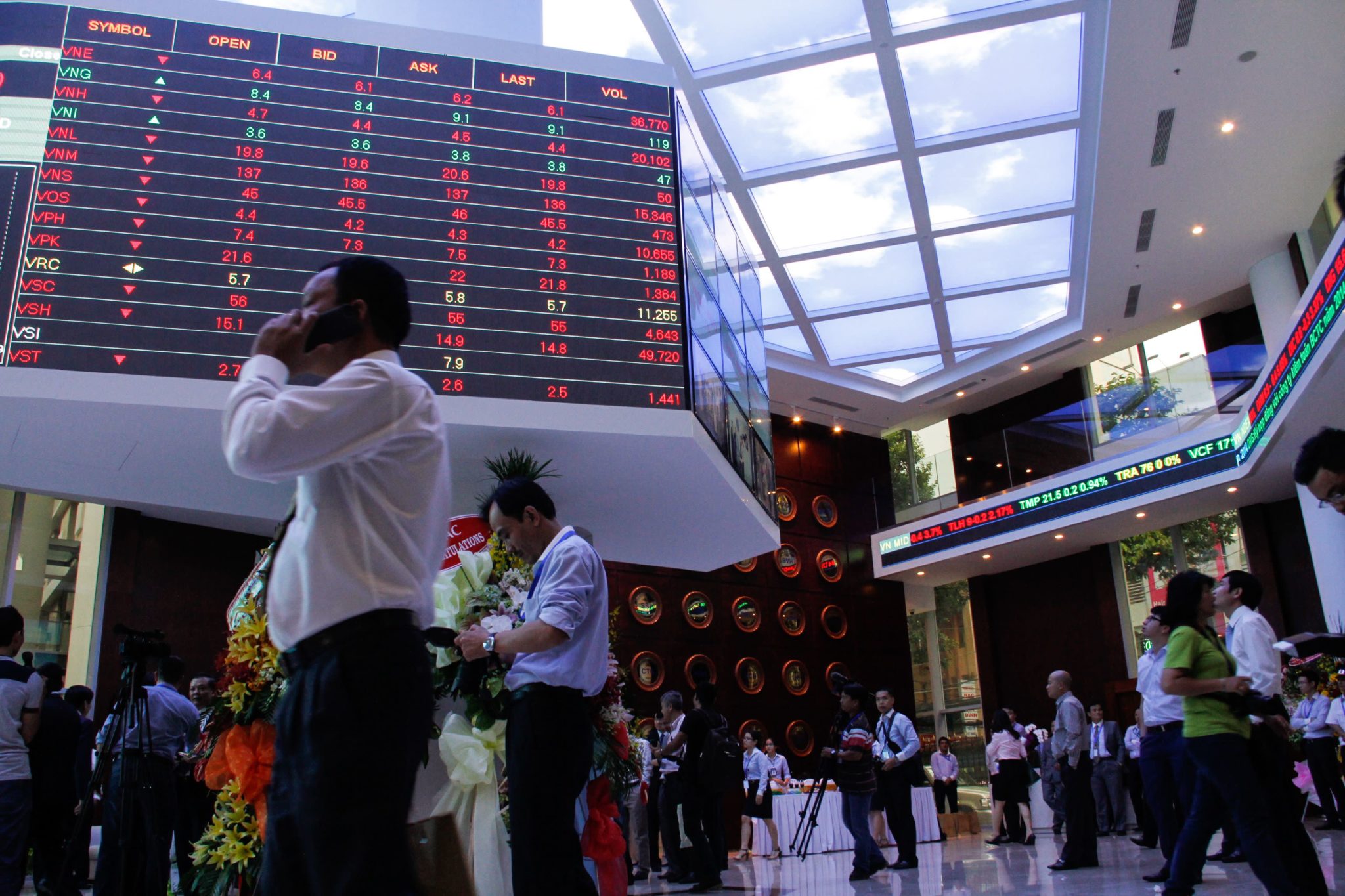
    Vietnam’s benchmark VN-Index fell 0.59% to 1,268.21 points Thursday as other Asian markets were little changed.

    The index closed 7.59 points lower after dropping 8.07 points in the previous session.

    Trading on the Ho Chi Minh Stock Exchange increased by 6% to VND16.59 trillion (US$671 million).

    GVR of Vietnam Rubber Group plunged 2.3%, followed by PLX of fuel distributor Petrolimex, down 2%.

    FPT of IT giant FPT Corporation and MBB of lender MB both fell 1.8%.

    Three blue chips gained, led by VHM of property giant Vinhomes, up 2.9%, and VIC of private conglomerate Vingroup, up 2.4%.

    Foreign investors were net sellers to the tune of VND684 billion, mainly selling FPT and HPG of steelmaker Hoa Phat Group.

    The HNX-Index for stocks on the Hanoi Stock Exchange, home to mid and small caps, fell 0.50%, while the UPCoM-Index for the Unlisted Public Companies Market went down 0.30%.

    Asian shares were subdued on Thursday, with Japanese stocks sliding to their lowest in three weeks as investors sought safety, pushing the yen to a one-month high while U.S. economic worries boosted prospects for the Federal Reserve to cut rates.

    Amid the fragile sentiment, Japan’s benchmark Nikkei slid more than 1% to its lowest in three weeks, while stocks in tech-heavy Taiwan and South Korean stood slightly higher on the day, giving up earlier gains.

    The MSCI’s broadest index of Asia-Pacific shares outside Japan up 0.25%, subdued after having tumbled nearly 3% during a three-day losing streak. The index had risen more than 0.6% but gave up those gains.

  • Saxo Bank Partners with Zurich Fintech Leonteq

    Saxo Bank is enhancing its structured investment product offerings through a strategic collaboration with Leonteq.

    Leonteq and Saxo Bank have initiated a partnership focused on the development and distribution of structured products, as announced by both companies on Tuesday. Under this agreement, Saxo Bank will take on the role of a sponsor within a standardized white-label issuance model developed by Leonteq while also managing the distribution of these financial products.

    Moreover, Leonteq has secured an international distribution mandate from Saxo Bank, granting the firm access to Saxo’s global distribution network. The first structured products, backed by Saxo Bank, are expected to be available on the Leonteq platform by 2025, subject to regulatory approval.

    Focus on the Swiss market

    Leonteq also intends to feature Saxo Bank-backed structured products on its digital investment platform.

    «The partnership with Leonteq marks a significant step for Saxo Bank in expanding our structured investment product offerings, particularly for our rapidly growing Swiss client base. This collaboration represents a genuine win-win situation,» stated Kim Fournais, CEO of Saxo Bank.

  • UBS Gets Business Back on Track

    UBS Gets Business Back on Track

    Switzerland’s largest bank indicated that profitability in the second quarter returned to the levels it saw before being forced to rescue Credit Suisse.

    UBS indicated that profit before taxes in the second quarter was $1.5 billion, a media release sent by the group on Tuesday (year-earlier figures are not directly comparable given the first-time integration of Credit Suisse).

    The bank nevertheless said it experienced continued client momentum, with its core wealth management business seeing net new assets of $27 billion.

    Of the net new assets, UBS said $16 billion were fee-generating assets. In the first half, net new assets totaled $54 billion, it indicated.

    Beyond that, UBS’s investment bank saw strong transactional activity, with the Global Markets business, where revenues were up 18 percent, experiencing its best second-quarter performance since 2013.

    Overall, the bank maintained that it had returned to the levels of profitability it had before being forced to rescue its former peer and competitor, Credit Suisse.

    We are now entering the next phase of our integration, which will be critical to realize further substantial cost, capital, funding and tax benefits, the media release stated.

    It realized additional cost savings of $0.9 billion in the second quarter, which corresponds to 45 percent of the cuts it is targeting by the end of 2026.

    By the end of this year, it expects to be in a position to realize 55 percent, or more than half, of its final target.

    The bank also managed to reduce risk-weighted assets in its non-core and legacy business by 42 percent year-on-year while its CET1 capital ratio was at 14.9 percent and its CET leverage ratio at 4.9 percent.

    It also restarted its share buyback program with the total amount of shares bought back at $467 million as of 9 August.

    The outlook for the remainder of the year continues to be «clouded by ongoing conflicts, other geopolitical tensions and the upcoming US elections.

    Entering the third quarter, we are seeing positive investor sentiment and continued momentum in client and transactional activity,» the bank maintained.

  • Dollar weakens against dong

    Dollar weakens against dong

    The U.S. dollar fell slightly against the Vietnamese dong Thursday morning. Vietcombank sold the greenback at VND25,400, down 0.08% from Wednesday.

    The State Bank of Vietnam set its reference rate 0.04% lower at VND24,245. Unofficial exchange points sold the greenback at VND25,730, up 0.04%.

    Globally the U.S. dollar was soft on Thursday after the Federal Reserve opened the door for an interest rate cut in September, helping keep the yen pinned near its highest since March in the wake of a hawkish pivot from the Bank of Japan.

    The dollar index, which measures the U.S. currency against six peers, was little changed at 104.02, having dropped 0.38% on Wednesday. The index fell 1.7% in July, its weakest monthly performance this year.

    The euro last fetched $1.0825 after rising 1% in July, while sterling was at $1.2852 ahead of the policy decision from the Bank of England, where the central bank could cut rates but markets and economists remain far from certain.

  • Gold prices rise as global rates hit 2-week high

    Gold prices rise as global rates hit 2-week high

    Saigon Jewelry Company gold price rose 1.01% to VND79.8 million ($3,166.35) per tael Thursday morning.

    Gold ring price went up 0.45% to VND77.65 million.

    Globally gold prices climbed to a two-week high on Thursday as U.S. Federal Reserve Chair Jerome Powell opened the door to cutting interest rates as early as September.

    Spot gold was steady at $2,448.38 per ounce, after hitting its highest level since July 18 earlier in the session. Prices were just about $35 shy of the record high of $2483.60 scaled on July 17.

    U.S. gold futures firmed 0.8% to $2,492.50.

    “Gold bulls couldn’t resist the urge to buy more gold after the Fed effectively signalled the beginning of its rate-cut cycle. But gold bugs may want to warrant some caution above $2,500, given gold’s reluctance to hold on to gains around these levels,” City Index senior analyst Matt Simpson said.

  • Techcombank named Vietnam’s Best Bank again

    Techcombank named Vietnam’s Best Bank again

    Techcombank has been named Vietnam’s Best Bank as well as Best Bank for Corporates at this year’s Euromoney Awards for Excellence.

    Techcombank has been named Best Bank in Vietnam 2024 by three international finance publications: Euromoney, Finance Asia, and Global Finance, becoming the only Vietnamese bank to ever win all three prestigious awards in the same year.

    In June, the bank was also named Number 1 Bank in Vietnam in the World’s Best Banks 2024 rankings by Forbes Magazine, based on an extensive survey of customer opinion.

    Jens Lottner, CEO of Techcombank, said that this is an unprecedented achievement.

    “These awards are testament to the success of the bank’s customer-centric strategy, the quality of its advanced data capabilities and digital infrastructure, and the unwavering commitment to excellence throughout the organization,” Lottner said. “Together, these pillars have firmly established Techcombank as one of the strongest banking platforms in Asia.”

    The Euromoney Awards for Excellence are widely considered to be one of the most prestigious accreditations in the banking industry and a strong and independent endorsement of excellence and achievement.

    Banks from over 100 countries entered the Awards for Excellence in 2024, and the best banks in each market were carefully selected by Euromoney’s independent team of editors and analysts.

    Techcombank has now won the Euromoney award for Vietnam’s Best Bank for an unprecedented fifth time, more than any other lender in Vietnam.

    This year’s award recognized Techcombank for its strong financial performance and profitability in 2023, achieved despite economic headwinds and proving the resilience of Techcombank’s business model.

    “Techcombank further solidified its leadership in Vietnam’s banking sector in 2023,” acknowledged Lousie Bowman, Euromoney Editor.

    Techcombank’s sustained profitability, robust asset quality, and balance sheet strength have enabled it to pay a cash dividend of VND1,500 per share to its shareholders in Q2 2024, one of the highest cash dividends in the industry.

    The award also acknowledged the bank’s focus on customer-centricity and its role as an industry pioneer through the launch of innovative digital and data-led solutions for individual, business, and corporate customers.

    For example, its new auto-earning solution enables individual customers to generate profit from their idle cash; Techcombank Merchant is a holistic solution designed to empower Vietnam’s many merchants to run and grow their businesses; and the new C-Cash solution helps Vietnam’s largest corporations uplift their treasury management to a world-class level.

    The quality of Techcombank’s suite of payments and collections, cash and treasury management, and FX solutions for SME and corporate customers was given special recognition with the Best Bank for Corporates honor in 2024.

    Techcombank has broadly applied data analysis and AI across the bank, and most major systems have been transitioned to the cloud.

    This was acknowledged by the Euromoney Best Bank in Vietnam award to put Techcombank years ahead of its competitors in Vietnam and to enable the bank to leverage its best-in-market digital platforms and data and AI capabilities to create more meaningful and more personalized experiences for customers than ever.

    “The bank’s key differentiator is its digital capability. Techcombank’s apps have received the market’s highest customer rating,” said Bowman of Euromoney.

    This rating is due to the smooth and personalized experiences that customers can enjoy when using the Techcombank Mobile app.

    For example, the bank is helping customers improve their financial awareness by providing personalized financial management advice and insights via the app, which enable them to enjoy their money and save for the future.

    Techcombank has already delivered over 52 million personalized pieces of financial advice to more than 4 million customers since the experience was launched.

    Another example is Techcombank’s new loyalty ecosystem, available through the app, and offering rewards and experiences tailored to individual customer preferences and lifestyles.

    It is already one of the largest and most diverse loyalty programs in the Vietnamese banking industry, encompassing over 19,000 points of sale with over 300 brands, where customers can earn reward points.

    The bank’s commitment to ESG excellence and to making a positive social and environmental contribution to Vietnam was also noted by Euromoney.

    In 2023, it provided more green credit to sustainability projects in Vietnam than ever before, while also supporting social initiatives with donations reaching VND148 billion (US$5.84 million) and promoting healthy living and physical fitness through support for the Hanoi and HCMC Techcombank marathons.

    “We are proud and humble to have been named Best Bank in Vietnam by Euromoney for a record fifth time,” Lottner said.

    “But this achievement is just the beginning of a new period of growth. We are now ready to accelerate and to leverage our digital platforms and data and AI capabilities to create more meaningful experiences for our customers and grow our business faster and more profitably than any other bank in Vietnam.”

  • Google Wallet now supports even more banks and credit unions in the U.S.

    Google Wallet now supports even more banks and credit unions in the U.S.

    Google Wallet has recently expanded its reach in the financial sector by adding support for 26 new banks and credit unions across the United States. This brings the total number of supported institutions to over 4,700, making Google Wallet a more accessible and versatile payment option for many users.

    The newly added institutions span a wide range of states, including California, Colorado, Illinois, Indiana, Kansas, Michigan, Mississippi, New York, Ohio, Pennsylvania, Texas, Washington, and Wisconsin. Several other banks without a specific home state have also been included in this expansion.

    Some notable additions include:

    • Achieva Health Savings
    • Blackhawk Engagement Solutions
    • Casey State Bank (IL)
    • Citizens State Bank (Lena, IL)
    • Commercial Bank and Trust of PA (PA)
    • Conway Bank (KS)
    • Direct Express
    • Elektra Go
    • Equals Money
    • Farmers State Bank of Calhan (CO)
    • First Family Federal Credit Union
    • HealthPlus Federal Credit Union (MS)
    • Hendricks County Bank and Trust Company (IN)
    • International Bank of Amherst (WI)
    • Ixonia Bank (WI)
    • Kaw Valley State Bank & Trust Company (KS)
    • LoadPay
    • Northwest Plus Credit Union (WA)
    • Paymentus
    • Pine River State Bank (MN)
    • Savannah Bank, NA (NY)
    • Settlers Federal Credit Union (MI)
    • Spentra/AAA
    • The Farmers and Merchants Bank (OH)
    • The First State Bank (TX)
    • The Southern Bank Company (CA)
    This latest expansion marks another milestone in Google Wallet’s journey towards becoming a ubiquitous payment platform. By partnering with over 4,700 banks and credit unions, Google Wallet is not only making digital payments more accessible but also contributing to the broader trend of financial inclusion.
    Furthermore, Google Wallet integrates with other Google services, such as Gmail and Google Maps, making it easier for users to track their spending, manage their finances, and discover new places to shop and dine.
    As Google Wallet continues to expand its network of supported institutions, it is poised to become an even more integral part of the digital payment landscape. With its user-friendly interface, robust security features, and growing list of partners, Google Wallet is a viable alternative to traditional payment methods for many consumers.
  • Dollar rises against dong

    Dollar rises against dong

    The U.S. dollar strengthened against the Vietnamese dong Monday morning.

    Vietcombank sold the dollar at VND25,474, up 0.06% from the weekend. The greenback is sold at VND25,740 on the black market, down 0.04%.

    The State Bank of Vietnam (SBV)’s reference rate rose 0.06% to VND24,261.

    The dollar has increased against the dong by 4.32% since the beginning of the year.

    Globally, the dollar eased on Monday in the initial reaction to U.S. President Joe Biden’s decision to end his reelection campaign, clearing the way for another Democrat to challenge Donald Trump.

    The U.S. currency slipped 0.08% to 157.38 yen early in the Asian day, while the euro gained 0.11% to $1.0895.

    Biden announced he was exiting the race on Sunday, and endorsed Vice President Kamala Harris to replace him as the Democratic candidate in the November election.

    Commonwealth Bank of Australia strategist Joseph Capurso warned it was too early to read too much in the dollar’s reaction.

    “The bottom line is what the polls show this week,” Capurso said, explaining that a decline in odds for a Trump win should see the dollar weaken, and vice versa.

  • Dollar gains on black market

    Dollar gains on black market

    The U.S. dollar rose against the Vietnamese dong on the black market Friday afternoon.

    Unofficial exchange points sold the greenback at VND25,750, up 0.53% from Thursday.

    The State Bank of Vietnam kept its rate unchanged at VND24,246.

    The dollar has risen 5.36% to VND25,750 against the dong this year.

    Globally the dollar was poised to snap a two-week losing streak on Friday, as traders pondered the U.S. rates outlook, while the yen was steady after inflation in Japan accelerated for a second month, keeping the prospect of a rate hike there on the table.

    The U.S. dollar was on the front foot in Asian hours after a stormy week that saw the yen, euro and sterling make significant gains against the greenback as investors fully price in a rate cut from the Federal Reserve as soon as September.

    The yen was at 157.72 per dollar after touching a six-week high of 155.375 on Thursday, according to Bank of Japan data. This was in the wake of Tokyo’s suspected interventions last week that could total nearly 6 trillion yen ($38.14 billion).

  • Dollar weakens on black market

    Dollar weakens on black market

    The U.S. dollar fell against the Vietnamese dong on the black market Tuesday morning. Unofficial exchange points sold the greenback at VND25,690, down 0.35% from Wednesday.

    Vietcombank kept its rate unchanged at VND25,457. The State Bank of Vietnam’s reference rate was stable at VND24,245.

    The dollar has risen over the dong by 4.16% since the beginning of the year.

    Globally, the dollar hung around five-week lows on Tuesday as comments from Federal Reserve Chair Jerome Powell bolstered the case for a rate cut in September, while cryptocurrencies gained on rising odds of former President Donald Trump getting reelected.

    Powell said on Monday that the three U.S. inflation readings over the second quarter of this year “add somewhat to confidence” that the pace of price increases is returning to the Fed’s target sustainably.

    The euro was a shade lower at $1.0893, while sterling last fetched $1.2967. The dollar index, which measures the U.S. unit versus six peers, was at 104.3, not far from the one month low of 104 it touched on Monday.

  • Gold ring price inches up

    Gold ring price inches up

    Saigon Jewelry Company gold ring price rose 0.07% to VND75.95 million (US$2,987.21) per tael Wednesday morning.

    Gold bar price was stable at VND76.98 million per tael. A tael equals 37.5 grams or 1.2 ounces

    Gold price was at $2,367.43 per ounce at the time of publishing.

    The growing speculation that the US Federal Reserve (Fed) is likely to start cutting rates as early as September continues to support the non-yielding metal. Furthermore, political uncertainties within Europe and globally might boost Gold price, a traditional safe-haven asset.

    On the other hand, the pause of China’s central bank Gold purchases for a second consecutive month might prompt traders to reduce bullish bets in the yellow metal as China is the world’s largest gold consumer.

  • Gold ring price edges higher

    Gold ring price edges higher

    Saigon Jewelry Company gold ring price rose by 0.07% to VND75.65 million (US$2,972.21) per tael Wednesday morning.

    Gold bar price was stable at VND76.98 million per tael. A tael equals 37.5 grams or 1.2 ounces.

    Globally, gold prices were flat on Wednesday as investors awaited minutes of the Federal Reserve’s last policy meeting for fresh cues on when the U.S. central bank will start cutting interest rates, overshadowing a strong domestic jobs report.

    Spot gold was little changed at $2,331.97 per ounce. U.S. gold futures gained 0.3% to $2,340.20.

    The gold market has been steady and holding in a narrow range for a few weeks now, said Marex analyst Edward Meir, adding that bullion prices might move higher later this year with all the elections up in the air.

    Ahead of the release of the Fed minutes, Chair Jerome Powell said on Tuesday the United States was back on a “disinflationary path,” but policymakers needed more data before cutting rates to verify that recent weaker inflation readings provided an accurate picture of the economy.

    Lower interest rates reduce the opportunity cost of holding non-yielding bullion.

    “There’s a clear path for gold to outperform from here, likely fueled by Western flows. Conversely, in the event that central bank demand drops drastically, rates remain high for longer and Asian investor sentiment flips, we could see a pullback in the second half,” the World Gold Council said in its mid-year outlook report.