Tag: #internet

  • Nokia to transform Globe’s fixed, wireless networks

    Nokia to transform Globe’s fixed, wireless networks

    The Philippines’ Globe Telecom has contracted Nokia to transform the operator’s fixed and mobile networks into a flexible cloud-based infrastructure ready for 5G and the IoT.

    Globe has signed two frame agreements  with the vendor – one covering wireless networks and the other for IP, optical and SDN technologies – to set the stage for the upgrade.

    Under the collaboration, Nokia will deploy its 4.5G Pro technology including 5G-ready base stations and small cells, in the Visayas and Mindanao regions. Some of the areas in these regions will be receiving broadband for the first time as a result of the deployment.

    Nokia will also set Globe up to support mobile edge computing and advanced carrier aggregation technologies on its network.

    The fixed agreement will involve the deployment of IP, optical and carrier SDN technologies across the Philippines, allowing the operator to deliver coverage to more regions, and to provide flexible data services over Nokia’s SDN platform to enterprise customers nationwide.

    “As the Philippines’ leading fixed and mobile service provider, we are devoted to improving people’s connected lives day-by-day. With Nokia’s innovative technologies, we are confident to lead the 5G and cloud network evolution,” Globe CEO Ernest Cu said.

    Last week, Globe’s rival PLDT announced that its wireless division Smart achieved data speeds of 1.4Gbps over LTE-A during a trial conducted with Huawei. The trial used five-carrier aggregation technology to achieve the blazing fast speeds.

    “It will take time for carrier aggregation on five frequencies to be deployed, largely because capable handsets are not yet commercially available. But the excellent results of these tests have encouraged us to roll out LTE-A using two or three component carriers which can already be utilized by several handset models in the market,” PLDT and Smart CTO Joachim Horn said.


  • Sri Lanka Telecom to build government fiber network

    Sri Lanka Telecom has secured a contract to build a fiber network connecting government offices in the nation.

    The operator has been selected to build the LGN2.0 (Lanka government network 2.0).

    As well as connecting government agencies and public institutions, the network will be used to provide free public Wi-Fi to citizens.

    The LGN2.0 project is being overseen by the Information and Communication Technology Agency of Sri Lanka (ICTA). It has a total budget of 12.7 billion rupees ($86.1 million) over the next two years.

    Sri Lanka’s Minister of Mass Media Gayantha Karunathilaka has stated that the project aims to address concerns that the existing LGN is not fast enough to support Sri Lanka’s ambitions to digitize the national economy.

    The original LGN was deployed between 2007 and 2012. It is managed by the government-owned entity Lanka Government Information Infrastructure (LGII).

  • Beware the Internet of Unpatchable Things: Akamai

    Beware the Internet of Unpatchable Things: Akamai

    A recent spate of attacks involving attackers using IoT devices to remotely generate attack traffic by using a 12-year old vulnerability in OpenSSH have been discovered by researchers at Akamai Technologies.

    Akamai notes that the research and subsequent advisory do not introduce a new type of vulnerability or attack technique, but rather a continued weakness in many default configurations of Internet-connected devices. These devices are now actively being exploited in mass-scale attack campaigns against Akamai customers.

    The Threat Research Team said it has observed incidents of what it has called SSHowDowN Proxy attacks originating from the following types of devices:

    • CCTV, NVR, DVR devices (video surveillance)
    • Satellite antenna equipment
    • Networking devices (e.g. Routers, Hotspots, WiMax, Cable and ADSL modems, etc.)
    • Internet connected NAS devices (Network Attached Storage)

    Compromized devices are being used for mounting attacks against a multitude of internet targets and internet-facing services, such as HTTP, SMTP and Network Scanning. It is also being used to launch attacks against internal networks that host these connected devices.

    Once malicious users access the web administration console, they have been able to compromise the device’s data and, in some cases, fully take over the machine.

    “We’re entering a very interesting time when it comes to DDoS and other web attacks; ‘The Internet of Unpatchable Things’ so to speak,” explained Ory Segal, senior director for threat research at Akamai.

    “New devices are being shipped from the factory not only with this vulnerability exposed, but also without any effective way to fix it. We’ve been hearing for years that it was theoretically possible for IoT devices to attack. That, unfortunately, has now become the reality.”

  • Bharti Airtel launches VDSL vectoring

    Bharti Airtel launches VDSL vectoring

    India’s Bharti Airtel has launched a new VDSL vectoring service the company has branded V-Fiber, capable of delivering speeds of up to 100Mbps.

    The company’s new service has been launched in Chennai, and is being rolled out across Airtel’s national broadband network – which spans 87 cities.

    Airtel will offer the service to its existing customers at no additional cost, except for the cost of an upgraded modem. For new subscribers, Airtel will offer an unlimited three month trial offer.

    The operator will now also offer all its fixed broadband subscribers unlimited voice calling at no extra cost, and is providing a rewards program to allow broadband customers to get 5GB of additional mobile data per month if they are also subscribed to Airtel’s mobile services.

    As part of Project Leap, Airtel’s nationwide network transformation initiative, the company is meanwhile augmenting its 550,000km of domestic and international fiber capacity to improve latency and customer service and meet growing demand for data services.

    “India is witnessing an explosive growth in data usage and a lot of in-home data consumption is happening over fixed broadband that offers consistent speeds. Airtel has always innovated ahead of the curve and offered its customers best-in-class broadband technology and experience,” Airtel director of operations Ajai Puri said.

    “With ‘V-Fiber’ and our national optic fiber backbone, we are all set to offer a future ready network for tomorrow’s digitally connected homes. This solution, besides reducing our carbon footprint, offers a very quick and convenient upgrade to the customer.”

    Airtel is bracing for the anticipated impact of the planned entry into the fixed broadband market of Reliance Jio Infocomm, the disruptive pan-Indian 4G service provider with an extensive existing fiber footprint.

  • Google, Facebook to build LA-HK cable

    Google, Facebook to build LA-HK cable

    The internet giants Google and Facebook apparently agree on at least one thing this month: that the world’s infrastructure is in need of another trans-Pacific cable system. They are teaming up with privately held Pacific Light Data Communication and TE Subcom to build the Pacific Light Cable Network, or PLCN.

    The new cable system will be a direct link between Los Angeles and Hong Kong. It will span some 12,800km between the two cities, potentially offering one of the lowest latencies available.

    PLCN will also incorporate the latest optical technologies, which means the total theoretical capacity will be the largest transpacific route so far – up to 120Tbps in all. It is expected to be launched commercially in the summer of 2018.

    It was just a few months or so since the that the FASTER cable, also backed by Google, came online between Japan and Oregon. The PLCN cable system will give them some diversity both by route and by landing station.

    For Facebook, this is the most public position on a transpacific cable they have taken. But in the Atlantic they are part of the group building the Marea cable system between Bilbao and Virginia Beach.

    TE Subcom will be doing the actual laying of the cable, of course. But I wonder who is behind the privately held PLDC over in Hong Kong.

  • ACCC likely to continue regulating ADSL access

    ACCC likely to continue regulating ADSL access

    Australian competition regulator the ACCC has made a draft decision to continue regulating access to Telstra’s wholesale ADSL network for a further five years.

    Former government monopoly Telstra is required to provide access to its ADSL network to competitors due to its dominant position in both the wholesale and retail ADSL markets. When a commercial agreement cannot be reached, Telstra must provide access at regulated prices.

    The ACCC had been investigating whether regulated access was still necessary given the progress of the rollout of the national broadband network (NBN).

    “Telstra retains its dominant position in both the wholesale and retail markets for the supply of ADSL fixed-line broadband services on a national level,” ACCC commissioner Cristina Cifuentes said.

    “Continuing regulation will ensure network providers continue to have access to Telstra’s copper network at reasonable prices. This will encourage them to continue competing in the retail market to develop and offer different ADSL broadband products to meet the needs of customers as they prepare to shift to the NBN.”

    A final decision on the matter is expected in early 2017, before the current access declaration expires.

  • ASN, Bell Labs set 65Tbps subsea cable speed record

    ASN, Bell Labs set 65Tbps subsea cable speed record

    Alcatel-Lucent Submarine Networks and Nokia Bell Labs have set a new transmission record over a 6,600km single mode fiber for transoceanic cable systems.

    The lab trial achieved a total transmission speed of 65Tbps using submarine grade dual band erbium doped fiber amplifiers.

    The trial used Bell Labs’ new probabilistic constellation shaping (PCS) modulation technology. PCS is designed to maximize the distance and capacity of high-speed transmission in optical networks, by using non-uniform transmission of constellation symbols to increase resilience to noise and other impairments.

    “The future digital existence where everyone, everything and every system and process is connected will require a massive increase in network capacity and the ability to dynamically optimize this capacity,” Nokia CTO and Bell Labs president Marcus Weldon said.

    “Probabilistic constellation shaping extends the limits of current optical transmission by utilizing novel modulation techniques to dramatically improve the performance and capacity needed for the new digital era that will be enabled by the Future X Network.”

    The same technology was used in September to achieve speeds of 1Tbps per channel https://www.telecomasia.net/content/bell-labs-achieves-1tbps-over-fiberover Deutsche Telekom’s terrestrial optical network during trials with the operator’s T-Labs and the Technical University of Munich.

    A capacity of 65Tbps is 13,000 times the capacity of the first subsea amplified transatlantic system in 1995.

  • Korea and Singapore’s broadband lead narrows

    Korea and Singapore’s broadband lead narrows

    South Korea continued to have the highest average connection speed in the world at 27 Mbps while Singapore maintained its position as the country with the highest average peak connection speed at 157.3 Mbps.

    These were among the findings of the Akamai Technologies’ Second Quarter, 2016 State of the Internet Report.

    Both countries, however, registered declines in average connection speed and average peak connection speed, respectively, at 7.2% (South Korea) and 7.1% (Singapore) compared to the first quarter.

    Meanwhile, the global average connection speed decreased 2.3% quarter over quarter to 6.1 Mbps, while the global average peak connection speed increased 3.7% to 36 Mbps. The 10 Mbps broadband adoption rate grew 0.7% quarter over quarter, but 15 Mbps and 25 Mbps broadband adoption rates fell 0.8% and 2.1%, respectively.

    In Asia-Pacific, the report noted that 14 of the 15 surveyed countries had average connection speeds above the 4 Mbps broadband threshold. Indonesia registered a 148% gain in average connection speed in the second quarter and the only country to see its speed double compared to the previous year.

    In the mobile space, Akamai reported that average mobile connection speeds ranged from a high of 23.1 Mbps in the United Kingdom to a low of 2.2 Mbps in Venezuela. The report noted that in the upcoming quarters, it expects to see mobile speeds continue to climb as 4G LTE becomes deployed more broadly worldwide.

    In Asia-Pacific, South Korea (11.1 Mbps) also led the world in average mobile connection in the second quarter of 2016, followed by New Zealand (9.8 Mbps), Japan (9.5 Mbps), Taiwan (9.3 Mbps), Australia (8.9 Mbps), and the Philippines (8.5 Mbps).

  • AIS ramps up fiber competition

    AIS ramps up fiber competition

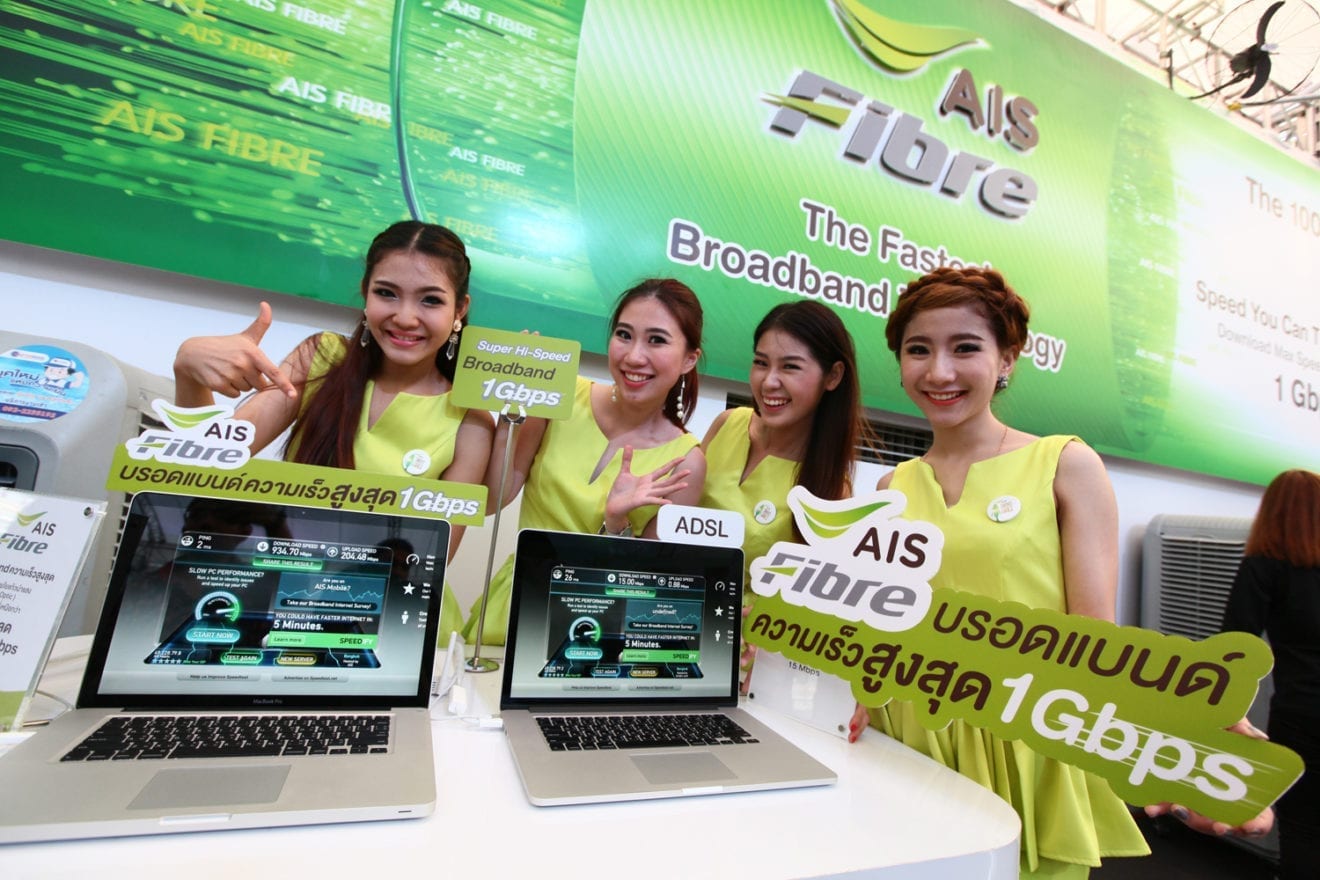
    Thailand’s top mobile operator AIS is gearing up to launch what it says will be the country’s fastest fiber broadband services.

    The operator aims to attract 300,000 users to its fiber service this year, increasing to 2 million by 2019.

    The operator first entered the fiber broadband fray in April and has already been shaking up the market. The company currently has around 200,000 subscribers to its existing fiber services, a roughly 2% share of the total market.

    Now the company aims to disrupt the market further, with plans to offer an entry-level 20Mbps service for 590 baht ($17) per month, comparable to the prices of ADSL broadband services.

    AIS will also offer 50Mbps services for 888 baht per month and 100Mbps services for 1,888 baht per month. All packages will include free WiFi routers, free AIS internet TV and free installation.

    With the new packages AIS has increased its target monthly fiber net additions to 45,000, up from a previous target of 30,000-35,000.

  • There are still 3.9b people not using the internet

    There are still 3.9b people not using the internet

    There are 3.9 billion people in the world that are still not using the internet today, with six nations  including China and India accounting for 55% of the total global population still offline.

    These are among the findings of the 2016 edition of The State of Broadband report released recently by the UN Broadband Commission for Sustainable Development.

    The four other nations with the most unconnected people were Indonesia, Pakistan, Bangladesh, and Nigeria.

    The report suggests that targeted efforts in just a few key markets could help enormously in redressing the gaping ‘digital divide’ between those who are online and those still offline.

    “There is a large body of economic evidence for the role of affordable broadband connectivity as a vital enabler of economic growth, social inclusion, and environmental protection,” said ITU secretary-general Houlin Zhao, who serves as co-vice chair of the commission with UNESCO director-general Irina Bokova.

    The Commission argues that if today’s near-universal basic mobile phone access could be converted to high-speed mobile broadband access, mobile phones could serve as a major accelerator of development, driving rapid progress towards the UN Sustainable Development Goals.

    The broadband report is optimistic about the potential of mobile broadband, with 165 countries now having deployed ‘4G’ high-speed mobile networks.

    “Broadband technologies can be powerful development multipliers,” Bokova added, “but this requires combined investments in access and in skills and in education. This is about opening new paths to create and share knowledge. It is about enhancing freedom of expression and about widening learning opportunities, especially for girls and women. This is about developing content that is relevant, local and multilingual.”

    The report confirms that progress in the 48 UN-designated Least Developed Countries has been encouraging, with the Commission’s target of 15% of the LDC population online expected to be reached by the end of this year.

    This year’s figures show that, once again, the top ten developing countries for household internet penetration are all located in Asia or the Middle East. The Republic of Korea continues to have the world’s highest household Internet penetration, with 98.8% of homes connected; Qatar (96%) and United Arab Emirates (95%) rank second and third, respectively.

  • Globe to deploy fiber in 20,000 villages

    Globe to deploy fiber in 20,000 villages

    The Philippines’ Globe Telecom has committed to connect 2 million Filipino homes with high-speed internet access with a speed of at least 10Mbps and above by 2020.

    The operator plans to deploy fiber in 20,000 villages across the country to achieve this goal.

    “That will change a lot for families because families today are so dependent on the internet,” said Globe President and CEO Ernest Cu at an event on Friday night.

    “Industries and Business Process Outsourcing (BPO) also cannot flourish without dependable connection to the United States, the UK, Australia and to the rest of the world.”

    “We are committed to spending $500 million to upgrade the network of Globe to enable continuous growth among enterprises in the Philippines,” he added.

    Since the joint purchase of the telco assets owned by San Miguel Corporation (SMC) by Globe Telecom and PLDT last May, both companies have been rolling out LTE 700-MHz cell sites across the country. In the Globe network, around 250 such cell ties will have been activated in Metro Manila by the end of this month, at least 188 of which will be active in the National Capital Region.

    Cu said the goal is to deploy at least 500 LTE 700-MHz cell sites nationwide by the end of 2016.

    The majority of these sites will cover major business districts and highly urbanized and populated areas in the country, including Metro Manila, Metro Cebu, and Metro Davao.

    Globe’s chief executive emphasized that the company is maximizing the use of the previously idle 700-MHz band in fulfillment of its commitment to the National Telecommunications Commission to improve the overall internet experience of its customers following the sell-out of SMC’s telco assets.

    “One of our goals its to try to create an experience as close to first world internet as possible. You can now do this with mobile, given the amount of spectrum that we have,” he said.

    Parallel to this, Globe has also started rolling out a capacity expansion program for its corporate data network to address the bandwidth requirement of its enterprise clients. The company will be equipping 61 of its corporate sites with fiber technology.

  • Banks, NBTC agree on 5 step m-banking security plan

    Banks, NBTC agree on 5 step m-banking security plan

    The National Broadcasting and Telecommunications Commission hosted a meeting with representatives from the Bank of Thailand, the Thai Bankers Association and the Telecommunications Association of Thailand.

    The participants have agreed on a five-step plan to tighten KYC rules to increase confidence in eBanking and mobile banking in the run up to the launch of Thailand’s Promptpay national mobile payments system.

    1. The NBTC, BOT, TCT and mobile operators will create a set of KYC rules. The NBTC will order telcos to follow them strictly and will evaluate compliance with the new rules.
    2. Banks and mobile operators will launch an awareness campaign for people to tell their banks when their mobile phone or SIM is lost.
    3. If it can be proven that the customer has told their bank that their SIM has been lost, they will not be held responsible for monetary losses.
    4. A system will be set up for banks to be notified automatically when new SIMs are issued. Until such a system is in place, banks will give telcos a watchlist of telephone numbers that are linked to Internet banking, mobile banking or Promptpay accounts for their special attention.
    5. Issuing new SIM cards for accounts linked to bank accounts can only be done in person by the account holder and not via proxy.

    Meanwhile, NBTC Secretary General Takorn Tantasit has banned the import of all Galaxy Note 7 phones due to their exploding batteries. Phones from affected batches are immediately banned from being imported and the import of new note 7 batches can only resume once Samsung provides the NBTC with satisfactory electrical and safety test results.

  • Malaysia-Singapore-Indonesia cable commissioned

    Malaysia-Singapore-Indonesia cable commissioned

    A new subsea cable company has contracted Huawei Marine Networks to deploy a 250km cable system connecting Malaysia, Singapore and Indonesia.

    Super Sea Cable Networks (SEAX) has commissioned construction of its SEAX-1 cable, which will connect Mersing on the eastern seaboard of Peninsular Malaysia with Singapore’s Changi and Indonesia’s Batam.

    Construction of the 24-fiber-pair system is expected to be complete by the end of next year. SEAX’s market focus will be wholesale operators in emerging markets, including Tier 1, Tier 2 and Tier 3 carriers who want to own but not operate cable systems.

    SEAX’s five-year plan is to target, Thailand, the Philippines, Cambodia, Vietnam and Myanmar in addition to Malaysia and Indonesia.

    The company has a facilities-based operator license in Singapore, an affiliate company in Indonesia and is partnered with telecoms infrastructure provider SACOFA in Malaysia.

    “SEAX-1 passes through one of the busiest region in the Asia Pacific region, where bandwidth demands are increasing exponentially,” SEAX CEO Joseph Lim said.

    “We believe this new submarine cable system will relieve bandwidth pressures on existing infrastructure and continue to provide this region with high-speed, reliable connectivity that will fast-track its growth.”

    Indonesia’s PT Telkom last week contracted NEC to build a subsea cable system connecting six large Indonesian islands with Singapore.

  • Telkom contracts NEC for new subsea cable

    Telkom contracts NEC for new subsea cable

    Indonesia’s PT Telkom has contracted NEC to build a cable system connecting six of the nation’s large islands with Singapore.

    The Indonesia Global Gateway Cable System will link the islands of Sumatra, Batam, Java, Bali, Kalimantan and Sulawesi.

    As well as providing enhanced connectivity between nine major Indonesian cities, the cable will link to Singapore and provide direct connectivity with two international subsea cables that land in Europe and the US respectively.

    The 100Gbps, eight wavelength, four fiber pair cable system will span around 5,300km in total. It is scheduled for completion in early 2018.

    “NEC is honored to be selected once again by Telkom as the supplier of an optical fiber submarine cable system, the advanced 100Gb/s IGG system,” NEC general manager for submarine networks Toru Kawauchi said.

    “Since first building an optical fiber submarine cable system for Telkom in 1991, NEC has continuously helped to expand Indonesia’s domestic connectivity, the Papua Cable System (SMPCS) being the latest such contribution.”

    The Sulawesi Maluku Papua Cable System connects eight provinces in eastern Indonesia – East Nusa Tenggara, Maluku, North Maluku, North Sulawesi, Papua, Southeast Sulawesi, South Sulawesi and West Papua.

    The nine cities that will be connected via the IGG system are Dumai, Batam, Jakarta, Madura, Bali, Makassar, Bilikpapan, Takaran and Manado.

  • Mobile and Internet Usage Propels Southeast Asia’s Retail Ecommerce Sector

    Mobile and Internet Usage Propels Southeast Asia’s Retail Ecommerce Sector

    Southeast Asia has all the ingredients for a promising ecommerce market—rising internet and mobile penetration, a growing middle class with greater discretionary spending, and an increasing supply of digital platforms. Still, many challenges continue to hamper ecommerce growth in the region, as explored in a new report, “Ad Fraud in the US: How More Sophisticated Methods Are Hurting Mobile, Video and Performance Measurement”

    Retail sales in the six largest economies in Southeast Asia—Indonesia, Malaysia, Philippines, Singapore, Thailand and Vietnam—will total $786.45 billion this year, representing 3.6% of worldwide sales. Indonesia, the most populated country in Southeast Asia, will also have the largest retail market, with $245.86 billion in sales. Thailand and Vietnam will follow, at roughly $190 billion and $161 billion, respectively.

    Retail potential in Southeast Asia is determined in large part by population size and purchasing power. Collectively, these six nations benefit from having a population of over 561 million people as of 2016, according to estimates from the US Census Bureau. And that number will continue to expand, growing to nearly 583 million people in 2020, adding about 21.7 million new consumers over the next four years.

    Robust economic growth in these markets is giving way to rising incomes and expanding middle classes. Data from the International Monetary Fund (IMF) shows that total GDP rose from $1.824 trillion in 2010 to $2.462 trillion in 2016. These figures, which account for inflation, are forecast to rise even further, topping $3.346 trillion by 2020.

    Southeast Asia is also experiencing a boom in urbanization, which will also help drive further retail expansion across the region. Generally, retail players focus on urban areas because they have the greatest opportunity (i.e., large population sizes) and favorable conditions for development—such as developed transportation systems, supply chains and technology. Several of the most densely populated cities in Southeast Asia are also the ones growing quickly in population size and retail infrastructure.

    Additionally, rapid ecommerce growth continues to increase in Southeast Asia. eMarketer estimates that the digital retail market—including retail products ordered online via mobile—will reach $14.04 billion in 2016, up from $10.50 billion in 2015, an increase of 33.6% year over year

    Nonetheless, ecommerce’s contribution to retail sales in Southeast Asia is still relatively small. In the six countries tracked by eMarketer, digital retail sales will make up 1.8% of total retail sales in 2016, with the lowest ecommerce share in the Philippines (0.9%) and the highest in Singapore (4.5%). These figures stand in sharp contrast to the more developed ecommerce markets in China and South Korea, where digital retail will represent 18.4% and 12.1%, respectively.

    Southeast Asia is on the cusp of an ecommerce boom, as fast-growing mobile and internet usage propels consumer spending. There are over 262 million internet users residing in these six markets. And many of these consumers are mobile-first internet users, or people who primarily access the web through their mobile phones. eMarketer estimates that about 177 million people—or 67.5% of internet users—will own and use a smartphone in 2016.