Tag: #internet

  • New Zealand’s Woosh Wireless enters administration

    New Zealand’s Woosh Wireless enters administration

    New Zealand wireless broadband provider Woosh Wireless has entered voluntary administration after burning through more than NZ$100 million ($67.7 million) in cash since it was founded.

    The operator has appointed local advisory and investment firm KordaMentha as administrators for the proceedings. The first meeting of creditors will be held early next month.

    Woosh was founded in 1999 and bought out by California-based Craig Wireless for $5 million in 2011.

    The company sold its fixed line network to rival Slingshot last year, and sold one of its three spectrum blocks – a 70 MHz lot of 2300-MHz spectrum – to Spark New Zealand for NZ$9 million in April.

    A KordaMentha partner said the company will be mindful of customers who rely on Woosh Wireless for their broadband services, particularly in remote areas in rural parts of Southland, where there is a strong concentration of subscribers.

  • Facebook, Microsoft team for mid-Atlantic cable

    Facebook, Microsoft team for mid-Atlantic cable

    On what do Facebook and Microsoft agree? Apparently, on the need for a new transatlantic cable between Spain and Virginia in the US. The MAREA cable system was announced yesterday, with the software and social networking giants working with Telefonica’s Telxius subsidiary to make it happen.

    MAREA will supposedly feature 8 fiber pairs and have an initial theoretical capacity of a whopping 160Tbps. It will stretch 6,600km and land in Bilbao in northern Spain and in Virginia Beach. That route takes a less popular southern route to Europe a bit north of the one taken by the aging Columbus system.

    The Virginia Beach landing can be better understood if one recalls that Telefonica’s BRUSA cable hooking up North and South America will also be landing there.

    Just last week we learned that Telefonica has already bought a 3.5 acre site there for a 20,000 square foot building for its cable landing station and data center there. In addition, fiber operators like SummitIG and Lumos Networks have been adding fiber infrastructure throughout southern and central Virginia that will surely help with the backhaul.

    Telxius will operate and manage the cable system itself. Telefonica launched Telxius as its infrastructure arm earlier this year, shifting ownership of towers, subsea cable systems, and other assets into it.

    They hope to monetize those assets in the wake of the blocking of the sale of O2 in the UK, and supposedly this week added several banks to prepare for a $4 billion to $5 billion IPO. That could happen as soon as July.

    This past year has seen the most submarine activity ever from the content guys, and they are increasingly taking the lead on new cable systems they feel are needed to meet their own bandwidth demand.

    Construction of the MAREA cable system is expected to begin in August and finish in October of 2017, although I’m sure they’ll have to time the actual cable laying operations around the Atlantic hurricane season.

  • Myanmar taps Intelsat for satellite backhaul

    Myanmar taps Intelsat for satellite backhaul

    Myanmar’s Ministry of Transport and Communications has arranged to use two Intelsat satellites to improve wireless broadband connectivity for the nation and expand broadband access for businesses.

    The multi-year, multi-transponder agreement will allow the government to significantly enhance its own network and help mobile operators achieve their 2G and 3G deployment goals, the parties said in a statement.

    This will hasten the expansion of high-speed wireless broadband connectivity for businesses and communities nationwide.

    Under the agreement, the ministry will use C-band satellite services over the Intelsat 902 craft for VSAT network and cellular backhaul services, and move to the higher-power services on the recently-announced Intelsat 39 satellite by 2018.

    “Over the past few years, Myanmar has made significant strides in expanding access to faster and more reliable broadband connectivity throughout the country,” the ministry’s permanent secretary Khin Maung Thet said.

    “With the help of Intelsat’s Globalized Network, we will leverage their satellite solutions to extend 2G and 3G communications services beyond urban centers and ensure that all of our citizens have access to higher bandwidth, superior quality and more affordable mobile broadband connectivity.”

    Intelsat CEO Stephen Spengler added that the satellite services “will help enrich the lives of the communities [the government] serves by improving medical and educational access, providing a lifeline during times of crisis and enabling Myanmar to foster strong relationships within and outside of the country.”

  • Google may get approval to test Loon in India

    Google may get approval to test Loon in India

    Google is reportedly in discussions with the Indian government to test its Project Loon in the nation through a four-day pilot program.

    The company is likely to secure approval for the test in Andhra Pradesh or Maharashtra. State-owned operator BSNL is co-ordinating with Google on the project, providing space, spectrum coordination and equipment testing, according to the report.

    The companies are evaluating the use of either the 700-MHz or 2500-MHz bands for the pilot, and the latter seems the more likely choice as it would not require the approval of the Department of Telecom. BSNL has 20 MHz of spectrum in the 2500-MHz band across 14 of India’s 22 telecom circles.

    Project Loon is a Google “moon shot” aimed at providing internet connectivity via a network of high-altitude helium balloons circling the globe.

    Trials of the technology are also being conducted in the US, Australia, Brazil, Indonesia, New Zealand and Sri Lanka. The technology is being developed with a particular focus on improving connectivity in emerging nations

  • Thailand’s AIS launches prepaid broadband

    Thailand’s AIS launches prepaid broadband

    Thailand’s AIS has launched the nation’s first prepaid fixed broadband service, introducing a 15Mbps speed plan for a 500 baht ($14) monthly top-up fee.

    AIS has set a target of becoming Thailand’s second largest broadband player by 2019, citing comments from a senior executive at the company.

    The operator launched commercial fixed broadband services in April last year and had 450,000 subscribers as of December. AIS plans to increase this to 1 million by 2018 and 2 million by 2019.

    In order to achieve its growth ambitions AIS has allocated 7 billion baht to extend its fiber network to cover 24 provinces this year, and a further 10 billion baht to expand this to 40 provinces in 2017.

    Meanwhile rival Jasmine International, whose subsidiary Triple T Broadband operates landline broadband services under the 3BB brand – has retaliated by slashing the price of its 50Mbps plans to 700 baht per month, from 2,500 baht.

  • Ooredoo Myanmar launches 4G services

    Ooredoo Myanmar launches 4G services

    Ooredoo Myanmar has become the nation’s first operator to launch 4G services as part of a staged rollout.

    The operator has introduced 4G in parts of Yangon, NayPyiTaw and Mandalay, according to an FAQ on the company’s website.

    The company plans to cover half of Yangon’s townships, around 90% of NayPyiTaw’s townhips and all of Mandalay with the service.

    Over the next couple of months, Ooredoo Myanmar plans to upgrade around a quarter of its more than 3800 cell sites to 4G.

    But further rollouts will require more spectrum and cell sites, according to CEO Rene Maza. Ooredoo Myanmar plans to continue to expand its 4G network as it acquires these assets.

    Myanmar’s new Ministry of Transport and Communications recently revealed plans to auction 2600-MHz spectrum as part of its 100-day plan.

    Ooredoo Myanmar is offering 4G services at the same price as its existing 3G offerings.

    The operator’s main rival Telenor Myanmar is also gearing up to launch 4G services following successful tests in Yangon, Mandalay, Myawaddy and Muse.

  • Singapore government to spend $2b on ICT this fiscal

    Singapore government to spend $2b on ICT this fiscal

    Singapore’s soon-to-be-formed Government Technology Agency (GovTech) will continue to partner the ICT industry and invest in technologies such as data analytics, ICT infrastructure, and platform-as-a-service to develop citizen-centric services.

    GovTech, which will be established at the end of this year, will replace the Infocomm Development Agency of Singapore (IDA) and aim to lead technological transformation in government.

    The agency is expected to continue to partner the industry to co-create such digital solutions and will be calling for a projected S$2.82 billion ($2.04 billion) of ICT tenders across fiscal year 2016.

    These ICT tenders will comprise mainly infrastructure and ICT security bulk contracts due to some multi-year contracts ending in FY16, as well as contracts relating to agency-specific systems. Last year, SMEs accounted for more than half of the total contracted value of ICT tenders.

    One key focus for government procurement this year will be to enhance ICT infrastructure to better support the data and digital services needs of a Digital Government in a Smart Nation.

    For example, increased data center virtualization will allow the government to modernize its hosting of ICT applications and ensure faster time to production for new digital services.

    Wi-Fi will be extended to more areas within government schools to support smart learning. The government will also continue to invest in its cybersecurity efforts, with a bulk tender for IT security services to be called in this fiscal year.

    “We want to empower Singapore with possibilities through technology. To do that, investment in infrastructure is necessary so that innovative citizen-centric services can be built and enhanced on a strong foundation,” IDA managing director Jacqueline Poh said.

    “There will be opportunities abound for the government and industry to collaborate and build a smart nation together.”

  • Demand for inflight broadband in APAC hits new heights

    Demand for inflight broadband in APAC hits new heights

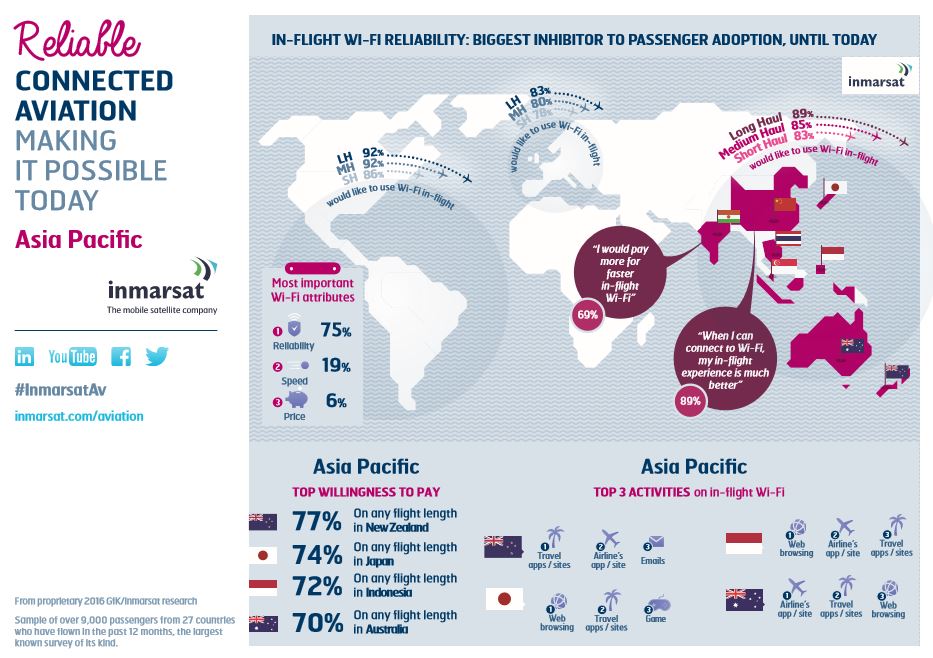
    Airlines in Asia-Pacific are seeing soaring demand for inflight broadband service, with a majority of passengers in the region expecting to have such services onboard, a new survey said.

    The survey, conducted between August 2015 and March 2016, garnered respondents from more than 9,000 passengers in Asia, Australasia, Europe, and Central and South America who had taken a short, medium or long haul flight in the past year and carried at least one personal device onboard the aircraft.

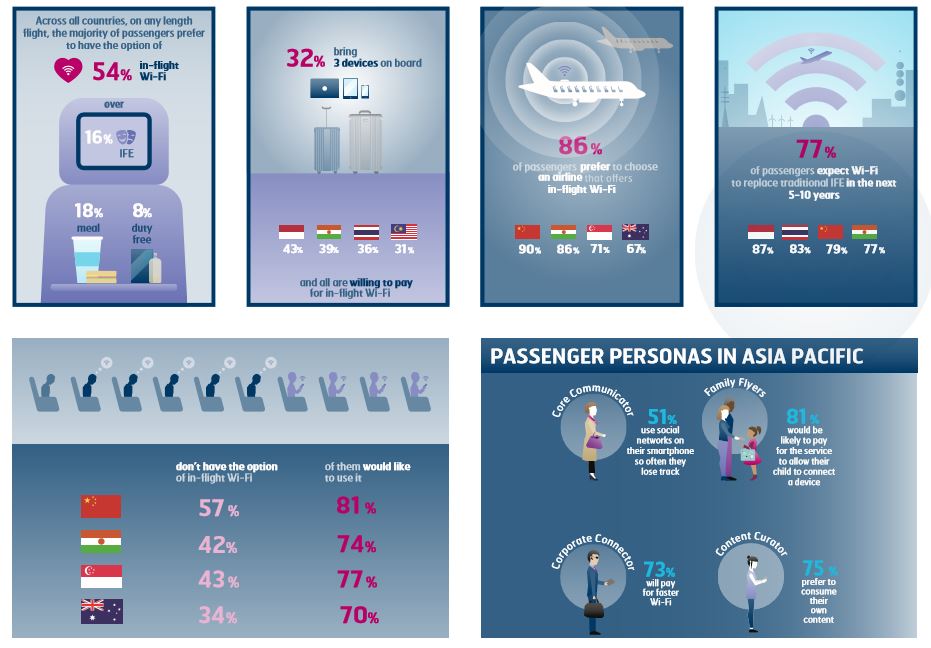
    According to the survey, conducted by Inmarsat and market research firm GfK, nine out of ten respondents from the region say the availability of onboard connectivity would influence their choice of airline, while over two thirds are willing to pay for the service.

    Meanwhile, 54% and 57% of Asia Pacific passengers would choose inflight broadband as a preferred service in short-haul and long-haul flights, compared to only 16% and 18% choosing traditional in-flight entertainment (IFE) as their preferred onboard service.

    Business flyers are even more likely to recognize the value of paying for high-speed onboard connectivity than vacationers, with 74% of business travelers surveyed indicating they are willing to pay more for faster inflight broadband compared to 62% of leisure travelers.

    The survey revealed that 64% of passengers felt that in-flight broadband can deliver all of their onboard entertainment needs. This highlights an opportunity for airlines to use in-flight broadband to increase ancillary revenues, as the majority of passengers are willing to pay for the service, with 68% of passengers under 34 years old and 55% of passengers over 45 years old willing to pay for unlimited internet usage during a flight.

    When it comes to the quality of the inflight broadband service, passengers are most concerned about reliability (that a connection does not drop out or cut off), availability (that the connection is available throughout the flight), and speed of the connection.

    Inflight WiFI reliabilityThe survey showed that quality is even more important than price in Asia Pacific, as passengers are prepared to pay more for a quality service. Some 72% of flyers in Asia Pacific would prefer not to use broadband that is of poor quality with 62% stating they would pay more for faster in-flight broadband

    “Our survey has highlighted a growing appetite for fast, reliable and consistent broadband in the air, with more than half of Asia-Pacific passengers preferring in-flight connectivity over a meal or traditional IFE,” said Bill Peltola, Asia Pacific regional director at Inmarsat Aviation.

    “Although three-quarters of Asia Pacific flyers would like to try onboard broadband in the future, only 3% of aircraft operating in Asia Pacific today offer the service, highlighting the potential for airlines to use it as a differentiation point to attract more customers.

    The inflight broadband connectivity survey

  • Globe rolls out fiber in world’s oldest Chinatown

    Globe rolls out fiber in world’s oldest Chinatown

    Globe Telecom has entered a collaboration with the city government of Manila to roll out fiber broadband technology in Binondo. This initiative will provide internet connectivity with speeds of up to 1Gbps to the world’s oldest Chinatown.

    Early this year, Globe made a call for local governments’ support for its initiative to build on its network infrastructure and provide better a internet experience for its customers, as part of efforts to transform the Philippines into a digital nation by 2020. The city government of Manila, led by Mayor Joseph Estrada, was the first government to respond to the call.

    The fiberization of the entire Binondo district, an age-old center of commercial activities in the capital, is expected to benefit business and residential establishments in the area and is expected to drive business growth in the district. The project will be completed in the third quarter of the year.

    “Globe is able to deploy fiber broadband technology in Binondo only because we are united with the local city government in realizing a vision of developing ‘connected communities’ where both enterprise clients and customers at home get to experience the full benefits of having world-class data connectivity,” Globe chief commercial officer Albert de Larrazabal said.

    “We hope to replicate the realization of this vision in many other areas in the country as we all aspire to further drive local economic growth.”

    The deployment of fiber broadband technology in Binondo will deliver ultra- fast internet to at least 5,000 new business and home subscribers as part of the initial rollout, Larrazabal said.

    Globe will also roll out small cell technology in various parts of Binondo as part of its efforts to expand network coverage and capacity.

    The pilot rollout of fiber broadband technology in Binondo forms part of Globe Telecom’s initiative of creating an internet super highway nationwide. By forming partnerships with other local government units, the operator plans to deploy fiber in 20,000 districts by 2020 that will provide internet access to around 2 million homes nationwide.

    Parallel to this, Globe will also invest in capacity enhancement for both mobile and wireline using different technologies that include 3G, LTE and Wi-Fi.

  • Nepal Telecom lays fiber to Nepal-China border

    Nepal Telecom lays fiber to Nepal-China border

    Nepal Telecom has revealed it has completed a project to lay fiber at the Nepal-China border, paving the way for an interconnection with China Telecom.

    The company has deployed fiber from Kathmandu to the Rasuwagadhi border point via two other Nepalese districts. The deployment uses all-dielectric self-supporting (ADSS) technology, which allows fiber to be deployed without the use of a support or messenger wire to save on deployment costs.

    A spokesperson for Nepal Telecom told that the operator has already commenced installation of equipment for an interconnection with China Telecom’s extensive fiber footprint.

    This will allow the operator to directly link to the Hong Kong Data Centre – one of the two largest data centers in the Asia region – and to establish global connectivity through Hong Kong via China. The company will also connect with a hub in Singapore via India.

    Through these arrangements Nepal Telecom plans to improve the speed and increase the price of its services.

  • AWS to be anchor customer for Hawaiki cable

    AWS to be anchor customer for Hawaiki cable

    In March, the Hawaiki cable project announced its contract with TE Subcom had come into force. They had raised the necessary funds to kick off the construction phase, and yesterday we learned where some of those funds came from.

    Amazon’s AWS division has stepped up for a large chunk of capacity on the system, becoming a high profile anchor customer on a submarine cable system for the first time.

    The Hawaiki cable is the latest project aimed at hooking up Australia and New Zealand directly with the west coast of the USA, stopping in Hawaii and branching off to American Samoa with options to reach several more.

    It’s a route dominated today by the longstanding Southern Cross cable system, and one on which we have seen several failed attempts to build an alternative – especially by partisans on the New Zealand side. This is the first time the money has finally added up though. As currently planned, the cable will stretch 14,000km and deliver as much as 30Tbps of capacity.

    Amazon AWS joins Vodafone, REANZ, and American Samoa Telecom as anchor customers. It’s Amazon’s first foray into the world of submarine cable systems, but surely not its last.

    The cloud giant is merely joining its tech brethren like Google, Facebook, and Microsoft in taking an active role in the underlying infrastructure they all depend on, taking up some of the slack as global telecommunications operators themselves continue to shy away from undersea investments in favor of wireless and terrestrial fiber.

  • Dyn Secures $50 Million in Funding to Expand Global Internet Performance

    Dyn Secures $50 Million in Funding to Expand Global Internet Performance

    Dyn, the worldwide leader in Internet Performance Management (IPM), announced today that it has secured $50 million in Series B equity funding from Pamplona Capital Management, a leading global private equity firm. This investment will strengthen Dyn’s global go-to-market growth strategy and enable accelerated product development. Additionally, Dyn also announced the public launch of its new platform that will help solve the significant challenges associated with operating critical business applications and infrastructure in the cloud.  

    “Internet Performance Management is a requirement for global Enterprises as companies leverage the Internet for mission-critical delivery of their business,” said Dyn CEO and co-founder Jeremy Hitchcock. “We have developed the capabilities to provide unique insights and ability to optimize Internet performance through managing the digital supply chain of information flows. Pamplona’s investment demonstrates a strong commitment to executing on the multi-billion-dollar opportunity and driving an aggressive, industry-leading go-to-market strategy and set of platform capabilities.”

    Dyn’s Platform for IPM offers IT professionals unparalleled transparency across the Internet, as well as traffic management tools that allow them to reroute their Internet-based assets as necessary, optimizing costs and improving response time and availability.

    Dyn helps leading global businesses, like Pfizer, Visa, Netflix, Twitter and many more, address their Internet Performance needs. Samir Jafferali, Edge Performance Site Reliability Engineer, LinkedIn, said, “Dyn’s IPM solutions are the first network service every single one of our members use when visiting our site. These solutions have made them a trusted partner as we continue to improve and optimize performance across our global networks.”

    Dyn also continues to add new Enterprise customers each quarter. In fact, eight of the top 10 Internet Services / Retail companies and six of the top 10 Entertainment companies in the Fortune 500 use Dyn. These customers recognize the economic benefits that come with embracing the cloud and the need for mitigating the myriad of risks that come with it. Dyn’s Platform delivers the one-stop visibility, analytics and control enterprises need to reliably make the Internet a competitive asset for their business.

    Supporting enterprise migration to the cloud has allowed Dyn to grow its revenue by more than 70 percent in the last two years and the Internet Performance Management company expects to surpass $100 million in Annual Recurring Revenue later this year. Yet, there is still much room to grow. IDC identifies Dyn’s market opportunity within the System Infrastructure Software as a Service market, which they estimate will reach more than $10B next year growing at a CAGR of 28 percent through 2019.

    Robert Mahowald, Group VP, Applications and Cloud Business Models at IDC, recently stated that, “The dynamics leading to Enterprise multi-cloud adoption and diversification present challenges for edge performance and governance, and strong opportunities for companies with Internet Performance Management solutions. The platform approach Dyn is taking gives its customers a plug-and-play solution to make the most of their cloud configurations. It has tremendous potential for any Enterprise CIO, which is why I think Internet Performance Management is an exciting evolution in how Enterprises will secure and mobilize their important cloud applications and data.”

    Pamplona’s investment in Dyn represents its inaugural investment for a new $1 billion U.S.-based Growth Equity fund focused on technology, media and telecommunications investments. As part of Pamplona’s investment, Justin Perreault, a partner, has joined Dyn’s Board of Directors.

    “Dyn has built a strong franchise based on running the fundamental and critical Internet infrastructure needs for its brand name customers,” said Perreault. “With a track record of substantial growth, a burgeoning IPM market opportunity and a strong results-orientated management team, Dyn provides a unique and exciting investment opportunity for Pamplona as we grow our U.S. investment presence.”

  • Taxing the internet giants: Catch me if you can

    Taxing the internet giants: Catch me if you can

    Southeast Asia is experiencing rapid growth in digital technology, social media, mobile activity and internet usage. Like every other emerging market that is witnessing rapid smartphone adoption, Indonesia is seeing mobile phones increasingly chosen as the platform for digital content consumption. According to US research firm eMarketer, spending on digital advertisement is growing very fast in Indonesia.

    The world consists of hundreds of different nations and legal jurisdictions, each with their own set of tax regulations. In cross-border transactions, the interaction of domestic tax systems can leave gaps that result in income not being taxed anywhere.

    Google is the poster boy of companies successfully practicing “tax optimization”. In the last couple of years, there have been intense discussions on how foreign-based online businesses have apparently failed to pay their “fair share” of tax.

    Multinational internet corporations with the help of their financial advisers used the tax treaty network and international structuring regime to minimize their tax burden through various mechanisms. In the digital era, taxing multinational companies becomes a lot more complicated.

    First, under international tax rules, local corporate tax will usually be levied on a business in its home country. The target country has the right to tax under traditional international tax concepts, if a non-resident business has a permanent establishment.

    Permanent establishment typically requires a relatively strong physical presence or a relatively high number of activities before a state has source-based jurisdiction over income.

    Most online businesses do not need these to do business; their online presence and payment systems are sufficient. It is very easy for businesses to claim that they have no taxable presence in a country. It becomes more difficult to apply traditional concepts to link an item of income with a certain location.

    Second, having a taxable presence is only the beginning of the story; countries then have to determine how much profit is attributable to that entity.

    There is a lack of definite legislation for guidance on this. Tax authorities have often left it to the companies to bargain with them.

    However, while negotiating, both parties will also be looking over their shoulders at their home country.

    Especially companies from the US, such as Google and Facebook, would prefer any tax they pay in other countries to be deductible as a credit against taxes to be paid in the US.

    Another question is how the government could tax a large business that has not yet been monetized, meaning it does not really earn any money, like WhatsApp? It is pretty much playing on the valuation, and taxes are applicable only when the business is sold.

    Third, governments are often slow to adapt their tax laws to technology. Many countries are now struggling with how streaming video services like Netflix fit into their tax structure.

    Historically, the problem with the taxation of digital goods is that the sales tax was designed to be imposed on the sale of tangible personal property.

    The tax base has been expanded over time to include several specific services, but many digital products are a mix of an intangible product and a service. Most transactions do not systematically fit into existing tax laws.

    Indonesia’s government has tried to address some of these problems. The Communications and Information Ministry has issued Decree No. 3/2016, which stipulates that internet companies providing services in the country must establish a permanent establishment.


  • TOT to take charge of Thai rural broadband project

    TOT to take charge of Thai rural broadband project

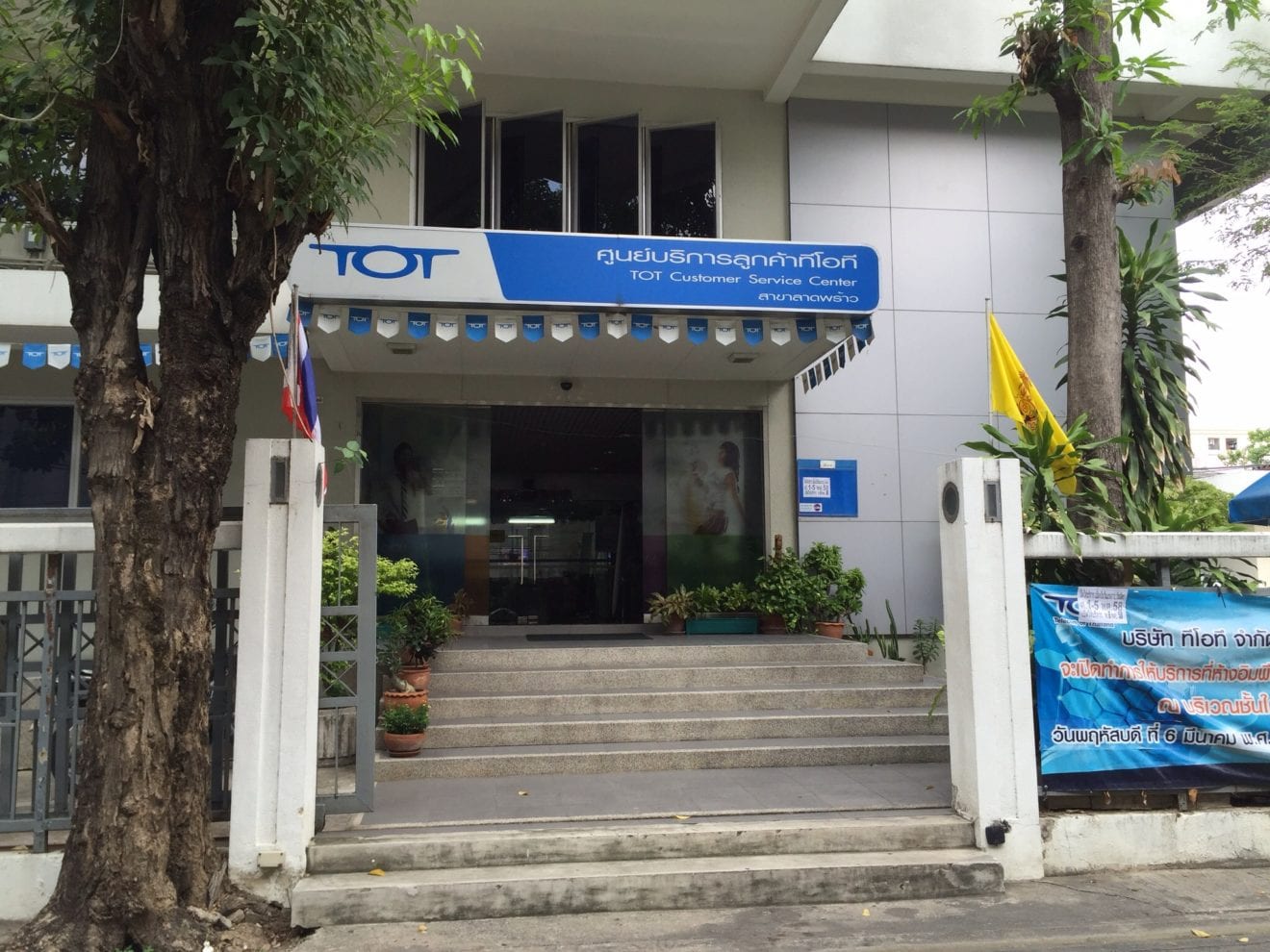
    Thai state-owned operator TOT has been instructed to go it alone in a project to build a national broadband network connecting 30,000 villages across the nation.

    TOT will take sole responsibility the project to bring broadband to the majority of Thailand’s villages that currently lack broadband connectivity.

    Initially the government had planned to have TOT and CAT Telecom jointly oversee the 15 billion baht ($427.5 million) project, but the ICT ministry decided that given TOT should take control of the project due to its existing extensive infrastructure.

    CAT has been told to focus on further investment in international internet gateway infrastructure to support the government’s policy of promoting Thailand as a digital hub for the Asean region.

    Construction of the network is expected to be complete by May 2017. The state will use the network to provide free broadband connectivity in public places in all villages, while TOT plans to offer at least 20Mbps plans with affordable tariffs.

    The national broadband project is expected to be partly funded from private sector investments. It forms part of the government’s five year master plan that aims to improve Thailand’s telecom infrastructure to lift the minimum standard for broadband speed across the nation.

  • Equinix launches data hub service

    Equinix launches data hub service

    The ways in which enterprises assemble their network infrastructure have been evolving rapidly as the industry-wide shift to the cloud accelerates. This week Equinix offered another piece of its ongoing response to that shift, unveiling a new Data Hub service that lets enterprises store their data next to the clouds they use but keep control over it.

    Equinix already has Cloud Exchange, providing connectivity to an ecosystem of cloud providers, as well as Performance Hub, which gets the enterprise WAN into the data center.

    This new offering simply bundles the space and power needed to house big data in a pre-configured package and with partners lined up to help with the particular storage technology.

    The idea is to let folks put their data as close as possible to the cloud services that use it, while at the same time not ceding control or access to it.

    That might be for compliance reasons, it might be to leverage a common data store from multiple cloud providers, it might be simply for data protection or replication, or simply to keep latency as low as possible for things like IOT.

    It’s all part of the industry shift toward caring where data actually is on the internet. From low latency trading, to sovereignty issues, to the caching of content at the edge, to small cells, to proximity to renewable energy, the recurring theme in this era of internet infrastructure has been the old real estate saying, ‘location, location, location’. It’s a quite different theme from the prior decade, in which everything was about achieving scale.