Tag: Investment

  • Indonesia Falls in 2019 Ease of Doing Business Ranking

    Indonesia Falls in 2019 Ease of Doing Business Ranking

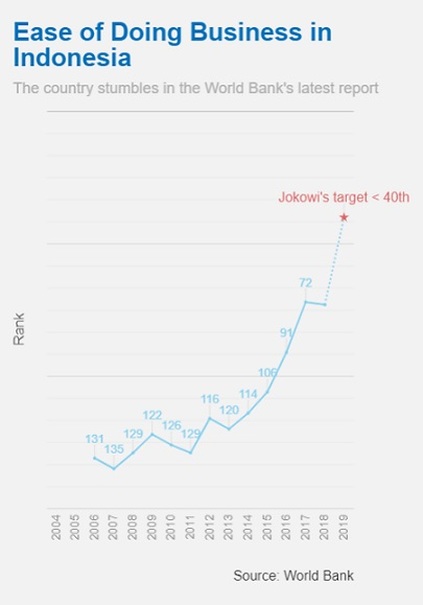
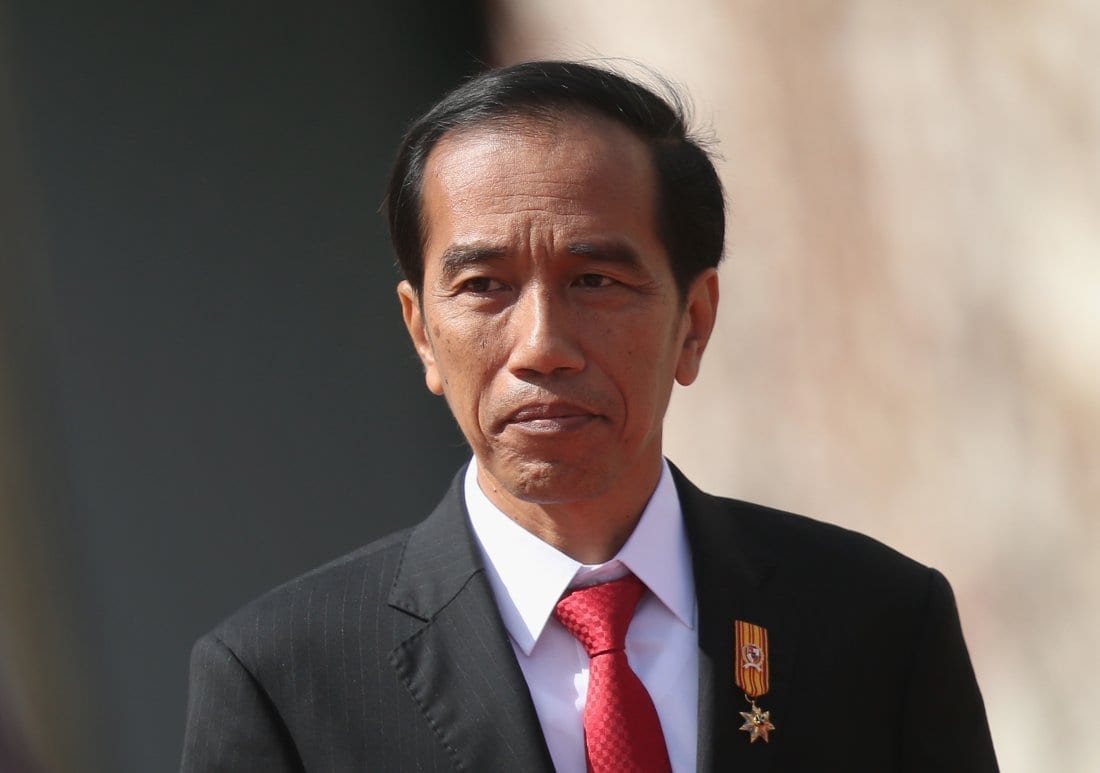
    If President Joko “Jokowi” Widodo wants to see Indonesia join the top 40 countries in the World Bank’s Ease of Doing Business ranking under his watch, he should make sure he wins re-election next year. Indonesia slipped one place to 73rd, behind Greece, the Ukraine and Kyrgyzstan, in the 2019 Ease of Doing Business report, released late on Wednesday. The president has set a target for the country to be in the top 40 by next year, but his second term will be decided in April, while the next report would not be out until next November.

    While Indonesia has made considerable progress in reforming the regulatory environment for businesses since Jokowi took office in 2014, Wednesday’s report reveals the stark realities of the country’s limited capacity to continue with these reforms.

    The country scored 67.96 out of 100 in the report’s aggregate measurement, up by only 1.46 points from last year. Slovenia, a Central European nation of only 2 million people and a $49 billion economy, sits in the coveted 40th place with an overall score of 75.61.

    Indonesia, for one, issued new rules that make starting a business, registering property and obtaining credit, easier for businesses and make it cheaper for them to get electricity. But reform stagnated in areas such as obtaining construction permits, protecting minority investors, paying taxes, trading across borders, enforcing contracts and resolving insolvencies.

    These bottlenecks allow economies like China, Kenya and Kyrgyzstan to overtake Indonesia. China made a leap to 46thplace in this year’s report, from 78th last year. Kenya moved up 19 places to 61st, while Kyrgyzstan went up seven places to 70th.

    Still, the report highlights Indonesia’s success in reforming its judiciary system and making the country a case study for others to emulate. The Supreme Court introduced training programs in 2003 for new and experienced judges, as well as special training for judges presiding over more specialized cases, such as those involving commercial or maritime disputes.

    “Indonesia’s efforts to train judges following judicial reforms bore positive results through a substantial decrease in court backlogs and insolvency case resolution times,” the World Bank said in the report.

  • Lotte pledges 50 trillion won investment

    Lotte pledges 50 trillion won investment

    Lotte Group announced Tuesday a major investment plan to spend 50 trillion won ($43.9 billion) and hire 70,000 workers over the next five years. “The plan comes in order to normalize management activities, obtain a competitive edge for future growth and contribute to vitalizing the local economy,” Lotte said in a statement.

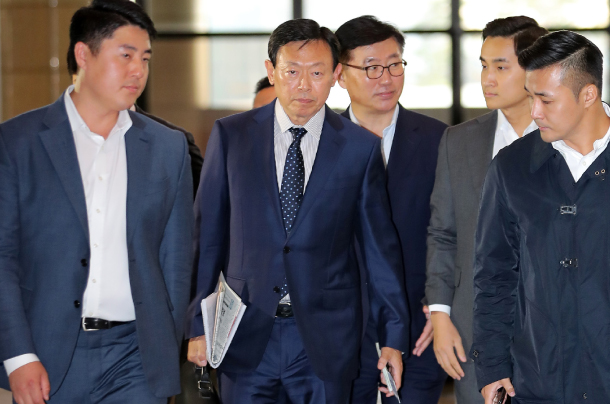
    The announcement comes on the heels of similar plans announced by other conglomerates like LG, Shinsegae and Samsung. Lotte couldn’t join that wave because Chairman Shin Dong-bin was sentenced to 30 months in prison last February for bribing former President Park Geun-hye. On Oct. 5, the Seoul High Court replaced the prison sentence with four years of probation, and Shin returned to work three days later.

    Lotte announced an investment plan of 40 trillion won in 2016. But most of the investments couldn’t be executed after the group was badly affected by the deployment of a U.S. antimissile system in Korea in 2017 on a golf course formerly owned by the group and a Chinese boycott against Lotte that followed. Shin’s imprisonment earlier this year also got in the way.

    Execution of the 50-trillion-won plan will start next year. A 12 trillion won budget is planned for 2019, a record for the conglomerate.

    The two sectors that will receive the greatest attention are chemicals and retail. Some 40 percent of the investments will be in chemicals and 25 percent in retail. Lotte grew to its current size thanks to food and retail, but in recent years, the company has been active in developing the chemical business.

    For chemicals, investments will focus on expanding local and overseas manufacturing facilities. The group currently has factories in three locations in Korea, which Lotte said will be expanded.

    Investments in overseas facilities will also be made to expand the company’s businesses abroad. Lotte Chemical has a $4-billion project in Indonesia that was put on hold when Shin was jailed. A source at Lotte said, with Shin back in the saddle, resuming the project won’t take long.

    The main goal for investments in retail is improving the infrastructure for e-commerce. Lotte said in a statement it plans to establish logistics and computing infrastructure to offer a more convenient experience for shoppers online and off.

    Tech development and enhancing the level of digitalization is a long-term goal across the conglomerate’s affiliates. For example, Lotte wants to apply tech to its food business: Artificial intelligence technology is underway to be used for trend analysis and to suggest new products.

    Indonesia and Vietnam will be two foreign markets Lotte’s affiliates will focus on. The company once had a huge footprint in China, but Beijing unofficially retaliated against Lotte after the deployment of the antimissile system in Korea. The company added in the statement that it would continue discovering new markets.

    The goal for new jobs in 2019 is 13,000, which is 10 percent higher than what Lotte plans to hire this year. Many hires will be in the e-commerce sector.

  • TabSquare raises S$10 Million to fuel AI-powered restaurant solutions

    TabSquare raises S$10 Million to fuel AI-powered restaurant solutions

    TabSquare, a leading provider of AI-Powered Smart In-Restaurant solutions, today announced it has raised S$10 million (US$7.2 million) in Series B financing led by Kakaku.com.

    Tabsquare’s platform has three critical elements: consumers, restaurants and F&B brands; now strengthened with the latest funding round.

    Founded in 2012, TabSquare has rapidly grown to be the leading in-restaurant technology provider in Singapore.

    The company’s main products are the SmartTab eMenu and the SmartKiosk – applicable to both sit-down and counter-service restaurants.

    The company’s products use AI to make personalised menu recommendations and improve customers’ ability to order, pay and deliver feedback.

    Chirag Tejuja, Co-Founder said, “TabSquare’s fast-paced growth proves there is a strong
    demand for innovative and effective technology that can solve issues commonly faced by restaurants in the region such as low restaurant profitability, high staffing costs and language barriers.”

    Through 6000 devices that serve more than 12 million diners and 6 million orders annually, TabSquare’s AI-Powered solutions leverage consumer data and learning algorithms to better predict demand, personalize offerings and improve the overall diner experience which aims at creating greater efficiencies and profits for restaurants.

  • US, Japan keen to invest in Vietnam infrastructure

    US, Japan keen to invest in Vietnam infrastructure

    Vietnam’s plans for building and expanding airports and seaports have attracted the interest of companies in the U.S. and Japan.

    Joel Szabat, deputy assistant secretary in the U.S. Department of Transportation’s Office of Aviation and International Affairs, said his country wants to strengthen ties with Vietnam in the transport infrastructure area, especially airports and seaports.

    He told Deputy Minister of Transport Le Dinh Tho at a meeting Tuesday that his department would facilitate U.S. investment in Vietnam’s infrastructure projects in the form of public-private partnerships (PPPs).

    But Vietnam needs to have more policy consistency and open policies, Szabat said.

    Last month Japan’s Secretary of State Tsukasa Akimoto told Deputy Minister of Transport Nguyen Ngoc Dong that many Japanese investors are eyeing key transport projects in Vietnam.

    They are interested in the Long Thanh International Airport and high-speed north-south railway, he said.

    At the meeting with Szabat, Tho said Vietnam is focusing on five areas of transport infrastructure: roads, aviation, waterways, railways, and network connections to boost logistics.

    One of its national infrastructure projects is the north-south expressway measuring over 2,100km in length, of which “650km will be built in 2017-2020 under the PPP model,” he said.

    With the country’s railway network being obsolete, there is need for an upgrade to both its long-distance and inner-city railways, he noted.

    “Our ministry is considering feasibility studies for the north-south high-speed railway.”

    The transport ministry is set to report on the high-speed railway to the National Assembly next year.

    It is now consulting various agencies for a feasibility study for the Long Thanh airport in the southern Dong Nai Province, which is expected to be approved by the government at the end of next year.

    Vietnam has 21 airports, eight of which receive international flights. Given the rapid rise in traffic, it plans to build, expand or upgrade several including Noi Bai in Hanoi and Tan Son Nhat in HCMC.

    The ministry this month approved changes to the upgrade plans for Tan Son Nhat Airport, including the addition of a third terminal and a 250-hectare expansion of the airport.

    Besides building a new terminal, T3, to the south with a capacity of 20 million passengers a year, the ministry also seeks to expand the two existing terminals to increase their capacity to 30 million passengers a year.When the work is complete, the airport’s size will increase from the current 545 hectares (1,350 acres) to 791 ha.

    The airport currently handles 36 million passengers a year against a designed capacity of only 25 million.

    Tho said Vietnam has two major ports, Lach Huyen in the north and Cai Mep-Thi Vai in the south, which can accommodate ships of up to 100,000 DWT.

    “However, network connections for logistics in ports remain underdeveloped.”

  • Japan top investor in Vietnam, has interests in multiple sectors

    Japan top investor in Vietnam, has interests in multiple sectors

    Japan is the biggest foreign investor in Vietnam in terms of pledged investment capital in January-August.

    In the first eight months of this year, pledged investment from Japanese companies reached $7 billion, nearly 29 percent of the total foreign investment that came from 97 countries and territories, according to the Ministry of Planning and Investment.

    Japanese investors back multiple projects across sectors, including agriculture, consumer goods, finance, and real estate. Their investments range from millions to billions of dollars.

    For instance, Japan’s Sumitomo and Vietnam’s private firm BRG signed a deal earlier this year to develop a $4.14 billion smart city project in Hanoi’s Dong Anh District.

    They hope to commence work on the first phase of the 272-hectares project late this year.

    Up to 70 percent of Japanese firms in Vietnam plan to expand their business in the country, as most of them believe that revenue will continue to increase, according to a recent survey by the Japan External Trade Organization (JETRO).

    Over 65 percent of surveyed firms said they have been profitable in Vietnam.

    Japan was the fourth largest trading partner of Vietnam last year, with a total turnover of almost $34 billion, up 13.8 percent from 2016, according to Vietnam Customs.

  • Samsung vows to invest $161B by 2021

    Samsung vows to invest $161B by 2021

    Samsung announced Wednesday it will spend 180 trillion won ($160.7 billion) and hire 40,000 more employees over the next three years to drive growth – an unprecedentedly ambitious plan from Korea’s biggest conglomerate.

    The 180 trillion won includes capital expenditures and research and development, and some 130 trillion won – 43.3 trillion won on annual average – will be dedicated to the domestic market, which Samsung said would indirectly create 700,000 more jobs.

    The annual figure is in line with the 43.4 trillion won Samsung spent on new facilities last year.

    The remaining 50 trillion won in investments is speculated to be earmarked for mergers and acquisitions as well as foreign manufacturing facilities.

    The pledge of 40,000 new jobs is meant to give jobs to young Koreans, the group explained. Korea is struggling with the worst youth unemployment rate in its history. The number of new jobs created by Samsung over the past three years was between 20,000 and 25,000.

    “Today’s announcement follows many months of deliberation and review by the management and board of directors of different Samsung companies that will make the investments, including Samsung Electronics,” Samsung said in a statement.

    The investments are divided into two categories. One is to sustain the company’s leadership in semiconductors and displays.

    “In addition to investments for memory products, spending will be dedicated to non-memory products and new advanced manufacturing equipment,” Samsung said. Developing profitable and new products will be the focus in displays, amid rising competition in the industry.

    The second category is to search for new growth engines. A total of 25 trillion won will go into four specific areas: artificial intelligence (AI), 5G telecommunications, automotive electronics components and biopharmaceuticals.

    The plan to invest 180 trillion won exceeds a widely expected figure of 100 trillion won. Samsung was supposed to announce its investment and hiring plans on Monday when Finance Minister Kim Dong-yeon visited its Pyeongtaek campus in Gyeonggi and met with its de facto chairman, Lee Jae-yong. But Samsung delayed the announcement at the last minute after stories were published that accused the government of “begging” for investments from conglomerates.

    Samsung’s ambitious plan does follow a request from President Moon Jae-in. In mid-July, the president directly asked Lee to “invest more locally and create more jobs” when the two met at a ceremony in India to mark the completion of Samsung’s biggest smartphone factory in the world.

    Wednesday’s announcement made clear Samsung’s industrial focus for the next few years. Samsung Chairman Lee Kun-hee, now bedridden, used to declare Samsung’s growth drivers every several years. In 2010, four years before he had an incapacitating stroke, Samsung named medical equipment, biopharmaceuticals, solar batteries, auto batteries and light-emitting diodes as its growth drivers, estimating they would generate 50 trillion won in annual revenue by 2020.

    In Wednesday’s announcement, Samsung changed its focus to AI and 5G connectivity that will create new opportunities in autonomous driving, the Internet of Things (IoT) and robotics. The top chaebol had already vowed to significantly expand its AI research capability, increasing its number of advanced AI researchers to 1,000. Becoming a global player in advanced markets for 5G chipsets and related devices and equipment is also on Samsung’s road map for the future.

    Samsung aims to become a leader in electronics components for future cars such as system on chip (SoC) semiconductors for autonomous driving, using its leadership in semiconductor, telecommunications and display technologies.

    In biopharmaceuticals, the group said it has seen strong growth in both contract manufacturing and the biosimilar businesses, promising to invest heavily to combat chronic and difficult-to-cure diseases.

    Following the upbeat statement on Samsung’s biopharmaceutical ambitions – despite a recent scandal over suspected accounting fraud – shares of Samsung BioLogics shot up 7.08 percent to close at 454,000 won Wednesday.

    Peaking at 600,000 won in April, the shares nose-dived to as low as 353,000 won early May after the Financial Supervisory Service started auditing it for accounting irregularities.

  • Vietnam tops ASEAN in luring Japanese investment

    Vietnam tops ASEAN in luring Japanese investment

    Almost 1,800 Japanese businesses have invested in Vietnam in the first half of the year, the highest among ASEAN countries.

    This number accounts for 24.6 percent of total number of Japanese firms investing in ASEAN countries, said Keiichi Kadowaki, chairman of Japanese Chamber of Commerce and Industry in ASEAN (FJCCIA).

    He was speaking at the 11th Dialogue between the Secretary General of ASEAN and the Federation of the Japanese Chamber of Commerce and Industry in ASEAN (FJCCIA) in Ho Chi Minh City on Monday.

    Japan and Vietnam also signed 36 memorandums of understanding worth $21 billion last month.

    “This shows that Vietnam is becoming more attractive to Japanese firms,” Kadowaki said.

    Vietnam’s open business environment and robust economic growth of 5-6 percent each year has increased its attractiveness in recent years, he added.

    Up to 70 percent of Japanese firms in Vietnam plan to expand their business in the country, as most of them believe that revenue will continue to increase, according to a recent survey by the Japan External Trade Organization (JETRO).

    Over 65 percent of surveyed firms said they have been profitable in Vietnam.

    Japan was the fourth largest trading partner of Vietnam last year, with a total turnover of almost $34 billion, up 13.8 percent from 2016, according to Vietnam Customs.

  • Japan leads foreign investors in Vietnam in year’s first half

    Japan leads foreign investors in Vietnam in year’s first half

    Foreign investors invested a total of over 20 billion USD in 1,366 new projects and 507 existing ones as well as in contributing capital and buying shares in domestic company in the reviewed period.

    With 5.06 billion USD, the Republic of Korea was Vietnam’s second biggest investor, followed by Singapore with 2.39 billion USD.

    During January-June, foreign investors poured their capital into 55 provinces and cities, in which Hanoi ranked first with 5.87 billion USD. The capital city was followed by Ho Chi Minh City (3.68 billion USD), and Ba Ria-Vung Tau province (1.93 billion USD).

    Manufacturing-processing industry continued to attract the most foreign direct investment (FDI) in Vietnam in the first half of 2018, with 7.91 billion USD, accounting for 38.9 percent of the total registered capital.

    It was followed by real estate, with 5.54 billion USD, and the wholesale and retail sector with 1.5 billion USD, making up 27.3 percent and 7.4 percent of the total, respectively.

    To date, Vietnam has attracted nearly 26,000 projects with a registered capital of 326 billion USD. Disbursement is estimated at 180 billion USD.

    Foreign investment accounts for 25 percent of the country’s total investments and contributes 20 percent of GDP. Last year, the sector contributed nearly 8 billion USD to the State budget, 14.4 percent of total revenue.

    At present, 58 percent of foreign investments focus on processing and manufacturing, generating half of industrial production value.

  • Thai investors acquiring more retail market share in Vietnam

    Thai investors acquiring more retail market share in Vietnam

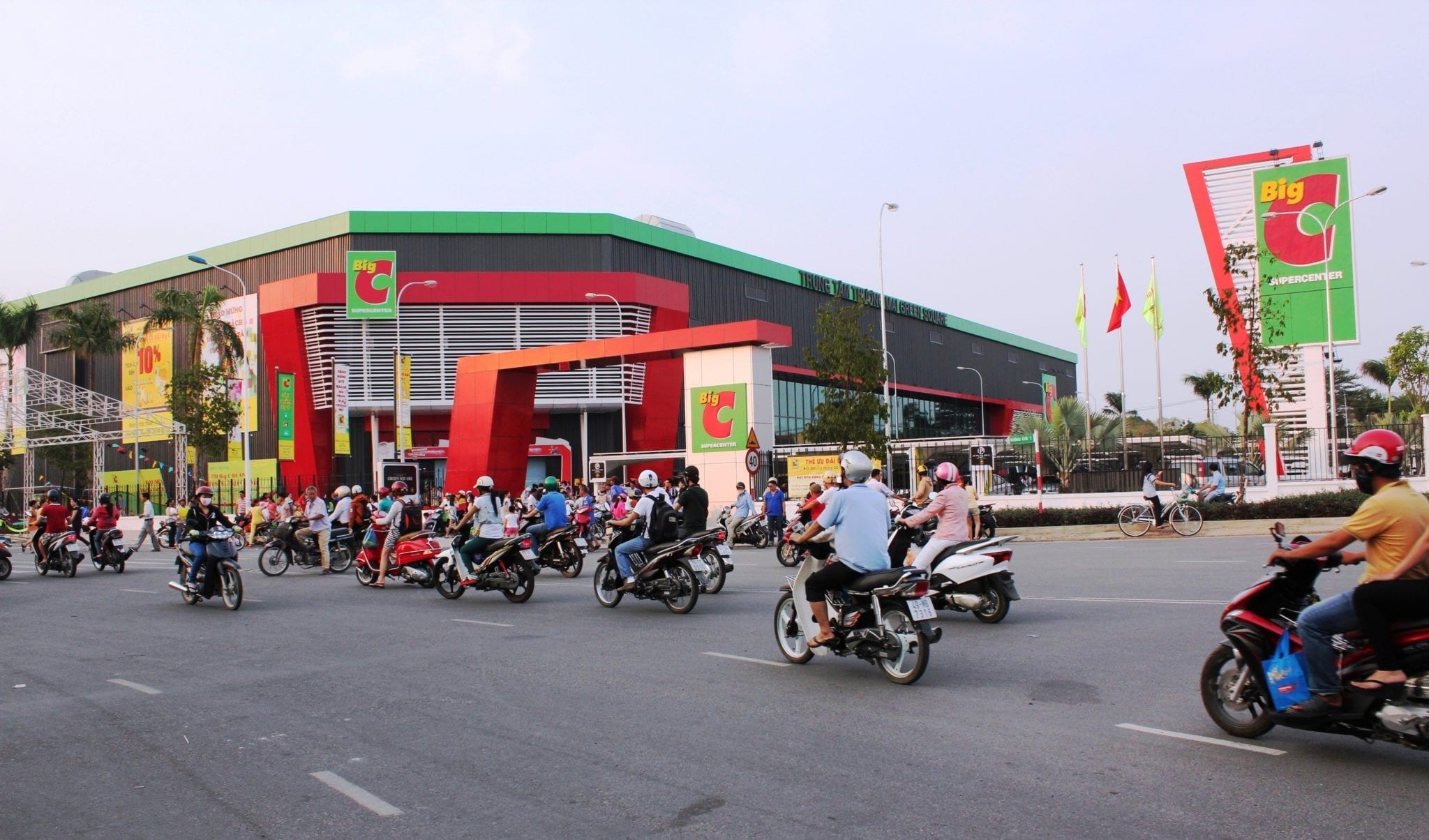
    In 2015, just after four years of establishment, Central Group Vietnam (CGV), acquired 49 percent of stake of Nguyen Kim. In 2016 alone, CGV acquired two big brands – Big C Vietnam and Lan Chi Mart. Through M&A deals, CGV has also brought other brands from Thailand and other countries to Vietnam.

    BJC, a subsidiary of TCC Holdings, has also been expanding in Vietnam. With MM Mega Market alone, BJC has 19 shopping centers, 3 entrepots in Da Lat (fresh vegetables and fruits), Dong Nai (fresh pork), Can Tho (seafood) and two general storehouses that provide fresh food. Besides, it also has B’s Mart with the network covering large cities.

    In 2016, after wrapping up the deal of taking over Metro Cash & Carry, BJC renamed the supermarket chain as MM Mega Market Vietnam, and since then, it has been following the business strategy with B2B (70 percent) and B2C (30 percent) Investment modes.

    Phidsanu Pongwatana, managing director of MM Mega Market, said the company is building the first pork entrepot in the north. It plans to open one to three distribution centers in the north next year, which will create 700 jobs.

    In 2017, CGV announced investment of $30 million to increase retail premises in Vietnam to 470,000 square meters.

    Meanwhile, the holding company in Thailand plans to invest $6.4 billion more in the next five years to expand the domestic and overseas markets, especially Vietnam, which is a key part in its plan to expand operation in the retail and hotel fields.

    Vietnam is considered a potential market, expected to bring to the group turnover four times higher in the next five years. It strives for revenue of $13 billion this year, an increase of 14 percent over 2017. Tos Chirathivat, CEO of Central Group, said the group would open 500 more shops in Vietnam by 2022.

    An analyst said Thai investors are now eyeing Vietnam because the market is witnessing development like Thailand did some decades ago with the rapid increase of the middle class and high economic growth rates.

    He also said the young population, increased consumption level, and the tariff cut to zero percent all have turned Vietnam into a vast market in ASEAN.

    According to the Foreign Investment Agency, the accumulative capital registered by Thai investors in Vietnam by March 2018 had reached $9.3 billion.

    With 490 projects, Thailand now ranks 10th among 126 countries and territories having FDI in Vietnam.

  • Investment in Vietnamese startups booming

    Investment in Vietnamese startups booming

    A total of 92 Vietnamese startups raised $291 million in funding last year, said Mai Duy Quang of the Vietnam Software and IT Services Association at the opening of K-Startup Grand Challenge on Thursday.

    That’s a 45 percent increase in number of startups from 2016 and a 42 percent hike in total investment, according to a report by Topica Founder Institute (TFI), an annual program which trains and connects startups with potential investors.

    The biggest deal last year was Foody, a food social network startup, which was acquired for $64 million by Singapore-based SEA Group, one of the most valuable startups in Southeast Asia.

    Another major winner was popular e-commerce site Tiki.vn which received a $54 million investment from JD.com, China’s second biggest online retailer, despite reports of losses in recent years.

    The three most invested startup categories in Vietnam last year were e-commerce at $83 million, food technology at $65 million and financial technology at $57 million, TFI’s report said.

  • PM Vietnam expects huge investments from Australia

    PM Vietnam expects huge investments from Australia

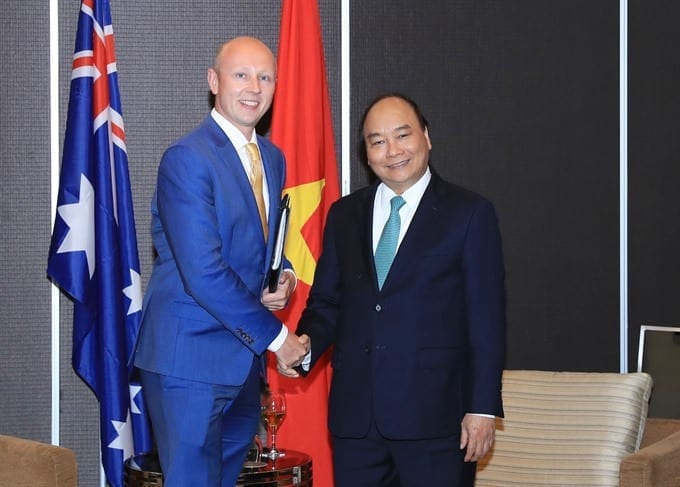
    Prime Minister Vietnam Nguyễn Xuân Phúc said he expected a new wave of investments, both direct and indirect, from Australia to land in Việt Nam for win-win benefits.

    His statement comes after the newly established strategic partnership of which the two countries are the members.

    Phúc said the partnership would provide a favourable environment for Australian investors to enter Việt Nam faster and would create a crucial foundation for Việt Nam and Australia to lift their cross-the-board co-operation to the next level.

    He said this at a working session with leading financial groups and investors from both Australia and Việt Nam in Sydney on March 16.

    The session was presided by 12 groups, finance investment funds and businesses managing an investment capital of worth over US$500 billion with keen interests in the Vietnamese market, along with nine prestigious financial groups of Việt Nam. The session was organised by VinaCapital and Macquarie Group.

    Macquarie Group Chairman Peter Warne showed great interest in Việt Nam’s priorities in infrastructure development. He said Việt Nam was urbanising strongly and thus its need for infrastructure, roads, transport and electricity was high.

    Meanwhile, VinaCapital CEO Don Lam said the Vietnamese Government had made great efforts to reform institutions and speed upequitisation of State-owned enterprises (SOEs). He hailed the Vietnamese Prime Minister for actively working to draw businesses and investment into the country.

    He said, as a result, Việt Nam’s business and investment environment had improved considerably, and the country’s market had become more attractive to international investors.

    PM Phúc welcomed the Australian groups’ interests in Việt Nam and spoke highly of the organisation of the session by VinaCapital and Macquarie.

    He told investors that 2017 was a successful year for Việt Nam as the country posted a growth rate of 6.81per cent, a record high in many years, maintained a stable exchange rate, soundly reined in inflation and achieved a record foreign reserve. The country also attracted $37 billion in foreign direct investment, the highest in a decade, and its stock market achieved a growth rate of 48 per cent, one of the highest rates in the global market.

    PM affirmed that the Vietnamese Government had undertaken many policies to ensure the sustainable development of the economy and safeguarding of the rights and benefits of investors.

    He further said Việt Nam had targeted to achieve a fast but sustainable growth on the basis of defending the rights of people and investors, and that the country had been persistent in pursuing the goal of building a facilitating, transparent and efficient government and continuing to improve the investment and business environment to meet OECD (Organisation for Economic Co-operation and Development) standards.

    He also told investors that the country would continue transforming its growth model, restructuring its economy, SOEs, human resources and other sectors.

    “Việt Nam is concentrating on developing a sustainable and healthy finance market that is friendly to investors,” he added.

    The country has so far signed 12 free trade agreements and the latest Comprehensive and Progressive Agreement for Trans-Pacific Partnership with Australia and is negotiating the Regional Comprehensive Economic Partnership with the aim of forming a large market to attract investors.

    During the intensive and extensive economic integration, Việt Nam had unceasingly worked to facilitate the development of the private economy, the Prime Minister told investors.

    At the session, Phúc, along with ministry and sector officials from Việt Nam, fielded questions pertaining to Việt Nam’s foreign investment attraction and agriculture development policies as well as its priorities in infrastructure development.

    Later, Phúc will chair the Việt Nam-Australia Business Forum.


  • Indonesia lures US to invest more

    Indonesia lures US to invest more

    The administration is revising regulations on tax incentives for investment and seeks to pass them by the end of this month.

    Speaking to 41 US-based companies grouped under the US-ASEAN Business Council on Tuesday morning, the President underlined the significance of investment into Indonesia from the world’s top economy.

    “American investment into Indonesia has been sizeable and plays an important role in the Indonesian economy,” Jokowi said during a meeting with the council at the Merdeka Palace.

    Realized foreign direct investment (FDI) in Indonesia by US firms surged by 71.5 percent to US$1.99 billion last year, driven by 625 projects. That is significantly higher than the 30 percent growth to $1.16 billion seen in 2016, spread across 540 projects.

    The US stood still as the sixth-largest foreign spender in the archipelago over the 2016-2017
    period.

    Jokowi also noted that the US brought high-quality investment into Indonesia through companies with powerful brands, state-of-the-art technology and a broad international network, including gold and copper miner Freeport-McMoRan, technology giants Google and Facebook and entertainment giant Walt Disney.

    Consequently, he expected US companies to jack up their investment although he was also aware of the many challenges of doing business in Indonesia, from policies regarding digital payment and patents to complicated export-import procedures.

    “Give me two months and I’ll bring you some positive [progress] on economic policy reforms,” Jokowi said.

  • Japan invests big in Vietnamese real estate

    Japan invests big in Vietnamese real estate

    Việt Nam’s real estate sector has witnessed significant participation from Japanese investors through cooperation with Vietnamese businesses recently, promising to bring benefits to the real estate market.

    According to real estate company Savills Việt Nam, over the past years, Asian investors, including Japanese ones, were only involved in commercial real estate like commercial centres, serviced apartments or office buildings. However, at present, these investors are increasing their activity in the residential segment due to the country’s young population and an increasing middle class, presenting an extremely attractive opportunity.

    Presence of big investors

    Shinichi Sakaki, deputy general director of the City Bureau, at Japan’s Ministry of Land, Infrastructure, Transport and Tourism, said the Japanese Government now has policies to support real estate developers promoting investment abroad. In addition, Japan has the experience of developing large-scale satellite towns, so it is trying to ‘export’ that technology abroad.

    One of the projects attracting not only investors but also the governments of Việt Nam and Japan is the cooperation agreement for the development of Nhật Tân – Nội Bài, aiming to build a smart city north of the Red River.

    The project was signed between Việt Nam’s BRG Group Joint Stock Company, Japan’s Sumitomo Corporation Asia and Oceania Group and the People’s Committee of Hà Nội.

    With total investment of nearly US$4.2 billion, this project is considered Japan’s largest foreign investment.

    Prior to that, another large Japanese investor, Mitsubishi Corporation, had co-operated with Vietnamese property developer Bitexco, to develop 240 low-rise housing units and two high-rise condominiums among a total of more than 1,000 low-rise and 17 high-rise condominiums at Hà Nội’s The Manor Central Park project.

    Bitexco and Mitsubishi established a joint venture company, of which Bitexco holds a 55 per cent stake and Mitsubishi holds the remaining 45 per cent.

    Recently, Nidec Group, one of the world’s leading hi-tech corporations and the second largest Japanese corporation on the Tokyo stock exchange (2017), joined forces with escalator firm Alpec to conquer the Vietnamese elevator market.

    With many years of experience in the field of high technology as well as research and development of lifts, Nidec will send foreign experts to support Alpec in quality management, labour safety, as well as the research and development of elevator equipment. The cooperation between the two sides promises to launch modern and environmentally-friendly elevator products, in accordance with the aesthetics and economic conditions of the Vietnamese people.

    Regarding potential cooperation between the two countries, Lê Hoàng Châu, president of the HCM City Real Estate Association (HoREA), said, in 2017, Japan replaced the Republic of Korea as the largest foreign investor in Việt Nam in general, and in the real estate market in particular. Many Japanese enterprises have participated in the implementation of major urban infrastructure projects funded by the Japanese Government, such as Obayashi, Shimizu, Hitachi, Sumimoto Construction, Mitsui and Maeda.

    In addition, there are enterprises that have invested in developing big projects such as Nomura Hải Phòng Industrial Zone, or Idemitsu Kosan Company Limited’s investment in Nghi Sơn Refinery and Petrochemical. Especially, in the past five years, some Japanese investment funds and enterprises have cooperated with real estate companies in Việt Nam in the form of buying shares, contributing to investment or lending for developing real estate projects in accordance with Japanese standards and suitable to consumers’ needs.

    The potential for investment and business cooperation among real estate companies in Japan and Việt Nam is very large, with 1,200 real estate development projects of Vietnamese enterprises in need of cooperation, joint ventures or teaming up with domestic and foreign businesses, especially Japanese ones.

    Potential cooperation

    The cooperation between Việt Nam and Japan will bring benefits to both sides, especially in creating opportunities for Vietnamese consumers to access high quality Japanese housing products, according to Châu.

    Meanwhile, regarding cooperation with Japanese units in the field of building management, Nguyễn Quang Huy, deputy general director of Property and Management Company (PMC), said cooperation with Japanese businesses brought benefits such as giving motivation to develop service standards and customer service strategies in a Japanese style, improving the prestige and company’s brand name, and being able to improve the foundations of implementing management, training or improving the quality of human resources.

    “However, we also face many challenges; the most fundamental difficulty is the different approaches between the two sides. Vietnamese people tend to focus on a short-term approach, expecting to see results quickly. Japanese people, on the other hand, appreciate the importance of long-term planning, so they start with the smallest things,” Huy said.

    “For example, in the field of building management, they teach staff how to cut nails, wash toilets, walk and serve customers. Therefore, Vietnamese businesses intending to cooperate with Japan should also pay attention to differences in the approach and find ways to create a workforce that loves the job, accepting career development on a long-term basis rather than short-term,” he said.

    According to the HoREA chairman, there is enormous opportunity for co-operation between HCM City and Japanese property developers and construction companies since the city now has some 1,200 projects, including infrastructure upgrades and beautifying works,

    Speaking at a meeting with a delegation of executives from 40 Japanese companies, Châu said the projects had been undertaken by local firms who want to tie up with foreign partners.

    Additionally, from 2018, the city was set to implement the National Assembly’s resolution No54 on special mechanisms and policies, which would give it almost complete autonomy in deciding and awarding projects.

    The city had already planned 21 programmes including removing houses along canals and giving itself a facelift.

    He cited the examples of Tokyu investing in Hưng Thịnh Corporation and Becamex’s projects and Hankyu and Nishi Nippon Railways tying up with Nam Long, Misubishi Corporation with Phúc Khang Corporation, and ACA with Sơn Kim Land.

    Concurring, Lê Trần Kiên, deputy director of the city’s Department of Construction, said the city aimed to relocate 20,000 people living along canals and in old apartments by 2020.

    “Some 21,850 houses are located along canals and need to be moved, mostly in Districts 8, 4 and Bình Thạnh,” he said.

    The city was considering ways to attract more foreign investment in public-private partnership projects (PPP), he said, adding that six PPP projects were underway to upgrade the city.

    HCM City is now soliciting Japanese investment in a project to upgrade the Cầu Dừa Canal in District 4.

    Speaking about the potential of co-operating with city-based companies, Keiji Kimura, chairman of J-CODE, said Việt Nam was set for rapid modernisation like Japan achieved 50 years ago.

    So Japanese companies would like to share their experience with HCM City partners in handling problems like traffic jams and pollution, he said.

    They were committed to apply modern technologies to develop HCM City’s infrastructure, he assured.

     

  • Indonesia Improves Ranking on Global Intellectual Property Index

    Indonesia Improves Ranking on Global Intellectual Property Index

    Indonesia has increased its ranking on the United States Chamber of Commerce’s 2018 International Intellectual Property Index this year, which shows that the government’s efforts to protect copyrights are starting to bear fruit.

    The sixth edition of the annual report titled “Create,” published last month, shows the state of intellectual property rights in the world’s 50 biggest economies.

    The index uses 40 indicators in eight categories to evaluate which policies and efforts have been effective in protecting intellectual property rights.

    Indonesia scored 12.14 compared with last year’s 9.64, putting it in 43th place – just above India (44), but below Thailand (41), Vietnam (40), Brunei (35) and Singapore (9).

    Topping the list are the United States, Britain, Sweden, France and Germany.

    Patrick Kilbride, vice president of international intellectual property for the Global Innovation Policy Center at the US Chamber of Commerce, said music and film are two of the sectors that have improved the most in Indonesia.

    “Indonesia does well [in the creative industry]. I think copyright helps to preserve [intellectual property]. It’s a vehicle for cultural experience,” he said.

    The report also notes that Indonesia has improved measures to control copyright infringements through an online system. The government and the creative and advertising industry established the Infringing Website List to address such cases in the creative industry.

    The report lauds the government’s framework for intellectual property rights, which was established across ministries. It notes that over the past decade, the country has had an inter-ministerial group tasked with the enforcement of these rights.

    Through a 2006 presidential decree, the government also created a national intellectual property task force, which is responsible for designing policies and measures to enforce intellectual property rights.

    The task force, which consists of cabinet-level officials from the ministries of industry, trade, finance, foreign affairs, justice and home affairs, reports directly to the president.

    Biotech, Software

    However, Kilbride said the biotechnology and software sectors are still vulnerable in the country.

    “Foreign companies operating in that space [biotech and software] may be less inclined to bring their products to Indonesia and must be less inclined to invest in domestic innovation,” Kilbride said.

    The report further highlights certain weaknesses Indonesia still has to address, such as limited participation in international intellectual property treaties, copyright piracy and a 2016 law that has proven to be a barrier to foreign companies entering the country, as it requires them to transfer all patented technologies and processes.

    Kilbride said 80 percent of research and development in Indonesia is currently state-funded, but that it should be the exact opposite. Private companies are deterred from investing or expanding in the country if there are no clear regulations on intellectual property rights.

    “The private sector doesn’t have enough confidence in the domestic system to take risks. Intellectual property is to enable risk-taking. If you are in a sector with a high cost of entry, maybe it takes a long time to take a product to market, from research to development and testing. It costs a lot of money. You won’t want to spend a lot of money without rock-solid rights,” Kilbride said.

    He said Indonesia will do well in the coming years as it has a large population, dynamic economy, young workforce and abundant natural resources. However, innovation is key.

    “With strong intellectual property protections, the industry would be willing to invest in Indonesia; to invest in R&D. [This will] put Indonesia on the cutting edge of global technology and help it to overcome the middle-income trap,” Kilbride said.