Tag: luxury

  • BMW Luxury Lounge Showcases Future Products

    BMW Luxury Lounge Showcases Future Products

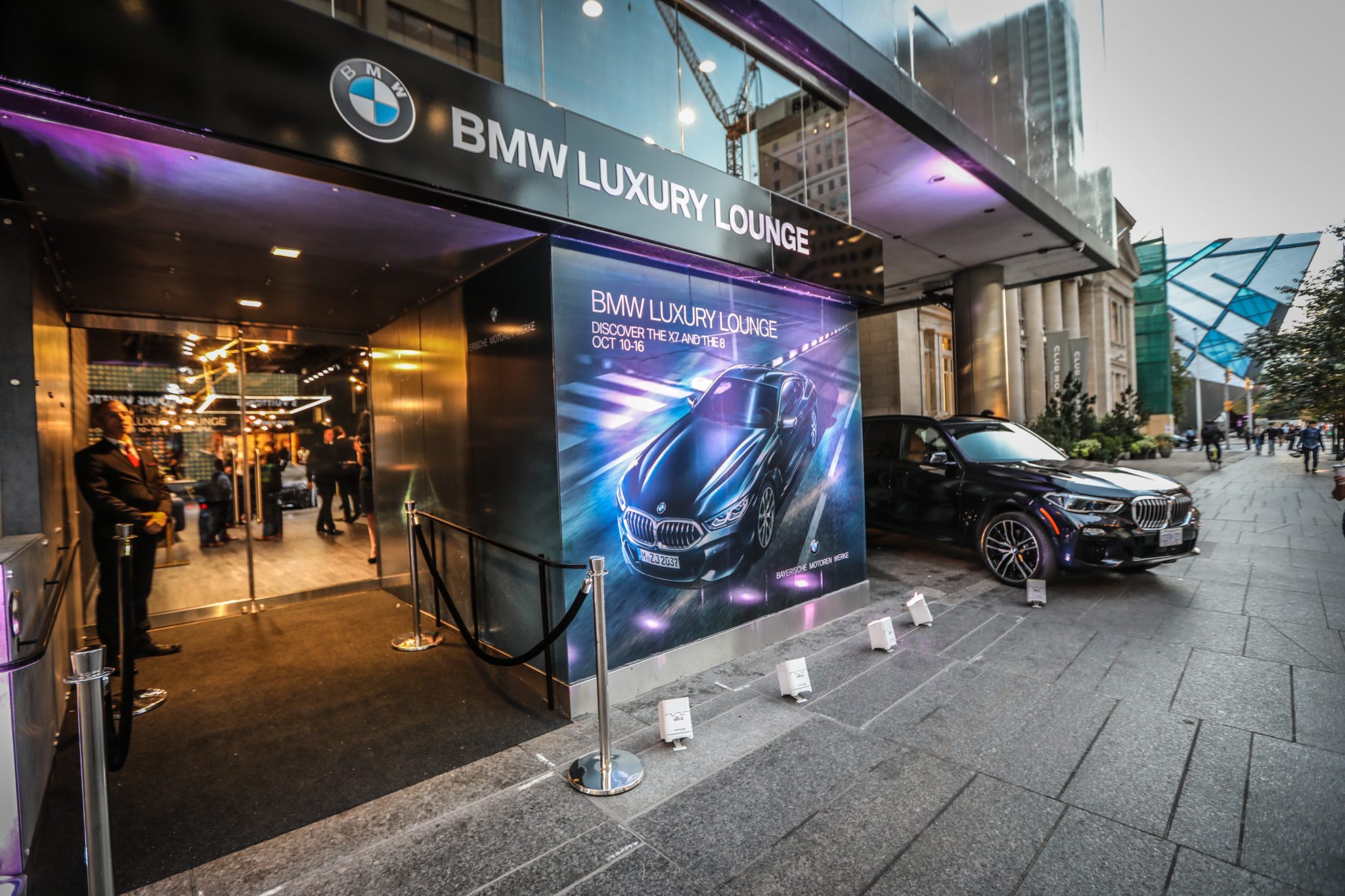
    In the midst of a product offensive that will see many new and refreshed models join its lineup in the coming months, BMW recently staged a limited-run brand experience in Toronto’s Yorkville neighbourhood to showcase two forthcoming models. The display, which has a pop-up feel to it, is known as the BMW Luxury Lounge, a venue open to the public during the day and invite-only events in the evening. As its name would suggest, the point is to generate interest in the brand and get attendees excited for a slew of new BMWs on deck.

    The site of the Luxury Lounge – Bloor St. W. near Avenue Rd. – is fertile ground not only for luxury automotive manufacturers but makers of other luxury goods as well, which is why BMW is partnering with Hugo Boss, Montblanc and Roche Bobois. These brands, along with Samsung Canada and art gallery LUMAS Canada have also contributed to furnishing the space which, with its black and glass walls, wood grain floors and leather sofa, has the feel of modern, minimalist luxury.

    “We’ve taken on this initiative because we believe customers’ expectations of luxury are evolving,” said Sebastian Beuchel, director, BMW brand management, said in a statement. “This beautifully designed space is a showcase for our interpretation of modern, contemporary luxury.”

    Last October, BMW hosted a similar limited engagement exhibit known as the Luxury Excellence Pavilion on Bay St. in the heart of Toronto’s financial district that not only showcased the Munich-based carmaker’s wares, but also those of other several other luxury brands. The feature attraction was the BMW X7 iPerformance, a concept vehicle first shown about a month earlier at the 2017 Frankfurt Motor Show.

    Fast forward a year, and it’s time for the Luxury Lounge, a similar exhibit but with some noteworthy differences.

    Whereas the Luxury Excellence Pavilion ran for almost two weeks (Oct. 16-29), the Luxury Lounge was around for just six days (Oct. 10-16) and there were no test drives from the BMW fleet available.

    In its place are two main attractions that represent the future of BMW and are bound to cause a bit of a stir.

    First up is a vehicle that can’t be discussed in detail but was available for viewing so long as visitors surrendered their mobile phones before entering the curtained-off backroom where it was being shown. A strict no-photo policy was in effect.

    I’m talking about the full-size, three-row 2019 X7 SUV, a vehicle BMW and its dealers are very excited about. The production X7 will make its world premiere at the Los Angeles Auto Show next month and will go on sale early next year. The one being shown in Toronto was an uncamouflaged pre-production copy. Getting it to Toronto took some doing, but its presence made a visit to the Luxury Lounge even more worthwhile.

    Now, in accordance with the wishes of BMW Canada’s communications team, I’ll move along… to the 8-Series coupe which is returning to the lineup after a 20-year hiatus. I have clearance to talk about this one freely.

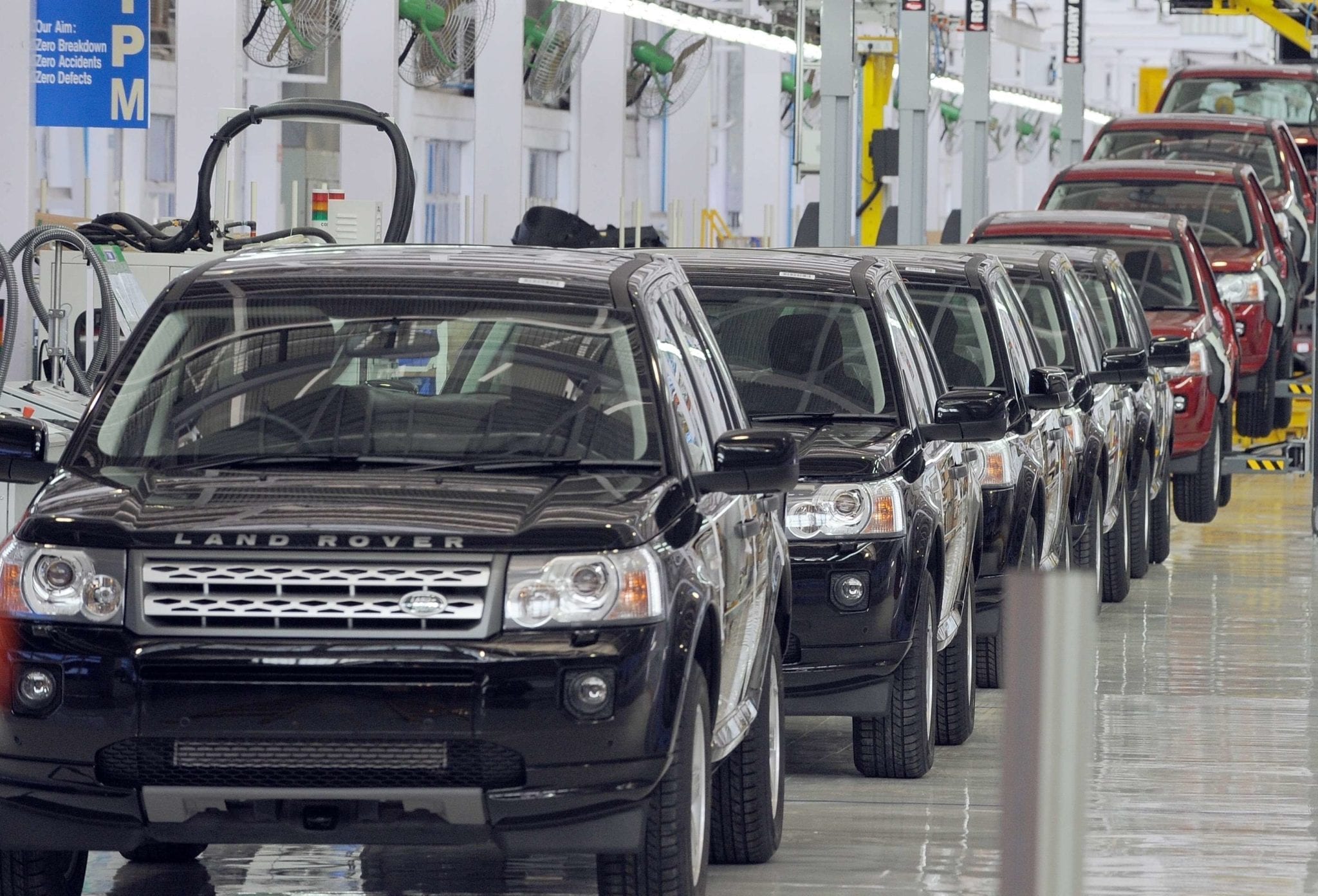
    Centred in the middle of the Luxury Lounge floor plan was a Dravit (metallic) grey 2019 850i xDrive, trimmed in factory option carbon fibre accents (roof, mirror caps, lip spoiler, rear diffuser, etc.) and optional M Performance 20-inch wheels finished in a metallic gold tint.

    Conceived as a flagship model, the 8 Series is a design and technology carrier and, as such, has features that will eventually spread across the BMW family.

    On this front, a few things stand out. The first thing that caught my eye are the new LED headlights the 8 Series is wearing, which feature standard high beam LaserLight technology (to comply with North American laws they’ll only work at speeds above 60 km/h) along with a more angular shape with two separate elements that still look like BMW headlights when viewed from a distance. Clever.

    Other new design elements include a revised kidney grille that is attached at the centre, a callback to the grilles of 1970s-era BMWs. Also, a BMW rep told me that customized paintwork will be offered on the 8 Series though the company’s Individual program. While they can’t guarantee they’ll be able to match every paint chip or swatch a customer has, BMW aims to make the 8 Series available in more exciting colours than those offered on a traditional list of set finishes.

    Inside, the cabin receives some noteworthy advances headlined by the company’s all-new Operating system 7.0 software, which powers the infotainment and instrument cluster screens. My eye was also drawn to the available glass crystal shift knob and iDrive controller.

    Finally, I’d be remiss if I didn’t mention the powertrain. The 8 is being offered with an overhauled variant of BMW’s 4.4-litre twin-turbocharged V8, which packs 523 horsepower and 553 lb-ft. of torque that is mated to a standard 8-speed automatic and xDrive AWD system.

    Fast? You bet. BMW has the 8 Series’ 0-100 km/h time pegged at 3.7 seconds.

    The best part for consumers and interested auto journalists alike is the wait for the 8 Series arrival won’t last much longer. Customer orders begin on December 8, with deliveries likely to begin in the new year. Pricing info hasn’t been released but will be announced closer to on-sale.

    As for the X7, look for more info when it’s revealed during the media preview days at the Los Angeles Auto Show on Nov. 28-29.

  • Luxury perfume brand Creed to launch in India

    Luxury perfume brand Creed to launch in India

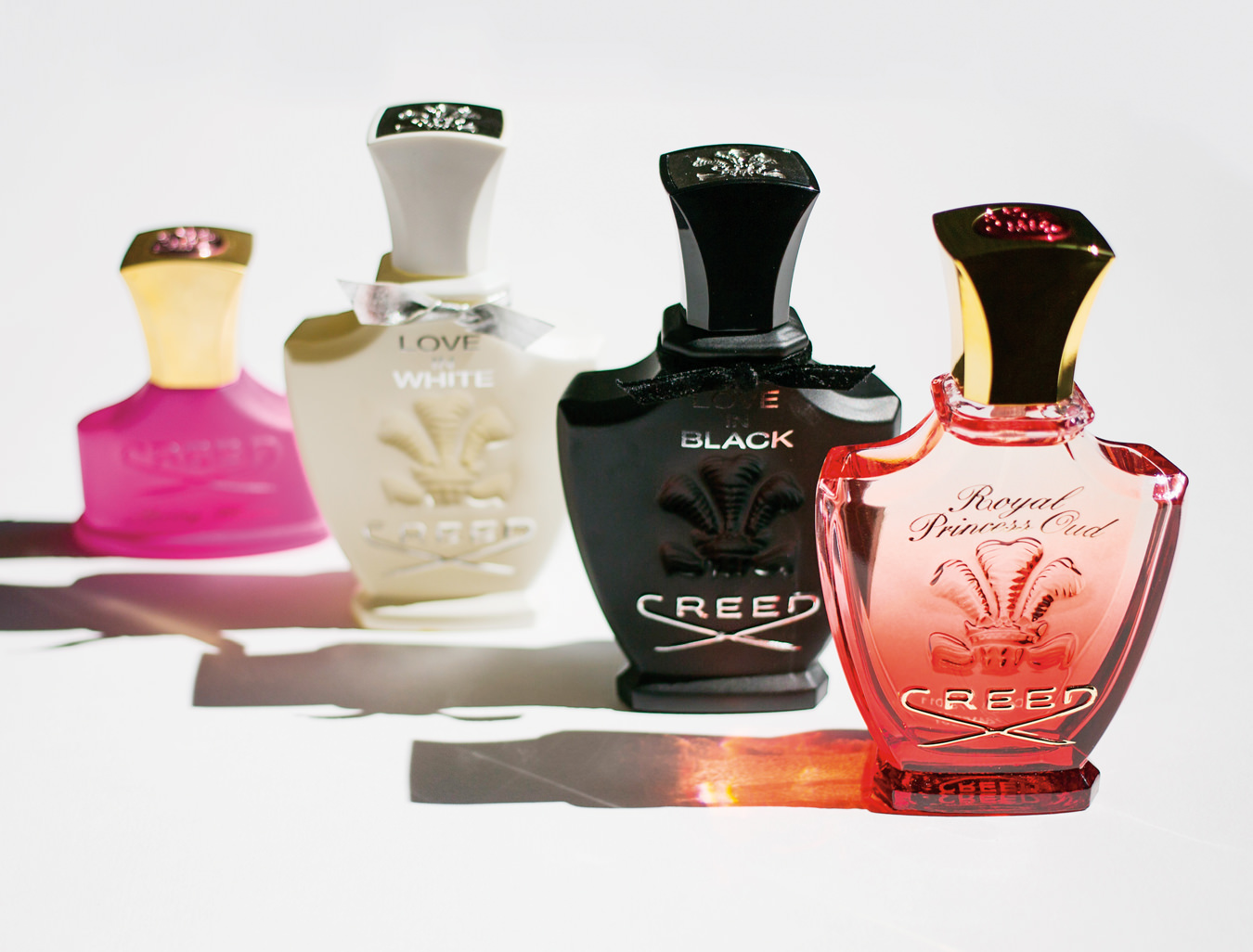
    London’s 250-year-old perfume brand Creed will be launched in India.

    Its maiden store is being launched in the country in partnership with Berkeley Beauty Brands Pvt Ltd, at The Chanakya Mall here.

    “The brand’s iconic status is in sync with the national capital that boasts of a cross-section of luxury connoisseurs. Owing to the globalisation and increase in the disposable income, India has become a profitable market for such luxury brands where the buyers want to experience international standards while shopping,” Gaganmeet Singh, Managing Director, Berkeley Beauty Brands Pvt Ltd, said in a statement.

    Founded in London in 1760, The House of Creed is the only family-owned luxury fragrance dynasty that has served royal houses as well as discerning patrons for over 250 years.

    Passed from father to son spanning seven generations since its London founding by James Henry Creed, it relies on a 4,000-year old infusion technique to capture the highest concentration of natural essential oils, and does not use preservatives.

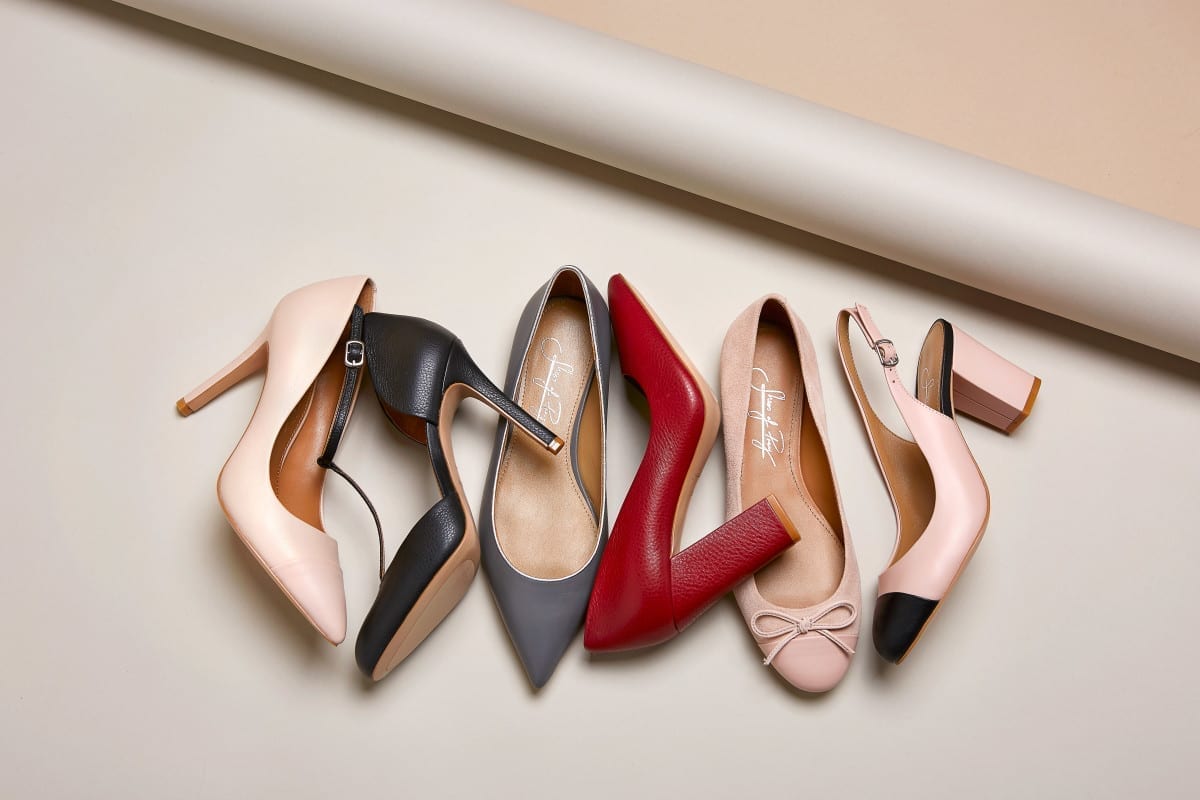
  • Luxury shoes are never enough for Chinese consumers

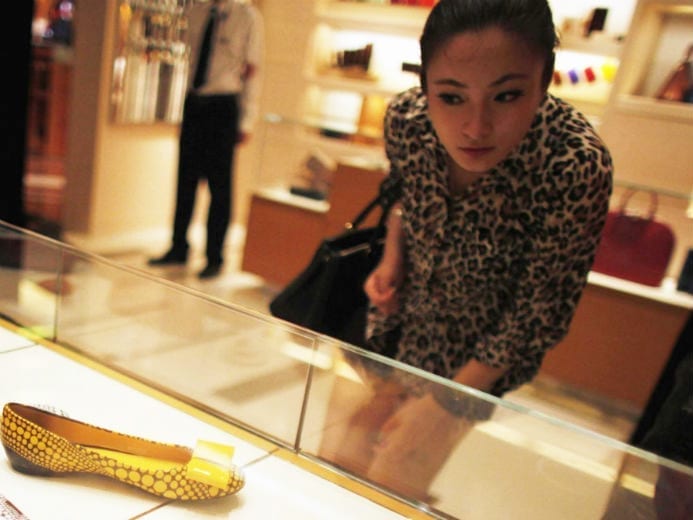
    Luxury shoes are never enough for Chinese consumers

    As the Chinese economy slowly exits the slumber of recent years — and as the anti-corruption campaign implemented by President Xi Jinping subsides — the retail industry is seeing remarkable growth across first- and second-tier cities, as well as the autonomous territory of Hong Kong.

    The development is part of a larger trend, according to a recent report from the consultancy Bain & Co. The firm noted that sales of luxury goods in mainland China are forecast to grow by 20 to 22 percent this year, and that has piqued the interest of Western shoe brands, both big and small.

    Thibaud André, senior consultant and marketing manager of Beijing-based market research company Daxue Consulting, pointed out that luxury shoes are a booming sector in the region.

    “A survey we ran in 2016 indicated that footwear was worth an estimated RMB 370 billion ($54 billion),” he said. “We expected it to increase to an average rate of 7 percent yearly, but I am quite confident that rate will soon hit the double-digits realm instead.”

    Although shopping overseas is still very important for Chinese buyers, the gap between domestic and international purchases is not as wide as it used to be. “The reason for that is a reduction in the price differentials between outside and home markets,” André explained. “Consumers aren’t as averse to spending their money here anymore, which means sales are looking rather robust.”

    And though the trade war between the U.S. and China continues to escalate, André predicted it will have little impact. “Big spenders don’t care about tariffs. They are well-versed in price differences across the globe, and if they want to buy something, they’ll just go for it.” Also working in their favor: Many luxury shoe brands are based in or produced in Europe, so they have escaped the import tax increases — at least for now.

    Chasing Exclusivity

    Experts said a combination of factors are driving sales. Evolving taste is one of them, according to Chloe Reuter of Reuter Communications, an intelligence, digital, communications and marketing agency with offices in Hong Kong and Shanghai that connects luxury brands with Asia’s well-heeled consumers.

    “The luxury sphere has become incredibly sophisticated in China,” she said, “and that applies to high-end footwear, too. There’s an undeniable thirst for [uniqueness], and increasingly, consumers are moving away from the more obvious names of the industry and shifting toward more niche labels.”

    Specialized footwear brands such as René Caovilla, Gianvito Rossi and Nicholas Kirkwood are decidedly becoming the go-to names for many shoe enthusiasts in place of fashion powerhouses peddling a wider gamut of items.

    “Chinese wealthy shoppers are really hard to excite these days,” Reuter said. “Indie or heritage brands with a long history of craftsmanship have a competitive edge because they feel truly different and original.”

    Amy Gu, GM of JD Footwear, a subsidiary of online retail giant JD.com, agreed: “Whereas traditionally, Chinese women focused mostly on big-name brands, we are now seeing an increasing interest in niche brands.”

    Irene Yu, senior director of merchandising at Lane Crawford, which is present both in mainland China and Hong Kong, noted that the specialty department store has seen a change in shopping habits over recent years.

    “Chinese luxury consumers are global, fashion-savvy, well-traveled,” she said. “They have access to a lot of information through social media, and that means they are very educated when it comes to luxury brands. They know their Gianvito Rossis and their Manolos. Of course, they are still very much willing to spend on the more established brands but are also looking for something that feels more prestigious. They are craving newness, and that’s opening the market to a wider net of players.”

    Getting Younger

    While older shoppers — usually categorized as Gen X — are still playing a significant role in the luxury market, millennials and Gen Z account for the larger growth in the footwear category (85 percent, according to another Bain report from last year).

    That has led to the rise of new spending habits: faster, more frequent, trend-driven — and mostly geared toward online shopping and influenced by digital social media platforms.

    “More and more consumers outside of China’s top-tier cities are using e-commerce to access guaranteed-authentic luxury products,” said Gu, noting that luxury shoe sales on the platform have grown continuously year over year. “Customers who buy high-end shoes are generally 18 to 35 years old and are largely brand-conscious. They focus on fashionable footwear.”

    The footwear segment is performing equally well for Lane Crawford, particularly online. “[Customers] still come to the stores to try on shoes, but it’s online that we get a lot of purchases,” said Yu. “To that end, the whole in-store visit is adapting to complement the digital sphere. It’s becoming more experiential to offer a 360-degree approach to the products.”

    Lane Crawford’s business strategy relies on collaborations, exclusive capsule collections and pop-ups, as well as a highly curated floor design. “We make sure each brand is presented in a way that reflects its ethos: cool urbanite for Nicholas Kirkwood, party girl for Aquazzura, for instance,” said Yu. “Clients are very receptive to that. And they do like coming in to check out limited-edition collabs: Off White x Yeezy 350 did very well for us. But we are always thinking of the link between online and offline.”

    Similarly, JD.com has hosted online pop-up stores by brands such as Fendi and Christian Louboutin to engage its young audiences. It also launched JD Delivery Express, a service in which specially trained JD employees hand-deliver packages while wearing distinctive uniforms, complete with white gloves, and they drive environmentally friendly electric vehicles rather than the company’s usual tricycles and scooters. “[Luxury] consumers place tremendous value on the shopping experience,” Gu said.

    Changing Trends

    A change in lifestyle — from unashamedly opulent to more wellness-oriented — is another key element in the country’s booming footwear sector.

    “The rise of the athleisure movement has been particularly significant for shoe retail,” Yu said. “Only a few seasons ago, it was all about the stilettos and the high-heels. Now designer sneakers make up a really big chunk of the market. Models like Balenciaga’s Triple S — we can’t keep them in stock. They are constantly sold out.”

    But again, it’s the smaller brands such as Golden Goose and Comme des Garçons that are drawing the attention of shoppers. “They are considered younger and a bit cooler compared with the Valentinos and the McQueens,” said Yu. “They speak directly to the consumers’ demographic.”

    Outside the sneaker realm, female buyers are going for chunkier block heels, slides and mules. “[Those looks are] less casual than a trainer but not as committing as a stiletto,” Yu explained.

    It is in the fashion arena in particular that the quest for distinctiveness shines brightest. And labels such as René Caovilla are tapping into that opportunity.

    “We tell a story, and our Chinese clients appreciate that,” said Edoardo Caovilla, the third-generation creative director and COO. “They are yearning for high-quality and long-lasting gratification, and they know they can get it with a company that’s been making only shoes since it was first established 90 years ago. They also respect our philosophy. That’s the essence of why we’re doing so well in the country: We’ve gained the trust of the market.”

    The brand has accomplished this feat without opening a standalone store; instead, it is distributed through Lane Crawford, where it is one of the best-selling labels. Helping to build buzz are high-profile endorsements — Caovilla shoes have been seen on the feet of Gigi Hadid, Rihanna and Jennifer Lopez, as well as Chinese stars such as Yao Chen, Shu Qi and Ming Xi.

    “For lasting success, it’s essential that we collaborate with the right kind of public figures,” Caovilla said. “Buyers are picky. They want to feel understood and for their wardrobe to express a very specific kind of luxury.”

    High-end French footwear label Robert Clergerie also has found a welcoming audience in the region. Though the brand is available only in department stores in China, it is performing remarkably well among consumers, particularly with tourism shopping.

    “[Chinese] millennials have a sense of independence and a unique style. They value heritage, quality and provenance,” said CEO Perry Oosting.

    He added, “We are working to improve all the touch points with Chinese clients traveling abroad across all our stores, such as integrating WeChat in the retail shopping experience. We also have our own WeChat platform, for which we create localized content and work with [key opinion leaders] in China to build engagement and relevance among our target audience.”

    Collaborating with influencers is an increasingly important strategy for brands if they aim for long-term sales results in the country. “KOLs are the most effective product marketing here. And they can help with sales abroad, too, if the brand hasn’t entered China yet,” said André of Daxue Consulting. “Besides exclusivity, social media is the biggest determinant for success.”

    Reuter believes that the country’s young, digitally savvy consumers are painting a new landscape for the global luxury industry. “Chinese shoppers are five years ahead of their counterparts,” she said. “The way they approach shopping is set to become the norm for the rest of the world’s wealthy.”

  • Millennial parents, the new force in luxury spending

    Millennial parents, the new force in luxury spending

    The development of China in the last decade is most easily visible through big numbers. But stats such as ‘Chinese travelling overseas increased by 1,380% from 2000 to 2017‘ do not help to understand the intricate changes in society that have taken place. One of these enormous (seismic, tectonic, however far you want to go) changes is in the new parenting culture of China’s affluent Millennial generation.

    The more traditional aspects of Chinese parenting culture are clear: a one-child policy, parents who feel the need to pressure their child into intensive study, Einstein-level maths, weekend classes and the like, with Grandparents and extended family all colluding into the alleged Little Emperor culture.

    The new lifestyle, opinions and expectations of China’s Millennials, and their influence as the drivers of luxury consumption, should now be well accepted by anyone who reads about global luxury. But now these Millennials are also parents – China’s new generation of modern parents, living in globalised cities and travelling internationally at will.

    Turn back just 5-6 years ago and it was not uncommon to come across hotels in Shanghai that labelled themselves ‘business hotels’, not interested in the ‘family’ sector. Only a few specialised shopping malls had sections for kids’ play areas and the like. In 2018, practically every single 5-star hotel offers children’s amenities, menus and activities, while countless shopping malls and other businesses now compete for family visitors with global names like Peppa Pig and Dora the Explorer tagging along.

    In luxury, brands are eager to capture the new Chinese family – ‘Baby Dior’ campaigns strongly, China has the most Burberry kids’ stores in the world, and ‘Fendi Kids’ opened in Shanghai’s Plaza 66 in 2017. Millennial parents not only demand but expect special organic food, imported children’s furniture, with ‘baby MBAs’ and ‘Olympic maths’ yet more angles on the drive of furthering their mini-me’s lifestyle.

    How is this new demographic of the affluent, modern Chinese parent evolving, and what must luxury brands know in order to connect with them?

    China is approaching a boom of Millennial mamas – or in their own words, “Spicy Mums (辣妈),” AKA ‘hot mamas’. They are the new generation of post-90 mums that maintain an image of both hot and cool.

    To understand this new demographic of the affluent, modern Chinese parent, luxury brands should be aware of the size of this social shift. Imagine the difference in parenting in the West, between those born in the 1930s or the 1960s. We’re talking about the first generation of parents that are asking new questions about parenthood, rather than simply accepting what was done before.

    Post-90 Spicy Mamas think, shop, and raise kids very differently than previous generations. A 2018 report on Chinese Millennial moms’ shopping behavior from CBN Data and a 2016 Maternal Marketing Whitepaper both share similar insights on this new demographic:

    They feel entitled to self-care and self-love. They see investment in premium brands as a necessity for themselves and their kids.
    They turn to other Millennial moms, rather than their own parents, for parenting advice.
    They are less sensitive about price, more concerned about product safety and quality.
    They love to shop for high-quality kids products via cross-border e-commerce.
    The Competition: Parenting to Win

    As the clearest indication of the thoughts of this demographic, one simple comment from a mother went viral on WeChat last year:

    “A Monthly Salary of 30,000 RMB (US$4,493) is Not Enough for My Child’s Summer Vacation”. Written by a highly-paid executive mom, it told the story of how she could hardly keep up with the extravagant overseas summer programmes that she lined up for her daughter. The mother explained that the total cost of her daughter’s education for the summer is 35,000 yuan (roughly US$5,240 USD), including 20,000 yuan (US$3,000) for a 10-day US study tour and other tutoring classes that cost up to 10,000 yuan (US$1,500) – and that she was compelled to do this as all of her peers were doing the same.

    With the country’s digital boom, new Chinese parenthood is also digitally integrated. Spicy mums form their communities mostly through dedicated apps and WeChat groups.

    Babytree, an online community with over 20 million Millennial parents, is among the most active sites. QinBaobao (“kiss baby” in Chinese), is a popular app for these parents to exchange parenting ideas, and post photos of their babies without the social pressures of mixing life or work contacts in WeChat. In these e-parenting communities, Haitao, meaning cross-border e-commerce, is frequently brought up: How to source safer, better products than the domestic options in China is a primary concern for such parents.

    KOL Parents Hit Key Cultural Pointers

    The demographics’ economic capacity to spoil their kids, combined with a lack of generationally consistent parenting knowledge, have given rise to a wave of parenting KOLs across social media. Among them, “ZhouYueyue” (粥悦悦) makes illustrations about a typical young mum’s experience, striking a chord with many. “NicoMama”, who shares more practical info graphics and healthy cooking tips, is deemed as a ‘mum authority’.

    There is plenty of space for niche content, too. “Nakikorose”, who brands herself as a “Maternity & Child Sleep Consultant”, seems to attract parents in a higher income bracket. Content perceived to be scientifically credible, or myth defying against the long-standing parenting superstitions in Chinese society is popular among post-90 spicy mums.

    Filial piety remains strong among all in China – at least, part of it. Millennial parents bring their own parents with them on holidays, family celebrations always involve gifts and blessings to their elders and they are still nonetheless keen to have willing babysitters! Yet they still consider that the instruction of the older generations may be based on ancient theorem – a mis-match with their otherwise international lifestyle and knowledge.

    The spending power of Spicy Mums is booming. From kids fashion, enrichment classes, to preschools that promises a “holistic” educational approach, there are a few main buying trends among China’s modern parents.

    1. Luxury kids wear – “mini-me”, but also “better-me”

    A quick view on social media can reveal that Spicy Mums love nothing more than dressing in similar outfits to their kids and posing alongside them for a selfie: ‘Aren’t I cute too?!’ Smart brands are wise to this.

    In May 2018, Dior posted pictures of child celebrity Heidi Cui in a Baby Dior dress in Cannes. Heidi first gained public attention from her role in the reality TV show “Where Are We Going, Dad?”

    This image combines youth with popularity and success – three traits which are catnip for Spicy Mums.

    Luxury kids wear is nothing new to the affluent Chinese market. D&G, Gucci, Baby Dior, Burberry, and French luxury line Bonpoint have been the capsule wardrobe for wealthy Chinese children. The practice of using celebrity kids’ street styles to raise brand awareness, however, is quite unique to the Chinese market. China’s kid fashion websites and magazines’s main content are celebrity kid styles, especially street style shot by paparazzi. What Suri Cruise, the Beckhams, and other celebrity kids are wearing in their day-to-day life, become the fashion bible for millennial Spicy Moms.

    The West has given a name to the demand for luxury kid wear – “the mini-me trend”. In these more mature markets, luxury kid wear consumption is led by the parents’ desire to channel their personality through their kids. A cool, well-dressed kid is a manifestation of the parents’ good taste.

    This trend is still in the embryonic phase, with affluent Chinese parents shopping for their kids by looking at leading western celebrities, dressing them in ways that they never could have achieved in their own youth. The trend is fertile branding ground and shows long-term opportunities.

    2. Experiences for both – ‘look what a good parent I am’

    Luxury kids fashion, imported organic food supplement – these are already the new normal for China’s millennial parents. Beyond the luxury purchase, they now seek experience, preferably with their own participation ready to be posted on their social media.

    Baby swimming is one example which is on trend. In the last few years, China’s first-tier cities have witnessed a boom in baby swimming clubs that charge over 10k RMB (1570 US Dollars) for an annual membership. The sport was first spotted on Chinese celebrities’ social media, and then publicised as the choice of all smart parents such as Mark Zuckerburg and actress Ziyi Zhang.

    Loong Swim Club, a market leader, rapidly expanded all over China, emphasizing its “German origin” to assure Chinese parents that it must be worth the fee. Loong has included a German flag in its logo header, and a EU distribution network in its homepage. Like other swim clubs, Loong uses social media to tell parents how baby swimming helps to develop kid’s social skills and increase their confidence level. For many young parents, these promised advantages are worth the hype.

    Recently, Four Seasons Hotel, Pudong, Shanghai and Hyatt On The Bund Shanghai have started to offer premium swimming classes for children in their pools – yet further indication of the changing expectations of their guests.

    All aspects of an affluent lifestyle should involve the child, including dining at 5 star hotels. The Peninsula Hotels in both Shanghai and Beijing are well aware of the family aspect as a draw. Last Christmas, The Peninsula Beijing offered experience such as baking cookies and decorating trees together. Along with the luxury elements such as Champagne for the parents and Christmas drinks for kids, the focus was on the creative, social activities done as a family, learning about a ‘western’ holiday and ripe in plentiful photo opportunites for the parents to share on their WeChats and Weibos.

    The ‘togetherness’ side also has an aspect of “I’m a big kid too” (aren’t we cute together?!):

    Would parents in the West want to buy Disney items for themselves? Perhaps somewhat unlikely. But Millennial Chinese parents are young-at-heart – proven by the ubiquitous ‘gamificiation’ now seen across many luxury brands. These parents want to be ‘part of the fun’ themselves. One recent example was Coach collaborating with Disney (Coach x Disney in trendy terms) in a ‘magic mirror’ on their WeChat accounts. The launch of their ‘A Dark Fairy Tale’ collection contained all of the current methods of interaction – short videos, the ability to interact with the AI ‘mirror’ and offline events related to the game – all targeted at adult buyers.

    3. “Holistic” pre-school

    “赢在起跑线上”, literally translates into “win at the starting line”, and well-summarises the prevalent parenting ethos in China. Even for the affluent, the ‘culture of scarcity’ feeling remains ever-present. With such a high population, the competitiveness and being sure of ‘not losing out’ is right at the pulse of cultural behaviours.

    While the need to ensure one’s children have the best education is recognisable in any demographic worldwide, the desire is distinct in China. While a wealthy family in, for example the UK, may feel confident that their child can go to the ‘right’ kindergarten and school, the urge to ensure that this is the case is the baseline of any affluent Chinese parent. The clothes, the lifestyle and more are desired, while the educational aspect of making sure their child keeps up with their peers is the very raison d’etre.

    And so, premium preschools with a “holistic” educational approach, promising to turn kids into smart, kind and confident individuals can set their own price.

    Willpower Royal British Education is one of many “holistic” preschools that cost well over RMB 200,000 ($30,000) per year in Beijing. The preschool has made a list of advantages to justify the cost: organic food with made-in-England silver cutlery, state-of-the-art facilities, bilingual education, and proper play time. The kindergarten also offers training courses such as horse riding and golf, hobbies that are traditionally associated with privilege.

    ‘International Schools’ are not available for Chinese passport-holders, but, the most affluent segment of Chinese parents may live abroad (or send their child to do so) for the number of years required to gain a foreign passport, before returning to study at an International School in China. Even for Chinese passport-holders, these International Schools have now created ‘bilingual’ schools, still in their name – for example Wellington or Dulwich having a separate school which can accept Chinese passport-holders, at the same RMB 200,000+ annual school fee.

    Such a “holistic” approach that combines study and play is considered a luxury in Chinese education. For millennial parents, the internationalism and social aspects are extremely attractive. They believe the craft courses, sport lessons, and social time with peers from similarly privileged backgrounds will give their kids an edge from early on.

    Little Star Group, which manages high-end kids wear brands such as I Pinco Pallino and YeeHoo in China, offers exactly such programs to Millennial families.

    The brand group has a special club space for its VIP members – Little Star Club. VIP families can join the specially designed activities in Bund 27, a prestigious address in Shanghai. Not only that, the club offers social training: classical music, horse riding, golf, and sailing courses. Every activity is described to enhance kids’ certain characters. Classical music is good for creativity, horse riding for chivalry, golf for calmness, and sailing for ambition.

    As a 28-year-old Spicy Mum told The Luxury Conversation, “If my kid grows up in this environment, his life vision and perspective will all be better.” With a British kindergarten degree, her 6-year-old boy has already secured a spot in a competitive elementary school in Beijing.

    China’s Spicy Mums are big spenders when they are convinced the value is there. Among the growing competition for this sector, the question is only whether they find your offer attractive or not.

    The Luxury Conversation Takeaways:

    Affluent mothers in China live by the word of WeChat groups. All keen to be in a WeChat group with their social peers, there is often one ‘leader’, who makes recommendations based on what celebrities are doing on Facebook and Instagram. As mentioned above, the ‘Spicy Mamas’ are keen to follow the trends set by celebrity parents and kids. Instagram is accessed by VPN in China and is well worth exploring in order to engage with these globally-versed mamas.

    Everything is education. Everything is betterment, upgrading … and basically showing off just how elite your kids (and therefore you) are. Create a reason/purpose for the luxury.

    Elite kids are ‘all access’. Dinner at a three-star Michelin restaurant? It’s a whole family affair with the family’s little Princess or Prince sampling the degustation and comparing it to others they have tried worldwide.

    The upgrading and the luxury should not be arbitrary – the ideal offering is to collaborate with a renowned education, institution, celebrity or other brand. Holding a cooking class in your hotel? Then give the little chefs a Cordon Bleu certificate afterwards. Promoting a healthy life? Then engage with one of China’s Olympic athletes for photo-opportunities. There should always be a famous badge, flag or face to attach to the activity as a mark of elite success achieved.

    For the ‘right’ investment in their child’s experience, there is no limit for affluent Chinese parents. No price is too great if it will deliver the truly elite, WeChat post-worthy moment for their child.
  • Luxury goods market to grow up to 8% in 2018

    Luxury goods market to grow up to 8% in 2018

    The personal luxury goods market is set to grow as much as 8% globally in 2018, according to a recent report, pushed on by double-digit sales growth in Asia and the accessories and footwear categories worldwide.

    Data issued by the Altagamma Worldwide Market Monitor and by a Bain & Co. study has forecast personal luxury goods will fetch revenues of 276 billion euros to 281 billion euros this year, a jump of 6-8%, on 2017.

    In October last year, it was first predicted that the market would witness 5% growth for this year.

    Expectations for average growth in earnings before interest, taxes, depreciation and amortisation in 2018 are up to 10% compared to the figure released in October, which was 7%.

    By category, sales of accessories, jewellery and cosmetic goods will lead this year’s positive performance, witnessing 7%, 7% and 6% growth, respectively.

    Shoes sales will also continue to play a major role, kicked on by sneakers, while apparel growth will slow, despite a lift of 4% for the year.

    By region, Asia will the most key, up 12% compared to the 10% increase forecast in October. Chinese tourism will bolster sales abroad, however, preferring travel to the US rather than Europe, where the strengthening of the euro negatively impacts tourists’ flow and spending.

    North America, which in October was forecast to grow by 4% this year, is now seen expanding by 6%, while Europe, last predicted for a 4% uptick in 2018, is set for 3% growth, hurt by currency conditions and sluggish spending in Germany and the UK. Japan, Latin America and Middle East will see personal luxury goods expand 5%, 3% and 2%, respectively.

    Back to China, domestic spend is also set to change, said the report.

    “Starting from July, China will reduce a series of import duties for a range of product categories, including apparel, fashion accessories and some categories related to furniture,” said report authors.

    “In particular, for these goods, duties will be halved, which will impact their pricing in China.”

    Looking further forward, the study predicts that the luxury market could reach 390 billion euros by 2025, registering a 4 to 5% compound annual growth rate.

  • What’s the new luxury?

    What’s the new luxury?

    Luxury brands are increasingly leveraging music festivals to turn young and affluent attendees into customers, with some going as far as to run their own events and concerts.

    Luxury brands would have once distanced themselves as far as possible from the mud and grime of a music festival. Today, however, they cannot get enough of the summer festival season with some even running their own concerts and events. What has caused this change in tune? And how can luxury brands best position themselves alongside music and festivals?

    Why Festivals Matter
    Luxury consumers can be found in abundance at racecourses, regattas and other seasonal sporting events. Every year brands compete for sponsorship rights in the hope that some of their attendees will turn into customers.

    Younger generations spend their time differently, however. While some of their forebears would not be seen dead at a music festival, a growing number of affluent millennials and Gen Z attend several festivals and concerts every year.

    Most of the 14 million people in the UK (OnePoll) and 32 million in the US (Billboard) who have attended a festival in the past two years fall into these age brackets and luxury brands can no longer ignore them: Bain & Co predicts that by 2025 millennials will count for 40 percent of the global luxury market and Gen Z five percent; figures that will only build beyond 2020.

    Festival Fashion and Instagram Installations
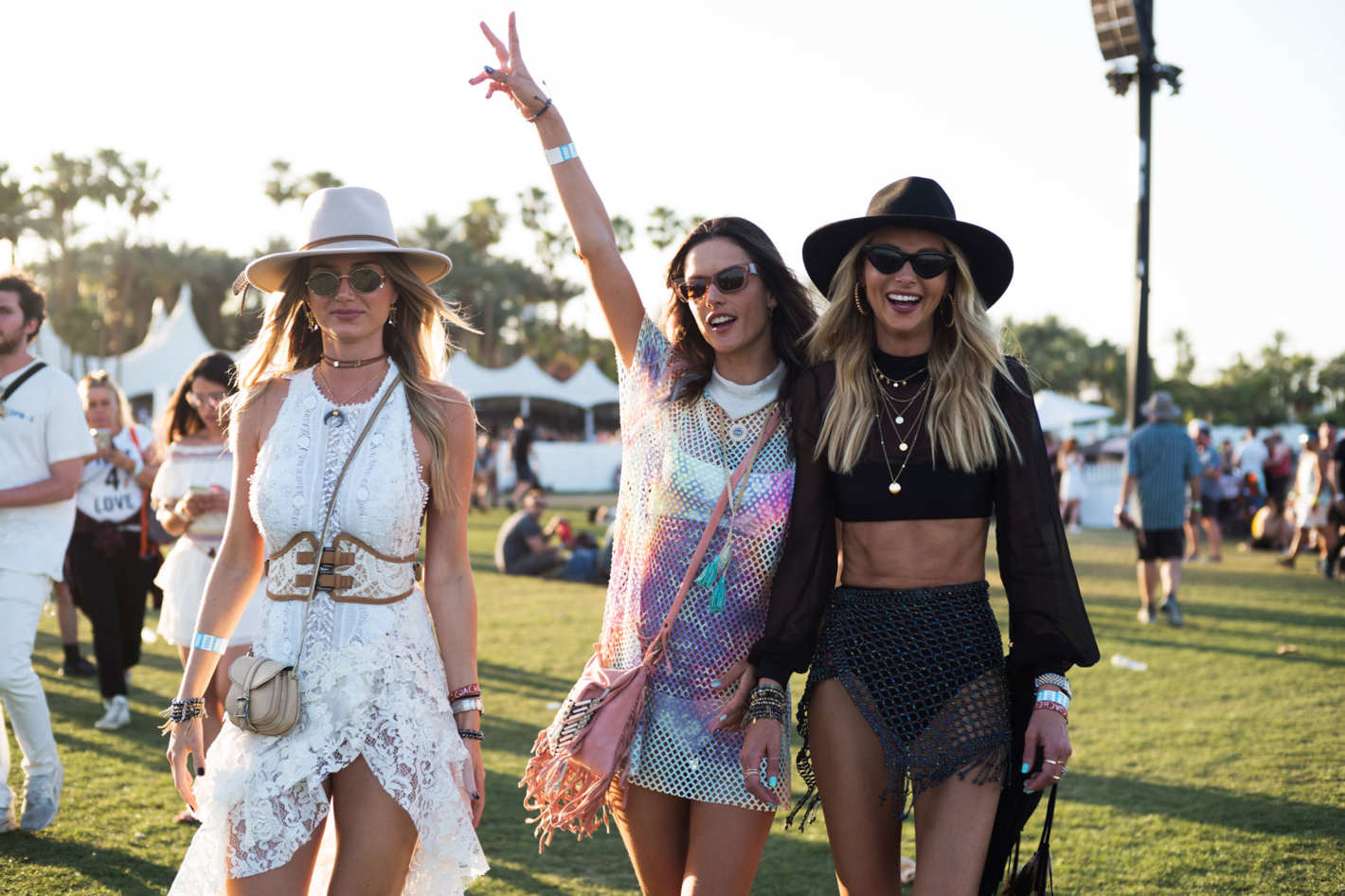
    Coachella traditionally kicks off the annual festival season and, in the build-up to April’s big event, luxury fashion houses ready seasonal festival fashion lines. Their target audience is less about the quarter of a million attendees at Coachella than the quarter of a billion reached through social media.

    Through social media, the music festival becomes a little more than a backdrop to the involuntary catwalk that is beamed across the world to millions. Influencers and celebrities are clad in the latest lines for the occasion and countless others coaxed into branded installations designed for maximum Instagram-ability.

    This year saw Swarovski send Chiara Ferragni to Coachella in a new jewellery line, Gigi Hadid announced a new Moschino collaboration with H&M and Revolve styled over 450 influencers for the festival.

    Music Matters
    For most festival goers, however, music is more important than fashion. Unexpected hits between live music and luxury include Burberry Acoustic, a series of performances and recordings of young British artists pioneered by former CEO Christopher Bailey. As well as accompanying catwalks, Burberry Acoustic acts as another social media channel, attracting nearly 3 million views on YouTube.

    Luxury department stores have also used music to get more young consumers through their doors, picking up on research that millennials prefer experiences over goods. Macy’s hosts ‘mini-concerts’ in New York, Selfridges has ‘Music Matters’ in London and Galeries Lafayette hosts ‘Music Machines’ in Paris. These live performances are often run in-line with other festival-esque experiences such as yoga classes, cookery courses and other pop-ups.

    Beyond the Music
    One major change to festivals over the past decade has been a focus on other attractions to appeal to a wider audience. Whereas food and drink were merely prerequisites to performances, their roles are now often reversed.

    This provides another avenue for luxury brands to gain exposure at festivals. Mulberry have hosted picnics at Wilderness Festival in the UK, an event that spends and promotes as much on its food as music. The same event hosts a Veuve Clicquot bar while other champagne houses are touring the country this year: Laurent Perrier is at Cornwall’s Great Estate Festival and Bollinger at Hay Festival.

    Branded Festivals
    Few luxury brands have managed to marry the commune-spirit with the commercial by running their own festival. Krug Champagne pioneered the luxury festival with their 2016 ‘Krug Island’ and 2017 ‘Into the Wild’ one-day festivals in the English countryside which paired little known artists with big name chefs and, of course, Krug Champagne. With no plans for a 2018 event, however, Krug seems to have abandoned the concept.

    It is not only luxury brands who have struggled to get their own festivals off the ground. Drinks brand Innocent have dropped their ‘Un-plugged’ festival series, Apple their Apple Music Festival and Virgin their V Festival among countless others. Organisers have cited low ticket sales and high start-up costs among the reasons for ceasing these events.

    Getting the Balance Right
    The dichotomy of a festival organiser is to balance commercial forces against the bohemian utopia that runs deep in every festival. When one outweighs the other – as it often does at a branded festival – it puts people off.

    But the same forces apply to existing festivals. Attendees of Coachella recently felt it had become overly commercial and started the #Nochella movement boycotting the event. Though tickets prices and the personal views of its billionaire backer were blamed, major retail outlets on the festival grounds did it for some.

    These successes and failures show the careful balance that luxury brands need to strike when it comes to music and festivals. Like traditional sponsorship, however, the best results will come when a brand is paired with an event of similar values.

  • Increasing Chinese wealth helps drive luxury auto sales growth

    Increasing Chinese wealth helps drive luxury auto sales growth

    Almost half of the automotive sales growth in China this year has come from luxury brands, driven by consumers’ increasing household wealth and consumer confidence.

    According to a report from Scotiabank, in March global automotive sales were up 1.2 percent over the previous year, with China one of the key forces behind this growth. As the Asian market becomes increasingly important to luxury auto brands, OEMs are set to benefit from newly eased regulations in China.

    “China now accounts for close to 30 percent of global luxury auto sales, up from 20 percent in 2012,” said Carlos Gomes, senior economist and auto industry specialist at Scotiabank, Toronto. “As wealth continues to increase in China this share will advance further.”

    Accelerating sales
    Chinese auto sales grew 3 percent in January and February, and growth picked up in March, with a 5.1 percent increase.

    Luxury cars made up half of the year-to-date growth in China. Scotiabank notes that this rise in luxury sales is the greatest seen in China since the government began its anti-corruption campaign.

    Over the past few years, the government’s communist party has been working to curb conspicuous spending, in an attempt to fight corruption in politics.

    As part of the campaign, China’s Finance Ministry implemented a 10 percent import tax on the highest priced automobiles entering the country. The tax affects vehicles retailing for at least 1.3 million yuan, or $205,000 at current exchange.

    As of 2012, China represented 20 percent of the total volumes for the top six premium marques. Today, Chinese consumers make up 30 percent of these brands’ businesses.

    Whereas these brands saw an average volume growth of 15 percent in 2016 and 2017 in China, in the first three months of this year, their year-over-year volumes rose 25 percent.

    The top six marques are projected to have their sales exceed 2.7 million cars this year. This would more than double the number sold just five years ago.

    By 2020, the luxury car industry in China is likely to become the world’s largest. The country is leading the way in the breakaway from reliance on dealerships.

    According to L2, while ultra-luxury auto brands such as Ferrari have a better handle on exclusivity and high-end image, standard high-end automakers are more accessible and have a better grasp on digital performance in China.

    L2’s research in its “China: Luxury Auto” report shows that more than 50 percent of luxury auto brands are available on China’s top retail Web site Tmall. Their presence on the ecommerce site beats out luxury fashion and jewelry brands.

    Along with China, auto sales around the world picked up in March due to growth in emerging markets and a 6.5 percent volume increase in the United States. Scotiabank attributes this to growing wages and incomes.

    “Luxury sales in China are up about 23 percent so far this year, lifting global luxury volumes by about 7 percent year-over-year through March,” Mr. Gomes said. “The key driver of these gains is ongoing increases in household wealth, which is being driven by strengthening global economic growth.

    “As long as that trend persists, luxury volumes will  outperform,” he said. “We expect the global economy to expand 3.8 percent in 2018 and 3.7 percent in 2019. If global GDP slows significantly from our current forecast, luxury volumes would slow as well.”

    Auto outlook
    Foreign automakers are set to benefit from some recently announced regulation changes in China.

    One of the changes relates to the 50:50 rule, which prevented automakers from owning more than half of their Chinese operations. At the time the regulation was implemented in 1994, it was intended to help local businesses by forcing OEMs to enter joint ventures.

    China is rolling this back, allowing automakers to have more ownership over their Chinese sales.

    The nation is also lifting its 25 percent tariffs on foreign cars.

    Tesla’s Elon Musk had complained about the import duties on Twitter, saying that having a 25 percent tax compared to the import duty of 2.5 percent for the United States was similar to “competing in an Olympic race wearing lead shoes.”

    The United States is currently at risk of a trade war with China following President Trump’s announcement of tariffs on steel and aluminum in March. Since then, each side has imposed new tariffs on different goods, escalating the disagreement.

    “The announcement that China will reduce import tariffs from the current 25 percent ‘as soon as possible’ is likely to have most significant near-term impact for luxury automakers,” Scotiabank’s Mr. Gomes said. “For example, tariff reduction will improve the affordability of imported luxury models, spurring even stronger sales going forward.”

  • Swiss Prestige incorporates Armin Strom watches

    Swiss Prestige incorporates Armin Strom watches

    Armin Strom has formed a distributor partnership with Swiss Prestige, which promotes Swiss watch manufacturers in Asia.

    Swiss Prestige CEO Jacqueline Ng says Armin Strom, with its distinctive designs featuring in-house movements, all made in small quantities, will be a “terrific” addition to the company’s curated selection.

    Armin Strom watches are designed so the inner mechanics of the movement can be seen through the dial.

    This partnership is an extension of the Armin Strom’s business network. With 20 employees in its Bienne headquarters, the company designs and makes all its own movements and cases. Every watch is hand finished, and can be personalised.

    Swiss Prestige represents Swiss watch brands in Hong Kong, China, Taiwan and Australia.

  • Luxury retailers ‘missing out on customer engagement’

    Luxury retailers ‘missing out on customer engagement’

    No one can accuse luxury retailers of cutting corners where advertising spend is concerned. On average, they divert 8 per cent of their turnover into funding advertising initiatives. In the US for example, luxury brands invested more than $5 billion in advertising last year, accounting for a significant portion of overall marketing expenditure.

    Love it or hate it, advertising is a principal ingredient of business success. How else would you make customers be aware of your brand and build an inspirational image? Advertising is also essential for increasing brand equity and driving traffic to point of sales, which is how you boost your revenues.

     The twist 

    So, assuming we can agree that advertising remains important, let’s explore the issue through some numbers to see whether luxury brands are extracting maximum value from their advertising investments.

    Here’s one number: the average conversion rate in retail is about 10 per cent, which is to say that merely one out of every 10 customers entering a store will buy something. The best-in-class brands can boast a 20 per cent conversion rate, but that still leaves anywhere between 80 per cent and 90 per cent of store visitors exiting without a purchase.

    On the bright side, these numbers are not necessarily a harbinger of doom because nowadays a store has become more of a touchpoint along the customer journey. A transaction may occur on the premises during the visit, but it may also take place at a later time in another brand store (think airport outlets, for instance) or online. Therefore, a visit without a purchase is not really the issue.

    But we truly have a problem when non-buying customers go away without leaving their personal information. This should be ringing all sorts of alarm bells because it means the brand cannot continue its conversation with these customers. Our research shows that in 2017, an average of 65 per cent of non-buying customers were not invited to leave their personal information. In other words, this is nearly 60 per cent of store visitors who cannot be engaged in further conversation.

    Advertising is only one of many budgetary considerations for luxury brands when it comes to attracting customers to a store as it also entails expenditure on rent, fittings, and staff salaries, among other things.

    When you add it all up, you start questioning the rationale behind these investments. Not because they no longer matter in the grand scheme of things, but because the current retail landscape has rendered existing advertising budget allocation practices inefficient.

    When you think back to the nearly 60 per cent of clients not engaged at all during a store visit, it becomes painful to think of the revenue opportunities missed, not to mention the “waste” of money spent to get those customers cross the store threshold in the first place.

    Luxury brands now operate in a world where consumers are starting to sidestep advertising and increasingly count on referrals and recommendations to choose a product or a service. Think of it in this way: marketing is no longer about what you say to customers but how you influence what they say to each other. 

    The fix

    With that in mind, it seems clear to us that luxury brands should spend more on creating unique and memorable customer experiences (both in-store and post-purchase) for buyers and non-buyers alike.

    Front-line team members should be considered an additional marketing channel, or at least an extension of one. While brands make substantial investments in PR and special events, they need to spend more to make a positive, lasting impression on the customers who come into the store instead of striving to draw even more customers inside.

    Part of the advertising budget should go into delivering customer experiences and providing value to store visitors, surprising and delighting them at the same time. You can guess what will follow, can’t you? Conversations sparked by viral tweets, social media shares, and likes, which is as good as advertising gets for luxury brands.   

    The help

     The gist so far is that luxury brands need to pivot from a push to a pull strategy. Carving out a larger portion of the advertising budget to invest in customer experiences is the way forward, but multiple factors need to interact for effective execution and tangible results.

    For one thing, brands need to put the right people on the shop floor. This may require investment in proper training and ongoing support. Other necessary ingredients are decent pay plus the right KPIs and incentives.

    Last but not least, luxury brands should empower their teams to do whatever is required to deliver a high-quality customer experience – one that will be remembered, shared, and seen by many. When the social media and word-of-mouth mills start churning, luxury brands will have all the vindication they need for having aligned their advertising budgets with the new realities of retail.

  • China’s luxury consumer drives global sales

    China’s luxury consumer drives global sales

    With Chinese consumers now making up almost a third of all luxury purchases globally, premium brands are having to turn their minds to China-specific engagement strategies.

    “The vast social influence of the Middle Kingdom has shifted the ‘Made in China’ moniker to ‘Made for China’,” according to Chris Maier, Managing Director – Analytics, Research & Insight at Publicis Media for Greater China.

    He explains how this trend is “driving a cultural movement to inspire local product flavour, rather than languish with off-the-shelf Western styles.

    “More and more global brands – especially in the luxury sector – are creating China-specific products with local bents to cater to the key consumers,” he says.

    A Publicis Media study of 1,000 luxury consumers across North Asia – including China – delved into how luxury resonates through consumer lives, including attitudes, behaviours and time spent. One insight was that China continues to push ahead as the most digitally native and highly digital-social culture, particularly in the information gathering process before a purchase.

    When asked about top touchpoints of influence on luxury purchases, invariably the top five of digital were head and shoulders above others: official website (41%), e-commerce website reviews (35%), social media advertising (31%), official social content (30%) and message app advertising (26%).

    Likewise, e-commerce is booming among Chinese luxury consumers.

    “Across the consumer’s journey – from awareness to research and consideration to purchase – e-commerce reviews landed as the top touchpoint influence, barring reviews and recommendations on TV & OTV. Recommendations rated high, but the go-to point is online retail,” Maier says.

    To capture the Chinese market, several luxury brands are now creating product lines specifically targeted to the Chinese market. Maier singles out luxury fashion retailers LVMH and Loewe as early movers.

    “China consumers are, justifiably, voicing specific wants for unique, locally relevant products to go with their new-found authority on the world stage,” he says.

    “If brands are to successfully maneuver in this new consumer age, uniquely fitting the what, where and how together is the trifecta for success.”

  • US subscription rental service Le Tote expands with China debut

    US subscription rental service Le Tote expands with China debut

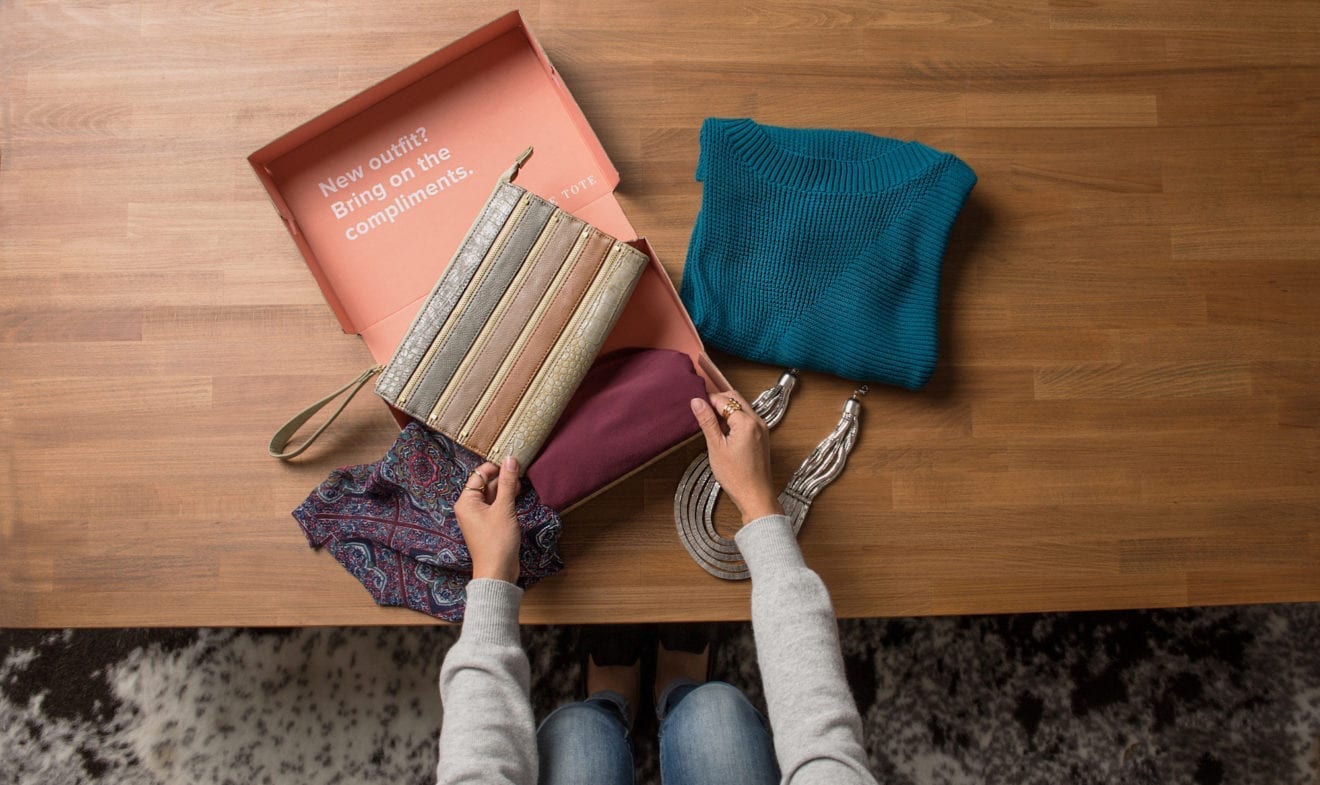
    American subscription fashion rental service Le Tote is making its international debut with Le Tote China.

    The San Francisco-based company said the launch is still in beta phase with a full roll out expected to the China public in spring 2018.

    Le Tote is the first US subscription service to launch in China, according to the company, in a press release.

    “To be the first US subscription service in China, the largest e-commerce market in the world, is an opportunity that is both humbling and exhilarating,” said Rakesh Tondon, Le Tote Co-Founder and CEO.

    “Regulatory restrictions are particularly tough and our partnership with Clement allows us to enter a market that so few venture-backed companies have been able to penetrate. With the launch of Le Tote China, we’re now able to reach a target demographic of over 400 million women – and we’re still in the early days of the country’s middle-class boom.”

    Le Tote has partnered with Chinese retail veteran, Clement Tang, to facilitate the Asian move, naming Tang Le Tote China CEO. Tang also invested in the subsidiary, leading the investment for Le Tote China.

    Tang worked for almost twenty years at Belle International, the largest shoe retailer in China, having most recently served as Executive Director and President, until the firm was acquired for $6.8 million.

    Providing women with the ability to rent unlimited clothing and accessories for a flat monthly fee, Le Tote China will provide the same service as its US operator. Tote has leveraged its domestic business model, proprietary technology and in-house talent to transpose the service for the international market. Starting small, some 3,000 ‘Founding Members’ have been selected to participate in the launch, with others placed on a waiting list.

    “China is a nuanced market with its own cultural norms, standards and expectations. We can’t simply cut and paste the Le Tote experience,” said Clement Tang, Le Tote China CEO.

    “We are eager to work with the Founding Members to deeply understand the market and deliver a service that truly resonates. We know that the average per capita income in China is growing 10% year over year and 60% of disposable income is spent on fashion. The Chinese consumer is primed and ready for the future of retail, but has not yet had access to a solution like ours.”

    Le Tote China is headquartered in Shenzhen with satellite offices in Beijing and Hong Kong. The distribution centre is in Dongguan, with plans to expand to Beijing and Shanghai as well.

  • Young shoppers’ big, luxurious spending emerges as new trend

    Young shoppers’ big, luxurious spending emerges as new trend

    Shoppers  in their 20s in South Korea have become more prone to spending big on luxury items and services, emerging as a new consumption trend, according to industry data.

    Mobile commerce company Tmon says the sales pattern over the past three months showed that purchases among young shoppers of luxurious products and high-end services in fashion, food and travel categories have significantly surged.

    From 21 October 2017,  Tmon’s overall sales of sneakers from luxury brands like Gucci, Golden Goose, Valentino and Alexander McQueen — which range price between 300,000 won (US$280) and 800,000 won — rose 66 percent, compared to the same period in the previous year.

    The sales increase was particularly high among consumers in their 20s, soaring by 106 percent on-year.

    Over the same period, hotel buffets, particularly dessert buffets, also logged a sales increase of 71 percent on-year among young consumers. The price of a hotel buffet in Seoul begins from 44,100 won per person.

    The company said it had sold over 2,400 entries to such dessert buffets in just two months, portraying young shoppers’ interest in Instagram-worthy food spots.

    “From luxurious goods to upscale brunch bites and private travel products, the tendency of consumers to focus on higher satisfaction is expected to continue throughout this year,” said Han Jae-yeong, Tmon’s chief strategy officer.

    A similar trend can be seen in the popularity of Moleskine, a Milan-based luxury notebook company founded in 1997.

    Its limited edition notebooks — some of which have been inspired by Lego, “Star Wars,” “The Simpsons” and “The Hobbit” — are typically priced from 30,000-40,000 won, but the notebooks quickly sell out.

    “Consumers tend to find high quality and the brand value of Moleskine products worth spending their money on, which also gives them even a sense of ‘achievement’ when they purchase a limited edition, although it’s pricey,” said Yim So-young, a marketing manager for Moleskine in Korea.

    “Korean consumers’ interest in limited edition goods and premium product lineups will only expand in the future,” she added.

    And the trend is more marked among, while not limited to, the younger generation.

    According to Lotte Home Shopping, sales of global premium home electronic appliances such as Blomberg dryers and Balmuda’s steam oven toasters have seen double-digit growth each year since 2015.

    The company said such high popularity is attributable to premium brand products’ high performance and luxurious and sleek design, as well as brand awareness.

    Swiss coffee maker Jura’s E7 automatic coffee machine receives at least 1,000 calls on order each time the product goes on air, the company said. The coffee machine costs nearly 1 million won.

    Among Tmon’s travel products, sales are rising for luxurious accommodation in Japan, such as at ryokan, a type of traditional Japanese inn equipped with Japanese hot springs and private bathing facilities.

    The most expensive ryokan are “Category A+++” which begin at 70,000 yen (US$640) per person. The price for average ryokan begin from 300,000 won per person. Until only recently, ryokan had been considered as accommodations primarily for middle-aged couples or family trips.

    The company, however, said over the past three months, 20-somethings’ purchases of ryokan accommodations through packaged tours or individual trips had soared 166 percent on-year.

    asIndustry watchers say the trend will likely last, as consumers continue to crave satisfactory experiences and pleasures.

    “It is experience that many consumers now prefer, and it’s especially the dominant and preferred choice among those in their 20s, who want to experience the diverse range of the latest, satisfactory products and services,” said Jeon Mi-young, research professor at the Department of Consumer Science at Seoul National University, in an interview with a local daily.

  • Luxury on WeChat : The keys to succeed in 2018

    Luxury on WeChat : The keys to succeed in 2018

    Today, China leads the world in technical innovation and WeChat is its most iconic ambassador.

    With more than 900 million daily active users (as of September 2017) and close to 40 billion messages exchanged daily, WeChat is now more than ever the daily life tool for Chinese netizens.

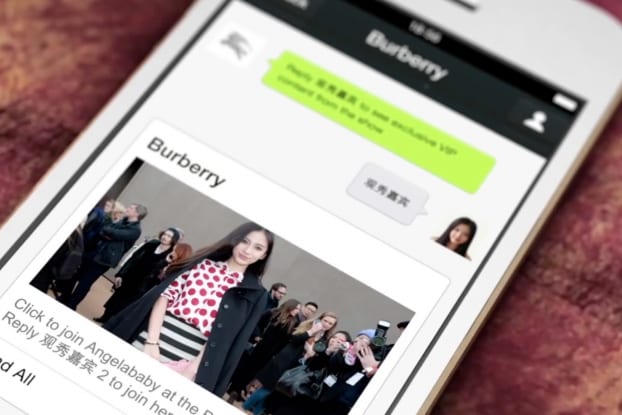
    On the business front, Chinese consumers represent +32% of all luxury goods sold worldwide, with Chinese travelers accounting for an increasing share, and WeChat represents the perfect tool to connect with these consumers. Today’s leading luxury brands have anchored WeChat at the center of their O2O strategy in China, operating on three main pillars: Social, CRM/Data, and E-Commerce.

    On the social front, luxury brands strongly improved their digital creativity (HTML5, Canvas, Gaming, VR, Mini Program, etc.) and combined social campaigns with KOL engagement and significant media buying investment to increase impact. In 2017, we saw a clear shift away from traditional media spending in favor of digital media where the ROI is more immediate and transparent.

    Furthermore, luxury fashion brands have taken a page from FMCG brands and begun to implement CRM integration, message segmentation and advanced user tagging based on social behavior and consumption data. Some of them have gone a step further and developed WeChat loyalty programs aimed to increase user engagement and drive repetitive spending.

    Finally, 2017 witnessed the rise of 3rd party luxury platforms (Luxury Pavillon, Toplife, Viplux, Secoo), coupled with the emergence of the WeChat mini program and an increased investment by brands into their own .CN websites.

    WeChat provides the perfect ecosystem for luxury brands to court the Chinese consumer, from immersive branding campaigns to boutique appointment systems and integrated WeChat e-commerce.


  • Hermès opens the door of its Orange Box in Hong Kong

    Hermès opens the door of its Orange Box in Hong Kong

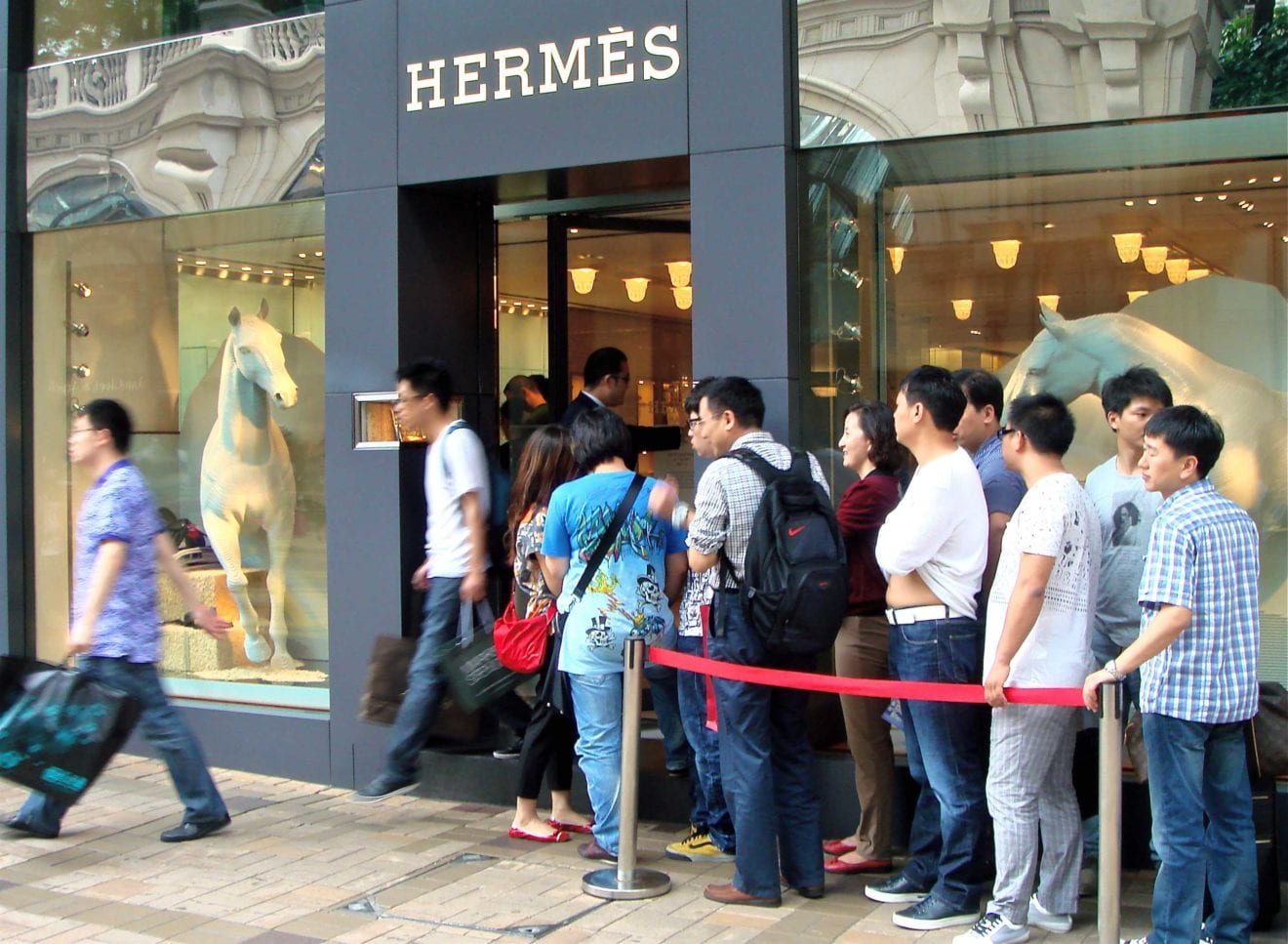
    On 11 January 2018, Hermès opened the door of its new store in Hong Kong, the original and first home in Greater China.

    Located in Landmark Prince’s, within the dynamic Central district on the corner of Ice House Street and Des Voeux Road, this new destination marks a significant milestone for Hermès and is a delightful occasion to celebrate the long-standing relationship
    between Hong Kong and our house.

    The relationship between Hermès and Hong Kong started with the first store in the city
    in 1975, followed by a dynamic expansion with a current network of seven shops in key locations. The Hermès homes host outstanding events and exhibitions, whilst encouraging a constant dialogue between  craftsmanship and the effervescent local culture.

    For the opening, Axel Dumas, CEO of Hermès, welcomed the guests and walked them through the three-floor majestic Orange Box.

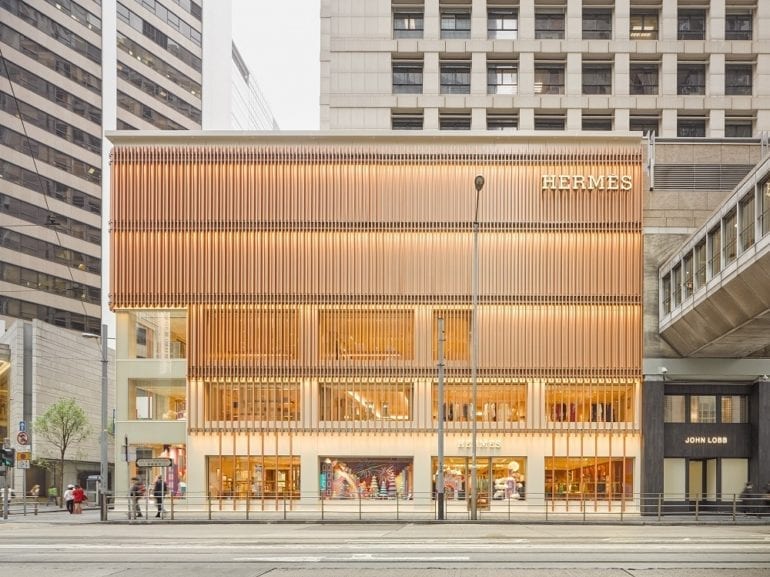
    Designed and built by the Parisian architecture agency RDAI under the artistic direction of Denis Montel, the edifice draws its stylistic influences from local architecture.

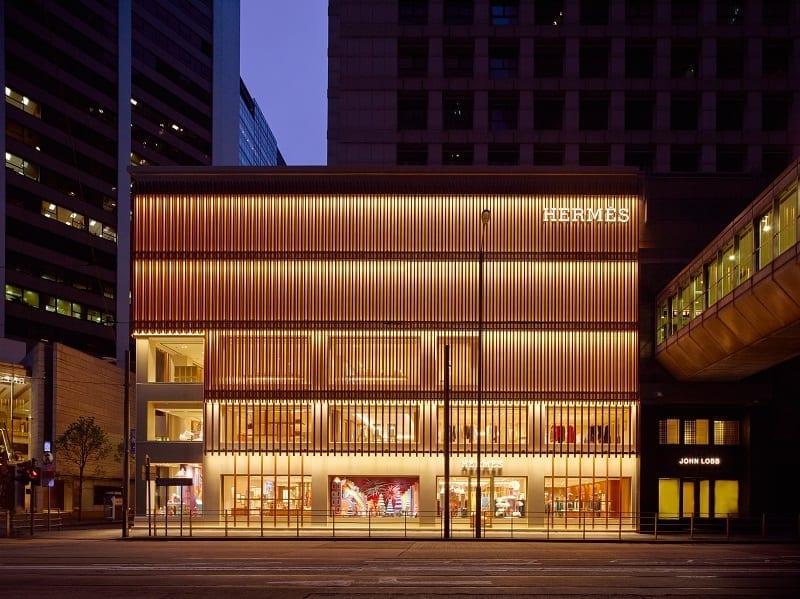
    The design is inspired by bamboo scaffolding construction techniques, the copper-coloured anodised aluminum facade asserts the rhythm and verticality of bamboo.

    Eight kilometres of rectangular tubes align to form a mantle with kinetic effects. This storefront of a thousand reflections allows glimpses of a ground floor, a mezzanine level and an upper floor – three levels totalling 9,167 square feet of retail and reception space.

    The aluminium facade rises a further two storeys, accentuating the presence
    of Hermès at this strategic crossroads in the city. The building’s pre-existing structure – comprising numerous pillars and a low ceiling height – required the architects to draw upon their constructive prowess.

    The building benefits from natural light enabled to penetrate throughout. Staircases and daylight cascade down the openings. The three floor areas have been subdivided using openwork screens and mobile partitions to create small lounges and private salons.

    On the upper level, it gives way to a balcony from which the city, its skyscrapers and its double-decker tram can be admired.

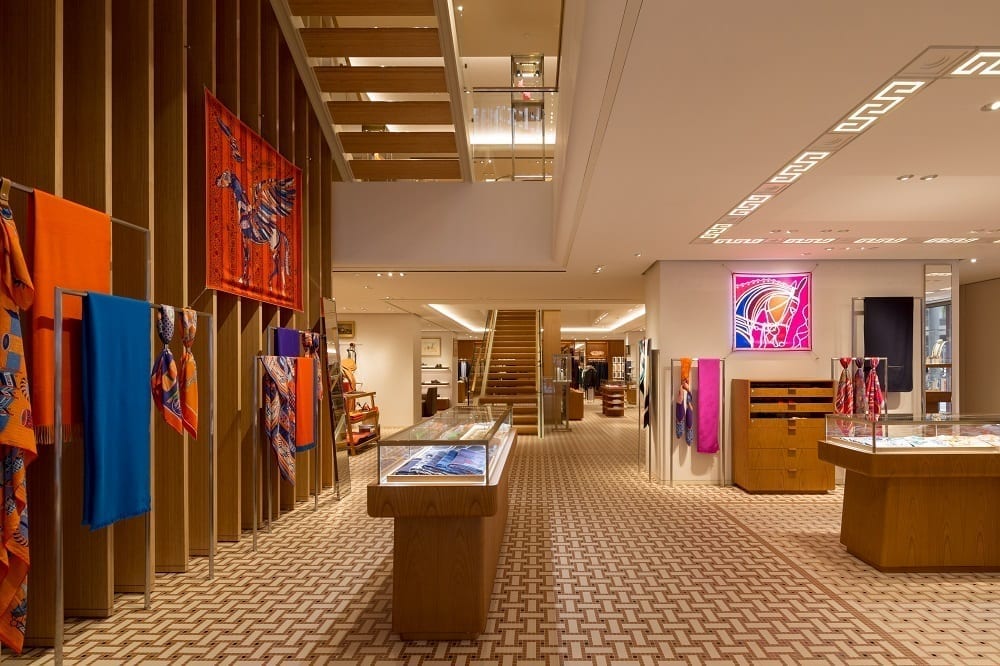
    The store has two entrances. The main door, located on Ice House Street, opens onto spaces dedicated to women’s silk, fragrances, and jewellery accessories.

    Source : Hermès

    The second entrance, on Des Voeux Road, leads to the men’s universe, with silk, shoes, leather goods, ready-to-wear and a private lounge for made-to measure. The mezzanine is formed of a succession of alcoves on either side of the central space, offering an exclusive setting for jewellery. It is home to the women’s universe, with ready-to-wear, gloves, hats, watches, leather goods, and even a powder lounge, a precious and private boudoir.

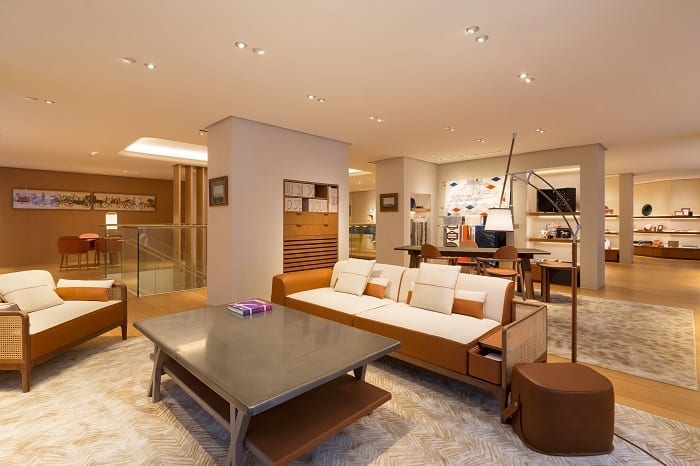
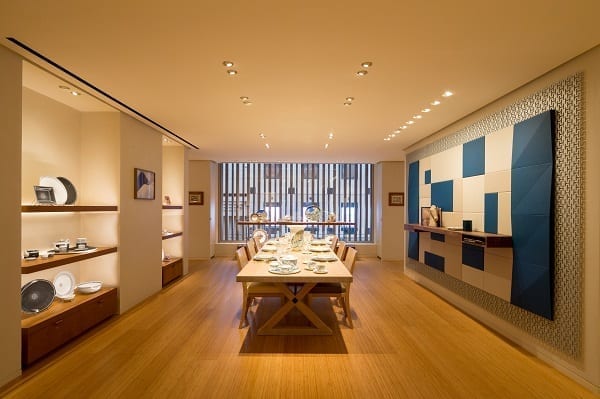
    The upper floor accommodates the home universe: furniture, lighting, furnishing fabrics and wallpapers, tableware, and offers guests a lounge where to enjoy the comfort of Hermès home.

    Source : Hermès

    The floor, in mosaic on the ground floor and bamboo parquet elsewhere, is in places covered with rugs that incorporate the pattern of bamboo fibres.

    Source : Hermès

    The interior design features lacquered wood, leather, stucco, marble, and woven metal. A palette of warm colours ranging from the sandy hue of the women’s universe to the burnt wood shade of the men’s universe. Elements in champagne-coloured woven metal subdivide the spaces.

    The extensive use of glass on both façades suffuses the store with golden light. Filtered by a forest of bamboo in the heart of the urban jungle, it allows a sophisticated nature to regain its rights and powers. In an ultimate act of celebration, Hermès has invited the French duo of artists ZIM & ZOU to transform the store windows with delicate humour into enchanted paper castles.

    The opening was followed by a party in the West Kowloon Cultural District of Hong Kong to link Hermès to the local artistic culture.

    The Orange Box of Hermès is an interwoven space of the brand heritage. It is a celebration of art and craftsmaship, which stands out for its delicate and warm colours. While walking through the three floor, the retail space resembles an art gallery and the products are showcased as if they were artworks to be appreciated more than purchased.

    Isn’t it the image of luxury we all have depicted in our mind and that today seems to be lost?

  • Neiman Marcus appoints new CEO

    Neiman Marcus appoints new CEO

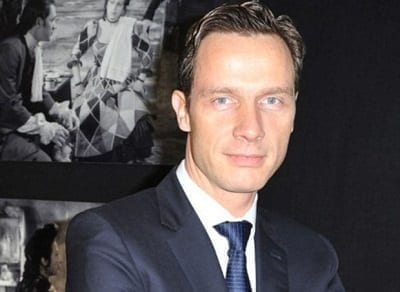
    It is a new era for Neiman Marcus. The US luxury department store chain has appointed a new CEO, Geoffroy van Raemdonck, in the wake of the departure of current chief executive, Karen Katz.

    Karen Katz, who is retiring after more than 30 years with Neiman Marcus, served in her capacity as CEO for seven years. She will relinquish her role next month, 12 February 2018.

    Having served as President for Europe, the Middle East and Africa (EMEA) and global travel retail at Ralph Lauren, van Raemdonck joins Neiman Marcus at a tumultuous time in the company’s history.

    With a solid track record at Ralph Lauren, spearheading the luxury brand’s omnichannel transformation, the luxury executive’s appointment hopes to lead Neiman Marcus into future growth and relieve heavy debts.

    “We are thrilled to welcome Geoffroy to Neiman Marcus, and look forward to extending the company’s positive momentum under his leadership,” said Neiman Marcus chairman David Kaplan.

    “He is a global industry leader and business builder with exceptional vision and energy.”

    Katz will remain on Neiman’s board of directors, and will work with van Raemdonck during the transition process.

    “Geoffroy has an impressive track record of success at luxury brands, and he is the right person to lead the company through this next phase of growth,” Katz said.

    During his career, Van Raemdonck has also spent time at French luxury group Louis Vuitton from 2008 to 2013 and Victoria’s Secret owner, L Brands Inc.

    Neiman Marcus, the Dallas-based group, which owns MyTheresa.com and Bergdorf Goodman, has been struggling since 2013, after Ares and Canadian public pension fund CPPIB acquired it from other private equity firms, and left it with a nearly $5 billion debt load.

    The firm’s most recently financial quarterly result saw losses widen to $26.2 million from $23.5 million over the same period last year, as debt and previously accrued losses continued to weigh on the business.

    However, Neiman Marcus recorded a 4.2% rise in comparable revenue in the first quarter of 2018, which it attributed to its ‘digital first’ strategy and new technology investments.

    Quarterly revenue rose to $1.12 billion, up 3.8% from $1.08 billion a year ago, said the firm.