Tag: Retail

  • Japan studies regular mandatory closings in the Retail Industry

    Japan studies regular mandatory closings in the Retail Industry

    Large-scale specialty stores such as Daiso and Ikea may be subject to mandatory closings every two weeks as the South Korean government studies the validity of such a regulation.

    Research on the appropriateness of the regulation on large-scale specialty stores will start this month, says the Korea Small Business Institute. It will examine whether the big retailers are hurting small shops, and whether the regular closures are necessary. Requested by the Ministry of SMEs and Startups, the study will determine if the regulation is necessary.

    The restriction on such large-scale specialty stores has become the thorniest issue in the retail industry. Large retail outlets such as E-mart, Home Plus and Lotte Mart are subject to restrictions on working hours following a revision of the Distribution Industry Development Act in 2012, aimed at protecting small shops. Local governments adopted ordinances based on the Act, forcing large retail outlets to close on the second and fourth Sunday of each month.

    However, critics say it is unfair as only retail outlets are subject to the regulation while shopping malls such as Shinsegae Group’s Starfield and specialty shops like Ikea were exempted.

  • Overlook to the future Chinese Real Estate market

    Overlook to the future Chinese Real Estate market

    Since the origination of REITs in the United States, in the 50 years of its development, REITs in the United States, Singapore, Japan has been running on a rather perfect system, with legal policies and tax system. REITs was able to help the countries in growth, sustainable decisions, and the industry coordination. China had the first REITs in 2005. Since then, REITs in China have been moving forward, to seek further opportunity.

    The new age of investment has come. PE is the most anticipated type of investment that most of the investors that are eyeing for. According to Asset Management Association of China, by the end of Februrary 2018, PE Fund pool have reached monthly growth of 250 billion Yuan, totaling 12 trillion Yuan. It has its competition to Public Placement.

    With the development of Real Estate Equity Fund and REITs, an increase in the amount of firms are interested to be a part of it. As the fundamental, Finfo Global along with CaishiV is going to host the 2nd Real Estate Equity Investment & REITs in Shanghai on May 17. The event have gathered worldwide trust firms, insurance company, law firms, securities, asset managements and banks. The event is excepting more than 300 managerial positioned attendees.

    At the event, Weida Kuang from China Remin University, National Development and Strategy Institution, City and Real Estate Institution with be introducing his ideas over the macro economy and the effect of the industry of real estates. Also, there are newly added topics such as low-cost rental housing, public rental housing, rental housing REITs, investment opportunities in second and third tier cities, offshore real estate PE Fund and its structuring,

    To learn more, please go to: https://www.peinreits.com/index.php/en/index.html

  • Myanmar allows full foreign ownership in Retail Business

    Myanmar allows full foreign ownership in Retail Business

    Foreign companies are now allowed to invest in Myanmar’s retailers and wholesalers, including holding 100% stakes, as the country makes efforts to lift foreign investment amid the Rohingya refugee crisis.

    The Ministry of Commerce announced the change on Friday, explaining that it wants to increase competition in the sectors and promote price stability and technology transfers. The new rule took effect on Wednesday.

    But restrictions still apply. Foreign companies must invest at least $700,000 to take an up to an 80% stake in retailers, and $3 million for anything more. They cannot own minimarkets and convenience stores with floor spaces of 929 sq. meters or less. For wholesalers, the minimums are set at $2 million for up to an 80% stake and $5 million for more.

    The ministry is also letting foreign companies themselves bring their products into Myanmar and sell them instead of going through local importers as in the past. This could encourage automakers and appliance manufacturers to make further inroads here.

    Foreign companies could technically take stakes in Myanmar retailers and wholesalers before if they received the ministry’s approval. But almost none got the green light. Japanese retailer Aeon, one of the handful that did, began operating supermarkets with a local partner in 2016.

    Emerging economies often restrict foreign investment to protect homegrown retailers and wholesalers. It is unusual for a country like Myanmar, with per capita gross domestic product of only $1,200 or so in 2016, to relax the rules so much.

    But de facto civilian leader Aung San Suu Kyi has come under fire for delays in key economic reforms. And human rights abuses against the Rohingya Muslim minority, hundreds of thousands of whom have fled to neighboring Bangladesh, are making American and European businesses uneasy about operating in Myanmar.

    The country approved about $5.7 billion of foreign investment in the 12 months ended March, down for a second straight year. A further decrease could throw a wrench into a development strategy heavily reliant on foreign money.

  • Shiqi Metro Mall golden egg for Dasin

    Shiqi Metro Mall golden egg for Dasin

    Acquired on June 19 last year, Shiqi Metro Mall has proved a profit booster for Dasin Retail Trust, according to its financial results for the three months to the end of March.

    Dasin is the only China retail property trust providing direct exposure to the growth of the Guangdong/Hong Kong/Macau Bay Area, and has an initial focus on retail malls. Its four present malls each had 100 per cent occupancy at the end of March.

    Largely because of the contribution of the Shiqi mall in Zhongshan, net property income year on year increased by 85 per cent. This was 3 per cent higher than forecast.

    Opened 10 years ago, the regional mall’s anchor tenants include Gome Electronics, Jane Eyre Furniture Mall, Jinyi Cinemas, KFC, RT Mart, Starbucks, Superior City Department Store, Watsons and Xin Xuan Hotel Restaurant.

    Other Dasin malls include Xiaolan Metro Mall, with tenants including Bank of China, Chow Tai Fook, KFC, McDonald’s, Pizza Hut and Sunning.

  • Global Brands expects massive loss this year

    Global Brands expects massive loss this year

    A big swing to a loss is expected by apparel group Global Brands Group Holding for its latest 12 months, to the end of March.

    A preliminary assessment of its accounts indicates a net loss attributable to shareholders of between US$70 million and $75 million.

    This compares to a net profit attributable to shareholders of about $90 million for the previous 12 months.

    Global Brands says the expected loss is primarily the result of one-off impairment charges from the write-off of a receivable arising from a loan made by the company, as well as impairment charges on various intangible assets. Also, a major licence expired during the year. Exceeding $100 million, the impairment charges and receivable write-off were non-cash adjustments.

    The company expects to release its annual results late next month.

  • New Zealand Consumer spending finished stronger in 2017

    New Zealand Consumer spending finished stronger in 2017

    Consumer spending growth accelerated to five per cent year-on-year in the three months to the end of December last year, with retail trade picking up momentum over the holidays, new National Australia Bank data has revealed.

    Up from three per cent growth y/y in the third quarter, NAB’s latest quarterly customer spending report, which measures around 2.7 million daily transactions through the bank’s facilities, has tracked spending increases across the entirety of metro and regional Australia.

    Retail trade increased 3.4 per cent y/y in Q417, up from 2.4 per cent in the third quarter, while accommodation and food services spending was 10.4 per cent, up 3 per cent.

    The Northern Territory was the strongest growth state for retail trade, up six per cent, offsetting a 0.6 per cent decline in Western Australia.

    Retail trade spending growth was 4.7 per cent in Victoria and 3.3 per cent in NSW. Across the entire economy Victoria was the strongest performer, while NSW and NT lagged.

    Average monthly customer spending during the quarter was up $166 to $2306 in metro areas and up by $104 to $2089 in regional areas.

  • Hong Kong retail rents about to rise again

    Hong Kong retail rents about to rise again

    Hong Kong retail rents will recover more quickly in Kowloon than on Hong Kong Island according to projections by Colliers analyst Melanie Kotschenreuther.

    Kotschenreuther predicts high-street Kowloon retail rents will rise 5 per cent in Mong Kok this year and 3 per cent in Tsim Sha Tsui, while across the harbour, high-street rents will rise by 2 per cent in both Causeway Bay and Central.

    “Rising retail sales and robust demand for prime locations should contribute to a slight recovery of overall high-street rents this year,” she writes in Collier’s First Quarter Hong Kong Retail analysis.

    “Second- and third-tier high-streets will likely remain under pressure in the first half year.” Next year, however, Colliers expects overall high-street rents to rise by 3 to 5 per cent.

    Kotschenreuther says the decline in high-street retail rents in major districts continued to slow, with average rents edging down 0.3 per cent quarter-on-quarter in the first three months of this year.

    “While some first-tier high-street retail rents, except in Central, have started to regain momentum due to robust demand for prime spots, rents outside first-tier high-streets in popular shopping areas have remained soft. Mong Kok, led by further rental improvements on first-tier Sai Yeung Choi Street South, could continue its positive direction, with overall high-street rents growing 0.9 per cent quarter-on-quarter. In contrast, overall high-street retail rents in Central dropped by another 1.4 per cent quarter-on-quarter in the first three months of this year as rental adjustments, particularly on second and third-tier high streets, continue.”

    She says one of the reasons for this is the large size shop configurations common within the area.

    Malls recovering

    Territory-wide, improved market conditions and rapidly recovering retail sales (up by 15.7 per cent during the first two months of this year) combined with proactive strategies by shopping centre owners will help drive further improvements in mall rents in the year ahead.

    “Malls are being transformed into lifestyle hubs, driven by new demand for excitement. We expect continuing tenant-mix refreshments and extended new dining experiences, paired with a comprehensive entertainment program. Mall operators are stepping up digital customer engagement and launching mobile apps to attract new visitors.”

    She says the financial results of operators of prime malls in major retail districts show a positive development of their tenant sales last year. Wharf’s flagship mall Harbour City in Tsim Sha Tsui and Champion’s Langham Place Mall located in Mong Kok announced year-on-year growth of 9.1 percent and 5.3 per cent, respectively – above Hong Kong’s overall retail sales growth last year of 2.2 per cent.

    “The upturn has extended into this year, with shopping malls enjoying a positive start into the Year of the Dog. Sun Hung Kai Properties announced that foot traffic in 12 of its malls was up 13 per cent and retail sales jumped 16 per cent during the Lunar New Year.”

    She says the appetite for international affordable luxury and lifestyle brands, medicines and cosmetics and new F&B concepts is increasing, which will help strengthen rents.

    Meanwhile, Colliers predicts 1.41 million sqft (131,200sqm) of new retail space to come on stream in core retail districts this year and a further 339,700sqft (31,560sqm) next year, led by Victoria Dockside in Tsim Sha Tsui and H Code in Central this year and at 15 Middle Road in Tsim Sha Tsui next year.

  • Kanmo Retail Group Digitises Retail Game with Capillary Technologies

    Kanmo Retail Group Digitises Retail Game with Capillary Technologies

    Capillary Technologies, a leader in omnichannel engagement and commerce solutions, has been locked in as the omnichannel partner for Kanmo Retail Group, which manages a portfolio of more than 70 brands across Indonesia, including Mothercare, Karen Millen, Coach, Justice and T.M. Lewin.Capillary will play a strategic role in supporting Kanmo Retail Group’s mission to provide outstanding retail experiences to customers through designing and powering the technology that enables the business to seamlessly connect online and offline customer journeys.

    As the Indonesian market charges towards digitising traditional retail stores and taking on an omnichannel approach, Kanmo Retail Group recognises the growing need to build a truly omnichannel system that puts their customers at the centre of everything they do.

    “Kanmo Retail Group caught on early to the fact that Indonesia is undergoing a digital boom. However, to truly yield results from our omnichannel strategy, we have to look beyond just engaging our customers through offline and online means. We have to take into consideration all customer touchpoints across our various brands and integrate them seamlessly onto a single platform,” said Bhavin Patel, Group Omnichannel Director at Kanmo Retail Group said.

    “Not only does Capillary helps to integrate all our existing systems and merge them into a single, omnichannel experience platform, they also provide us with the flexibility of scaling and easily deploying the solution accordingly. Additionally, the advanced AI-based reporting and actionable insights engine enabled us to analyse data across channels which in turn provide us business insights and allowing us to improve our campaigns,” Patel added. “All these made Capillary the perfect choice for us.”

    Capillary Vice President and Business Head for Asia Pacific, Abhijeet Vijayvergiya commented on Capillary’s partnership with Kanmo Retail Group, “We are excited to be working with Kanmo Retail Group and empowering their digital journey. With a passionate team at Capillary accompanied with Kanmo Group’s futuristic vision, we look forward to seeing a long-term and rewarding partnership.”Kanmo Retail Group is currently using the following solutions from Capillary Technologies:

    • Capillary’s Loyalty+ and Insights+

    Kanmo Retail Group will be able to build an omnichannel loyalty programme that ensures customers can continue their seamless journey across all Kanmo brands. At the backend, all Kanmo brands will now have a 360° single, unified view of their consumers across channels and have access to in-depth actionable insights and recommendations for the next critical interaction.

    • Capillary’s Order Management System

    As part of Anywhere Commerce+, this feature allows Kanmo Retail Group to integrate all their inventory in the backend with all the orders that have been placed. With a single view of orders and inventory, Kanmo store employees can easily assist customers with omnichannel experiences such as placing orders from the store that can either be picked up from any store of their choice or be delivered to their homes. It would also help Kanmo Group increase efficiency and reduce errors in fulfilment across their omnichannel operations.

    In Southeast Asia, Capillary is working with 14 million customers and has 14 hundred stores active on its platform, including Mitra10, Bata, Caring Pharmacy, TungLok Group and McDonald’s. Fresh off a US$20m funding round led by blue chip investors Warburg Pincus and Sequoia Capital, Capillary also plans to use some of the new funds in strengthening its presence in Southeast Asia, including Indonesia, after achieving a threefold growth in the region.

  • How does the Facebook inquiry relate to retail?

    How does the Facebook inquiry relate to retail?

    In the latest example of the United States Democratic political machine’s inability to accept losing the ‘un-losable election’, Facebook has become the next scapegoat for failure.

    The spectacle of one small geeky guy being bullied by 20 senators and the might of the ‘political inquisition’ is absurd theatre that may provide some people with an avenue to exorcise their frustration but will change little.

    Why? For three very good reasons.

    Firstly, the very foundations of e-commerce rely on monetising data collection. Without it the model does not work and the world leader in e-commerce technology and its monetisation is the United States.

    Secondly the intelligence community is so intertwined in this web that it will defend it at all costs.

    And thirdly, while when confronted with direct questions about personal data consumers may offer negative opinions, their behaviour betrays that they care more about what they can get than they do about what information is collected as a result of their actions.

    If there are any traditional retailers expecting e-commerce to be derailed as a result of the Facebook inquiry they will be sadly disappointed. The media angle taken on e-commerce data portrays the lemming-like thinking that sees e-commerce (which produces less than 10 per cent of retail sales dollars and a fraction of the gross margin) given a halo of power that magnifies its influence beyond its natural impact.

    Data collection and its manipulative use online creates the virtual equivalent of a product stalker following a shopper around a centre and shouting in their ear every five minutes that they should buy their product for a discounted price until the customer either capitulates or runs away.

    Most shoppers (read more than 90 per cent by dollar value) would prefer to buy at physical stores for a multitude of reasons. However what data allows online outlets to do is destroy competitors by starving their profitability – not by providing a better alternative.

    E-commerce outlets do not build brands. They generate transactions. They do not build experiences. They provide transactional convenience. And they use data to do it. Make no mistake, they can decimate traditional retailers who either put their head in the sand and ignore them or react the wrong way.

    Unless the retail industry starts to think strategically, rather than tactically, e-commerce may end up with the majority share of retail purely by outlasting bricks and mortar retailers economically by starving them of profitability.

    So regardless of any meaningful legislative changes that are unlikely to emerge from the Facebook inquiry, the e-commerce game will roll on and the technologically enabled, globally connected marketplace will continue to evolve beyond the ability of legislator’s attempts to curb it.

    It is not new (we’ve been collecting data on consumers in one form or another since commerce began) but it is technologically turbo-charged.

    However, as any true merchant will tell you, there is a big difference between data points and really knowing what turns on a customer and how to charm them. That is where the real opportunity will always live for real retailers and brands as distinct from product and price catalogue sellers.

  • Online Giants Carve Out Twin Empires in China’s Age of New Retail

    Online Giants Carve Out Twin Empires in China’s Age of New Retail

    The largest e-commerce players in China have rapidly expanded their scope and reach in recent years through a wave of investments and acquisitions. Alibaba owns two of China’s largest e-commerce platforms, Taobao and TMall, as well as an electronic payments system, AliPay. JD has allied with Tencent, which owns WeChat. Now, a report released by Oliver Wyman, a global consulting firm, analyses how the two players’ ubiquity in mobile payments, deep consumer data and sophisticated logistics capabilities has resulted in a new ‘age of empires’ in China’s retail sector where incumbents must quickly adapt to survive.

    The report, Chinese Grocery’s Age of Empires, reveals the e-commerce giants’ efforts to drive further growth by introducing new shopping formats – dubbed O2O, or online-to-offline. These blend online shopping’s convenience and wealth of information with the social experience and physical contact with products that people enjoy in traditional, brick-and-mortar stores. This is most immediately visible in the online grocery sector, where Alibaba and Tencent/JD are actively pursuing three strategic plays that could together increase their share of grocery shopping from around 10 percent today to around 30 percent over the next five years, by when it could be worth approximately 400 billion renminbi in gross merchandise value.

    “With the grocery sector seeing mobile payment penetration of 35%, the two giants are seeking to maximize their critical advantage of dominance in covering 97% of the overall mobile payment market,” says Richard McKenzie, Partner, Greater China at Oliver Wyman. “Now their investments are rapidly building a wider ecosystem of alliances that will make them ubiquitous through online-to-offline tools and features.”

    Over 460 million people in China regularly shop online, where densely populated cities facilitate home delivery. As a result, China has leapfrogged other markets to take the lead with nearly 10 percent of the population shopping for groceries online, compared to just 3 percent in the United States and 6 percent in the United Kingdom, Europe’s highest rate.

    This rapid change favors the two giant empires, which could make it hard for independent retailers to survive outside of them, evidenced by declining like-for-like sales and margins among China’s traditional supermarkets and convenience stores over the past few years. However, they may yet survive in some form with help from the online giants themselves, leveraging the empires’ logistics networks, rapid delivery services and new software solutions.

    Both empires are building their O2O power through three plays, each of which blends their online capabilities with offline stores in new ways:

    1. Experimentation with own retail formats

    Unlike supermarkets elsewhere that offer online shopping in parallel with a traditional in-store experience, China’s players integrate elements of the two. For example, Alibaba’s Hema stores offer smartphone payment and home delivery within 30 minutes. . Though expensive to set up and with high initial running costs, these stores are only marginally loss making. With further maturity and ramp up, breaking even is within reach. Oliver Wyman believes there is potential for at least 1,000 stores in major cities with total revenues of RMB 200 billion.

    1. Strategic Partnership with Big Box Retailers

    Big-box retailers have tried and failed to launch their own O2O and online shopping services in the past. Amid pressure from the online giants, a flurry of partnerships has seen large retailers aligning themselves with the two tech empires. These show early signs of success as parties combine their different strengths. Examples include Alibaba installing Tmall Supermarket shelves in RT-mart branches, with one-hour home delivery for products on these shelves, while Walmart, which has a strategic partnership with JD, is using its O2O unit JD Daojia as the service platform for over 150 stores to attract online traffic.

    1. Reinvention of the traditional world of “mom and pop” shops

    Traditional stores still account for half the sales of fast-moving consumer goods in China, much of them through the more than 7 million family-run stores that dominate retail outside big cities. Since early 2017, JD and Alibaba have been converting these into franchises, helping them optimize their stock through data-based curation tailored to their neighborhoods. Smartphone-based ordering systems and rapid delivery have also revolutionized procurement. Tmall planned to open 10,000 such franchises in 2017, while JD is aiming for one million by 2021. Alibaba and JD are further likely to dominate the growing market for their ordering systems, a market that could be worth up to RMB 400 billion over the next five years.

    Wai-Chan Chan, Partner, Greater China at Oliver Wyman notes, “China has not only surpassed the US in terms of online grocery penetration but also in terms of the pace of innovation and introduction of value-added services. Customers at a Hema store can pay seamlessly via their mobile phone, have fresh crayfish cooked in-store and delivered to their home within 30 minutes. Players in other markets are still some way behind in matching that offering.”

    As O2O becomes the new normal in retail, the two alliances will act as both players and facilitators of these models. While retailers and brands need to plan the best way to function in a retail world dominated by the two tech empires, identifying opportunities for synergy, it will pose a more serious challenge for some incumbents.

    The new environment will pose serious challenges to independent supermarkets and hypermarkets. Survival will require drastic changes, but this is unlikely under their current set-up. Some leading convenience stores should be able to survive outside these empires in the short term, but they too will come under threat in time from the revival of family-run stores under the franchise networks run by the two giants.

    The tech empires will inevitably influence the shape and future of the supermarket and hypermarket industry. It is crucial for incumbents to find ways to partner or co-exist with them if they are to survive and thrive.
  • Fast Retailing Group’s profit soars despite efforts

    Fast Retailing Group’s profit soars despite efforts

    Fast Retailing Group’s profit soared 30.5 per cent in the six months to the end of February – on sales up a healthy 16.6 per cent.

    The Japanese fast-fashion company, which owns Uniqlo and GU, among other brands, said consolidated revenue totalled ¥1.1867 trillion (US$11.05 billion) while operating profit reached ¥170.4 billion (US$1.587 billion).

    Uniqlo’s international business drove the growth, with both Uniqlo Japan and the fast-growing GU brand performing strongly as well.

    As it pursues its medium-term vision to become the world’s largest apparel retailer, the company is focusing on Uniqlo and GU. It sees opening global flagships and large-format stores in major cities around the world as a key strategy “to help consolidate Uniqlo’s position as a key global brand”.

    “Within the Uniqlo International segment, Greater China (Mainland China, Hong Kong and Taiwan), Southeast Asia and South Korea are entering a new stage of growth as the key drivers of operational growth for the Fast Retailing Group,” the company said in an earnings statement.

    Operating losses at Uniqlo USA contracted, putting that business on track to turn a profit going forward.

    “In terms of the GU operation, we plan to open more GU stores in Japan, while expanding the brand’s international presence, especially in Greater China.”

    Uniqlo’s domestic Japanese operation also achieved an increase in sales and profit in the first half year. Revenue totalled ¥493.6 billion (up 8.5 per cent) and operating profit ¥88.7 billion (up 29 per cent). In the six months to February 28, same-store sales, including online sales, expanded by 8.4 per cent year-on-year. Online sales increased 31.6 per cent to constitute 7.5 per cent of total revenue.

    Uniqlo International’s profitability improved in Greater China and South Korea on higher sales, driven by strong sales of winter ranges such as HeatTech and down. Uniqlo Southeast Asia and Oceania continued to generate a strong performance, with solid demand for summer clothing and firm demand from travellers for winter clothing resulting in significantly higher first-half revenue and profit.

  • Zara Debuts Augmented Reality Retail Experience for Limited Time in Select Stores Worldwide

    Zara Debuts Augmented Reality Retail Experience for Limited Time in Select Stores Worldwide

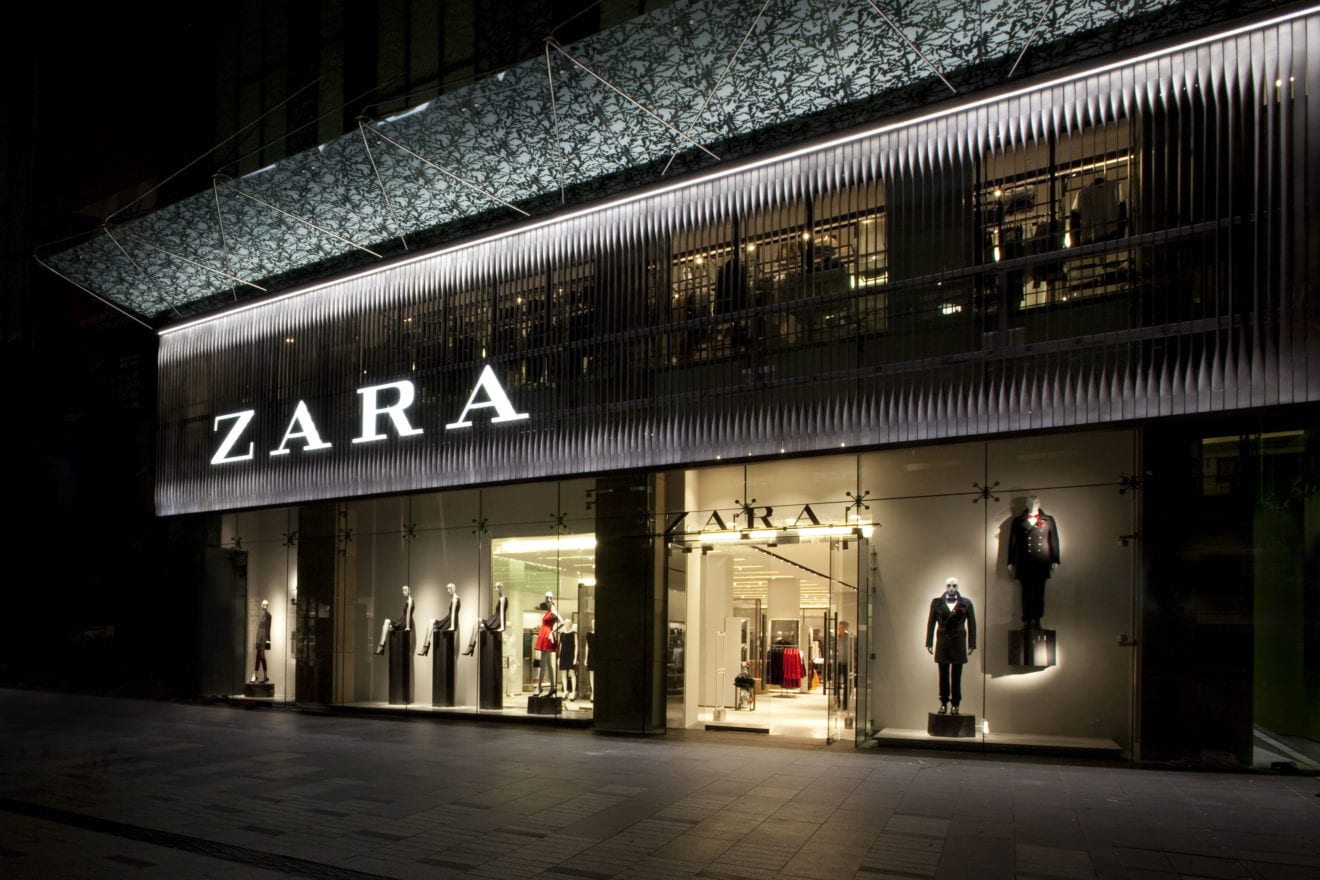
    Zara will unveil an augmented reality experience running for two weeks in select stores worldwide. The innovative concept superimposes state-of-the-art technology on the retail environment, engaging customers both outside and inside the store to shop and to share like never before.

    This made-to-measure augmented reality is enabled on mobile devices via the Zara AR app. The activation plays out at three different sites: store windows, centrally-located podiums, and atop e-commerce boxes. When smartphones are positioned at the graphic signage, models Léa Julian and Fran Summers seemingly come to life as 7 to 12-second sequences in people’s screen displays. Incredibly realistic and proportioned according to each setting, they naturally pose, move around, and even speak while dressed in the SS18 Zara Studio Collection. All of their looks can be purchased instantly through a single touch on the Zara AR app, as well as in store.

    The experience will be highly visible from the street, with store windows appearing completely empty aside from bold signage encouraging people to access the Zara AR app. Downloading is easy: simply connect to the dedicated Wi-Fi network, or else by QR code, via iTunes and Google Play, or through the link on zara.com or the app. In addition to the shopping feature, a social media sharing feature invites people to take and send photos alongside the holograms, establishing a virtual connection that seems remarkably real. To maximize the limited-time experience, different sequences of new looks will be introduced after the first week.

    Zara Augmented Reality is the conception of Paris-based creative director, Ezra Petronio, who developed this high-quality experience and app with HOLOOH, a French company, in addition to research partner, INRIA (the French National Institute for computer science and applied mathematics). The 12 dynamic sequences were captured as holograms in a 170-square-metre studio involving 68 cameras, among the largest recording systems of its kind in the world. Petronio, who is also the co-founder of Self Service magazine, enhanced Issue 47 (September, 2017) with a shop-able augmented reality component.

    With augmented reality finding more and more real-world applications, the Zara experience demonstrates how innovation, inspiration and additive technology can reimagine conventional retail. Engaging in both the store environment and the app simultaneously, shoppers will discover ease of use alongside their sense of awe. Zara’s global reach brings the advanced renderings to a wide and inclusive public. In a sense, this exciting concept could not have been more natural for the retailer: as the dedicated branding makes clear, augmented reality has been within Z-AR-A all along.

  • Daigou retailer to expand into over 150 pharmacies

    Daigou retailer to expand into over 150 pharmacies

    Daigou retailer AuMake has inked a deal with pharmacy network Chemsave which will see its own branded products distributed through a network of 150 pharmacies across the country.

    The announcement, which follows the listed retailer declaring a trading halt earlier this week, will see Aumake’s own-branded health supplement and honey products distributed initially, prior to further expansion.

    Cross promotional marketing will accompany the products, with AuMake’s recently launched live streaming functionality to move into some Chemsave pharmacies.

    The listed retailer hopes that the partnership will bolster its credibility of its private label range, while Chemsave is looking to increase its exposure to the Chinese market.

    “Aumake is thrilled to have formed this strategic partnership with Chemsave, which is a significant milestone,” Aumake executive chairman Keong Chan said of the deal.

    “This partnership with Chemsave allows us to significantly expand the reach of our products across Australia … this is not simply a distribution agreement but a long-term mutually beneficial strategic alliance.”

    Chemsave CEO Michael Dixon concurred, saying that the Chinese market represents a lucrative opportunity for its network.

    “Over the last year we have had the opportunity otm eet with a number of groups with a view to forming a partnership that will allow us to grow our members’ businesses and increase our presence with the important and influential Chinese consumer,” he said.

    The initial terms of the contract are set out across two years, with an option for a further two-year extension if mutually agreed.

    Aumake shares rose 10 per cent to 27 cents in early Wednesday trading.

  • Time to go to into a retail rehab

    Time to go to into a retail rehab

    Why are retailers failing at such an alarming rate?

    The preconditions for any business to be successful are:

    1. Is there a real market need that I understand?
    2. Do I have access to a product or service address that need?
    3. Am I sufficiently equipped (skills, resources, motivation etc) to address this opportunity in a particular way that provides me with a competitive advantage or at least desirable point of difference?

    Points one and and two are usually not the issue because failure is quick – if the business even succeeds in getting off the ground.

    The root cause of many failures can be found in HOW the retailer chooses to play the arbitrage game of tapping into a supply to meet a need.

    That is, entrepreneurs will pick the way in which business is done (proposition delivered) and attempt to build some differentiation around that that can be defended at a profit.

    Timing: First or faster

    An example would be Zara that aims to bring the latest fashion (from the catwalk to the store) in less than six weeks – and if anecdotal reports are to be believed have done so in a matter of days. Or you can be the Concord. Or the movie house that shows all the premiers.

    Leverage:  Add value, minimise cost

    Someone turns raw meat into patties, someone solves the challenge of distributing fuel to every town in every country. Someone is the cheapest, someone figures out how to make things smell better, work differently, last longer or taste better. We are limited only by our imagination and the possibilities of innovation are endless. Of course, any particular innovation can be made redundant in a flash.

    Change: Adapt, transform, improve

    More than simply adding value, there are opportunities for entrepreneurs to transform products completely. Old tires can become road base. Cars can be turned into supercars or transformed into vehicles for mobility impaired people and clothes can be altered to fit. Wind can be turned into electricity.

    Access: Exclusive or convenient

    Businesses also exist on the premise that access to the product/ service is exclusive or particularly convenient. This is a very typical ‘advantage’ that many smaller retailers rely on, and it is most often also their weakness. E.g. to be the only menswear retailer in Yepoon or the only newsagent in the shopping centre, or maybe even the only convenience store on that particular side of that particular city block leverages ‘access’ as the method of arbitrage.

    Most small, product-oriented retailers tend to rely on the ‘access’ angle to create a POD. Retailers tend to be resellers, so innovation is not a primary focus. The only value-add lies in the bulk-breaking activity. These SME retailers are content to be ‘the only shoe shop’ in the mall as their core proposition.

    In the past this has been a legitimate approach to ‘capitalise’ on an opportunity. There has always been limits as to how far people would travel to gain access to a product, so geography-based retail propositions have been viable since forever.

    But, reliance on this particular approach is the reason why the technological shift in the market is causing serious competitive pressure. And being blind to the change that has occurred is the cause of many retail failures.

    Too many retailers rely on the fact that they are ‘the only’ cafe on the strip, the only menswear retailer in a suburb, the only servo on that street.

    If you merely rely on being the only store in a particular geography, the internet obliterated that point of difference because on the internet, geography hardly matters.

    Everything that is for sale is in every customer’s pocket. And the time delay (caused by delivery requirements) are (a) offset by cost saving and (b) becoming shorter and shorter. In metropolitan areas, many e-commerce providers are providing same-day delivery and food delivery businesses do it in a matter of hours.

    This leaves traditional corner-stores an ever-shrinking market comprising mostly of emergency shoppers or impulse buyers.

    That is why Amazon poses such a threat to retailers – suddenly there is a competitor that it is more convenient and cheaper than your shop on your corner, and you can do very little about it.

    The internet has made geography irrelevant – and if THAT has been the basis of your business, so is the business.

    The only appropriate response is to change your execution. You need pick a different propositional dimension to differentiate.

    The problem is obvious. The solution is obvious. But maybe, like any good rehab program, the starting point is to admit the problem.

  • Pop-ups leading way for Dickies Vietnam

    Pop-ups leading way for Dickies Vietnam

    Dickies Vietnam is planning to open its first Ho Chi Minh City flagship store.

    Meanwhile, the American apparel brand is paving the way by opening pop-up stores at Diamond Plaza, Parkson C&T, Parkson Hung Vuong, Parkson Saigon Tourist and Takashimaya from this month through to June.

    Dickies arrived in Vietnam in November under distribution deal between Son Kim Fashion and Williamson-Dickie, with a flagship store being opened at Vincom Royal City in Hanoi.

    The group plans to open 30 Dickies stores in five years.