Tag: Singapore

  • Clarion Events Asia Announce the Acquisition of RetailEX ASEAN

    Clarion Events Asia Announce the Acquisition of RetailEX ASEAN

    Clarion Events Asia, part of the global Clarion Events Group – a leading event organiser, producing and delivering innovative and cutting edge events since 1947 – today announced that they have acquired RetailEX ASEAN, a fast growing trade exhibition serving retailers in the ASEAN region. Co-organising the event with IMPACT, the premium venue in Thailand, Clarion Events look to enhance its offering to the retail industry in Asia.

    The purchase of RetailEX, based in Thailand, further increases Clarion Events involvement in the Asian retail market. “The combination of RetailEX ASEAN’s early success with Clarion’s history of nurturing events will provide our clients with the business intelligence to transform retail in Asia” said Richard Ireland, Managing Director of Clarion Events Asia. “The acquisition is expected to result in a show that can support the needs of retailers across ASEAN as they transition through the next 5-10 years of exciting transformation. We are grateful that the co-founder of RetailEX ASEAN, Ms Rosalind Ng, Managing Director of Globe International Events Consultancy has set a good foundation for us to bring the event to the next level.”

    “A partnership was formed with Clarion Events Pte Ltd (Asia) to broaden and strengthen RetailEX ASEAN’s position in the ASEAN region,” commented Mr Loy Joon How, General Manager, IMPACT Exhibition Management. “This new collaboration with Clarion Events could not have come at a better time for us as we are anticipating new upcoming challenges for the ASEAN retailers in this digital age of disruption. Clarion Events, with their success in e-Commerce and Internet Retailing events will bring a whole new dimension to RetailEX ASEAN, which now promises to be the most complete and most exciting retail trade show in the region.”

    RetailEX Asean will continue to operate under that name. Clarion Events will leverage the IMPACT team’s knowledge of the market and to work closely with them during the integration of both companies – which will take place over the next 6 months, leading to the RetailEX ASEAN show happening on 14-17 September, at the IMPACT Exhibition Hall, Bangkok. “With the involvement of Clarion Events, our clients will expect higher international quality services,” stated Mr Loy. 

    To augment the offering to retailers of the region, Clarion Events will introduce Internet Retailing Expo (IRX) ASEAN to co-locate with RetailEX ASEAN. With a successful history in Indonesia the event provides a vital digital/ ecommerce offering to retailers looking to compete in the online retail space. “We look to offering the Thailand retail market even more expertise from around the world and seeing more visitors attracted to the show this September” says Richard Ireland. 
  • Real Singapore retail sales slightly rising

    Real Singapore retail sales slightly rising

    Real Singapore retail sales – the data excluding motor vehicles – recovered 0.7 per cent in December over November – and by an even smaller 0.3 per cent year-on-year.

    Retail sales index Feb.

    The total value of retail sales in December 2016 was estimated at $4.2 billion, similar to that of December 2015.

    Sales of computer & telecommunications equipment and department stores fell 6.8 per cent and 2.2 per cent month-on-month.

    But sales of watches & jewellery, medical goods & toiletries, optical goods & books, recreational goods, mini-marts & convenience stores, furniture & household equipment, petrol service stations and supermarkets increased between 1.2 per cent and 6 per cent. Retailers of wearing apparel & footwear and food & beverages recorded marginal growths of 0.2 per cent and 0.1 per cent respectively.

    Year-on-year, retail sales of medical goods & toiletries, recreational goods, furniture & household equipment, mini-marts & convenience stores, optical goods & books and supermarkets rose between 0.8 per cent and 9.9 per cent in December 2016.

    In contrast, sales of computer & telecommunications equipment fell 9 per cent, with sales of petrol service stations, food & beverages, wearing apparel & footwear, watches & jewellery and department stores down by between 0.3 per cent and 2.2 per cent.

    Food & beverage services

    Sales of food & beverage services (seasonally adjusted) fell 2.2 per cent in December 2016 month-on-month. Compared to the same period last year, sales of food & beverage services declined 0.3 per cent in December 2016.

    F&B index Feb.

    After seasonal adjustment, turnover of fast food outlets decreased 5.6 per cent month-on-month, while sales of other eating places (such as cafes), restaurants and food caterers fell between 1.5 per cent and 1.8 per cent over the same period.

    Year-on-year, restaurant sales declined 7.9 per cent, but turnover at other eating places, food caterers and fast food outlets rose between 3.7 per cent and 5.1 per cent.

  • Singapore soya-sauce chicken chain for Taipei

    Singapore’s soya-sauce chicken hawker outlet is heading overseas with Taipei as its first stop.

    The Michelin star restaurant’s Taiwanese debut will be at Hoyii North Station in the first half of this year.

    Owner Chan Hon Meng says he is excited to share Singapore’s food culture with the rest of the world, and hopes this will encourage more young people to join the hawker profession.

    Like Hawker Chan, which opened in Smith Street in November, the Taipei outlet will be a quick-service restaurant.

    Chan’s signature soya-sauce chicken dish earned a one-star rating in the inaugural Singapore Michelin Guide last July. His hawker stall at Chinatown Food Complex is touted as the cheapest Michelin-starred food establishment in the world, with its award-winning noodles selling at only S$2.50 (US$1.76).

    If the Taipei branch succeeds, Chan hopes to next expand into Malaysia.

  • Funding Societies launches mobile lending app

    Funding Societies launches mobile lending app

    Funding Societies has launched FS Bolt – a mobile application designed to provide flexible working capital loans for Singapore SMEs.

    Complementing the government’s financing programs for SMEs, FS Bolt offers loans with quantum up to S$20,000 ($14,000) for companies incorporated in Singapore.

    Available on both iOS and Android devices, the application process takes two minutes to complete, claims the company.

    An automated credit assessment process enables decision time of two hours and disbursement within 24 hours – making FS Bolt a quick source of working capital loans in Singapore.

    FS Bolt also provides loan tenor flexibility – It charges no fees for early repayment, atypical of financial products in the market. With this feature, borrowers only pay interest while using the funds and are encouraged to repay their loan as soon as their finances permit.

    Addressing the underbanked SME concerns

    SMEs face many hurdles when seeking financing as they often lack credit history, collateral, and sophisticated financial documents required by most loan products. FS Bolt alleviates such issues by offering a credit product specifically targeted to answer SME needs. FS Bolt also incorporates automation and highly intelligent systems to include non-traditional datasets into the firm’s credit assessment processes.

    “Funding Societies’ vision is to help small businesses. Over the last year and a half, borrowers have indicated that they often need funds to tide over short periods of finance-related issues,” said Funding Societies co-founder Kelvin Teo. “The FS Bolt app was created to address these concerns. SME owners get peace of mind from the quick credit decision and they can opt to repay early without charges if they don’t need it anymore.”

    Funding Societies currently also provides bigger, longer-term SME loans and invoice financing services with quantum up to S$1 million. As the firm’s most recent innovation, FS Bolt expands the firm’s offerings and shows Funding Societies’ continued commitment to serve the Singapore SME sector by improving credit availability.

    At the Singapore Budget 2016, the government introduced “SME Working Capital Loans” to support SMEs with financing. The “SME Working Capital Loans” is a loan scheme provided under SPRING, an agency under the Singapore Ministry of Trade and Industry.

  • Stunning Herman Miller store at Marina Square

    Stunning Herman Miller store at Marina Square

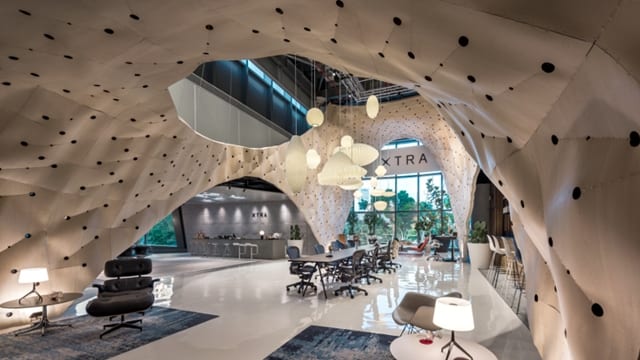
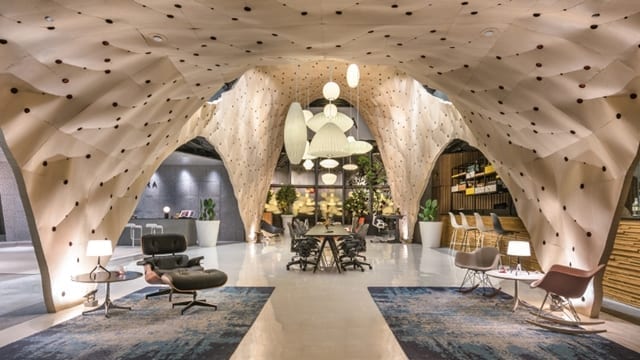
    A stunning Herman Miller store-in-store at Marina Square uses ‘fabricwood’ to frame entrances and create impact.

    Herman Miller store

    Herman Miller store 3

    Herman Miller store 4

    The store is part of furniture and lighting retailer Xtra’s latest flagship and the ‘fabricwood’ effect is created by bending 280 panels of plywood into giant arches ranging from a low three metres at the entrance to a lofty eight metres at the opposite end. It was conceived by design director Pan Yicheng from Produce.

    “Occupying a 20m long, 7m wide space, the plywood surface stretches across the entire site like a sail of tensile fabric, with symmetrical qualities that take on the proportions of the Herman Miller logo,” reports Designboom in a designer-contributed article. “The minimal surface, which reminds one of German architect and structural engineer Frei Otto’s soap film experiments, contains a series of arches that frame the entrances and connections to the rest of Xtra, the street and the adjacent cafe.”

    After extensive research for the project, Yicheng was motivated by Herman Miller’s structural and material innovation.

    Herman Miller store 5

    “Indeed, the brand’s use of moulded plywood offers light and elegant furniture, while the study of comfort and ergonomic for their working chairs results in an elastic mesh material stretched at the back of the furniture to create a doubly curved and frameless suspended surface that supports a full range of seating postures.”

    Originally used for shaping fabric to fit the human body, Yicheng has exported the technique of ‘darting’ onto plywood. The darts and their respective angles determine the eventual curvature when closed. Circular cut-outs are used at converging points of darts to allow the plywood to bend and avoid tears.

    When assembled, fabricwood forms a naturally undulated surface. The most challenging part of the project has been to translate flat pattern drawings into three-dimensional modelling and vice versa. A combination of the latest computer simulation techniques and physical modelling has helped achieve the desired curvature. The elasticity of the plywood has played a major factor in shaping the skin, while the dart angles have been re-calibrated to accommodate any changes to the plywood material.

    More images and details about the fabricwood on Designboom.

  • Singapore retail sales up 0.4% in December

    Singapore retail sales up 0.4% in December

    Singapore’s retail sales rose 0.4 per cent in December 2016 compared to the same month in 2015, mainly due to higher sales of medical goods & toiletries.

    Stripping out sales of motor vehicles, retail sales went up by 0.3 per cent, the Department of Statistics said on Wednesday.

    Compared to November, the seasonally adjusted retail sales figure decreased by 1.9 per cent in December. Excluding motor vehicles, they rose 0.7 per cent.

    Notably, retailers of medical goods & toiletries reported 9.9 per cent increase in sales year on year. Surprisingly, motor vehicle sales rose only 0.9 per cent year on year.

    On a seasonally adjusted basis, motor vehicles sales recorded a dip of 11.9 per cent compared to November. Retail sales of computer & telecommunications equipment and department stores also fell 6.8 per cent and 2.2 per cent respectively over the same period.

  • Tourists give local businesses a big boost

    Tourists give local businesses a big boost

    Tourism spending was a silver lining for the struggling retail industry last year. Tourists spent $4.3 billion on shopping between January and September. That is nearly 50 per cent more than in the same period in 2015, according to figures released yesterday by the Singapore Tourism Board (STB).

    And local businesses are benefiting. These visitors are turning to “mass market” goods such as confectionery, gifts and souvenirs, and fashion and accessories, as opposed to globally available luxury items, STB said.

    One shop that has been pulling in the crowds is local souvenir shop Supermama.

    “Souvenir” brings to mind run- of-the mill keychains and magnets, but the shop, which opened in 2011, sells nothing of that sort.

    Instead, stocked at its four outlets are Singapore-themed porcelain items, with designs such as the HDB corridor and tembusu tree.

    Founder Lee Meiling said today’s savvier tourists avoid the “usually tacky souvenirs created to get a quick buck from the tourist”.

    “The visuals are designed by local Singapore designers telling very local aspects of the Singapore culture and lifestyle,”she said.

    Some items come with a write-up on the Singapore icons they feature. Tourist sales make up between 20 per cent and 35 per cent of sales, an increase from the 15 per cent two years ago, added Ms Lee.

    Explaining visitors’ interest in home-grown brands, deputy chief executive of STB Melissa Ow said during a press briefing yesterday: “People want to have some affinity with the destination, so something that is going to be intrinsic and unique, and speaks to the attributes of the destination will, I think, continue to have a lot of value among our visitors.”

    Another retail store, Megafash, which carries more than 600 independent local brands, has also gained traction among tourists, which comes as a bit of a surprise to the company, as it did not target this group.

    Items sold by the outfit include plates that are designed with recipes for local dishes such as nasi lemak, “rainbow agar agar” doorstops, and T-shirts with Singlish phrases.

    Several of its six stores are near tourist areas. The outlet in Tanjong Pagar shopping mall 100AM, for example, is next to a hotel.

    The Farm Store – which sells items such as chilli-crab aprons and supplies these items to other shops, including Megafash, Naiise and Tangs at Tangs Plaza – has seen a 30 per cent year-on-year increase in tourists looking for “uniquely Singapore” souvenirs.

    Head of retail and marketing at Singapore Polytechnic’s business school Amos Tan said such Singapore brands tend to do well because consumers are looking for novelty.

    “Consumers today, they have been there, done that, travelled all over, and seen the global brands elsewhere. So they look for something that is truly Singaporean, and these shops offer them.”

  • Singapore CIOs taking action against BYOD threats

    Singapore CIOs taking action against BYOD threats

    CIOs in Singapore are stepping up their fight against the security risks posed by the widespread adoption of BYOD practices.

    More than one in three (36%) CIOs say a lack of employee knowledge and skills around data security is the most significant security risk their organisation will face in the next five years, according to a report from Robert Half.

    While traditionally, the response to IT security has been to find the optimum way to protect a business’ assets from external security attacks, a growing risk now faces organisations in the form of potential internal security threats.

    This threat is made evident by the fact that almost three in four (74%) CIOs allow their employees to access corporate data on their personal devices.

    Matthieu Imbert-Bouchard, managing director of Robert Half Singapore said that BYOD practices offer many advantages such as increased employee satisfaction, productivity and cost savings, so companies must take steps to balance both their employees’ needs and their security concerns.

    To combat the ongoing threat posed by BYOD, nearly all (97%) of CIOs are taking action to protect their company from potential data breaches.

    The most common response (58%) is to train personnel on cyber-security policies and corporate practices when using their personal devices. Signing an acceptable use policy also seems to be standard practice for more than half (57%) of the Singaporean companies.

    Technical applications are being implemented as 53% say they are deploying mobile device management technology and 52% are using authentication software.

    There is an increased demand for IT security specialists with the niche skills needed to protect companies against data security risks, including risks related to BYOD. But finding the right skillset is a challenge, with all of Singaporean CIOs saying it is difficult to source skilled technology professionals, with one in three (29%) saying professionals with mobile security skills are the most in demand.

  • Soo Kee Group forming JV in Thailand

    Soo Kee Group forming JV in Thailand

    Soo Kee Group has sealed a deal to form a company with Thai jeweller Aurora Design.

    With an initial paid-up capital of S$1.2 million (US$845,000), the JV will be set up in Thailand. Soo Kee will hold a 40 per cent stake in the company with Aurora holding the balance. The move will help Soo Kee launch its bespoke bridal jewellery brand, Love & Co, on the Thailand market. It is also in line with the group’s growth strategy to widen business networks and strengthen its market position in the region.

    Under the agreement, the JV will sell gold and diamond products under the Love & Co brand while Soo Kee will license and supply intellectual property rights, products and support to the company.

    “Thailand’s huge population and growing upper and middle classes provide a large target market for luxury spending,” says Soo Kee Group CEO Daniel Lim. “We believe the sheer size of the country also presents many untapped opportunities for the group.”

    Meanwhile, the group has entered the bullion business as part of its product diversification plan. It acquired a 70 per cent stake in DK Bullion for S$800,000 this month.

    Soo Kee, founded in 1991, has more than 60 retail stores across Singapore and Malaysia.

  • Hermes sales rise 7 per cent in Asia

    Hermes sales rise 7 per cent in Asia

    Hermes sales rose 8 per cent last year for French high-fashion goods manufacturer Hermes International.

    In what it describes as a “difficult context”, the group’s consolidated revenue reached €5202 million (US$5.5 billion).

    Sales growth was sustained in the fourth quarter (up 8 per cent at current exchange rates, and 7 per cent at constant exchange rates), with all geographies progressing.

    Hermes continued to improve the quality of its distribution network, with four store openings and renovation and extension works.

    Japan (up 9 per cent) performed well thanks to its selective distribution network, despite the strengthening of the yen and a high comparison basis.

    Asia excluding Japan (up 7 per cent) pursued growth, particularly with extensions of the Liat Towers and Takashimaya stores in Singapore and store openings in Macau, at Hong Kong Airport and in Chongqing in China.

    In Mainland China, the group says it continued to develop even though the context remains challenging in Hong Kong and Macau.

    Growth over the year was driven by leather goods and saddlery products, which continue to be the mainstay of the group. Otherwise, sales benefitted from a positive momentum at year end in such sectors as silk and the ready-to-wear and accessories division.

    Growth “remarkable”

    Hermes says the 14 per cent growth in leather goods and saddlery was remarkable, thanks to the success of the collections and the diversity of models, particularly the Constance, Halzan and Lindy bags alongside the Birkin and Kelly.

    The ready-to-wear and accessories division was stable over the year, posting a 4 per cent increase in the fourth quarter driven by the latest women’s collections, particularly shoes.

    While sales eased 1 per cent for the silk and textiles business line in the fourth quarter, Hermes says it was a good result in the face of being penalised by events in Europe and slowing sales in Greater China during the first half of the year.

    A 9 per cent growth in sales of perfumes was driven by the success of Terre d’Hermes, the launch of Galop d’Hermes and the latest creations such as colognes Eau de Neroli Dore and Eau de Rhubarbe Ecarlate.

    Down 3 per cent, the watches division was penalised by a still challenging market and a high comparison basis at year end. Sales rose 2 per cent for other Hermes business lines, encompassing jewellery, Art of Living and Hermes Table Arts.

    Meanwhile, Hermes is pursuing its long-term development strategy based on creativity. This year it is celebrating the “Meaning of Objects”.

  • Garmin sets up regional HQ in Singapore with eye on SEA

    Garmin sets up regional HQ in Singapore with eye on SEA

    Global manufacturer of fitness products Garmin has selected Singapore as its regional headquarters as part of the brand’s strategic plan to strengthen its presence in the region.

    Garmin’s consumer products have been sold in Singapore through distributors since the early 1990s. The company has a strong foundation in engineering products for aviation and marine since 1989.

    With the opening of its Singapore headquarters, Garmin will now directly manage sales and marketing of its consumer business devices in South-East Asia and India region.

    Leading Garmin’s Singapore business is its managing director for South Asia/ India region, Engelhard Al Sundoro, who will manage Garmin’s consumer business in six Southeast Asian (SEA) countries that include Singapore, Malaysia, Philippines, Indonesia, Vietnam and Thailand.

    “Outside of US, China and Taiwan, it is a natural step for the brand to strengthen our presence in SEA with Singapore as our headquarters as consumers here tend to be early adopters of technology,” said Al Sundoro.

    Garmin had recently announced its partnership with EZ-Link to launch a special version of its vivosmart HR activity tracker with built-in NFC contactless payment capability. This would allow commuters to use their fitness band to pay for their train, bus, cab rides and even purchase items at selected retail stores in Singapore.

    “As a company, we need to be an enduring brand that consistently innovates. In order to do that, it is essential for us to be closer to our customers to understand what they need. Even as a global brand, Garmin sees each market differently as the customer needs in each region is diverse,” he added.

  • iFashion Group acquires lifestyle marketplace Megafash

    iFashion Group acquires lifestyle marketplace Megafash

    Singapore-based lifestyle venture platform, iFashion Group, announced today it has acquired Singaporean independent designer brands marketplace Megafash for S$3.5 million (US$2.23 million), in a cash and shares deal.

    iFashion group also appointed Jeremy Khoo, the CEO and founder of Dressabelle – an O2O fashion marketplace that it acquired last year for S$7.5 million (US$5.5 million) – as its new CEO.

    This new development will strengthen iFashion Group’s position as a major lifestyle portal in Southeast Asia. Megafash has both a strong online and offline presence, with its 7 stores occupying over 15,000 sq ft. It works with over 2,000 indie brands globally to sell over 300,000 unique products on its marketplace. In 2016, Megafash’s annualised revenue was reported to be S$8 million (US$5.7 million).

    “It’s an exciting time for us at Megafash. The brand has grown significantly, from 3 stores in 2015 to 7 stores currently. In times of economic downtown, we are pleased to say that our revenue grew five times from 2015. Megafash continues to grow as Singapore’s leading lifestyle marketplace. In fact, in December we received as many as 2,000 orders a day,” said Megafash’s CEO and Co-Founder, Jiawen Ngeow, in an official press release.

    The acquisition of Megafash will also accelerate iFashion Group’s plans to go public. A press release said that the company is mulling an IPO at the end of April or May.

    Last year. besides Dressabelle, iFashion Group made two other acquisitions: online retail real estate booking platform INVADE, and Malaysian fashion brand NOSE.

  • Eight in ten Singaporeans shop online

    Eight in ten Singaporeans shop online

    Online shopping is fast becoming a favourite activity of Singaporeans, research shows, as the country’s bricks and mortar retail sector continues to struggle.

    A survey, conducted by Edelman Intelligence and Criteo, revealed that 84% of Singaporeans love to shop online and nearly a third of respondents – especially millennials and wealthier Singaporeans – make at least one purchase each week on e-commerce platforms.

    Nearly every Singaporean questioned (95%) had used their smartphone or tablet to browse for products or services online in the past month. But while Singapore enjoys the world’s highest smartphone penetration, locals were less likely to use their phone to make purchases, feeling that computers are better suited to purchasing high-value items.

    Almost two thirds (65%) said they would prefer to use their computers for big ticket items such as airfares or luxury goods, and 42% would be happy to spend more than SG$500 on a single purchase compared to 16% on their mobile.

    Personal income also has a direct correlation to where products are bought; those on a higher income tend to buy from Japan, the UK and Europe, whereas those on a lower income tend to buy from China. (For more 2017 retail trends in Singapore, read Warc’s report: Trend Watch 2017: Singapore seeks retail revival, economic resilience.)

    The data also reveals that showrooming, where shoppers browse in-store then buy online, is also a growing trend in the country. The primary incentive for showrooming is deals and promotions (69%) and cheaper products (66%) whilst free or cheaper delivery is a big consideration (43%). Almost two thirds of respondents had searched for a product online while being in a store to compare deals.

  • DHL Supply Chain appoints Jerome Gillet as CEO of its new Singapore cluster

    DHL Supply Chain appoints Jerome Gillet as CEO of its new Singapore cluster

    DHL Supply Chain, which is involved in contract logistics solutions, has named Jerome Gillet as CEO of the new Singapore cluster which includes Singapore, Malaysia, and the Philippines.

    In this role, Gillet will continue to report to DHL Supply Chain Asia Pacific CEO Terry Ryan, while remaining as a member of the regional board.

    The appointment will bring synergy for the three markets and drive new growth for the region.

    The DHL Supply Chain businesses locally will continue to be led by the respective country heads – Jason Goh, managing director, DHL Supply Chain Singapore; Mike Davies, managing director, DHL Supply Chain Malaysia; and Suzie Mitchell, managing director, DHL Supply Chain Philippines — who now report to Gillet.

    “We see tremendous opportunity in Singapore, Malaysia and the Philippines to grow our business with even more focus on greater service quality in the markets. Jerome has repeatedly demonstrated his commitment to customer needs, and, in a changing economic climate, he is well placed to help customers deliver greater value from their supply chains,” said.

    “An innovator and strategic leader, Jerome is well suited to lead the next stage of growth transformation in our Singapore cluster. With his track record of delivering accelerated growth and building strong customer relationships, I am confident he will drive this new cluster in achieving high and sustainable growth.”

    “I am looking forward to accelerating growth in the newly formed cluster with a strong focus on quality, innovation and customer centricity,” said Gillet.

    Gillet’s career in logistics spans over 20 years (the last 17 years in the Asia Pacific) and includes roles in general management, operations and business development. His last appointment as chief customer officer (CCO) of DHL Supply Chain Asia Pacific saw him turn Asia Pacific into the fastest-growing region worldwide within DHL Supply Chain.

    The growth was driven by his business development efforts in key sectors such as Consumer & Retail, Technology and Life Sciences.

    Prior to his role as the CCO, Gillet was the vice president of Consumer sector for Asia Pacific, and increased annual new business gains by over 200% between 2008 and 2014.

  • Singapore Airlines Q3 operating profit up 1.7%

    Singapore Airlines Q3 operating profit up 1.7%

    Singapore Airlines reported on Tuesday a 1.7 percent rise in third-quarter operating profit, helped by an unexpected growth from cargo and mail, while net fuel costs fell.

    Profit reached S$293 million ($207 million) for the three months ended Dec. 31, S$5 million up from the same period last year.

    The carrier, a barometer of the health of Asia’s airline industry, said “2017 is expected to be another challenging year amid tepid global economic conditions and geopolitical concerns, alongside other market headwinds such as overcapacity and aggressive pricing by competitors.”

    The company has come under pressure due to weakening demand for full-service long-haul travel amid competition from low-cost carriers and Middle Eastern network carriers.

    Operating profit in its main SIA brand fell 16.6 percent to S$151 million. Profit fell 9.1 percent in its Silkair regional airline, and was flat-to-slightly-higher for low-cost subsidiaries, Tiger Airways and Scoot.

     SIA Cargo posted an operating profit of S$53 million, its best third quarter performance in nine years, due to stronger-than-expected demand. In the same period of last year, SIA Cargo only managed a S$2 million profit.

    Net fuel costs declined $200 million, largely due to a $256 million reduction in fuel hedging loss, the company said.