Tag: Technology

  • WeChat Pay to be ready in 7-Eleven, Guardian Singapore

    WeChat Pay to be ready in 7-Eleven, Guardian Singapore

    Customers of 7-Eleven, Cold Storage and Guardian stores in Singapore will soon be able to pay for purchases using WeChat Pay. The owner of the two retail chains, Dairy Farm Group, has worked with NETS to enable visitors from China and Chinese nationals based in Singapore to use the service from November 1.

    WeChat Pay is currently being trialled at the 7-Eleven and Guardian stores at Changi International Airport and some stores in key tourist destinations in the Orchard and Chinatown districts.

    According to the Singapore Tourism Board, visitors from China increased by almost 13 per cent, from 2.8 million in 2016 to 3.2 million last year. The partnership between Dairy Farm Singapore and NETS together with WeChat will enable Singapore’s largest multi-format retailer to better cater to the growing number of China visitors, by offering visitors a convenient way to pay when they shop in Singapore.

    Head of merchant services at NETS, Alvin Seck, said working with payment partners like WeChat and retailers like Dairy Farm Group enables NETS to roll out new payment services for consumers quickly while minimising adoption costs for merchants.

    “With this partnership, 7-Eleven and Guardian in Singapore along with Cold Storage and Giant can just make use of its existing NETS uPOS terminals to accept WeChat Pay, in addition to NETS, QR, NETS FlashPay, credit and debit payments.”

    To use WeChat Pay for payments, users simply need to scan the NETS QR code on the NETS uPOS terminal.

    Dairy Farm Singapore’s regional finance director, Tom van der Lee said this latest payment mode service is part of the multi-format retailer’s digital-transformation journey in line with the government’s ‘Smart Nation’ drive.

    “More customers are adopting cashless payments, thanks to easier and faster payment transactions with the uPOS terminal plus the convenience of the wide array of payment options to choose from across our Cold Storage, Giant, 7-Eleven and Guardian stores. Cold Storage alone has seen cashless payment increase by 6 per cent and at Guardian by 3 per cent since Dairy Farm Singapore installed 1800 unified NETS POS terminals last year – the single largest deployment by retailer here.”

  • Kakao’s blockchain gets 9 development partners

    Kakao’s blockchain gets 9 development partners

    Nine companies have agreed to develop apps for Kakao’s new Klaytn blockchain system. The public platform was developed by Ground X, Kakao’s blockchain subsidiary. It was offered on Oct. 8 on a test basis, or testnet. Kakao, Korea’s largest messenger app company, announced the introduction on Monday.

    The companies building the apps are from a wide range of industries from gaming to health care. They are planning to use Klaytn for the development and operation of dApps, or decentralized applications.

    Service operators are attracted to dApps because of their decentralized nature, transparency and ability to incentivize users through in-app rewards.

    Wemade Tree, a subsidiary of game developer Wemade Entertainment, is one of the Klatyn partners. Wemade said it wants to use blockchain because it allows for smooth and speedy operations. Wemade’s games, including its popular Legend of Mir massively multiplayer online role-playing games (Mmorpg) series, have over 200 million accumulated users.

    Piction Network, which helps web comic and novel creators retain ownership over their works while making them available for users, has also partnered with Klaytn. Piction Network plans to provide its Klaytn-powered network to webtoon platform Battle Comics, which currently has over a million active users.

    A blockchain-based food data project called Hint Chain, operated by Vital Hint, has also announced a plan to utilize Klaytn. Vital Hint first gained popularity for providing recipe recommendations through apps like Foodiest. Hint Chain goes one step further and analyzes individual tastes and eating habits. Hint Chain plans to use Klaytn to help consumers manage their eating and purchasing habits, and make this information available to restaurants, convenience stores, supermarkets and hospitals.

    Other notable industry partners include Nabu Studio, a sports simulation game developer, Airbloc, a data marketplace for businesses interested in gathering personal information for research and advertising, and Humanscape, a data marketplace specifically dealing with health information related to rare and incurable illnesses.

    Cosmochain, another partner, is a beauty information platform that incentivizes users to provide feedback on cosmetics products.

    VETTA is a crowdfunding platform for games selected by GTR, a game accelerator. Rayon connects borrowers and lenders.

    “It’s important to prove the value and utility of blockchain in order for the technology to commercialize,” said Han Jae-sun, chief executive of Ground X. “We will soon gradually begin presenting high-quality services that we worked on together with partners.”

    After the selected partners complete a test run, Klaytn plans to launch in the first quarter of 2019. Until the official release, Klaytn will continue forming new partnerships with qualified companies.

    “Service providers and developers interested in using Klaytn’s testnet can still register on the official Klaytn homepage,” said a Kakao spokesperson.

  • HTC Opens Flagship Vive Store in China

    HTC Opens Flagship Vive Store in China

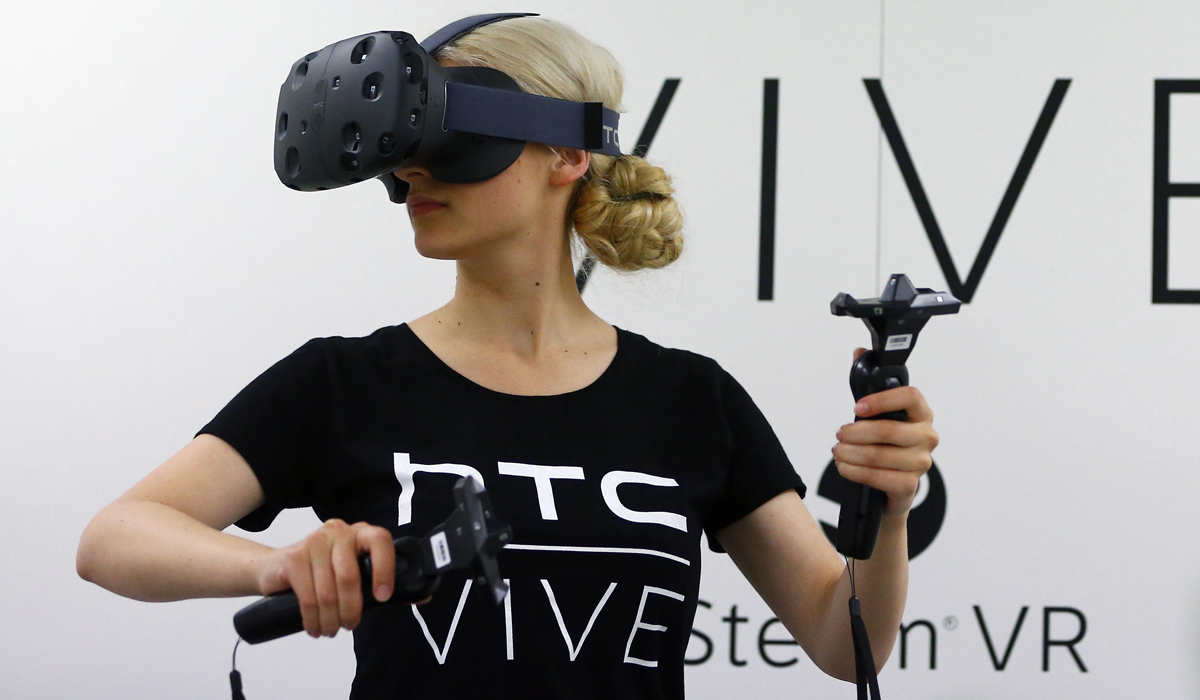
    Taiwanese smartphone maker HTC has opened the doors of its first global flagship store for its Vive VR headset. The Shenzhen store will offer consumers the chance to experience VR technology in a relaxed in-store environment. The brand wants consumers to build a better understanding of how VR works, the content available, and how it can enhance their lives – through entertainment and practical applications.

    HTC launched its first Vive headset three years ago and is now a predominant player in the Chinese VR market, claiming 82 per cent market share at one point last year.

    It is now partnering with video game maker Ubisoft Entertainment, Warner Brothers and the McLaren Formula 1 team to participate in the China Digital Entertainment Expo and Conference, nicknamed ChinaJoy, where it will have a VR gaming carnival.

    HTC has long been running at a loss as sales of its handsets fall in the highly competitive smartphone market and it sees VR technology as an opportunity to return to profitability.

  • TabSquare raises S$10 Million to fuel AI-powered restaurant solutions

    TabSquare raises S$10 Million to fuel AI-powered restaurant solutions

    TabSquare, a leading provider of AI-Powered Smart In-Restaurant solutions, today announced it has raised S$10 million (US$7.2 million) in Series B financing led by Kakaku.com.

    Tabsquare’s platform has three critical elements: consumers, restaurants and F&B brands; now strengthened with the latest funding round.

    Founded in 2012, TabSquare has rapidly grown to be the leading in-restaurant technology provider in Singapore.

    The company’s main products are the SmartTab eMenu and the SmartKiosk – applicable to both sit-down and counter-service restaurants.

    The company’s products use AI to make personalised menu recommendations and improve customers’ ability to order, pay and deliver feedback.

    Chirag Tejuja, Co-Founder said, “TabSquare’s fast-paced growth proves there is a strong
    demand for innovative and effective technology that can solve issues commonly faced by restaurants in the region such as low restaurant profitability, high staffing costs and language barriers.”

    Through 6000 devices that serve more than 12 million diners and 6 million orders annually, TabSquare’s AI-Powered solutions leverage consumer data and learning algorithms to better predict demand, personalize offerings and improve the overall diner experience which aims at creating greater efficiencies and profits for restaurants.

  • Small Cell Forum puts orchestration, SON on roadmap

    Small Cell Forum puts orchestration, SON on roadmap

    The work program for the Small Cell Forum for the coming year covers “every aspect of densification,” including policy improvements for siting and spectrum, 5G-enabling technologies and the next iteration of its enterprise action plan, according to SCF. One of the work items focuses on the edge computing landscape, which the forum describes as an excellent example of an area where a common framework will be essential to avoid fragmentation—but one where every operator will deploy differently to support different use cases.

    Indeed, the pushing of intelligence, processing and cloud services to the edge of the network is making the small cell into a “gold mine” by adding many more services to the connectivity, according to SCF. Technologies like ETSI’s Multi-access Edge Computing or the OpenFog initiative, which is now the basis of an IEEE standard, are ways to distribute cloud services widely and bring them close to the users, supported along with radios on small cells equipped with processors or in separate miniservers. The distributed topology reduces latency and backhaul costs and improves responsiveness and QoS for users, the forum notes.

    The forum has been bringing operators, vendors and other stakeholders together as part of “Densification Summits” that it has held in the US, China and India over the past 12 months, discussing how to map clear and cost-effective migration paths to dense, software-driven and automated 5G networks. As such, the forum says it has been able to gather a range of requirements from industry and enterprise as to what future networks should enable.

    Another important task for the forum is developing a full road map for orchestration and SON. “Unsurprisingly, on the eve of commercial 5G, many of the issues which operators highlighted relate to that new standard—for instance, how it will interwork with WiFi, and what a 5G small cell for massive IoT applications should look like,” the SCF stated. “And some of the Forum’s most important 4G technologies will be revisited to plot a 5G migration, including the nFAPI interface for virtualized small cell networks.”

    According to the forum, one of the most important foundations of the new work program is the Enterprise, which is based on a year of in-depth discussions within SCF’s Enterprise Advisory Council. It identifies requirements that are common to all sectors and can be addressed by a unified small cell platform, while also drilling down on the specific variations within individual markets such as hospitality, healthcare and commercial property.

    SCF says it has been increasingly engaged with spectrum regulators and national and municipal authorities to help them understand the benefits of densification and how it can be accelerated by the right rules. Activities in 2018-19 will take this work further, to remove more of the barriers that challenge at-scale deployment.

    Last month, the FCC voted to approve rules aimed at speeding up the deployment of small cells and other 5G network equipment by regulating in part the fees and timelines cities and states can impose on wireless network operators and other wireless players.

    US outdoor small cell antenna shipments increased 84% in 2017, according to a report from EJL Wireless Research. The firm is forecasting that US outdoor small cell antenna shipments will increase by 75% in 2018 due to increasing demand from all four US national mobile operators as well as neutral host operators.

  • NEC  launches Open Innovation Centre in Singapore

    NEC launches Open Innovation Centre in Singapore

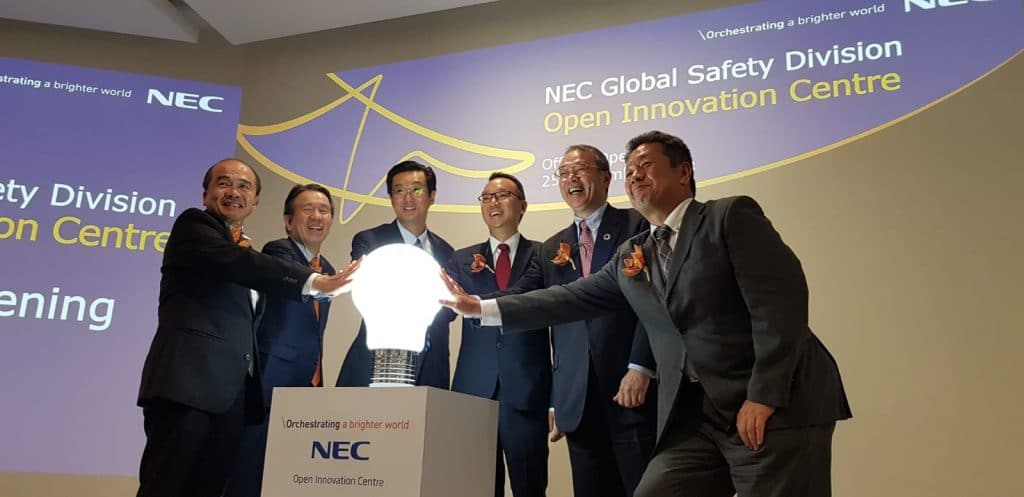
    NEC Corporation announced the opening of the NEC Open Innovation Centre (OIC) in Singapore which forms a part of the wider NEC innovation eco-system, and reaffirms NEC’s commitment to foster open innovation and partnerships with private and public sectors.

    Supported by the Singapore Economic Development Board (EDB), the OIC is part of NEC’s $100 million investment over the five years from 2017 in research and innovation in the Asia Pacific region.

    The Centre, operated by Global Safety Division, is NEC’s first of its kind facility outside Japan which infuses market-leading NEC technology and a deep partner ecosystem to offer cutting edge solutions in areas such as public safety, transportation and aviation.

    The Centre provides a platform where solutions can be translated into realistic and relatable use cases. It houses various revolutionary thematic zones which allow an immersive experience in AI and biometric solutions within the context of daily life. For example in the “home” zone, visitors will be shown how our face can be utilized as a powerful and trusted digital identity to securely access government and commercial services with NEC’s Trusted Digital Identity solution.

    NEC is also at the forefront of advanced ICT solutions for safety, security and efficiency in air travel. With more people flying today as well as heightened security threats, passengers are asked to go through more checks and screenings. All this leads to earnest needs of frictionless travel experience.

    NEC One ID-Single token technology takes travel experience to new heights by providing integrated identity management across the travel process that allows passengers to authenticate their identity online or in person for all stakeholders, ensuring an efficient flow within the airport.

    “We are delighted that NEC has chosen Singapore to establish its first Open Innovation Centre outside of Japan. Singapore’s strong base of enterprises, partners and digital talent offer NEC an ideal location to forge collaborations and translate its strong biometric identification technology into new applications for public safety and commercial domains for Singapore and beyond,” said Ms. Lily Phua, Director of New Businesses, EDB.

    Mr Vinoop Goel, Regional Director in Asia-Pacific from International Air Transport Association (IATA), comments, “With the number of travelers expected to double in 20 years time, the use of technology will be critical for increasing passenger throughput in the existing airport terminals. NEC’s OIC is a good showcase of the technologies that can make air travel more efficient, including IATA’s OneID initiative, and we look forward to implementations of these technologies to improve the passenger experience and enhance the efficiency of airline and airport operations.”

    “The vision of the Open Innovation Centre is to orchestrate a smart and safer city in collaboration with governments and businesses. With a digitally disruptive team at the heart of OIC’s operations, new ideas of approaching public safety can be prototyped and launched within the centre and further deployed in global markets. This is only possible with strong support from our industry partners who are already on board the OIC ecosystem,” said Mr Tan Boon Chin, Managing Director, Global Safety Division, NEC Corporation. “We believe that a trusted digital identity based on biometrics such as facial recognition technology can transform businesses so as to provide secure and frictionless experience across home, city and aviation.”

    NEC has been developing biometric identification technologies for more than 40 years, and systems using NEC’s Bio-IDiom biometrics have been introduced through more than 700 systems in 70 countries and regions around the world. Moreover, earlier this year, NEC’s iris recognition was named the world’s most accurate by the U.S. National Institute of Standards and Technology, which has also recently named NEC’s face recognition and fingerprint recognition technologies as the most accurate.

  • Snapchat adds new ad features for retailers

    Snapchat adds new ad features for retailers

    On the back of a tie-up with Amazon, which saw Snapchat commence the testing of visual search shopping, the U.S. social media firm has now debuted three advertising routes for retailers to use.

    The first, coming out of its initial test phase, is called Shoppable Snap ads, which are made available through Snapchat’s self-service ad-buying platform. Previously known as Collection ads, advertisers can now create shoppable collections of products.

    That leads to the second new function, where brands can import their product catalogs and instantly create ads from assets already available.

    Brands can also use their imported product catalog feed to create Story Ads and Snap Ads as well. It is designed much like the shopping links already used by Instagram and Facebook, allowing users to tap on a product image and view more information about it.

    Thirdly, Snapchat pixel is designed to hone in on Snapchat users who visit a site, allowing brands to see what types of pages the users visit.

    Looking forward, Snapchat will team up with more than 40 new partners with digital ad experience, to help advertisers create ads with e-commerce, direct response and data-driven capabilities.

    The news comes as Snapchat continues to garner a strong following, especially among younger consumers.

    A report by research firm eMarketer said Snapchat is expected to add 1.2 million new teen users by 2022.

    In comparison, rival social media firm Facebook, is expected to lose 2.2 million users, said the report.

    For the recently ended second quarter, Snapchat’s global revenues grew 44 percent reaching $262 million. Snapchat predicts current third-quarter revenues to fall between  $265 million to $290 million, up 27 percent to 39 percent from a year earlier.

  • Walmart may soon track heart rates through shopping carts

    Walmart may soon track heart rates through shopping carts

    But its not about burning calories, Walmart wants to capture shopper reactions based on what they see or feel in terms of products and prices. The patent, titled “System and Method for Biometric Feedback Cart Handle,” will have grocery carts fitted with sensors on the cart’s handle, that will transmit the data to Walmart’s servers.

    “If biometric indicators show signs of an emergency, the program may also issue a broadcast throughout the store to call associates’ attention to the situation and could potentially initiate a call for emergency medical help as well,” said technology blog CBInsights.

    However, not all shoppers are happy with this new development with many taking to social media to express their concerns. Susan La Duke tweeted that is was on “the list of reasons” why she would never shop at Walmart.

    The retail giant has also bolstered its e-commerce and grocery teams witha reshuffle of senior executives in the US.

    Kieran Shanahan was promoted as the new senior vice president of e-commerce retail for everyday living while Tom Ward was named the new senior vice president of digital operations.

    It also announced that Andrea Albright will take up the position of senior vice president of snacks, beverage and impulse, replacing Al Dominguez who is leaving the company after 12 years.

    Bloomberg reported that Shanahan and Ward had helped expand the online grocery business prior. Walmart’s grocery segment makes up more than half its US sales.

    Deutsche Bank had upgraded the shares of Walmart on Tuesday based on strength in the online grocery industry. Deutsche Bank analyst Paul Trussell said that the retail giant is “reaping returns on the many years of investment in e-commerce and customer service”, which puts the retailing giant in the best position to move forward.

    Trussell also lifted his stock target from $US89 to $US113. Nuveen managing director Stephanie Link agrees that Walmart’s digital investments and acquisitions with Jet and Flipkart are a good move although she said to CNBC that Deutsche Bank’s call is a little early as Walmart still has to do some more to deliver growth.

    “They [Walmart] have just started to make these investments, and you’re just starting to see some results, but I think it’s going to take a long time … I think the environment is competitive and I think what Walmart is doing is right, but I don’t necessarily want to own the stock,” she said on CNBC‘s “Halftime Report.”

  • Zara Opens Its First Concept Fashion Store in Shanghai

    Zara Opens Its First Concept Fashion Store in Shanghai

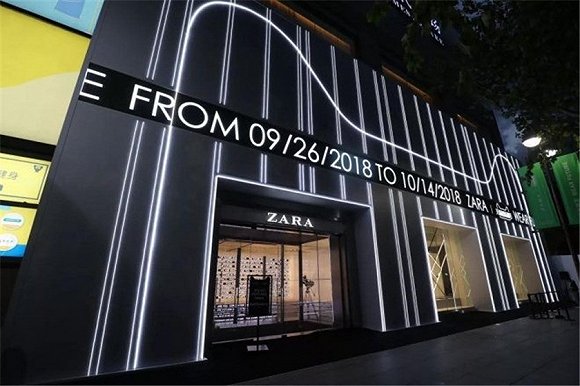
    Fast-fashion retailer Inditex has opened its first Zara China concept store, in Shanghai’s CBD.

    The store features digital services provided in collaboration with Alibaba’s Tmall platform to allow customers to buy limited-edition items via their mobile phone. Visitors can scan product barcodes to signal an attendant to bring clothes to a fitting room, and then make a digital payment if they decide to purchase.

    Following lacklustre earnings last year, Zara is refocusing on digitisation, O2O services and social influencers to reach its target demographic.

    Zara China was launched in 2006 and now operates more than 180 stores. China is home to Inditex’s second largest retail network after its home territory of Spain.

  • GS25 brings facial recognition to new shop

    GS25 brings facial recognition to new shop

    Convenience store chain GS25 has opened up a cashier-less store in Seoul that uses face-recognizing cameras to handle payments.

    The company’s first Smart GS25 started operation at LG CNS’ headquarters in Gangseo District, western Seoul, on Monday. LG CNS is a long-time provider of electronic systems to GS25 and one of the companies working to add state-of-the-art technology to the convenience store chain.

    The unmanned branch is only accessible to LG CNS staff. The store’s front entrance will allow customers to enter through face recognition after they register with a camera in front of the store. Payments can also be made through the face-scanning technology, and the store automatically charges customer’s bank accounts.

    “We aim to introduce and test 13 new smart solutions by the end of this year at the Smart GS25,” the convenience store said in a statement on Monday. “The [long-term] purpose is to apply them to our branches to reduce our franchisees’ labor costs.”

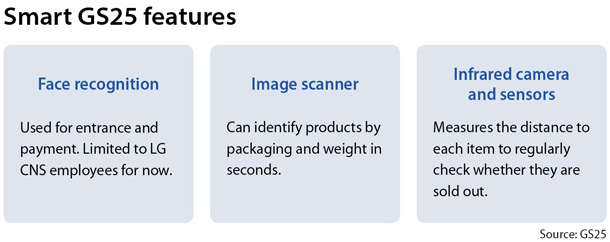
    The experimental GS25 has eight new tech features. Although GS25 is late to the game, as its competitors CU, 7-Eleven and Emart24 have already rolled out their own automated technologies, some of GS25’s features are new to Korean convenience stores.

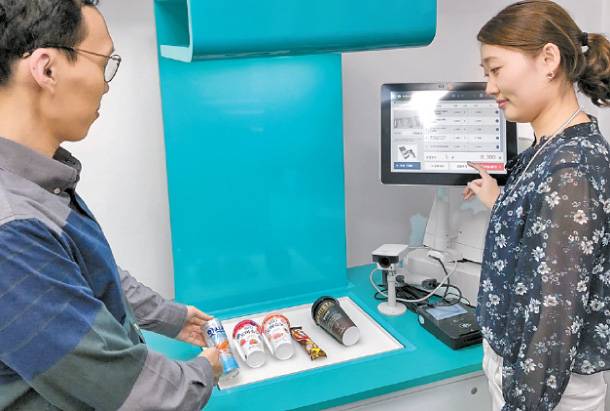
    One is the aforementioned face recognition technology for entrance and payments. Another is the image scanner at the cash register. Most convenience stores without a human cashier use barcodes to identify the products. GS25’s new system instead identifies an item by its packaging and weight.

    This allows customers to simply place items on the table before paying using facial recognition or a credit card. The company says it takes only about a second for the system to recognize five items at once, whereas with the conventional bar code system it would take 15 seconds to scan them one by one.

    An infrared camera and sensors are also installed at the store to regularly check which items need to be restocked.

    This system measures the distance to products to see whether there are any left on the shelf and automatically reports this information to the store supervisor.

    Other features include a smart CCTV that will track where customers spend the most time. This can help the store owner to decide where to place different items.

    “The Smart GS25 is not just an unmanned convenience store packed with tech gadgets,” said Lee Hyun-gyu, a manager of the new shop. “Its main function is to prove technologies that will enhance the convenience of store operation and relieve franchisees of the burden of labor costs. We expect some of the technologies tested here will be shown at our franchises by next year.”

    A GS25 spokesman added, however, that a Smart GS25 open to the public would probably not be autonomous.

  • Tommy Hilfiger launches a smart clothing collection

    Tommy Hilfiger launches a smart clothing collection

    Luxury-apparel retailer Tommy Hilfiger has released a “smart clothing” collection equipped with Bluetooth.

    The new Tommy Jeans Xplore smart-clothing range has Bluetooth chips embedded in the fabric, allowing the garment’s movements to be tracked by an app and wearers to be rewarded for having them on while physically visiting locations marked by branded icons on a map. Points earned in the game can be exchanged for gift cards, signed merchandise, runway shows and concert tickets, product discounts, and charity donations.

    A statement released by the brand read: “We’ve always been at the forefront of digital innovation, using technology to deliver what our customers are looking for – unique experiences and instant gratification… Tommy Jeans Xplore is the next evolution of our vision, reaching consumers where they are and inviting them to be a part of the brand experience.”

    Liron Slonimsky, CEO of technology at Awear Solutions (which developed the Bluetooth technology in the items) added: “Never before has a brand been able to understand how the consumer truly uses the product after it leaves the store. Tommy Hilfiger’s innovative history has shown that they understand what consumer engagement truly is and we knew they would be the perfect partner to launch Awear Solutions to the market.”

    Not all reviews of the new clothing concept are positive, with various articles dubbing the product line “creepy” and “ridiculous”. A Techradar.com review observed “The Tommy Hilfiger brand is usually quick to embrace new technology, but this isn’t exactly a big innovation. It’s essentially just a tracker to keep an eye on how often you wear the clothes, making it a glorified loyalty scheme.

    “Perhaps the even bigger question is how much data Tommy Hilfiger will be recording from those who are wearing the clothes and how will that be used?”

  • Is Google going to make it into China?

    Is Google going to make it into China?

    Google wants to get back into China, and is laying the groundwork for a key part of the initiative: bringing its cloud business to the world’s second-largest economy.

    The internet giant is in talks with Tencent Holdings Ltd., Inspur Group and other Chinese companies to offer Google cloud services in the mainland, according to people familiar with the discussions. They asked not to be identified discussing private matters.

    The talks began in early 2018 and Google narrowed partnership candidates to three firms in late March, according to one of the people. Trade tensions between China and the US now loom over the effort. It’s unclear if the plans will proceed, this person said.

    The goal is to run Google internet-based services – such as Drive and Docs – via the domestic data centers and servers of Chinese providers, similar to the way other US cloud companies access that market. In most of the rest of the world, Google Cloud rents computing power and storage over the internet, and sells a collection of workplace productivity apps called G Suite that are run on its own data centers. China requires digital information to be stored in the country and Google has no data centers in the mainland, so it needs partnerships with local players.

    Google Cloud chief Diane Greene said last week that she wants the business to “be a global cloud,” but declined to comment specifically about China. Still, the company is seeking a Shanghai-based business development manager for its cloud business. The job posting lists “experience in, and knowledge of, the Chinese market” as a preferred qualification.

    A Google Cloud spokesman declined to comment. Inspur and Jane Yip, a Tencent spokeswoman, didn’t immediately respond to requests for comment on Friday.

    A tie-up with large Chinese tech firms, like Tencent and Inspur, a major cloud and server provider, would also give Google powerful allies as it attempts a broader return to mainland China, where it pulled its search engine in 2010 over censorship concerns.

    After years of slowly rebuilding a presence in China, Google has pressed the accelerator recently. It’s building a cloud data centre region in Hong Kong this year and opened an artificial intelligence research centre in Beijing in January. Along with other Alphabet Inc. units, it has begun investing more in Chinese companies. Plans for a censored search app in China surfaced earlier this week, sparking a furious debate about whether Google is putting profit over its mission to “organize the world’s information and make it universally available.”

    A cloud partnership for Google in China would help the company compete more with larger rivals Amazon.com Inc. and Microsoft Corp. In late 2017, Amazon agreed to sell its Chinese servers and some other cloud assets to local partner Beijing Sinnet Technology Co. The move complied with laws introduced that year mandating the storage of data within the country and bolstering government control over the movement of information. The move mirrored a similar set-up between Microsoft and its local partner 21Vianet Group Inc.

    With Tencent, Google would have an even more high-profile ally – but would also go up against local competitors including Alibaba Group Holding Ltd., which operates a major cloud business in China.

    China is the second-largest cloud market, but local companies dominate, making it difficult for outsiders like Google, according to Synergy Research Group. “You can never say never, but that is an incredibly tough proposition,” Synergy analyst John Dinsdale said. A June report from Synergy ranked Google fourth in the Asian cloud market, behind Amazon, Alibaba and Microsoft.

    In January, Google struck a patent-sharing deal with Tencent. The agreement came with an understanding that the two companies would team up on developing future technologies.

    Tencent operates its own cloud service and is building an ecosystem of partners that includes Cisco Systems Inc., Nvidia Corp. and Deloitte, according to Tencent’s website. It already offers a cloud service called the Tencent Kubernetes Engine that’s based on a popular Google technology by the same name. Google could host services, such as Gmail, Drive and Docs, on Tencent’s data centers, and the Chinese company may suggest existing cloud customers try Google offerings.

    Tencent founder Pony Ma is a representative of China’s National People’s Congress, and Inspur, formerly the state-owned Shandong Electronics Devices Plant, could provide political cover for Google as it seeks to gain approval from authorities to operate more of its largest businesses in country.

    Google has touted the security and AI strengths of its cloud division. Tensorflow, a coding library for AI applications created by Google, is growing in popularity with researchers and software developers in China. While the feature is compatible with other cloud services, it’s designed to work most efficiently with Google’s cloud.

  • The great differentiator in retail industry

    The great differentiator in retail industry

    The retail industry is competitive, it’s relentless and the success of brands and retailers depends on how firmly they deal with their competition. One way to stay ahead of the curve is the incorporation of technology in a brand’s operating model.

    Technology is changing the shape of the global retail industry as also the way many retailers and businesses operate. In retail, technology gives brands the platform to better satisfy their customers by helping them concentrate on consumer needs.

    According to a Walker study, customer experience will overtake price and product as the key brand differentiator by 2020 and 86 percent of consumers will pay more for a better experience. The challenge in serving the modern customer for most retailers, therefore, lies in bringing about the right balance between technology and humans.

    Retailers with the foresight to understand the potential of technology without getting lost in its complexities, and merging it with human interaction, have always been able to grow faster and bigger. Simply put, technology is beginning to play an increasingly important role in the management of complex retail operations all over the world. To stay ahead of the game, retailers are taking the help of different technologies to lead the way in changing two aspects: their points-of-sale and their points-of-supply.

    As retail markets continue to grow and become complex, it is becoming increasingly tough for businesses to keep a track on new developments and then to figure out how these developments can be combined into their operating models in order to come up with a winning proposition – both for themselves as well as their consumer. This is one of the many reasons that retailers need technology.

    Other important factors for retail brands to transform their IT capabilities include:
    – Increasing the company’s ability to respond to the evolving marketplace through enhanced speed and flexibility
    – Collecting and analysing customer data while enhancing differentiation
    – Working effectively; retailers need one system working across stores (or even across national borders) to make sure the most effective use of stock and improve business processes

    Technology in Retail

    High tech innovations help retailers stay competitive in key categories including consumer convenience, price, size and speed. High tech tools help in manufacturing products in bulk, ensuring fulfillment of consumer demands with greater speed and ease both at the warehouses/ stores and on the sales floor.

    Technology also balances inventory assortments, manages ordering and tracks pricing. Customer tracking tools increase customer satisfaction and promote loyalty by enhancing shoppers’ in-store experience.

    For example, in-store sensors and beacon technology can record behavioral and demographic data to a business’s cloud computing system, offering insight into the customers’ psyche. This data can then guide product, layout and display strategies. The data gathered systems can analyse customer browsing and buying patterns, which then be used to personalise in-store experiences for consumers. IoT beacons can also help customers quickly find items in a store and notify them of offers and discounts via their smartphones.

    On the executive level too, technology plays a positive role in strategy and decision making, saving time and adding convenience and profits to the business.

    Personalisation & CRM Through POS Systems: Thanks to modern technology, cloud-based POS systems aid business owners in the automation of daily tasks. These include payment and checkout like interactive signage, employee attendance, self-service applications like customer check-in. POS systems also help in the overall optimisation of processes like tracking inputs from different access points, implementation of a reservation system (in case of a restaurant) and developing a customer loyalty program.

    These smart register terminals provide reports, calculate discounts, offer coupons, capture and match tally of customer profile information with ease to avoid chaos at the billing counter. They use a signature capture technology for credit card transactions which retains receipts electronically.

    Use of POS technology has served towards making the payment process easier and contactless. RFID and NFC technology provide customers with the bonus of making a purchase using their smartphones and smartwatches.

    It is important for retail businesses to streamline these processes to develop a system which is informative and error-free.

    Inventory Management: According to stores.org, “Retailers will continue to explore ways to use IoT in the coming year for everything from keeping better tabs on their inventory to managing losses from theft and connecting with shoppers.

    With the help of technology, managers can track inventory in an organised manner through its purchase cycle and offer real-time information and updates about the product to consumers. Technology is also already helping in informing managers of the status of the store stock – whether it needs replenishing or not.

    Features like ‘Electronic Data Interchange (EDI)’ help in maintaining direct computer-to-computer transactions from the store to the vendors’ databases and ordering systems. The wireless hand-held inventory units keep a check on the entire database at the headquarters by downloading and help in downloading the data regularly.

    The Universal Product Code (UPC), is used for product identification system using bar code and unique numbering for organising the goods category wise. Automatic replenishment manages restocking of what’s been sold. Customer Relationship Management (CRM) software allows retailers to track customers.

    Price Auditing: Despite being a time consuming and costly process, price auditing is another important aspect for retailers which ensures that the consumers are not being charged extra or less. Auditing has been streamlined to a large extent by the introduction of technology as products can now be scanned at the time of purchase. Th is creates more accurate pricing, saves store employees a lot of time and creates better trust between the store and the customers.

    Impact of Technology on the Retail Industry

    The dawn of e-commerce had dealt a huge blow to the traditional retail – that is until retailers discovered the advantages of Omnichannel retail. With the advent of new technology, retailers are now raising the industry from the simple concept of buying and selling and taking Omnichannel to another level altogether.

    “Retailers will continue to adopt emerging technologies in 2018 to close the gap between the digital and physical worlds, and to learn more about consumers. Mobile will become an increasingly important part of the retail equation as stores also evolve. And throughout the industry, retailers will attain more data about their shoppers and use artificial intelligence to enhance their marketing and merchandising. Personalisation in retail will play a important role in 2018.

    Retailers will use data and AI platforms to better engage customers with personalized shopping experience both online and in the store. More retailers will use AI-based capabilities and technologies to better match shoppers with products. They will be able to access personal shopping history, demographics, page views and clicks then use AI to offer better recommendations and individually tailor their marketing,” says Sunil Nair, Sr. Vice President IT & Business Solutions, SPAR India (Max Hypermarkets).

    Indians as customers are more digitally aware now than ever before, and this number will increase over the next few years. More Indians getting into the digital space would mean more opportunities and challenges for us retailers in terms of getting through to the right audience in a manner that converts them into loyal customers. Upcoming technologies are going to make way for the Indian Retail Industry to make a digital breakthrough and provide exactly what the digitally-aware customers would want,” he adds.

    “India is one of the biggest consumer market in terms of mobile devices. Coupled with an efficient distribution and logistics setup, the retail industry is set for exponential growth. The real time analytics could bring in efficiencies in inventory management, product placements, supply chain, deliveries, and even product development for the right consumer market. The two hot technologies that are becoming very popular are ‘Robotics & Drone Deliveries’ in retail are yet to get a serious consideration in Indian market,” says Chetan Chaturvedi, CIO, Head – IT, Reliance Market Retail Ltd.

    “With the availability of new technologies each consumer today can be viewed as a unique individual with clearly identifiable preferences. Therefore, Indian retail needs to move from one-size-fits-all approach to a highly-customized, consumer-centric
    approach. The way retail is currently structured, this requires a both a big paradigm and structural shift,” adds Abhishek Lal, Sr. Director E-commerce – Emerging Markets, adidas Emerging Markets.

    “AI has become one of the biggest technological developments in recent years. With its ability to help turn large and diverse data sets into enriched information that can help improve speed, cost and flexibility across the value chain. In fashion, AI helps brands and retailers with predictive forecasting, capacity planning and merchandising. Consumers enjoy the benefi ts of better product availability,” says Manoj Patel, Dep. CIO, House of Anita Dongre Ltd.

    How IOT is Shaping the Industry

    “Retailers will make greater use of beacons, sensors and the Internet of Things devices to drive the in-store experience in 2018. IoT will be the tool that can finally bridge the gap between the digital and physical worlds as it finally offers the ability to obtain and use data in stores. Retailers will be able to use these devices to gather more information about consumers in the store and convert that into data that can also be used online and through mobile. They will pilot more IoT programs to enhance store entry, customer interaction, improve merchandising and offer more rapid checkout. We are in the process of implementing IOT for inventory management, improving in-store experience through personalised marketing and energy management,” explains Nair.

    “IoT adaptation varies from company to company. For beauty and cosmetics retail, it would help in recognizing customer sentiments through camera sensors, analysing in-store traffic and converting them as shoppers in real time. IOT can help out in building virtual assist to ‘try on’ makeup look before actually buying the final products. We are working on that,” says Tarun Bali, Head IT, Quest Retail Pvt. Ltd., The Bodyshop.

    “IoT is key for this consumer facing industry and it would create a huge impact in our customer offerings. There is use of sensors which capture Image/ Video/ Product information which are critical elements for retailers. Organizations need to store IoT data and use in for better operating decisions,” Piyush Chowhan, Chief Information Officer, Arvind Fashions Ltd.

  • Channeling Artificial Intelligence in beauty

    Channeling Artificial Intelligence in beauty

    Since time immemorial women have been using various aids to enhance their beauty. Between the ancient times and the advancement of scientific techniques, we have seen the phenomenal growth of the beauty and cosmetics business. We have seen the modernisation of beauty treatments from ancient Egypt to the present day. We have also seen and experienced the heights of product innovations, using research and development of cosmetic techniques. New ingredients are being researched and used and then promoted as the next best beauty discovery. Even ingredients from ancient texts are being combined with scientific techniques to formulate beauty products. Each product claims to be better than the previous one.

    We have also been through basic customised beauty care, formulating products for different skin and hair types. Even here, there is a kind of generalisation and the theory of ‘different skin types’ does not take into account the many differences there are between one individual and the other. Through these years, branding has become important. The customer starts believing that using a certain branded product will make her look like the brand’s ambassador. Actually, the product she uses has not really taken into account her personal characteristics and features. But, Artificial Intelligence is changing all of this.

    What is Artificial Intelligence? Actually intelligence itself is difficult to define, so one can imagine how complex the concept of Artificial Intelligence must be! In fact, the definition itself has undergone changes, since the developments have been so rapid. The basic and simple definition refers to ‘machine that imitate human behaviour’. However, this is too simple a definition, because a machine maybe made in a way that it imitates human behaviour, but can it imitate human intelligence? Experts say that computer programmes can be made to imitate human behaviour, but the programme must be such that it ‘must be able to do many different things in order to be called intelligent’.

    As far as Beauty is concerned, programming has helped to prepare a database that can take many individual characteristics into account, so that it is possible to manufacture a product that is specifically meant for an individual, rather than conforming to broader specifications of ‘skin types’. Advances in technology can help to further machine learning with Artificial Intelligence, so that it becomes possible to find a custom made product for each individual.

    When I started my first herbal salon, more than four decades ago, I followed the principle of customised beauty care, at the client card level. The details of the individual client would be noted down in the Client Card. Apart from the basic, details of allergies, history and past treatments would also be noted down. In a way, we were preparing a data base. But, now with computer programming, it is possible to create an immense data base, with more detail. The customer herself can refer to the virtual card and refer to it while searching for a custom based product.

    There are beauty brands abroad, who are adopting Artificial Intelligence to create personalised products that are specifically tailored for customers. The ‘search’ for products will also have to be detailed and specific, so that the customer can make the connection among the different categories of products, ingredients, the different key words in order to select the best suited product. Most online retailing outlets do have ‘chats’ where the customer can be helped to find the products best suited. However, machines will have to be programmed to take many other distinctions into account, like geographical location, climate, skin colour, ethnic background, and so on.

    With the help of Artificial Intelligence, the customer may be able to find a skin profile that is totally personalised and unique, so much so that it may not fit any other person. If such detailed data is taken into account by product developers, it maybe possible to make similar products, with or without a particular ingredient, which is suited to one, but not to the other. In fact, one can consider including the medical aspect to find solutions for skin problems. Medical professionals or pharmacists may also be involved to work out the different aspects of the programming.

    It seems the possibilities are limitless with further development of technology. But, I still feel that at some point, the human factor must come in. For instance, only a human being can say whether a particular product feels good or not, whether it really does all that it promises to do. We cannot rely totally on machines and Artificial Intelligence.

  • When robots strolling around at Incheon Airport

    When robots strolling around at Incheon Airport

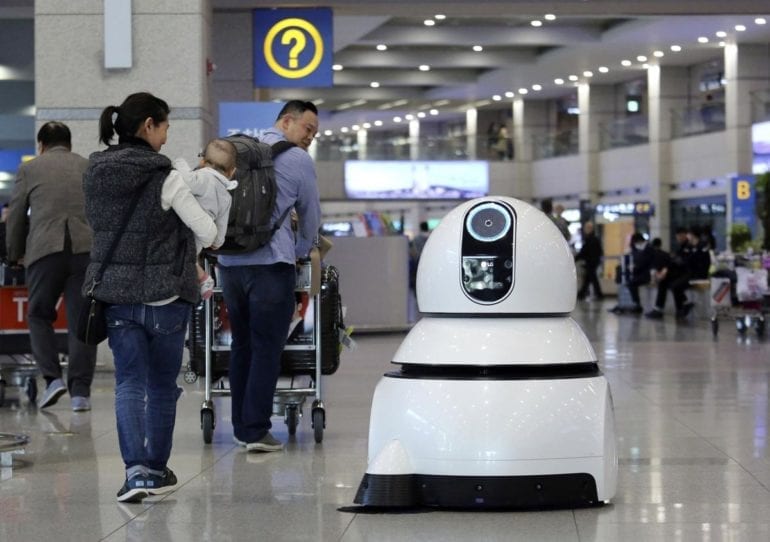
    Incheon International Airport will deploy robot guides that can escort travelers to immigration and baggage claim areas from 21 July, in time for the summer peak season.

    The airport said it is first in the world to put robots into service, as opposed to testing them.

    The second-generation robot, dubbed Airstar, is an upgraded version of guide robots that were tested in the airport last year.

    Airstar robots have improved driving and voice recognition features compared to the test versions and are also capable of expressing 14 different emotions.

    The self-driving feature was upgraded by using more sensors including three-dimensional camera sensors that help avoid obstacles and ultrasonic sensors that recognize very close objects, the airport said.

    As for voice recognition, the new robot is designed to distinguish voice commands from other noises in the airport. The robot speaks four languages: Korean, English, Chinese and Japanese.

    The robots will escort travelers, tell them how busy immigration desks are, what products are restricted on board and the way to gates after scanning barcodes on boarding passes.

    The robots can also take photos of travelers in the airport and send it to them by email or text message.

    The second-generation robot hardware was designed by Puloon Technology and LG’s IT service unit LG CNS developed the software starting last September.

    Eight robots will be deployed in Terminal One and six in Terminal Two, which opened at the beginning of this year.

    “We plan to make Incheon a cutting-edge smart airport by adopting drones, Internet of Things technology and autonomous shuttle buses,” said Chung Il-young, CEO of Korea’s largest airport.