Tag: telecom

  • Globe Telecom taps Cloudera to harness machine learning

    Globe Telecom taps Cloudera to harness machine learning

    Globe Telecom in the Philippines has deployed the Cloudera platform to enhance customer experience and deliver real-time targeted marketing campaigns and offers to its 60 million customers.

    Globe Telecom is using machine learning with Cloudera to enrich customer experiences across channels and deliver targeted and optimized products and services, while maintaining compliance with the latest industry data regulations.

    The operator’s mobile data traffic grew 85% from 151 petabytes (PB) in 2016 to 280 PB this year. Mobile data is a growing and significant contributor to total mobile revenues for the first half of 2017 versus the similar period a year ago.

    “To sustain our growth, we are always looking for ways to improve customer experiences across our channels and touchpoints,” said Gil Genio, chief technology and information officer at Globe Telecom.  “Our ability to strategically manage and monetize information about our customers will enable us to deliver value-added products and further differentiate ourselves in today’s competitive business landscape.”

    With Cloudera Enterprise now at the core of Globe Telecom’s data management architecture, the increasing volumes of data are ingested from different sources and channels into a centralized data hub and made available to all employees across the organization with full fidelity and security.

    Mark Micallef, regional VP for Asia Pacific and Japan at Cloudera, said Globe Telecom can now use data to gain valuable insights, make accurate business decisions faster and deliver targeted marketing campaigns and offers to enhance their customer’s experience.


  • Smart Transfer launches cross-border m-payment app

    Smart Transfer launches cross-border m-payment app

    Smart Transfer has introduced a person-to-person mobile payment platform that supports international social payments across multiple currencies at no charge to users.

    The Smart Transfer app allows international money transactions to be made to any bank account, phone number, email address, or social media platform.

    The Smart Transfer app allows users to send money to recipients via all social media platforms, mobile numbers, email addresses or conduct cashless payments through QR code at partner merchants. There is no need to know the receiver’s SWIFT codes, bank codes, branch codes or account numbers.

    While overseas money transfers typically take two to five working days, Smart Transfer’s cross-matching engine and integration with various banks across different countries, moves money to overseas bank accounts within seconds.

    Smart Transfer’s peer-to-peer model eliminates the numerous middlemen and excessive fees involved in conventional international money transfers, streamlining the traditionally lengthy process and saving users significant time and money. Smart Transfer’s proprietary currency cross-matching engine also touts favorable exchange rates, passing the savings on to the consumers.

    Smart Transfer features a multi-currency wallet, enabling users to send and receive money across seven currencies (HKD, CNY, SGD, USD, GBP, IDR, and AUD). User monies are held with trusted bank partners such as Hang Seng Bank, Standard Chartered Bank, and Bank of China, providing a layer of assurance to users over safety of their funds.

    The app also features a built-in chatbot that is able to execute transactions according to a user’s instructions. It is integrated within Facebook Messenger and Telegram to break down language barriers, leveraging AI-based natural language processing technology to process four different languages (English, Chinese, Japanese and Indonesian).

    Smart Transfer is currently supported across the United States, United Kingdom, Hong Kong, Australia, Singapore, and Indonesia, with plans to expand its offerings to more than 212 countries and up to 30 currencies by end of 2017.

  • Supersnap International Opens the Most Advanced Data Center in Asia

    Supersnap International Opens the Most Advanced Data Center in Asia

    SUPERNAP International today announced the opening of one of the largest, most advanced data centers in the ASEAN region, SUPERNAP Thailand, The Bangkok Campus.

    The opening of the campus is a major catalyst for propelling the success of “Thailand 4.0” – the Thai government’s plan to transform the country into a high-value based economy through innovation and technology.

    This new multi-tenant carrier-neutral data center facility, located in the eastern province of Chonburi, plays an important role in the region as the critical infrastructure that powers the ability of businesses to succeed on the growing Internet of Things, Cloud and Artificial Intelligence markets. SUPERNAP Thailand is expected to be a catalyst for attracting more investment to the region and is poised to become the data center hub for Asia Pacific.

    SUPERNAP Thailand’s BANGKOK 1 data center is designed and built to the specifications of the industry-renowned, Tier IV Gold-rated Switch LAS VEGAS multi-tenant/colocation data centers in the United States. Its advanced design and diverse connectivity options are expected to enable clients to respond to rapid market growth and connect to global economies.

    “We welcome clients throughout ASEAN, APAC and the rest of the world to run their mission-critical IT infrastructure in what we expect will be one of the most secure, reliable and connected data centers in the world,” said Sunita Bottse, Managing Director of SUPERNAP Thailand. “Our high standards in uptime, security, efficiency and resiliency can be critical for corporations who operate 24 hours a day in every business line – including finance, e-commerce, oil and gas, transportation and health care.”

    The world-class SUPERNAP Thailand data center is one of the safest places to operate mission-critical IT infrastructure in the region. Its location 110 meters above sea level is outside of the flood zone and links to national and international telecommunications carriers enabling businesses to connect to key markets in Asia and around the world.

    SUPERNAP Thailand incorporates Switch’s patented designs that deliver highly efficient HVAC (heating, ventilation and air conditioning) technology enabling the facility to host high-density IT workloads. It is designed to achieve a target PUE range of 1.35-1.45 – a level more efficient than other data centers in ASEAN, which typically have PUE levels above 2. Its efficient design and plans for sourcing renewable energy helps SUPERNAP Thailand promote economic growth and technology development in a sustainable manner, directly in alignment with the sustainability goal of Thailand 4.0.

    The SUPERNAP Thailand data center in Chonburi is expected to include: 

    • 21,000 square meters of data center space with two data halls
    • 20 megawatts of power distributed through diverse 115 kilovolt transmission paths
    • Proprietary tri-redundant UPS power system
    • Up to 40 kilowatts of power per cabinet
    • Multi-carrier fiber couples with separate paths
    • Patented Switch SHIELD: dual independent roof decks rated to withstand 322 kph winds
    • 24/7 on-site network operations center (NOC), fire, safety and security
    • On-site, on-net member resources including conference spaces

    “Companies that have built their own data centers in the past are now realizing that they can mitigate risks and achieve better service level agreements (SLAs) by operating in SUPERNAP Thailand’s mission-critical colocation data center,” Sunita Bottse said. “Clients who tour the SUPERNAP Thailand data center experience first-hand the power and scale of the campus and what that means to their business growth.”

  • Australia to remove 2-GHz spectrum cap

    Australia to remove 2-GHz spectrum cap

    The Australian government has announced plans to remove the current cap on spectrum holdings in the 2-GHz band to allow all operators to bid for leftover spectrum from previous actions.

    But the government, acting on the advice of competition regulator ACCC, has elected to retain the current allocation limits in the 1800-MHz band.

    Meanwhile there will continue to be no allocation limits on holdings in the 2.3-GHz and 3.4-GHz bands, communications minister Mitch Fifield announced.

    The government plans to hold a multiband residual lots auction late this year, and has decided to hold a single auction process for all four bands rather than several smaller auctions.

    Telecoms regulator ACMA will conduct the auction on behalf of the government.

    The government has meanwhile proposed a new spectrum management reform that will replace current legislative arrangements with new legislation that seeks to streamline licensing for a simpler and more flexible framework.

    Under the proposed reforms, spectrum pricing will be reviewed to “ensure consistent and transparent arrangements to support the efficient use of spectrum and secondary markets.”

    The draft law is currently undergoing a second round of consultation before it is finalized and sent to parliament.

  • CK Hutchison hit with $5b tax bill in India

    CK Hutchison hit with $5b tax bill in India

    CK Hutchison Holdings has been hit with a 320.32 billion rupee ($5 billion) tax demand in India over the sale of its Indian mobile business to Vodafone a decade earlier.

    The demand includes a base tax claim of 79 billion rupees, as well as 164.3 billion rupees interest and a 79 billion rupee penalty, CK Hutchison said in a stock exchange filing.

    The company received an initial demand in February and a further notice earlier this month, the filing states. But CK Hutchison has received legal advice that the claim is not enforceable and is therefore expected to have limited impact on its finances.

    Indian tax authorities have been attempting to tax Vodafone over the 2007 sale for a long time, and the government even went so far as retroactively changing tax lawfollowing a Supreme Court decision ruling that the acquisition was not taxable as it involved two offshore holding companies.

    But Vodafone has long resisted paying and is currently involved in international arbitration seeking to have the demand revoked. Now authorities have opened a new front by attempting to tax the seller in the transaction.

    One of Vodafone’s arguments in resisting the claim has been that if the transaction is taxable it should be paid by the seller rather than the buyer.

    CK Hutchison said the legal advice it has received is that retroactively changing the tax law to circumvent the Supreme Court verdict is in violation of the principles of international law.

  • South Korean cellcos won’t sue over subsidy hike

    South Korean cellcos won’t sue over subsidy hike

    South Korea’s mobile operators have reportedly decided against taking legal action over the mandated subsidy hike for regular telecoms subscriptions.

    The ICT ministry this month instructed operators to implement a 25% discount rate for regular new subscribers, up from the current discount rate of 20%. In response, SK Telecom, KT and LG Uplus were said to be considering taking the government to court to request having the order rescinded.

    But the operators have now written to the ministry indicating that they will accept the discount hike.

    The discount is typically offered to customers on a two-year contract plan choosing not to take advantage of a handset subsidy.

    The ministry has estimated that the discount increase will allow a combined 19 million subscribers to achieve a combined 1 trillion won ($888.6 million) in savings per year. The current government has made reducing telecoms expenses for households a priority.

    But the operators have opposed the move on the grounds that it could dramatically impact their profitability, and that the decision was made without sufficient consultation with the industry. The operators have also expressed concern that the discount rate could be raised further in the future, compounding the impact on their finances.

  • STI to expand 4G services to Bali

    STI to expand 4G services to Bali

    Sampoerna Telekomunikasi Indonesia (STI) has announced plans to expand its Net1 Indonesia branded LTE services to the island of Bali.

    The operator’s 450-MHz LTE service will be deployed to all areas of Bali ranging from Gilimanuk on the west to the eastern end in Gili Selang, the operator announced. STI is targeting rural areas before entering urban areas.

    “Bali is one of the provinces on Indonesia that support the nation’s economy through its tourism industry, STI CEO Larry Ridwan said.

    “Over time, the tourism industry is not only talking about traveling or merely to market travel destinations, but also to provide growth for supporting industries, especially in remote parts of Bali island. That is why we have a strong commitment to support local economy of Bali through the provision of reliable telecommunication access.”

    STI is in the process of migrating its CDMA subscribers to its 4G network and plans to complete the migration by the end of the year.

    STI is Indonesia’s only operator to have deployed in the 450-MHz band using CDMA2000 1x technology. The operator holds a nationwide license and has so far deployed coverage on the islands of Sumatra, Java, Kalimantan, Sulawesi, Bali, Nusa Tenggara Barat, and Maluku.

    As part of its 4G migration, STI recently entered a partnership with telecoms vendor PT INTI to jointly produce devices supporting the 450-MHz spectrum.

  • Korean cellcos may sue govt over subsidy hike

    Korean cellcos may sue govt over subsidy hike

    South Korean mobile operator’s SK Telecom, KT and LG Uplus are considering taking the government to court over an order to increase discounts for new subscribers.

    The operators last week received a formal order to implement a 25% discount rate for regular new subscribers as part of the current government’s objective of reducing telecoms expenses for household.

    The change would represent a five percentage point increase of the current selective discount rate of 20% for regular subscribers, which was itself raised from the previous 12% in 2015.

    But the operators are reportedly considering taking administrative litigation to counter the order, citing a lack of sufficient discussion and consultation about the change as well as a need to prevent further revenue declines and asset depreciation.

    Another potential avenue for challenging the decision involves the way the discount rate was calculated.

    The mobile sector has also expressed concern over the potential for the 25% figure to be raised further in the future – the ICT ministry has proposed to review the discount rate every two years to reflect the average length of a postpaid contract.

    South Korea’s ICT ministry has estimated that the higher discount rate will reduce the country’s mobile costs by around 1 trillion won ($884.6 million) per year.

    Analysts have meanwhile estimated that the cut would lead to a 300 billion won reduction in sales for the three operators if applied to all customers currently benefiting from the selective discount rate, and 600 billion won in losses if it is expanded to apply to all existing subscribers.

  • 5G connections to reach 1.4b by 2025: Juniper Research

    5G connections to reach 1.4b by 2025: Juniper Research

    5G connections are forecast to reach 1.4 billion by 2025, an increase from just one million in 2019, the anticipated first year of commercial launch, according to Juniper Research.

    In a new research, Juniper warned that to be successful, 5G fixed wireless broadband would need to meet expectations in real-world scenarios to compete with fiber broadband.

    The research forecasts that China, US and Japan will have the highest number of 5G connections by 2025. Together these three countries will have 55% of all 5G connections by 2025.

    The US alone will account for over 30% of global 5G IoT connections by 2025, with the highest number of 5G connections for fixed wireless broadband and automotive services.

    However, in terms of commercial IoT revenues, Juniper forecast that the ARPC (average revenue per connection) would be disappointing, including smart cities and digital health. This was due to low data requirements and nominal duty-cycles.

    The research urged operators to develop new business models to minimize network operating costs, including software-based solutions to manage the diverse requirements of individual 5G IoT connections.

    Furthermore, Juniper advised that maximizing connectivity revenues through 5G fixed wireless broadband would prove crucial to offset this disappointment, with ARPC forecast to remain above $50 until 2025.

    “Operators and vendors must test their networks in a real-world environment at scale, ensuring speeds can compete with fiber services,” said research author Sam Barker.

    “Networks that can deliver the highest speeds and greatest reliability will command the highest ARPCs, hastening an operators’ return on 5G investment,” said Barker.

  • AIS launches 1Gbps Next G mobile service

    AIS launches 1Gbps Next G mobile service

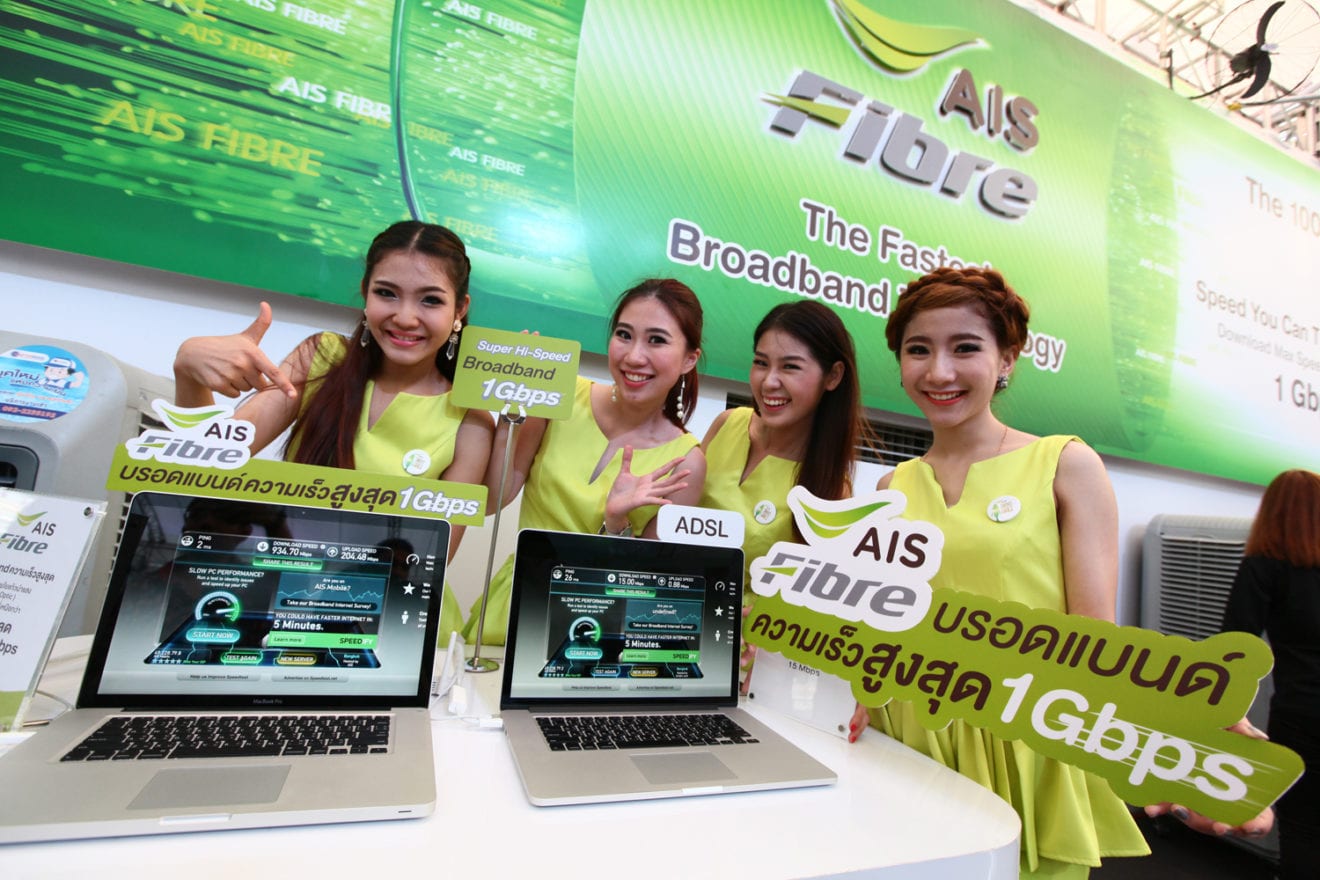
    Thailand’s AIS has launched a new mobile service offering connection speeds of up to 1Gbps by combining 4G and Wi-Fi connectivity.

    AIS’ Next G branded service is now available on supported handsets via a firmware upgrade.

    The service has been developed in collaboration with Samsung and Korea Telecom. It uses Multipath CTP technology to integrate AIS LTE-Advanced and Super Wi-Fi frequencies, providing speeds of up to 1Gbps in areas where both networks are available.

    Next G is currently compatible with Samsung Galaxy S series handsets of S7 and newer, with more handsets supporting the technology expected to be rolled out in the future.

    The upgrade forms part of AIS’ evolution to 5G, and is now available in major provinces nationwide.

    AIS currently has around 49,000 4G base stations and 80,000 Wi-Fi hotspots throughout Thailand. The operator’s 4G customer base meanwhile reached 15.8 million by the end of the second quarter.

    Concurrently with the launch, AIS is aiming to improve the customer experience, and has recently upgraded one of its major customer service shops with a new Digital Gallery concept displaying innovations from major smartphone makers and other device brands.

  • Belize’s Smart goes live with FTS’ convergent billing

    Belize’s Smart goes live with FTS’ convergent billing

    Smart based in Belize has implemented FTS’ real-time billing and charging solution to support its expansion into 4G LTE as it offers innovative services to its customers.

    Supporting Smart’s LTE, 3G and 2G networks on a single platform, FTS’ Leap Billing solution includes convergent charging, billing, invoicing, customer management and partner management. In addition, FTS has provided Smart with a mobile solution, including prepaid IN gateway, voicemail and IVR systems.

    “Throughout the project FTS demonstrated its experience in implementing complex, multi-network solutions,” said Ernesto Torres, Smart’s CEO. “FTS’ billing solution enables us to provide new services while achieving an enhanced customer experience.

    As our growth continues, we look forward to FTS’ continued support.”

    Using FTS’ billing system, Smart can now configure and deploy real-time promotions, new pricing plans and loyalty programs. This enables the rapid delivery of innovative services such as shared data plans, social media packages and more.

    “This project demonstrates FTS’ ability to deploy complex, end-to-end, BSS and VAS systems,” said Avi Kachlon, FTS’ CEO.

    “This successful project marks another important milestone for FTS as we further expand our presence in the Caribbean and Latin American markets,” said Kachlon. “We are working closely with our customers to support their operations, and are looking forward to a long-term partnership with Smart.”

  • 3 HK upgrading 4G capacity on MTR

    3 HK upgrading 4G capacity on MTR

    3 Hong Kong has completed the first phase of a project to enhance its 4G network capacity at 18-high traffic MTR stations.

    The company has upgraded its equipment at the concourses of the Tsim Sha Tsui, Prince Edward, North Point, Quarry Bay, Yau Tong, Jordan, Mong Kok and Yau Ma Tei stations.

    The whole project is expected to be complete by July 2019, and will involve upgrades throughout stations and tunnels to increase its 4G network capacity at the 18 MTR stations manyfold.

    “Using mobile service at MTR stations has become an integral part of our daily lives. 3 Hong Kong is therefore working on 4G enhancement at 18 high-traffic MTR stations to boost capacity manyfold and strengthen the network,” 3 Hong Kong CTO of Mobile Daniel Chung said.

    “The project is gradually being extended to other stations. We are constantly monitoring 3 Hong Kong’s network performance to ensure that customers enjoy an advanced mobile network featuring comprehensive coverage, high capacity, high speed and high reliability, outside and inside of MTR stations.”

  • SK Telecom more than doubles Q2 profit

    SK Telecom more than doubles Q2 profit

    SK Telecom more than doubled its net profit during the second quarter due to factors including a record performance at chipmaker SK Hynix.

    The operator reported a net income of 620.5 billion won ($555.06 million), up 113.2% year-on-year. Revenue meanwhile grew 1.8% to 4.35 trillion won and operating income increased 3.9% to 423.3 billion won.

    But it was a challenging quarter for the operator’s core telecommunications business, with operting income on a non-consolidated basis falling 3.3% year-on-year to 462.3 billion won due to increased marketing expenses and depreciation costs from the 2.6-GHz spectrum acquired last year.

    Despite this non-consolidated revenue edged up slightly to 3.11 trillion won, due to increased mobile data usage and increased sales in new business areas including IoT solutions.

    Revenue from the SK Broadband division meanwhile increased 1.9% year-on-year to 730.1 billion won and the unit reported a record-high quarterly operating income of 31.6 billion won.

    Internet commerce arm SK Planet meanwhile posted a 5.4% increase in sales to 275 billion won, but still recorded an operating loss of 35.1 billion won.

    “Despite the challenges in the mobile telecommunications market, SK Telecom posted improved results due to the strengthened performance of its main subsidiaries,” SK Telecom CFO Ryu Young-sang commented.

    “SK Telecom will become a global leading ICT company by achieving meaningful growth in media and IoT, while maintaining leadership in the mobile network operations business.”

    The company is also planning to connect its AI platform to other services, including mobile services, media, commerce and its T Map mobile navigation service to generate differentiated big data it can use to provide customized products and services.

  • China Unicom’s mixed ownership pilot approved

    China Unicom’s mixed ownership pilot approved

    China’s National Development and Reform Commission (NDRC) has given approval for a pilot program involving opening investment in China Unicom to the private sector, to evaluate transitioning to a mixed ownership model for the market’s state-owned operators.

    In an announcement, Unicom confirmed that the NDRC has given in-principle approval for the pilot program.

    But the details of the pilot – such as the identities of the private investors, pricing terms and percentage of shareholding to be allocated – will still require approval from various ministries.

    While media outlets are reporting that Alibaba and Tencent are expected to lead the private investment in China Unicom, the operator stressed that the company has not entered any legally binding agreement with any potential investors. But the company did not explicitly deny that negotiations with the internet giants are underway.

    “[Unicom’s controlling shareholder] is not aware of the source of  information in those media reports and has not entered into any legally binding documents, including framework agreement or subscription agreement, with any potential investor,” the company said.

    The Chinese government is conducting the pilot as part of plans to evaluate opening China’s telecoms sector up to private investment to reform the ownership structure and competitiveness of Unicom as well as rivals China Mobile and China Telecom.

    Unicom was selected for the pilot because it is the least profitable of China’s big three operators.

  • China Telecom expanding data center reach

    China Telecom expanding data center reach

    China Telecom is expanding its data center capacity in Hong Kong as part of the collaboration agreement with Global Switch signed in April.

    The company has added a new floor with its Shatin data center to increase server capacity, and has also arranged to build and operate the colocation areas for two of the new buildings from the in-construction Global Switch Tseung Kwan O (TKO) data center.

    The agreement with Global Switch is designed to allow China Telecom to tap into its partner’s extensive data center capacity outside of mainland China.

    The 45,000 square meter TKO data center will offer a power capacity of up to 70 mega-volt amps.

    It is expected to boast Tier 3 status and also provide access to local and international Tier 1 and Tier 2 carriers, and to boast connectivity to three subsea cables – the Asia-Pacific Gateway, the Asia-Submarine cable Express and the East Asia Crossing – due to its proximity to the TKO landing station.

    The facility is targeting LEED Gold and BEAM PLUS Gold energy efficiency ratings.

    China Telecom subsidiary China Telecom Americas has meanwhile expanded its network coverage in North America with three new PoPs, in Oregon and Illinois in the US and Quebec in Canada.

    The network expansion is aimed at bolstering the operator’s trans-Pacific proposition and helping the company stay ahead of growth in demand for bandwidth.

    “China Telecom is proud to be enhancing its Hong Kong data center portfolio with the expansion of its best-in-class Shatin facility and the addition of a new site at Tseung Kwan O in partnership with Global Switch,” China Telecom Americas President Joe Han said.

    “China Telecom’s latest investment in Hong Kong data centers and North America points of presence means our customers can expect reliable, low-latency, worldwide connectivity. This will enable them to deploy applications fast and flexibly.”