Tag: telecom

  • India’s telecoms sector under “severe financial stress”

    India’s telecoms sector under “severe financial stress”

    India’s Department of Telecom (DoT) has asked the nation’s finance ministry to cut its target for non-tax revenue to be raised from the telecoms industry by nearly 40% due to the “severe financial stress” the sector is facing.

    The Finance Ministry has set a revenue target of 473.04 billion rupees ($7.3 billion) to be raised by the telecom ministry. But the department has asked for this to be cut to 295.24 billion rupees in light of the rapidly declining revenues from all the major operators.

    Non-tax revenue from the sector comes from sources including license fees, spectrum usage charges and spectrum acquisition costs. But the DoT believes there is little prospect of holding the next round of spectrum auctions this year.

    In addition, because license fees are paid as a proportion of revenue, license fees that had been projected to total around 166.64 billion rupees are likely to decline to 92.55 billion rupees in the current financial year.

    Spectrum usage charges are also tracking to be lower than anticipated at 49.7 billion rupees.

    Major operators have been grappling with declining revenues since the entry into the market of disruptive pan-Indian LTE operator Reliance Jio Infocomm with its aggressive free services promotion.

    While the free service period is now over, experts expect the trend of falling revenues to continue for some time as operators feel the brunt of the large tariff cuts they made to stay competitive.

  • SK Telecom sets distance record with quantum repeater

    SK Telecom sets distance record with quantum repeater

    SK Telecom has announced it has developed and successfully tested a quantum repeater over a 112km pilot fiber network.

    The repeater can dramatically extend the distance of quantum communication, and could pave the way for the application of quantum cryptography to commercial LTE networks.

    Quantum cryptography is the most secure form of communications equipment known that cannot be broken with any existing hacking technology. But the previous maximum transmission distance of 80km has been viewed as the largest obstacle to the commercialization of the technology.

    SK Telecom said its new Trusted Repeater can dramatically extend the distance of quantum key distribution (QKD), and has set a new QKD distance record of 112km. For example, the company would be able to transmit quantum keys from Seoul to Busan, at a distance of 460km, by installing five repeaters.

    The operator plans to work with global partners to apply quantum cryptography solutions including the repeater to commercial networks worldwide.

    “SK Telecom has opened a new chapter in the field of quantum technologies by developing the Trusted Repeater, an enabler for long-distance quantum communication,” said Park Jin-hyo, senior vice president and head of network technology of SK Telecom’s R&D Center.

    “SK Telecom will continue to focus on developing key quantum cryptography technologies and building a related ecosystem.”

    The company has been developing quantum cryptography technologies since 2011 at its Quantum Tech lab. In February, SK Telecom entered an agreement with Nokia to cooperate on the quantum cryptography business, and jointly established the Quantum Alliance with Deutsche Telekom.

  • BT launches device security management platform

    BT launches device security management platform

    BT has launched a new security service that uses technology from IoT security company ForeScout Technologies to  provide real-time agentless visibility and control of devices connected to corporate networks.

    BT Managed Endpoint Access Security can support managed, unmanaged, private, BYOD and IoT devices.

    ForeScout’s agentless approach to network security is designed to real-time discovery, classification, assessment and monitoring of devices allowing end-customers to see what is on their network, from campus to cloud, and to securely manage it.

    ForeScout can also orchestrate a policy-based security enforcement operation, with leading IT and security management products to automate security workflows and accelerate threat response.

    “By bringing ForeScout’s technology into our portfolio, we extend our ability to protect organizations against the latest threats through improved visibility and control,” BT vice president for security David Stark said.

    “Whether it’s protecting a head office or a branch site, adding the ability to monitor just about any device connected to the network offers a much required additional layer of security to companies moving into the digital world.”

    The service will be available globally from June 2017.

  • 3 HK, GASH Point team on gaming services

    3 HK, GASH Point team on gaming services

    3 Hong Kong, the mobile division of Hutchison Telecommunications Hong Kong (HTHKH), has signed an agreement with GASH Point, an Asian digital entertainment payment platform, in its latest push to tap the growing gaming market.

    As part of the agreement, the pair will launch co-branded game points cards, ranging between HK$10 ($1.28) and HK$1,500. Users can use the cards to access 3,000 mobile and PC games, as well as digital content. Gamers could also be offered privileges such as special edition gaming equipment.

    The operator said customers can buy GASH game points and receive bonus game points amounting to not less than 5% of a purchase via 3 Hong Kong’s direct carrier billing service. Such transactions will be charged directly to a 3 Hong Kong customer’s mobile bill, thereby providing total peace of mind when making a purchase.

    Gamers holding a GASH Point account can access digital entertainment content via the Gash app. Such items include games such as Clash of Kings, MonsterStrike and the Xifeizuan Palace Game. The app also allows access to Japanese digital content via the DMM.com audio-visual gaming platform and the DLsite.com online shop dedicated to otaku, Japan’s anime and manga fandom scene.

    Kenny Koo, 3 Hong Kong’s director of roaming and service development, said the co-branded cards are expected to be introduced in July at the earliest.

    Koo said 3 Hong Kong is the first operator in the city to seal such a deal with Gash, and the company expects the collaboration with GASH Point will help boost mobile data usage and consumption of value added services.

    The collaboration with GASH Point is the company’s latest effort to build an integrated gaming platform for gamers. In May, 3 HK and Razer, a lifestyle brand for gamers, formed a strategic partnership to collaborate on a number of areas including co-branding, mobile devices and plans, and virtual currency distribution, as well as open RazerStore in Hong Kong.

    “We aim to become the telecoms operator of choice among gamers. The route to this goal involves collaboration with world-class partners, so we can offer the hottest gaming products and services, while delivering the latest eSports information,” the executive said.

    GASH COO Simon Lu said the collaboration with 3 Hong Kong provides local users with a convenient payment method and is “an important milestone” in its penetration of the Asian market.

    “This [partnership] will allow us to extend our operational scale, enhance the GASH application user experience, establish an online-to-offline (O2O) scenario and revamp GASH’s website in order to improve loyalty among members. What’s more, we will offer specially-tailored services, while developing more payment options and making an even greater diversity of digital entertainment content available to satisfy user demand and boost our membership numbers,” he said.

    Lu said there is a lot of potential in gaming market in Asia Pacific, which generated $46.6 billion of revenues in 2016, up 10.7% from the year before.

    GASH currently has presence in Hong Kong, Taiwan, Japan and Korea, with over 10 million registered users across these markets and an annual transaction of $300 million.

    Lu said Hong Kong currently contributes about 15% of the company’s total revenue and gamers in Hong Kong spend two and three times more than those in Taiwan.

    In addition to gaming, Lu said GASH and 3 Hong Kong will also explore in other areas such as co-organizing e-sports tournaments and digital entertainment content.

  • PT Datacomm debuts hybrid cloud suite

    PT Datacomm debuts hybrid cloud suite

    PT Datacomm Diangraha, through Datacomm Cloud Business (DCB), has launched what it is touting as simple and secure hybrid cloud solutions for Indonesian enterprises.

    The new offering – which utilizes hybrid IT solutions from Hewlett Packard Enterprise (HPE) – aims to help Indonesian enterprise customers migrate to the cloud with technology that addresses the security and compliance standards stipulated by the Indonesian government.

    DCB aims to capitalize on the growing rate of cloud computing adoption to help, to help Indonesian enterprises source, manage and consume IT services. This includes the deployment of services across a mix of traditional IT, private cloud and public cloud (hybrid infrastructure) to create the optimal IT mix—where workloads are deployed and applications are sourced from the most appropriate platform, based on a customer’s unique requirements (e.g., performance, cost, compliance, location).

    The deployment, which includes HPE servers and all-flash storage, will provide flexibility for enterprise customers to choose the cloud deployment option that best suits their needs.

    Solutions provided by Datacomm Cloud Business will include private managed cloud, cloud management platforms, public cloud, disaster recovery-as-a-service and backup as-a-service.

    The offerings will be fully hosted in Indonesia to meet with Indonesian Government Regulation (PP) No. 82 in 2012 on data sovereignty requirements.

    “Through our participation in the HPE Partner Ready Service Providers Program, we are now empowered with the knowledge, expertise and technology innovation that can help our customers move beyond their traditional infrastructure and reap the benefits of the hybrid IT world,” Datacomm Cloud Business managing director Sutedjo Tjahjadi said.

    “Through our offerings, customers will be able to ensure they move at the speed of business while enjoying international service standards, meeting the Indonesian government local compliance requirement and having access to 24×7 local support as required.”

    DCB is expanding its investment in the cloud computing local infrastructure. DCB will also add two additional cloud node infrastructure projects between now and the end of the year in Bandung and Medan.

  • SKT launches five-band CA, 4X4 MIMO

    SKT launches five-band CA, 4X4 MIMO

    SK Telecom has announced the launch of five-band carrier aggregation (CA) and 4X4 multiple input multiple output (MIMO) technologies as part of its ongoing evolution to 5G.

    The operator has made five-band CA LTE-A Pro available in the main areas of 53 cities across South Korea, supporting data rates of up to 700Mbps.

    The five-band CA service utilizes SK Telecom’s 10MHz of 800-MHz spectrum, 20MHz in the 1.8-GHz band, 10MHz in 2.1-GHZ as well as a 10MHz and 20MHz carrier in the 2.6-GHz bands.

    SK Telecom has meanwhile launched 900Mbps LTE-A Pro in the CBDs of six cities by combining existing three or four band carrier aggregation with 4×4 MIMO. The six cities are  Seoul, Busan, Daegu, Gwangju, Daejeon and Ulsan.

    Among SK Telecom’s handset line-up, currently only the Samsung Galaxy S8 supports these new services, and will require an over-the-air firmware upgrade to do so. But the operator said it anticipates that more upcoming premium smartphones will support the services.

    SK Telecom has set a target of having the two services combined cover more than 50% of the Korean population by the end of the year.

    The operator also plans to launch 1Gbps LTE-A Pro services in the first half of next year by combining five- or four-band CA with other technologies such as 4X4 MIMO.

    “SK Telecom’s LTE-A Pro services represent an early application of 5G technologies that support Gbps-level data speeds and massive network capacity,” SK Telecom SVP and head of infrastructure strategy Choi Seung-won said.

    ““SK Telecom will continue to offer differentiated mobile communications quality through LTE-A Pro service, while utilizing the network to gain a valuable edge in the 5G era.”

  • Ncell launches 4G despite PAC directive

    Ncell launches 4G despite PAC directive

    Nepal’s Ncell has announced the launch of 4G services, despite reports that the company is to have its 4G license withheld due to a tax dispute.

    In a statement, Ncell said it has launched 4G in Kathmandu, Nagarkot, Banepa and Dhulikhel, and has set a target of rolling out 4G to 15% of the country by the end of the year.

    Ncell will allow customers to replace their existing SIMs with a 4G compatible USIM for free at Ncell stores, and will provide 1GB of bonus data with a three day validity to celebrate the launch of 4G.

    The company said customers can expect download speeds of between 10Mbps and 37Mbps and upload speeds of 3Mbps to 18Mbps.

    The statement made no mention of the recent directive from the parliamentary Public Accounts Committee (PAC) that Ncell be prohibited from launching 4G until the dispute is resolved over capital gains tax associated with the sale of TeliaSonera’s indirect controlling stake in Ncell to Malaysia’s Axiata in 2015 for $1.03 billion.

    The PAC has “serious reservations” over the launch, and will call a meeting this week to decide on a formal position over whether to oppose the issuance of Ncell’s 4G license under Nepal’s technology neutrality policy.

    According to the report, Ncell had launched 4G before regulator the Nepal Telecommunications Authority (NTA) had a chance to reach a decision over the validity of the 4G license.

  • Myanmar cellcos cleared to use 1800 for 4G

    Myanmar cellcos cleared to use 1800 for 4G

    Myanmar’s Ministry of Communications and Information Technology (MCIT) has granted permission to the market’s mobile operators to launch 4G over the 1800-MHz spectrum assigned to them.

    Mynmar Posts and Telecommunications, Telenor Myanmar and Ooredoo Myanmar have been cleared to use 2x10MHz of 1800-MHz spectrum allocated under a 12 year license.

    Operators will be required to pay an $80 million usage fee, the ministry’s Posts and Telecommunications Department has revealed.

    State-owned MPT has announced that with the approval the operator will be expanding its network to 4G, starting with the cities of Nay Pyi Taw, Yangon, and Mandalay. The operator will offer customers the ability to swap their existing 2G and 3G SIMs to a 4G SIM free of charge.

    MPT has teamed up with KDDI and Sumitomo for its mobile operations as part of the liberalization of Myanmar’s telecoms sector.

    Telenor Myanmar and Ooredoo Myanmar will meanwhile be able to use the spectrum to expand their respective 4G operations to more cities and regions.

    Telenor Myanmar launched 4G services in July last year, and now offers 4G in 19 cities. Ooredoo Myanmar launched 4G in May  in Yangon, Mandalay, and Nay Pyi Taw, and has since expanded the network to the Magwe Region.

  • India’s Supreme Court holds tower removal order

    India’s Supreme Court holds tower removal order

    India’s Supreme Court has put a hold on a state government order to remove all mobile towers from within 500 meters of jails across Rajasthan after a challenge from mobile operators.

    The Cellular Operators’ Association of India (COAI), the main industry body for India’s mobile sector, is seeking to have the order overturned on the grounds that it would affect around 8 million people an have a cascading effect on the sector.

    The order from the Rajasthan government, issued on April 6, demanded all operators remove their towers from within the vicinity of jails by early June.

    In order to comply with the order, operators would have to remove a total of 400 towers, including base station controller sites catering to a further 2,500 base stations.

    In the court challenge, COAI has argued that even the national Department of Telecommunications has supported operators’ position that they should not have to remove the towers.

    A policy passed earlier this year permits setting up cell towers within 500 meters of jails, hospitals, schools and other public or private locations, the report notes. But this policy has since been amended to stipulate that construction of towers in the vicinity of these locations can be blocked by a court order.

    COAI is seeking a declaration that operators should not have to follow the order, and that the state government should not be allowed to penalize them for non-compliance.

  • Colt optimizes routes between Tokyo, Chicago exchanges

    Colt optimizes routes between Tokyo, Chicago exchanges

    Colt Technology Services has launched newly optimized low-latency network routes linking stock exchanges in Tokyo and the Chicago Mercantile Exchange.

    The enhancements aim to benefit traders in Chicago who require fast connectivity to Tokyo, or exchange venues in Tokyo that require low-latency connectivity to Chicago.

    Connectivity will be provided through the company’s private Ethernet-based Colt IQ Network. Latency between Tokyo and Chicago is expected to reach a mere 121.07ms between each endpoint after network optimization.

    Exchange venues across the globe will be able to utilize Colt’s ultra-low-latency network that links financial markets in Japan and America. Enterprises in other industries that require leased bandwidth, advanced security, and low-latency Ethernet services are also expected to benefit from these optimizations.

    Bandwidth is selectable from a range of 1Mbps to 10Gbps, and offers optional protection and redundancy.

    Colt has also commenced optimization of other key routes in the Asia-Pacific region.

    The company said its network is configured to be fully redundant, from the infrastructure and backbone to the local loop. Point-to-Point, Point-to-Multipoint, and Multipoint-to-Multipoint topology options are available. Colt’s services are based on MEF9 and MEF14.

  • Hong Kong cellcos call for clear spectrum roadmap

    Hong Kong cellcos call for clear spectrum roadmap

    Hong Kong’s mobile operators are all calling on the government to develop a clear spectrum roadmap that covers the release and allocation of spectrum for 5G services.

    HKT has called on the government to perform an “urgent and radical overhaul” of its mobile spectrum policies and practices to prepare for the introduction of 5G mobile technology.

    The Office of the Communications Authority (OFCA) must improve its “archaic mobile spectrum principles and practices,” or the telecoms industry and Hong Kong as a whole will suffer irreparable damage, the operator has argued.

    In a response to the government’s public consultation on the re-assignment of 900-MHz and 1800-MHz mobile spectrum, widely used for mobile services, HKT said a new, forward looking plan for spectrum management is needed to meet the future needs of the industry and Hong Kong society.

    The operator called an earlier attempt by the government to attract new market entrants “an example of the complete failure of its policy.”

    While 21 ViaNet originally bid for 30 MHz of 2.3-GHz spectrum with the stated aim of launching mobile services, the company subsequently decided to use the spectrum for local fixed services, and then reduced its use of the valuable spectrum to only cover certain village houses. HKT said this wasted “valuable mainstream mobile spectrum which is in short supply in Hong Kong.”

    “Hong Kong is facing a severe spectrum deficit and is seriously lagging behind the other developed markets in policy making. The government’s current spectrum rollout plan has failed to set the stage for early adoption of 5G,” HKT group managing director Alex Arena said.

    “Along with the archaic principles and practices adopted by the CA for building access, spectrum charging, and spectrum management, this poses a clear and substantial threat to Hong Kong’s services based economy, consumer satisfaction, our role as a telecommunications hub, our ability to service as a gateway to Mainland China, and our ability to be a creative center.”

    HKT wants the government to provide a clear roadmap for the release of adequate spectrum to the industry, classify mobile operators as utility providers and facilitate their access to buildings and land for cell site installation and manage spectrum in a way that incentivizes investment by industry.

    In addition, HKT is calling for an overhaul of the current spectrum utilization fee (SUF), replacing the current system of charging on a per MHz basis to reflect the large bandwidth that will be required for 5G.

    The operator said in 2016, spectrum costs represented 12.2% of its operating costs, well above OFCA’s calculation of 3-4%.

    “As we move into the information economy, our telecommunications infrastructure is a vital national resource. There is no time to waste. The Government needs to resolve these matters now,” Arena said.

    “HKT, together with the rest of the industry, looks forward to engaging in active dialogue and discussion with the Government about the way forward.”

    In a separate submission, rival SmarTone also called for the development of a clear spectrum roadmap.

    The operator indicated that it supports the adoption of a hybrid approach combining administrative acquisition of spectrum with a market based approach to its release, one of the three options being proposed for the future management of spectrum assets.

    Meanwhile 3 Hong Kong’s submission has asserted that the regulator should be giving existing licensees of 900-MHz and 1800-MHz spectrum a right of first refusal while reallocating the frequency bands.

    The operator argued that taking spectrum away from mobile operators would hinder long-term investment and innovation and risk disrupting customer service continuity. An excessive SUF is the equivalent to a spectrum tax on mobile users and is against the public interest, the submission added.
  • AIS projecting 5% revenue growth for 2017

    AIS projecting 5% revenue growth for 2017

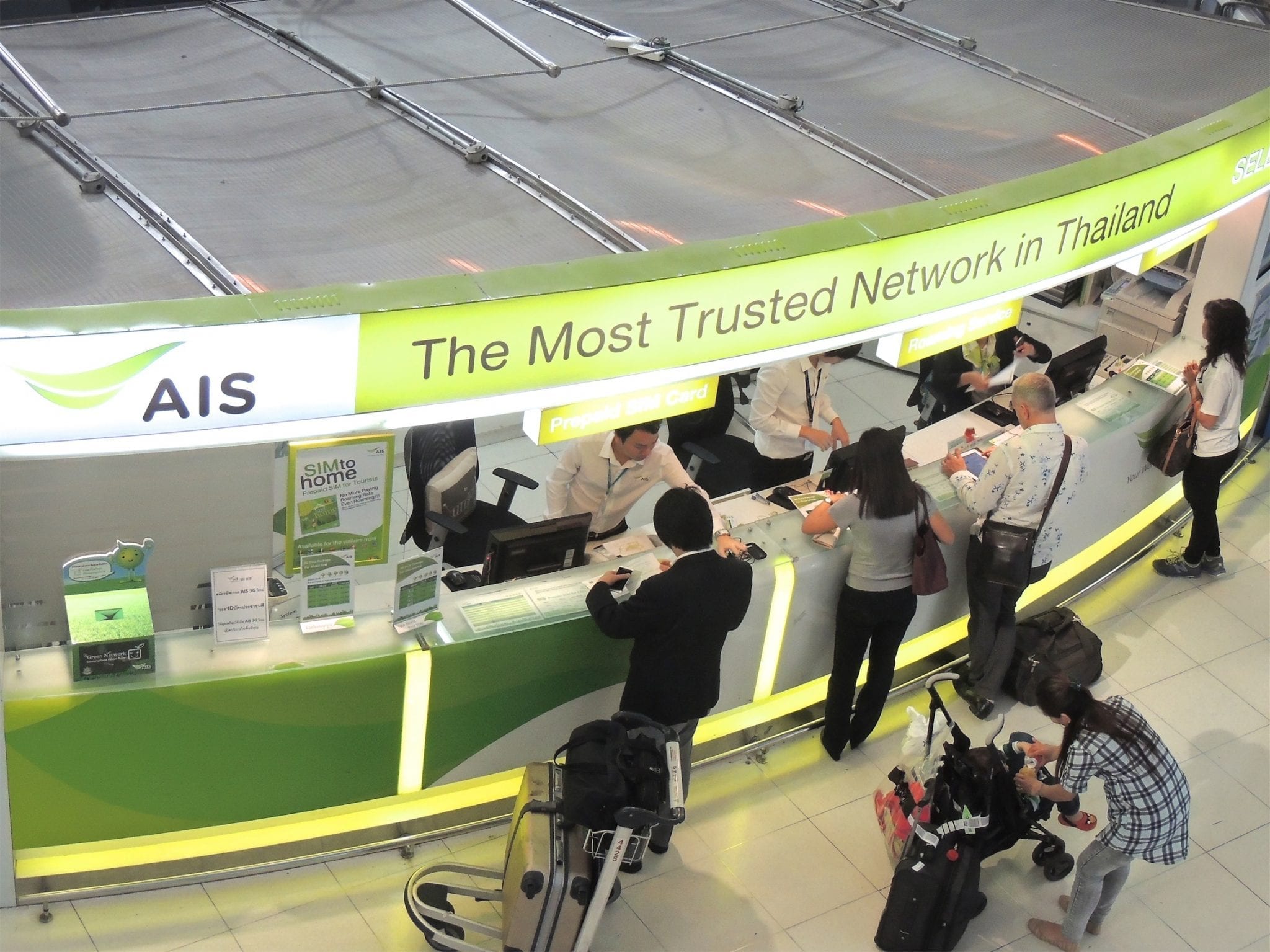
    Thailand’s AIS is projecting a 5% increase in revenue and a 44% growth in ebitda this year as a result of strong growth in 4G customers.

    AIS VP of investor relations Nattiya Poapongsakorn as stating that the operator is expecting service revenue for the year of 129 billion baht ($3.75 billion), with the majority expected to come from data services.

    AIS’ total 4G customer base roughly doubled in the past 12 months to reach 12 million by the end of March, which compares to a 3G customer base of 24.6 million and a 2G subscriber base of 4 million.

    AIS aims to increase its revenue market share to 50% this year, up from 48% as of March. She said the operator’s 4G users have an ARPU of 400 baht, compared to just 250 baht overall.

    For the first quarter, AIS reported service revenue of 31.4 billion baht, with data services accounting for 57% of this.

    The operator meanwhile plans to spend around 45 billion baht to expand its networks in 2017, with 40 billion to be spent on mobile networks and the remainder on fiber infrastructure. But the company plans to reduce its handset subsidy budget after incurring subsidy costs of 10 billion baht last financial year.

  • Viu debuts in Thailand

    Viu debuts in Thailand

    Viu has officially launched in Thailand, offering premium Asian content with Thai subtitles, comprising the latest dramas and variety shows from Korea and Japan.

    This brings the service to 15 markets including Hong Kong, Singapore, Malaysia, India, Indonesia, the Philippines and the Middle East namely Bahrain, Egypt, Jordan, Kuwait, Oman, Qatar, Saudi Arabia and United Arab Emirates.

    “The Hallyu which is sweeping across Asia is notable in Thailand and we are pleased to see that Viu has already recorded over 820,000 fans on Viu Thailand Facebook page even months before our launch,” said Janice Lee, managing director of PCCW Media Group.

    “Leading K-communities and die-hard Korean fans in Thailand all eagerly await Viu’s service launch to access our vast library of premium Korean and other Asian content,” said Lee.

    She said Viu research shows that 93% of online population in Thailand have watched videos on the web.

    “We are fully leveraging this surging trend with a two-pronged approach of our services: ad-supported free viewing of their favorite shows and subscription services with express content access and premium features such as unlimited downloads, 1080p HD video quality and ad-free video viewing,” said Lee.

    “As Thailand is one of the most highly Internet penetrated markets with Millennials who are very receptive to online video viewing and digital advertisements, we expect Viu Thailand to mirror the success we have in other Asian markets with healthy growth in subscription and advertising revenue in due course,” she added.

  • DoCoMo plans major leadership shake-up

    DoCoMo plans major leadership shake-up

    Japan’s NTT DoCoMo has announced significant proposed changes to its management team as part of efforts to “further grow and develop the company.”

    The operator revealed that one executive director, one director, two audit and supervisory board members and four senior vice presidents are planning to resign, mostly to take up new positions at DoCoMo subsidiaries or affiliate companies.

    In their places there are two new candidates for the board of directors, two new candidates for the audit and supervisory board and seven new senior vice president candidates.

    The changes to the executive positions will be put up for approval at the shareholders meeting, the board of directors meeting and the audit & supervisory board meeting scheduled on June 20, 2017.

    If the changes are approved, DoCoMo’s new board will include executive vice presidents Hirotaka Sato, Kiyohiro Omatsuzawa, Hiroshi Tsujigami, Kouji Furukawa and Kyoji Murakami, as well as senior vice presidents Hiroshi Nakamura and Hozumi Tamura.

    The top leadership team will consist of president, CEO and board member Kazuhiro Yoshizawa, senior executive vice president, CIO, CISO, chief privacy officer and board member Hiroyasu Asami, and senior executive vice president for global business, corporate and CSR and board member Toshiki Nakayama.

  • Cellcos to spend $21b on 5G NR by 2025

    Cellcos to spend $21b on 5G NR by 2025

    Mobile operators will spend more than $21 billion on standardized 5G NR (New Radio) infrastructure by the end of 2025, according to SNS Research.

    Despite the lack of sufficient LTE coverage in parts of the world, mobile operators and vendors have already embarked on R&D initiatives to develop 5G.

    According to the GSA (Global mobile Suppliers Association), in the first quarter alone at least 25 operators from 15 countries have demonstrated 5G technologies, or announced 5G tests or trials.

    Last week, South Korea’s KT said it is in the final stages of testing for the 5G trial network that will support next year’s Winter Olympic Games in PyeongChang, while Japanese counterparts KDDI and China Mobile also announced trials on pre-5G technologies.

    With pre-standard 5G network deployments well underway, the research firm in March released an estimate, predicting mobile operators worldwide will spend more than $250 million on pre-standard 5G network rollouts by the end of 2017.

    Although 2020 has conventionally been regarded as the headline date for 5G commercialization, the very first standardized deployments of the technology are expected to be commercialized as early as 2019 with the 3GPP’s initial 5G specifications set to be implementation-ready by March 2018.

    Between 2019 and 2025, SNS Research expects the standardized 5G NR infrastructure market to aggressively grow at a CAGR of approximately 70%, eventually accounting for over $21 billion in annual spending by the end of 2025.

    The market will be complemented by additional investments of over $7 billion on NextGen (Next Generation) core and transport (fronthaul/backhaul) networking infrastructure, the research firm estimates.

    SNS Research notes that 5G is expected to provide a single network environment to deliver not only existing mobile broadband and internet of things services, but also new innovations such as self-driving cars, cloud robotics, 3D holographic telepresence and remote surgery with haptic feedback.

    The 3GPP agreed in March to accelerate some elements in the 5G NR timeline to allow operators to speed up deployment of 5G services.

    The standard body set a December 2017 deadline to complete the non-standalone 5G NR specification process and finalize the spec by March next year. The move means non-standalone 5G NR products could be launched as early as 2019.

    Non-standalone 5G NR mode will be designed to anchor a connection in LTE, using 5G NR carriers to improve data rates and reduce latency.