Tag: telecom

  • Consortium contracts ASN for INDIGO cable system

    Consortium contracts ASN for INDIGO cable system

    A consortium consisting of Asian operators, Google and telecommunications infrastructure company Superloop have commissioned a new subsea able system linking Singapore, Indonesia and Australia.

    Singtel, Indonesia’s Indosat Ooredoo as well as Australia’s Telstra and education sector network provider AARNet have joined Google and Superloop’s SubPartners to join the INDIGO cable system.

    The cable system, formerly known as APX West and Central, will be deployed by Alcatel-Lucent Submarine Networks.

    It will span around 9,000km between Singapore and Perth on the west coast of Australia, and onwards to Sydney on the east coast. A ranching unit with two additional fiber pairs will connect Singapore and Jakarta.

    Construction of the cable is expected to be complete by mid-2019. The system will use an open cable two fiber pair desgin, providing consortium members with spectrum ownership and giving them the ability to independently adopt technology advancements and upgrades as required.

    “With internet data consumption growing by 70% in Asia last year alone these sorts of investments in international networks are critical for meeting the needs of connected consumers and businesses,” Telstra group MD for global services and international David Burns said.

    “The construction of INDIGO is timely to meet the rising demand for high-speed broadband between Asia and Australia. This cable system complements our global connectivity that links Asia, the US, Europe, Australia and the Middle East,” Singtel Enterprise VP for carrier services Ooi Seng Keat added.

    Superloop has inherited its membership in the INDIGO consortium via the recent acquisition of subsea cable operator SubPartners for $2.5 million. As part of the acquisition Superloop has provided a guarantee involving the meeting of SubPartners’ construction capex costs for the project.


  • Global telecoms service revenues due to rebound

    Global telecoms service revenues due to rebound

    The global telecommunications services market is on track to rebound after a long period in decline, reaching $1.3 trillion by 2021, MarketLine has projected.

    The market has declined at a negative CAGR of 3.4% between 2012 and 2016 due to downward price pressure motivated by intensifying competition, MarketLine analyst Nicholas Wyatt said.

    “4G mobile internet is now standard in many markets, particularly developed ones, so the only way lots of mobile operators can differentiate themselves from the competition is on price,” he said.

    “This has forced prices down and negatively impacted a market that has reached saturation point in many countries.”

    MarketLine estimates that the wireless segment contributed around $775 billion in sector revenues during 2016, or 64.9% of the $1.2 trillion total market value.

    Growing demand for mobile data is expected to help stimulate a 2.2% CAGR in the market between 2016 and 2021, driving the total market to a value of $1.3 trillion.

    Growth is expected across all regions, with APAC growing slightly higher than the US and Europe due to the region’s relatively lower saturation level.

    “Subscription volumes have plateaued in recent years, but a slight uptick is expected as populations expand and businesses require increasingly mobile staff,” Wyatt said.

  • New Zealand cellcos propose joint rural expansion program

    New Zealand cellcos propose joint rural expansion program

    New Zealand’s mobile operators Spark, Vodafone New Zealand and 2degrees have submitted a joint proposal to improve rural broadband and mobile infrastructure under two government programs.

    The operators have applied to be selected for the Rural Broadband Initiative Extension and Mobile Black Spot Fund programs.

    If selected, the companies have committed to investing “hundreds of millions of dollars” in the project, including NZ$75 million to deploy the infrastructure, as well as opex costs, spectrum and other resources.

    The operators said their proposed expenditure would more than match the government’s own planned NZ$150 million ($104.6 million) contribution to the program, which would come from the Telecommunications Development Levy.

    Under the proposal, the partners would roll out around 500 new cell sites providing a 25% increase in land coverage across New Zealand, providing access to fast broadband for thousands of rural households and businesses and extending mobile coverage to more than 1,200km of state highways.

    “Rural New Zealand is a key driver of our country’s economic growth and productivity and for these sectors to remain competitive they need fast broadband and mobile coverage – not just in offices, but on farms, in schools, and on the roads,” Vodafone NZ CEO Russell Stanners said.

    “The combination of the Government’s RBI funding and this investment by the three mobile network operators presents a once in a generation opportunity to deliver both competitive ultra-fast broadband and world class 4G mobile infrastructure to areas of New Zealand that today have neither.”

  • Sonus, Palo Alto develop mobile security architecture

    Sonus, Palo Alto develop mobile security architecture

    Sonus Networks and Palo Alto Networks have jointly announced a new security architecture designed to mitigate the impacts of rogue LTE endpoint devices and erroneous IP traffic crossing 4G-LTE mobile networks.

    The Sonus security architecture includes existing Sonus Session Border Controller (SBC) elements, providing the Interconnection Border Control Function and Proxy-Call Session Control Function (IBCF and P-CSCF), as well as the Palo Alto Networks Next-Generation Platform to move security to the network edge, lowering mobile networks costs and customer churn.

    The joint architecture allows operators to implement new policies that block unauthorized traffic on EPC networks, increase security, reduce network congestion and associated costs and enhance the user experience of operators’ mobile subscribers by providing protection from mobile malware.

    Operators can now leverage their Sonus P-CSCF and IBCF deployments to detect and mitigate anomalous IP communications traffic from rogue endpoints, as well as obtain complete visibility and threat prevention capabilities provided by the Palo Alto Networks Next-Generation Platform.

    With this security architecture in place, operators can reduce capital costs by limiting the over-provisioning of networks while implementing a more effective overall security posture in conjunction with growing IP Communications services, such as VoLTE and VoWiFi.

    Additionally, operators can deter theft of service and ensure greater network availability and quality of experience for mobile subscribers by preventing targeted network attacks and blocking malware targeting mobile devices.

    “The Sonus and Palo Alto Networks architecture brings together the unique capabilities offered by each company to deliver a best-in-class security solution for mobile operators that unifies LTE data and VoLTE security policy and enforcement,” said Kevin Riley, Sonus CTO and senior vice president, Engineering.

    “Establishing a secure mobile network for the Internet of Things will be a key differentiator for mobile operators and their customers in the coming years  We are looking forward to working with Palo Alto Networks to continue this momentum as we get ahead of identity and security issues and redefine this evolving landscape together.”

  • AirAsia to start Vietnamese carrier

    AirAsia to start Vietnamese carrier

    AirAsia, the low-cost carrier headed by Malaysian tycoon Tony Fernandes, plans to start a Vietnamese carrier in a local partnership, as cheap fares and rising incomes fuel a travel surge in the South-east Asian nation.

    The region’s largest budget airline will partner Gumin, Hai Au Aviation Joint Stock and businessman Tran Trong Kien for the venture, which is expected to start flying early next year, AirAsia said.

    Gumin will own about 70 per cent of the new venture, with AirAsia holding the rest.

    Vietnam is the latest country to woo Mr Fernandes, who is seeking to build a pan-Asian budget airline, as the 28 per cent growth in passenger traffic was triple the pace in other South-east Asian nations. The fifth-biggest market in the region has seen domestic traffic double since 2013, and the middle-class will comprise close to a quarter of its population by 2010, AirAsia said.

    AirAsia has over the years established affiliates in Indonesia, Thailand, India and Japan, and is betting on a low-cost, long-haul model for global travel via its AirAsia X unit. It has ordered hundreds of planes from Airbus, and is selling a plane- leasing unit to raise more cash.

    Vietnam will continue to see a double-digit gain in passenger numbers in the next decade, said ACB Securities in December.

  • Huawei unveils All-Cloud Network architecture

    Huawei unveils All-Cloud Network architecture

    Huawei unveiled its All-Cloud Network architecture for enterprises at last week’s CeBIT 2017, in a bid to help enterprises accelerate their digital transformation.

    The vendor’s new architecture is comprised of three parts – ubiquitous connections, an open cloud platform and a social technology industry application.

    The architecture consists of CloudFabric – designed to build a simple, efficient, and open cloud data center network as well as CloudDCI to build an on-demand and smart data center interconnection network based on cloud services.

    The portfolio also includes CloudCampus, which aims to enable cloud management of the network throughout the entire lifecycle, from network deployment to O&M, as well as all Wi-Fi access in the campus network. CloudEPN meanwhile includes on-demand value-added network services for enterprises.

    Finally, Edge-Computing-IoT (EC-IoT) is a security solution designed to meet predictive maintenance requirements and enable digital transformation for vertical industries.

    “Digital transformation not only means applying new technologies such as cloud computing, SDN, and NFV, but also involves reforming business models, operational modes, and thinking patterns,” said Kevin Hu, president of Huawei Switch & Enterprise Gateway product line.

    “The All-Cloud Network architecture will deliver ubiquitous connections, an open cloud platform, and social technology industry applications to enterprises. In addition, it will simplify network resource management and enhance the value of network data. All of these factors will create an open network for enterprises to reap business benefits with tremendous potential.”

  • BT completes first stage Michelin deployment

    BT completes first stage Michelin deployment

    BT has delivered the first milestones of its global enterprise networking contract with tyre manufacturer Michelin.

    The contract was signed late 2016 and is now in deployment phase. It is designed to transform Michelin’s global network infrastructure and provide all the advantages of the latest network, unified communications and security technologies.

    Under the terms of the five-year contract, BT is to provide Michelin with managed network services for 216 sites in 43 countries across all continents.

    Managed from France, the services covered by the contract are set to play an important role in delivering Michelin’s strategic IT transformation program.

    Agnès Mauffrey, Group CIO of Michelin, said they are driven to look for new ideas to improve the performance of our products and the efficiency of our business.

    “We see a great match between these requirements and BT’s global reach, local in-country capabilities and strong global portfolio,” said Mauffrey.

    “Our aim is to create a platform for digital innovation which will give our people around the world high performance access to cloud-based services, allowing them to collaborate more effectively, she said. “This is being done in a secure and reliable environment over which we have complete control.”

    Luis Alvarez, CEO of BT’s global services division, said BT will support Michelin globally through a dedicated network operations centre and provide centralised network management.

    The contract includes services from several areas of the BT portfolio: BT Connect (network services), BT Security (security services), BT One (unified communications and collaboration services) and BT Advise (professional services).

    “We understand how important digital is to our customers and how cloud services integration can contribute to their success,” said Alvarez. “In the midst of this digital revolution, we also make sure that organizations retain control of their IT, so that the performance, reliability and security of their cloud applications meet all their business requirements.”

  • China Mobile service revenue up 6.7% in 2016

    China Mobile service revenue up 6.7% in 2016

    China Mobile has recorded a five-year high growth in service revenue growth for 2016, due to strong mobile data revenue growth.

    Operating revenue for the year grew 6% to 708.42 billion yuan ($102.7 billion), with service revenue up 6.7% to 623.42 billion yuan.

    During the year, wireless data traffic became China Mobile’s single largest revenue source for the first time, after growing by 43.5% to account for 46.2% of total service revenue.

    Net profit grew a slim 0.2% to 108.74 billion yuan ($15.78 billion), but excluding the gains from the disposal of tower assets to telecommunications infrastructure sharing joint venture China Tower in the prior year, profit would have grown 10.5%.

    China Mobile added 223 million 4G customers throughout the year, bringing its total 4G base to 535 million and representing a penetration rate of 63%. The company also added 400,000 4G base stations to its network, taking its total population coverage to more than 1.3 billion.

    The operator’s total mobile customer base grew 2.7% from 2015 to 848.9 million.

    On the fixed line front, China Mobile added 22.59 million broadband customers, taking the total to 77.62 million, with 76.9% of these subscribed to services with speeds of at least 20Mbps.

    China Mobile is the last of China’s big three operators to report its results for 2016. China Mobile’s performance compares to a 6.4% increase in operating revenue and 10.2% decline in net profit for China Telecom, as well as a 94.1% slump in net profit and 1% decrease in operating revenue for China Unicom.

  • Smart’s 2016 revenue grows 26% on mobile data growth

    Smart’s 2016 revenue grows 26% on mobile data growth

    The Philippines’ Smart Communications has reported a 26% increase in revenues for 2016 to 25.5 billion pesos ($509 million), in a result attributed to sustained growth in the company’s mobile data business.

    Smart, the wireless subsidiary of incumbent operator PLDT, said mobile data revenues for the year grew a strong 42% to 17 billion pesos.

    During the year, data revenues edged out voice calls and text messages as the operator’s largest wireless revenue source for the first time. Total usage reached 148,000 terabytes, up 49% from 2015.

    “The shift to data and digital services continues to gain momentum. With access to PLDT’s extensive fixed line network, Smart is rolling out the country’s fastest mobile internet network to address the growing demand of our subscribers for data services at home, their schools and offices and while on the go,” PLDT chief revenue officer Eric R. Alberto said.

    To help meet the steep rise in demand for mobile data, Smart has accelerated its rollout of LTE and 3G data networks and is incorporating the use of low-brand frequencies such as 700-MHz. The upgrade has now been completed in Metro Davao and is now underway in Metro Manila and Metro Cebu.

    Smart is also adopting LTE-A technology in selected areas, and recently entered a 5G partnership  with Huawei aimed at preparing its network for an evolution to the standard.

  • CITIC Telecom posts record $109.5m profit for 2016

    CITIC Telecom posts record $109.5m profit for 2016

    Hong Kong-based CITIC Telecom International has reported a record high operating profit of HK$850.1 million ($109.5 million) for 2016, up 6% from the prior year.

    During the year, CITIC Telecom launched its new City Link roaming services supporting data sharing in mainland China, Hong Kong and Macau, based on a network of more than four million Wi-Fi hotpots in the three markets.

    This launched helped the operator capture a 57% share of Macau’s 4G market, and increase its mobile broadband users by 17%.

    CITIC Telecom also achieved 100% coverage in Macau with its optical network, and completed the acquisition of 340,000 square feet for CITIC Telecom Tower, which once complete will become one of the largest data centers in Hong Kong.

    Internationally, the company commenced the process of acquiring Linx Telecommunications, which serves 14 countries in Europe and Asia. This deal was completed last month.

    The company also recently completed the acquisition of Singapore-based cloud, technology and managed services provider Acclivis Technologies and Solutions, and achieved growth with its data flow trading platform DataMall through a collaboration with China Mobile.

  • Chunghwa Telecom Global launches SD-WAN

    Chunghwa Telecom Global launches SD-WAN

    CHT Global (Chunghwa Telecom Global) has launched its SD-WAN services on a global scale to help enterprises transition from traditional static hardware to software-based WAN.

    The company is partnering with VeloCloud Networks, a Cloud-Delivered SD-WAN company, to provide the underlying infrastructure for the service.

    CHT Global has one of the widest international cable line networks in the Pacific and beyond through its undersea submarine cables that direct global voice and data traffic.

    Its leverage in the Asia-Pacific in conjunction with its SD-WAN services will allow customers to ensure reliable wide-area network connections, whether they are DSL, cable, or LTE.

    “CHT Global SD-WAN will minimize the congestion that commonly occurs with traditional broadband Internet that would otherwise interfere with the delivery of time-sensitive applications and lower the QoE for end users,” CHT Global CEO and president Joe Yang said.

    “By pairing up VeloCloud’s technology and knowledge of managed services with CHT Global’s submarine cable network, businesses around the world can increase operational efficiency and maximize performance.”

  • Globe launches 4CC LTE-A

    Globe launches 4CC LTE-A

    The Philippines’ Globe Telecom announced it has become the first operator in the nation to implement 4-component-carrier aggregation LTE-Advanced using the 2600-MHz band.

    The upgrade effectively doubles LTE capacity in areas covered by the deployment, the company said, and will be capable of generating speeds of up to 400 Mpbs once compatible devices hit the market.

    So far Globe has implemented the upgrade at 110 sites mostly in Metro Manila, including most areas in Makati and certain areas in Quezon City, Marikina, Antipolo, and San Mateo.

    The operator aims to deploy the technology in more than 500 sites this year across more of Metro Manila as well as key areas of North Luzon and South Luzon.

    Globe is using its new 2600-MHz band spectrum allocation acquired through its joint purchase with rival PLDT of conglomerate San Miguel Corporation’s telecommunications assets last year.

    Since acquiring the spectrum, the company has also deployed around 1,200 2600-MHz LTE sites mostly in Visayas and Mindanao.

    “This is the first time that a telco operator in the Philippines is making use of this 4-component carrier spectrum LTE-Advanced technology and we are maximizing the potential of the new spectrum assigned to us for the benefit of our customers,” Globe SVP for program governance Joel Agustin said.

    “This technology milestone significantly improves customer experience as smartphone penetration in the country continues to increase.”

  • Nepal Telecom reaches 500,000 4G subscribers

    Nepal Telecom reaches 500,000 4G subscribers

    Nepal Telecom has revealed that its 4G subscriber base has passed 500,000 less than three months after launching the services.

    The operator, currently Nepal’s only 4G provider, announced that it now has over 524,000 subscribers. Nepal Telecom launched 4G services at the start of January, initially in the Kathmandu and Pokhara areas.

    But of the operator’s total 4G subscriber base, only around 67,500 are postpaid, whereas the remainder are prepaid. Nepal Telecom launched prepaid LTE services in February.

    The total 4G base also currently only makes up a small portion of Nepal Telecom’s roughly 8.1 million mobile internet users, the report indicates.

    Nepal Telecom is also currently limited to providing 4G using a mere 5 MHz of 1800-MHz spectrum, capping peak data rates at 32.4Mbps, but is currently seeking more spectrum from the government to offer faster services.

    To mark the occasion of this year’s Holi spring festival in Nepal, the operator has meanwhile introduced new data and SMS offers for subscribers, including 200MB of bonus data for GSMA/CDMA prepaid users on a top up of 200 rupees ($1.88).

  • HKT, Huawei co-found C-V2X consortium

    HKT, Huawei co-found C-V2X consortium

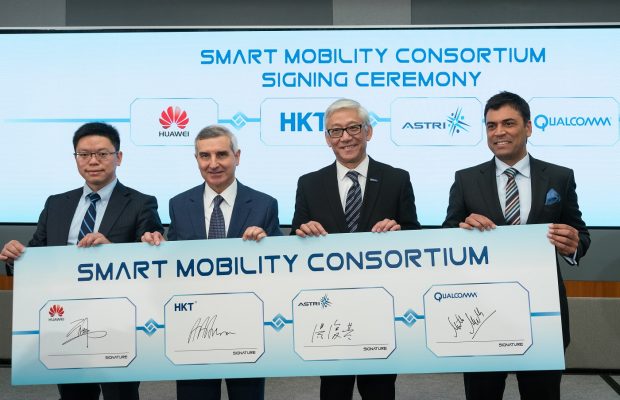
    The Hong Kong Applied Science and Technology Research Institute (ASTRI), operator HKT and vendors Huawei and Qualcomm have formed a consortium aiming to build a smart mobility system for Hong Kong using cellular vehicle-to-everything (C-V2X) technologies.

    The consortium aims to revolutionize Hong Kong’s transportation sector using C-V2X, a standard covering both network-based and direct communications for vehicles.

    A C-V2X powered smart mobility system will therefore enable vehicles to connect to both the cloud and each other, as well as to pedestrians and to traffic infrastructure.

    Vehicles can use the “co-operative awareness” this enables to improve mobility safety as well as autonomous driving, and can help law enforcement and traffic and urban planners to plan and monitor the safety and efficiency of traffic movements.

    The consortium aims to use C-V2X to introduce intelligent transport services including a warning mechanism for collision and control, assistance for cruise control and parking, and alert systems for speed and lane violations.

    It plans to work with government, the automobile industry and other stakeholders to realize this vision. The project is also expected to generate opportunities for other sectors including shipment, ridesharing, home-delivery, insurance, infotainment and mobile healthcare.

    “Hong Kong is a well-connected city with good infrastructure. If we complement these strengths with the latest innovation in science and technology, Hong Kong can become one of the most sophisticated and advanced smart cities in the world,” ASTRI chairman Wong Min-yam commented.

    “This Smart Mobility Consortium is a giant step in that leap. ASTRI is developing state-of-the-art applications, platforms and prototypes which can benefit not just Hong Kong, but potentially other cities in this region too. We, as the SAR’s largest technological R&D institution, are partnering with three eminent organisations to bring revolutionary changes to the way we manage our city’s traffic.”

    The consortium plans to carry out C-V2X pilot in the second quarter of this year. “Our trial sites will likely be at Hong Kong Science Park and the Chinese University of Hong Kong. We hope to extend the pilot to East Kowloon at a later stage,” said Peter Lam, managing director for engineering at HKT.

    “For C-V2X implementation, dedicated spectrum in 5.9GHz is needed. We will try to seek a spectrum testing license from the government to do the pilot,” he added.

  • Huawei to take 16.83% stake in Bakrie Telecom

    Huawei to take 16.83% stake in Bakrie Telecom

    Huawei has arranged to acquire a 16.83% stake in Indonesian operator Bakrie Telecom by converting some of the operator’s debt into shares.

    Debt-laden Bakrie Telecom issued a 7.6 trillion rupiah ($568.1 million) mandatory convertible bond in 2016 as part of a debt restructuring. Huawei has now decided to convert its holdings of the bond into shares.

    With the move, 1.23 trillion rupiah worth of Bakrie Telecom’s debt has been converted into shares.

    Bakrie Telecom president commissioner Anindya Novyan Bakrie told that the conversion will help improve the company’s financial situation for this reason, and therefore the company welcomes Huawei’s move.

    But under Indonesian trading rules, the shares to be converted will not be available for trading for one year.

    While Huawei’s Indonesian subsidiary PT Huawei Tech Investment will also have the right to elect representatives on Bakrie Telecom’s board, Anindya said no decision on this has yet been made.

    The possibility of a debt conversion was first floated last year but at the time it was suggested that Huawei would be taking just a 9% stake, with fellow creditors Protelindo and SUPR receiving shares of 7% and 6.8% respectively.