Tag: telecom

  • Globe launches first 700-MHz base station

    Globe launches first 700-MHz base station

    Philippine operators Globe and PLDT have wasted no time in taking advantage of their newly-acquired 700-MHz spectrum holdings.

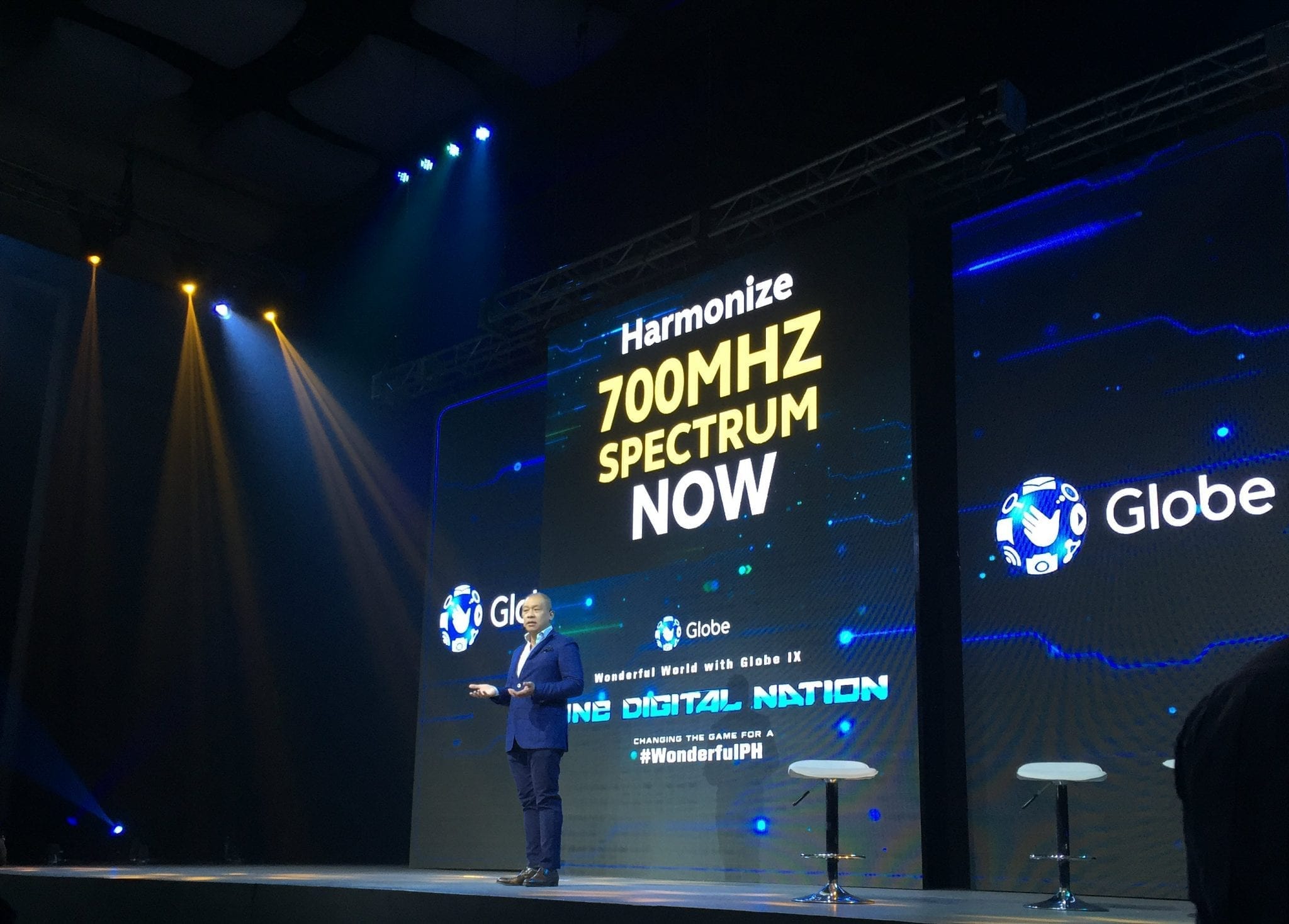
    Globe Telecom has announced it has activated the nation’s first cell site that utilizes the 700-MHz band, less than a week after Globe and PLDT each acquired half of San Miguel Corporation’s (SMC) telecom assets.

    Globe executive Joel Agustin said the company plans an initial rollout of around 200 sites using the 700-MHz band.

    “The intention is that the first batch of the 200 sites we plan to roll out will be in areas where connectivity matters most to our customers as well as in locations with high convergence of users like here in the National Capital Region,” he said.

    Agustin said the 700-MHz band will be essential for the company’s efforts to improve indoor data coverage and to deploy LTE-based broadband in rural areas.

    PLDT separately announced that its wireless broadband unit Smart Communications will start using the 700-MHz spectrum it acquired through the SMC transaction this year as part of the accelerated deployment of its LTE service.

    The operator revealed it has been holding discussions with device manufacturers to introduce more affordable LTE smartphones and tablets compatible with the 700-MHz band into the country.

    Around 45% of subscribers to PLDT’s two wireless brands – Smart and Sun Cellular – are now using smartphones, up from 30% in 2015. But at present the majority of these are 3G/HSPA only handsets.


  • Global telcos eye stake in Vietnam’s Mobifone

    Global telcos eye stake in Vietnam’s Mobifone

    A number of international telecoms operators have reportedly expressed an interest in participating in the privatization of Vietnamese state-owned operator Mobifone.

    Companies including Norway’s Telenor, Sweden’s Comviq and Australia’s Telstra have shown interest in acquiring stakes in the company.

    Mobifone has an estimated brand value of $539 million. Plans for the privatization of the company have been in consideration since 2005 but the process has been repeatedly delayed.

    Now the government is pushing to complete the process in 2016-2017 as part of a push to hasten the privatization of state-owned enterprises.

    Australia’s Telstra could be a key partner for the operator. Telstra had previously been involved in the Vietnamese market as part of a partnership with Viet Nam Post and Communications, but exited the market in 2003. Now the operator is looking to return to the market by participating in the privatization of Vietnam’s telecom enterprises.

    Comviq is meanwhile a former partner to Mobifone and so it also has history in the market, while Telenor has been aggressively pursuing Asian expansion.

  • 9 in 10 telcos go Hadoop to fight revenue fraud

    9 in 10 telcos go Hadoop to fight revenue fraud

    Telecoms revenue fraud is a primary driver for increased Apache Hadoop adoption, according to a recent poll of telco and enterprise users by Cloudera and Argyle Data.

    Communication service providers lose around $38 billion to fraud every year.

    Conducted during a recent webinar to introduce Cloudera and Argyle Data’s joint fraud prevention platform, the survey indicated that over 90% of attending organizations already use or intend to use Hadoop for fraud prevention.

    About one-third (34%) of attendees said they already have Hadoop in place and may use the platform in their fraud prevention efforts.

    “Fraud prevention is a textbook use case for Hadoop-based analytics because the ROI is immediately visible,” said Vijay Raja, solutions marketing manager at Cloudera. “Real-time machine learning relies on large amounts of data to detect sophisticated revenue threats, making Cloudera the ideal platform on which to run Argyle Data’s threat analytics.”

    The platform enables mobile operators to reduce loss by detecting previously undiscoverable revenue threats, promising to deliver up to 350% improvement over rules-based offerings. The platform uses a native Hadoop architecture, combined with real-time data ingestion, analytics, and machine learning.

    “Unsupervised machine learning delivers everything telco fraud analysts need to be efficient at and deliver immediate ROI,” said Arshak Navruzyan, vice president of product management at Argyle Data.  “The Cloudera-Argyle Data solution interoperates seamlessly with all participants in the Hadoop cluster.

  • San Miguel selling telco assets to PLDT & Globe

    San Miguel selling telco assets to PLDT & Globe

    Philippine conglomerate San Miguel corporation is selling its telecom business to incumbent operators PLDT and Globe following the collapse of its JV negotiations with Telstra.

    Under the agreement, San Miguel will sell its telecom unit Vega Telecom for 69.1 billion pesos ($1.48 billion) inclusive of 17.02 billion pesos worth of liabilities. PLDT and Globe will each acquire half of the business.

    Vega Telecom owns controlling stakes in multiple telecom-related units. These are BellTel, Eastern Telecommunications, Cobaltpoint Telecommunication (formerly Extelcom), Tori Spectrum Telecommunication (formerly Wi-Tribe) and Hi-Frequency Telecommunication.

    The acquisition will finally grant PLDT and Globe access to radio spectrum in the coveted 700-MHz band, which San Miguel currently holds a monopoly on.

    PLDT and Globe have been petitioning the government for years for access to this spectrum, but the regulator had so far declined to act to recall the spectrum.

    In addition to the 700-MHz spectrum the acquisition also covers frequencies in the 900-MHz and 1800-MHz bands, PLDT said in a stock market filing.

    But as part of the deal, PLDT and Globe have agreed to relinquish part of the 700-MHz, as well as 850-MHz, 2500-MHz and 3500-MHz bands to regulator NTC to allow the potential entry of a third operator into the market.

    “This transaction offers a breakthrough opportunity, not only for the companies involved but also for the industry and the country. This will enable existing operators to provide significantly improved Internet and data services to the public and to our customers in the shortest possible time,” PLDT CEO Manuel V Pangilinan said in a statement.

    “ At the same time, it leaves the door open for new entrants into the industry. Taken together, thiswill enable the industry to better support the country’s development efforts – especially significant with the onset of a new government.”

  • Huawei validates key 5G technologies

    Huawei validates key 5G technologies

    Huawei has announced it has completed the first stage of key 5G technology tests as part of a series of 5G field trials organized by the IMT-2020 5G Promotion Group.

    The vendor completed outdoor macro-cell tests in Chengdu, China consisting of a number of key 5G enabling technologies and an integrated 5G air interface.

    As part of the trial, Huawei evaluated three foundational technologies – filtered orthogonal frequency division multiplexing (F-OFDM), sparse code multiple access (SCMA) and polar code – the air interface technology.

    Results show that F-OFDM was able to improve system throughput by 10%, SCMA was able to increase uplink connections by 300% and downlink system throughput by up to 80%, and polar code provided coding gain of between 0.5dB and 2dB compared to the code used in LTE systems.

    Huawei said results of the test demonstrate that the new 5G air interface technology can improve spectral efficiency and meet the ITU-R’s diverse service requirements for the standard.

    The IMT-2020 5G Promotion Group was launched by the China Academy of Information and Communication Technology to encourage joint efforts to promote 5G field trials and evaluations among the global mobile industry.

    Earlier this year the group announced a three-phase 5G trial plan spanning from 2016 to 2018.

  • Telstra invests in security company vArmour

    Telstra invests in security company vArmour

    Australian operator Telstra has formed a partnership with – and made an investment in – data center and cloud security company vArmour.

    Under the agreement, investment arm Telstra Ventures has participated in vArmour’s recent $41 million Series D funding round.

    Telstra will also add vArmour’s security offerings to its portfolio of enterprise services. In the long term, the operator said it will also be able to develop security consulting and managed services for its customers.

    The vArmour platform is designed to give organizations application-layer control over their networks to help stave off, detect and respond to cyber threats.

    Jeremy Howe, Telstra’s director of IP Data and Security Solutions, commented that the acquisition is aimed at addressing its enterprise customers’ evolving security demands.

    “We see a growing demand among enterprise customers for solutions that help them secure their data in a private, public and hybrid cloud mix. One of the main concerns companies have in embracing cloud services is data control and security,” he said.

    “vArmour’s distributed security software addresses the problem of traffic blindspots inside data centers. This helps businesses protect themselves from one of the critical emerging threats in the security environment, in addition to the benefits of having greater visibility of what is going on with your data.”

  • XL Axiata to form JV with Indosat Ooredoo

    XL Axiata to form JV with Indosat Ooredoo

    Indonesia’s XL Axiata has revealed it will enter a joint venture with Indosat Ooredoo to provide consultancy services in future network collaboration between the two operators.

    The JV, PT One Indonesia Synergy, will be 50-50 owned by the two companies.

    In a statement to the Bursa Malaysia, XL parent Axiata Group said it is expected that the joint venture will “provide consultancy services in future network collaboration. The transaction parties are in the process of jointly exploring the possibility of entering into such a collaboration.”

    XL Axiata and Indosat Ooredoo agreed in January to share 4G infrastructure in several cities as a possible first step towards the long-discussed plans to form such a network sharing agreement.

    Indonesia’s telecom ministry has also been pressuring the nation’s ten mobile operators to merge or jointly deploy networksto address crowding in the market, although this mainly applies to the smaller mobile operators struggling to compete with Indosat, XL and rival Telkomsel.

    The stock market statement adds that the forming of the JV is not expected to have a material impact on the group’s financial results for the current year.

  • Optus commences rollout of VoLTE

    Optus commences rollout of VoLTE

    Australia’s Optus has commenced the rollout of VoLTE technology to Australia’s major capital cities.

    The Singtel subsidiary revealed that its initial rollout will concentrate on the central business district metro areas of Sydney, Melbourne, Brisbane, Adelaide, Perth and Canberra.

    Optus will initially offer VoLTE over Samsung’s flagship Galaxy S7 and S7 Edge smartphones.

    Optus managing director Dennis Wong said the company plans to “continue to add capability to other devices and remains focused on expanding our VoLTE footprint to further locations, particularly in regional Australia.”

    “We’ve been testing and tweaking VoLTE for the best customer experience and we’re excited Optus customers will start to see the benefits of this technology on our 4G Plus network.”

    Last year the operator launched the first commercial 3x LTE-A carrier aggregation network combining one FDD carrier with two TDD blocks. The network combines 1800-MHz and 2300-MHz frequency bands.

    Optus is Australia’s second largest operator after incumbent Telstra, offering both fixed and mobile services as well as satellite and other services.

  • China awards fourth telecoms license

    China awards fourth telecoms license

    Chinas’ big three operators will have new competition, with the Ministry of Industry and Information Technology (MIIT) issuing the nation’s fourth telecoms license to China Broadcasting Network.

    The license will allow China Broadcasting Network to provide domestic internet data transmission and telecoms infrastructure services.

    With the license the company willl be able to provide key telecoms services including broadband, calling and text messages, Shanghai Daily reported. The company will offer services via its subsidiary China Cable Television Network, which operates cable TV services nationwide.

    A spokesperson for the MIIT said the introduction of a new operator is expected to improve market competition, as well as technology innovation and integration.

    The allocation is also in line with the ministry’s three-network convergence project, which aims to combine telecoms, television and internet services into a single network.

    China Broadcasting Network was founded in 2014 and has registered capital of 4.5 billion yuan ($691.9 million).

    Shares in incumbent operators China Mobile, China Telecom and China Unicom all declined slightly in the wake of the news. But Reuters reports that the introduction of China Broadcasting Network to have little impact on the operators’ businesses in the short term, due in part to the broadcaster’s capital constraints.

  • Hanoi Telecom taps Infinera to expand backbone

    Hanoi Telecom taps Infinera to expand backbone

    Vietnamese wireless operator Hanoi Telecom Corporation has expanded its backbone network using equipment from Infinera.

    Hanoi Telecom extended its existing Infinera TM-Series metro network with the vendor’s DTN-X technology for its backbone connecting Ho Chi Minh City and Vung Tau.

    The new technology is allowing Hanoi Telecom to deploy 500Gbps super-channels – a first for the Vietnam market.

    Infinera’s Instant Bandwidth is also being used to allow optical capacity to be easily software-activated in 100Gbps increments.

    “We intend to advance the deployment of high bandwidth solutions to our customers in the Vietnam market by using the DTN-X XTC Series based on the innovative PIC technology,” Hanoi Telecom chairwoman and CIO Trinh Minh Chau said.

    “Infinera’s Instant Bandwidth allows us to differentiate our services through pre-deployed capacity which can be delivered on-demand via software defined activation. In addition, Infinera’s platforms have demonstrated the type of reliability and quality we are looking for in our network.”

    Infinera’s local partner Nissho Electronics Vietnam oversaw the rollout.

    Hanoi Telecom provides carrier and wholesale services focused mainly on wireless, broadband and VoIP services, as well as retail operations under the Vietnam Mobile brand. The company is one of Vietnam’s lagest wireless operators with more than 13 million subscribers.

  • Panalpina Transforms Global Communications Infrastructure with BT

    Panalpina Transforms Global Communications Infrastructure with BT

    BT has announced a contract with Panalpina, one of the world’s leading freight forwarding and logistics companies, to transform and manage its global communications infrastructure. The transformation will enable Panalpina’s 15,000 employees to better communicate and collaborate internally and with their customers. This supports the company’s vision to work closer with its clients to build smart and efficient end-to-end logistics solutions.

    BT will overhaul Panalpina’s network infrastructure, currently sourced from more than a dozen domestic and regional providers, and migrate it into a single integrated platform, connecting 500 offices in more than 75 countries. BT will also provide services from its BT One Voice portfolio, to converge voice and data on a single platform.

    The new network will be a hybrid infrastructure, based on BT’s IP Connect and Internet Connect services, combining the reliability and security of IP-based Virtual Private Networks (VPN) with the flexibility of Internet connections. BT’s services will underpin the continued implementation of Panalpina’s new global enterprise resource planning (ERP) and transportation management systems, which require optimal end-to-end control of the infrastructure.

    Additional services, such as BT Connect Intelligence, will provide an application-aware network architecture designed to support strategic business applications.

    “This agreement with BT is a major milestone on our way to becoming the most customer focused global provider of freight forwarding and logistics solutions,” said Ralf Morawietz, Chief Information Officer at Panalpina. “As our single point of contact for communication services, BT will take away the burden of managing a multitude of different suppliers, and will make it easier for us to implement new services and to support our employees and customers around the globe.”

  • Thai telecoms regulator weakened in new frequency act

    Thai telecoms regulator weakened in new frequency act

    Thailand’s military cabinet has approved a new frequency act that puts the formerly independent regulator under the control of the new digital economy commission while the selection process now goes through the executive branch.

    The new National Broadcasting and Telecommunications Act calls for a single seven-member board (down from two five-member boards and one chair, one for broadcasting and one for telecommunications).

    Selection will be through a committee consisting of the president of the constitutional court, the president of the supreme court, the president of the administrative court, chairman of the national anti-corruption commission, the auditor-general, the chairman of the national human rights commission and the governor of the Bank of Thailand. The committee will select 14 individuals which are passed to new Digital Economy Ministry (previously the ICT Ministry) which will forward them to the senate for selection which will forward the final selection to the Prime Minister.

    The new NBTC act stipulates that the NBTC will have to follow the policy of the Digital Economy Commission and abide by the government policy statement. The new DE Commission is chaired by the Prime Minister.

    The DE Commission will have the final say if there is dispute whether the NBTC is complying with government policy or not.

    Matters of satellite and orbital slots are no longer a matter for the NBTC.

    Spectrum allocation for telecommunications will be by auction except for certain designated uses.

    In an earlier draft it was understood that the DE Commission could allocate spectrum for good causes and only let the NBTC handle commercial spectrum.

    Another key change is in the NBTC budget which must be efficient and economical and the NBTC must obey any orders given by the auditor-general.

    In the transition period, the existing NBTC will continue until their term is over in September 2017 unless there are less than four NBTC board members remaining in which case the entire NBTC board will be considered expired.

    Meanwhile the new computer misuse act was also approved and will be put to the military-appointed legislature later this week. Leaked drafts show the bill to be draconian with the Digital Economy Ministry having immense power.

    The DE Ministry will have the power in censoring websites without the need for judicial review. It can arrest and fine hackers without any recourse for appeal or review in a court of law.

    Elsewhere Deputy Junta leader and defence minister General Pravit Wongsuwan has ordered police to closely monitor social media and to report any political activities to the military’s cyber warfare division over the course of the next five years.

    Junta leader and prime minister General Prayuth Chanocha last Friday announced a five year transitional period to democracy.

  • XL Axiata swings back to profit in Q1

    XL Axiata swings back to profit in Q1

    Indonesia’s XL Axiata swung back to a net profit for the first quarter during what CEO Dian Siswarini said was a “promising start to 2016.”

    The operator reported a net profit of 20 billion rupiah ($1.5 million) during the period, which compares to a loss of 758 billion rupiah in the same quarter last year.

    Profit for 2016 was positively impacted by the strengthening of the rupiah against the US dollar this year, compared to a weakening in the first quarter of 2015.

    Revenue meanwhile grew 2% year-on-year during Q1 of 2016, with core usage revenue up 5%, driven by a 23% year-on-year growth in the data segment. Data traffic grew 94% year-on-year and total data users grew to 22.8 million, or 54% of XL’s total base.

    XL commented that LTE has become a key part of the operator’s mobile internet leadership strategy. By the end of the quarter, XL expanded its LTE footprint to cover 3,286 sites in 36 Indonesian cities and areas. The company’s total BTS footprint as of the end of March was 59,040.

    “We have made a promising start to 2016 with further improvements in our operating and financial performance, and we hope to build momentum as we execute on our transformation agenda,” Siswarini said in a statement.

  • Malaysia’s P1 rebrands as webe

    Malaysia’s P1 rebrands as webe

    Malaysia’s Packet One Networks (P1) has rebranded as webe as part of its transformation into a digital mobility service provider.

    But the operator has not yet announced when it plans to launch mobile services or provide details on any mobile plans.

    The operator, which was acquired by Telekom Malaysia in 2014, plans to differentiate from its established rivals in the mobile network services market with a focus on being a community-driven brand.

    To support these ambitions the company has launched a mobile app to promote community projects. The initial seven projects include an app to highlight and alert uses on dengue prone areas, a project to create additional ICT classrooms for disabled students and the first Malaysian-made feature length zombie movie.

    Announcing the rebranding, webe CEO Puan Chan Cheong said the operator is last to market in the mobile industry and therefore needs to stand out by being significantly different.

    “Being last to market means we are also able to learn from mistakes – some our own, and some from others we’ve seen in the marketplace,” he said.

    “The past two years have been hard work for us as we sought to understand how we could build a better company and a brand you could love. The answer we arrived at: by having a higher purpose and a deeper connection with our communities.”

    He said the decision not to provide details on plans or products at the launch of the new brand was intentional as part of these promotional efforts.

    The launch will mark Telekom Malaysia’s re-entry into the mobile market following the demerger of its mobile unit (now Axiata Group) in 2008.

  • Globe’s GCash adapted for tax payment

    Globe’s GCash adapted for tax payment

    The Philippines’ Bureau of Internal Revenue (BIR) has teamed up with Globe Telecom to improve tax collection via the GCash mobile money service.

    Under the partnership, Globe’s GCash and the BIR have relaunched the Philippines’ first electronic tax filing and payment system.

    Together with the USAID Facilitating Public Investment Project and the USAID E-PESO Activity, Globe relaunched the electronic filing and payment system on Tuesday with more enhanced features.

    The goals of the project are to improve tax collection and administration, curb corruption, and strengthen the business climate in the country.

    “The continuous payment of right taxes will continue and sustain the growth of the Philippines,” said BIR Commissioner Kim Henares in a statement. “The bureau aims to increase funding contribution for the country’s growing needs for basic infrastructure and social programs necessary to reduce poverty, thus, the government continues to push for the growth of the country’s fiscal space.”

    GCash was first introduced for national tax payments in 2005 when BIR’s thrust was to expand the provision of electronic services, most notably with the release of eBIRForms v6, an improved e-filing software that can serve all taxpayers.

    The use of GCash has now been expanded to allow payments for all types of taxes and also works with local and national government agencies to increase public’s awareness through the e-Bayad campaigns and enable usage of electronic payments in government transactions.

    GCash President Albert Tinio said GCash also helps the government utilize mobile money for collections and disbursements of social welfare benefits, government fees, and taxes. By limiting face-to-face transactions, the service is able to increase access to government services and reduce potential leakages especially in hard to reach areas.

    With the partnership in place, all Philippine taxpayers can use their mobile phone to pay for all types of taxes instead of going to BIR regional district offices or authorized agent banks with their cash or check.

    The Gcash mobile app can be downloaded from the Google Play Store for Android. Users need to register for the service and fund their Gcash account in any partner outlet.