Tag: Thailand

  • Asian cities set to surge up retail hub rankings

    Asian cities set to surge up retail hub rankings

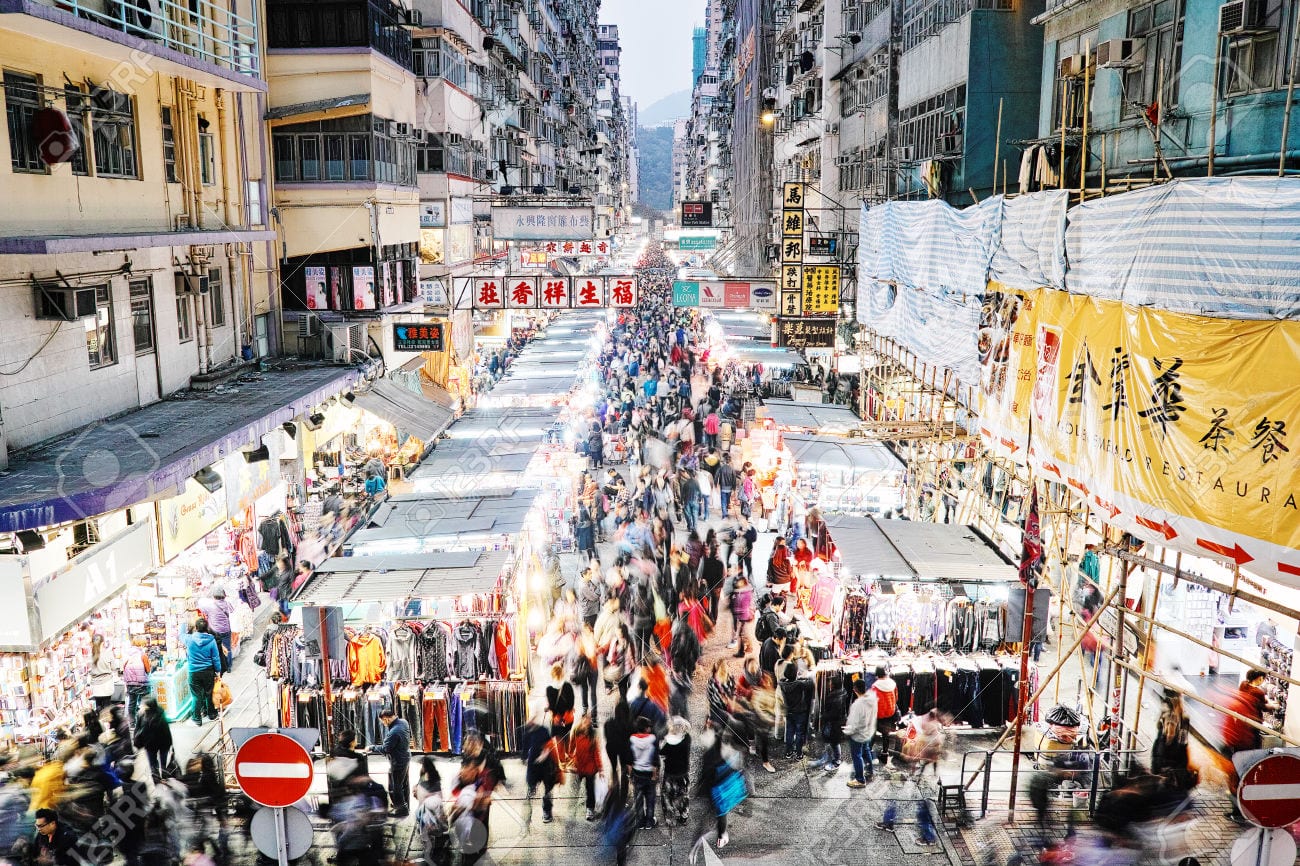
    Asia is home to more than half the world’s most dynamic retail hubs, according to new research that reinforces images of the region’s mall-strewn megacities.

    The research, by professional services and investment management company JLL, says 12 of the fastest-growing retail cities are in Asia, with eight in China alone — another indication that global economic growth is increasingly driven by the Asia-Pacific region.

    JLL lists Dubai as the world’s fastest-growing retail destination, with Shanghai second and Beijing third. Places 9 to 13 are occupied by Bangkok, Chengdu, Kuala Lumpur, Jakarta and Manila, respectively. Only two European cities make the top 20 — Moscow and Istanbul — with none from Africa. Mexico City is the sole city from the western hemisphere, sitting at number 19.

    Overall, JLL lists London as the “most attractive” city for retailers, with Hong Kong second and Paris third. Dubai, Singapore, Shanghai, Tokyo and Beijing all make the top 10, with Bangkok, Taipei, Seoul and Osaka in the top 20.


    Shanghai at night. The Chinese megacity is projected to be one of the world’s retail hubs in the coming years (Photo: Simon Roughneen)

    The study looks at the presence of 240 international retail brands in 140 cities — which altogether make up 36% of the world’s gross domestic product, 13% of the global population and a third of total worldwide consumer spending.

    “The search for growth is escalating the penetration of international brands across the world’s most attractive retail cities, especially in Asia,” said David Zoba, chairman of JLL’s Global Retail Leasing Board.

    Asia catching up

    Many Western economies continue to suffer from slow growth — in stark contrast with Asia, where the International Monetary Fund predicts overall growth of more than 5% in 2016-17 and describes the region as “the engine of the global economy.”

    Asia is urbanizing rapidly as economies develop and incomes rise, meaning that big global brands will increasingly look to Asia as a source of consumers. World Bank research shows that nearly 200 million people in the East Asia and Pacific region –excluding India and its heavily populated neighbors such as Pakistan — moved from the countryside to cities during the decade after 2000.

    In 1800, only 3% of the world’s population lived in cities, a figure that rose to 13% by 1900. Now more than half the world’s population is urbanized, with projections that 70% or more of the world will live in urban areas by 2050. And while in the 19th and 20th centuries urbanization was mainly a Western and Japanese phenomenon, developing countries are catching up fast, particularly in Asia.

    Despite the steady rural-urban shift, only 36% of East Asia’s population had moved to urban areas by 2010, with only Japan, Malaysia, South Korea and Taiwan having larger urban than rural populations.

    While China had by far the largest absolute numbers of people moving to cities, smaller countries such as Cambodia, Laos and Vietnam showed higher rates of urbanization. Laos more than doubled its small urban population, while high-growth economies such Cambodia and Vietnam both had between 4% and 4.5% annual urban population growth rates. Retail investors are noticing opportunities even in smaller cities such as Phnom Penh, where Japanese mall operator Aeon opened the city’s first large shopping mall in 2014.

    Asia’s cities will continue to grow over the coming decades as the region becomes wealthier. McKinsey Global Institute expects that in the next 15 years, “the center of gravity of the urban world will move south and, even more decisively, east.” According to MGI, half of global GDP in 2007 came from 380 developed world cities, with the 22 biggest cities in developing countries contributing a mere 10%.

    However, MGI predicted that by 2025 half of the cities in its 2007 rankings will not make the list, with 136 developing world cities entering its ranking of the 600 biggest urban economies — including 100 from China alone.

    “By 2025, developing-region cities of the City 600 will be home to an estimated 235 million middle-class households earning more than $20,000 a year at purchasing power parity (PPP),” MGI reported. The figure is larger than the 210 million such households expected in the cities of developed regions.

    Thinktank Oxford Economics said that cities such as Chengdu, Hangzhou and Wuhan “will become as prominent in 2030, in economic terms, as cities like Dallas and Seoul are today.”

    Shift east

    The thinktank predicted that by 2030 eight European cities will drop out of the global top 50 cities ranking, measured by GDP, while nine Chinese cities will join that group, taking the Chinese total to 17, which will be more than North America and four times more than Europe.

    In turn, the thinktank said, this will mean more Asian consumers with money to spend. “Starting from a comparatively low base today, China will boast some 45 million high-income urban households (exceeding $70,000 per annum at 2012 prices and exchange rates) by 2030, putting it well ahead of Europe and hot on the heels of North America. Shanghai will jump from a rank of 69th today to 8th for its number of high-income households in 2030,” Oxford Economics said.

    Otherwise, however, the seven megacities with the most high income residents will remain the same as today, with Tokyo leading New York, London, Osaka, Los Angeles, Paris and Chicago.

    But Asian cities are set to add tens of millions of middle-income households (incomes between $10,000 and $70,000) to their ranks by 2030. Jakarta will be home to 9.4 million, with 7 million to 9 million more in each of Chongqing, Shanghai, Tokyo and Beijing, the projected top five cities ranked by population of middle-income households, according to the thinktank.

    JLL said that for retailers, vying for market share in emerging economies is sometimes risky, but the potential prize — market access to vast populations and rapidly expanding middle classes — outweighs any perils.

    For example, China’s anti-corruption crackdown has had “a knock-on effect” on the luxury goods market in the world’s second-biggest economy, said James Hawkey, JLL’s head of retail for China. But retailers are nonetheless “increasingly comfortable dealing with these risks, and generally have their eyes on the long-term prize of establishing a strong position in major world markets.”

    Although incomes and spending power remain lower in many Asian countries and cities than in the West, part of the attraction of smaller, less-developed markets is relatively low rental costs.

    “Places like Ho Chi Minh City, Jakarta and Bangalore present an opportunity for retailers to establish their brands at rents of less than $2,000 per square meter per year with projected in-store sales increasing by 8% to 10% until 2019,” JLL reported.

    Wealthy mid-sized cities or trade-oriented city-states such as Singapore and Hong Kong also benefit from high numbers of visitors such as tourists or business travelers.

    But Asia’s urbanization will not mean that rural dwellers will be ignored by retailers, particularly in China.

    “Retail potential in Asian hubs is strongly influenced by what is happening in their hinterlands — what is happening in nearby provinces and/or countries,” Steven McCord, JLL’s head of research for northern China, told the Nikkei Asian Review.

    “Shanghai exerts a ‘gravity effect’ over its surrounding cities and provinces due to its size and the wealth of its retail offer. Therefore, close to 80 million people within day-trip distance to Shanghai will regularly travel to that city for large shopping sprees,” McCord added.

  • AIS, Dtac enable cross-network VoLTE calls

    AIS, Dtac enable cross-network VoLTE calls

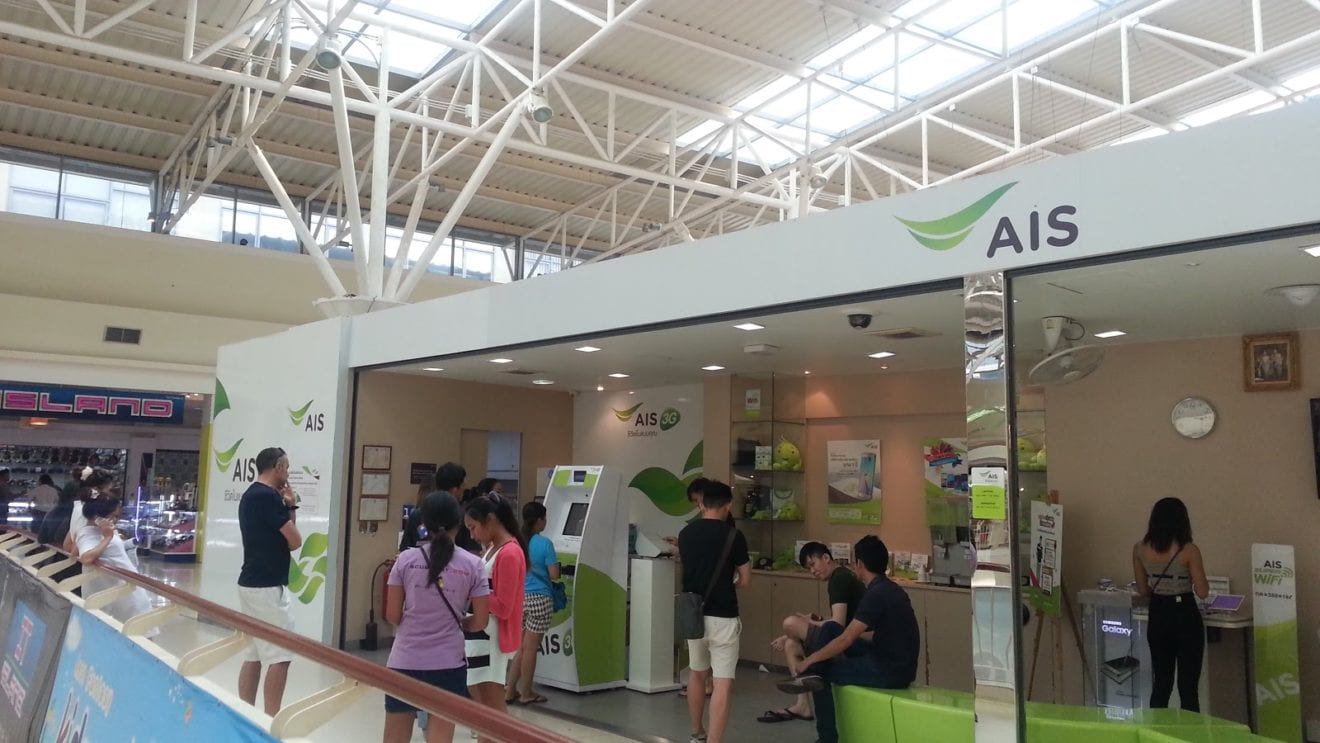
    In a first for the Asean region, Thai operators AIS and Dtac have teamed up to facilitate cross-network VoLTE calls.

    The operators enabled AIS-Dtac VoLTE calls last week and plans to implement cross-network 4G video calls from Tuesday.

    Cross-network VoLTE calls are being made available to both prepaid and postpaid customers at no additional cost.

    While each of Thailand’s top three mobile operators – AIS, Dtac and True Corp – recently launched VoLTE, the functionality had previously only been available for within-network calls.

    Industry watchers believe the move may be an attempt by market leaders AIS and Dtac to fend off competition from fast-growing challenger True Corp. But the Nation quotes True Corp’s chief commercial officer Kittinut Tikawan as stating that the company is confident it can negotiate simila deals with both AIS and Dtac.

    The move will also pave the way for the launch of the iPhone 7 and iPhone 7 Plus in Thailand later this month.

  • OJK to Expand Banking Industry, Aims for Thailand

    OJK to Expand Banking Industry, Aims for Thailand

    Financial Services Authority (OJK) Chairman Muliaman D. Hadad said that the OJK is in the process of exploring the possibilities of expanding Indonesian banking industry overseas.

    “The most possible [cooperation] is with Thailand, because there have been two or three meetings,” Muliaman said.

    Muliaman said that similar cooperation will also be established with other countries. Muliaman explained that Thailand serves as an important stepping stone to establish cooperation with Cambodia, Vietnam, Laos, and Myanmar. “Why Thailand? Because Thailand has dominant business [partnership] with its neighbouring countries,” Muliaman added.

    Muliaman said that there are lots of possibilities for Indonesia to expand its financial industry to Thailand. Moreover, several of Indonesian business sectors have started to expand to Thailand, including property and trade.

    Aviliani, an economist from the Institute for Development of Economics and Finance (Indef) praised OJK’s plan to integrate the national banking industry with ASEAN. Aviliani said that the integration is important to allow Indonesian banks to open branch offices and conduct business activities in neighbouring countries. However, Aviliani asserted that the policy may not always favour the banking industry. “Banks will always reflect on market potential,” Aviliani said.

    Aviliani added that the potential for overseas banking market is not quite as large as the domestic market. “Opening [branch offices] overseas will be difficult if [banks] cannot profit. But when foreign banks expand to Indonesia they will reap benefits because [Indonesia] has a large market potential,” Aviliani said.

  • Asia dominates retail destination rankings

    Asia dominates retail destination rankings

    Asian cities dominate the latest retail destination rankings, with the Middle East taking most of the remaining spots.

    According to the latest edition of JLL’s Destination Retail report, which ranks markets for retailer expansion around the world, Asia is fuelling global growth, taking 12 of the top 20 spots. Six of those cities are in China – but Singapore, Hong Kong and Macau are not among them. Six months ago Hong Kong was second only to London – neither city makes the list now.

    This time around, the top two cities are Dubai and Shanghai, with Beijing ranking third. The other Asian cities in the top 20 are Bangkok, Chengdu, Kuala Lumpur, Jakarta, Manila, Tianjin, Shenyang, Shenzhen, Chongqing and Hangzhou. (The full list is below).

    Besides Dubai, Abu Dhabi, Kuwait, Jeddah and Riyadh make the list, meaning 85 per cent of the top 20 destinations are in just two regions.

    “The global retail landscape is expected to change significantly over the next 10 years, as a fast-growing middle class in emerging markets attracts retailers hungry for growth,” says David Zoba, chairman of JLL’s Global Retail Leasing Board.

    JLL says Shanghai has become a favourite of international brands looking to test the Chinese market and gain exposure. While established prime markets include West Nanjing Rd and Huaihai Rd, new submarkets targeting local residents are popping up along the many new metro lines leading out of the city, and the city’s retail network is growing and shifting.

    Beijing follows as the third-fastest-growing retail market with its swelling middle class and strong concentration of high-net-worth individuals. Properties such as China World Mall and the landmark project Taikoo Li continue to draw high-end shoppers, while malls like Beijing APM and Oriental Plaza dominate tourist-friendly shopping strip Wangfujing. The Chinese capital’s suburbs are also experiencing rapid growth as people choose to shop more locally rather than brave the traffic into the city centre.

    “Emerging markets can expose international retailers to greater levels of economic and geopolitical risks. One pertinent example is China’s anti-corruption campaign and the knock-on effects on the luxury market,” says James Hawkey, head of retail for China, JLL. “However, international retailers are increasingly comfortable dealing with these risks, and generally have their eyes on the long term prize of establishing a strong position in major world markets.”

    Added Zoba: “The search for growth is escalating the penetration of international brands across the world’s most attractive retail cities, especially in Asia. Retailers who succeed in acquiring the right space in the right place at the right time will benefit from successful, profitable growth, but they should be mindful that potential rewards go hand in hand with risk,” continues Mr Zoba.

    Retail rents in these emerging markets reflect legislation, market transparency, reputational risk, maturity, as well as growth potential, meaning that their levels are relatively low compared to more mature markets. Places like Ho Chi Minh City, Jakarta and Bangalore present an opportunity for retailers to establish their brands at rents of less than US$2000 per square metre per year with projected in-store sales increasing by 8 to10 per cent until 2019, based on Oxford Economics forecasts. However, as cities mature and the pace of new construction of retail centres slows, rents will gradually increase.

    JLL’s Destination Retail report 2016 examines the presence of 240 international retail brands across 140 retail cities, giving insights for international retail expansion. The 140 cities make up 36 percent of the world’s GDP, 13 per cent of the global population and 33 per cent of total consumer spending.

    Top 20 Global Growth Cities for Retail

    1              Dubai

    2              Shanghai

    3              Beijing

    4              Kuwait City

    5              Abu Dhabi

    6              Jeddah

    7              Riyadh

    8              Moscow

    9              Bangkok

    10           Chengdu

    11           Kuala Lumpur

    12           Jakarta

    13           Manila

    14           Istanbul

    15           Tianjin

    16           Shenyang

    17           Shenzhen

    18           Chongqing

    19           Mexico City

    20           Hangzhou

  • TrueMoney Transfer is Thailand’s first affordable remittance solution for migrant workers

    TrueMoney Transfer is Thailand’s first affordable remittance solution for migrant workers

    TrueMoney, a subsidiary of Ascend Group, announces the launch of TrueMoney Myanmar and the launch of its fund transfer solution, TrueMoney Transfer.

    TrueMoney Myanmar aims to be a leading financial service provider, offering bill payment, mobile topup, remittance, and cash collection services. With two offices, one in Yangon and one in Mandalay and a network of 3,000 agents nationwide, TrueMoney Myanmar is working  continuously to expand its services and agent network to fulfill its mission of enabling everyone access to innovative financial services, leading to better lives because we believe that financial access should be a basic right for everyone.

    TrueMoney is also launching TrueMoney Transfer, the company’s first international money transfer solution. Fast, easy, safe, and affordable, TrueMoney Transfer enables real-time fund transfers from Thailand to Myanmar, allowing Burmese migrant workers to significantly reduce the expense and risks associated with sending money to family back home.

    Fast with real-time fund transfers, easy with 250 transfer spots in Thailand by end-2016 and 681 transfer spots in Myanmar, safe with a passcode to receive the money that only the sender knows, and affordable with transaction fees starting at 50 Baht. To celebrate the launch of the TrueMoney Transfer service, TrueMoney is waiving the transfer fees for all transactions until October 31, 2016. Transfer fees usually start at only 1,818 MMK  per transaction.   

    Migration within and across Myanmar’s long borderline has been long-standing. In an aim of improving relatives’ standard of living, many Burmese have chosen to cross borders in search of decent work and income. To date, according to the United Nations (UN), Thailand is home of almost 2 million hard working Burmese sending 2,8 billion Kyat back home annually, namely 1 million Kyat per person per year. 

    Transferring money to loved ones has undoubtedly become a crucial need for Burmese migrants and their families. However, a large number of Myanmar workers remain unbanked, due to a variety of reasons such as, but not limited to legal status, language barrier, and access to banking services. We have developed TrueMoney Transfer to give a faster, safer, more secured and affordable alternative to the commonly used informal channels”, said Ms. San Thaw Da Wun, Country Director of TrueMoney Myanmar. 

    Indeed, sending money from Thailand to Myanmar can be very expensive and uncertain. Because no other options are available to date, Myanmar migrant workers are placing their trust and savings within informal networks, which are complicated, time-consuming – it can take up to 4/5 days to send funds –, and unsafe – there is no guarantee that the intended receiver will ever receive the money.

    Mr. Lawt Aung, Senior Product Executive of TrueMoney said, “TrueMoney Transfer will deeply change the lives of millions of hard-working people who do not have access to proper banking services. The network we have built throughout Myanmar is the stronger existing. Our 681 TrueMoney Transfer spots in Myanmar cover 91 percent of migrant workers hometowns such as Mon, Tarintharyi, Kayin, Shan, Yangon, and Bago, bringing services for money transfer in rural areas where banks don’t even have a representation. The solution will enable money transfer from Thailand to Myanmar only. By end of 2016, the 250 transfer spots in Thailand will be concentrated in areas with a large population of Myanmar migrant workers such as Bangkok, Samut Sakhon, Samut Prakarn, Tak, Ranong, Kanchanaburi, and Phuket.

    Ms. San Thaw Da Wun added, “It has never been that simple to transfer money internationally”.

    Users can simply register a user account at one of TrueMoney’s official agent shops in Thailand, show their ID, and instantly transfer funds to Myanmar. After informing the agent of the receiver’s name and mobile number and the amount to be transferred, the sender will be told the exact amount the receiver will receive. The sender will also receive an 8-digit code via SMS. The receiver can immediately use the given code, in addition to their identification and mobile phone number, to receive cash at any of the TrueMoney Transfer spots in Myanmar.

    TrueMoney has developed this new innovation to offer a cross-border remittance service that is fast, easy, safe, and affordable to upgrade the standard of living of everyone.

    TrueMoney Transfer – Fact Sheet


    TrueMoney – Key information

    About TrueMoney Thailand Company

    TrueMoney is an Ascend Group subsidiary and the first epayment provider in Thailand that has been granted a license from the Ministry of Finance and the Bank of Thailand to offer cross-border remittance service

    About TrueMoney Transfer solution

    TrueMoney has been developing the TrueMoney Transfer solution to help unbanked individuals as well as migrant workers to safely send money to their loved ones and to give them an alternative to costly and unsecured informal money transfer solutions

    Key information about TrueMoney Transfer

    • TrueMoney Transfer, Thailands first fast, easy, safe, and affordable remittance solution for migrant workers
    • With 250 TrueMoney Transfer spots in Thailand by end- 2016 and 681 in Myanmar, a very affordable cost as well as no fee applied for receiving money, this is the most accessible platform available to date
    • You can transfer up to 30,000 Baht per transaction and up to 200,000 Baht per day
    • The transfer fee is waived until October 31, 2016 (normally 50 Baht for 100-5,000 Baht transferred)
    • TrueMoney Transfer is available for individual customers only

    Process to setup an account

    • To use TrueMoney Transfer simply register for the service by showing your ID and mobile phone number at one of TrueMoneys official agent shop. This process is one time will take just a few minutes.
    • Then, youll need to give the receivers details and mobile phone number before handing over the money you wish to transfer. The TrueMoney Transfer officer will let you know exactly how much money the receiver will get in the destination currency.
    • You will then get an 8digit transaction code via SMS to your registered mobile phone number.
    • The receiver simply need to show the 8digit transaction code, ID, and their mobile phone number to any TrueMoney Transfer spot in Myanmar to get the cash right away.

    Target users

    Unbanked individuals and migrant workers who wants to transfer money back to Myanmar


    Transaction fee (Conditions as stipulated by the company)

    Remittances from 100 Baht to  5,000 Baht

    Transaction fee at 50 Baht

    Remittances from 5,001 Baht to  10,000 Baht

    Transaction fee at 100 Baht

    Remittances from 10,001 Baht to  15,000 Baht

    Transaction fee at 150  Baht

    Remittances from 15,001 Baht to  20,000 Baht

    Transaction fee at 200 Baht

    Remittances from 20,001 Baht to  25,000 Baht

    Transaction fee at 250 Baht

    Remittances from 25,001 Baht to  30,000 Baht

    Transaction fee at 300 Baht


    TrueMoney Transfers user profile

    Myanmar migrant workers Key data

    Number of Myanmar workers in Thailand to date

    2 million workers, 50% nonregistered

    Gender

    • 57% male
    • 43% female

    Age

    • 1624: 21%
    • 2534: 52%
    • 3555: 27%

    Location

    • Bangkok Outskirts: 38%
    • South: 27%
    • North: 16%
    • Central: 13%
    • Bangkok: 6%

    Occupation

    Fishing worker, Farm worker, Factory worker, Rubber worker, Construction worker, Housekeeper


    Myanmar’s remittance market

    Average number of fund transfers per individual per year

    6 times a year

    Average amount sent per transfer per individual

    6,650 THB

    Total number of transactions per year

    12 million THB

    Total amount of money transferred per year

    77 billion THB

  • Skytrain ticketing goes smart

    Skytrain ticketing goes smart

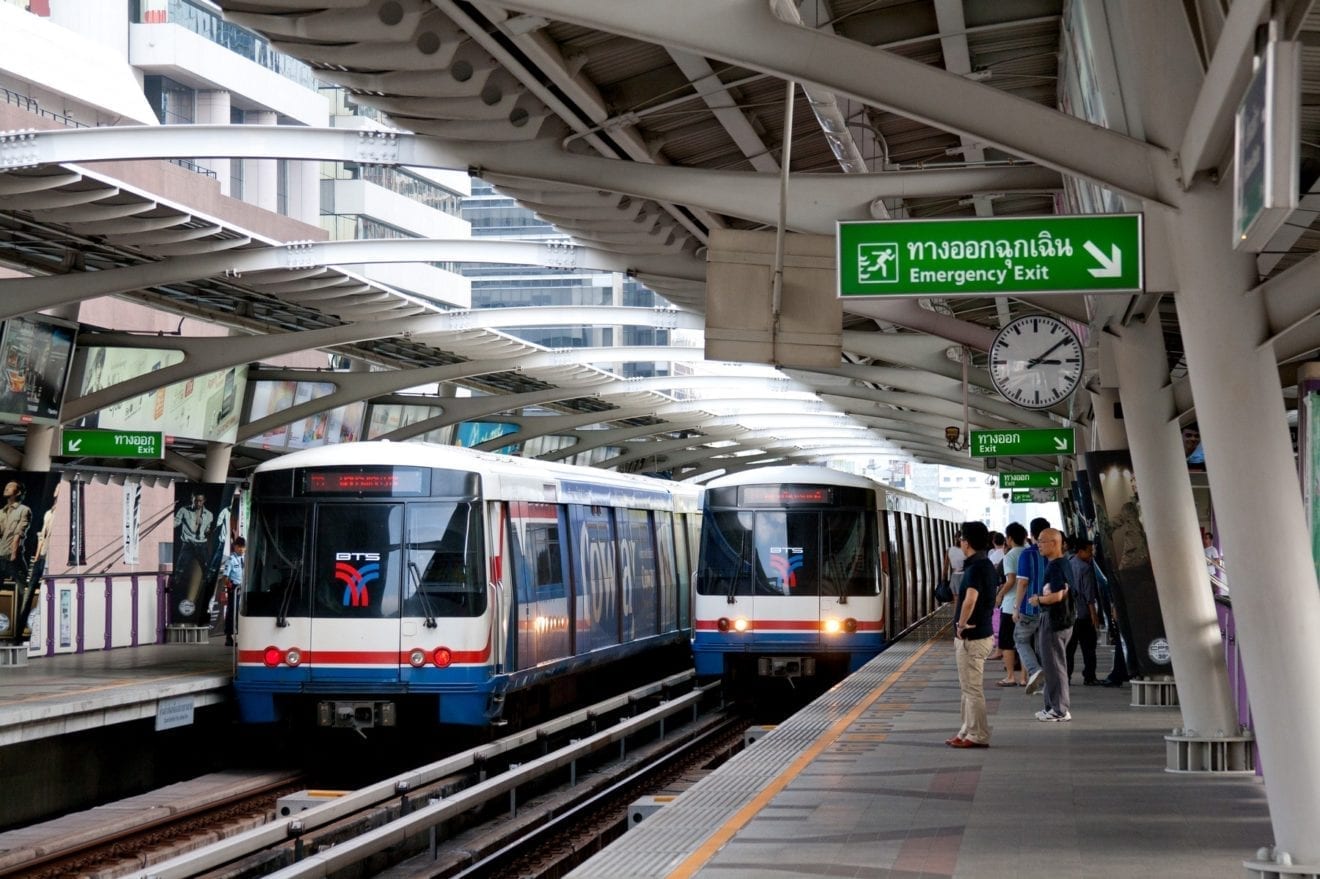
    The little tokens and even plastic smart cards now used in the mass transit systems will soon be outdated once the media business unit of BTS Group Holdings introduces new services that will enable skytrain fares to be paid with a smartphone.

    By the first quarter next year, BTS commuters will just have to swipe the barcode embedded in the Rabbit Line Pay application at the turnstile. No more queues to get change, tokens or cards.

    With the new mobile service, you just swipe your Rabbit Line Pay card and walk through the turnstile, says Mr Kavin.

    “Next year, we’re going to change the entire BTS system, enabling users of Rabbit Line Pay [a function embedded in the Line app] to cover skytrain fares via smartphones or mobile devices,” says Kavin Kanjanapas, chief executive of BTS Group, which owns a majority stake of VGI Global Media Plc.

    Line is the most popular instant messaging platform in Thailand with more than 33 million active users.

    “The new mobile ticketing service will be a great convenience to commuters and perfectly serve modern Bangkok lifestyles, as you just swipe your barcode embedded in the Rabbit Line Pay application and walk through the turnstile,” says Mr Kavin, also chairman of VGI’s executive committee.

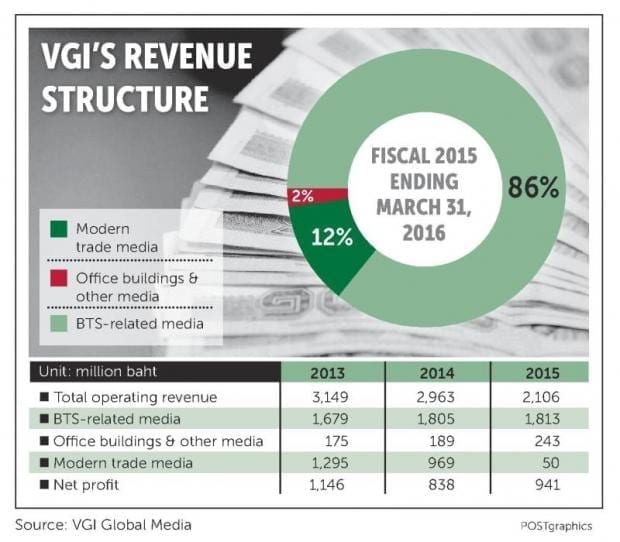
    The innovative mobile ticketing service shows just how far VGI has come since its humble beginnings. Founded in 1995 with initial registered capital of only 1 million baht, the company was intended to provide marketing and advertising services for the Bangkok Mass Transit System Plc (BTSC), which operates the skytrain.

    The company’s registered capital today is 858 million baht, with 686 million in paid-up capital. VGI is now Thailand’s major provider of out-of-home (OOH) media solutions, having more than 10,000 large still-image screens installed in the BTS skytrain network and at large retail stores nationwide.

    It also has more than 11,000 square metres of advertising space in the product display zones of large, modern stores and around 5,000 digital screens and other types of OOH advertising at BTS stations, Tesco Lotus, Big C and Watson stores, along with large office towers throughout Bangkok.

    It further holds licences to manage various forms of advertising at 13 airports operated by Airports of Thailand Plc and the Civil Aviation Department.

    In addition, the company runs retail shops in 23 BTS stations, on top of radio networks covering nearly 2,000 stores in Thailand.

    Like the BTSC, whose situation became critical in the wake of the 1997 financial crisis when passenger number was low due to a sharp decline in purchasing power, VGI struggled during its first three years of operations.

    After seeing low ridership number of fewer than 100,000 a day (in contrast with original projections of 600,000 a day), almost every advertiser who had booked space with VGI asked to scrap their deals and withdrew their deposits.

    As with the BTSC, VGI spent nearly 10 years battling financial constraints. It started seeing a glimmer of hope after the BTSC, which shared a huge portion of the group’s debt, exited its rehabilitation plan in 2008 and merged with Tanayong, the property development firm Mr Kavin’s father, Keeree Kanjanapas, founded in 1968.

    The merged company became BTS Group Holdings in 2010, which focuses on four core businesses: mass transit, property, media and services.

    After the group’s strong business revival, VGI itself has been successful in developing its lifestyle media network, mainly through active mergers and acquisitions (M&A) over the past couple of years, acquiring stakes in SET-listed Master Ad Plc, the country’s largest OOH advertising company, aviation media company Aero Media, and most recently Rabbit Card and its related online business.

    The latest acquisition will enable VGI to enter into an e-payment business that offers Rabbit Card as a payment tool for travelling on the skytrain and for purchasing merchandise from leading retailers nationwide.

    Rabbit Line Pay will also enable users to buy goods online and from brick-and-mortar retail stores. It also lets VGI extend its services to cover online payment for skytrain fares and retail purchases within Rabbit Card’s network of merchants nationwide through their mobile devices.

    Additional Rabbit businesses comprise other online ventures operated by Rabbit Internet, including Rabbit Daily, which provides lifestyle content through a web portal, and Rabbit Finance, which is a licenced, leading online financial products comparison website previously known as ASK Hanuman.

    This strategic move will allow VGI to raise the effectiveness and measurability of its advertising campaigns.

    VGI aims to create a new media advertising platform, Data-Centric Media Hypermarket, that can directly reach targeted audiences. It is projected to bring VGI’s daily audience from 1.9 million people to 25 million (mostly active Line users). It has also set a long-term revenue target of 8.2 billion baht over the next five years, up from 3.9 billion in 2015.

    To fulfil the ambitious new media advertising platform, Mr Kavin says VGI still needs to complete two to three acquisition deals.

    “Over the last 3-4 years, we’ve spent more than 3 billion baht on M&A, mainly on Master Ad, and most recently Rabbit Card,” said Mr Kavin. “From next year onwards, M&A will no longer be our focus. Rather, we will look to the integration of all our businesses to create the best synergy within VGI,” he says.

  • Discovery Japan Mall opens online

    Discovery Japan Mall opens online

    Tokyo-based craft products retailer DigitalStudio has launched Discovery Japan Mall, a cross-border eCommerce venture.

    Specialising in Japanese brands, the mall’s initial catalogue includes mainly toys, fishing gear, cosmetics, food, watches and fashion. About 100 Japanese companies have opened stores on the mall, offering about 15,000 items.

    Shipping is available to more than 120 countries and regions, and as part of the opening campaign free international shipping is offered for orders worth JPY 20,000 (US$190) or more until the end of this month.

    As well as credit cards, the mall supports payment by AliPay, PayPal, UnionPay and WeChat. The website is available in English, simplified and traditional Chinese, Indonesian, Korean and Thai. Purchases can be made by smartphone, and all orders include tracking and shipping insurance, plus delivery from Japan.

    Discovery Japan Mall representative Norio Itabashi says many hidden Japanese products do not reach the overseas market, and the mall is working with craftsmen and manufacturers to sell unique products.

    DigitalStudio was established in 2003 with the aim of “continuing to bring Japan to the world”.

  • IIJ, TCCT launch joint cloud services in Thailand

    IIJ, TCCT launch joint cloud services in Thailand

    Internet Initiative Japan and Thai data center and IT infrastructure provider TCC Technology (TCCT) have jointly launched a new cloud service in Thailand named Leap GIO Cloud.

    The new service is being operated by Leap Solutions Asia (LSA), a joint venture between the two companies.

    Targeted at local Thai companies and Japanese enterprises doing business in the market, Leap GIO Cloud encompasses both public and private cloud services.

    The public cloud service can be self-provisioned and billed on an hourly or monthly basis, while the private cloud service is being offered for a monthly fee.

    LSA has also secured SAP certifications for hosting services, cloud services and SAP HANA operations services, and will use these certifications to offer support for implementing and operating SAP BASIS in the cloud.

    LSA was established in April  as a 60/40 joint venture majority-owned by TCCT.  The joint venture aims to become a market leader in Thailand’s cloud sector.

  • Thai Union takes bite of Red Lobster

    Thai Union takes bite of Red Lobster

    Seafood producer Thai Union has made a US$575 million strategic investment in US seafood restaurant company Red Lobster.

    Golden Gate Capital retains its majority shareholding in Red Lobster.

    Thai Union is regarded as the world’s largest producer of shelf-stable tuna products with annual sales exceeding THB 125 billion (US$ 3.7 billion) and a global workforce of more than 46,000 people. It says it has taken a 25 per cent interest in the restaurant chain, with the option to acquire an extra 24 per cent through the conversion of preferred shares.

    “Red Lobster is an iconic brand, with a leading market position in seafood casual dining and a world-class management team, and has delivered strong performance since Golden Gate acquired it in 2014,” says Thai Union Group CEO Thiraphong Chansiri.

    “This investment marks a strategic step to build Thai Union’s direct-to-consumer channel, and will enable us to benefit from the extensive restaurant industry expertise of both the Red Lobster management team and Golden Gate.”

    He says Thai Union has worked closely with Red Lobster for more than two decades.

    With 40 years’ industry experience, Thai Union has expanded its product lineup to include lobster, shrimp, sardines, mackerel, tuna, salmon and crab. Its brands include Chicken of the Sea, John West, King Oscar and Petit Navire, and it has production units in 12 countries.

    JP Morgan acted as exclusive financial adviser to Thai Union for the investment.

    Headquartered in Orlando, Florida, Red Lobster claims to be the world’s largest seafood restaurant company. As a private company owned by Golden Gate Capital, Red Lobster has 58,000 employees in more than 700 restaurants in the US and Canada, with a growing international footprint.

    Golden Gate Capital is a San Francisco-based private-equity investment firm with more than $15 billion of capital under management. In addition to Red Lobster, investments sponsored by Golden Gate Capital include California Pizza Kitchen, Pacific Sunwear, Payless ShoeSource and Zales.

  • IPhone 7 to officially launch in Thailand on Oct. 21

    IPhone 7 to officially launch in Thailand on Oct. 21

    Three major mobile operators in Thailand including AIS, DTAC and TRUE have announced will begin selling the iPhone 7 and iPhone 7 Plus on Oct. 21.

    While the pre-ordering will start early on Oct. 14 for all three companies, AIS and DTAC have opened a page for interested customers to register and guarantee the chance to pre-order the phones.

    Apple Watch Series 2, a product announced by Apple at the event in San Francisco on the same day as the new iPhone, will also launch in Thailand on Oct. 21.

    Apple has faced controversy by removing the headphone jack in the iPhone 7 in order to offer a waterproof handset. However, the new phone comes with a 12-megapixel camera and optical image stabilization, an impressive upgrade from the camera in iPhone 6s.

    The iPhone 7 comes in Silver, Gold and Rose Gold and the new colors Black and Jet Black.

  • Combine all your rewards points and get more out of your luxury shopping

    Combine all your rewards points and get more out of your luxury shopping

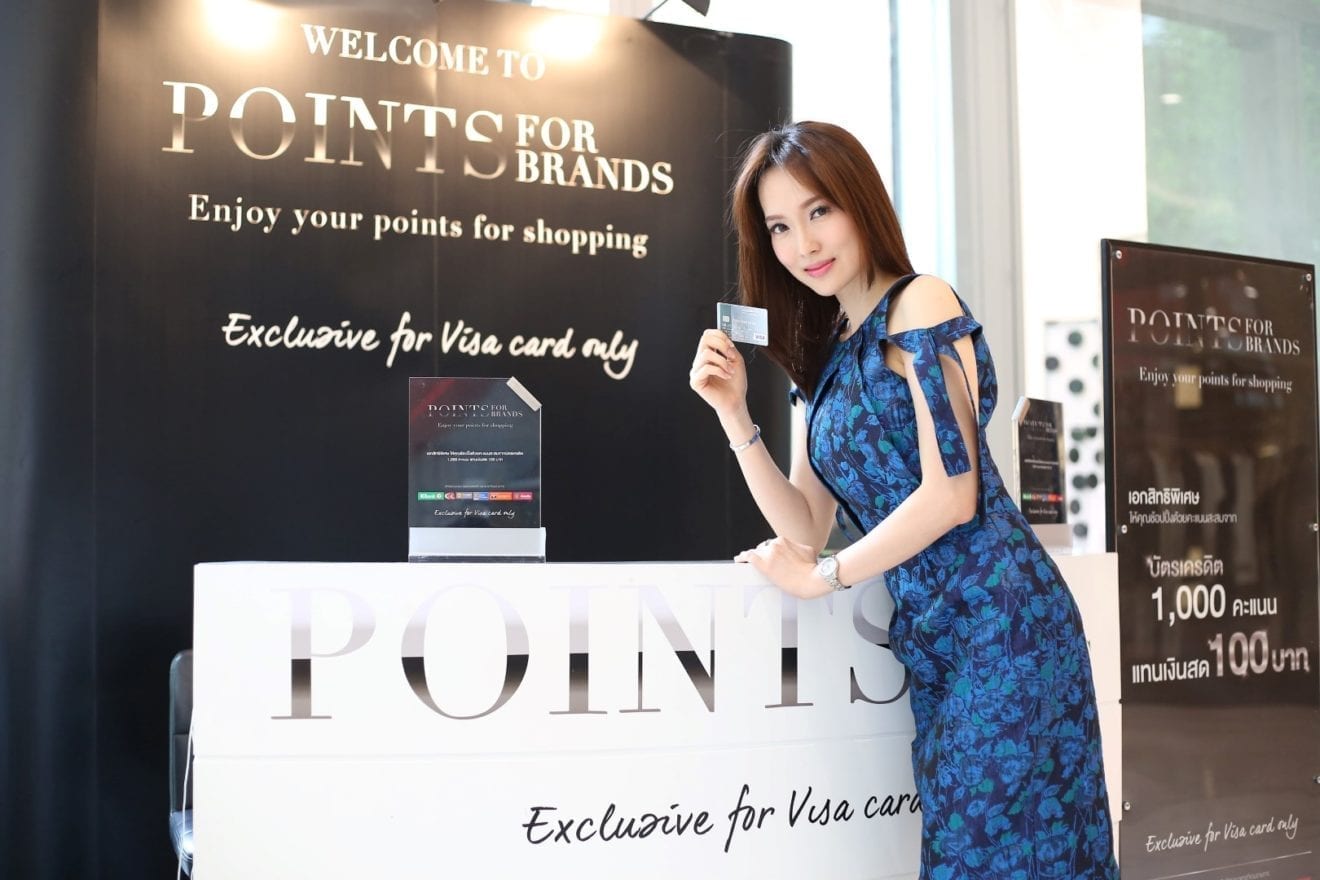
    Shoppers can now save money on luxury brands by combining reward points from their different Visa credit cards.

    The “Points for Brands” campaign enables customers with Visa credit cards issued from leading financial institutions in Thailand, including Kasikornbank, Bank of Ayudhya (Krungsri), Krungthai Bank, Krungsri First Choice, Government Savings Bank, and Thanachart Bank to pool reward points for purchase of goods at selected luxury brands at a rate of 1,000 points for THB 100.[1] 

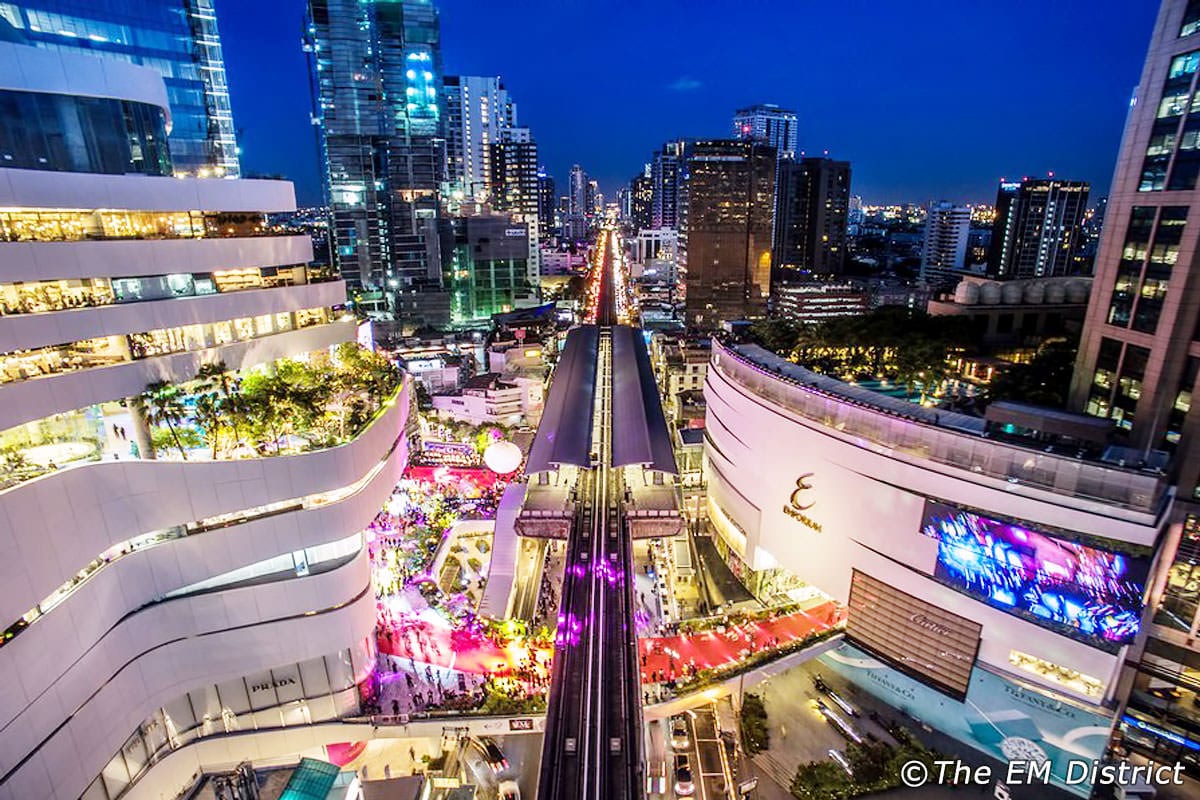
    There are more than 70 participating brands at The Emporium and The EmQuartier, including Coach, Kate Spade, DKNY, DVF, Proenza, COMME des GAçONS, Jimmy Choo, Valentino, EMPORIO ARMANI, Balenciaga, Calvin Klein, Hugo Boss, MCM, and Club 21.

    “This is the first time our cardholders can purchase luxury brands by redeeming points from across their portfolio of Visa credit cards, a rarity for premium categories,” said Suripong Tantiyanon, Visa Country Manager, Thailand.

    Exclusive to Visa cardholders, more information, along with help on how to redeem reward points, can be found at Points for Brands booth on M Floor at EmQuartier

  • Reinvented Siam Discovery wins two awards

    Reinvented Siam Discovery wins two awards

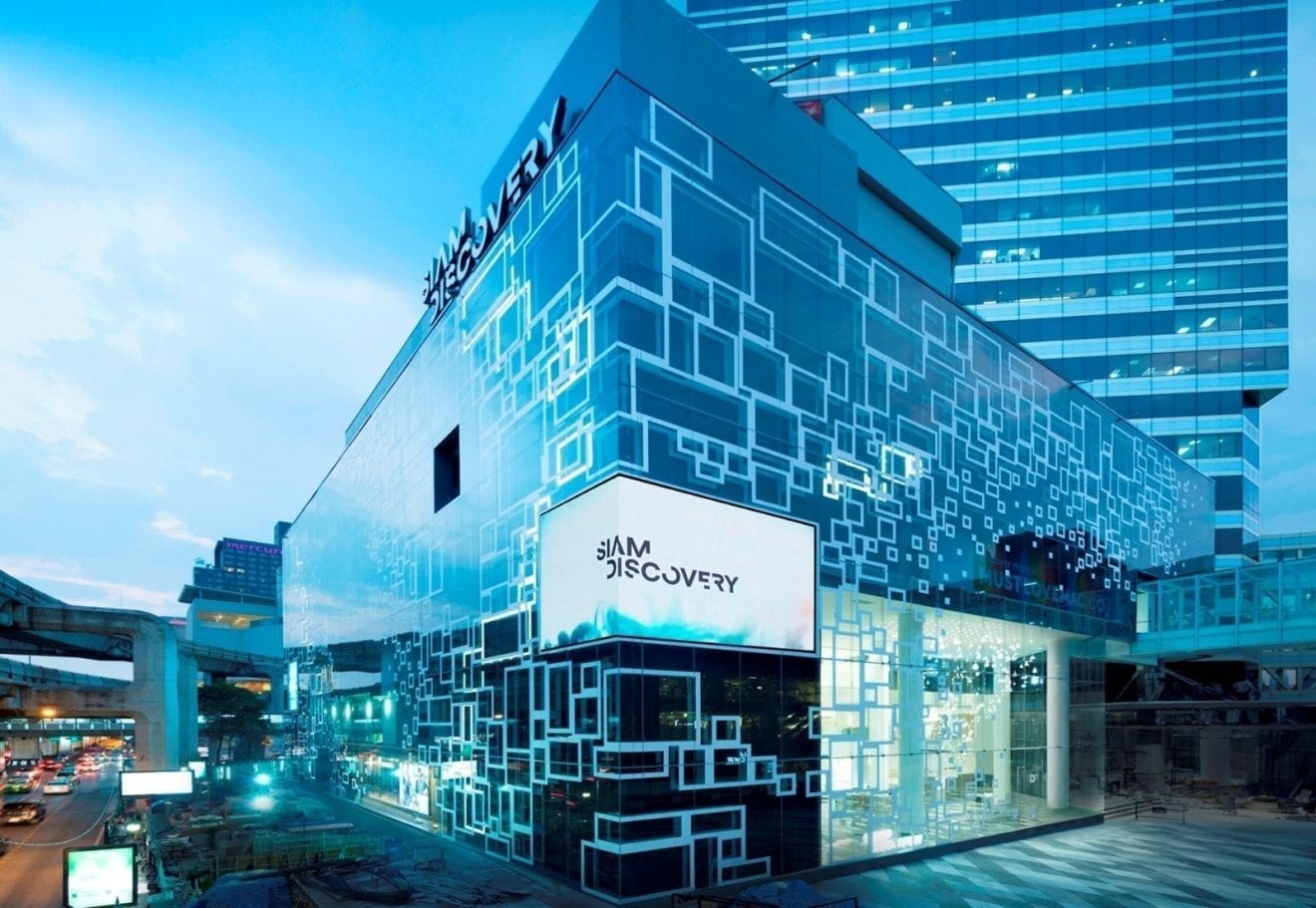
    Siam Discovery – The Exploratorium, Thailand’s first hybrid-retail destination and lifestyle specialty store which opened in May, has won two awards.

    A reincarnation of the old Siam Discovery, the store was named Best Retail Development and Best Commercial Development in the latest Thailand Property Awards.

    Best Commercial Development award from Thailand Property Awards 2016

    Best Retail Development award from Thailand Property Awards 2016

    Siam Discovery is owned by Siam Piwat, which also owns and runs Siam Center, Siam Paragon and Paradise Park shopping centres, and jointly owns megaproject IconSiam.

    “Siam Discovery has broken every rule of Thailand’s retail industry to offer exciting experiences and creativity,” says Siam Piwat CEO Chadatip Chutrakul.

    Chadatip Chutrakul, Chief Executive Officer of Siam Piwat and Oki Sato, Chief Consultant for the overall design inspiration for the new Siam Discovery

    “The awards reflect the success of the distinctive design and the ideas behind it by a team of design experts such as Nendo’s Oki Sato and Urban Architect, who came together and imbued the architecture of the refurbished Siam Discovery with elegance and uniqueness.”

    She says the new concept permeates “every single design detail” across more than 40,000 sqm, including open space.

    Dan Tantisunthorn, Charnchai Cherdchuwongthanakorn, Paiboon Jaikla_ Siam Piwat's Senior Executives collected award from Suwat Liptapanlop_ representative of the judges

    “Even the product displays and stores of more than 5000 brands are decorated to match the personalities of each specific Lifestyle Lab on each floor. This gives our customers the freedom to browse for products that suit their stories and interests, and make shopping both convenient and a fun exploration.”

    In their 11th edition, the Thailand Property Awards aim to boost the stability and efficiency of the country’s real-estate market and encourage entrepreneurs.

  • Thai police bust fake instant Nestle coffee factory

    Thai police bust fake instant Nestle coffee factory

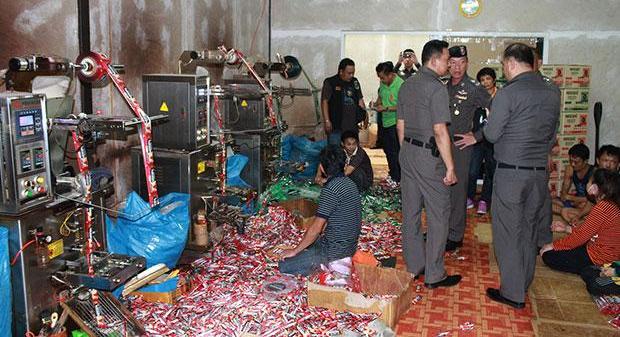
    Thai police have busted a fake Nestle instant coffee factory in Bangkok’s northern suburbs.

    Acting on a tip-off, a team of police descended on a business premises in Pathum Thani on Thursday armed with a search warrant. Inside they found 2 million THB worth of fake Nestle instant coffee, (equivalent to about US$60,000 at retail value).

    fake-nescafe

    They discovered machinery including four mixing machines, four packaging machines and 19 sacks of mixed instant coffee awaiting packaging, falsely branded Nescafe 3-in-1.  More than 89,000 sachets of fake instant coffee destined for distribution were seized, along with 280,000 empty packs.

    The factory was staffed by nine foreign migrant workers, including four Laos nationals.

    Police are now trying to track down the man running the factory, believed to be from Chiang Rai.

    Once caught he will be charged with producing and selling bogus food products and with producing and selling foods with unlicensed labels. The penalty, if convicted, is a prison term of up to 10 years and a fine of up to 100,000 baht ($3000).

  • Godiva to Open the First Shop in Bangkok

    Godiva to Open the First Shop in Bangkok

    Months after popular ice-cream brand Ben&Jerry opened their first shop in Bangkok, looks like we will be able to continue to binge on new, sweet treats at Godiva.

    Godiva, the Belgian luxury chocolate store, announced it will launch its first shop in Bangkok at Groove, in CentralWorld.

    Selling an assortment of premium chocolates, biscuits and frappé drinks. Let’s hope they stock their famous chocolate-covered strawberries as well. Godiva has long been one of the premium edible souvenirs that Thai people buy for each other when traveling abroad.

    The opening date has not yet been confirmed.

  • Hooters Taiwan launch marks Asian expansion

    Hooters Taiwan launch marks Asian expansion

    Atlanta-based operator and franchiser Hooters of America will enter Taiwan with five new locations.

    The Hooters Taiwan restaurants will be opened by Hooters’ Asian partner, Bangkok-based franchisee Destination Resorts.

    The first is scheduled to open in Taipei, with typical menu including wings, burgers and salads. The other four will be in Kaohsiung, Taichung, Taoyuan and Tainan.

    “With existing bustling locations throughout Asia, we’ve seen proven demand for Hooters’ world-famous chicken wings served with iconic Hooters Girl hospitality,” said Gary Murray, CEO, Destination Resorts.

    hooters-hong-kong

    Hooters expects good growth in Taiwan thanks to a robust economy and strong brand recognition in the market.

    Earlier this year the franchisee opened two more Thailand locations, the largest international Hooters in Pattaya, and the nation’s fourth location in Bangkok’s Nana district.

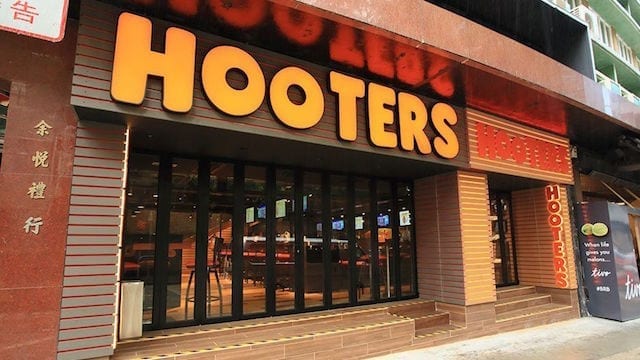
    It also recently opened the first Hooters in Hong Kong. (pictured)

    Four more are planned this year – in Samui, Thailand; Manila Eastwood in Philippines; Marina Bay in Singapore and in Phnom Penh, Cambodia.

    The new locations will incorporate the latest design features that deliver “the familiar, fun-loving persona of the Hooters brand along with contemporary elements that combine to deliver a one-of-a-kind guest experience”.

    Hooters is the franchisor and operator of more than 420 Hooters restaurants in 42 states of the US and 26 countries.