Tag: trading

  • US, China trade war finally (temporary) stops

    US, China trade war finally (temporary) stops

    China and the United States agreed to a ceasefire in their bitter trade war on Saturday after high-stakes talks in Argentina between US President Donald Trump and Chinese President Xi Jinping, including no escalated tariffs on Jan 1. Trump will leave tariffs on US$200 billion (RM835.8 billion) worth of Chinese imports at 10% at the beginning of the new year, agreeing to not raise them to 25% “at this time”, the White House said in a statement.

    “China will agree to purchase a not yet agreed upon, but very substantial, amount of agricultural, energy, industrial, and other product from the United States to reduce the trade imbalance between our two countries,“ it said.

    “China has agreed to start purchasing agricultural product from our farmers immediately.”

    The two leaders also agreed to immediately start talks on structural changes with respect to forced technology transfers, intellectual property protection, non-tariff barriers, cyber intrusions and cyber theft, services and agriculture, the White House said.

    Both countries agreed they will try to have this “transaction” completed within the next 90 days, but if this does not happen then the 10% tariffs will be raised to 25%, it added.

    The Chinese government’s top diplomat, state councillor Wang Yi, said the negotiations were conducted in a “friendly and candid atmosphere”.

    “The two presidents agreed that the two sides can and must get bilateral relations right,“ Wang said adding they agreed to further exchanges at appropriate times.

    “Discussion on economic and trade issues was very positive and constructive. The two heads of state reached consensus to halt the mutual increase of new tariffs,“ Wang said.

    “China is willing to increase imports in accordance with the needs of its domestic market and the people’s needs, including marketable products from the United States, to gradually ease the imbalance in two-way trade.”

    “The two sides agreed to mutually open their markets, and as China advances a new round of reforms, the United States’ legitimate concerns can be progressively resolved.”

    The two sides would “step up negotiations” toward full elimination of all additional tariffs, Wang said.

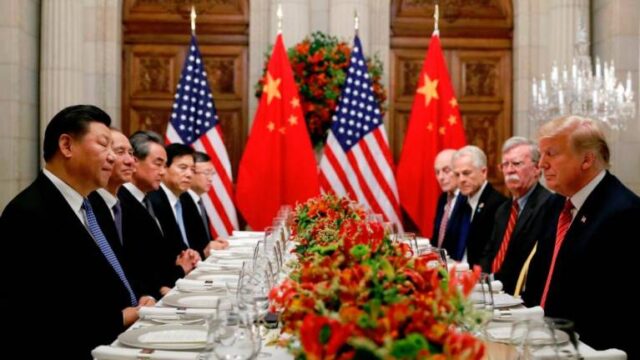
    The announcements came after Trump and Xi sat down with their aides for a working dinner at the end of a two-day gathering of world leaders in Buenos Aires, their dispute having unnerved global financial markets and weighed on the world economy.

    After the 2½ hour meeting, White House chief economist Larry Kudlow said the talks went “very well,“ but offered no specifics as he boarded Air Force One headed home to Washington with Trump.

    China’s goal was to persuade Trump to abandon plans to raise tariffs on US$200 billion of Chinese goods to 25% in January, from 10% at present. Trump had threatened to do that, and possibly add tariffs on US$267 billion of imports, if there was no progress in the talks.

    With the United States and China clashing over commerce, financial markets will take their lead from the results of the talks, widely seen as the most important meeting of US and Chinese leaders in years.

    The encounter came shortly after the Group of 20 industrialised nations backed an overhaul of the World Trade Organisation, which regulates international trade disputes, marking a victory for Trump, a sharp critic of the organisation.

    Trump told Xi at the start of their meeting he hoped they would achieve “something great” on trade for both countries. He struck a positive note as he sat across from Xi, despite the US president’s earlier threats to impose new tariffs on Chinese imports as early as the next year.

    He suggested that the “incredible relationship” he and Xi had established would be “the very primary reason” they could make progress on trade.

  • Trade war refugees race to relocate to Vietnam, Thailand

    Trade war refugees race to relocate to Vietnam, Thailand

    Experts say this is the biggest shift in cross-border supply chains since China joined the World Trade Organisation in 2001. Fred Perrotta spent four years building a network of Chinese suppliers for his line of trendy backpacks, but as soon as the United States announced tariffs on almost half of its Chinese imports, he started looking for suppliers in other countries.

    That process is now so far advanced it would be too late to reverse it even if U.S. President Donald Trump and his Chinese counterpart Xi Jinping call a truce in their growing trade war at this week’s G20 summit, the 33-year-old said.

    Perrotta’s company, Tortuga, is joining what industry experts say is the biggest shift in cross-border supply chains since China joined the World Trade Organisation in 2001.

    The shift is creating stiff competition to secure new facilities in neighboring countries and rebuild supply chains outside of China, home to a fifth of global manufacturing.

    “Everyone is nervous and scrambling around,” Perrotta said by phone from Oakland, California, where he recently took delivery of the first samples from a potential new supplier in Vietnam.

    “Long-term, we will probably shift everything.”

    The scramble is driven by the risk of more, and higher, U.S. tariffs on China, and fears that nearby emerging economies can only accommodate new businesses on a “first come, first served” basis.

    Vietnam and Thailand are emerging as preferred destinations, but they still face capacity constraints ranging from red-tape to skilled labor and limited infrastructure.

    Frenzied activity 

    In an interview with more than a dozen company executives, trade lawyers and lobby groups in various industries revealed a frenzy of activity across Asia in recent months: executives are requesting product samples, touring industrial parks, hiring lawyers and meeting with officials.

    In June, Hong Kong-listed furniture maker Man Wah Holdings bought a factory in Vietnam for $68 million and said earlier this month it plans to almost triple its capacity to 373,000 square meters by the end of 2019.

    “The acquisition is to mitigate the risks posed by tariffs,” Man Wah said in a statement.

    Vietnam-based industrial real estate developer BW Industrial says inquiries have surged since October, and all its factories are now leased out.

    “The manufacturers are from all over the world but they all have production plants in China and need to start production ASAP,” Chris Truong, a sales manager at BW Industrial said.

    In Thailand, SVI Pcl, which provides electronics and manufacturing solutions, said it has just selected four new deals worth about $100 million with existing customers who have operations in China.

    “The trade war is good for us,” CEO Pongsak Lothongkam said. “We have been approached by so many companies that we have to prioritize.”

    KCE Electronics, Southeast Asia’s biggest maker of printed circuit boards (PCBs), has been contacted by U.S. companies who want to seek a new supplier to replace one in China, CEO Pitharn Ongkosit said.

    “It’s a good opportunity. Many customers have contacted us to ask about our products and prices. But there are no sales yet as it will take time,” he said.

    Stars Microelectronics Pcl, another Thai electronics manufacturing services provider, is also getting new business.

    “Two (or) three companies will start moving their production base (out of China) to us soon,” CEO Peerapol Wilaiwongstien said.

    Cambodia is also attracting interest, with Parsippany, NJ-based bicycle maker Kent International Inc shifting Chinese production to the Southeast Asian country.

    “We have a big business in the United States,” Arnold Kamler, the company’s majority owner and chief executive said. “There is no choice but to as rapidly as possible look to move production away from China.”

    Disruption 

    The re-sourcing and relocation efforts mark an acceleration of an already established trend as China’s economy shifts towards services, consumption and high-tech production.

    “We are on the cusp of the biggest sourcing disruption that we have seen in a generation,” said Stephen Lamar, executive vice-president of the American Apparel&Footwear Association, whose more than 1,000 members contribute over $400 billion annually to U.S. retail sales.

    “The No. 1 thing I hear from companies is along the lines of: ‘For years we have been talking about diversifying from China and now we have to actually do it’.”

    Shifting production can take years to complete: firms need to secure funding, find the right suppliers, sort out new logistics – all while dealing with new legal and accounting issues in a country they may not know well.

    “Any relocation away from China is going to be very slow and very uncertain,” said Aidan Yao, senior Asia EM economist at AXA Investment Managers.

    Low tech goods and low value manufacturing would be the quickest to migrate while higher value-added exports in the machinery, transport and IT category would likely take decades to relocate due to high R&D costs and competitive Chinese labor costs, UBS said in a note earlier this month.

    Yet a regional client poll by Citi conducted in the last month showed more than half of them already adjusting their supply chain to limit upheaval to their business.

    China’s sophistication in areas such as automation means no one country can replace China, said trade lawyer Sally Peng of Sandler, Travis&Rosenberg.

    “So everyone is looking for that China Plus One, Plus Two, Plus Three country strategy, all the way to Africa,” she said.

    Companies hold out little hope for a truce in the trade dispute when Trump and Xi are due to meet on the sidelines of the G20 summit in Buenos Aires this week.

    Indeed, Trump said on Monday he expected to move ahead with raising tariffs on $200 billion in Chinese imports to 25 percent from the current 10 percent.

    While Chinese export data shows little sign yet of an impact from the trade war, some economists say that is because companies are rushing to get shipments out ahead of more tariffs.

    Collateral victims 

    To be sure, smaller emerging Asian economies are not necessarily licking their lips about the prospect of the trade war between the world’s top two economies worsening.

    Growth has slowed in the third quarter across Southeast Asia, as well as in Taiwan, Japan and South Korea, with officials partly blaming the trade war for it.

    Thailand’s exports of electronic integrated circuits, for instance, rose 4 percent to the United States in October but fell 38 percent to China. Vietnam’s manufacturing sentiment indicator is the highest in Asia but is well off its peak.

    A lack of infrastructure is also a problem for countries seeking to pick up business.

    Thailand is 41st in World Bank infrastructure quality rankings, Vietnam is 47th, compared to China’s 20th ranking.

    Bangkok is seeking to address that with its Eastern Economic Corridor, an ambitious $45 billion development project which plans improvements to deep water ports, airports and railways.

    Beyond infrastructure bottlenecks, red tape – particularly in Vietnam – remains hard to navigate and skilled labor is not easily available.

    Vietnam’s unemployment rate is 2.2 percent. Thailand’s is even lower.

    “The proportion of unskilled labor in Vietnam remains large and there hasn’t been any effective plan to improve this issue, and I don’t see any significant change in five or even 10 years,” said the vice chairman of the Vietnam Electronic Industries Association, Nguyen Phuoc Hai.

    “Whether cheap labor will remain one of Vietnam’s advantages in the face of the fourth industrial revolution is questionable.”
  • China could use Vietnam to avoid US tariffs: experts

    China could use Vietnam to avoid US tariffs: experts

    Experts said the U.S.-China trade war puts Vietnam at risk of fraud as capital moves into the country to avoid U.S. sanctions. Vietnamese products would face tough competition from China in both the domestic and overseas markets, Nguyen Thi Thu Trang, director of the Vietnam Chamber of Commerce and Industry’s (VCCI) WTO Center, said at a recent conference on the impact of the Sino-American trade spat.

    In the domestic market, China might seek to dump its goods on Vietnam to avoid Donald Trump’s tariffs. Cheaper Chinese goods competing with Vietnamese goods will not benefit Vietnam’s economy.

    In overseas market, China might borrow the “made in Vietnam” label to dodge U.S. tariffs.

    If this cannot be controlled, there could be grave consequences for Vietnamese firms since the U.S. might apply the same tariffs as they have done on China, according to industry insiders.

    Ho Duc Lam, chairman of the Vietnam Plastics Association, said his industry has been impacted by having to compete directly with Chinese companies as China might borrow the “made in Vietnam” label to dodge U.S. tariffs.

    Tran Dinh Thien, an economist and member of the Prime Minister’s Economic Advisory Group, noted that the trade war brings both opportunities and challenges for Vietnam, but it is up to local companies to identify the opportunities.

    He said the trade war has hit investors’ confidence causing them to pull out of emerging markets including Vietnam. The global supply chain is badly disrupted as a result, and the investment environment has become uncertain, he said.

    Lam argued that to protect domestic companies the government should consider import taxes if there are signs of a safeguard action.

    It should not issue licenses if there is no guarantee that more than two thirds of the production chain would be in Vietnam, and should promote free trade agreements with Europe and others to reduce Vietnam’s dependence on the U.S. and China, he added.

    Trang of the VCCI said since the trade war shows no signs of ending soon production enterprises should monitor the situation to respond nimbly to changes and should know where and how to take advantage of potential opportunities.

    It is known which goods face sanctions, so businesses should research about customers for those goods and offer them a better deal, she said.

    The U.S.-China trade war escalated in September with the U.S. levying an additional 10 percent tariff on about $200 billion worth of Chinese products. Washington is set to raise the tariffs to 25 percent in January if there is no agreement between the both sides.

    China retaliated with 5 and 10 percent tariffs on $60 billion worth of U.S. products.

  • Vietnam ratifies Trans-Pacific Partnership

    Vietnam ratifies Trans-Pacific Partnership

    Solidifying its commitment to the Trans-Pacific Partnership that was redrafted and signed in March, Vietnam is the latest member nation to ratify the trade agreement. Vietnam’s lawmaking body approved the Comprehensive and Progressive Agreement for Trans-Pacific Partnership (CPTPP) on November 12, following Australia’s ratification on October 31.

    Other countries to have now ratified the deal include Japan, Canada, Mexico, Singapore and New Zealand, taking the member count to seven.

    Originally a 12-country trade deal, the CPTPP – also known as TPP-11 – had to be redesigned in March to facilitate 11 members, after US president Donald Trump pulled Washington out of the deal shortly after taking office in early 2017.

    At its first creation, the CPTPP represented some 30% of global trade, but without the US, that figure has dropped to 13%. Still, it is expected to reduce tariffs between the 11 participating nations that together add up to US$10 trillion.

    As for Vietnam, the deal comes at a time when the Southeast Asian nation looks to rid its dependency on its two major trading partners – the US and China, amid the recent tensions between the two.

    Some 25% of Vietnam’s total trade is with China, which is is in a tariff battle on all of its exports to the US.

    The new CPTPP gives Vietnam the chance to limit its reliance on China for things such as yarns and textiles for its garment industry, meaning it will source from member countries to receive tariff-free components.

    “This is an important political decision, affirming our country’s active role in international integration,” Nguyen Van Giau, head of the National Assembly’s external relations department said this week.

    Up close, the deal sees taxes on nearly 43% of Vietnam’s apparel exports to Canada removed immediately after the agreement takes effect, and 100 percent after four years, the government said.

    The garment sector is Vietnam’s second largest export-earner after smartphones, while footwear products and seafood will also benefit.

    The pact, which includes specific requirements on labour rights and conditions of work, is also expected to help Vietnam advance in labour reforms, the International Labour Organization said.

    Brunei, Chile, Malaysia and Peru are the four remaining members yet to ratify the pact.

  • Indonesia Gov’t Considers Reducing Its Levy on Palm Oil Exports

    Indonesia Gov’t Considers Reducing Its Levy on Palm Oil Exports

    The government is considering reducing its levy on palm oil exports, Coordinating Economic Affairs Minister Darmin Nasution said on Thursday, as the country pushes to maintain its position in international markets for the commodity.

    Speaking at an industry conference in Bali, the minister said an “adjustment” to the levy was among steps to be taken by the government, although he later said that this was still being discussed.

    “We don’t have final position yet,” Darmin said on the sidelines of the event. “We have to calculate that carefully. We don’t want lowering it only to result in lower prices.”

    Indonesia, the world’s top producer of the commodity, currently imposes a levy of up to $50 per metric ton on various palm oil products.

    The Indonesian Palm Oil Association (Gapki) said last week that it had proposed cutting the palm oil export levy by $20 per ton until prices of the vegetable oil reach $700 per ton.

    The government’s reference price for crude palm oil has stayed below $750 per ton for over a year.

    Darmin said the government would discuss the levy adjustment intensively over the next two months, hoping to reach a decision around year-end.

  • EU trade pact can reduce Vietnam’s reliance on China, US

    EU trade pact can reduce Vietnam’s reliance on China, US

    The Vietnam-EU trade pact can diversify export markets and help reduce reliance on China and the U.S., experts say. On October 17, the European Commission submitted the EVFTA for signature and conclusion to the European Council. Once authorized by the Council, the agreement will be signed and presented by the end of this year to the European Parliament for ratification. The European Parliament is set to ratify the EVFTA early next year.

    The trade pact, which has been negotiated since June 2012, is considered a game changer as it would eliminate almost all trade tariffs between the two sides.

    Luu Bich Ho, former head of the Vietnam Institute for Development Strategies under the Ministry of Planning and Investment, said that the deal would play a major role in reducing Vietnam’s reliance on the U.S. and China, the world’s two largest economies.

    “This is obviously an opportunity for Vietnam to increase export [to the EU] to avoid being affected should the U.S. seek to limit imports from Vietnam,” Ho said.

    It’s also a chance for Vietnam to diversify its markets as it is still heavily dependent on China in trade, he added.

    In the first nine months this year, the U.S. was Vietnam’s largest export market, accounting for 19.5 percent of Vietnam’s total exports, a growth of 13.2 percent year-on-year, according to Vietnam Customs.

    Although the EU came second and accounted for 17.4 percent, this market has the smallest growth rate among Vietnam’s top six export markets at 10.5 percent.

    China was the third largest export market, had the highest growth rate of 29.9 percent. It was also Vietnam’s largest import market, accounting for 27.3 percent of Vietnam’s total imports.

  • Rising dollar, market glut cut Vietnam’s shrimp export value

    Rising dollar, market glut cut Vietnam’s shrimp export value

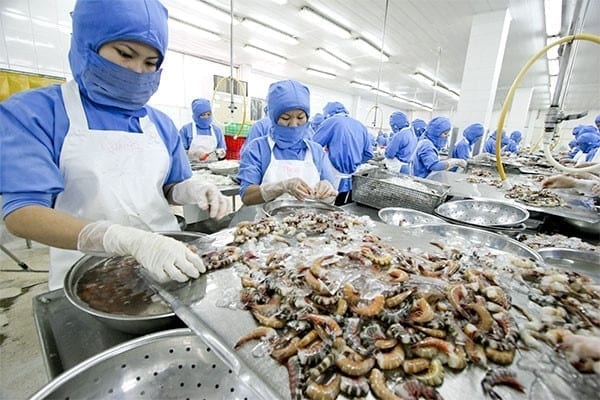
    Vietnam’s shrimp export value plunged almost 15 percent year-on-year in September, hit by the rising dollar and other factors. The Vietnam Association of Seafood Exporters and Producers (VASEP) said shrimp export value dropped by 14.8 percent year-on-year in September.

    Total shrimp export value for the first nine months of the year went down four percent year-on-year to $2.6 billion, the association added.

    The slip in export value began in the second quarter, because of several factors including excessive shrimp supply across the globe and overseas markets taking safeguard action to protect domestic enterprises, the association said.

    Global shrimp supply is expected to rise some 5.5 percent from 2017 to 2018, Undercurrent News, a global seafood news publication, quoted James Anderson, a University of Florida seafood economist, as saying.

    The situation has been worsened by the rising dollar, causing importers to buy less.

    The DXY index of the U.S. dollar versus six developed market currencies is up 4.82 percent this year, now topping the rise of the dollar against emerging market currencies.

    This saw the shrimp export value to the U.S. decrease continuously from April to July this year. In the first nine months of the year, it fell three percent year-on-year to $472.4 million.

    A similar trend can be seen in shrimp exports to the E.U., despite an impressive increase in value in the first six months of the year, the association said.

    VASEP expressed hope that if world prices improve in the coming months, Vietnam’s shrimp export output will increase in the fourth quarter and boost total value for the year to $3.85 billion, last year’s figure.

    However last year’s shrimp export value marked a year-on-year increase of 22 percent.

    Vietnam is world’s third-largest shrimp supplier, according to the agriculture ministry.

  • Malaysia’s Aug exports decline 0.3%, trade surplus at nearly 4-year low

    Malaysia’s total exports fell marginally by RM215.2 million or 0.3% to RM81.8 billion in August, the second time exports recorded a decrease in 2018 after February due to the high base effect, according to the Department of Statistics.

    Trade surplus also recorded the lowest value since November 2014 at RM1.6 billion on the back of a double-digit growth of 11.2% or RM8.1 billion in imports to RM80.2 billion in August.

    Total trade stood at RM162 billion, RM7.9 billion or 5.1% higher than the same month a year ago.

    The main products which contributed to the decline in exports were palm oil and palm oil-based products (-RM1.5 billion); liquefied natural gas (-RM918.3 million); timber and timber-based products (-RM49.0 million); and natural rubber (-RM39.5 million).

    However, increases were recorded for crude petroleum (+RM1.3 billion); electrical & electronic products (+RM985.5 million); and refined petroleum products (+RM232.2 million).

  • China says US disappoints the world by upping the ante in trade war

    China says US disappoints the world by upping the ante in trade war

    China warned the United States today that upping the ante in a tit-for-tat trade war will “only serve to disappoint” the world as Washington threatened to raise the tariff rate on the next US$200 billion (RM814 billion) of Chinese imports.

    Beijing said it would be forced to take countermeasures to defend Chinese interests, free trade and the international order.

    “The US has no regard for the world … playing both soft and hard ball with China will not have any effect, and only serve to disappoint the countries and territories opposed to a trade war,” China’s Ministry of Commerce said in a statement, adding that it still hopes to turn the situation around.

    Foreign ministry spokesman Geng Shuang called Washington’s actions “blackmail” and urged the US “to return to rationality and not act on impulse. It will only hurt themselves.”

    President Donald Trump asked the US Trade Representative to consider increasing the proposed tariffs to 25% from the planned 10%, USTR Robert Lighthizer said on Wednesday.

    “We have been very clear about the specific changes China should undertake. Regrettably, instead of changing its harmful behaviour, China has illegally retaliated against US workers, farmers, ranchers and businesses,” Lighthizer said in a statement.

    Officials, however, downplayed suggestions the move was intended to compensate for the recent decline in the value of the Chinese currency, which has threatened to take much of the sting out of Trump’s tariffs by making imports cheaper.

    The US dollar has been strengthening since April as the central bank has been raising lending rates, which draws investors looking for higher returns.

    “It’s important that countries refrain from devaluing currencies for competitive purposes,” a senior administration official said. “But I wouldn’t draw the conclusion that the announcement we’re making today is directly linked to any one practice.”

    Washington and Beijing are locked in battle over American accusations that China’s export economy benefits from unfair policies and subsidies, as well as theft of American technological know-how.

    Trump has threatened to slap tariffs on virtually all of China’s exports to the US.

    Officials said they remained in regular contact with their Chinese counterparts but could announce no new meeting.

    The US already imposed 25% tariffs on US$34 billion in Chinese goods, with another US$16 billion to be targeted in coming weeks.

    On July 10, Washington unveiled a list of another US$200 billion in Chinese goods, from areas as varied as electrical machinery, leather goods and seafood, that would be hit with 10% import duties.

    Increasing the rates to 25% could make them significantly more painful.

    The comment period on the proposed penalties, which includes public hearings where business can ask for exemptions, due to take place later this month, would be extended into September, the officials said.

    Much of American industry and many members of Trump’s own Republican Party have expressed outrage but have so far been unable to thwart Trump’s trade policies.

    The US Senate last week passed legislation which if enacted would lower trade barriers on hundreds of Chinese imports.

    Jake Colvin, vice-president of the National Foreign Trade Council, said the Trump administration could be boxing itself into a corner.

    “It’s hard to see how this action lends itself towards a resolution to what is increasingly a trade crisis,” he told AFP.

    Trump and senior administration officials believe the volume of US imports and vigorous health of the American economy give Washington an advantage in the current confrontation.

    But Fred Bergsten, founding director of the Peterson Institute for International Economics, told CNBC that China would be able to absorb blows more easily than Washington.

    “They can expand their stimulus, fiscal spending, bank lending,” he said.

    “They can compensate much better than we can. They come from a much higher base.”

    And Bergsten warned that the US economy is likely to slow and a trade war only makes that expected decline worse.

  • Vietnamese government fines illegal Bitcoin trading site

    Vietnamese government fines illegal Bitcoin trading site

    The firm claimed to have a license to trade the cryptocurrency, but was hit by a $1,750 fine. Vietnam’s information ministry has fined a company that claimed to be the first website to be certified to exchange bitcoin in Vietnam for illegal social networking and setting up an illegal site.

    Bitcoin Vietnam, which is based in District 4, Ho Chi Minh City, received a VND40 million ($1,750) penalty from the Vietnam Radio, Television and Electronic Information Department under the Ministry of Information and Communications.

    Nguyen Tran Bao Phuong, the legal representative for Bitcoin Vietnam, said they were looking into the charges.

    The company is in a transition period, so its business registration code had been revoked before the decision was made, she said .

    “Bitcoin Vietnam is a cryptocurrency exchange. We do not yet have a license to offer intermediate services, but we are not operating illegally. The company is closely following any new regulations about Bitcoin, and is willing to comply with any new law,” Phuong said.

    The company opened in 2013 and is certified to buy and sell Bitcoin, according the company’s website.

    However, in a recent interview, a representative admitted that the company’s license is only for “financial advisory” purposes.

    Over the last four years, the company has launched a number of websites such as bitcoin.vn and vbtc.vn.

    The State Bank of Vietnam does not recognise virtual currencies as a legal form of payment, and distribution or use of digital currencies is not protected by law.

  • Stocks slump on trade-war worries

    Stocks slump on trade-war worries

    Asian stocks followed their US counterparts lower after President Donald Trump’s decision to slap tariffs on China heightened concern a trade war could hurt global growth. The yen climbed to its strongest in more than a year.

    Equity indexes from Tokyo to Shanghai tumbled well over 3 percent. US stock futures also declined, signaling a further retreat for the S&P 500 Index after it tumbled 2.5 percent, the most in six weeks. As investors dumped stocks, they rushed to the safety of Treasuries, where yields dipped below 2.8 percent, and the yen, which jumped past 105 per dollar for the first time since November 2016. Follow live coverage of reaction here.

    The sell-off began after Trump instructed US Trade Representative Robert Lighthizer to levy tariffs on at least US$50 billion in Chinese imports. Subsequently, China announced plans for reciprocal tariffs on $3 billion of imports from the US, including products from steel to pork. News that the US is shielding some countries from steel and aluminum tariffs did nothing to lift investor gloom.

    “The window from coming back from an all-out trade war is still open, but closing fast, and obviously leaves a lot of uncertainty over the next two to three weeks,” said Kay Van-Petersen, a Singapore-based global macro strategist with Saxo Capital Markets. It is “classic risk-off for equities today and potentially over the next few days,” Van-Petersen said. Eventually it “could open up some interesting opportunities, especially in the credit space and in the consumption-driven sectors,” he said.

    Adding to the image of the ascendance of the “America first” faction, Trump said he is replacing White House National Security Adviser H.R. McMaster with John Bolton, a controversial foreign-affairs specialist whom the U.S. Senate declined to confirm as President George W. Bush’s ambassador to the United Nations.

    Oil prices climbed amid worries that Bolton would pursue a hard-line stance against Iran.

    Investor fears of escalating trade tensions are being realized as the U.S. tariffs quickly sparked a reciprocal response from China. Traders had already been bracing for the possibility of slowing growth as the Federal Reserve reiterated its commitment to further interest-rate increases after Wednesday’s hike.

  • Crypto Trading in Korea Continues, Questions Remain

    Crypto Trading in Korea Continues, Questions Remain

    Cryptocurrency trading in Korea is getting more detached, flying by its own rules. Recently, the news of an upcoming ban rattled the market. CoinMarketCap decided to alter its calculation protocol to exclude prices in Korea, thus for a while scaring investors that a flash crash had happened.

    But it turns out, Korean trading is not really affecting the sentiment of other markets. Korean trading mostly serves a very local taste for risk. In the summer months, interest in Bitcoin for a while coincided with the threat of North Korea.

    Later, it turned out that Koreans simply found investing in crypto irresistible, and moved in en masse. In the past, Korean authorities have had other bouts of market mania related to risky assets, thus being extremely anxious on how cryptocurrencies could affect personal finance.

    The Korean markets have seen an influx of retail investors, ranging from office workers to students, in search of a fast-growing investment in Bitcoin or other cryptocurrencies. Korean exchanges are fast to adopt new coins and allow immediate trading in pairs against fiat.

    But some see the latest price spikes as highly speculative and at a risk of crashing.

    For now, there are no further updates on what the Korean government would do with exchanges. Trading continues at a premium to US-based exchanges, and the Korean Won remains the fourth most active fiat currency in trading pairs.

    The matter is becoming politicized, and there are protests that the government should not meddle too much and make honest investors into outlaws.

    And while Bitcoin commands higher prices, it is difficult to move assets between exchanges and make use of the difference in trading.

  • Indonesia to Restrict Bitcoin Trading

    Indonesia to Restrict Bitcoin Trading

    The list of countries that are hawkish of Bitcoin or outright ban it has something in common: up and coming economies that have just emerged from decades with a large grey sector. Russia is a prominent example, where cryptocurrencies saw years of outright repression. Morocco is the most recent country to consider an outright ban. Ecuador and Bolivia have long-standing bans, as well as Bangladesh and Nepal. The reasons for the ban vary, but the biggest concerns are about money laundering.

    Macedonia and Kyrgyzstan have similar stories- long years of economic struggle, a large grey sector and skepticism of anything related to potential financial scams.

    But now, a new batch of countries is joining in attempts to curb the spread of Bitcoin. Indonesia, a nation with a conservative streak, plans to ban all cryptocurrency transactions. Local Indonesian media, cited by FinanceMagnates, has pointed to a possible blockage for providing money services to cryptocurrency users.

    The refusal to provide a bridge to cashing out is nothing new in Southeast Asian countries, where a booming cryptocurrency community of exchanges and projects clashes with local banks, who are reluctant to provide accounts and see cryptocurrencies as competitive.

    Agus Martowardojo, Governor of Bank Indonesia, said the sovereignty of the Indonesian Rupiah will not be undermined, and the regulator will curb ” arbitrage opportunities, unhealthy business practices and business controls”.

    “Level playing fields with formal financial institutions need to be maintained, we require all financial technology activists who move in the payment system to register with Bank Indonesia, report on activities, and conduct trials in the regulatory sandbox,” said Martowardojo.

    In effect, the language of the ban means Indonesians who own Bitcoin will not have access to exchanges any time soon. Such a move may do what has happened in the past to other countries with limits on legal exchanges- owners would resort to LocalBitcoins for even more speculative and risky trading.

    So far, very few countries have gone directly after the Bitcoin network, walling off nodes or banning local mining. And experience has shown that when it comes to Southeast Asia, neighboring countries keep offering options.

  • HSBC debuts mobile stock app

    HSBC debuts mobile stock app

    HSBC has introduced a new stock trading mobile app for both Android and iOS to help Hong Kong customers more easily trade Hong Kong, China A and US stocks.

    The HSBC HK Easy Invest standalone stock trading app includes new features including a one-screen quick buy function, interactive charts, a sector heat map and tailored news.

    Customers can access the app using their existing HSBC Personal Internet Banking Details or Touch ID fingerprint authentication for Apple users. The app also employs several industry-standard security measures for further protection.

    To promote the new app, HSBC is offering new users a HK$100 brokerage fee rebate on customers’ first trade using the system until November 30.

    “With changing customer behaviour and increasing demand for faster and more convenient banking services, we are expanding our digital capabilities to better meet customers’ needs,” HSBC head of retail banking and wealth management for Hong Kong Greg Hingston said.

    “HSBC HK Easy Invest is a smart and powerful tool that is easy to use, fast and secure, helping us support our customers as they manage their wealth.”

  • Goldman Sachs studying whether to trade bitcoins

    Goldman Sachs studying whether to trade bitcoins

    Large banks have until now avoided trading in bitcoin due to its reputation as a conduit for illicit activity.Goldman Sachs is exploring whether to launch a trading  venture in bitcoin in response to client demand, a person familiar with the matter said Monday.

    Goldman’s consideration of the digital currency could give bitcoin a boost at a time when it is under criticism in China and by some large banks.

    Goldman is looking at establishing a team that could trade bitcoin and other digital currencies, said a person familiar with the bank’s thinking.

    The venture might resemble other Goldman teams that trade euros or treasury bonds. Goldman has received interest from a variety of parties, including investment funds, insurers and corporate clients. The study is at an early stage and may not yield a decision to proceed with such a venture, the person said.

    “In response to client interest in digital currencies, we are exploring how best to serve them in the space,” said Goldman spokeswoman Tiffany Galvin.

    Large banks like Goldman Sachs have until now avoided trading in bitcoin due to its reputation as a conduit for illicit activity.

    At the same time, financial companies have been active in the development of “blockchain,” the underlying technology of bitcoin, which is seen as a potentially important technology.

    Bitcoin critics include JPMorgan Chase chief executive Jamie Dimon, who called the digital currency a “fraud” that will eventually “blow up.”

    But Morgan Stanley chief executive James Gorman offered measured praise for bitcoin last week, calling it “obviously highly speculative” but “not something that’s inherently bad.”

    Bitcoin has retreated since breaching the psychologically important $5,000 level on September 1. On Monday, it traded at $4,375.