Author: Mei Ling Tan

  • Sim Leisur to open theme park at Paradigm Mall

    Sim Leisur to open theme park at Paradigm Mall

    Penang-based theme park developer Sim Leisure Group is to open an indoor recreational center at Paradigm Mall in Petaling Jaya, Malaysia.

    Sim Leisure has already started the construction of the 35,000sqft indoor recreational center which it will operate as a tenant for up to 12 years.

    It is scheduled to open by the end of November, before the peak year-end school-holiday season.

    Paradigm Mall is located in the heart of Petaling Jaya, next to the Lebuhraya Damansara-Puchong highway in Klang Valley. The six-floor mall has 700,000sqft of retail space and more than 300 retail spaces.

    Sim will build Escape Challenge, an indoor version of Escape, targeting youth and young families. Both Sim and the mall believe the new feature will help draw families to the mall, increasing foot traffic for the retail stores.

    “For years, we have been approached by developers and mall operators to develop an indoor version of Escape,” said Sim Leisure CEO Sim Choo Kheng. “Paradigm Mall Petaling Jaya is a strong community partner and perfectly highlights the unique traits of a family mall. We are very proud of this partnership given the affinity for play parks by parents and children. Installing the play area in the mall is a natural fit given that no other malls in Klang Valley have recreation centers of this genre,” he said.

    Sim will use the Escape Challenge at Paradigm Mall as a showcase of its capabilities as it tries to develop the indoor recreational concept in other markets, especially Mainland China.

    “We foresee this indoor version of Escape growing exponentially in the years to come as the retail shopping business continues to undergo a transformation.”

    “Following our initial public offering and a record year of profitability last year, our global aspirations remain on track. We will continue to scale our proven and successful business model into new markets across the region that are awaiting a new genre of affordable and healthy family entertainment.”

    Sim Leisure Group has been developing and operating theme parks in Penang. Sim Choo Kheng has more than 29 years of experience in the theming industry.

  • The Cheesecake Factory to open at Sands Cotai Central, Macau

    The Cheesecake Factory to open at Sands Cotai Central, Macau

    American upscale casual-dining restaurant The Cheesecake Factory in Macau is set to open in Sands Cotai Central.

    The more than 8500sqft restaurant, which will be operated by a subsidiary of Maxim’s Caterers Limited, will offer fresh from-scratch dishes and more than 30 cheesecakes and specialty desserts from the US.

    The venue is sized to accommodate more than 220 guests and is decorated with hand-painted wall murals and artistic lighting features, keeping a consistent look with The Cheesecake Factory restaurants all over the world.

    The Cheesecake Factory in Macau will also feature a Macao-only limited-edition dish with Macao culinary characteristics: Portuguese Chicken, a portion of a half roasted chicken with coconut curry and peanut sauces and crispy potatoes.

    The opening of The Cheesecake Factory in Macau follows launches regionally in Hong Kong, Shanghai, and Beijing.

  • Starbucks Reserve Riverside 66 Tianjin opens doors

    Starbucks Reserve Riverside 66 Tianjin opens doors

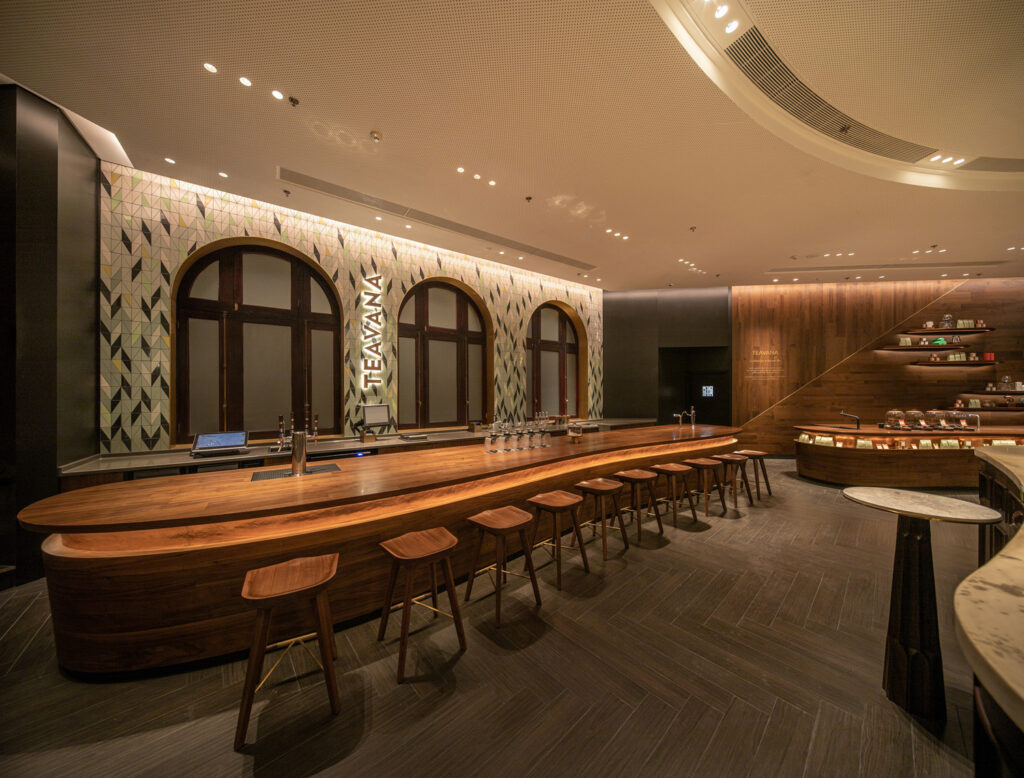
    Starbucks opened a flagship Reserve store in Tianjin, China, today which was built inside a Renaissance-era heritage building dating back to 1921.

    The Starbucks Reserve Riverside 66 Tianjin flagship store combines history with an entirely modern ‘third-place experience’ for the brand’s customers.

    “Over the past 20 years in China, Starbucks has constantly pushed to innovate and reimagine the third-place experience, to bring people and communities closer together,” said Leo Tsoi, senior VP, COO, and president at Starbucks China – retail. “We are immensely proud and privileged to preserve a revered piece of history that binds together four generations of Tianjin residents, and to share this rich cultural inheritance with more people, passing it on to future generations.”

    The new store marks the first in the city to feature a Starbucks Bar Mixato and Starbucks Teavana tea bar, in addition to its Starbucks Reserve offer.

    The building, located on the city’s main commercial street, was designed by Shen Liyuan, who was among the first Chinese architects to study overseas. It housed the Zhejiang Xinye Bank until the early 1950s, a symbol of the city’s economic prosperity and development.

    In the 1980s, the early days of China’s economic transformation, it reopened as the high-end Yongzheng Tailor Shop before being converted into the Xinye Foreign Trade Mall. The location was officially designated as a city heritage site in 1997 and has been vacant for the past 20 years.

    Working with local historic preservation experts, it took Starbucks three years to navigate technical complexities and realize the vision for a modern restaurant space in a preserved building.

    Features of the building, such as the majestic Greek-style exterior facade, glass dome, imported marble columns, and marble carvings, have all been preserved, along with the original bank counters. The architects specified bronze tubes to avoid using nails in the columns when the lighting was installed. Lighting and air conditioning systems were embedded into the glass dome.

    “Beyond preserving the century-old architecture in its fullest form, the Starbucks flagship store has also made creative use of its unique features,” said Luo Shuwei, historian and senior researcher from the Tianjin Academy of Social Sciences. “Starbucks partners have shown great passion and dedication to ensure that every design detail is in harmony with the original architectural style, to create a warm and welcoming ambiance that is also filled with history.”

  • Crabtree & Evelyn stores closed and brand moves to E-commerce

    Crabtree & Evelyn stores closed and brand moves to E-commerce

    Beauty-products brand Crabtree & Evelyn halved its losses in the first half of the year as parent, Hong Kong-listed Nan Hai Corporation continued its transformation from offline to online.

    Since January, Crabtree & Evelyn has closed all of its 150 traditional retail stores across eight countries, shifted its manufacturing and distribution to third-party providers and sold its Australian warehouse.

    Nan Hai Corporation CEO Liu Rong said that while traditional retail companies continue to struggle or close, “Crabtree & Evelyn is now ahead of the market in meeting the challenges of the current and future business environment”.

    Crabtree & Evelyn is the only retail activity business by Nan Hai Corporation, whose principal areas of focus are cinemas, news media, and property investment.

    The brand’s sales for the six months to June 30 reached HK$166.5 million (US$21.2 million), down from $288.5 million during the same period last year. The brand lost $185.1 million, down from $363.5 million.

    Liu said the decrease in revenue but lower loss were due to the effective execution of the innovative business restructuring initiated last November.

    Crabtree & Evelyn’s new focus on direct e-commerce drove online revenue to approximately $64 million, an increase of 69 percent compared to the corresponding period last year.

    Sales in Mainland China increased to approximately $8.2 million, up 93 percent year on year.

    Liu says Crabtree & Evelyn’s new strategy is to transform its business from one of traditional retailing to an “OMO operating model”, (which we believe refers to Open Market Operations), starting from e-commerce.

    In the current half-year, Crabtree & Evelyn is rolling out its new branding and business model internationally which comes off the back of two years’ research and development.

    “All of these products have been manufactured by third-party partnerships, the first result of a faster, more flexible, and lower cost global supply chain,” said Liu in Nan Hai’s half-yearly results analysis.

    “A new global digital platform with full e-commerce and social functionality will be introduced in 35 markets, with corresponding investment in internal teams and capabilities. The new products will also be launched on online shopping malls via exclusive arrangements with Tmall global, Amazon, and Feelunique. Initial feedback from both the new millennial consumer and retail partners has been extremely positive.”

    Liu said he expects the relaunch of Crabtree & Evelyn will inject new vitality into the brand. “We have prepared for this relaunch with the brand communication, product portfolio, digital communication and distribution model, and the transformation of the operating model along with business restructuring required to attract more users to become loyal customers.”

    Previously, the company had said it planned flagship stores in major cities in the future, but this was not referenced in the half-year results summary.

  • Google’s popular YouTube Kids app is getting a ‘Preschool’ filter and web version

    Google’s popular YouTube Kids app is getting a ‘Preschool’ filter and web version

    Back when Google unveiled the YouTube Kids app for Android and iOS devices in 2015, its goal was pretty simple and so was the execution of the product itself. Roughly four and a half years later, the children-friendly, parentally controlled video platform naturally looks far more mature and versatile, meeting the specific needs of more age groups and user categories than ever.

    After expanding its functionality to distinguish between “older” and “younger” users last year, YouTube Kids is now getting a third option to ensure even younger children can be kept protected from content deemed unsuitable for their age. We’re talking preschoolers aged 4 and under here, which will be served with videos that “promote creativity, playfulness, learning, & exploration” if their parents so choose.
    Of course, just like before, you’ll still also be able to select an “approved content only” option under which the search feature will be blocked and your child will merely get access to videos, channels, and collections hand-picked and green-lighted by yourself. Speaking of, you should continue to keep in mind that not all YouTube Kids content is manually reviewed and carefully grouped in the right age category, so if you end up activating the “preschool”, “younger”, or “older” setting, you’ll definitely need to keep an eye out for inappropriate videos and immediately report them as such.
    In other news, you might be happy to hear that after crossing 100 million installs through the Play Store alone, YouTube Kids will finally become available on the web as well. The app’s browser version is gearing up for an official launch “later this week”, although no further details are available at the moment.
  • Pokemon Masters out now on Android and iOS

    Pokemon Masters out now on Android and iOS

    If you’re stuck in queues waiting for hours to be able to play World of Warcraft: Classic, you can definitely pass the time by checking out the newly released Pokemon Masters mobile game. Despite its name, this isn’t a game about Pokemon since you won’t be hunting and collecting little monsters.

    Pokemon Masters is about trainers, as players will collect Sync Pairs (the game’s name for trainers) and their set partners. The premise is simple: form a team with three trainers and their Pokemon and target your opponents’ weaknesses to deal more damage.

    The goal of the game is to travel the island of Pasio collecting badges and trying to access the higher levels of the leaderboards. There are 65 Sync Pairs available at launch, which can be purchased in-game if you don’t want to try and collect them by playing the game.

    Pokemon Masters offers co-op play, so you’ll be able to play with friends all around the world, but you need to teal up with two other players. The game is free to download on both Android and iOS platforms via Google Play Store and App Store.

  • Samsung Galaxy Fold launched

    Samsung Galaxy Fold launched

    Samsung confirmed that the Galaxy Fold will be launched on the market in September, but it didn’t reveal an exact release date. Although reports pointed to a rather late September launch, it looks like Samsung has decided to greatly advance the launch schedule.

    The Korean media reports Samsung is ready to launch the Galaxy Fold on September 6, the first day of IFA 2019 trade fair. Even though pre-registrations for the foldable smartphone recently opened in China, South Korea will be the first country to get the Galaxy Fold.

    The same report claims Samsung Galaxy Fold will be released in September in the United States and China, although an exact release date hasn’t been unveiled yet. Samsung expects to sell around 20-30,000 Galaxy Fold units in South Korea by the end of the year.

    A Samsung official responded to the report by saying that “the specific launch schedule is not yet confirmed,” but if the information is accurate, we’ll learn more about the Galaxy Fold availability in less than a week from now.

  • Skype brings a handful of new features to its app

    Skype brings a handful of new features to its app

    Skype’s messaging app might seem a bit obsolete for some due to the lack of many features, but that’s about to change. The developer announced a new set of improvements are coming to Skype in the coming days.

    The newest update brings message drafts, a much-needed feature that allows Skype users to save any messages they didn’t send in the corresponding conversation. Skype also says that messages saved as drafts are even available when you leave and come back to the Skype app, but we don’t think adding this feature in any other way would be useful.

    Message bookmarks is another important addition in this update. It will allow Skype users to bookmark any message in conversations by simply right-clicking or long-pressing the message and tapping Add bookmark. The message will be saved in the Bookmarks screen with other bookmarked messages.

    Furthermore, the update brings the option to preview photos, videos, and files that you want to share before sending them. You can even add a message that will be sent along with the files if you want to write an explanation or description for what you’re sending.

    Also, a new way to display multiple photos or videos sent at once. You’ll now see an album in the chat history with all the photos combined, but you can also check them out individually by clicking between the photos or videos in the album.

    All the new features announced today will be available on the latest version of Skype across all platforms, so expect to see them soon on your phone.

  • Amazon In Talks For Stake In Indonesia’s Ride-Hailing Startup Go-Jek

    Amazon In Talks For Stake In Indonesia’s Ride-Hailing Startup Go-Jek

    Amazon.com Inc is in early talks with Go-Jek Group to buy a stake in the Indonesian ride-hailing startup, a source familiar with the matter told Reuters on Wednesday.

    Details of the stake were not known and the source did not want to be identified as the talks are private.

    Both Amazon and Go-Jek did not respond to a Reuters request for comment.

    Indonesia’s first unicorn, Go-Jek, has up to 20 services and has evolved from ride-sharing to allowing its customers to make online payments and order everything from food to groceries.

    Earlier this year, Amazon also bought a stake in British online food delivery company Deliveroo as it competes with Uber Technologies Inc’s Uber Eats in the global race to dominate the market for takeaway meals.

    Reuters reported in July that Amazon is expanding its transportation prowess to do virtually everything short of building a car.

    Go-Jek, which counts Alphabet Inc’s, Alibaba Group Holdings Inc, Tencent Holdings and Visa Inc (V.N) as investors, last raised here funding in July at a valuation of around $10 billion.

  • More Jobs In Auto Lost, Toyota And Hyundai Cut Production

    More Jobs In Auto Lost, Toyota And Hyundai Cut Production

    With India’s auto sales declining for the ninth straight month in July, more automotive manufacturers are laying off workers and temporarily halting production to keep costs in check, according to sources and documents seen by Reuters.

    Japanese carmaker Toyota Motor and South Korea’s Hyundai Motor are the latest in a string of companies to briefly halt some parts of production at plants to combat slumping sales, according to company memos to employees, reviewed by Reuters.Passenger vehicle sales in July fell at the fastest pace in nearly two decades.

    The sales declines have triggered major job cuts in India’s auto sector, with many companies forced to shut down factories for days and axe shifts.

    Sources have told Reuters that even more companies have now begun to lay off temporary workers as the slowdown worsens.

    Denso Corp’s India unit, which makes powertrain and air-conditioning systems for cars, has cut some temporary workers at its Manesar plant in north India, four sources familiar with the matter told Reuters.

    A spokeswoman for Denso said the information was incorrect and declined to elaborate further.

    In a separate email, another company official disputed that the firm employed temporary workers at its Manesar plant.

    Bellsonica, which is part-owned by India’s biggest carmaker Maruti Suzuki and makes auto framework parts, has also let more than 350 workers go in Manesar, two sources said.In an email, Bellsonica said the workers that had been let go were temporary workers, and most had been let go earlier in the year.Reuters earlier this month reported automakers, component manufacturers and dealers had already cut 350,000 jobs

    In a meeting with India’s finance ministry on Aug 7, industry executives asked for tax cuts, and easier access to finance for dealers and buyers, in an effort to revive sales.Toyota, in a notice dated Aug 13, told its workers the company would halt production at its plants in Bengaluru in southern India on Aug 16 and 17 “due to low market demand of vehicles” and high stock of about 7,000 vehicles. N Raja, deputy managing director, at Toyota’s India unit, told Reuters that while the company had a flexible production system it had to resort to five no-production days in August to prevent the build up of stock.”The industry is deeply concerned with the reality of poor customer sentiment faced by the sector,” said Raja, adding he hoped the government would step in to support the industry

    Hyundai, in a memo on Aug 9, also said it would halt production for several days in August across various departments including the body shop and paint shop as well as its engine and transmission plants. A Hyundai Motor India spokesman said the company expected sales to pick up in the festive season starting next month and added that the company had not laid off any workers.

  • Tesla Raises Prices For Some Vehicles In China

    Tesla Raises Prices For Some Vehicles In China

    U.S. electric vehicles maker Tesla Inc said on Friday it had raised prices for some vehicles in China, a decision that comes as the Chinese yuan trades at its weakest levels in more than 10 years.

    The starting price for the Model X sport utility vehicle (SUV) was now 809,900 yuan ($114,186) compared with 790,900 yuan previously, Tesla said on its China website. Its long-range dual-motor variants of mass-market Model 3 vehicles were now priced at 439,900 yuan, up from 429,900 yuan previously.

    People familiar with the matter told Reuters earlier this week that Tesla would hike prices on Friday and could do so again in December should Chinese tariffs on U.S.-made cars take effect.

  • Is the Chinese digital sector monopolized by a few companies?

    Is the Chinese digital sector monopolized by a few companies?

    There has been quite a lot of discussion about the Chinese digital reality. Almost everybody is aware that most of the Chinese online ad revenue share is occupied by either Tencent or Baidu.

    The international commerce market is also largely dominated by companies like Alibaba, which creates the understanding that a monopoly of sorts is present in the country. However, it’s not like we can judge these Chinese enterprises based on our understanding of Western ideals.

    Things like culture are one of the main key points that need to be focused on, but as a benefit of the doubt, let’s try and look at the operations of these companies as something similar to how they’d be dealt with in the Western world.

    Examples of possible monopolies

    Let’s take Tencent as an example for the gaming and telecommunications industries. Right now, the company is poised to take 13% of the global gaming market share, which already speaks volumes about the company’s market share in China alone.

    It is currently considered that in terms of gaming, Tencent has around 60-70% of the Chinese market share. And when it comes to telecommunications all we need to do is consider WeChat, which is basically a necessity in China. With this one product, Tencent occupies around 40-50% of the market share thanks to foreign media also having a small breakthrough thanks to amended regulation.

    But the question here is whether or not this needs to be regulated. Would the government consider artificially deflating the profit capabilities of some of their best-performing companies in order to open up opportunities for newer companies, or would they much rather keep these companies in their best shape as they drive more and more innovation as well as jobs for the local population?

    We’ve already encountered similar “suggestions” in the Western world, where the government in both the United States and the European Union were considering to somehow fine Google for their alleged monopoly on the search “industry”.

    The US could not find anything resembling the issue, while the EU fined the company for prioritizing platforms that were owned by Google. For example, the research showed that the company would first display their own products in the search arch, and only later display everything else, which was a clear breach of guidelines.

    It’s hard to apply that example to industries like gaming and telecommunications, but the point is easily understood.

    How monopolies can be dealt with

    Naturally, it would not necessarily be within the interests of the Chinese government to artificially deflate their best-performing corporations in order to free up space for smaller companies. One such reason is that the Chinese market is a very attractive opportunity for foreigners, which would fill the gap immediately, thus lowering the opportunity for Chinese nationals.

    The best way to do this is to conduct nation-wide research first, to determine if the local populace would be open to more options in various industries, or if they like this centralized style of doing business. Because in most cases, these large Chinese corporations are B2B aggregates for B2C businesses.

    A great example of this would be the latest survey in Finland where, according to Сasinopånett EU, is a monopoly on the betting industry from the government itself. But we can just as easily draw a parallel between these two nations.

    In Finland’s case, it’s within the interest of the population to have a privatized industry so that the market is based on competition, which is calculated through customer satisfaction and improved consumer spending.

    In China’s case though, restricting a company like Alibaba within the ramifications of a maximum market share it could have, would lower its competence on the global market. However, restricting Tencent could indeed see more advantageous options appear for telecommunications.

    The difficulty in concocting a universal law for every industry is that exceptions will have to be made for the advantage of the economy. This is mostly because China focuses a lot on export, therefore prioritizing its performance on the global markets, rather than the local one.

    Should the universal law against monopoly be implemented, China’s GDP will most surely be damaged as these companies will start failing to perform well on a global level.

    Is China full of monopolies?

    The immediate answer would be that yes, the country has clear signs of monopolies in various industries. This is determined by how fast and effectively large corporations can “get rid” of competition by lowering prices to a point where other options aren’t even considered by the consumers.

    In a sense, controlling the Chinese monopoly requires global laws, rather than local ones, which would require years of negotiation in itself.

    Sources:

    https://casinopånett.eu/nyheter/finnene-vil-ha-slutt-pa-landets-spillmonopol/

    https://newzoo.com/insights/articles/supercell-acquisition-tencent-set-to-take-13-percent-of-the-games-market/


  • Large police raid in the Philippines: Cebu POGO Operations employees arrested

    Large police raid in the Philippines: Cebu POGO Operations employees arrested

    The POGO (Philippines Offshore Gaming Operations) have been in quite a lot of trouble in their respective country in the last few years. There has been an insurmountable amount of pressure from the local government to somehow reduce their business power in the long term, by either planning crippling regulation updates or simply implying that they will support the industry.

    This was the case when the country’s president Rodrigo Duterte announced not too long ago that there are no plans to classify POGO as illegal business methods in the country, but the recent police raid on Cebu is a direct contradiction to that announcement.

    What happened?

    On the 7th of September, the Philippines police raided Cebu operations of Xing Huang Jin Cheng Co in the capital.

    According to the reports from the Philippine National Police-Criminal Investigation and Detection Group-Central Visayas, they arrested as many as 181 Chinese nationals that were legally employed in the company, alongside several locals, South Korean and Thai citizens.

    The number of employees arrested was so large that they had to be transported in a nearby gym to “keep them under control”.

    The charges being pressed against Cebu are based on suspicion of them lacking a license to conduct offshore gambling operations from the Philippines, but the lawyers of the company have something very different to say.

    What do the lawyers say?

    According to Jeff David, the lawyer representative of Cebu, the government is challenging the company for missing a POGO license but does not consider the fact that the BPO (business processing outsourcing) license is present.

    Furthermore, David mentions that the company has all of the legal documentation well undercover for their operations in offshore jurisdictions and that this is nothing but a hit against the company for not complying with the local police’s corrupt ways.

    Furthermore, David mentions the inhumane treatment of Chinese employees and the exploitation by the police of their severe lack of the English language. According to David, these employees had very little to defend themselves against the accusations or the demands that the police were making the moment they broke into the building.

    This could be plausible as Chinese nationals comprise a large majority of gaming companies based in South-East Asia or Oceania, and there have been recorded cases of local police keeping a much closer eye on these individuals specifically.

    In fact, according to Kathy Pena, an HR representative from Playamo AU, this is also the case in some Australian live casinos that offer blackjack and roulette games:

    “Our company mostly focuses on offshore jurisdictions as the primary source of customers. Therefore we have to have a large staff of people who understand these languages, or know how to structure our platform to better suit these audiences.

    Furthermore, we tend to employ Chinese nationals and bring them over to Australia with a working visa and no strings attached. We give them a stable job and it’s up to them to find a place to live here.

    We’ve had several altercations so to say with the local police, who more or less wanted to know why there were so many Chinese nationals working in an Australian company.

    The answer is quite simple. Once we find it hard to find skilled labor locally, we broaden our perspective to nearby jurisdictions, and so far, Chinese nationals have met our criteria to an A+.

    I fully understand the situation Cebu representatives may be in right now, as we’ve experienced a similar issue multiple times, but not at that scale and not so extreme. Hopefully, it all works out well for everybody involved.”

    What will be the next steps?

    It is likely that Cebu lawyers will start an investigation on whether or not this raid was warranted, and if it was nothing but a political move gains POGO companies in the Philippines.

    Both the lawyers and the company owners understand the aversion that the government has towards them, as gaming isn’t necessarily the most moral of businesses. But as long as the law allows it, there is absolutely no leverage the police can have against these individuals.

    Should the investigation prove that Cebu had both a POGO and a BPO license, the company would have some leverage over the government to compensate for inflicted damage. But should there be actual evidence of the license missing, multiple executives could find themselves in the Philippines jail or paying a humongous fine.

  • EFG Appoints New Chairwoman of APAC

    EFG Appoints New Chairwoman of APAC

    EFG International replaces former Asia Pacific chair, Tee Fong Seng, with a 40-year veteran and ex-CEO of DBS in Hong Kong.

    Amy Yip succeeds Tee, who recently joined Pictet as its Asia CEO of private wealth management, with the intention to «help drive and oversee the further expansion of EFG’s business in Asia Pacific, in line with its 2022 strategic plan». According to EFG, its 2022 plan for sustainable profitability includes a focus on hiring relationship managers and growing its international business.

    Yip is currently a member of the Board of Directors of Fidelity International, Deutsche Boerse, Temenos and American International Group. Her vast financial sector experience includes DBS in Hong Kong, where she was CEO (2006-2010), senior roles in the Hong Kong Monetary Authority (1996-2006), J.P. Morgan, Citibank and Rothschild Asset Management. Yip is also the founding partner of investment management firm RAYS Capital Partners, which specializes in Asian markets, established since 2011.

    «I am honored to have been appointed as the new Chair of EFG’s Asia Pacific Advisory Board. I look forward to working closely with Albert Chiu (Asia Pacific executive chairman), the regional management team and the Board of Directors to successfully grow EFG’s Asia Pacific business,» Yip said in the release.

    EFG International chair, John Williamson, expressed his confidence in Yip’s hire highlighting regional development «with a strong focus on the quality of client service and risk management».

  • Volvo XC90 To Come In A 3-Seater Excellence Trim In India

    Volvo XC90 To Come In A 3-Seater Excellence Trim In India

    Volvo Auto India is all set to launch the XC90 Excellence variant in India on September 3, 2019. The Excellence option is only on offer in select markets and India gets to be one of them. The regular XC90 Inscription trim cabin is already pretty upscale, but the Excellence adds to that. So there’s a lot more on offer and yes, you’re quite literally in the lap of luxury. To begin with the XC90 Excellence comes with individual seats at the rear and this makes it a 3-seater which means there’s a lot of space for anyone sitting at the rear. The seats can be reclined and adjusted electrically. There’s a lot provided at the rear to pamper the passengers and this includes features like a massage function – which along with the rest of the seat functions (including ventilated cooling and seat heating) can be operated using a pop-up touchscreen that sits between the two seats.

    Volvo also provides tray tables that can be folded out of the central armrest. The armrest also has a storage bin housed below it which contains charging and USB points. Between the seats is the in-car refrigerator where you can store and cool any beverage of your choice. The Excellence comes with its own exclusive set of crystal glasses and special champagne flute holders, that can be housed inside the fridge to keep them cool. Now, that’s taking exclusivity to a whole new level. There is a holder between the seats to stick the specially designed flutes too.

    Now with all these features at your disposal, you certainly want a bit of peace and quiet so what Volvo has done is put a glass partition between the cabin and the cargo area to make sure that the cabin is quiet and of course cooler. The cabin will be finished in two colors – black or beige. All these luxurious features will certainly cost you. Currently, the XC90 lineup starts at around ₹ 80 lakh and goes up to ₹ 1.31 crore, we expect the XC90 Excellence to be priced at ₹ 1.3 crore.